Main-Kinzig-Kreis cannabis social clubs
Discover legal cannabis in
Main-Kinzig-Kreis. With
6 cannabis social clubs, Main-Kinzig-Kreis leads in legal cannabis access in Germany. Whether you smoke daily or you're just cannabis-curious, there's a
cannabis social club here for you. Available products range from cannabis flower and hash to various cannabis products, with full transparency on THC and CBD content. For visitors and tourists: At least six months of official German residency is required — tourists and new arrivals cannot join. All clubs operate under Germany's Cannabis Act (KCanG), effective since April 2024.
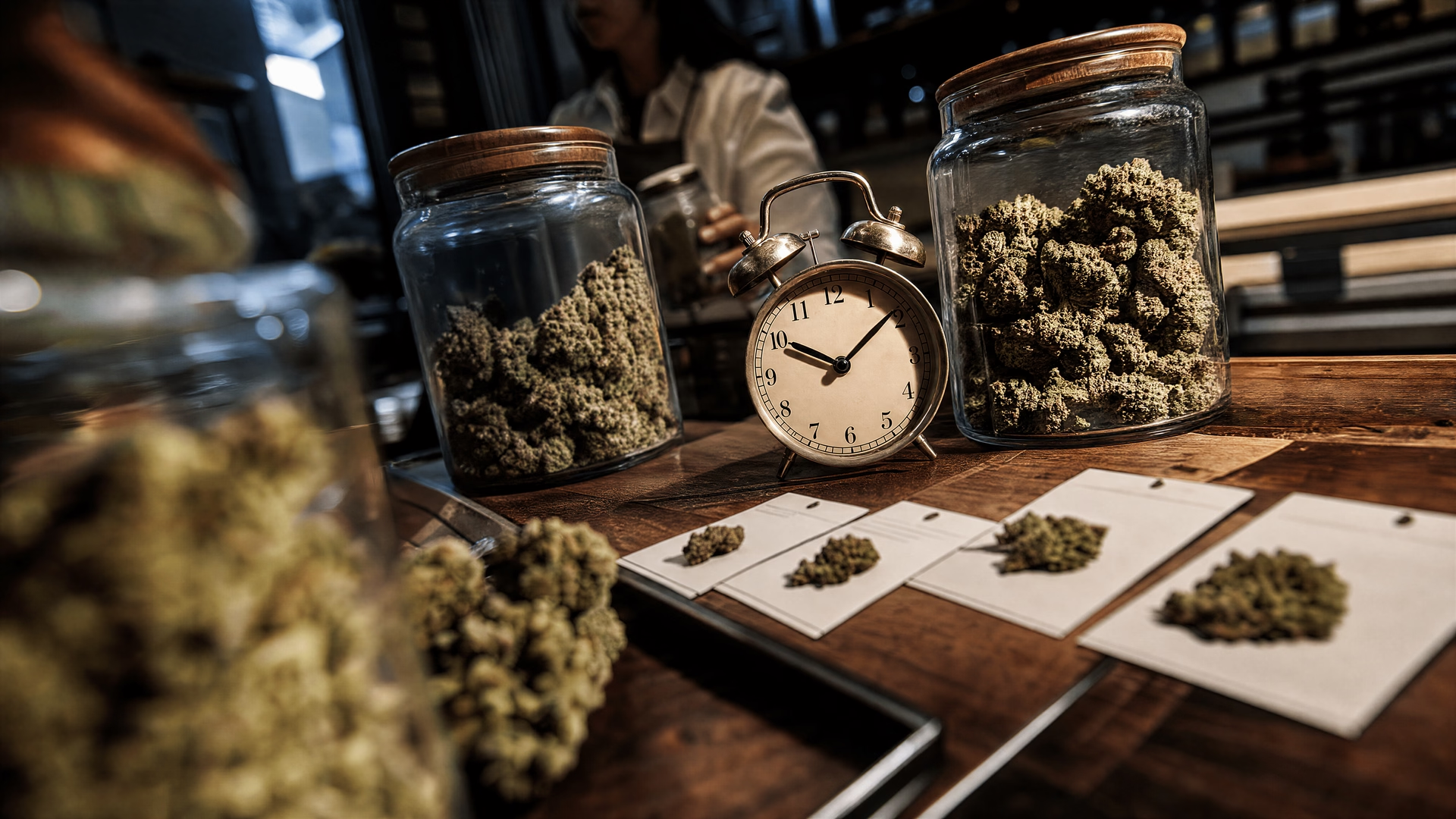
So you've heard about cultivation clubs in Germany — here's what they actually are. A cannabis social club is a member-run, non-commercial entity. There are no shareholders. No investors. Just members pooling resources for legal cannabis access. Available products include cannabis flower and hashish. Every item shows its THC and CBD content, often down to the decimal. Consumption rules vary: on-site consumption is prohibited, including near entrances Some clubs have a dedicated lounge for smoking; others are strictly take-away operations. You can purchase up to 25 grams — a hard limit that every legitimate club enforces. Don't confuse this with a dispensary — the cannabis social club model is about community-driven, non-commercial cannabis access.
Popular clubs in Main-Kinzig-Kreis include velvet-green e.V. Cannabis Social Club Bad Soden-Salmünster Gelnhausen, Velvet-green e.V. Cannabis Social Club, Cannabis Social Club Buds and Friends, GreenSnacks CSC, and Local-Leafs Cannabis Club e. V. Hanau — each with their own membership process and community.
Community Life in Main-Kinzig-Kreis
The cannabis culture you'll find in Main-Kinzig-Kreis's cannabis social clubs has evolved into something genuinely sophisticated. Smoking weed in a regulated setting changes everything about the experience. Variety knowledge is part of the culture: members learn to identify terpene profiles, compare THC to CBD ratios, and choose products — flower, hash, and cannabis varieties — that match their needs. There's a lounge culture too. Clubs that offer on-site consumption spaces create a social environment where people connect, share a joint, and build community. Cannabis culture in Main-Kinzig-Kreis isn't performative — it's practical. People come to enjoy quality weed, know exactly what they're consuming, and leave the stereotypes at the door.
6 cannabis clubs in Main-Kinzig-Kreis
Main-Kinzig-Kreis cannabis social club Scene
How does the club scene in Main-Kinzig-Kreis actually look? The scene is 6 clubs strong, ranging from intimate spaces with a handful of members to larger operations with extensive product lists. Cannabis variety has improved dramatically: clubs now stock indica varieties for relaxation, sativa for energy, and hybrids for balance. Hash, hashish, and cannabis products are widely available. Quality varies, and that's the honest truth. The best clubs test their products, label accurately, and train their staff to guide members through the menu. The weaker ones? They still beat the black market by a mile. The lounge scene is where community happens. Members smoke, socialise, share rolling tips, and compare notes on new varieties. Costs are clear: individual product prices displayed openly. No games, no negotiation.
Joining a cannabis social club in Main-Kinzig-Kreis
How do you actually
join a cultivation club in
Main-Kinzig-Kreis? Here's the practical guide — no fluff, just facts.
Step 1: Eligibility. You must be at least 18 years old. Valid, non-expired photo ID is mandatory. No ID, no membership, no discussion.
Step 2: Application. Some clubs accept walk-in applications; others require a referral or invitation from an existing member.
Step 3: Fees. Membership costs €20–50 per month. This is the operational contribution — non-profit means every cent goes to running the club.
Step 4: Orientation. Most reputable clubs include a brief orientation: house rules, purchase limits (25 grams), on-site consumption policies, and product labelling. Cash payment is standard for initial
registration. Card payments are inconsistent across clubs. Travelling to Main-Kinzig-Kreis? Read this: At least six months of official German residency is required — tourists and new arrivals cannot join. Once you have your membership card, you're set. Present it at every visit, respect the rules, and you'll have access to quality cannabis products.
Community — it's the word that keeps coming up when you talk to members of cannabis social clubs in Main-Kinzig-Kreis. It's not a buzzword here — it's the lived experience. Inside these clubs, knowledge flows in every direction: veterans share cannabis wisdom, newcomers bring fresh questions, and everyone benefits from collective experience with different products — flower, hash, and more. The workshop culture is thriving: growing classes (relevant where three plants per adult household member is permitted), cannabis education, cannabis cooking, joint-rolling sessions, and frank discussions about responsible consumption. The social dimension is real. Members celebrate together, support each other through hard times, and form friendships that extend beyond the club walls. Whether you're a long-term resident or a visitor, the community in these clubs is genuine. You'll leave knowing more about cannabis than when you walked in.
Getting Started in Main-Kinzig-Kreis
Here's your practical guide to getting started with cultivation clubs in Main-Kinzig-Kreis. Main-Kinzig-Kreis offers 6 clubs to choose from. Factor in: distance from where you're staying, product selection, lounge access, and community character. If you're visiting from outside Germany: At least six months of official German residency is required — tourists and new arrivals cannot join. Don't skip this step — the rules matter. Bring: photo ID, cash (membership fee plus budget for first purchases), and time. Some clubs require a referral — call ahead. Once registered, browse the menu: variety names, THC percentages, product types. Ask for a recommendation if it's your first time. On-site smoking? On-site consumption is prohibited, including near entrances Legal purchase limits: 25 grams daily, 50 grams monthly. Plan accordingly.
Responsible cannabis use. Not a contradiction — it's the foundation of how cannabis social clubs in Main-Kinzig-Kreis operate. Understanding THC is step one: potency varies dramatically between varieties. A 10% THC flower is a different experience from a 25% one. Clubs label everything so you can choose with full information. The substance has real effects. Adults in these clubs acknowledge that — and act accordingly. If you are new to cannabis, the golden rule is "start low, go slow." A small initial amount is a reasonable starting point. Wait before consuming more — effects from cannabis build gradually. Driving after smoking cannabis is illegal everywhere. Full stop. Don't do it. Mixing cannabis with alcohol amplifies both — this is something clubs actively warn about. Not every member wants to get high. CBD-dominant varieties offer relaxation and potential therapeutic benefits with minimal THC. Ask your club about their CBD options.
Legal Framework
The
legal framework governing cannabis clubs in
Germany — explained clearly. Everything starts with KCanG — formally Consumer Cannabis Act — which has been in force since 2024. Adults aged 18+ can join a cannabis social club and access cannabis flower and hashish. The daily limit is 25 grams; the monthly limit is 50 grams. Every club must operate as a registered association, with a maximum of 500 members. This prevents any club from becoming a de facto commercial operation. Clubs must maintain 200 meters distance from schools and playgrounds. Clubs must demonstrate compliance to receive and maintain their license. Home growing is permitted: three plants per adult household member. Clubs may distribute seven seeds or five cuttings per month to members for personal cultivation. For members under 21: 30 grams per month with max 10% THC. The legislation prioritises youth protection alongside adult access. On-site smoking rules: on-site consumption is prohibited, including near entrances
Key Regulations at a Glance| Regulation | Detail |
|---|
| Legal basis | Consumer Cannabis Act (KCanG) |
| Effective since | 2024 |
| Minimum age | 18 years |
| Daily limit | 25 grams |
| Monthly limit | 50 grams |
| Member cap | 500 |
| Distance rule | Clubs must maintain 200 meters distance from schools and playgrounds. |
| Organisation type | registered association |
| Home growing | 3 plants per adult household member |
| Products | cannabis flower and hashish |
| Youth provision | 30 grams per month with max 10% THC |
| Seed allowance | 7 seeds or five cuttings per month |
All clubs operate under Germany's Cannabis Act (KCanG), effective since April 2024. Unlike the Netherlands, Germany does not have coffeeshops. Instead, since April 2024, licensed growers' associations under the Cannabis Act (KCanG) allow adult members to access cannabis legally. According to EUDA — the European Union Drugs Agency — cannabis is the most widely used controlled substance across Europe, with Germany recording some of the highest rates of adult cannabis use on the continent. Official documentation is published by Bundesgesundheitsministerium (Federal Ministry of Health).
Cannabis Policy in Main-Kinzig-Kreis
What makes Main-Kinzig-Kreis's cannabis landscape unique? In theory, every state in Germany follows the same KCanG framework. In practice, Main-Kinzig-Kreis puts its own stamp on how that framework is lived and enforced. Licensing speed, inspection frequency, and regulatory attitude all vary by state. In Main-Kinzig-Kreis, this translates to specific conditions that affect both club operators and members. For cannabis consumers in Main-Kinzig-Kreis, the practical impact is subtle but real. The product range (cannabis flower and hashish) and limits (25 grams daily) are national, but the availability of on-site smoking lounges, the prevalence of community events, and the general vibe of cannabis culture are regional. Main-Kinzig-Kreis's position within Germany's cannabis landscape continues to develop. Municipal elections, state-level advocacy, and public opinion all shape the direction. For visitors and tourists, the state-level differences are worth understanding — they explain why the club experience in Main-Kinzig-Kreis might feel different from what you'd find in another part of Germany.
Main-Kinzig-Kreis and Surroundings
Main-Kinzig-Kreis's geography and neighborhoods create distinct cannabis micro-cultures. Main-Kinzig-Kreis's 6 clubs are spread across its neighborhoods, and each location reflects the character of its area. The key neighborhoods offer distinct club experiences. Some areas lean toward social smoking lounges; others toward curated product menus with detailed THC and CBD breakdowns. Transport tip: use public transit. Driving after smoking cannabis is illegal in Germany, so plan your route before you visit. Most clubs are accessible by bus, tram, or bike. Nearby cities —
Bad Soden-Salmünster, Main-Kinzig-Kreis,
Langenselbold, Maintal, Gelnhausen, Bruchköbel, Nidderau, Schlüchtern, Erlensee, and
Wächtersbach — add regional depth. Each has its own cultivation clubs, and a day trip can expose you to different product selections and club cultures. Tourists: don't just visit a club. Explore the neighborhood. Eat, walk, talk to locals. The cannabis scene is part of the city's fabric, not separate from it.
Want to explore beyond Main-Kinzig-Kreis? Main-Kinzig-Kreis rewards the curious traveller. Bad Soden-Salmünster, Main-Kinzig-Kreis, Langenselbold, Maintal, Gelnhausen, Bruchköbel, Nidderau, Schlüchtern, Erlensee, and Wächtersbach aren't far, and they have their own cannabis social clubs — each with different product selections, menus, and community vibes. A day trip to a nearby city isn't just a change of scenery — it's a chance to compare menus, discover new varieties (indica, sativa, hybrids), and experience how different communities approach smoking and cannabis culture. Your membership in one club doesn't automatically transfer to another — most cultivation clubs are independent and require their own registration. But the process is familiar once you've done it. Across the region, cannabis variety and product selection vary by club, with consistent THC and CBD labelling. Product variety tends to be higher in larger cities. For tourists and visitors, exploring the region turns a single-city trip into a broader cultural experience.