











Why cannabis feels creative even when the work is not better
The mistake that keeps showing up in cannabis-and-creativity writing is simple: it treats feeling imaginative as if it were the same thing as making more original, useful, or finished work. Those are not the same outcome. A person can feel flooded with insight and still produce ideas that are rambling, repetitive, or hard to execute.
That distinction matters because cannabis is common enough that myths scale fast. SAMHSA estimated that 61.8 million people aged 12 or older in the United States used marijuana in the past year in 2023, and 42.0 million used it in the past month. UNODC estimated 228 million cannabis users globally in 2022. When a substance is this widespread, romantic claims about “unlocking” creativity travel farther than careful evidence does.
The popular claim that cannabis unlocks creativity
The popular story is familiar: cannabis quiets inhibition, opens unusual associations, slows time, and lets ideas arrive more freely. Subjectively, that can be real. THC, the main intoxicating cannabinoid, is a partial agonist at CB1 receptors, which are dense in the prefrontal cortex, hippocampus, basal ganglia, and cerebellum. Those systems help regulate reward salience, memory, timing, attention, and cognitive control. Change those systems and thoughts can feel newly vivid, strange, emotionally charged, or interconnected.
That is one reason cannabis has long been tied to creative subcultures. It appears in the history of jazz, Beat writing, postwar art scenes, reggae, hip-hop, and later studio culture. The 19th-century Club des Hashischins in Paris included Théophile Gautier, Charles Baudelaire, and Gérard de Nerval. But presence is not proof of causation. Baudelaire himself became skeptical, warning that intoxication could tempt artists away from disciplined labor. That ambivalence is more convincing than the modern cliché.
It is also a category error to import claims from psychedelic research and paste them onto cannabis. Cannabis does not share the receptor pharmacology or cognitive profile of classic serotonergic psychedelics. Evidence for a broad creativity boost is weaker and much more mixed.
Subjective inspiration versus objective creative performance
Acute cannabis intoxication can increase self-rated creativity without improving objective creative performance once positive mood is considered. Strong evidence
The best modern experiment on this split is Carrie Cuttler and colleagues’ 2021 paper in the Journal of Applied Psychology. Under acute cannabis intoxication, participants rated themselves as more creative. Yet they did not perform better on objective divergent-thinking measures once positive mood was taken into account. That finding cuts straight through the mythology: cannabis can raise the feeling of creativity without raising creative performance.
That result makes sense mechanistically. If intoxication boosts positive affect and lowers self-criticism, ideas may seem better than they are. A weak metaphor can feel profound. A loose association can feel original just because it arrived with unusual intensity. Time distortion adds to this. Minutes feel fuller. Thoughts feel weightier. Subjective significance increases.
Meanwhile, the cognitive functions needed to test, shape, and remember ideas often move in the opposite direction. THC has repeatedly been shown to impair attention, working memory, episodic memory, verbal learning, and psychomotor performance in controlled studies. Reviews such as Broyd et al. (2016), along with work cited by Nora Volkow and colleagues at NIDA, show that acute effects are especially relevant in domains tied to learning, memory, and attention. D’Souza and co-authors, in THC administration studies, documented dose-related impairment in verbal learning and working memory, alongside other intoxication effects. Those deficits are not side issues. They sit right inside the creative process.
Creative work, step by step
- Generate options Produce many possible ideas, angles, or associations.
- Hold options in mind Keep multiple possibilities active long enough to compare them.
- Evaluate Discard weak ideas and test stronger ones against the goal.
- Sustain effort Stay on task long enough to develop raw material.
- Revise Edit, sequence, and refine until the work is coherent.
Creativity is not just generating options. It also requires holding several options in mind, comparing them, discarding weak ones, sustaining effort, and revising without losing the thread. If memory and evaluation wobble, ideation can become noisy rather than fruitful.
The article's core position: idea generation and idea execution are different jobs
The most defensible model is a two-stage one. Cannabis may, for some people and under some conditions, loosen the gate. It can reduce self-censorship, widen associative spread, and make remote connections feel available. Lower doses of THC may sometimes help users produce unusual ideas, especially in familiar settings and among people who are not overwhelmed by the intoxication. But running the whole creative operation is a different job.
Execution depends on convergent thinking, judgment, sequencing, timing, and persistence. That is where cannabis often struggles. Higher THC doses more reliably degrade working memory, sustained attention, and error monitoring. The same shift that reduces top-down filtering can also increase distractibility and make bad ideas harder to reject. In plain terms: easier brainstorming, worse editing.
This is also why cannabis can resemble flow without actually producing it. Arne Dietrich’s work on flow stresses a balance between automaticity and control. Some users report narrowed temporal focus or less self-monitoring and interpret that as flow. Yet heavy intoxication usually disrupts the stable attention and skill-task fit that real flow requires.
| Moderator | Why it changes the outcome | Direction suggested by the article |
|---|---|---|
| Dose | Lower doses may reduce inhibition; higher doses more reliably impair working memory and attention | Low dose may sometimes help brainstorming; high dose more often hurts execution |
| Tolerance | Experienced users may feel less disrupted than novices at the same dose | Can change subjective comfort without proving enhancement over sober baseline |
| Route | Inhaled and oral products differ in onset, predictability, and duration | Inhaled is easier to titrate; edibles are easier to overshoot |
| Setting | Familiar low-pressure settings differ from unfamiliar or demanding ones | Familiar contexts may feel easier; technical or collaborative tasks are more vulnerable |
| Traits | Openness, anxiety, and baseline creativity shape the response | Some users feel freer; others become scattered or self-conscious |
Moderators matter. Dose matters. Tolerance matters. Route matters. A low inhaled THC dose in a familiar studio is not cognitively comparable to a high-THC edible in an unfamiliar setting. Trait openness, anxiety level, baseline creativity, and prior experience all shape the result. CBD is not a shortcut here either. It may soften some THC-related anxiety in mixed formulations, but there is little direct evidence that CBD itself enhances creativity.
So the cleanest answer is not “cannabis makes people creative” or “cannabis kills creativity.” It is narrower and more accurate: cannabis can make ideas feel more alive, more interesting, and more worth pursuing. That is psychologically real. It is not the same as producing better work.
What scientists mean by creativity
Scientists use the word creativity more narrowly than popular culture does. In research, a creative product or idea usually has to be both novel and useful, or at least appropriate to a goal. That matters here. Feeling flooded with associations, sensing hidden meaning, or having a rush of inspiration is not the same as producing work that other people judge as original and effective. The distinction is central to cannabis research, because acute THC often shifts self-evaluation more reliably than it improves performance.
THC is a partial agonist at CB1 receptors, which are dense in brain regions involved in memory, reward, timing, motor coordination, and cognitive control, including the prefrontal cortex and hippocampus. That gives a plausible route by which cannabis could widen associations or lower inhibition in some moments. It also gives a plausible route by which it could disrupt attention, working memory, and revision. Both effects matter for creativity. One opens the gate. The other may prevent the work from getting finished.
Carrie Cuttler and colleagues made this split unusually clear in a 2021 Journal of Applied Psychology study. Participants under acute cannabis intoxication rated themselves as more creative, but objective creativity did not improve once positive mood was taken into account. That is the cleanest modern corrective to the cliché that cannabis simply “boosts creativity.” It often boosts the sense of creativity.
Divergent thinking, convergent thinking, and incubation
Divergent thinking Idea generation that favors many possible answers, uses, or associations rather than one best solution.
Common creativity measures named in the article
- Alternate Uses Task
- A divergent-thinking task where a person lists unusual uses for an ordinary object such as a brick or paperclip.
- Remote Associates Test
- A convergent-thinking task where a person finds one word that connects three other words.
- Incubation
- A pause in active work after which a better strategy or solution may appear.
Creativity is not one mental operation. Researchers often separate divergent thinking from convergent thinking. Divergent thinking is idea generation: producing many possible answers, angles, or uses. A classic task is the Alternate Uses Task, where a person lists unusual uses for a brick, paperclip, or shoe. Scores may reflect fluency, flexibility, originality, and elaboration.
Convergent thinking Goal-directed thinking that narrows options and selects the strongest or single best answer.
Convergent thinking is different. It asks whether someone can combine clues into the single best answer. The Remote Associates Test is a standard example: find one word that links three others. Insight problems work similarly. They reward selection, constraint, and pattern resolution, not just free association.
This difference matters for cannabis. If THC loosens top-down filtering, some users may generate more unusual associations at low doses or in familiar settings. But the same drug state can impair the working memory and cognitive control needed to hold rules in mind, test an idea, reject weak options, and converge on the strongest solution. Reviews by researchers such as Nora Volkow and broader cognition work including Broyd et al. have repeatedly tied cannabis effects to attention, learning, and memory. D’Souza and other THC administration studies show the same direction more sharply at higher doses: poorer verbal learning, weaker working memory, more cognitive noise.
Then there is incubation. People sometimes solve creative problems after stepping away from them. Incubation is not magic; it may reflect unconscious recombination, recovery from fixation, or the chance return of a better strategy. A songwriter taking a walk, a coder sleeping on a bug, and a painter leaving a canvas alone for a day are all using incubation, but in domain-specific ways. Cannabis may alter the subjective texture of incubation by changing time perception or salience. That does not mean it improves the eventual solution.
Improvisation, flow, and artistic risk-taking are not identical constructs
Improvisation is real-time generation under constraint. Flow is a state of deep absorption in which action feels smooth, attention is stable, and skill matches challenge. Artistic risk-taking is a willingness to try material that may fail, offend, or break convention. These overlap, but they are not interchangeable.
A jazz improviser draws on procedural memory, timing, ear training, ensemble awareness, and fast error correction. A poet drafting strange images may rely more heavily on verbal association and self-permission. A software developer working on an elegant algorithm needs sustained rule-based reasoning. A painter making a bold compositional choice may be taking aesthetic risk without being in flow at all.
Arne Dietrich’s work on flow is useful here. Flow is not just disinhibition. It depends on a balance between automaticity and control. Cannabis can, for some people, feel flow-like because self-monitoring changes and the present moment feels enlarged. But heavy intoxication usually undermines the attentional steadiness and task-skill fit that actual flow requires. Feeling less inhibited is not the same as being in a high-performance creative state.
Why laboratory creativity tasks only capture part of real artistic practice
Lab tasks are useful because they isolate pieces of cognition. They are also limited. Writing a novel, producing an album, designing a chair, editing a film, or building software unfolds across weeks or years. Real creative practice includes domain knowledge, taste, revision, collaboration, sequencing, and craft. Most of the hard part is not generating options. It is deciding which option deserves labor.
That is why a laboratory measure can miss what artists actually do. An alternate-uses task does not capture harmony, brush handling, debugging, narrative pacing, or the discipline of rewriting. Baudelaire understood this long before modern cognitive science: intoxication might produce vivid impressions, but disciplined artistic labor still has to shape them. That old ambivalence is more credible than romantic mythology.
So when scientists talk about creativity, they are not talking about a mystical trait. They are talking about separable processes that can move in opposite directions. Cannabis may help some people feel more open, more associative, more willing to take a strange idea seriously. It is much less dependable for judgment, revision, timing, and execution. For creative work, that difference is everything.
The neurobiology: how THC changes attention, memory, reward, and association
THC does not “switch on creativity” in any simple way. It changes signal flow in brain systems that govern attention, short-term memory, timing, reward, inhibition, and the filtering of associations. That matters because creative work is built from several different operations, not one: generating unusual ideas, holding them in mind, testing them against goals, discarding weak ones, and turning the survivors into something coherent. THC can push some of those operations in opposite directions at the same time.
Partial agonist A compound that activates a receptor, but not to the maximum effect a full agonist could produce.
Pharmacologically, delta-9-tetrahydrocannabinol is a partial agonist at the CB1 receptor. “Partial agonist” means it activates the receptor, but not to the full extent a maximal agonist would. CB1 receptors are part of the endocannabinoid system and are found densely throughout the brain, especially in regions tied to executive control, memory, movement, timing, and reward. Unlike a neurotransmitter such as glutamate or GABA, THC does not mainly carry content from one neuron to another. It modulates transmission. In many synapses, CB1 activation reduces the release of other neurotransmitters, changing how strongly circuits fire and how tightly they are regulated.
That is why intoxication can feel mentally expansive while also making cognition sloppier. The gates loosen. The editor weakens.

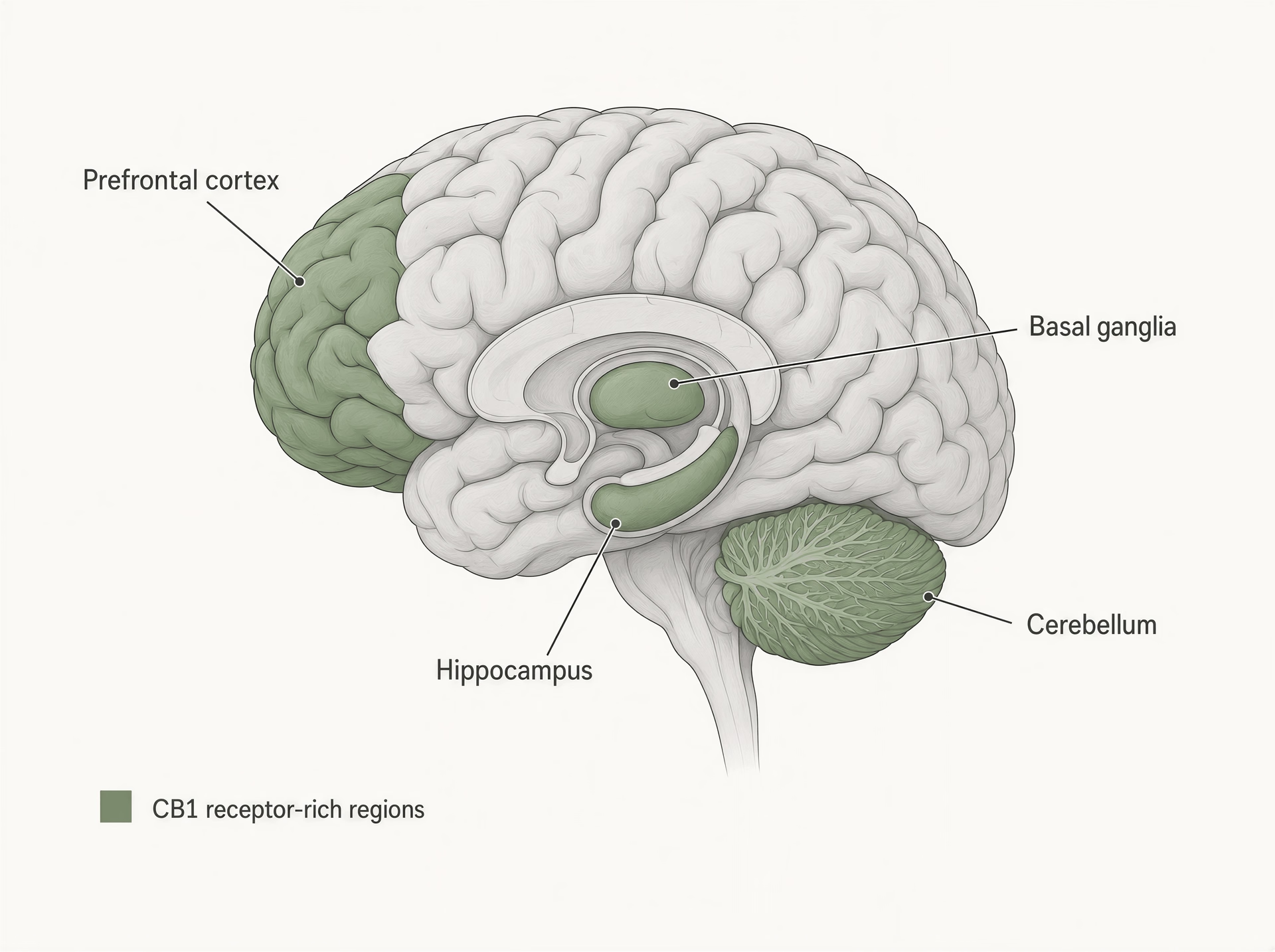
CB1 receptors in the prefrontal cortex, hippocampus, basal ganglia, and cerebellum
Brain regions the article links to THC effects
- Prefrontal cortex Planning, sustained attention, inhibition, and working memory.
- Hippocampus Forming and retrieving recent memories and stabilizing new information.
- Basal ganglia Action selection, motivation, habit, and reward-linked salience.
- Cerebellum Timing, prediction, coordination, and aspects of sequencing.
The prefrontal cortex is heavily involved in planning, decision-making, sustained attention, response inhibition, and working memory. THC acting at CB1 receptors in this region can reduce top-down control. In plain language, the brain becomes less strict about what deserves focus and what should be suppressed. Sometimes that can feel liberating. A person may become less self-censoring, less locked into habitual solutions, or more willing to entertain a strange image, metaphor, or chord change. But the same shift can also degrade judgment, increase distractibility, and make it harder to keep a task structure in mind.
The hippocampus is central to forming and retrieving episodic memories and to holding recent information in a usable state. It is one of the regions most strongly implicated in the classic short-term memory effects of THC. This is one reason users often report losing the thread of a conversation or forgetting what they were about to write down. Creativity research often underrates this point. If you cannot stabilize a promising idea long enough to compare it with other ideas, elaborate it, or sequence it into a larger project, inspiration stays fragmentary. D’Souza and colleagues, along with a wide controlled-administration literature, have shown that acute THC impairs verbal learning and working memory, especially at higher doses.
The basal ganglia matter for action selection, habit, motivation, and reward-linked behavior. THC’s effects here help explain why some stimuli or ideas suddenly feel unusually important, funny, moving, or profound. Salience shifts. A half-formed phrase can seem like a breakthrough. Sometimes it is. Often it only feels that way in the moment. This is one route by which subjective creativity rises without objective output improving.
The cerebellum is usually introduced as a motor structure, but that is incomplete. It contributes to timing, prediction, coordination, and some aspects of cognitive sequencing. CB1 receptor activity here is one reason intoxication can alter temporal perception and psychomotor control. In artistic terms, this can affect rhythm, pacing, and the smooth execution of practiced routines. Improvisers may sometimes experience altered timing as interesting or expressive. Precision tasks tend to suffer.
These regional effects are not isolated. They interact. Nora Volkow and colleagues have repeatedly argued that cannabis-related cognitive effects show up most consistently in attention, learning, and memory, with severity shaped by dose, age of initiation, use pattern, and potency. That position fits both neurobiology and lab data.
Associative looseness, reduced inhibition, and altered salience
THC may loosen associations and help early divergent thought for some users under some conditions, especially at lower doses. Limited evidence
A common report under THC is that remote associations seem easier to access. Two ideas that would normally stay separate suddenly feel linked. A sound suggests a color. A memory unlocks a plot point. A design problem seems to invite a lateral answer instead of an obvious one. This is the part of cannabis and creativity that gets romanticized, and it is not entirely imaginary. Reduced inhibition and weaker top-down filtering can broaden the range of material admitted into conscious thought.
But “more associations” is not the same as “better ideas.” Associative looseness is a double-edged change. It can help with divergent thought, especially in the earliest generative phase when quantity and novelty matter more than precision. It can also flood the workspace with irrelevant connections. The mind becomes more permissive, not necessarily more discerning.[1] High on cannabis and creativity: The joint effects of cannabis use and creativity on divergent thinking and state creativity. Carrie Cuttler, colleagues. Journal of Applied Psychology, 2021.
Mood amplifies this problem. Carrie Cuttler and colleagues, in a 2021 study in the Journal of Applied Psychology, found that acute cannabis intoxication increased subjective creativity ratings, yet did not improve objective divergent thinking once positive affect was accounted for. That is a hard finding to ignore. If feeling good and less self-critical makes people rate their own ideas more favorably, then some of the “creative boost” is a change in self-evaluation rather than a gain in generative ability.
This maps onto altered salience. THC can make ideas feel vivid, important, emotionally resonant, or newly meaningful. In reward terms, the internal “this matters” signal can become stronger. That can be useful when a person is blocked by inhibition, fear of judgment, or rigid expectations. It can also make weak ideas seem profound and make tangents harder to abandon. Error checking declines just when confidence may rise.
That split helps explain the mixed creativity literature. Studies on divergent thinking under cannabis have produced variable results, often depending on baseline creativity, dose, and task design. Lower intoxication may, in some people, ease idea generation by reducing inhibitory control. Higher intoxication more reliably harms attention and task management. Cannabis is also not a psychedelic in the serotonergic sense, and importing claims from LSD or psilocybin research is a category mistake. The receptor pharmacology is different, and so is the cognitive profile.
Why working memory impairment matters for creative production
Working memory is the ability to hold and manipulate information over a short interval. It is the mental scratchpad that lets a songwriter compare two lines, a painter remember the intended composition while adjusting one corner, or a writer track argument, tone, and structure across paragraphs. When THC disrupts this system, creativity does not disappear, but it often becomes harder to organize.
This is where the two-stage model is most useful. Early-stage ideation may sometimes benefit from loosened gating, reduced self-censorship, and unusual associations. Later-stage production depends much more on executive control. Revision, sequencing, timing, and convergence are not optional extras. They are the machinery that turns a spark into finished work.[2] Acute and chronic effects of cannabinoids on human cognition—a systematic review. S. J. Broyd, F. van Hell, C. Beale, others. Biological Psychiatry, 2016.
Acute THC often compromises exactly that machinery. Reviews such as Broyd et al. (2016) and repeated summaries by Volkow and NIDA point in the same direction: attention, episodic memory, psychomotor performance, and working memory are reliable points of vulnerability. Practically, that means remote association may feel easier while proofreading, structure checking, and factual verification get worse. People may generate more fragments and trust them more, yet fail to catch repetition, incoherence, or weak transitions.[3] 2023 National Survey on Drug Use and Health (NSDUH): Detailed Tables. Substance Abuse and Mental Health Services Administration. NSDUH, 2024.[4] World Drug Report 2024. United Nations Office on Drugs and Crime. UNODC, 2024.
That distinction matters in a world where cannabis use is common. SAMHSA estimated that 61.8 million people in the United States used marijuana in the past year in 2023, and 42.0 million used it in the past month. Globally, UNODC estimated 228 million cannabis users in 2022. So this is not an obscure question. But the evidence does not support the fantasy that intoxication improves the whole creative process. The sharper claim is narrower and better supported: THC may loosen the gate for some users under some conditions, but it often makes it harder to run the factory.
What the experiments actually show
Cannabis is used by a huge number of people, so the question is not fringe. SAMHSA estimated that 61.8 million people in the United States used marijuana in the past year in 2023, and 42.0 million used it in the past month. UNODC estimated 228 million users worldwide in 2022. That scale helps explain why the idea that cannabis boosts creativity keeps resurfacing. But prevalence is not proof. The experimental literature is much less romantic than the folklore.
The cleanest reading of the evidence is this: acute cannabis intoxication often changes how creative people feel, but it does not reliably improve how creative they perform on objective tasks. Sometimes it may loosen associations or reduce inhibition enough to help early ideation in specific users at low doses. Just as often, and more predictably at higher THC doses, it disrupts the memory, attention, and executive control needed to make ideas coherent, original, and usable.
THC is the main driver here. It is a partial agonist at CB1 receptors, which are dense in the prefrontal cortex, hippocampus, basal ganglia, and cerebellum. Those circuits matter for working memory, timing, reward, self-monitoring, and cognitive control. Creativity depends on those systems too. That is why the effect is mixed from the start: the same intoxication that can make remote associations feel newly meaningful can also weaken error detection and make mediocre ideas seem brilliant.
Acute intoxication and self-rated creativity
One of the most cited modern studies on this question is Carrie Cuttler and colleagues’ 2021 paper in the Journal of Applied Psychology. Its result is the one popular writing usually skips: people under acute cannabis intoxication rated themselves as more creative, but they did not perform better on objective creativity measures once positive affect was taken into account.
That distinction matters. Self-rated creativity is not fake; it captures a real subjective state. People may feel more open, less self-censoring, more absorbed in sensory detail, and more willing to follow an unusual idea. They may experience time differently, notice more connections, or assign more salience to thoughts that would otherwise be dismissed. Subjectively, that can feel like inspiration.
But feeling inspired is not the same thing as producing better work.
Cuttler’s study is useful because it tested both sides at once. Acute intoxication raised state creativity ratings. Yet when the researchers looked at objective performance, the boost largely disappeared. Positive mood explained a substantial part of the effect. In plain language: cannabis may make people feel brighter, freer, and more inventive partly because it changes mood and self-evaluation, not because it increases creative output itself.
That pattern fits a lot of anecdotal experience. Users often report that ideas arrive with unusual force or novelty. Later, when sober, many of those ideas do not hold up. The mismatch is not mysterious. Reduced self-criticism can be pleasant and sometimes productive during brainstorming, but it also lowers the threshold for treating weak material as profound.
Related work in this area, including studies discussed by Mathias P. Steffens and co-authors, points in the same direction. Intoxication can alter creativity perceptions in workplace or performance contexts without producing a clear increase in externally rated novelty or usefulness. The split between “I felt unusually creative” and “independent raters saw no improvement” is now one of the most stable findings in the modern literature.
This is also where some cannabis-creativity arguments quietly import ideas from psychedelic research. That move is sloppy. Cannabis does not share the same receptor pharmacology or cognitive profile as serotonergic psychedelics. The evidence for creativity enhancement is much weaker with cannabis, and the self-perception effects are stronger than the performance effects.
Objective divergent-thinking results in controlled studies
When researchers try to measure creativity directly, they usually do not ask whether a poem felt magical to write. They use structured tasks. Common examples include divergent-thinking tests such as generating many uses for an ordinary object, or rating the originality and usefulness of produced ideas. These tasks are imperfect, but they are still better than relying only on intoxicated self-report.
On these measures, cannabis does not look like a dependable enhancer.
Cuttler et al. 2021 is again central. Participants who were acutely intoxicated reported higher creativity, yet objective divergent-thinking performance did not show a meaningful advantage once mood was considered. Other studies in the broader divergent-thinking literature, including work by Schafer and colleagues, have found mixed effects, often hinging on baseline creativity, task type, or intoxication level. In some subgroups, lower levels of intoxication may coincide with slightly greater associative looseness or fluency. In others, especially with heavier intoxication, performance worsens.
That inconsistency is exactly what one would expect from the broader cannabis cognition literature. Creativity is not a single faculty. Divergent thinking draws on associative breadth, but it also depends on working memory, attention, retrieval, and enough executive organization to keep track of what has already been generated. Convergent thinking, revision, and project completion depend even more heavily on executive control.
And this is where THC starts to look less flattering.
Controlled administration studies by researchers including D’Souza and many others have repeatedly found that acute THC impairs verbal learning, working memory, attention, and in some cases produces psychotomimetic effects at higher doses. Reviews such as Broyd et al. 2016 and recurring analyses by Nora Volkow and colleagues at NIDA have made the same broad point: the most reliable short-term cognitive effects of cannabis show up in memory, attention, and learning. Those are not side issues. They are part of the machinery creative work runs on.
So even if intoxication broadens associations for some users, it may simultaneously damage the ability to hold, sort, and evaluate those associations. That tradeoff is a serious problem for real-world creativity. A songwriter does not only need a strange image; they need to remember the previous line, track meter, judge whether the phrase is trite, and revise. A designer does not only need novelty; they need constraints, sequencing, and error checking. A painter may benefit from loosened inhibition during sketching, but not from degraded sustained attention over a six-hour session.
This is why the strongest evidence supports a two-stage model: cannabis may sometimes loosen the gate, but it often weakens the rest of the system.
Dose, tolerance, mood, and setting as moderators
The modifiers matter enough that broad claims are misleading. A novice taking a high-THC edible in an unfamiliar environment is not in the same cognitive condition as an experienced user taking a small inhaled dose in a familiar studio. Route, dose, cannabinoid profile, expectations, and tolerance all change the outcome.
Dose is probably the biggest variable. Lower THC doses may reduce inhibition or increase unusual associations in some people. Higher doses more reliably impair working memory, sustained attention, time estimation, and verbal encoding. In practical terms, the “maybe helpful for brainstorming” window, if it exists for a given person, is likely narrow. Past that point, the impairments become easier to predict than the inspiration.
Tolerance complicates interpretation. Regular users may report that cannabis helps them work because they function more smoothly under doses that would obviously impair occasional users. That does not mean they are cognitively enhanced relative to their sober baseline. It may only mean they are less disrupted than a novice would be. Chronic use can also bring its own costs, and NIDA notes that about 3 in 10 people who use cannabis meet criteria for cannabis use disorder across a wide severity range.
Mood is another major moderator. Positive affect by itself can improve willingness to generate ideas and can reduce the fear of producing bad ones. Cuttler’s 2021 findings strongly suggest this is part of the cannabis-creativity story. If intoxication elevates mood or lowers harsh self-monitoring, people may generate more freely while assuming the ideas are better than they are. That can be useful during incubation or first-draft generation. It is not evidence of a direct cognitive enhancement.
Setting matters too. In a familiar, low-pressure context, reduced self-consciousness may help some artists improvise or sketch more freely. In a demanding environment with deadlines, collaboration, or technical constraints, the same intoxication can impair timing, listening, memory, and judgment. Arne Dietrich’s work on flow helps here even though it is not cannabis-specific. Flow is not just absorption. It depends on a match between skill and challenge plus stable attentional control. Cannabis may mimic the feeling of flow for some users while undercutting the control that genuine flow requires.
CBD, despite frequent speculation, has very little direct evidence behind it in creativity research. It may alter some THC effects in mixed formulations, especially anxiety or dysphoria, but there is no strong case that CBD itself enhances creativity.
So the bottom line is not “cannabis kills creativity” or “cannabis unlocks genius.” It is narrower and more defensible. The evidence for true enhancement is weak and conditional. The evidence for changed self-perception is stronger. Cannabis can make ideas feel bigger, stranger, and more important. Turning them into finished work is a different task, and THC often makes that task harder.
Cannabis and flow states: overlap, confusion, and the limits of the analogy
Flow gets abused in cannabis talk. People often mean “I felt absorbed,” “time changed,” or “the music sounded deeper.” None of that is identical to flow as studied in psychology. Mihaly Csikszentmihalyi’s model, and later work by researchers such as Arne Dietrich, treats flow as a high-functioning state, not just an altered one. It is marked by intense task focus, clear goals, immediate feedback, a close match between skill and challenge, and reduced self-consciousness without losing the ability to perform. That last part matters. Flow is organized. It is not cognitive drift with good vibes.
What flow requires psychologically
Real flow depends on attention that is stable, not merely narrowed. A jazz improviser in flow is tracking rhythm, harmony, motor execution, audience response, and future phrase options at once. A writer in flow is not only generating lines but holding structure, tone, and revision standards in working memory. That takes executive control even when the experience feels effortless.
This is where the popular analogy starts to break. THC, the main intoxicating cannabinoid, is a partial agonist at CB1 receptors distributed through the prefrontal cortex, hippocampus, basal ganglia, and cerebellum. Those regions help regulate timing, reward, memory, movement, and cognitive control. Acute THC can alter salience and self-monitoring, but it also impairs the very systems flow relies on when performance must remain coherent across time. D’Souza and colleagues, along with a large broader literature reviewed by Broyd et al. in 2016 and discussed repeatedly by Nora Volkow and NIDA, found short-term deficits in attention, working memory, verbal learning, and psychomotor performance. If those functions wobble, sustained flow usually does too.
Why cannabis can mimic some features of flow
The resemblance is still real enough to explain why people confuse the two. Cannabis can reduce self-criticism, intensify sensory engagement, and make remote associations feel newly meaningful. Time may seem compressed or stretched. Repetitive creative tasks can feel more immersive. For some users, especially at lower THC doses and in familiar settings, that can produce a strong “zone in” feeling.
The best modern evidence, though, points to a split between experience and output. In a 2021 Journal of Applied Psychology study, Carrie Cuttler and colleagues found that acute cannabis intoxication increased subjective creativity ratings, but did not improve objective divergent-thinking performance once positive affect was accounted for. That is an important result because mood is part of the story. If you feel relaxed, less inhibited, and less harsh toward your own ideas, your ideas may seem better even when external judges do not rate them as more original or useful.
So cannabis may open the gate. It does not reliably run the whole factory.
Where intoxication disrupts real flow
The limit shows up once a task demands consistency, sequencing, error correction, and judgment. Flow is not simply reduced self-consciousness; it is reduced self-consciousness in the service of skilled action. Excess THC often pushes people past looseness into fragmentation. Attention skips. Timing drifts. Weak ideas feel profound. Revision standards soften. That may be acceptable during free sketching or rough improvisation. It is a problem during editing, arranging, drafting, or performance under pressure.
Dose and context matter a lot. An experienced user taking a low inhaled dose in a familiar studio is not cognitively comparable to a novice taking a high-THC edible in a distracting setting. CBD may soften some THC-related anxiety in mixed formulations, but there is little direct evidence that CBD itself improves flow or creativity.
Given how common cannabis use is, this distinction matters. SAMHSA estimated 61.8 million Americans used marijuana in the past year in 2023, and UNODC estimated 228 million users worldwide in 2022. The cultural association is undeniable. The stronger claim is not. Cannabis can produce a state that feels flow-adjacent. True flow usually asks for more control than intoxication can reliably preserve.
Historical relationship between cannabis and creative communities
Cannabis has a long, real, and often overstated connection to artistic and literary life. That distinction matters. The historical record shows recurring association: writers, musicians, painters, and performers have used cannabis in certain scenes, eras, and subcultures. It does not show that cannabis reliably produced better art. Much of the mythology comes from collapsing atmosphere into causation.
That caution is even more important now, when cannabis is common enough to invite lazy storytelling. SAMHSA estimated that 61.8 million people aged 12 or older in the United States used marijuana in the past year in 2023, and 42.0 million used it in the past month. UNODC estimated 228 million users globally in 2022. With a substance this widespread, it would be surprising if it did not appear repeatedly in creative communities. Presence alone proves very little.

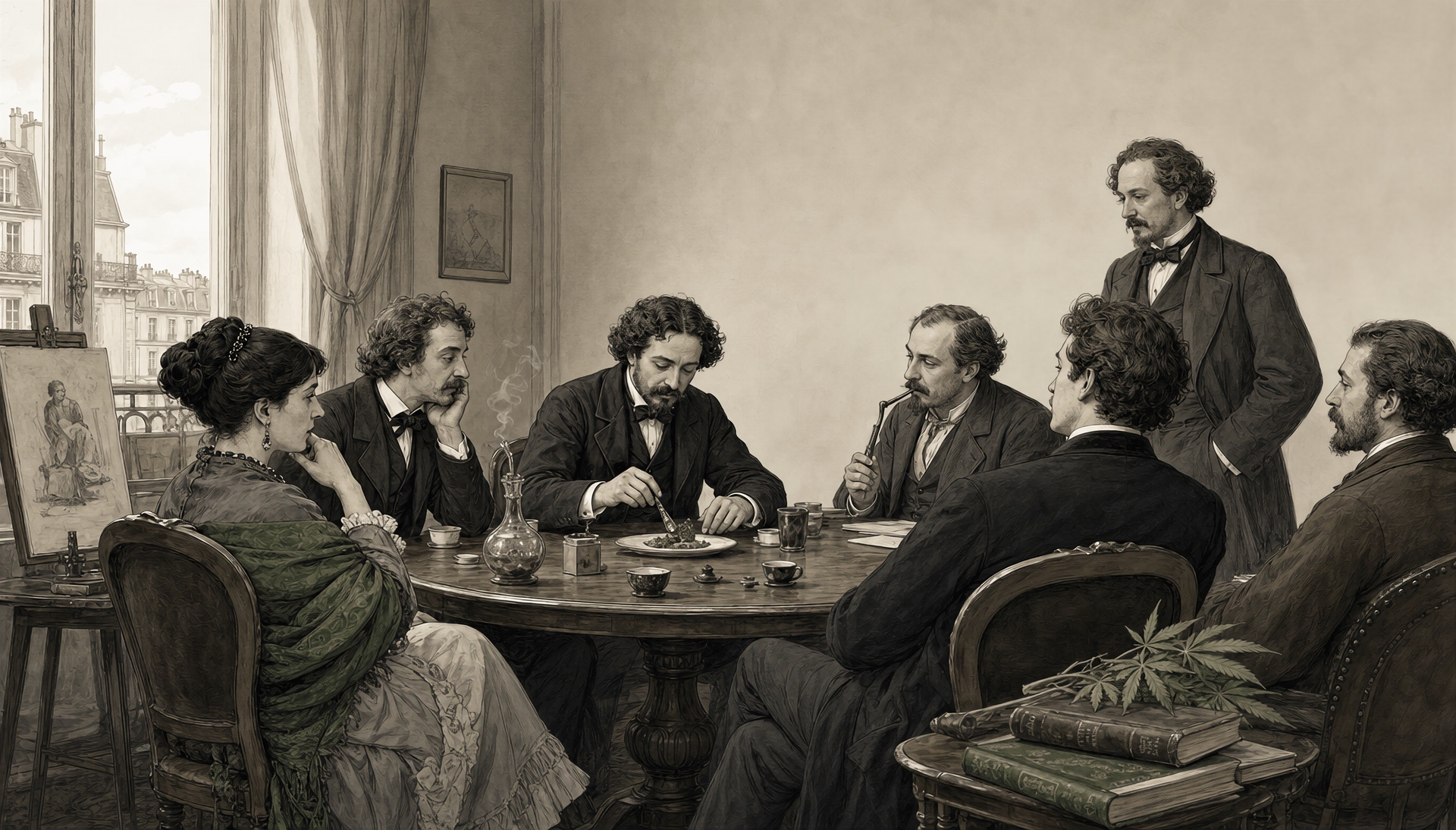
Hashish in 19th-century literary and artistic circles
One of the most cited early examples is the Club des Hashischins in Paris in the 1840s. The circle gathered at the Hôtel de Lauzun and included figures such as Théophile Gautier, Gérard de Nerval, and, at times, Charles Baudelaire. Hashish there was part experiment, part salon ritual, part theatrical performance. Gautier’s accounts helped cement the image of hashish as a portal to heightened imagery and altered perception, and later readers often treated those scenes as proof that intoxication nourished literary genius.
That reading is too simple. The club’s importance is cultural and symbolic, not experimental. It tells us that elite literary circles were curious about altered consciousness and willing to aestheticize it. It does not tell us that hashish improved anyone’s craft.
Baudelaire is the corrective figure here. In Les Paradis artificiels (1860), he wrote about hashish and opium with fascination, but also with distrust. He was not a straightforward prophet of drug-inspired art. Quite the opposite: he argued that intoxication could give a person the illusion of depth while weakening the discipline needed for actual artistic labor. That ambivalence feels more honest than the later cliché of the intoxicated genius. Baudelaire understood the split that modern research would describe much more dryly: feeling expansive is not the same as producing durable work.
The same pattern appears in English-language writing about hashish. Fitz Hugh Ludlow’s The Hasheesh Eater (1857) offered one of the best-known American accounts of the drug’s effects, full of grand internal visions and sensory distortion. It shaped literary imagination around hashish for decades. Yet it remains a subjective document, not evidence of enhanced creative performance. Walter Benjamin’s later hashish protocols in the 1920s and 1930s belong to the same category: intellectually valuable records of altered experience, but not proof of improved composition, criticism, or artistic execution.
So the 19th-century archive gives us something important, just not what popular myth wants. It shows that cannabis and hashish entered creative life as objects of fascination, self-study, and social identity. It does not show a repeatable creativity engine.
Jazz, criminalization, and the mythology of the “creative drug”
The link between cannabis and jazz is historically stronger than many other supposed art-drug pairings, but it is also where mythmaking gets especially distorting. In the 1930s and 1940s, cannabis was present in parts of jazz culture through “tea pads,” backstage use, slang, and a shared urban nightlife economy. Musicians such as Louis Armstrong openly discussed cannabis later in life; Mezz Mezzrow built much of his public persona around it. This history is documented.
What is not documented is the leap from “present in jazz culture” to “caused jazz innovation.” That leap erases too much. Jazz developed through Black musical traditions, formal training, relentless practice, improvisational systems, club work, migration, recording technology, and brutal working conditions shaped by racism and policing. To reduce bebop, swing, or Armstrong’s phrasing to a drug story is historically careless.
Criminalization is part of the story because it helped create the mythology. Anti-cannabis campaigns in the United States often racialized jazz spaces and linked marijuana to Black and Mexican communities in order to justify surveillance and repression. The image of the jazz musician with “muggles” or “gage” was not only a scene reality; it was also a policing narrative. That matters because the “creative drug” label was never neutral. It was entangled with stigma, exoticism, and criminal control.
Armstrong is a good example of why precision matters. He praised cannabis as a relaxant and associated it with pleasure and relief. That is historically meaningful. It tells us something about musician culture and about the social functions cannabis served in difficult lives. It does not prove that it improved trumpet technique, harmonic invention, timing, or ensemble sensitivity. In fact, from a modern cognitive standpoint, that broad causal claim looks weak. THC acts as a partial agonist at CB1 receptors in brain regions involved in memory, timing, and executive control. Those are not trivial systems for musicians. Lower-dose disinhibition may feel freeing. Higher-dose impairment is another matter.
Beat writing, reggae, hip-hop, and contemporary creative scenes
By the Beat era, cannabis had become both a personal practice and a political symbol. Allen Ginsberg publicly supported marijuana liberalization and treated prohibition as part of a larger critique of state repression and cultural conformity. Cannabis circulated in Beat-adjacent circles alongside jazz, Buddhism, travel, and experiments in consciousness. But even here, the archive resists a single story. Kerouac, Ginsberg, Burroughs, and their peers had very different drug histories, working habits, and aesthetic aims. “The Beats used cannabis” is true in a broad sense and nearly useless as an explanation for the writing itself.
The same care is needed with reggae and Rastafari. In Rastafari, cannabis has often functioned in spiritual, sacramental, communal, and reasoning contexts that differ sharply from the secular modern idea of a substance used to spark artistic novelty. Bob Marley became a global symbol of cannabis-linked music culture, but reducing that relationship to “weed made reggae creative” misses the religious frame entirely. For many Rastafari practitioners, cannabis was tied to meditation, livity, and collective identity before it was tied to performance.
Hip-hop inherited some of this symbolic weight and changed it. Cannabis appears across rap lyrics, studio lore, regional scenes, and visual branding from the late 20th century onward, sometimes as relaxation, sometimes as rebellion, sometimes as routine. Yet hip-hop’s creativity came from production technology, sampling, DJ technique, verbal competition, neighborhood networks, and entrepreneurial media shifts. Cannabis was present in parts of that ecosystem; it was not the master cause.
That is the recurring historical lesson. Cannabis has often mattered socially before it mattered cognitively. It can mark belonging, signal nonconformity, ease social friction, shape rituals, and color how artists interpret their own process. Those functions are historically significant. They still do not settle the performance question.
Modern evidence points to a two-stage model that fits this history well. Cuttler and colleagues, in a 2021 Journal of Applied Psychology study, found that acute cannabis intoxication increased subjective creativity but did not improve objective creative output once positive affect was accounted for. That helps explain why artistic communities keep telling stories about inspiration under cannabis even when causal proof remains thin. People may genuinely feel more open, less self-censoring, and more impressed by remote associations. Turning those associations into finished work is another task entirely. Laws also vary by jurisdiction, so this history is educational, not a recommendation for creative practice.
Why some artists swear by cannabis and others avoid it
If cannabis and creativity had one uniform effect, the debate would be over by now. It does not. Some artists describe it as a way to quiet the inner censor long enough to sketch, jam, or free-write. Others say it wrecks timing, muddies judgment, and turns half-formed ideas into ideas that only feel brilliant. The split is real, and the evidence points to individual variability rather than a simple pro- or anti-cannabis answer.
That matters because cannabis use is not rare or marginal. SAMHSA estimated that 61.8 million people in the United States used marijuana in the past year in 2023, and UNODC estimated 228 million users worldwide in 2022. With exposure this common, plenty of creative workers will test its effects on their own process. Their reports will differ because the drug effect is interacting with personality, dose, tolerance, setting, and the kind of work being done.
Trait openness, anxiety, inhibition, and self-criticism
A plausible reason some people like cannabis for creative starts is that THC can loosen top-down filtering. THC is a partial agonist at CB1 receptors, which are dense in brain regions involved in memory, reward, timing, and executive control, including the prefrontal cortex and hippocampus. In some users, that can feel like wider association, lower inhibition, and less fear of saying something strange or making something ugly.
For a painter facing a blank page, or a musician trying to improvise without freezing, that reduction in self-criticism may be the whole attraction. Positive mood probably plays a part too. Carrie Cuttler and colleagues reported in a 2021 Journal of Applied Psychology experiment that acute cannabis intoxication increased subjective creativity, but objective creativity did not improve once positive affect was taken into account. That finding is hard to dodge: feeling more creative is not the same as producing better work.
People high in trait anxiety may have especially mixed outcomes. A small amount of THC may reduce inhibition in one person and produce self-consciousness or paranoia in another. The same goes for openness. Someone already inclined toward unusual associations may experience cannabis as permission to wander mentally. Someone who needs strong attentional control to stay on task may just become scattered. This is one reason internet mythology around “weed makes you creative” never holds up well. The mechanism that loosens the gate can also weaken error monitoring and make weak ideas seem profound.
Domain differences: brainstorming versus editing, improvising versus revising
| Creative phase | What the phase needs | How cannabis is framed in the article |
|---|---|---|
| Brainstorming / first draft | Associative breadth, lower inhibition, willingness to generate | Sometimes may feel easier, especially at lower doses |
| Improvisation | Fast generation under constraint with timing and error correction | May feel freer, but timing and control can degrade |
| Editing / revision | Working memory, sequencing, selection, error monitoring | Often impaired by acute THC |
| Finishing / project completion | Persistence, task structure, memory for next steps | Heavy or poorly timed use can interfere |
Creativity is not one thing. Brainstorming, improvisation, revision, and finishing a deadline-driven project rely on partly different mental operations. Cannabis looks more plausible in the first category than in the last.
The two-stage model fits the data better than romantic stories do. Cannabis may help some people generate unconventional material or begin work they were avoiding. It is much less reliable for convergent thinking, selection, sequencing, revision, and execution. That is where acute THC effects become a liability. Research across controlled administration studies, including work discussed by Nora Volkow and reviews such as Broyd et al. (2016), has repeatedly linked THC with short-term impairment in attention, working memory, verbal learning, and cognitive control. Those are editing skills.
So the songwriter who says cannabis helps with melodic fragments may be telling the truth about stage one. The novelist who says it ruins sentence-level revision may also be telling the truth. Arne Dietrich’s account of flow is useful here: real flow requires automaticity and control in balance. Heavy intoxication often breaks that balance. It may resemble flow from the inside while degrading timing and task stability from the outside.
Tolerance, expectancy, and learned rituals
Tolerance changes the picture. A novice taking a high-THC edible in an unfamiliar setting is not comparable to an experienced user taking a small inhaled dose in a familiar studio. Expectancy changes it too. If an artist has spent years pairing cannabis with recording, painting, or late-night drafting, the ritual itself can become a cue that says: now we begin.
That cue may be doing more work than the pharmacology. Cuttler’s findings, and related work by Mathias P. Steffens and others on workplace creativity perceptions, support the idea that self-evaluation shifts under intoxication. People may interpret altered mood, altered time sense, and reduced inhibition as evidence of heightened creativity. Sometimes what cannabis improves is not the work but the willingness to start the work.
That distinction is not trivial. Starting matters. So does finishing. Some artists swear by cannabis because it helps them enter the studio mentally. Others avoid it because they have learned, often correctly, that it taxes the very capacities needed to shape raw material into art. Both reports can be accurate at once.
The downside: overconfidence, unfinished projects, dependence, and cognitive cost
The romantic story says cannabis unlocks creativity. The harder truth is that it often changes how ideas feel more than it changes how good they are. That distinction matters because creative work is not just ideation. It is also judgment, memory, sequencing, revision, and showing up again tomorrow.
THC acts as a partial agonist at CB1 receptors, which are densely expressed in the prefrontal cortex, hippocampus, basal ganglia, and cerebellum. Those systems help regulate attention, timing, reward salience, working memory, and cognitive control. So the same intoxication that can make one association feel vivid or newly meaningful can also weaken error detection, blur priorities, and interrupt the boring but necessary mechanics of finishing work. Useful for loosening the gate, sometimes. Often bad for running the whole factory.
Given how common cannabis use is, these risks are not niche. SAMHSA estimated that 61.8 million people in the United States used marijuana in the past year in 2023, and 42.0 million used it in the past month. The CDC notes it remains the most commonly used federally illegal drug in the country. A realistic discussion of creativity has to include the downside.

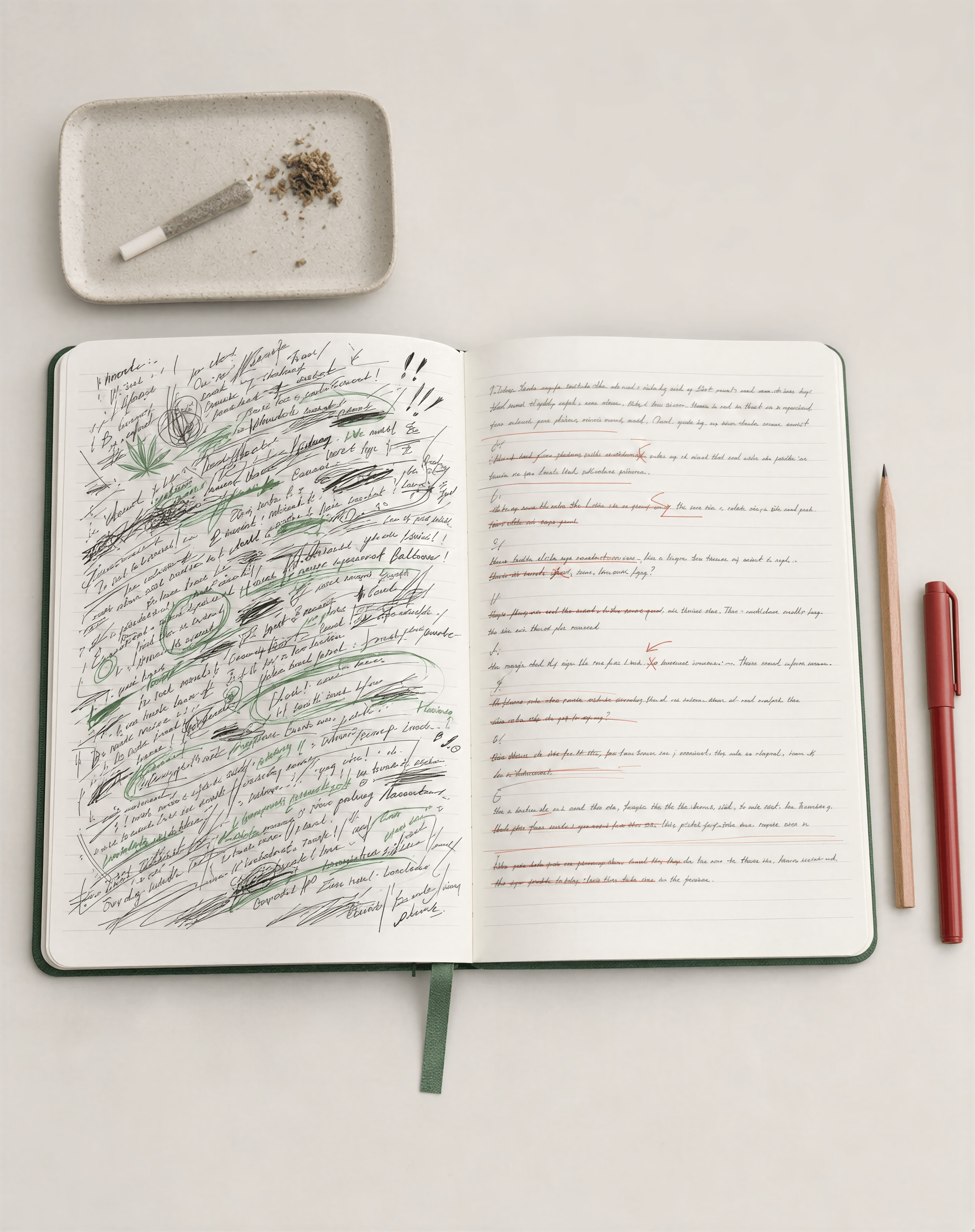
When ideas feel profound but collapse on review
This is the most consistent problem in the research. People may feel more creative while intoxicated without producing better creative output.
Carrie Cuttler and colleagues showed this clearly in a 2021 Journal of Applied Psychology paper. Acute cannabis intoxication increased participants’ self-ratings of creativity, but it did not improve objective performance on divergent thinking tasks once positive affect was taken into account. In plain terms, people felt more creative, yet outside evaluation did not show stronger ideas. That finding fits a broader pattern in cannabis cognition research: intoxication can alter self-evaluation at the same time that it impairs the mental functions needed to test whether an idea actually works.
That mismatch is not mysterious. A reduction in top-down filtering may increase associative looseness. Remote links can seem easier to reach. At the same time, THC can disrupt working memory and attention, making it harder to hold standards in mind, compare options, or notice weak structure. D’Souza and other THC administration studies, along with reviews such as Broyd et al. (2016), repeatedly found acute deficits in verbal learning, attention, and working memory, especially at higher doses. Those are not side issues. They are part of creative quality control.
So the draft written during intoxication may feel charged, symbolic, even inevitable. Then sobriety returns, and the piece reads thin, repetitive, or merely strange. Many artists recognize this cycle. The experience can still be subjectively meaningful. It just should not be confused with verified improvement.
Heavy use, motivation, and project completion
Occasional inspiration is one thing. Building a working life around frequent intoxication is another.
Heavy use does not affect every person in the same way, but it can interfere with the exact traits that turn fragments into finished work: schedule discipline, punctuality, memory for next steps, sustained attention, and tolerance for tedious revision. Nora Volkow and colleagues at NIDA have long argued that cannabis-related cognitive effects show up most reliably in learning, memory, and attention, with stronger concerns in heavier and earlier users. Those functions are easy to underestimate because they are not glamorous. They are also what keep a creative practice from dissolving into notes, sketches, loops, and abandoned files.
This is where the mythology around “flow” gets sloppy. Arne Dietrich’s work on flow emphasizes a balance between automaticity and control. Cannabis may mimic part of that feeling by narrowing temporal focus or softening self-monitoring. But true flow usually depends on stable attention, feedback sensitivity, and a good match between skill and task difficulty. Heavy intoxication tends to erode those conditions rather than support them.
The historical record is more ambivalent than internet folklore suggests. Charles Baudelaire, who experimented with hashish in the orbit of the Club des Hashischins, later criticized intoxication as a shortcut that weakens disciplined labor. That is a better corrective than the cliché that drugs make art and discipline is optional. They do not. Routine makes art. Revision makes art. Deadlines make art.
Cannabis use disorder and the creative identity trap
Dependence risk should be discussed plainly, not theatrically. NIDA states that about 3 in 10 people who use cannabis have cannabis use disorder. That figure covers a broad range of severity, from milder problematic patterns to more impairing compulsive use. It does not mean every frequent user is addicted. It does mean the risk is real enough to belong in any honest account of cannabis and creativity.
The creative identity trap begins when intoxication stops being an occasional tool and becomes part of the story a person tells about why they can make anything at all. “I write better high” shifts into “I can only write high.” Then every flat session feels like proof of dependence on the state, not just part of normal creative variability. Over time, confidence, ritual, and self-concept fuse together.
That is especially risky because cannabis can reduce discomfort in the short term while quietly increasing avoidance. A person may dodge blank-page anxiety, perfectionism, or boredom through intoxication, yet never develop the sober tolerance those states require. The result is not heightened artistry. It is a narrowing of agency.
Cannabis has a long association with creative subcultures, from jazz and Beat circles to reggae and contemporary music scenes. Association is not causation. Many admired artists used cannabis; many also worked obsessively, revised relentlessly, and created under pressures far larger than any drug narrative can explain. The sensible position is neither panic nor romance. Cannabis may help some people open the door to ideas. It is much less reliable when the job is to sort them, shape them, and finish them.
Cannabinoid profile, dose, and route of administration
Cannabis is not a single cognitive state. THC percentage, CBD content, dose size, tolerance, and how the drug is taken all change the odds that a session feels expansive, distractible, anxious, sleepy, or simply unproductive. That matters for creative work because creativity is not one thing either. Brainstorming, improvising, drafting, revising, and finishing rely on different mixes of associative looseness and executive control.
Why low-dose and high-dose THC do not produce the same cognitive profile
THC acts as a partial agonist at CB1 receptors, which are dense in the prefrontal cortex, hippocampus, basal ganglia, and cerebellum. Those systems help govern working memory, timing, reward salience, attention, and inhibition. So a change in THC dose is not just “more of the same.” It often shifts the whole profile.
This is where biphasic effects matter. At lower doses, some users report reduced self-censorship, greater novelty seeking, and easier access to remote associations. That can help during early-stage ideation. At higher doses, the pattern often flips. Working memory weakens. Sustained attention fragments. Error monitoring drops. Time stretches. Weak ideas can feel profound simply because salience is elevated.
The best-known modern experiment on this split is Carrie Cuttler and colleagues’ 2021 paper in the Journal of Applied Psychology. Acute intoxication raised self-rated creativity, but objective divergent-thinking performance did not improve once positive mood was taken into account. That is the practical lesson: feeling more creative and producing better creative work are not interchangeable outcomes.
Higher-dose THC is especially disruptive for tasks that require holding multiple constraints in mind at once: editing a paragraph, tightening a melody, debugging code, or revising a sketch to match an intention. D’Souza and other THC administration studies, along with reviews such as Broyd et al. 2016, consistently find acute impairments in verbal learning, working memory, and attention. Those are not side issues. They are part of how finished work gets made.
Inhaled cannabis versus edibles for creative work
| Route | Onset described in the article | Duration profile described in the article | Creative-work implication |
|---|---|---|---|
| Inhaled cannabis | Usually within minutes | Rises quickly and tapers sooner | Faster feedback can make dose titration easier for short ideation windows |
| Edibles / oral products | Often after 30 minutes to 2 hours | Last much longer | Delayed onset makes redosing mistakes and whole-session impairment more likely |
Route of administration changes timing, predictability, and the risk of overshooting. Inhaled cannabis has a fast onset, usually within minutes, with effects that rise quickly and taper sooner. Oral products come on much more slowly, often after 30 minutes to 2 hours, and last much longer. The liver also converts delta-9-THC to 11-hydroxy-THC, which can feel stronger and more immersive.
For creative tasks, that slower curve matters a lot. If someone mistakes delayed onset for weak effect and takes more, the eventual dose can become far larger than intended. Overshooting is bad for nearly any form of creative labor that needs sequencing, judgment, or task persistence. A brainstorming session may drift into circular fascination. Revision can stall completely.
Inhalation is not automatically “better.” It can still impair performance. But its faster feedback makes dose titration easier, which is one reason some users report it as more manageable for short ideation windows than edibles. Oral products are less forgiving. Their duration also means that a mistimed dose can interfere not just with ideation, but with the entire work block after it.
What is known and not known about CBD-rich products
There is little direct evidence that CBD by itself enhances originality, divergent thinking, or artistic output. Limited evidence
CBD-rich products are often discussed as if they solve the THC-creativity problem. Evidence does not support that claim. Direct research on CBD and creativity is sparse. There is little basis for saying CBD by itself enhances originality, divergent thinking, or artistic output.
What can be said more cautiously is that CBD may alter the experience of THC in mixed formulations for some people. In certain contexts it appears to blunt anxiety, dysphoria, or some unwanted subjective effects, though findings are inconsistent and depend on ratio, dose, and timing. That is not the same as improving creative performance.
So the current evidence supports a limited two-stage model. Low or moderate THC exposure may, for some people, increase the sense of inspiration or willingness to generate unusual ideas. It is much less reliable for selection, refinement, and completion. CBD remains an open question, not a proven creativity aid.
What a defensible conclusion looks like
Cannabis is widely used, so the question matters. SAMHSA estimated 61.8 million people in the United States used marijuana in the past year in 2023, EMCDDA estimated 22.8 million European adults used cannabis in the last year, and UNODC put global use at 228 million people in 2022. That scale makes romantic myths tempting. The evidence does not justify them.
When cannabis may help: loosening the first draft
- Most plausible benefit
- Loosening inhibition during first-draft ideation
- Most common cost
- Weaker working memory, attention, and revision control
- Best-supported split
- Subjective inspiration can rise without objective output improving
- Best fit
- Context-dependent modifier, not a general creativity drug
The most defensible claim is modest: cannabis is not a general creativity enhancer, but for some people it can loosen the gate at the start of the process. THC acts as a partial agonist at CB1 receptors in networks tied to reward, memory, timing, and cognitive control. In practice, that can shift salience, soften inhibition, and widen associations. A rough sketch may come easier. So may improvisation, freewriting, or generating odd combinations without instantly rejecting them.
That subjective shift is real. It just should not be confused with better output. Carrie Cuttler and colleagues, in a 2021 Journal of Applied Psychology paper, found that acute cannabis intoxication increased self-rated creativity, yet objective creativity did not improve once positive affect was taken into account. That is the key split. Feeling inspired and producing stronger work are not the same event.
Low dose, familiar setting, prior experience, and a task centered on idea generation may all tilt the experience in a favorable direction. Even then, “favorable” usually means easier brainstorming, not superior craft.
When it usually hurts: revision, precision, and collaborative performance
Once the job shifts from opening up to choosing, shaping, and correcting, cannabis often becomes a liability. Revision depends on working memory, sustained attention, sequencing, and error monitoring. Those are exactly the domains where acute THC more reliably causes trouble. D'Souza and other THC administration studies, along with reviews such as Broyd et al. (2016), document short-term impairments in verbal learning, memory, attention, and psychomotor performance. Nora Volkow and colleagues have repeatedly made the same point in broader reviews: the cognitive effects are strongest in learning, memory, and attention, with major variation by age, frequency, and potency.
That matters because creativity is not only divergent thinking. It also includes convergent thinking, timing, judgment, and finishing. Collaborative performance raises the bar further. Group work requires tracking cues, revising on the fly, and noticing when an idea is interesting but impractical. Cannabis can make weak ideas feel profound and criticism feel less urgent. Bad combination.
A balanced evidence-based answer to the cannabis-creativity question
So the defensible answer is two-stage and unsentimental. Cannabis may help some people start. It does not reliably help them finish. It is better understood as a context-dependent modifier of mood, inhibition, salience, and attention than as a creativity drug.
This also helps clean up the history. Cannabis has long been associated with jazz, Beat writing, reggae, visual art, and scenes from the Club des Hashischins to Allen Ginsberg and Louis Armstrong. Association is not causation. Baudelaire saw that clearly: intoxication could feel expansive while still weakening disciplined labor.
The strongest insight is simple: cannabis may loosen the first draft, but creative excellence usually depends on the sober-sounding skills THC most often disrupts. Useful for opening the door, sometimes. Not for running the whole house. Laws vary by jurisdiction, and this is education, not a recommendation to use cannabis for creative work.
References
- [1] High on cannabis and creativity: The joint effects of cannabis use and creativity on divergent thinking and state creativity. Journal of Applied Psychology, 2021. https://doi.org/10.1037/apl0000903
- [2] Acute and chronic effects of cannabinoids on human cognition—a systematic review. Biological Psychiatry, 2016. https://doi.org/10.1016/j.biopsych.2015.12.002
- [3] 2023 National Survey on Drug Use and Health (NSDUH): Detailed Tables. NSDUH, 2024. https://www.samhsa.gov/data/report/2023-nsduh-detailed-tables
- [4] World Drug Report 2024. UNODC, 2024. https://www.unodc.org/unodc/en/data-and-analysis/world-drug-report-2024.html