














Hydroponics and cannabis: what the term actually covers
Hydroponics does not mean “plants grown in water.” That is one subtype. More precisely, hydroponics means growing plants with mineral nutrients supplied in solution, with the root environment managed directly rather than left to the buffering and biological complexity of field soil. Some hydro systems suspend roots in aerated nutrient solution. Others run nutrient solution through an inert or semi-inert substrate such as rockwool, perlite, clay pebbles, or coco coir. Some recirculate the same solution after adjustment; others are drain-to-waste, where fresh solution is applied and runoff is discarded. Put bluntly: hydroponics is a way of controlling the root zone, not a single piece of hardware.
That distinction matters in cannabis because the crop responds strongly to root oxygen, irrigation timing, and mineral balance. The equipment can differ wildly while the governing biology stays the same.
Why hydroponics is a root-zone management strategy, not a single system
| System | Root environment | Main control variable or risk |
|---|---|---|
| DWC | Roots partly or largely in nutrient solution | Dissolved oxygen |
| Substrate-based hydro | Roots in porous medium | Air-filled porosity, water-holding curve, irrigation frequency |
| Recirculating hydro | Shared reservoir chemistry changes continuously | Daily pH and EC drift |
| Drain-to-waste | Fresh feed enters substrate each cycle | Substrate modifies feed chemistry |
Deep water culture, nutrient film technique, ebb-and-flow, aeroponics, drip-fed rockwool, drip-fed coco, and Kratky all get called “hydro.” They should. But they do not expose roots to the same physical conditions.
In water culture systems such as DWC, roots sit partly or largely in nutrient solution, so dissolved oxygen becomes a primary control variable. In substrate-based hydro, roots occupy a porous medium, and the key variables are air-filled porosity, water-holding curve, and irrigation frequency. A drip-to-waste coco setup can be hydroponic even though it looks, at first glance, like pot culture. The defining feature is not whether roots touch free water. It is whether the grower is feeding a mineral solution into a managed root environment rather than relying on soil as the main nutrient reservoir.
Recirculating and drain-to-waste systems also behave differently. In recirculating hydro, the reservoir chemistry changes continuously as plants remove nitrate, potassium, calcium, and water at different rates. Cornell Controlled Environment Agriculture guidance has long stressed that pH and EC need daily attention in such systems because plant uptake reshapes the solution. In drain-to-waste systems, the incoming feed can remain stable, but the substrate itself may modify it. Coco is the obvious example. It is not inert in the way perlite is inert; it can bind calcium, magnesium, and potassium, which changes early feeding dynamics.
This is why “which system yields more?” is often the wrong first question. A badly run DWC bucket with warm solution and low oxygen can lose to a well-managed drip system in coco. A carefully engineered aeroponic room can produce very fast growth, yet it is less forgiving because clogged nozzles or pump failure can dry roots with alarming speed. Kratky is a legitimate hydroponic method, but for large flowering cannabis plants it pushes against a real biological limit: as plant size and transpiration rise, passive root-zone oxygen supply becomes harder to maintain.
How cannabis physiology makes hydroponics attractive
Cannabis is a fast-growing annual with high transpiration demand under strong light. In controlled environments, flowering crops are often run around 600 to 1000 µmol/m²/s PPFD without CO2 enrichment, and higher with enrichment when the rest of the environment keeps pace. Under those conditions, root function matters a great deal. Roots need oxygen for respiration, and respiration powers active nutrient uptake. If the root zone is waterlogged, too warm, or poorly aerated, uptake slows before the leaves tell you why.
Matric resistance The force roots must overcome to pull water from a medium. Lower matric resistance means water is easier for roots to extract.
Hydroponics can help because it reduces matric resistance compared with dense soil and lets growers correct deficiencies or excesses quickly. That does not mean cannabis wants constant saturation. It means the crop benefits when water, oxygen, and ions are supplied in a controlled balance.
Water temperature is a hard physical constraint, not folklore. According to U.S. Geological Survey dissolved oxygen tables, freshwater at saturation holds about 9.1 mg/L oxygen at 20°C, 8.3 mg/L at 25°C, and 7.6 mg/L at 30°C. Warmer reservoirs hold less oxygen and also become friendlier to root pathogens, especially Pythium spp. That is why experienced hydro growers target roughly 18 to 21°C in the root zone. They are not chasing a magic number. They are working with gas solubility and pathogen pressure.
Cannabis nutrition also rewards precision. Reviews such as Cockson et al. have pointed out that cannabis feeding advice is often borrowed from other crops or inflated by anecdote. Saloner and Bernstein, across studies from 2019 to 2023, showed that higher mineral supply can raise inflorescence yield only up to a point; beyond that, ion imbalance, salinity stress, or reduced quality traits can appear. That finding cuts directly against the common habit of driving EC upward in late flower. EC is only a measure of total dissolved salts. It says nothing by itself about whether the ratio is appropriate.
What popular hydro guides usually get wrong
The usual mistake is treating hydroponics like a shopping category. Bucket, tray, pump, chiller, bottle set. The plant does not care about brand identity. It cares about oxygen at the roots, stable temperature, pH in a usable range, and irrigation matched to transpiration.
Hydro often outperforms soil in optimized indoor rooms, but it does not guarantee automatic yield gains. Limited evidence
Popular guides also overstate automatic yield gains. Hydro often does outperform soil in optimized indoor rooms, but not because water culture is inherently superior in every case. The advantage comes from tighter root-zone control. Lose that control and the edge disappears. Sometimes quickly.
Another repeated error is confusing stronger feed with better feed. University of Arizona CEAC guidance places common hydroponic pH management around 5.5 to 6.5 because nutrient availability shifts rapidly outside that band. Cannabis growers often work in a narrower range, roughly 5.7 to 6.2, and allow a modest drift. That is sensible chemistry, not superstition. The same logic applies to EC: moderate, cultivar-appropriate levels usually beat indiscriminate salt loading.
And many guides underrate environment. High light increases transpiration and nutrient flow, but only if irrigation frequency, VPD, root temperature, and calcium supply stay aligned. When they do not, the result is often tip burn or deficiency symptoms in plants sitting above a reservoir that looks “on target” on paper.
Variables that decide hydro performance
- Oxygen Roots need enough oxygen for respiration and active nutrient uptake.
- Temperature Reservoir and root-zone temperature shape oxygen solubility and pathogen pressure.
- Irrigation control Event timing and volume determine the water-air balance around roots.
- Nutrient balance EC alone is not enough; ratios and stage-specific demand matter.
The main argument of this article is simple. Hydroponics is a family of root-zone management strategies. For cannabis, the decisive variables are oxygen, temperature, irrigation control, and nutrient balance. Hardware is visible, so growers obsess over it. The chemistry and physiology decide the harvest.
Why hydroponics can outperform soil for cannabis
- Main advantage
- More direct root-zone control
- Typical benefits
- Faster vegetative growth, quicker correction, repeatability
- Main tradeoff
- Less buffering and less forgiveness than soil
- Why it works
- Water, oxygen, ions, and temperature are easier to steer
Hydroponics can beat soil with cannabis, but not for the reasons usually given. The edge is not magic, and it is not the logo on the reservoir. It comes from root physics and solution chemistry. When the root zone has abundant oxygen, water is easy to extract, nutrients arrive in the right proportions, and temperature stays in range, cannabis often grows faster in vegetative growth, recovers from mistakes sooner, and performs with more repeatability from run to run than it does in conventional soil.
That does not mean “hydro” is one thing. Deep water culture, drip-fed rockwool, coco fertigated several times a day, ebb-and-flow benches, and aeroponics all create different root environments. Some are highly aerated and weakly buffered. Others act more like container substrate culture than bare-root hydro. The common advantage over soil is that the grower can control the root zone more directly. The common disadvantage is that the plant loses the buffering and biological slack that make soil forgiving.
Lower mechanical resistance and faster nutrient delivery
Roots in soil do not grow through empty space. They push through particles, films of water, and pores of varying size. That takes energy. In hydroponic systems, especially water culture and porous inert media such as rockwool or expanded clay, mechanical resistance is lower and water is easier to access. The plant spends less effort extracting solution from small pores under tension and more on producing new tissue. That is one reason vegetative growth often looks faster in hydroponics even before flowering is considered.
Nutrient delivery is faster too. In soil, ions move toward roots by mass flow and diffusion, but the chemistry is moderated by clay, organic matter, microbial processes, and cation exchange. That moderation can help stability, yet it also slows correction when the recipe is wrong. In hydroponics, the nutrient profile around the root can be changed within hours by adjusting the reservoir or feed tank. If nitrogen is too low, calcium is being antagonized by excess potassium, or the pH has drifted out of range, the system can be corrected almost immediately. Cornell controlled-environment guidance makes the same point for recirculating crops generally: pH and EC must be checked often because plant uptake continuously changes solution composition.
This is where a lot of online cannabis advice goes off track. Higher EC is often treated as a shortcut to larger flowers. It is not. EC only estimates total dissolved salts. It says nothing by itself about ratio, balance, or whether the plant can still take up water efficiently. Saloner and Bernstein, across studies published from 2019 to 2023, showed that increasing mineral supply can raise cannabis inflorescence yield up to an optimum, then flatten out or backfire as salinity stress and ion imbalance increase. In practical terms, hydroponics wins because it allows precise feeding, not because it encourages constant overfeeding.
pH control also matters more in hydro than many growers admit. University of Arizona CEAC guidance places standard hydroponic nutrient management around pH 5.5 to 6.5, and commercial cannabis rooms often keep the working range tighter than that. Outside those values, iron, manganese, phosphorus, calcium, and magnesium do not become “unavailable” all at once, but the balance shifts quickly enough to cause hidden deficiencies before leaf symptoms are obvious. Soil can mask these swings because the medium itself buffers change. Hydro usually does not.
Cleaner indoor operation is a real advantage too, though it is less glamorous than yield claims. Inert media and closed irrigation systems bring in less particulate matter, create less mud, and make sanitation easier. In a sealed room, that can reduce mess, runoff variability, and some pest pathways. It does not prevent problems. It just makes the system easier to standardize.
Root-zone oxygen, transpiration, and growth rate
The real performance driver in hydroponic cannabis is often oxygen at the roots. Root cells need oxygen for respiration. Without it, active transport slows, nutrient uptake becomes less efficient, root tips suffer, and disease pressure rises. That is why the choice between DWC, drip irrigation, and ebb-and-flow often matters less than whether the root zone stays oxygenated and cool.
Water temperature controls part of this directly. According to U.S. Geological Survey dissolved oxygen tables, freshwater at saturation holds about 9.1 mg/L oxygen at 20°C, about 8.3 mg/L at 25°C, and about 7.6 mg/L at 30°C. That drop is not trivial. A warm reservoir gives roots less oxygen at the exact moment warmer conditions also increase microbial activity and make Pythium outbreaks more likely. The common advice to keep nutrient solution around 18 to 21°C is not superstition. It follows basic gas solubility and plant pathology.
Cannabis responds strongly to transpiration demand, which links the root zone to the shoot environment. Under flowering light levels around 600 to 1000 µmol/m²/s without CO2 enrichment, water use can rise fast if leaf temperature and vapor pressure deficit are pushing transpiration. When uptake is high, hydroponics can keep water and nutrients moving to the plant with much less delay than dry-back-prone soil. That supports fast growth. It also means mistakes appear faster. If calcium supply is marginal, if irrigation frequency lags behind evapotranspiration, or if root oxygen drops, hydroponic plants can tip burn or stall quickly even when the reservoir analysis looks acceptable.
So hydroponics does not outperform soil because roots are “fed directly” in some mystical way. It outperforms when water, oxygen, and ions are supplied at a rate that matches canopy demand. Get that match right and vegetative growth is often visibly quicker. Get it wrong and hydro falls apart faster than soil.
| Aspect | Hydroponics | Soil or living substrate |
|---|---|---|
| Buffering | Low; changes show up fast | Higher; errors are softened |
| Failure tolerance | Pump or chiller failure can damage plants quickly | Water and nutrients persist longer in the pot |
| Nutrient chemistry | Directly managed in solution | Modified by organic matter, microbes, and exchange sites |
| Containment of problems | Shared loops can spread issues | Problems are often more localized |
Where soil or living substrate still has advantages
Hydroponics is less buffered. That is its strength and its weakness. A pump failure, clogged dripper, failed chiller, or prolonged power outage can damage a hydro crop in hours, especially in aeroponics or small-volume recirculating systems. Soil or a biologically active substrate usually gives more time. Water remains in the pot longer. Nutrients do not swing as abruptly. Microbial processes can soften minor feeding errors.
Living substrates can also offer qualities hydro does not automatically reproduce. Organic matter, microbial competition, and higher chemical buffering can stabilize pH and moderate some nutrient antagonisms. Coco sits in the middle here: often grouped with hydro because it is fertigated frequently, but not truly inert because its cation exchange behavior affects calcium, magnesium, and potassium management. Media are not interchangeable, and growers who treat them that way often blame the cultivar for problems caused by substrate chemistry.
There is no automatic rule that hydroponics produces better flowers, stronger aroma, or higher cannabinoid content than soil. Limited evidence
Quality is another area where hydro claims often outrun evidence. There is no automatic rule that hydroponics produces better flowers, stronger aroma, or higher cannabinoid content than soil. Saloner and Bernstein’s work is useful here again: more mineral supply is not linearly tied to better quality, and organ-specific nutrient partitioning changes by developmental stage. Bruce Bugbee and other controlled-environment researchers have made a similar broader point in cannabis physiology: environment and plant balance matter more than folklore. A well-run soil or living-substrate crop can match or exceed a badly managed hydro crop in finished quality.
So yes, hydroponics can outperform soil for cannabis. In optimized indoor production, it often does. Faster vegetative growth, quicker correction of deficiencies, tighter repeatability, and cleaner room management are real benefits. But the reason is not the hardware itself. It is the root-zone conditions that hardware either maintains or fails to maintain. Oxygen, temperature, irrigation frequency, pH, and nutrient balance decide whether hydro becomes an advantage or a liability.

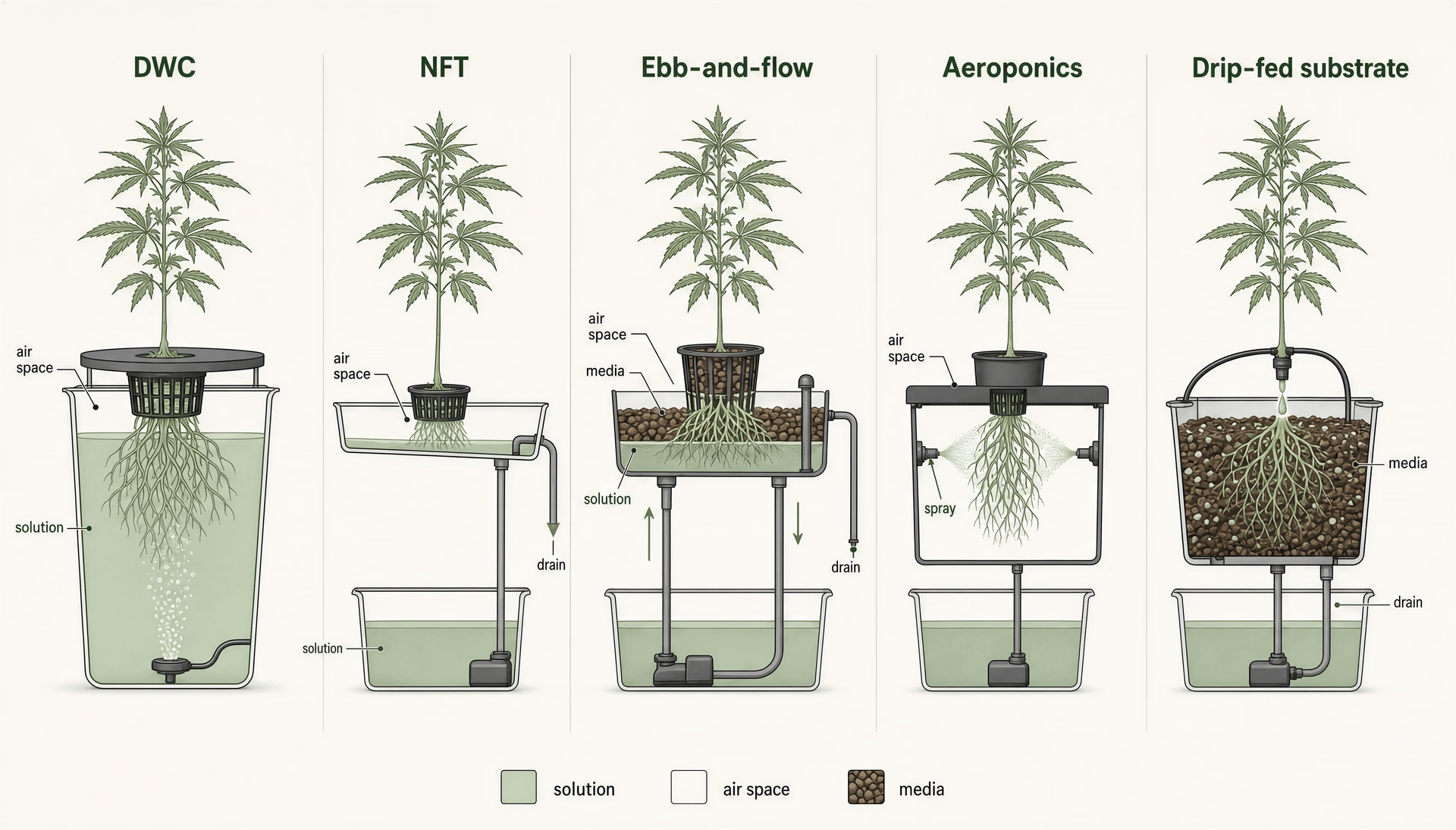
Hydroponic systems for cannabis: strengths, weaknesses, and best use cases
Hydroponics is not a single technique. It is a set of ways to control the root zone more tightly than soil allows. For cannabis, that matters because growth rate and flower yield respond strongly to root oxygen, irrigation timing, solution temperature, pH, and total salt load. The hardware matters less than growers often assume. A badly managed DWC bucket can lose to a well-run drip system in rockwool every time.
That is why “which hydro system is highest yielding?” is usually the wrong first question. The better one is: what root environment does this system create, and how stable is it under real-world mistakes? Cannabis is a long-cycle, high-transpiration crop with significant oxygen demand in the root zone, especially under strong light. Flowering rooms commonly run around 600 to 1000 µmol/m²/s PPFD without added CO2 in controlled-environment work; when light and transpiration rise, root-zone problems surface faster, not slower. Saloner and Bernstein’s cannabis mineral nutrition studies from 2019 to 2023 also argue against a common hydro reflex: pushing EC upward as if more salts automatically mean more flowers. They do not. Beyond the crop’s optimum, osmotic stress and nutrient antagonism start to bite.
| Feature | DWC | RDWC |
|---|---|---|
| Reservoir layout | One plant site per bucket or tank | Multiple plant sites linked to a central reservoir |
| Main strength | Direct root access and rapid growth when cool and aerated | Uniform chemistry across connected sites |
| Main risk | Each reservoir depends on constant oxygenation and temperature control | Mistakes and pathogens spread through the whole loop |
| Best fit | Small, simple setups with close monitoring | Operators ready for plumbing complexity and biosecurity |
Deep water culture (DWC) and recirculating DWC
DWC suspends roots directly in an aerated nutrient solution. A net pot sits above a bucket or tank, roots grow down into the water, and air stones or diffusers keep dissolved oxygen high enough for respiration. Recirculating DWC, often called RDWC, links multiple plant sites to a central reservoir so solution chemistry is more uniform across the system.
The appeal is obvious. Roots have direct access to water and dissolved ions with almost no matric resistance, so uptake can be fast. When reservoir temperature is controlled and aeration is strong, vegetative growth can be very rapid. That part is real. It is not magic; it is plant physiology. The roots do not have to pull water from a substrate with variable moisture tension, and nutrients can be corrected quickly.
The weakness is equally obvious once the plants get large. The entire root system depends on constant oxygenation and temperature control. Warm solution is the enemy. USGS oxygen solubility data make the problem plain: freshwater holds about 9.1 mg/L dissolved oxygen at 20°C, 8.3 mg/L at 25°C, and 7.6 mg/L at 30°C. That drop is large enough to matter biologically, and warmer water also favors oomycetes such as Pythium spp. So the famous “DWC grows huge plants” claim is true only when the reservoir stays cool, clean, and highly aerated. Let the solution drift into the mid-20s Celsius and the margin for error collapses.
DWC suits beginners only in small, simple setups where each plant has its own reservoir and the grower is willing to monitor pH, EC, and water temperature closely. RDWC is less forgiving than it looks. It scales plant count efficiently, but it also spreads mistakes and pathogens efficiently. One contaminated loop can affect every site. If a pump fails, all plants are exposed. If pH drifts, all plants see it. Cornell CEA guidance is relevant here even though it is not cannabis-specific: recirculating hydro demands near-daily monitoring because plant uptake continuously changes solution composition.
Use DWC if you want direct visibility into root health and are prepared to manage aeration and temperature aggressively. Use RDWC only if you understand that plumbing complexity and biosecurity are part of the method, not optional extras.
Nutrient film technique (NFT)
NFT runs a thin film of nutrient solution along the bottom of a shallow channel. Roots sit in the channel, partly wetted by the moving solution and partly exposed to air. In theory, that gives an excellent oxygen-water balance. In practice, cannabis can outgrow the elegance of the design.
NFT works very well for small, fast crops such as lettuce because the root mass remains manageable and the crop cycle is short. Cannabis is different. It forms dense, fibrous root systems over a much longer flowering period. Those roots can fill channels, dam the flow, and create uneven wetting. Once that happens, one plant can steal water from the next, and small slope errors become big management problems.
The root environment in NFT is high oxygen when everything is clean and flowing properly. That is the strength. The maintenance burden comes from keeping channels clear, ensuring a reliable slope, and preventing localized dry spots. Because the nutrient film is shallow, pump interruptions become serious quickly. Roots can dry out faster than in flood-and-drain or drip systems with buffered media. That makes NFT more brittle than its simple appearance suggests.
For cannabis, NFT is usually a specialist choice rather than a general recommendation. It can suit small plants, short veg times, and operators who value low water volume and rapid nutrient response. It is not my first choice for large flowering plants. The channel geometry that works for herbs often becomes awkward with a crop that develops heavy tops and heavy roots. You can make it work. You also have to fight the crop more than with other systems.
Ebb and flow or flood and drain
Flood-and-drain systems periodically pump nutrient solution into a tray or table filled with containers or a shared bed of media, then let the solution drain back to the reservoir. During the flood cycle, roots are wetted and salts are replenished. During the drain cycle, air re-enters the root zone. That wet-dry rhythm is the whole point.
This is one of the most balanced hydro methods for cannabis. It creates a root environment with alternating access to water and oxygen, and it can work with several media: expanded clay, rockwool blocks, coco-perlite mixes, even coarse peat-free blends. Because the roots are not permanently submerged, the system has more buffering capacity than DWC. If a pump fails for a short period, media still hold water. If irrigation is a little late, the crop does not immediately crash.
Its failure points are mechanical rather than theoretical: stuck float switches, clogged drains, poor table leveling, salt buildup in the media, and inconsistent flood frequency. Media choice matters a lot. Rockwool behaves very differently from clay pebbles, and coco has cation exchange effects that can alter calcium, magnesium, and potassium availability. Treating all “hydro media” as interchangeable is a mistake.
Flood-and-drain scales reasonably well and is more beginner-friendly than RDWC or aeroponics. It also gives growers useful flexibility. Irrigation frequency can be increased as light intensity and canopy size rise, which matters because transpiration demand under strong LEDs can change fast. For cannabis, that adaptability is a real advantage.
Aeroponics
Aeroponics suspends roots in air and delivers nutrient solution as a fine mist or spray. Done well, it gives the highest root-zone oxygen exposure of any mainstream hydro system. That is why it has a reputation for very fast growth. The reputation is deserved. So is its reputation for punishing mistakes.
The root environment is high-oxygen and low-resistance. Nutrients arrive in small droplets, roots remain exposed to air between spray events, and uptake can be extremely efficient. That can translate into aggressive vegetative growth and precise feeding control. It also means there is almost no buffer. If nozzles clog, roots dry. If the pump fails, roots dry. If biofilm builds up, spray uniformity degrades. If water sanitation slips, the fine plumbing becomes a contamination network.
So the clear position is this: aeroponics is high-performance but unforgiving. Not “advanced” because it sounds impressive, but advanced because the failure modes are fast and expensive. Fine droplet systems need clean water, filtration, disciplined maintenance, and redundancy. Low-pressure spray variants are somewhat less demanding than true high-pressure aeroponics, but neither is a beginner system for large flowering cannabis.
Aeroponics can suit research rooms, skilled hobbyists who enjoy engineering, and operators who can build in backups. It is a poor fit for anyone who wants to leave the garden unattended for long periods. The upside is real. The margin for error is thin.
Kratky and other passive methods
Kratky hydroponics relies on a non-circulating reservoir. The plant starts with roots in nutrient solution, then as the solution level falls, an air gap develops and part of the root mass becomes adapted to oxygen access. No pumps. No active aeration. Very simple.
That simplicity is the selling point, but for cannabis it is usually a niche method, not a serious general-purpose production system. The reason is biological, not ideological. Cannabis is a relatively long-cycle crop with high water use and substantial root oxygen demand once it enters vigorous vegetative growth and flowering. Passive systems can support small plants or short experimental runs, yet they do not offer much control once the plant’s demand accelerates. You cannot easily respond to shifts in transpiration, rising EC from water drawdown, or stage-specific nutrient changes identified in cannabis nutrition work such as that reviewed by Cockson and colleagues.
Kratky can work for seedlings, clones, small autoflowers, education, or proof-of-concept grows. Presenting it as equivalent to actively aerated hydro for large flowering plants is misleading. As the reservoir depletes, nutrient concentration can drift, pH can shift, and oxygen availability becomes more limiting than enthusiasts often admit. Passive methods reduce equipment complexity by giving up control. For cannabis, that tradeoff is usually unfavorable.
| System | Strengths | Weaknesses | Best use case |
|---|---|---|---|
| DWC | Fast uptake, visible roots | Warm-water and oxygen failures hit hard | Small disciplined setups |
| NFT | High oxygen when flow is clean | Channels can clog with dense cannabis roots | Small plants or specialist setups |
| Flood-and-drain | Alternating wetting and aeration, adaptable media | Mechanical issues like drains and timing matter | Beginner to intermediate mixed-media rooms |
| Aeroponics | Very high oxygen and rapid growth | Nozzle clogs and pump failure are serious | Research or highly engineered rooms |
| Kratky | No pumps, simple hardware | Limited control as plants get large | Seedlings, small plants, education |
| Drip-fed substrate | Buffered root zone with strong controllability | Medium-specific chemistry must be managed | Commercial and repeatable production |
Drip-fed substrate systems and why many commercial growers prefer them
A large share of so-called hydroponic cannabis production does not look like DWC at all. It looks like drip irrigation into rockwool slabs, rockwool blocks, coco coir, or coco-perlite in containers, often with runoff collection or drain-to-waste management. This is still hydroponic cultivation in the agronomic sense: mineral nutrition delivered in solution, with the root zone managed by irrigation strategy rather than field soil.
There is a reason experienced operators keep landing here. Drip-fed substrate systems offer a buffered root environment with high controllability and lower catastrophic risk than pure water-culture methods. The substrate holds both water and air. Irrigation pulses can be matched to plant size, light level, and vapor pressure deficit. If a dripper misses one cycle, the plant usually survives. If power blips, roots do not immediately desiccate. If one plant gets sick, the problem is more containable than in a shared recirculating loop.
Dry-back The planned drop in substrate water content between irrigation events. It restores air to the root zone but can also concentrate salts if pushed too far.
Rockwool is popular because it is uniform, inert, and easy to steer by controlling water content and EC in the slab. Coco is popular because it is forgiving and familiar, though it is not inert; its cation exchange capacity means calcium, magnesium, and potassium management need attention. Many beginners think of coco as “soil-like hydro,” which is not wrong as a practical description, but it can hide important chemistry. Pre-charge and irrigation strategy matter.
Commercial growers also favor drip-fed substrates because they scale labor and data collection well. Irrigation can be automated by time, solar integral, substrate sensors, or target runoff. Dry-back can be used intentionally to influence oxygenation and steering. In contrast, very large DWC or aeroponic rooms increase systemic risk. One root disease event, one reservoir temperature problem, or one pump issue can hit a lot of plants at once.
This does not mean drip-to-coco or drip-to-rockwool always outyields every other method. It means the system is more stable under commercial constraints, and stability is often what produces higher realized yield over time. A theoretical high-performance system that fails twice a year is not high-performing in practice.
If there is one ranking that holds up well, it is not about prestige. Aeroponics sits near the top for potential and near the top for fragility. DWC can be excellent in small, disciplined setups but gets risky as heat and scale rise. NFT is elegant but often awkward for large cannabis plants. Flood-and-drain is adaptable and forgiving. Passive Kratky is real hydroponics, yet usually a side path for cannabis rather than a main road. Drip-fed substrate systems win so much real-world adoption because they balance oxygen, water, nutrients, and operational resilience better than the classic bucket-and-bubbles image of hydro suggests.
That is the larger point. The system is a tool for shaping the root zone. Cannabis responds to the root zone more than to the mythology around the hardware.

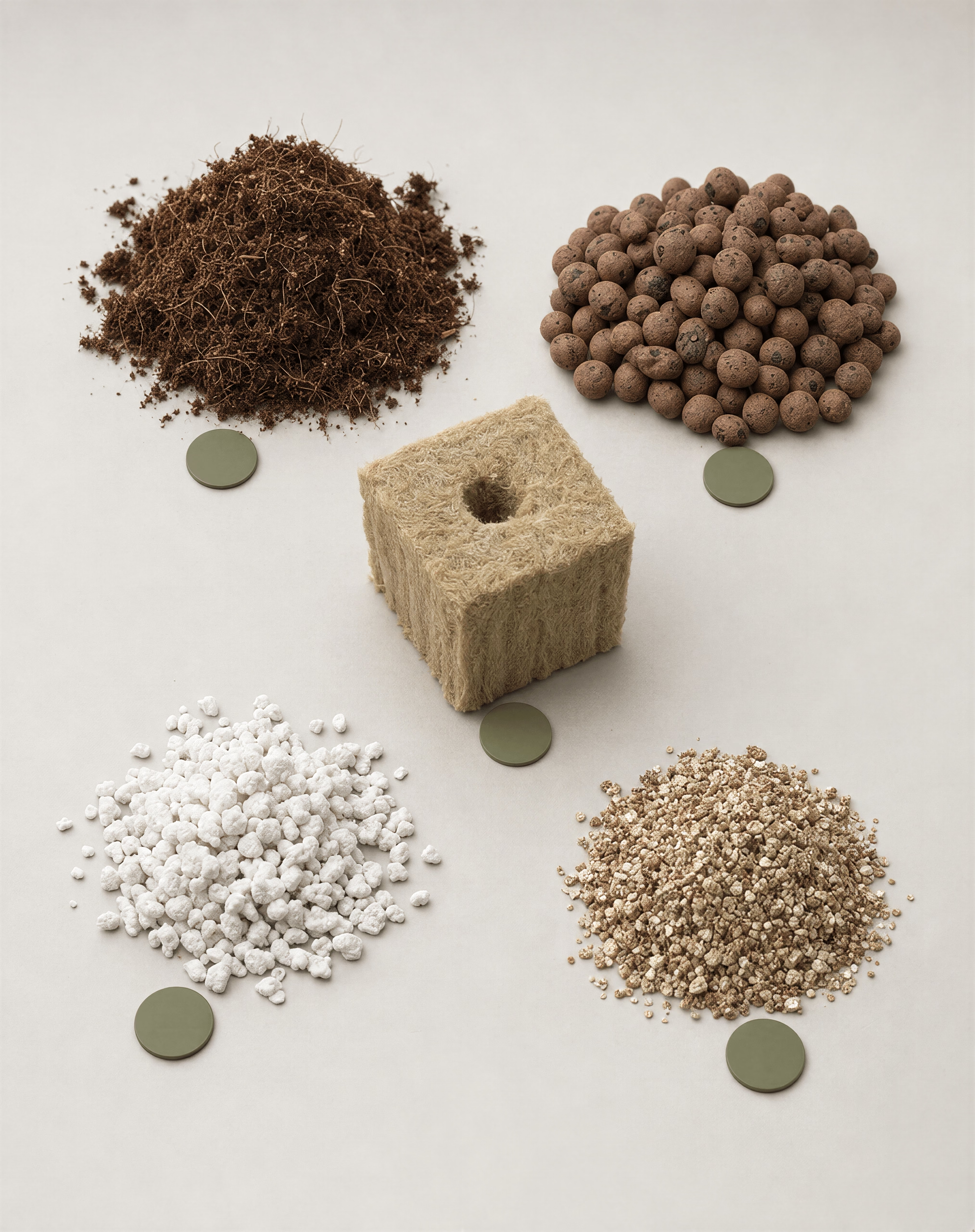
Grow media: inert does not mean interchangeable
A hydroponic medium is not just something to hold the plant upright. It sets the rhythm of irrigation, the amount of oxygen left around the roots after each feeding event, the way calcium, magnesium, and potassium behave in the root zone, and how easily pathogens gain a foothold. Two crops can receive the same nutrient solution at the same EC and pH and still perform very differently because one medium stays airy while the other stays wet, or because one buffers cations while the other hardly interacts with them at all.
That point gets missed constantly in cannabis cultivation. People talk as if “hydro” means the hardware choice and the medium is a side note. It is the opposite. The medium is part of the system design. Pick rockwool and you are choosing a frequent-irrigation, high-control strategy. Pick coco and you are choosing a buffered substrate with real cation exchange behavior and a different calcium-magnesium program. Pick a coarse aggregate and you are accepting that water management must be tighter because the margin for missed irrigations shrinks.
Rockwool
Rockwool became dominant in greenhouse horticulture for a reason: it is uniform. Slabs and blocks arrive with predictable pore structure, predictable water-holding behavior, and very little chemical reactivity. That makes it easier to steer irrigation based on measured dry-back rather than on guesswork. In cannabis, that consistency is valuable because crop demand shifts sharply between early vegetative growth and heavy flowering under high light.
Its main advantage is control. Rockwool can hold a large volume of water while still retaining a useful amount of air-filled porosity if irrigation is managed properly. That “if” matters. Over-irrigated rockwool stops being forgiving. Constant saturation lowers oxygen diffusion to roots and creates the exact conditions that favor root dysfunction and, in recirculating rooms with warm solution, Pythium pressure. The medium is not the disease cause by itself; poor water content management is.
Because rockwool has very low cation exchange capacity, it does not buffer nutrient mistakes much. That sounds harsh, but it is also why skilled growers like it. Changes in feed composition show up quickly in the root zone. Deficiency corrections are faster than in more buffered media. So are overfeeding problems. Cornell and other controlled-environment programs have long stressed daily pH and EC monitoring in recirculating systems for this reason: solution chemistry drifts as plants selectively absorb ions.
For cannabis, rockwool suits a high-frequency fertigation approach where root-zone oxygen is protected by short irrigations and deliberate dry-back between events. It does not reward sloppy timing.
| Medium | Water behavior | Chemical behavior | Management note |
|---|---|---|---|
| Rockwool | High, predictable water holding with controllable dry-back | Very low cation exchange capacity | Short frequent irrigations and careful timing |
| Coco coir | Good moisture retention with product-to-product variation | Meaningful cation exchange; affects Ca, Mg, and K | Use pre-buffered coco and a calcium-aware feeding plan |
| Expanded clay | Very fast drainage and high aeration | Low buffering | Frequent irrigation or regular solution contact |
| Perlite | Adds air-filled porosity, dries quickly in pure culture | Mostly inert | Often blended with wetter media |
| Vermiculite | High water retention | Higher cation exchange than perlite | Useful in blends, but too much can keep flowering media too wet |
Coco coir
Coco is often called inert. It is not. Not chemically. That is the first thing to understand.
Coco coir has meaningful cation exchange capacity, and that affects feeding strategy from day one. Fresh or poorly buffered coco can adsorb calcium and magnesium while releasing potassium and sodium. In practice, that means the nutrient solution the grower mixes is not identical to the solution the roots actually experience. If the crop is fed like rockwool from the start, calcium and magnesium shortages can appear even when the reservoir numbers look acceptable.
That is why pre-buffered coco matters, and why many experienced growers run a calcium-forward nutrient profile in coco, especially early on. This is not superstition. It follows directly from the exchange chemistry of the substrate. Cannabis, with its fast growth and high transpiration under strong lighting, is particularly unforgiving when calcium supply to expanding tissues is disrupted. Tip burn and marginal necrosis are often blamed on “hot feed” alone when the deeper issue is a mismatch between transpiration demand, irrigation frequency, and substrate chemistry.
Coco also holds water differently from rockwool. It can maintain a root-friendly balance of moisture and air, but particle size and fiber-to-pith ratio change that balance a lot. Fine coco stays wetter. Coarser material drains faster and leaves more oxygen in the pore space. That variability is one reason coco products perform differently even when the label makes them sound similar.
Used well, coco is a strong fit for drip irrigation and drain-to-waste cannabis production because it buffers the root zone more than rockwool while still allowing intensive fertigation. Used badly, it encourages chronic overwatering: the top looks dry, the lower profile remains too wet, roots lose oxygen, and growth stalls.
Expanded clay, perlite, and vermiculite
These materials are often grouped together, but they do not behave the same.
Expanded clay pebbles are coarse, durable, and highly aerated. They drain fast and hold relatively little water compared with rockwool or coco. That makes them useful in flood-and-drain systems, net pots, and recirculating setups where frequent contact with nutrient solution is expected. Their strength is oxygen availability. Their weakness is low buffering against irrigation failure. Miss a cycle under high transpiration and plants can wilt quickly.
Perlite is lightweight, porous, and mostly valued for increasing air-filled porosity. In pure form it dries quickly, so it is often blended with more water-retentive media. For cannabis roots, that extra air space can be helpful, especially in rooms where growers have a habit of irrigating too often. But pure perlite culture demands tightly managed fertigation because the root zone does not store much water or nutrient solution.
Vermiculite goes the other direction. It holds much more water and has greater cation exchange capacity than perlite. That can be useful in propagation or in blends designed to reduce irrigation frequency. In a flowering cannabis crop, though, too much vermiculite can keep the medium wetter than is ideal, reducing oxygen diffusion and increasing disease risk if temperatures climb.
Peat-free blends and hybrid media
Peat-free and hybrid substrates are increasingly common, and not only for environmental reasons. They let growers tune physical properties by mixing components with different water and air characteristics: coco plus perlite, wood fiber plus coir, bark fines plus mineral aggregates, and similar combinations.
The benefit is flexibility. A blend can be engineered for more frequent irrigation, faster rewetting, or more air near the base of the container. The problem is variability. With hybrids, you have to know what each ingredient contributes. A blend heavy in fine particles may look airy when dry but stay saturated deep in the pot. One rich in wood fiber may change structure over time as it decomposes. “Peat-free” tells you very little about how the root zone behaves.
For cannabis, hybrids make sense when the goal is to match substrate physics to irrigation capacity and plant size rather than to follow medium loyalty.
How water-holding capacity and air-filled porosity change irrigation strategy
Water-holding capacity and air-filled porosity are not abstract lab terms. They determine how often you irrigate, how long roots spend with enough oxygen, and how much room you have for error.
Air-filled porosity The share of pore space occupied by air after drainage. Higher air-filled porosity usually improves root oxygenation but lowers water storage.
A medium with high water-holding capacity can reduce irrigation frequency, but if it also has low air-filled porosity after saturation, roots spend longer in a low-oxygen state. A medium with high air-filled porosity supports respiration better, but it usually needs more frequent irrigation because it stores less water. That is the trade-off.
Cannabis responds strongly to that trade-off because root respiration supports active nutrient uptake. When the root zone stays too wet, nutrient disorders can appear even when the reservoir is well mixed and pH sits in the standard hydroponic band of about 5.5 to 6.5, as University of Arizona CEAC guidance recommends. Warm solution makes the penalty worse. According to USGS tables, water at 20°C holds about 9.1 mg/L dissolved oxygen at saturation, compared with 8.3 mg/L at 25°C and 7.6 mg/L at 30°C. Less oxygen in the water, less oxygen around the roots, more pathogen pressure.
So irrigation strategy has to fit the medium, not the other way around. Rockwool usually wants short, frequent events with managed dry-back. Coco often benefits from enough volume to prevent salt buildup while avoiding a constantly waterlogged lower profile. Clay-heavy systems may need multiple daily cycles because the medium itself stores little moisture. There is no universal schedule. The medium decides the logic.
Nutrient solutions for cannabis: from source water to stage-specific feeding
Hydroponic feeding starts before any fertilizer hits the tank. It starts with the water itself, because source water sets the chemical background for everything that follows: pH behavior, calcium supply, sodium stress, sanitizer residues, and how often the reservoir drifts out of range. This is where many cannabis guides go wrong. They jump straight to bottle schedules and EC targets as if all water were the same. It is not.
Cannabis nutrition in hydroponics also cannot be reduced to a single N-P-K number. The plant’s demand changes with stage, cultivar, light level, vapor pressure deficit, irrigation frequency, and root-zone conditions. Saloner and Bernstein’s work from 2019 through 2023 helped make that plain: more mineral supply can increase inflorescence yield up to an optimum, but pushing EC higher does not produce endless gains and can make ion balance worse. That fits broader hydroponic science. EC measures total dissolved salts, not whether those salts are in a ratio the plant can use.
Starting with water quality: hardness, alkalinity, sodium, and chloramine
Source-water checks before mixing nutrients
- Alkalinity Shows how strongly bicarbonates will push pH upward after mixing.
- Calcium and magnesium Tell you how much baseline hardness the water already supplies.
- Sodium and chloride Raise EC without feeding the crop usefully at normal levels.
- Disinfectant type Chloramine is more persistent than free chlorine and does not gas off easily.
Alkalinity Water’s acid-neutralizing capacity, usually driven by bicarbonate. High alkalinity tends to push hydroponic pH upward after mixing.
A water report matters more than a feeding chart. The first numbers to look for are alkalinity, calcium, magnesium, sodium, chloride, sulfate, and whether the supplier uses chlorine or chloramine for disinfection. Hardness and alkalinity are often confused, but they are not the same thing.
Hardness is mainly the amount of dissolved calcium and magnesium. Alkalinity is the water’s acid-neutralizing capacity, usually driven by bicarbonate (HCO3-) in typical water supplies. A grower can have hard water with useful calcium and magnesium but manageable alkalinity, or relatively soft water with enough bicarbonate to cause constant pH rise. That second case surprises people.
In hydroponics, bicarbonates matter because they resist acidification and keep pushing solution pH upward after mixing. If alkalinity is high, the reservoir may look fine after adjustment, then drift back up as plants remove nitrate, ammonium, potassium, and water. The practical result is hidden lockout risk, especially for iron, manganese, zinc, and phosphorus as pH rises beyond the usual hydroponic working range. University of Arizona CEAC guidance places hydroponic nutrient solutions broadly around pH 5.5 to 6.5, and commercial cannabis growers often hold roughly 5.7 to 6.2, sometimes allowing a controlled drift across that band.
Sodium is another underappreciated problem. It contributes to EC but does not feed the crop in any meaningful way at typical irrigation levels. If source water carries substantial sodium, a meter may suggest acceptable total salts while the actual nutrient fraction is poor. Sodium also competes osmotically and can contribute to substrate accumulation in drain-to-waste systems. The same warning applies to chloride when it is elevated.
Chloramine deserves its own mention. Unlike free chlorine, it is stable. It does not gas off readily by simply letting water sit overnight. At municipal-water levels it often causes no immediate disaster, but it can affect beneficial microbial programs and contributes reactive chemistry that some growers would rather not keep in the reservoir. Activated carbon can remove chloramine if sized and maintained correctly. Reverse osmosis can remove much of it as part of broader purification, but RO is not free of tradeoffs.
RO water solves some problems while creating others. It strips out bicarbonates, sodium, and much of the unwanted load, giving a clean starting point. It also strips away much of the calcium and magnesium, so the nutrient recipe must replace them deliberately. That is the part many growers miss. RO does not make nutrition simpler by itself; it makes it more controllable. Those are different things.
For cannabis, controllability is usually worth it when source water is highly alkaline or sodium-rich. If source water is already low in alkalinity and moderate in calcium and magnesium, blending RO with raw water can be more sensible than running 100 percent RO. The goal is not purity for its own sake. The goal is a stable nutrient solution with known chemistry.
Cannabis macronutrients across propagation, vegetative growth, and flowering
The N-P-K label is a crude shorthand. Cannabis needs nitrogen, phosphorus, and potassium, yes, but also significant calcium, magnesium, and sulfur, with shifting demand over time. Treating phosphorus as the magic “bloom” lever is one of the least evidence-based habits in cannabis growing.
Propagation calls for modest EC and a solution that supports root formation without excessive osmotic load. Young cuttings and seedlings have limited uptake capacity and small root systems, so high salts can slow establishment rather than accelerate it. Nitrogen should be present, but not pushed. Calcium is especially important because new tissues depend on continuous calcium supply through transpiration and local xylem flow. Weak early calcium nutrition often shows up later as distorted new growth or fragile root development, then gets misdiagnosed as a pathogen problem.
Vegetative growth usually benefits from a stronger nitrogen supply, but that does not mean indiscriminate nitrate loading. High light increases photosynthetic demand and transpiration; if irrigation frequency, root oxygen, and calcium transport do not keep pace, “more veg feed” can produce lush but physiologically soft growth. Magnesium demand also rises because chlorophyll synthesis and carbon fixation depend on it. Sulfur matters here too. It is required for amino acids such as cysteine and methionine, for glutathione metabolism, and for many enzyme systems. It is often treated as an afterthought because deficiency symptoms are less famous than calcium or iron problems.
In flowering, cannabis usually needs less nitrogen relative to potassium than in vegetative growth, but not zero nitrogen. Extreme late-flower nitrogen cuts can induce premature senescence and reduce photosynthetic capacity before the crop has finished filling. Saloner and Bernstein’s studies on medical cannabis mineral nutrition showed developmental stage affects nutrient partitioning among organs, which is exactly why one static feed recipe underperforms. Flowers are not built on phosphorus alone. Potassium supports osmotic regulation, sugar transport, and stomatal function. Calcium remains non-negotiable. Magnesium still drives chlorophyll function in the leaves that power inflorescence development.
A hard truth: many hydro growers overfeed bloom. Rising EC in late flower is often defended as “stacking weight,” yet the literature points toward diminishing returns and greater salinity stress beyond an optimum. If the root zone becomes too saline, water uptake slows because the osmotic gradient works against the plant. Leaves may claw, margins may burn, and the grower, seeing pale flowers, may add more feed. That usually makes the problem worse.
Micronutrients, chelation, and hidden deficiencies
Micronutrients are needed in tiny amounts, but “tiny” does not mean optional. Iron, manganese, zinc, copper, boron, molybdenum, chlorine, and nickel all serve enzyme systems and structural roles that can fail before obvious leaf symptoms appear.
Iron is the classic hydroponic hidden deficiency. The reservoir can contain enough total iron on paper, yet if pH stays too high or the chelate is poorly chosen for the working pH, new growth still turns interveinally chlorotic. Chelation keeps metal ions soluble. Fe-EDTA works in mildly acidic solution but loses reliability as pH rises. Fe-DTPA is more stable somewhat higher. EDDHA is very stable but can be excessive or stain systems and is not the usual first choice in standard hydro ranges. This is solution chemistry, not brand mystique.
Manganese and zinc deficiencies can also appear when pH drifts upward, especially in recirculating systems where the solution composition keeps changing. Boron is another one to watch because deficiency can look like twisted new growth, brittle tissues, poor meristem development, or failed root tips. Calcium and boron problems often travel together in the diagnostic process because both affect growing points, but the fix is not always more calcium.
Coco-based hydro adds another complication. Coco has cation exchange sites and commonly binds calcium, magnesium, and potassium differently from inert media like rockwool or clay aggregate. A recipe that behaves well in rockwool can produce apparent Ca/Mg issues in coco unless the medium is properly buffered and the feed account for exchange dynamics.
Reservoir mixing order, stock solutions, and precipitation risks
Concentrated fertilizers are not infinitely mixable. Calcium nitrate should not be stored in the same stock concentrate with phosphates or sulfates, because calcium phosphate and calcium sulfate can precipitate. Once precipitated, those nutrients are no longer available to the plant, and the grower may not realize that the cloudy residue in a line or tank is literally missing nutrition.
| Stock tank | Typical contents | Why separate it |
|---|---|---|
| Part A | Calcium nitrate and iron chelate | Keeps calcium away from concentrated phosphates and sulfates |
| Part B | Magnesium sulfate, potassium phosphate, potassium sulfate, trace mix | Prevents insoluble calcium phosphate or calcium sulfate from forming |
That is why commercial programs separate stock tanks into parts. A common pattern is: - Part A with calcium nitrate and iron chelate - Part B with magnesium sulfate, potassium phosphate, potassium sulfate, and trace mix
The exact formula varies, but the principle does not. Separate incompatible ions in concentrate, then dilute into the reservoir with strong agitation.
Reservoir mixing order
- 1 Fill the reservoir with most of the water first.
- 2 Add one concentrate and mix thoroughly.
- 3 Add the next concentrate only after dilution and mixing.
- 4 Top up with final water volume.
- 5 Add acids last and cautiously; never combine concentrates undiluted.
Mixing order matters. Fill the reservoir with most of the water first. Add one concentrate, mix thoroughly, then the next, then final top-up water. Add acids last and cautiously. Never pour concentrates together undiluted. Never add acid directly onto concentrated nutrient salts. Precipitation and localized reactions happen fast.
Recirculating versus drain-to-waste nutrition strategies
Recirculating systems reward precision but punish neglect. As plants remove water and specific ions at different rates, the reservoir does not remain chemically identical to the original recipe. Nitrate, potassium, calcium, and magnesium are not taken up in lockstep. Water temperature, root oxygen, and pathogen load all feed back into uptake patterns. Cornell CEA guidance is right to insist on daily EC and pH monitoring in recirculating hydroponics. In cannabis, daily may not even be enough under high PPFD and aggressive transpiration.
Drain-to-waste is less chemically elegant but often more forgiving. Each irrigation event delivers a fresh solution, and runoff carries away some accumulated salts. This is one reason drip-fed coco can perform so consistently for cannabis. The root zone still needs management, yet the reservoir itself does not drift the way a recirculating system does.
There is no universal recipe. A cultivar under 900 µmol/m²/s with high transpiration and frequent irrigation will not want the same nutrient profile as a slower plant under lower light. Hydroponic success comes from adjusting feed strength, ratios, and irrigation style to the actual crop response. Hardware gets attention because it is visible. The harvest is decided by water chemistry, ion balance, root oxygen, and how closely the feeding program matches the plant’s stage and environment.
pH and EC management: the chemistry most growers underestimate
pH and EC are not scoreboards. They are diagnostics. Used well, they tell you what the roots, the water, and the environment are doing together. Used badly, they turn into superstition: constant bottle adjustments, daily panic, and reservoirs that swing harder because the grower keeps “correcting” what was only normal plant activity.
For hydroponic cannabis, that distinction matters. The crop is fast, hungry, and sensitive to root-zone errors, but the literature does not support the common claim that simply pushing concentration higher drives yield higher. Saloner and Bernstein’s cannabis nutrition work from 2019 to 2023 points the other way: mineral supply helps until it does not, and excess can create salinity stress, ion antagonism, and quality tradeoffs. Cornell CEA and University of Arizona hydroponic guidance make the same broader point for recirculating systems: solution chemistry changes continuously because plants do not remove nutrients in the same ratio they were added.
Why pH drift happens in hydroponic cannabis systems
pH drift is not random. It is the chemical footprint of uptake, alkalinity, microbial activity, and sometimes root stress.
The first driver is ion balance. When roots absorb more nitrate than ammonium, they tend to release hydroxyl or bicarbonate equivalents, and the solution pH rises. When they absorb more ammonium, they release hydrogen ions, and pH falls. This is basic plant physiology, not cannabis folklore. Because most cannabis hydro formulas are nitrate-dominant, a slow upward drift is common in healthy systems. A sudden downward drift in a formula that was not changed may point to excess ammonium, microbial nitrification, root damage, or solution contamination.
The second driver is source water alkalinity. Many growers confuse alkalinity with pH. They are not the same. Water can start at an acceptable pH and still contain enough bicarbonate to resist acidification and keep pushing reservoir pH upward after adjustment. That is why two growers can feed the same formula at the same starting pH and see very different daily trends.
The third driver is differential nutrient uptake. Plants rarely remove nitrogen, potassium, calcium, magnesium, phosphorus, and sulfur in perfect proportion to the recipe. Cannabis changes demand sharply by stage. Vegetative plants often pull nitrogen and potassium aggressively. Flowering plants shift relative demand, and under high light they may expose calcium transport limits even when calcium is present in the tank. As ions disappear unevenly, the remaining solution changes character. pH follows.
Then there is root health. Healthy white roots respire and absorb selectively. Stressed roots do not. Warm solution, low oxygen, and early Pythium pressure can alter uptake before roots look visibly brown. This is where pH drift becomes useful. A reservoir that used to show a mild predictable rise and suddenly starts dropping, or swings much faster than normal, is sending a message. Check water temperature, dissolved oxygen, smell, and root appearance before you reach for more pH-down.
For most hydroponic cannabis systems, a working pH of about 5.5 to 6.5 is defensible, matching University of Arizona CEAC guidance for hydroponics generally. In practice, many experienced growers keep roughly 5.7 to 6.2 in veg and allow a gentle rise into the low 6s in bloom. That is not because cannabis needs mystical “sweet spots.” It is because iron and manganese stay more available at the lower end, while calcium, magnesium, and phosphorus are often less troublesome when pH is not pinned too low.
What EC measures and what it does not
EC measures how well the solution conducts electricity. That makes it a proxy for dissolved ionic concentration. Proxy is the key word.
A reservoir at 1.8 mS/cm tells you the solution has more charged ions than one at 1.2 mS/cm. It does not tell you whether those ions are the right ones, in the right ratios, or available under current root-zone conditions. Two tanks can read the same EC while having very different chemistry. One might be balanced. The other might be heavy in sodium, chloride, or residual sulfate while short on nitrate or calcium.
That is why chasing EC upward is one of the most common hydro mistakes. Higher EC raises osmotic pressure. Once solution concentration gets too high, roots must work harder to take up water. Growth can slow even while the meter suggests “strong feeding.” Tip burn, dark foliage, stalled transpiration, and leaf-edge necrosis often come from this mismatch. Cannabis is not exempt. Cockson and colleagues’ review of cannabis mineral nutrition noted how scattered nutrient recommendations remain and how often overfeeding appears in practice.
EC also says nothing direct about oxygen status, root disease, pH buffering, or irrigation timing. Under intense light, around 600 to 1000 µmol/m²/s in many flowering rooms without CO2 enrichment, transpiration can rise fast. If irrigation or reservoir volume does not keep pace, the plant may concentrate salts in the root zone even while bulk reservoir EC seems acceptable. In rockwool or coco, slab or pot EC can become far higher than the feed going in. The handheld meter is not wrong. It is just answering a narrower question than the grower thinks.
There is no single cannabis EC chart that deserves blind trust because cultivar, light, CO2, media, irrigation frequency, and water quality all move the target. Limited evidence
Target ranges by growth stage and system type
There is no single cannabis EC chart that deserves blind trust. Cultivar, light level, CO2, media, irrigation frequency, and water quality all move the target.
Still, practical bands help. Seedlings and fresh clones usually do well around 0.4 to 0.8 mS/cm if the propagation environment is dialed in. Early vegetative growth often sits around 0.8 to 1.3. Established veg commonly lands near 1.2 to 1.8. Flowering often works around 1.4 to 2.2, with many plants showing no benefit from the upper end unless light, transpiration, and root health fully support it. If you are pushing beyond about 2.2 in a recirculating system, you should have a specific reason and close observation, not habit.
System type changes interpretation. Deep water culture and aeroponics expose roots directly to solution, so errors hit fast; these systems often reward moderate EC and stable pH more than aggressive feeding. NFT behaves similarly but can be even less forgiving if flow or oxygen falters. Ebb-and-flow with inert media adds a little buffer. Drip-fed coco is the outlier: because coco has cation exchange capacity and can bind calcium, magnesium, and potassium, input EC and root-zone EC are not the same thing. Runoff or media extract readings matter there.
Meter calibration, sampling protocol, and data logging
Bad meters create fake problems. Calibrate pH meters often, ideally weekly in active flower, with fresh 4.0 and 7.0 buffers. Store the electrode properly; a dried bulb drifts and responds slowly. EC meters need calibration too, usually with a standard like 1.413 or 2.76 mS/cm depending on the device.
Sampling needs discipline. Measure at the same time each day, before top-offs and before adding acids or nutrients. Stir or circulate the reservoir first. In recirculating systems, sample from the well-mixed tank, not from a stagnant corner. In media-based systems, pair reservoir readings with runoff or substrate extract readings at regular intervals.
Minimum daily log for hydro rooms
- pH Shows how uptake and alkalinity are shifting the solution.
- EC Tracks total ionic concentration trends.
- Reservoir temperature Flags oxygen-solubility and pathogen-risk changes.
- Water level or top-off volume Needed to interpret whether EC changes come from uptake or dilution.
Log four things at minimum: pH, EC, reservoir temperature, and water level or top-off volume. Without volume, EC trends are easy to misread. Add notes on room VPD, PPFD changes, and any root observations. Patterns appear quickly when the data are contextualized. A pH rise of 0.2 with steady EC and strong water use means something very different from the same pH rise with warm solution and sagging water uptake.
When rising EC means under-watering and when falling EC means over-dilution
Trend interpretation beats single readings.
If water level drops and EC rises, the plants are taking up water faster than nutrients. In a reservoir system, that can be normal under high transpiration, but if the rise is steep it often means the solution is too strong for current conditions or the root zone is effectively under-watered. In drip systems, it can mean irrigation pulses are too infrequent, allowing evaporation and plant uptake to concentrate salts around roots. The fix is not automatically “add more feed.” Often it is the opposite: lower feed strength, increase irrigation frequency, or reduce environmental demand.
If water level drops and EC falls, plants are taking up nutrients at least as fast as water. That often signals a feed that is slightly too weak for current growth rate, especially if foliage is pale and daily uptake is strong. But do not respond to one day of data.
If EC falls after a large top-off, that is not plant behavior. That is dilution. Many growers mistake this for heavy nutrient uptake and then add concentrate too soon. Watch the 24- to 72-hour trend after the system has mixed and stabilized.
pH and EC matter because roots are chemical reactors, not because the numbers themselves are magical. Read them as part of a process: water chemistry, temperature, oxygen, light, and transpiration. Growers obsess over hardware because hardware is visible. The reservoir trendline is quieter. It is also usually more honest.
Water temperature, dissolved oxygen, and root health
- DO at 20°C
- 9.1 mg/L at saturation
- DO at 25°C
- 8.3 mg/L at saturation
- DO at 30°C
- 7.6 mg/L at saturation
- Common reservoir target
- 18-21°C
Hydroponic cannabis succeeds or fails at the roots. Not because roots are mysterious, but because they obey chemistry. A nutrient reservoir is not just a bucket of fertilizer water. It is the plant’s respiratory environment. Roots need oxygen to convert sugars into ATP, power ion transport, maintain membrane function, and keep new tissue growing. When oxygen falls, nutrient uptake slows, roots exude more stress compounds, and opportunistic pathogens gain an opening.
That is why reservoir temperature matters so much more than system branding. Dissolved oxygen in water drops as temperature rises. The U.S. Geological Survey lists freshwater oxygen saturation at about 9.1 mg/L at 20°C, 8.3 mg/L at 25°C, and 7.6 mg/L at 30°C. That decline looks small on paper. In practice, it is enough to shift a root zone from comfortably aerobic to marginal, especially once roots, microbes, and warm-room conditions start consuming oxygen faster than the solution can regain it.
Why 18-21°C reservoir temperatures are so commonly recommended
The common 18-21°C recommendation is not folklore. It sits in a useful middle ground between plant metabolism and oxygen physics. At that range, water can still hold close to saturated oxygen, while roots remain active and nutrient viscosity stays manageable. Push the reservoir much colder and growth can slow, especially if the canopy is warm and transpiration demand is high. Let it drift into the mid-20s and oxygen availability falls while microbial pressure rises.
Cannabis has a large, metabolically active root system in fast vegetative growth and during heavy flowering. Under high light, often 600-1000 µmol/m²/s in indoor production without CO2 enrichment, demand for water and minerals rises sharply. That means root respiration rises too. Warm solution under bright light is a bad combination: the plant asks more from the roots at the same moment the water can physically supply less oxygen.
This is also why “room temperature water is fine” is bad advice in many grow rooms. A reservoir sitting at 25-27°C may not show immediate wilt, but it is operating with less oxygen headroom. Any extra stress—organic residue, a clogged airline, dense roots, a pump failure, or a pathogen load—becomes more dangerous.
Dissolved oxygen, aeration, and circulation
Near-saturation dissolved oxygen for the actual water temperature is the target. Not an arbitrary number pulled from a forum. Saturation changes with temperature, altitude, salinity, and system design, so the practical goal is to keep oxygen replenishment high enough that roots are not working in depleted water.
Air stones are the common starting point. They work by breaking air into many bubbles, increasing gas exchange and creating local agitation. Fine bubbles increase surface area, but the stone itself is not magic; placement, pump output, and reservoir depth all matter. In deep water culture, weak air pumps and undersized stones are a common hidden limitation.
Venturi injection pulls air into flowing water through a pressure differential. It can oxygenate aggressively and is often more efficient than relying on bubbles from the bottom of a tank alone. It also improves mixing. Waterfalls and return-line splashing do something similar by exposing more water surface to air and disrupting boundary layers. They can be very effective in recirculating systems, though less so if the drop is small and the flow path creates stagnant corners elsewhere.
Circulation pumps are different. They do not add much oxygen by themselves unless they disturb the surface or feed a venturi. Their main job is to stop stratification, distribute nutrients and temperature evenly, and prevent dead zones where roots and microbes consume oxygen faster than it is replaced. A still reservoir can test fine in one spot and anaerobic in another.
What each hardware element actually does
- Air stones Increase gas exchange by making bubbles and agitation.
- Venturi injection Pulls air into moving water and can oxygenate aggressively.
- Waterfalls or splashing returns Expose more water surface to air and improve gas exchange.
- Circulation pumps Even out nutrients and temperature and reduce dead zones, but add little oxygen by themselves.
The practical lesson is simple: aeration adds oxygen; circulation spreads it. Most recirculating systems need both.
Biofilms, root pathogens, and sanitation
Root disease rarely appears out of nowhere. It usually follows a chain of conditions: warm water, low oxygen, organic residue, stagnant sections of plumbing, and time. Pythium species are the classic hydroponic problem, though growers often call every brown-root issue “root rot.” That label hides the mechanism. Pythium is an oomycete, not a generic decay process, and outbreaks are strongly associated in greenhouse guidance with poor sanitation and oxygen-poor root zones.
Biofilm A structured microbial layer that sticks to reservoir walls, tubing, channels, and emitters. It shelters microbes, traps residues, and narrows flow paths.
Biofilms are part of that story. A biofilm is a structured microbial layer stuck to reservoir walls, tubing, emitters, channels, and pump housings. Once established, it traps nutrients, shelters pathogens from disinfectants, and narrows lines. It also creates rough internal surfaces where debris accumulates and flow slows down. In NFT channels, drip lines, spray manifolds, and aeroponic nozzles, this can become a major failure point.
Sanitation is not the same as sterility theater. It means removing the conditions that let biofilms persist. Clean reservoirs between crop cycles. Flush and scrub lines, fittings, pump intakes, and return paths. Remove root fragments quickly. Eliminate dead legs in plumbing where solution sits with little turnover. Keep lids closed to reduce light entry, since light in the reservoir supports algae, and algae feed the broader microbial mess.
| Root sign | Usually healthier interpretation | Usually trouble interpretation |
|---|---|---|
| Color | White to cream | Tan to brown with worsening trend |
| Texture | Firm | Soft or slimy |
| Odor | Neutral or earthy | Sour, swampy, or sulfurous |
| Root tips | Many fresh white tips | Reduced white tips or damaged fine roots |
Healthy roots are usually light colored, firm, and smell earthy or neutral. Trouble starts with slight tan staining, slime, sour odor, reduced white root tips, and afternoon droop despite adequate EC and water level.
How warm water changes disease risk and nutrient uptake
Warm water raises disease risk in two ways at once. First, it lowers oxygen solubility. Second, it speeds microbial growth, including organisms that exploit stressed roots. That combination is why a reservoir that seemed acceptable at 20°C can become unstable at 26°C with no other obvious change.
Nutrient uptake also shifts. Root membranes rely on oxygen-driven metabolism to actively transport ions. When oxygen is limited, uptake of nitrate, potassium, calcium, and other nutrients becomes less efficient even if the solution tests “correct.” This helps explain the frustrating hydroponic pattern where pH and EC look normal but plants still show deficiency-like symptoms. The issue is not always missing nutrients. Sometimes the root system has lost the energy to absorb them properly.
Warm, low-oxygen water also weakens root tip growth, and root tips are where much of the uptake happens. Once fine roots are damaged, the plant often compensates by drinking less, which can make the solution EC rise as water is removed more slowly than salts. Many growers respond by changing feed strength when the primary problem is actually root-zone environment.
So the 18-21°C rule is not a superstition and not a minor optimization. It is one of the main controls on oxygen supply, pathogen pressure, and nutrient uptake. Get it wrong, and the rest of the feeding program starts to lie to you.
Lighting and environment in hydroponic cannabis production
Hydroponic cannabis is often framed as a root-zone story: dissolved oxygen, reservoir temperature, pH drift, EC, pump reliability. All of that matters. None of it works in isolation. A hydro crop is tied to the air above it more tightly than many growers admit, because light intensity, leaf temperature, humidity, and CO2 set the pace of photosynthesis and transpiration, and transpiration is what pulls water and calcium-bearing xylem flow from root to shoot. When that pace rises, the whole system has to keep up.
This is why claims that “hydro yields more” are often only partly true. Hydro can support faster growth because roots face less mechanical resistance than in dense soil, oxygen can be kept high, and nutrient delivery is more direct. But the yield jump many growers attribute to hydro is often inseparable from better lighting, tighter HVAC control, and more frequent irrigation. Put a poorly conditioned room over a hydro system and it can underperform a well-run substrate crop very quickly.
PPFD, DLI, and why hydroponic plants demand environmental matching
PPFD measures the photons hitting the canopy each second, in µmol/m²/s. DLI turns that into a daily total. Cannabis responds to both, and hydroponic crops usually reveal mismatch faster because they can move water and ions rapidly when the environment allows it, then crash into bottlenecks just as fast when it does not.
For flowering cannabis without CO2 enrichment, controlled-environment work commonly places productive PPFD in roughly the 600 to 1000 µmol/m²/s range. That number by itself is not a target. It is a contract. If a grower pushes 900 µmol/m²/s, the crop now needs enough root-zone oxygen, water delivery, calcium transport, and leaf cooling to support that photon load. If any one of those lags, symptoms appear that are often misread as a simple nutrient deficiency. Tip burn. Marginal necrosis on rapidly expanding leaves. Upper-canopy stress. Slowed flower bulking despite a “strong” feed.
Bruce Bugbee’s crop physiology work has long emphasized a point that applies directly here: more light raises photosynthetic potential only when other limits are removed. In hydroponics, those limits often show up as irrigation frequency and root health rather than fertilizer concentration alone. Cornell CEA guidance on recirculating systems makes the same general point from another angle: pH and EC shift continuously because plant uptake changes solution composition all day. High-light hydro is dynamic, not static.
DLI exposes another common mistake. Two rooms can run the same PPFD, but the one with a longer photoperiod in vegetative growth or stronger average intensity across the day drives more total carbon gain and more total water movement. That means more demand on pumps, emitters, dehumidification, and nutrient balance. Hydro rewards precision. It also punishes lazy assumptions faster than soil.
LED fixtures, canopy uniformity, and plant architecture
LEDs changed cannabis production less because they are “more advanced” and more because they allow tighter control of photon distribution and fixture spectrum while adding less radiant heat to the canopy than legacy HID systems. That shift matters in hydro because lower radiant heat can decouple leaf temperature from room air temperature. A room at a given dry-bulb temperature may produce cooler leaves under LED than under high-pressure sodium, and cooler leaves transpire differently.
Uniformity is the underrated variable. A fixture that produces hotspots drives uneven transpiration and uneven nutrient flow across the canopy. Plants under the center may demand more calcium and water, while edge plants remain underlit and vegetative. The result is not just uneven yield. It is uneven physiology, which makes irrigation timing and EC interpretation harder.
Plant architecture should be shaped to the light map, not forced to compensate for a poor one. Flat, even canopies work because they reduce the distance between the dimmest and brightest sites. That lowers variability in leaf temperature, stomatal conductance, and flower development. In practice, this usually matters more than small spectral differences between competent LED fixtures.
Spectrum still has effects. Blue-rich light tends to suppress stretch and can produce tighter morphology; far-red can alter shade responses and canopy penetration dynamics; red-heavy fixtures can drive efficient photosynthesis but may encourage lankier structure if used without enough blue. Yet growers often overstate spectral fine-tuning and understate geometry. A mediocre spectrum with excellent canopy uniformity often outperforms a fashionable spectrum over an uneven canopy.
| Environmental factor | If too low | If too high |
|---|---|---|
| VPD | Transpiration slows and calcium transport can suffer | Plants may close stomata and stress under excess water loss |
| Room temperature | Metabolic demand may be subdued | Evaporative demand rises and warm reservoirs become riskier |
| Reservoir temperature | Growth may slow if excessively cold | Dissolved oxygen falls and pathogen pressure rises |
| PPFD | Growth and demand stay moderate | Water, oxygen, and nutrient delivery must keep pace |
Temperature, humidity, VPD, and transpiration-driven nutrient flow
Hydroponics does not free the crop from environmental physics. It makes those physics more visible.
Transpiration is the bridge between the room and the reservoir. As water evaporates from leaves, xylem flow pulls more water upward from the roots, carrying dissolved minerals with it. Calcium is the classic example because it moves primarily with transpiration and is not very mobile once deposited in tissue. When growers raise light intensity but keep humidity high, reduce air movement, or let roots become stressed, calcium transport to rapidly growing tissues can falter even when the reservoir contains plenty of calcium.
That is why VPD matters. Vapor pressure deficit is a practical way to describe how strongly the air is pulling moisture from the leaf. Too low, and transpiration stalls. Too high, and the plant can close stomata to avoid excessive water loss, cutting carbon gain while still suffering stress. Neither extreme is forgiving in hydro. The crop may show deficiency-like symptoms caused by transport failure rather than lack of ions in solution.
Temperature ties the whole loop together. Warm rooms raise evaporative demand. Warm reservoirs cut dissolved oxygen. The U.S. Geological Survey’s standard values make this plain: freshwater at saturation holds about 9.1 mg/L dissolved oxygen at 20°C, about 8.3 mg/L at 25°C, and about 7.6 mg/L at 30°C. That drop is not academic. Root respiration, nutrient uptake, and pathogen pressure all change within that range. Pythium pressure rises as nutrient solution gets warmer and oxygen availability falls.
This is why reservoir temperatures around 18 to 21°C remain a sensible target in cannabis hydro. Not because the number is mystical. Because oxygen solubility, root metabolism, and sanitation all become easier to manage there. Above-ground climate and below-ground chemistry are linked every hour the crop is alive.
CO2 enrichment: when it helps and when it just magnifies mistakes
CO2 enrichment can increase cannabis yield under high light. That part is real. It raises the ceiling on photosynthesis when PPFD is already strong, nutrition is balanced, irrigation frequency is adequate, and temperature is managed to support faster metabolism. Under those conditions, enriched rooms can make effective use of light levels that would otherwise be wasteful.
Used badly, CO2 is just an amplifier of errors.
A room running elevated CO2 with weak dehumidification, poor irrigation uniformity, high reservoir temperatures, or excessive EC often does not gain much. It simply drives plants harder into hidden limits. Saloner and Bernstein’s work on cannabis mineral nutrition is relevant here. Their studies from 2019 to 2023 show that increasing mineral supply helps only up to a point; after that, quality traits or ion balance can worsen. The same logic applies to CO2. More growth potential does not mean the crop wants ever-higher EC. Often the opposite: once transpiration, water uptake, and dry matter accumulation shift, the feed program needs recalibration, not brute-force concentration.
A practical rule is simple. Do not add CO2 to rescue a room that is already failing to control temperature, humidity, irrigation timing, or root-zone oxygen. Fix those first. Hydroponic cannabis responds impressively when the whole chain is aligned. When it is not, lighting and CO2 expose the weak link rather than hiding it.
Irrigation strategy, scheduling, and root-zone steering
Irrigation is where hydroponic design stops being a diagram and starts becoming crop physiology. Two rooms can run the same cultivar, the same fertilizer, and the same lights, yet produce very different plants because one room keeps the root zone oxygenated and chemically stable while the other swings between saturation, salt buildup, and water stress. That is why “system choice” is often overrated. What matters day to day is how water, air, and ions move around the roots.
The core tradeoff is simple. Roots need water, but they also need oxygen for respiration. Push irrigation too hard and the pore space in the medium fills with water, oxygen diffusion slows, and uptake suffers. Wait too long and the remaining solution becomes more concentrated as the plant removes water faster than salts, driving EC upward around the roots. Cannabis is not unique in this respect, but it is unforgiving when high light, fast transpiration, and heavy flowering demand all hit at once.
Continuous water culture versus pulse irrigation
In deep water culture, nutrient film technique, and other continuously wet systems, roots sit in solution or are exposed to a constant thin flow. The advantage is low matric resistance: the plant does not have to pull water from a drying substrate. Deficiencies can also be corrected quickly because the whole root zone sees the new solution almost at once.
The catch is oxygen. In continuous water culture, dissolved oxygen is not a bonus; it is the limiting variable that decides whether constant moisture helps or harms. The U.S. Geological Survey lists freshwater oxygen saturation at about 9.1 mg/L at 20°C, 8.3 mg/L at 25°C, and 7.6 mg/L at 30°C. That drop matters. As reservoir temperature rises, oxygen availability falls at the same time microbial pressure rises, including the oomycetes commonly grouped under “root rot,” especially Pythium. For cannabis, that is why solution temperatures around 18-21°C are so widely recommended. It is not folklore. It follows basic gas solubility and root respiration.
Pulse irrigation systems work differently. Drip-fed coco, rockwool, or peat-free slabs receive short irrigation events separated by periods in which the medium drains and re-aerates. Here, oxygen comes less from dissolved gas in a reservoir and more from air-filled porosity after each pulse. Frequency has to match the medium. Coarse clay pebbles or perlite dry fast and may need frequent small events under high PPFD. Rockwool holds a large amount of water but also drains predictably, so it supports multiple pulses per photoperiod. Coco holds water well and has a different cation behavior, especially around calcium, magnesium, and potassium, so irrigation has to respect both moisture and chemistry.
A practical rule: continuous systems need active control of dissolved oxygen and water temperature; substrate systems need active control of moisture content and salt distribution. Neither is “easier” when pushed hard.
How dry-back helps and hurts
- Benefit As media dry, large pores refill with air and root oxygenation improves.
- Cost The remaining water holds salts at higher concentration.
- Useful range Moderate dry-back can support roots and structure growth.
- Too far Aggressive dry-back can spike root-zone EC and create osmotic stress.
Dry-back management in substrate systems
Dry-back means the reduction in substrate water content between irrigation events. The term gets wrapped in too much steering jargon, but the underlying mechanism is straightforward. As the medium dries, large pores refill with air, which improves root-zone oxygenation. At the same time, salts become more concentrated in the shrinking water volume. So dry-back can help if it restores oxygen, but it becomes harmful when it drives local EC too high.
That is the balancing act.
In vegetative growth, modest dry-backs usually support active root development and keep internodes from becoming overly lush. In flowering, the target often shifts toward stability: enough dry-back to maintain oxygen and generative pressure, not so much that the crop experiences repeated osmotic stress. Saloner and Bernstein’s cannabis mineral nutrition work from 2019-2023 is relevant here because it shows that more mineral supply is not linearly beneficial. Chasing higher EC in the tank while also allowing aggressive dry-backs is a common self-inflicted problem. The root-zone EC can end up far above the feed EC.
Media choice changes what “moderate” means. Rockwool can tolerate frequent pulses with controlled dry-backs because its water-holding curve is predictable. Coco tends to buffer change differently and can hide salt accumulation if runoff is too low. Small containers dry faster than slabs. Large flowering plants under 600-1000 µmol/m²/s can empty a root zone surprisingly fast, especially when VPD is high. Scheduling by the clock alone is not enough; crop load, light, temperature, and humidity all change water use.
Runoff targets, recirculation, and waste nutrient management
Runoff is not just wasted water leaving the pot. It is a measurement tool. If feed EC and pH go in one way and runoff comes out much higher or lower, the substrate is telling you what is happening around the roots. Cornell CEA guidance has long stressed daily monitoring in recirculating hydroponics because plant uptake continuously shifts solution composition. Cannabis is no exception.
In drip substrate systems, some runoff helps prevent stratified salt buildup, especially late in the day when transpiration is high. Too little runoff invites EC stacking in the upper root zone. Too much runoff keeps the medium waterlogged, reduces oxygen, and discards nutrients the crop never used. The target is not a magic percentage; it depends on medium, plant size, and whether the system is recirculating or drain-to-waste. What matters is trend data: feed EC, runoff EC, feed pH, runoff pH, and how fast those values drift.
Recirculating systems save water and fertilizer but demand tighter sanitation and chemistry control. If one plant sheds pathogens into a common tank, the whole crop shares the problem. If selective nutrient uptake pulls nitrate, potassium, or calcium out of balance, the reservoir drifts away from the recipe on paper. That is why pH should stay within the standard hydroponic working zone, roughly 5.5-6.5 according to University of Arizona CEAC guidance, with many growers holding cannabis near 5.7-6.2 for much of the cycle.
How irrigation frequency changes plant shape and flower development
Irrigation frequency acts as a growth signal. Frequent early pulses, especially in high-water-content media, usually push a more vegetative response: larger leaves, faster expansion, softer growth, and longer internodes if light and VPD are not tuned with it. Longer intervals and firmer dry-backs tend to suppress excess stretch and shift the plant toward a more compact, more generative posture. That does not mean “stress equals yield.” Severe dry-backs reduce water uptake, spike root-zone EC, and can impair calcium transport to rapidly developing tissues.
Flower development depends on consistency. Under high light, the plant can only sustain heavy floral growth if irrigation replenishes water at the rate the canopy is transpiring. Miss that window repeatedly and flowers may stay smaller, leaf edges may burn, and deficiency symptoms can appear even when the reservoir analysis looks adequate. Too frequent irrigation creates a different failure mode: swollen, low-oxygen root zones, slower metabolism, and bland growth that looks green but underperforms.
That is what root-zone steering really means when stripped of sales language. It is not a secret recipe. It is the controlled use of irrigation timing, event size, and dry-back to manage oxygen, salinity, and plant water status. Get those right and the hardware matters less than people think. Get them wrong and no hydroponic system rescues the crop.
Common hydroponic cannabis problems and how to diagnose them
Hydroponic cannabis failures often get misread because the leaves are the last place many problems become obvious. By the time a plant shows clawed tips, interveinal chlorosis, or droop, the real issue may already be in the reservoir, the root mat, the irrigation schedule, or the room climate. That is why symptom-led diagnosis matters more than reaching for a bottle labeled “fix.”
Hydro problem triage order
- 1 Check water temperature first.
- 2 Check dissolved oxygen or at least aeration status.
- 3 Measure pH and EC in the reservoir and runoff where relevant.
- 4 Inspect roots, not just leaves.
- 5 Review irrigation history and room environment.
- 6 Only then decide whether to dilute, cool, oxygenate, sanitize, or adjust feed.
Start with a short triage sequence before changing anything:
1. Check water temperature. Reservoirs drifting above about 21°C deserve attention. Oxygen solubility drops as temperature rises: freshwater at saturation holds about 9.1 mg/L dissolved oxygen at 20°C, 8.3 mg/L at 25°C, and 7.6 mg/L at 30°C, according to the U.S. Geological Survey. Warm nutrient solution is not just warmer water. It is less oxygen and a friendlier environment for Pythium. 2. Check dissolved oxygen or at least aeration status. If you do not own a DO meter, inspect air pumps, stones, recirculation flow, waterfall return, and root movement. 3. Measure pH and EC in the reservoir and, where relevant, in runoff or drain. Cornell and other CEA programs stress that recirculating solutions shift daily because plants remove water and ions at different rates. 4. Look at roots, not just leaves. Healthy roots are usually white to cream, firm, and fresh-smelling. Brown roots are not always diseased; nutrient staining can color roots. Texture and smell matter. 5. Review recent irrigation history and environment. Did the medium stay saturated too long? Did PPFD rise without more frequent irrigation? Did VPD spike after a dehumidifier setting change? 6. Only then decide whether to add, remove, dilute, cool, oxygenate, or sanitize.
That order prevents one of the most common hydro mistakes: treating every symptom as a nutrient deficiency.
Root rot, slime, and low-oxygen symptoms
If a hydroponic cannabis plant looks wilted even though the root zone is wet, think oxygen before fertilizer. Roots need oxygen for respiration, ATP production, ion uptake, and membrane transport. In hydroponics, the root zone can fail from suffocation long before it dries.
The classic pattern is deceptive. Leaves droop. Growth slows. Lower leaves may yellow. Tips can burn. Stems may lose vigor. New growth can look small and weak. Many growers call this underfeeding because the plant appears unable to support rapid growth. Often it is the opposite problem: roots cannot absorb what is already there.
When low oxygen progresses into disease pressure, roots become tan to brown, soft, and slimy, with a swampy or sulfurous smell. Pythium spp. are frequent culprits in greenhouse hydroponics, and university greenhouse guidance consistently links outbreaks with warm nutrient solution, low oxygen, and poor sanitation. “Root rot” is a broad label; the actionable question is whether you have a pathogen problem, an oxygen problem, or both.
| Clue | What it suggests |
|---|---|
| Water temperature above 21–22°C | Lower oxygen headroom and greater pathogen risk |
| Weak bubbling or dead air pumps | Insufficient oxygen replenishment |
| Heavy biofilm | Microbial buildup and possible flow restriction |
| Wilting during peak transpiration with a wet root zone | Root hypoxia rather than drought |
| Rapid decline after chiller, pump, or recirculation failure | Systemic root-zone failure rather than simple deficiency |
Look for these clues:
- Water temperature above 21–22°C** in DWC, aeroponics reservoirs, or recirculating systems
- Weak bubbling or dead air pumps**
- Heavy biofilm** on tubing, stones, channels, or roots
- Wilting at lights-on or during peak transpiration**, despite a wet root zone
- Rapid decline after a chiller, pump, or recirculation failure**
Not every brown root mass is diseased. Some nutrient lines stain roots. If the roots are firm, the plant is drinking well, and the reservoir smells clean, color alone is weak evidence. Touch matters. Smell matters more.
The fix depends on the cause. If oxygen is low, adding more EC will worsen stress. Restore aeration, reduce water temperature, remove dead root material if severe, and correct sanitation. If disease is established, simply cooling the reservoir may stop it from accelerating but not reverse damaged tissue. In aeroponics and NFT, where root exposure and film thickness are narrow safety margins, failures progress fast. In DWC, decline can be slower but just as serious.
A hard truth: warm water and weak aeration destroy more hydro gardens than exotic deficiencies do.
Nutrient burn, lockout, and antagonisms
Burn and deficiency can appear together. High EC can produce scorched tips while also reducing uptake of specific ions through osmotic stress and antagonism. This is why “more feed” is such a poor first response.
Cannabis nutrition research from Amit Bernstein, Assaf Saloner, and colleagues between 2019 and 2023 makes the point clearly: increasing mineral supply can improve yield up to an optimum, but excess fertilization is not linearly beneficial. Ion balance shifts. Quality traits can suffer. Organ partitioning changes. Yet hydro culture still attracts the idea that pushing EC upward always pushes flowers upward too. The evidence does not support that.
Typical nutrient burn signs include:
- bright yellow or bronze tip necrosis on newer leaves
- dark green foliage
- downward clawing when nitrogen is excessive
- high reservoir EC or rising media EC
- slower water uptake because the osmotic load is too high
Nutrient lockout A condition where nutrients are present in the solution or medium but are not absorbed well because of pH, salinity, competition between ions, or root stress.
Lockout is trickier. The plant may sit in a nutrient-rich solution and still look deficient because pH, salinity, or competition between ions is blocking uptake. High potassium can suppress magnesium uptake. Excess ammonium can interfere with calcium. Too much phosphorus can alter micronutrient availability. In coco-based hydro systems, cation exchange complicates things further because the medium itself can hold and release K, Ca, and Mg.
Diagnosis improves when you compare input EC to runoff EC in drain-to-waste or substrate systems. If runoff EC is climbing well above input, salts are accumulating. If the plant looks thirsty, tips are burning, and runoff is hot, do not add stronger feed. Lower EC and reset the medium.
In recirculating systems, watch trends rather than one isolated number. If EC rises while water level falls, plants are taking up water faster than nutrients; the solution is probably too strong. If EC falls quickly, uptake is strong, but that does not automatically justify pushing concentration higher. Match feed to growth stage and plant response, not internet bravado.
Calcium and magnesium issues that are not really Ca/Mg deficiency
“Needs cal-mag” is one of the least disciplined phrases in hydroponic cannabis growing. Sometimes the plant really does need more calcium or magnesium. Often it does not.
Calcium transport depends heavily on transpiration and xylem flow. A reservoir can contain adequate Ca while leaves still show marginal necrosis or distorted new growth if the environment is driving uneven water movement. High PPFD, rapid top growth, low humidity swings, excessive VPD, root damage, or erratic irrigation can all create calcium-distribution symptoms. The nutrient is present. Delivery is failing.
Magnesium problems are also frequently misread. Interveinal chlorosis on older leaves may indicate true Mg deficiency, but it can also follow:
- excess potassium competing for uptake
- root-zone hypoxia
- pH drift out of range
- salt buildup in the medium
- cold, saturated substrate reducing uptake
- coco that was not properly buffered and is binding cations
This matters because adding more Ca/Mg to an already imbalanced reservoir can increase total salinity and worsen the original problem. If leaves show rust spots and edge damage after a big increase in light intensity, look at transpiration demand and irrigation frequency before assuming deficiency. Controlled-environment cannabis work from groups including Bruce Bugbee and University of Guelph researchers has shown repeatedly that light, irrigation, and nutrition interact. A feed recipe that worked at 600 µmol/m²/s may fail at 900 if irrigation timing and climate are unchanged.
True calcium deficiency tends to hit new growth first because Ca is relatively immobile. True magnesium deficiency usually starts on older leaves because Mg is mobile. But even that rule is not enough on its own. Root health and environment can scramble textbook symptom order.
pH instability, precipitation, and reservoir contamination
Hydroponic pH is not cosmetic. The University of Arizona CEAC and standard hydroponic guidance place most nutrient solutions in the 5.5 to 6.5 range because nutrient availability shifts quickly outside it. Iron, manganese, phosphorus, calcium, and magnesium do not all respond the same way. A plant can look healthy while hidden lockout is developing.
A reservoir that drifts from 5.8 to 6.2 over a day is not necessarily alarming. A reservoir that swings hard every day may point to low alkalinity control, microbial activity, poor mixing, contaminated probes, or unbalanced nutrient stock preparation.
Precipitation is a separate issue. If concentrated calcium salts meet concentrated phosphates or sulfates before dilution, insoluble compounds can form. Once they precipitate, those nutrients are no longer available to the plant. Cloudiness, sediment, scale on heaters or pumps, and clogged lines are warning signs. So is a sudden unexplained drop in available phosphorus or calcium after a tank mix change.
Reservoir contamination often announces itself through slime on surfaces, drifting pH, foul odor, and unstable EC readings. Organic additives, dead roots, light leaks into nutrient tanks, and poor sanitation all feed this problem. If the reservoir receives light, algae will eventually join the party. Algae do not just look ugly; they alter oxygen and pH dynamics, especially between light and dark periods.
Before adjusting pH repeatedly, verify the meter. Dirty or uncalibrated probes create phantom problems. Too many growers chase numbers that were wrong from the start.
Pump failures, leaks, clogged emitters, and system-specific emergencies
System failures are diagnosis problems too, not just maintenance problems. What fails in one hydro setup looks different in another.
| System | Typical emergency | First check |
|---|---|---|
| DWC | Loss of aeration or rising reservoir temperature | Air pump, water temperature, backup power |
| NFT | Blocked channel or uneven slope | Flow path and channel wetting |
| Ebb and flow | Failed fill or drain cycle | Timers, pumps, drains, table level |
| Drip substrate | Clogged emitter or uneven irrigation | Pot weight, runoff volume, emitter output |
| Aeroponics | Nozzle clog or pump failure | Misting pattern, filters, pump status |
In DWC, the urgent risks are loss of aeration, rising water temperature, and root stagnation. Plants may droop even with buckets full. Check air pumps and backup power first.
In NFT, a blocked channel or uneven slope can leave some roots flooded and others dry. Plants often wilt fast because the water film is thin by design. Small root masses can become large obstructions late in flower.
In ebb and flow, stuck timers, failed fill pumps, or blocked drains create either drought stress or prolonged saturation. Both can produce leaf curl and yellowing, but the recent irrigation history tells you which one happened.
In drip systems with coco or rockwool, clogged emitters can make one plant look deficient while the rest appear fine. Compare pot weight, runoff volume, and EC between healthy and affected plants. The odd plant out often has a mechanical irrigation problem, not a unique nutrient need.
In aeroponics, nozzle clogs and pump failures are true emergencies. Roots can desiccate quickly because the system depends on frequent misting. Aeroponics can drive fast growth when engineered well, but it is far less forgiving than many guides admit.
When a system incident happens, resist the urge to “feed through the stress.” First restore water delivery, oxygenation, and temperature control. Then reassess pH, EC, and root condition after the plant has had time to resume normal uptake.
Hydroponic troubleshooting gets easier once you accept one principle: the same leaf symptom can mean drought, overwatering, hypoxia, salinity stress, pH-induced lockout, root disease, or a failed emitter. Leaves are clues. Roots, water chemistry, and irrigation history supply the answer.
Maximising yield in hydroponic cannabis without chasing myths
High hydroponic yield is not the product of a secret additive, a heroic EC number, or a reservoir full of “boosters.” It comes from repeatable control. That is the position the evidence supports.
Cannabis in hydro grows fast because roots face less physical resistance than in soil, nutrients can be corrected quickly, and oxygen supply can be kept high when the system is managed well. But “hydro” does not guarantee more flower. A sloppy deep water culture setup with warm solution and pH drift can be outperformed by a tightly managed coco drip crop. Hardware matters less than people think. Root-zone oxygen, water temperature, irrigation timing, canopy shape, and nutrient balance decide whether genetic potential turns into saleable biomass.
Saloner and Bernstein’s work from 2019 to 2023 is a useful corrective to internet folklore. Their studies showed that increasing mineral supply can raise inflorescence yield up to a point, then stop helping or begin to hurt quality and ion balance. That is exactly why growers who keep raising EC through flower often report bigger numbers on the meter but not better harvests in the drying room.
Matching cultivar to system and canopy style
Cultivar choice sets the ceiling, and not every cultivar fits every hydroponic setup. A tall, stretchy plant with long internodes behaves very differently in NFT or aeroponics than a compact, branch-heavy plant in drip-fed rockwool or coco. If the cultivar doubles or triples after the light cycle change, a shallow-rooted channel system with limited buffering can become harder to manage than a slab or pot-based hydro system with more root volume and more forgiving irrigation.
This is where a lot of growers waste time chasing universal recipes. There are none. Some cultivars are aggressive feeders in vegetative growth but become sensitive in mid flower. Others stay dark green and claw easily when nitrogen remains too high. Some stack dense inflorescences only under high light with strong calcium transport, which means transpiration, air movement, and irrigation frequency have to support that demand.
What repeatable hydro yield usually depends on
- Cultivar fit Choose genetics that match the system’s root volume and irrigation style.
- Canopy uniformity Flatten the canopy so light interception and transpiration stay more even.
- Environmental stability Hold root temperature, VPD, and irrigation timing steady.
- Moderate stage-specific feeding Push EC only when plant response shows a real need.
A practical rule is to match vigorous, high-transpiration cultivars to systems that let you irrigate frequently and maintain stable root conditions. Drip-to-waste coco or rockwool is often more forgiving than recirculating NFT for this reason. Very large flowering plants also expose the limits of passive methods. Kratky can work for small plants or experiments, but presenting it as equivalent to actively aerated systems for full-cycle flowering cannabis ignores basic root physiology. Cannabis is a long-cycle, oxygen-hungry crop.
Canopy style matters just as much. A cultivar that branches uniformly suits a flat, multi-top canopy. One that insists on a dominant main stem may require more topping, trellising, or a lower plant count with more training time. Yield is easier to repeat when plant architecture matches the room rather than fighting it.
Training, spacing, and light interception
Yield is largely a light interception problem. Hydroponics can only convert what the canopy captures.
Controlled-environment cannabis research commonly places flowering PPFD around 600 to 1000 µmol/m²/s without CO2 enrichment. That range works only if the canopy is even. If one plant towers over the others, the upper flowers take excess light while lower sites fall below productive levels. The result is familiar: top-heavy plants, weak lower flowers, and disappointing grams per square metre despite a high fixture output.
Training is therefore not cosmetic. Topping, low-stress training, trellising, and selective defoliation are tools for flattening the canopy and improving photon distribution. A level canopy also improves irrigation uniformity in substrate systems because transpiration demand is more even across the crop. That feeds back into nutrient uptake and calcium movement. Uneven canopies create uneven water use, which creates dry-back differences, which creates inconsistent EC in the root zone.
Spacing has to respect leaf area, not just pot count. Crowding can raise humidity within the canopy, reduce air exchange around leaves, and suppress transpiration from shaded interior growth. Too wide a spacing wastes photons on the floor. The target is a full but not congested canopy where most leaves are productive and airflow reaches the interior.
Environmental stability as the real yield multiplier
Environmental stability is a more reliable yield multiplier than simply pushing harder with light or feed. Limited evidence
The largest gains usually come from removing instability, not from pushing intensity.
Hydroponic roots are extremely responsive to solution conditions. Water temperature is the bluntest example. According to U.S. Geological Survey dissolved oxygen data, freshwater at saturation holds about 9.1 mg/L oxygen at 20°C, 8.3 mg/L at 25°C, and 7.6 mg/L at 30°C. That drop is not academic. Warmer nutrient solution holds less oxygen precisely when roots are respiring hard, and warmer reservoirs also favour Pythium and related root pathogens. This is why experienced growers hold nutrient solution around 18 to 21°C. It is physics, not superstition.
Vapor pressure deficit matters too. If VPD is too low, transpiration stalls and calcium transport suffers even when the reservoir tests “correct.” If VPD is too high, plants can pull water faster than roots can maintain balanced uptake, especially under strong light, leading to tip burn, marginal necrosis, or rapid substrate EC rise. Hydro gives fast growth, but it also punishes environmental mismatch quickly.
pH stability belongs in this same category. University of Arizona CEAC guidance places hydroponic nutrient solutions broadly in the 5.5 to 6.5 range, and commercial cannabis growers often narrow that to roughly 5.7 to 6.2 depending on stage. In recirculating systems, a pH swing is not harmless because micronutrient availability can shift before visible deficiency appears. Daily monitoring is not obsessive. Cornell CEA guidance on recirculating hydroponics makes the same point for greenhouse crops: plant uptake continuously changes solution composition.
When to push EC, when to back off, and how to read plant response
EC is a rough measure of dissolved salts, not a measure of nutritional wisdom. More is not more.
Cannabis nutrition literature reviewed by Cockson and colleagues notes that recommendations remain inconsistent and often borrowed from other crops. That should make growers less confident about rigid feed charts, not more. Saloner and Bernstein showed that developmental stage changes nutrient demand and that excess fertilization does not produce a linear increase in yield.
Push EC only when the crop is actually asking for more. Signs include strong transpiration, rapid biomass gain, pale but not chlorotic new growth, and a stable or falling root-zone EC in a well-irrigated substrate. Back off when leaves darken excessively, tips burn, margins curl, water uptake slows, or runoff and substrate EC rise while growth stalls. In recirculating systems, rising reservoir EC can indicate that plants are taking up more water than nutrients, a classic sign the solution is too concentrated for current conditions.
Stage matters. Early vegetative growth often tolerates moderate EC better than under-rooted transplants. Mid flower can support substantial demand if light, CO2, and irrigation frequency are all aligned. Late flower is where many growers make avoidable mistakes by forcing concentration after the crop has already set most of its sink strength. At that point, high salinity can reduce water uptake through osmotic stress and flatten quality.
Harvest consistency versus headline yield
There is a tradeoff between chasing maximum biomass and producing repeatable, high-quality flowers. Denser, wetter, salt-pushed inflorescences are not automatically a better outcome. Depending on cultivar and environment, the last increment of yield can come with weaker aroma expression, harsher smoke after drying, poorer mineral balance, or a less manageable postharvest profile.
That is why serious yield strategy is conservative in the right places. Stable root temperatures. Near-saturation oxygen for the actual water temperature. A canopy that intercepts light evenly. Irrigation matched to evapotranspiration and substrate properties. Moderate, stage-specific nutrition instead of bottle-stacking. Those practices are less glamorous than “bloom boosters,” but they are what produce consistent harvests.
Headline yield is easy to brag about. Repeating it crop after crop is the hard part. Hydroponic cannabis rewards the grower who can keep the plant’s environment boring. That is not exciting advice. It is the advice that works.
Choosing the right hydroponic setup for skill level, budget, and risk tolerance
Hydroponics is not a single method. It is a set of ways to manage the root zone, and for cannabis the winner is rarely the flashiest hardware. The deciding variables are simpler: how much oxygen roots get, how stable the solution temperature stays, how often irrigation matches plant demand, and how quickly you can catch pH and EC drift. Cornell CEA guidance is blunt on this point in recirculating crops: solution chemistry changes every day because plants do not remove nutrients in fixed ratios. That is why system choice should start with failure tolerance and monitoring habits, not internet yield claims.
| Grower situation | Best fit | Why |
|---|---|---|
| First-time hydro grower | Drip-fed substrate or simple ebb-and-flow | More buffer and wider error margin than pure water culture |
| Small indoor space | Drip-fed coco or small slabs | Stable and simple plumbing with less reservoir swing than tiny DWC |
| High-output controlled room | Drip-fed substrate or engineered recirculating tables | Scales irrigation control and reduces catastrophic shared-root risk |
| High technical skill and risk tolerance | Aeroponics | Highest potential speed but very fast failure modes |
Best systems for first-time hydro growers
For a first run, drip-fed substrate culture and simple ebb-and-flow are the safest bets.
Drip-fed coco or rockwool gives a buffer that deep water culture, NFT, and aeroponics do not. If the pump stops for a short period, the root zone still holds water and air. That matters because cannabis is a long-cycle crop with high transpiration under common flowering intensities of roughly 600 to 1000 µmol/m²/s. In coco, though, remember that the medium is not inert; it can bind calcium, magnesium, and potassium, so feeding strategy needs to account for that.
Ebb-and-flow is also beginner-friendly because it oxygenates roots during drain-down and is mechanically simple. You still need to watch pH, EC, and reservoir temperature, but the margin for error is wider than in NFT or aeroponics.
DWC can work for beginners, but only if they understand water temperature. At 20°C, freshwater holds about 9.1 mg/L dissolved oxygen at saturation; at 25°C that falls to about 8.3 mg/L, and at 30°C to about 7.6 mg/L, according to USGS. Warm, under-aerated DWC is how people invite Pythium.
Kratky is not where I would start for full-size flowering cannabis. It is a real hydroponic method, yet passive oxygen supply is a weak match for a crop that becomes large, thirsty, and root-hungry.
Best systems for small indoor spaces
Small spaces reward simplicity and low spill risk.
Single-bucket DWC fits physically, but the reservoir swings fast in a warm tent. A small volume changes pH and temperature quickly, so it needs more attention than its simple appearance suggests.
Drip-fed coco in fabric pots or small slabs is often the more stable choice. It scales from one plant to several, keeps plumbing simple, and avoids the thin-film dependency of NFT. NFT channels are compact, but cannabis roots can become thick and mat-forming, which raises the odds of channel blockage and uneven flow.
Kratky only makes sense here if expectations are modest and the plant size is kept modest too. It is more of an experiment than a dependable production method for dense flowering plants.
Best systems for high-output controlled rooms
Once the goal is high throughput under tight environmental control, drip-fed substrate culture and engineered recirculating tables usually beat hobby-style DWC.
Commercial rooms often favor drip irrigation into rockwool or other structured media because irrigation pulses can be matched to evapotranspiration, dryback can be managed, and individual zones are easier to steer. That fits what Saloner and Bernstein showed from 2019 to 2023: more mineral supply is not endlessly beneficial, and stage-specific balance matters more than pushing EC upward.
Aeroponics can be extremely fast when well built. Roots get excellent oxygen exposure, and nutrient delivery is efficient. It is also unforgiving. A clogged nozzle, pump failure, or biofilm issue can damage roots very quickly. Use it when redundancy, sanitation, and technical oversight are already in place.
When not to choose hydroponics
Do not choose hydroponics if you cannot check the system daily, keep solution temperatures near 18 to 21°C, or manage pH in roughly the 5.5 to 6.5 range cited by the University of Arizona CEAC. Do not choose it if power reliability is poor and there is no backup plan. Do not choose it if your budget covers lights but not environmental control; the IEA noted legal U.S. cannabis cultivation used about 2.6 TWh in 2023, a reminder that indoor hydro often brings hidden energy loads.
If your tolerance for sudden failure is low, choose drip-fed substrate culture. If you want simple hydro with some buffer, choose ebb-and-flow. If you can monitor a reservoir closely and keep it cool, DWC is viable. If space is tiny and plant count is low, small drip systems usually make more sense than NFT. If you want maximum speed and accept technical risk, aeroponics is the specialist option. If you want passive, low-intervention growing, hydro may not be the right category at all for large flowering cannabis. And before any setup choice, check local law. Cannabis cultivation rules vary sharply by jurisdiction.