












Why the Hemp vs Marijuana Divide Is a Legal Line, Not a Botanical One
The usual shorthand says hemp and marijuana are two different kinds of plant. That framing is legally convenient and scientifically sloppy. Both are cannabis. The split that matters in practice is usually not species, but regulation: how much THC a sample contains, which form the product takes, which analyte a laboratory measures, and which legal system claims authority over it.
That is the method of comparison for this article. Not folklore, and not branding terms. Laws. Thresholds. Analytes. Enforcement systems. Once those are placed side by side, the core point becomes hard to miss: the same cannabis flower, extract, or edible can be lawful hemp in one jurisdiction and unlawful marijuana in another without any change in the underlying biology.
Cannabis taxonomy versus legal categories
Botanists and taxonomists have argued for decades over whether cannabis should be treated as a single species, multiple species, or a set of subspecies and varieties. Legislatures mostly sidestepped that debate. They needed a workable administrative boundary, not a settled botanical theory. So modern hemp law often starts with a broad plant definition and then adds a chemical cutoff.
The clearest example is the U.S. 2018 Farm Bill. Congress defined hemp as “the plant Cannabis sativa L. and any part of that plant, including the seeds thereof and all derivatives, extracts, cannabinoids, isomers, acids, salts, and salts of isomers” so long as the delta-9 tetrahydrocannabinol concentration is “not more than 0.3 percent on a dry weight basis.” That wording matters because it does not describe a separate species from marijuana. It describes one legal subset of cannabis carved out by THC concentration.
That is why claims that hemp is simply “non-psychoactive cannabis” are not precise enough for legal analysis. A regulator may care about delta-9 THC in raw plant material, total THC after decarboxylation, THC per serving in a beverage, or whether a product is inhalable at all. Canada shows how far legal categories can drift from plant taxonomy. Health Canada defines industrial hemp as cannabis with THC at 0.3% w/w or less in the flowering heads and leaves, yet the broader Cannabis Act still controls consumer cannabis products and phytocannabinoid extraction through a separate architecture. Same genus. Different legal pathways.
International treaty law does not clean this up. The 1961 Single Convention on Narcotic Drugs controls cannabis and cannabis resin, but it does not provide a modern commercial hemp category with detailed THC testing rules. That omission left national governments free to build their own definitions around domestic policy goals: agriculture, narcotics control, food safety, consumer protection, or taxable adult-use markets. The World Health Organization’s Expert Committee on Drug Dependence, in its cannabis reviews, treated these categories as policy constructs layered over chemistry, not as fixed reflections of taxonomy. That is the correct way to read the field.
Why THC thresholds became the dominant policy tool
THC thresholds won because they are administrable. Not perfect. Not scientifically pure. But administrable.
Lawmakers needed a line that laboratories could test, police could cite, and producers could try to breed for. THC, especially delta-9 THC, became that line because it is the cannabinoid most closely tied to intoxication in law and public policy. A dry-weight percentage also looks objective, even when the underlying measurement can be sensitive to sampling time, plant part, moisture correction, and lab method.
The famous 0.3% figure often gets treated as if nature itself created it. It did not. It is a policy number with a history in research and regulation, then repeated until it acquired an aura of scientific inevitability. The problem is that cannabis chemistry does not stop at delta-9 THC. THCA, the acidic precursor, can convert into delta-9 THC when heated. A flower that looks compliant if a lab reports only delta-9 can function very differently once smoked, vaporized, or baked into a product.
That is why analyte choice is not a technical footnote. It can decide legality. USDA recognized this in hemp production rules by requiring laboratories to use “a post-decarboxylation method or other similarly reliable methods” in which total THC reflects the potential conversion of THCA into THC. In other words, federal crop compliance in the United States moved beyond a simple delta-9 snapshot toward a total THC concept. That choice was meant to prevent obvious evasion through high-THCA plant material that tests under 0.3% delta-9 before heat is applied.
Yet product law does not always track cultivation law. Texas is a good case study in legal friction. Reporting in 2026 by Texas Public Radio described the state’s renewed enforcement of limits on smokable hemp, while the hemp-marijuana boundary still turns on a 0.3% delta-9 THC threshold. KUT reported the same year that possession of THCA products is not explicitly prohibited in state law. That gap matters. If one rule focuses on delta-9 and another ignores the practical significance of THCA conversion, businesses, police, and courts are left arguing over whether the law is targeting chemistry as sold, chemistry as heated, or chemistry as intended for use.
Product form adds another layer. A 0.3% dry-weight threshold behaves very differently in raw flower than in a gummy or beverage. In a heavy edible, the denominator can make a sizable amount of THC appear compliant on a percentage basis. Regulators know this, which is why many states have shifted toward product-specific serving caps, intoxicating-hemp restrictions, or channeling certain hemp-derived products into marijuana-style systems. Illinois did exactly that in 2026, according to Axios Chicago, by bringing much of the intoxicating hemp market into the state cannabis regulatory framework. That move made a policy judgment: source is less important than effect and product type.
How the same plant can change legal status across borders
Cross a border with the same cannabis sample and the law can change faster than the chemistry.
In the United States, the federal baseline after 2018 is 0.3% delta-9 THC on a dry-weight basis for hemp, paired in cultivation with USDA’s total-THC-oriented testing approach. But states still shape retail products, inhalables, age limits, enforcement priorities, and whether intoxicating hemp is treated more like licensed cannabis. North Carolina’s rapid 2026 push to revise hemp rules after federal spending legislation set a 0.3% THC limit for hemp products shows how quickly one level of government can trigger another. The legal category is not stable. It is actively maintained and repeatedly redrawn.
The European Union also uses 0.3%, but in a different setting. The European Commission raised the Common Agricultural Policy threshold from 0.2% to 0.3% in 2021 for eligible hemp varieties. That sounds like convergence with the United States, but only at first glance. EU member states still diverge sharply on finished products, CBD extracts, and the sale of hemp flowers. So the same crop variety may qualify for agricultural support while the resulting flower or consumer product faces very different treatment in France, Germany, or another member state.
Switzerland makes the contrast even sharper. The Federal Office of Public Health states that cannabis with total THC below 1.0% is generally not subject to the Narcotics Act. That is more than three times the U.S. and EU headline threshold. A cannabis plant testing at 0.8% total THC could be narcotic cannabis in much of the United States and the EU, but non-narcotic hemp-type cannabis in Switzerland. Nothing botanical changed. Only the legal line did.
Canada sits somewhere else again. Its 0.3% standard applies to flowering heads and leaves for industrial hemp, while extraction and consumer products remain under the Cannabis Act structure. This means a low-THC crop can still enter a more tightly controlled legal channel once cannabinoids are processed or sold in forms the law treats as cannabis products rather than agricultural hemp.
The strongest conclusion from these comparisons is simple: “hemp” and “marijuana” are regulatory labels attached to cannabis under local rules. Those rules may rely on delta-9 THC alone, total THC including THCA conversion, dry-weight percentage, product format, or intended market. Treating the divide as a botanical fact hides the real source of legal risk. The plant stays the same. The threshold moves.
The Chemistry Regulators Actually Care About
The legal line between hemp and marijuana is usually written in the language of chemistry, not botany. That sounds technical, but the practical point is simple: regulators are not asking whether a plant “is hemp by nature.” They are asking how much THC a sample contains, which form of THC they are measuring, when they are measuring it, and whether the result is expressed on a dry-weight basis. Change any one of those inputs and the same crop can move from lawful to unlawful on paper without any biological transformation at all.
That is why the U.S. 2018 Farm Bill matters so much. It defines hemp as Cannabis sativa L. and “any part of that plant” with a delta-9 tetrahydrocannabinol concentration of not more than 0.3 percent on a dry weight basis. The key words are doing heavy legal work: “delta-9,” “0.3 percent,” and “dry weight basis.” But that federal text does not end the story, because other rules—especially USDA testing rules, state laws, and foreign regulatory systems—often move beyond delta-9 alone and ask about the THC that could exist after heating.

Delta-9 THC, THCA, and decarboxylation
Delta-9 tetrahydrocannabinol, usually shortened to Delta-9 THC, is the principal intoxicating cannabinoid used in many legal thresholds. When lawmakers or journalists talk about a 0.3% THC cap, they often mean Delta-9 specifically. That makes sense at first glance, because Delta-9 is the form most closely associated with intoxication in smoked or vaporized cannabis and in many finished products.
But freshly harvested cannabis does not contain all of its potential THC in that form. A substantial share exists as tetrahydrocannabinolic acid, or THCA, the acidic precursor to Delta-9 THC. THCA is produced by the plant biosynthetically and can convert into Delta-9 when exposed to heat through smoking, vaping, cooking, or laboratory decarboxylation. Raw flower that appears compliant if a lab measures only Delta-9 can therefore behave very differently once it is burned or baked. Chemistry, here, does not sit politely in the background. It determines whether a sample is counted as lawful hemp or treated as marijuana.
Regulators know this. USDA’s hemp testing framework says laboratories must use a “post-decarboxylation method or other similarly reliable methods where the total THC concentration level considers the potential to convert THCA into THC.” That language, finalized in the federal hemp program in 2021, is not a drafting accident. It is a policy choice aimed at preventing high-THCA plant material from slipping through a Delta-9-only screen even though ordinary use would convert much of that THCA into Delta-9 THC.
This is where legal outcomes start to diverge sharply by jurisdiction. The federal statutory definition in the Farm Bill uses Delta-9 language, but the production-side testing regime under USDA effectively uses a total-THC concept. Some states follow that logic closely. Others do not. Texas is a vivid current example. Reporting from Texas Public Radio in 2026 described the state’s continued use of a 0.3% Delta-9 THC threshold to distinguish hemp from marijuana, while KUT reported the same year that possession of THCA products is not explicitly prohibited under state law. That gap matters. A flower product can test under 0.3% Delta-9 before sale, yet contain enough THCA that smoking it would generate much more Delta-9 in actual use. If the statute targets only one analyte, THCA becomes the legal pressure point.
My view is straightforward: where regulators are trying to separate low-intoxicant hemp from cannabis intended for intoxicating use, Delta-9-only testing of raw flower is chemically weak and easy to game. A rule that ignores THCA is not tracking real-world exposure very well. It is tracking a temporary molecular state before heat is applied.
Dry-weight basis and why it matters
The phrase “dry-weight basis” can look like a detail fit for a lab manual. It is not. It changes the denominator in the calculation and can decide whether a product passes or fails.
Dry-weight measurement removes water from the equation so THC concentration is assessed against the mass of the material after drying rather than as sold or harvested in a wet state. The 2018 Farm Bill expressly chose this basis for hemp in the United States. That choice reduces one obvious route around the law: dilution by moisture. If a producer could rely on wet weight, a greener, wetter sample might appear to have a lower THC percentage simply because water inflates total mass. Dry-weight analysis tries to standardize comparisons across crops and samples.
This matters most for plant material, especially harvested flower and pre-harvest field samples, because moisture content can vary dramatically by harvest timing, weather, storage, and curing practices. A crop at 75% moisture and the same crop dried down for smoking are not chemically identical in percentage terms if one insists on using gross weight. Dry weight is the attempt to fix that.
Yet “dry weight” solves one problem while creating others in processed products. Consider beverages or gummies. In those forms, water, sugar, gelatin, fats, and other ingredients can dominate the mass of the product, which means a percentage threshold can behave strangely. A drink can contain several milligrams of THC but still show a tiny concentration by weight because the denominator is large. That is one reason product-specific rules often emerge after broad hemp definitions prove too blunt. Illinois moved in that direction in 2026 when it brought much of the intoxicating hemp market into the state cannabis regulatory system, according to Axios Chicago. North Carolina’s quick 2026 response to federal spending legislation setting a 0.3% THC limit for hemp products, reported by Axios Raleigh, shows the same pressure: once states confront actual consumer products rather than abstract plant categories, chemistry and product form collide.
International systems also reveal how much legal significance is packed into measurement conventions. Canada defines industrial hemp as a cannabis plant, or any part of it, with THC at 0.3% w/w or less in the flowering heads and leaves. Switzerland uses a much higher threshold: cannabis with total THC below 1.0% is generally outside the Narcotics Act, according to the Federal Office of Public Health in 2024. Same genus. Different line. Different enforcement map.
Total THC versus Delta-9-only testing
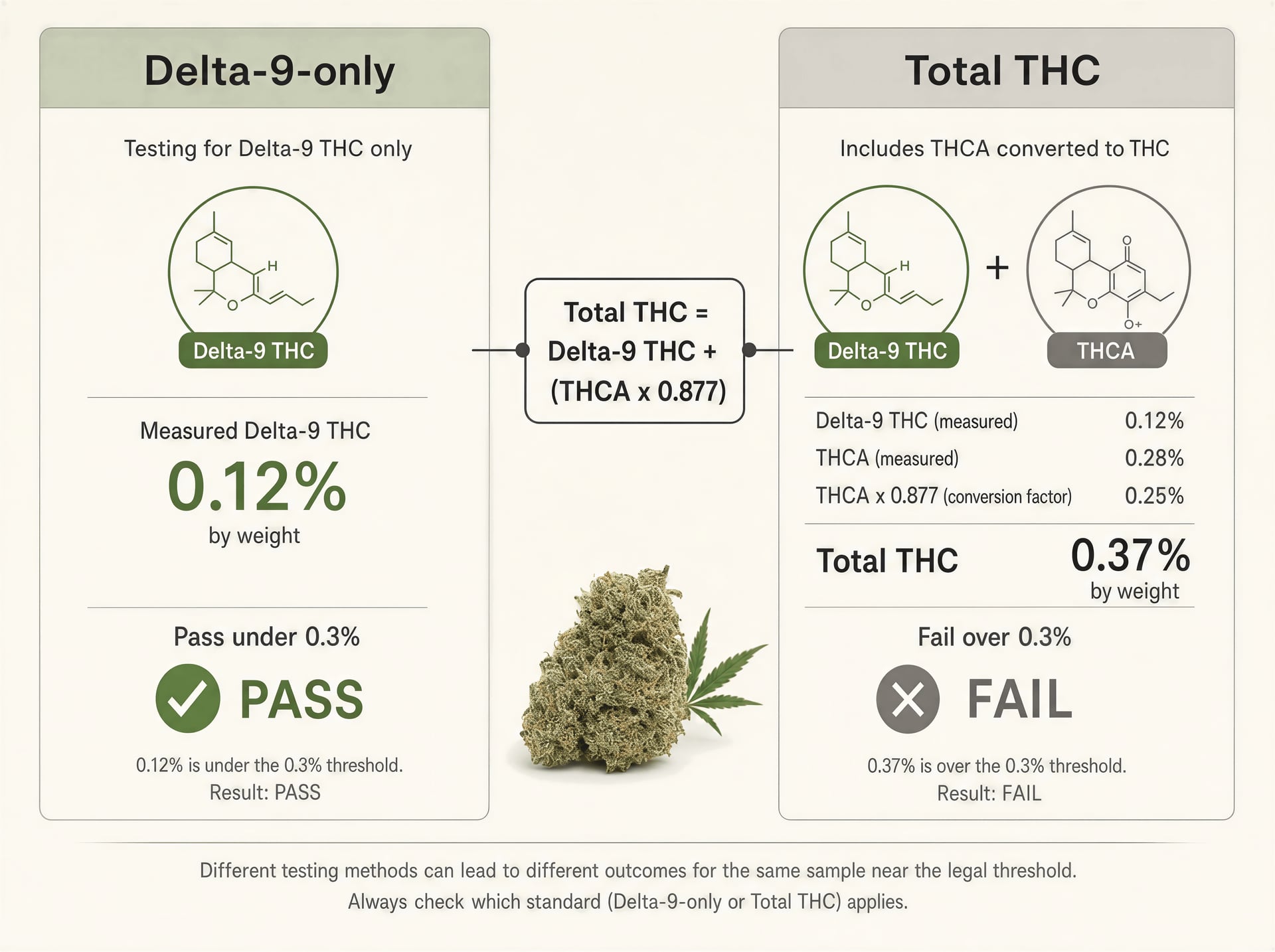
The most important testing dispute is whether the law looks only at measured Delta-9 THC or at “total THC,” which typically means Delta-9 plus the amount of THC expected to result from THCA after decarboxylation. Laboratories often calculate this with a conversion factor that reflects the molecular weight change when THCA loses its carboxyl group. In practice, that is why regulatory reports commonly use a formula such as:
Total THC=Delta-9 THC + (THCA × 0.877)
The 0.877 factor is not arbitrary. It accounts for the mass difference between THCA and the Delta-9 THC produced after decarboxylation. If a sample contains 0.1% Delta-9 THC and 0.5% THCA, total THC would be roughly 0.1 + (0.5 × 0.877)=0.5385%. Under a Delta-9-only rule, that sample looks compliant with a 0.3% cap. Under a total-THC rule, it fails clearly.
That distinction is one of the central reasons “hemp” is not a stable scientific category. In the European Union, the Common Agricultural Policy raised the THC limit for eligible hemp varieties from 0.2% to 0.3% in 2021, but member states still vary in how they treat flowers, extracts, and consumer products. Switzerland’s 1.0% total-THC approach shows how a higher threshold can support a broader lawful hemp sector while still drawing a legal line. Canada’s framework separates low-THC industrial hemp from the wider consumer cannabis system, and extraction of phytocannabinoids is handled under stricter federal controls. These are policy architectures built on chemistry, not discoveries about hidden species boundaries.
Total-THC testing is the more defensible approach for raw flower and pre-harvest compliance because it reflects the product’s likely post-heating behavior. Delta-9-only testing still has a place in some finished-product contexts, especially where the product will not be heated and where statutes are written that way, but as a general border between hemp and marijuana it is less credible. If the legal question is whether a cannabis material can function like high-THC cannabis once used as intended, THCA cannot be treated as irrelevant just because it has not converted yet.
That is the larger point regulators keep running into. Chemistry does not hand lawmakers a single natural dividing line. Legislatures choose one: 0.2%, 0.3%, 1.0%; Delta-9 alone or total THC; raw plant, finished edible, beverage, or inhalable flower. The plant stays the same. The category changes.
Where the 0.3% Standard Came From and Why It Became So Influential
The modern 0.3% THC rule is often treated as if it marks a natural dividing line inside Cannabis sativa L. It does not. That number became famous because regulators needed an administrable cutoff, not because botanists discovered a universal biological boundary separating “hemp” from “marijuana.” Once written into statutes, however, the figure hardened. It now shapes farming permits, crop destruction orders, criminal exposure, insurance, laboratory protocols, and interstate commerce.
The historical rise of 0.3%
The number is usually traced to agronomic research rather than to criminal law. A key reference point is Ernest Small and Arthur Cronquist’s 1976 taxonomic treatment, “A Practical and Natural Taxonomy for Cannabis,” published in Taxon. In that paper, they proposed 0.3% delta-9 THC in the upper leaves of female plants as a practical criterion for distinguishing what they called Cannabis sativa subsp. sativa from subsp. indica. Practical is the important word. Small later emphasized that the threshold was not a sharp biological truth. It was a helpful convention for classifying plant populations with different typical resin profiles.
That distinction mattered in crop science because breeders, agronomists, and regulators were trying to identify fiber and grain cultivars that tended to produce relatively low THC. It did not matter, at least at first, as a universal rule for every legal purpose and every product form. A standing field grown for fiber is not the same thing as a concentrated extract, a dried flower, a beverage, or a vape cartridge. Yet the number migrated far beyond the context in which it was first used.
Canada was one of the jurisdictions that helped cement 0.3% into modern hemp governance. Current federal guidance still defines industrial hemp by plant material containing THC at 0.3% w/w or less in the flowering heads and leaves. That approach kept the focus on low-THC cultivation while placing extraction and consumer cannabis under separate legal frameworks. Later, the United States borrowed the same headline number but embedded it in a broader federal definition. The 2018 Farm Bill states that hemp means Cannabis sativa L. and “any part of that plant” with “a delta-9 tetrahydrocannabinol concentration of not more than 0.3 percent on a dry weight basis.” That language did more than legalize a crop. It turned a once technical agronomic marker into a national jurisdictional boundary.
The threshold then spread by imitation and policy convenience. The European Union had long used 0.2% in parts of its agricultural framework, then raised the limit to 0.3% in 2021 under the Common Agricultural Policy. Switzerland offers the clearest counterexample: cannabis with total THC below 1.0% is generally outside the Narcotics Act. Same plant genus. Different legal line. That alone shows the point. If 0.3% were a fixed scientific boundary, 1.0% could not function in practice as a lawful hemp-type threshold in a neighboring European market. But it does.
From agronomic shorthand to legal bright line
Once lawmakers adopted 0.3%, the number stopped behaving like a rough descriptor and started operating like a switch. Above it, the crop may be contraband. Below it, it may be an agricultural commodity. This is the classic movement from guideline to bright line.
The U.S. example is especially revealing. Congress chose a delta-9 THC threshold on a dry-weight basis in 2018, but USDA implementation pushed the compliance system toward total THC by requiring laboratories to use post-decarboxylation methods or other similarly reliable methods that account for THCA’s conversion into THC. That is a major legal shift hidden inside a technical testing rule. A plant can test below 0.3% delta-9 before heating yet exceed the limit once THCA is converted. So even where the statute names delta-9 THC, enforcement may function as total THC control.
That matters because bright lines are only bright after regulators decide what, exactly, is being measured. Delta-9 only? Delta-9 plus 0.877 times THCA? Flowering tops only? Whole plant? Finished product by dry weight? Wet slurry before processing? Those choices determine who is lawful and who is not.
The current state-level volatility in the United States shows how deeply entrenched the number has become and how unstable its application remains. In Texas, hemp is still distinguished from marijuana by a 0.3% delta-9 THC threshold, and enforcement against smokable hemp has resumed, yet legal uncertainty persists because THCA possession is not explicitly prohibited in state law, as reported by Texas Public Radio and KUT in 2026. In other words, the same 0.3% figure can coexist with serious ambiguity when the analyte named in the statute does not match the chemistry of the products actually being sold.
North Carolina’s 2026 push to rewrite hemp rules after federal spending legislation set a 0.3% THC limit for hemp products shows another dynamic: once a federal threshold is chosen, states often rebuild their entire regulatory architecture around it. Illinois moved in a different direction but reached the same structural lesson. Its 2026 hemp law pulled much of the intoxicating hemp market into the state cannabis regulatory system. That move effectively acknowledged that source-based legality—hemp-derived versus marijuana-derived—often matters less in practice than the cannabinoid profile and intended use of the final product.
Critiques of the threshold as scientifically thin
Scientists and policy analysts have been questioning the 0.3% line for decades because it is neither toxicologically grounded nor taxonomically clean. It does not identify a level at which psychoactive risk suddenly appears. It does not map neatly onto distinct plant species. And it is easy to manipulate around the edges through breeding, harvest timing, sampling location, moisture content, and product formulation.
Ernest Small himself later remarked that 0.3% was arbitrary. Other scholars have made the same point more bluntly: the line is administratively useful, but scientifically flimsy. A plant testing at 0.29% and one at 0.31% are not meaningfully different in any ordinary biological sense, yet one may be lawful hemp and the other a destroyed crop. Add laboratory measurement uncertainty and the problem gets worse. Sampling from different parts of the inflorescence can shift the result. Testing before or after decarboxylation can shift it again. So can the date of harvest.
There is also a category error built into public discussion. The 0.3% threshold originated as a way to identify low-THC plant material, not as a universal rule for all downstream goods. Applied to finished products, especially heavy items with small cannabinoid loads, dry-weight accounting can produce absurd outcomes. A gummy or beverage may fall below 0.3% by weight while still delivering a substantial intoxicating dose per serving. Regulators have noticed. That is one reason states increasingly regulate intoxicating hemp products more like marijuana, regardless of botanical source.
The better reading of the history is straightforward: 0.3% won because it was available, legible, and easy to copy. It supplied a single number that could fit statutes, licenses, test reports, and police reports. That convenience gave it staying power. Its scientific weakness did not prevent adoption; if anything, the very simplicity of the number helped it travel. The result is a global legal norm that looks natural only because it has been repeated so often.
United States Federal Law: The Farm Bill Definition of Hemp
The modern U.S. federal line between hemp and marijuana is legal, not botanical. A field of Cannabis sativa L. does not announce its status by species name, leaf shape, or intended use. Federal law assigns that status by THC content, and even then the picture is less simple than the often-repeated “0.3% THC” slogan suggests. The statutory definition speaks in terms of delta-9 THC on a dry-weight basis, but USDA crop-testing rules pull the system toward total THC by accounting for THCA conversion. On top of that, federal recognition of hemp as an agricultural commodity does not erase FDA authority over foods, supplements, and drugs, and it does not block states from imposing their own criminal, licensing, or consumer-product restrictions.
The 2018 Farm Bill's statutory language
The key federal text is in the Agriculture Improvement Act of 2018, usually called the 2018 Farm Bill. Congress amended the Controlled Substances Act and related agricultural statutes to define hemp as:
> “the plant Cannabis sativa L. and any part of that plant, including the seeds thereof and all derivatives, extracts, cannabinoids, isomers, acids, salts, and salts of isomers, whether growing or not, with a delta-9 tetrahydrocannabinol concentration of not more than 0.3 percent on a dry weight basis.” > — U.S. Congress, 2018
That sentence does several jobs at once. First, it sweeps broadly across plant parts and downstream materials: seeds, derivatives, extracts, cannabinoids, isomers, acids, salts. Congress did not legalize only stalk fiber or sterilized seed. It wrote a category that covers the plant and an enormous range of compounds and materials derived from it. That breadth is why the Farm Bill became the legal foundation for the post-2018 market in hemp-derived cannabinoids.
Second, the statute fixes the threshold at “not more than 0.3 percent.” That number was not discovered as a bright natural boundary between intoxicating and non-intoxicating cannabis. It is a legal cutoff. Historically, the 0.3% figure is often traced to taxonomic work by Ernest Small and Arthur Cronquist in 1976, who used it as a practical classification marker, not as a universal public-safety line. Congress later turned that marker into federal law. Once it entered the statute, however, the number gained enormous force. A crop at 0.29% delta-9 THC on a dry-weight basis can be hemp; at 0.31%, it may fall outside the definition.
Third, the definition is expressly limited to “delta-9 tetrahydrocannabinol” and specifies measurement “on a dry weight basis.” Both phrases matter. Delta-9 THC is the principal intoxicating cannabinoid regulators usually care about, but raw cannabis flowers commonly contain substantial THCA, the acidic precursor that can convert into delta-9 THC when heated. Dry-weight measurement also changes outcomes because water content can dilute or concentrate a percentage result. A fresh plant and a dried flower from the same crop will not present the same numbers.
This is where popular shorthand goes wrong. People say “hemp is cannabis under 0.3% THC,” but the statute does not say “total THC,” and it does not say “THCA plus THC.” It says delta-9 THC, dry weight basis. Read literally, that leaves room for high-THCA material that tests below 0.3% delta-9 before decarboxylation. That gap has shaped years of dispute over hemp flower, smokable products, and intoxicating hemp derivatives.
The Farm Bill also removed hemp from the federal definition of marijuana in the Controlled Substances Act, which was a major shift. Yet “removed from the CSA” is not the same as “free from all federal regulation.” Hemp became federally lawful in a specific sense: as a defined category of cannabis no longer treated as Schedule I marijuana solely by virtue of meeting that THC threshold. It did not become a regulatory blank space.
USDA implementation and total THC testing
USDA’s hemp production program made the statutory line harder in practice than the statutory wording alone might suggest. The Department’s rules, first in the 2019 interim final rule and then in the 2021 final rule, require laboratories to test in a way that captures the THC a crop can produce after THCA converts to delta-9 THC. USDA states that laboratories must use “a post-decarboxylation method or other similarly reliable methods where the total THC concentration level considers the potential to convert THCA into THC” (U.S. Department of Agriculture, 2021).
That is the critical move. Congress wrote “delta-9 tetrahydrocannabinol concentration,” but USDA told labs to measure post-decarboxylation or its equivalent. In chemistry terms, decarboxylation removes a carboxyl group from THCA, converting it into delta-9 THC when heat is applied. So USDA compliance testing is functionally a total THC regime, even if the statute’s famous phrase remains “0.3 percent delta-9.”
For growers, this distinction is not academic. A pre-harvest sample can show low delta-9 THC but still fail once THCA is counted through a total THC method. The common formula used in testing reflects the molecular-weight conversion from THCA to THC, generally expressed as THC + (THCA × 0.877). The 0.877 factor accounts for the loss of the carboxyl group during conversion. This means a flower with 0.2% measured delta-9 THC and 0.3% THCA would have an approximate total THC of 0.2 + (0.3 × 0.877)=0.4631%, well above the 0.3% limit for compliance purposes.
That approach is sensible as policy. If regulators measured only naturally present delta-9 THC in raw flower, high-THCA cannabis could fit the statutory wording while becoming far more potent when smoked, vaped, or otherwise heated. USDA’s method closes that loophole. It also shows that the real legal boundary is not merely about one compound named in isolation; it is about how agencies choose to measure the plant’s intoxicating potential.
USDA also built compliance around sampling windows, laboratory registration, and uncertainty concepts that further complicate the popular picture. Hemp must be sampled before harvest within prescribed timeframes, because THC levels can rise as the plant matures. The final USDA rule expanded the harvest window from 15 to 30 days after sampling, a practical concession to farming conditions, but the core issue remains: legality can turn on a sample taken at a specific moment. There is nothing fixed or timeless about that.
Even the handling of test uncertainty shows that this is a regulatory system, not a pure scientific fact. USDA moved away from treating certain negligent violations automatically where a producer made reasonable efforts and a crop exceeded the threshold, and it adjusted negligence thresholds upward from 0.5% to 1.0% total THC for some enforcement purposes. But that did not change the legal definition of hemp itself. The crop still must meet the 0.3% standard to qualify as hemp; the higher figure changes how violations are treated, not what hemp means.
Why federal hemp legality does not settle state law
The Farm Bill settled one question and left many others open. It established that qualifying hemp is not federal marijuana. It did not create a single nationwide rule for every hemp product, every retail format, every state criminal code, or every consumer market.
Start with federal agencies. USDA regulates domestic hemp production. FDA regulates foods, dietary supplements, cosmetics, drugs, and certain therapeutic claims. Those authorities are separate. A hemp extract can come from lawful hemp under the Farm Bill and still violate the Federal Food, Drug, and Cosmetic Act if marketed in a way FDA does not permit. That is why “federally legal hemp” is not a complete answer when discussing CBD in foods, delta-8 products, beverages, or inhalable consumer goods. Agricultural legality and product legality are different questions.
Then there is state law. States may run their own USDA-approved hemp plans or operate under the federal plan, but they also retain broad power over consumer safety, retail sales, age limits, licensing, testing, packaging, and criminal enforcement. This is where the legal map becomes unstable. One state may treat low-delta-9, high-THCA flower as lawful hemp under its statutes or enforcement posture; another may treat the same material as contraband or fold it into the regulated marijuana system.
Recent state developments make the point sharply. In North Carolina, lawmakers moved quickly in 2026 to rewrite hemp rules after federal spending legislation set a 0.3% THC limit for hemp products, a reminder that federal action can trigger rapid state revisions rather than uniformity. In Illinois, also in 2026, lawmakers pushed much of the intoxicating hemp market into the state’s cannabis regulatory system, treating hemp-derived intoxicants more like marijuana for retail-control purposes. In Texas, enforcement of a rule targeting smokable hemp resumed in 2026, even though hemp is still distinguished from marijuana by a 0.3% delta-9 THC threshold; at the same time, reporting from KUT noted that THCA possession is not explicitly prohibited under state law. That is analyte politics in real time. Delta-9 only? Total THC? Finished product? Raw flower? The answer changes the legal result.
So the strongest way to state the federal position is this: the 2018 Farm Bill created a federal agricultural definition of hemp centered on no more than 0.3% delta-9 THC on a dry-weight basis, but USDA implementation effectively tests crops using a total THC logic, and neither move prevents states or FDA from imposing additional rules. A cannabis sample can satisfy one part of federal law and still create legal problems under product law, state law, or both. That is not a contradiction. It is how the U.S. system is built.
The THCA Problem: Why Delta-9-Only Rules Create Loopholes and Litigation
The sharpest fault line in modern hemp law is not botanical. It is chemical and procedural. A statute may say “delta-9 THC,” but the flower on the shelf often contains most of its THC in acidic form, as tetrahydrocannabinolic acid, or THCA. Before heating, THCA is not delta-9 THC. After heating through smoking, vaping, or baking, a substantial share converts to delta-9 THC by decarboxylation. That is the core mismatch. A product can appear compliant under a delta-9-only threshold while functioning, in real-world use, much like cannabis sold in adult-use markets.
The 2018 U.S. Farm Bill hardwired this tension into federal law by defining hemp as Cannabis sativa L. and its derivatives with “a delta-9 tetrahydrocannabinol concentration of not more than 0.3 percent on a dry weight basis.” Read literally, that language focuses on one analyte: delta-9 THC. But regulators quickly recognized the loophole. If the law measures only delta-9 in raw plant material, then high-THCA flower can slot into the hemp category before anyone strikes a lighter. USDA’s answer was to move in a different direction for production compliance. Its 2021 hemp rule requires laboratories to use “post-decarboxylation or other similarly reliable methods” so that total THC reflects “the potential to convert THCA into THC.” That is a quiet but major shift from the text many nonlawyers think controls the entire field.
How high-THCA flower can test compliant before heating
Fresh or cured cannabis flower usually contains cannabinoids in their acid forms. THCA dominates in many chemovars. On a certificate of analysis, a sample might show delta-9 THC at 0.2% dry weight, apparently under the familiar 0.3% line, while THCA sits at 20% or 25%. Under a delta-9-only reading, that flower looks like lawful hemp. In actual use, it does not behave like low-THC fiber hemp.
Chemically, the issue is simple. THCA loses a carboxyl group when heated and becomes delta-9 THC, though not at a one-to-one mass ratio because carbon dioxide is lost in the reaction. That is why laboratories and regulators often use the 0.877 conversion factor in total THC formulas: total THC=delta-9 THC + (0.877 × THCA). The 0.877 figure reflects the molecular weight difference between THCA and THC. So flower with 0.2% delta-9 THC and 20% THCA does not represent 20.2% total THC. It represents about 17.74% total THC. That still places it far above any ordinary hemp threshold.
This is not a technical corner case. It is the business model behind a large portion of the “THCA flower” market in states where statutes or enforcement practices have leaned heavily on delta-9 alone. Texas has become a prominent example. Reporting from Texas Public Radio in 2026 described enforcement returning for a rule targeting smokable hemp, while the legal distinction between hemp and marijuana still turned on the 0.3% delta-9 THC threshold. KUT in 2026 added the key detail: possession of THCA products was not explicitly prohibited in state law. That gap matters because it creates space for sellers to argue that unheated flower rich in THCA is lawful hemp so long as measured delta-9 remains under 0.3%.
The intoxicating potential is not hypothetical. It is predictable. Anyone familiar with combustion chemistry knows what happens next. Once the product is smoked or vaporized, the statute’s pre-heating analyte stops describing the user experience. This is why delta-9-only rules are not just incomplete; they are structurally evasive when applied to inhalable flower. They invite regulated categories to diverge from functional reality.
Total THC formulas as an anti-evasion response
Total THC rules exist because lawmakers and agencies saw that loophole early. They are an anti-evasion device. The idea is straightforward: classify plant material based not only on delta-9 THC present at the time of testing, but also on the amount of THCA reasonably available to become delta-9 THC after decarboxylation.
USDA’s hemp framework is the clearest U.S. federal statement of that logic. Although the Farm Bill’s definitional section uses delta-9 THC language, USDA did not leave production testing there. Its rule requires post-decarboxylation or similarly reliable methods and explicitly says total THC must consider THCA’s conversion potential. In practice, that means the federal production system does not accept the fiction that a high-THCA crop is harmlessly “hemp” because the delta-9 number, frozen before heating, is low.
Other jurisdictions have taken related paths, even if they differ on threshold. Canada’s industrial hemp rules still use the familiar 0.3% THC benchmark in flowering heads and leaves, but Canada separates that agricultural category from the broader Cannabis Act system, which regulates consumer cannabis and phytocannabinoid extraction through a different architecture. Switzerland, by contrast, uses a much higher ceiling: cannabis with less than 1.0% total THC is generally outside the Narcotics Act, according to the Federal Office of Public Health in 2024. That higher line changes market structure, but the important point here is that Switzerland’s rule is candid about total THC. It addresses actual potency more directly than a narrow delta-9-only test does.
The European Union adds another layer of complexity. The European Commission raised the Common Agricultural Policy threshold from 0.2% to 0.3% in 2021 for eligible hemp varieties, yet member states continue to diverge on finished flower, extracts, and retail products. The result is a patchwork where the same plant may be agricultural hemp for subsidy or seed-catalogue purposes, but treated quite differently when sold as inhalable material. Again, the category is legal, not natural.
Where product form changes, the rationale for total THC can change too. For beverages or gummies, delta-9 may be the relevant analyte because the product has already been processed and the intoxicating cannabinoid is already present in active form. For raw flower, especially smokable flower, ignoring THCA makes far less sense. That distinction should be stated plainly. A delta-9-only rule is somewhat more defensible for certain finished products than for inhalable plant material designed to be heated by the consumer.
Evidentiary and forensic complications
Even when regulators adopt total THC concepts, disputes do not disappear. They move into evidence, lab method, and statutory interpretation.
The first problem is textual. If a legislature names only delta-9 THC, defense lawyers can argue that agencies, police, or prosecutors have no authority to collapse THCA into the legal threshold. That argument has force when criminal liability is at stake. Courts generally do not like agencies rewriting penal definitions through guidance documents or laboratory conventions. If the statute says delta-9, a defendant may insist that only delta-9 counts. Regulators answer that the law would otherwise be trivial to evade. Both sides have a point, which is why litigation persists.
The second problem is analytical. “Total THC” sounds exact, but it rests on measurement choices. Labs may use direct post-decarboxylation methods or calculate total THC from separate delta-9 and THCA values. Sample preparation matters. Moisture content matters because the threshold is on a dry-weight basis. Timing matters because cannabinoid profiles can shift during harvest, curing, storage, and transport. Sampling error matters because one bud from the top of a plant may not match another from lower branches. For a crop hovering around legal limits, those details can decide whether a farmer destroys a field or brings it to market.
Federal hemp rules partly acknowledge this by building in measurement uncertainty concepts for crop compliance. But in retail or criminal settings, the uncertainty question becomes more adversarial. Was the seized flower tested as sold, after drying, after grinding, or after heating? Was the lab accredited for cannabis testing? Did the method quantify THCA separately? Did the analyst apply the 0.877 conversion correctly? Those are not trivial technicalities. They are the case.
There is also a consumer-facing evidentiary issue. Retail packaging may advertise “under 0.3% delta-9 THC” and provide a lab report proving exactly that. The statement can be chemically accurate and still deeply misleading about effect. For courts and regulators, that creates a classification headache. For users, it creates an expectations problem. The label tracks one legal metric while obscuring the likely post-heating potency.
The current U.S. state landscape shows how unstable these lines are. North Carolina lawmakers moved rapidly in 2026 after federal spending legislation imposed a 0.3% THC limit for hemp products, according to Axios Raleigh. Illinois, Axios Chicago reported in 2026, pushed much of the intoxicating hemp market into the state cannabis regulatory system. Those moves reflect the same policy judgment: when hemp-derived or nominally hemp products produce marijuana-like effects, governments often stop treating the hemp label as dispositive.
That judgment is correct. For smokable flower, delta-9-only classification is a bad rule. It misdescribes the product, rewards formalism over function, and generates exactly the loopholes and lawsuits now consuming state legislatures, agencies, and courts. Total THC is not perfect, and laboratory practice still leaves room for dispute, but it is closer to the pharmacological reality that law is trying, however imperfectly, to govern.
State-Level U.S. Divergence: North Carolina, Illinois, and Texas as Case Studies
The 2018 Farm Bill looked simple on paper. It defined hemp as Cannabis sativa L. and “any part of that plant” with a delta-9 THC concentration of not more than 0.3 percent on a dry-weight basis. That sentence became the launch point for a national hemp market, but it never created a uniform retail system. It did something narrower: it drew one federal line around one cannabinoid measurement. States then built very different legal architectures on top of it.
That divergence is no longer a side issue. It is the main story. A jar of flower, a gummy, a vape, or a canned drink can be treated as lawful hemp, restricted intoxicant, licensed cannabis product, or contraband depending on which state is asking, which compound is being measured, and whether the rule targets cultivation, possession, manufacturing, or sale. North Carolina, Illinois, and Texas show how fast the center of gravity has shifted away from the old hemp-versus-marijuana binary. These states are increasingly sorting products by intoxication risk, product form, and retail channel rather than by plant origin alone.
The scientific chemistry did not change. The legal categories did.
North Carolina's rapid rewrite after federal spending legislation
North Carolina’s recent scramble over hemp rules is a good example of how federal action can force state lawmakers to rebuild definitions in a hurry. According to Axios Raleigh in 2026, legislators moved quickly after federal spending legislation set a 0.3% THC limit for hemp products. That matters because much of the earlier hemp economy had operated in the space between broad Farm Bill language and thin state retail controls. Once the federal signal hardened around products, not just crops, states had to decide whether to copy that threshold, add age gates, restrict formats, or channel sales through more tightly regulated systems.
The speed of the rewrite tells its own story. If hemp were a stable botanical category, there would be little need for urgent statutory repair. But the category is not stable. It depends on what regulators mean by “THC” in the first place. The federal Farm Bill speaks in terms of delta-9 THC on a dry-weight basis. USDA production rules, by contrast, require laboratories to use post-decarboxylation testing or similarly reliable methods that account for THCA’s conversion into THC, effectively a total-THC approach for crop compliance. Those are already two different legal lenses applied to cannabis under the same broad federal framework.
North Carolina’s response shows what happens when lawmakers confront the retail consequences of that mismatch. A 0.3% limit sounds precise, but precision here is deceptive. In a beverage, dry weight calculations can make surprisingly large amounts of delta-9 THC appear compliant because the denominator is the product’s total mass. In flower, the same nominal threshold can be much harder to satisfy if the state or an enforcement lab starts thinking in total-THC terms. In edibles, the issue becomes milligrams per serving versus percentage by weight. So when lawmakers “revise hemp rules,” they are not merely updating definitions. They are choosing which testing logic controls which product.
That is why North Carolina’s rewrite should be read as a policy pivot, not a clerical fix. The state is being pushed to answer several questions the Farm Bill left unresolved. Is hemp legality determined by source or by finished-product effect? Does a low-delta-9 product that can intoxicate through other pathways remain “hemp” for retail purposes? Should flower, vapes, and drinks be treated the same way? Once federal spending legislation emphasized a 0.3% THC cap for hemp products, the pressure increased to close gaps that had let highly intoxicating hemp-derived goods circulate in ordinary retail settings.
North Carolina is not unusual in facing these questions. What makes it a useful case study is the visible cascade from Washington to Raleigh. One federal adjustment set off a state-level rewrite because the state had to decide how much of the intoxicating hemp trade it was willing to tolerate outside a cannabis-style system. That is fragmentation in action: same plant, same federal baseline, very different state consequences.
Illinois and the move to regulate intoxicating hemp within cannabis systems
Illinois has taken the clearest position of the three states discussed here. Instead of pretending that hemp-derived intoxicants are meaningfully different from other THC products just because they originated from legally defined hemp, the state moved to regulate much of that market inside its cannabis system. Axios Chicago reported in 2026 that Illinois enacted a framework bringing much of the intoxicating hemp market into the state’s cannabis regulatory structure.
That is the right policy move.
The reason is straightforward. If a product is sold for its intoxicating effect, regulators should not ignore that effect merely because the delta-9 THC came from hemp or because another cannabinoid pathway helped produce the same result. The old retail model created an obvious asymmetry. Licensed cannabis operators faced testing, packaging, taxation, age restrictions, and track-and-trace obligations. Meanwhile, hemp-derived intoxicants often reached consumers through gas stations, smoke shops, convenience stores, and online channels under lighter rules. That was less a principled distinction than a loophole with a chemistry lesson attached.
Illinois appears to have treated the issue as one of functional equivalence. A hemp-derived product that intoxicates is, from a public-health and enforcement perspective, closer to cannabis than to rope fiber or grain seed. Folding such products into the cannabis system acknowledges that reality. It also exposes a deeper point about legal definitions: “hemp-derived” does not answer the regulatory question that matters most to states, which is what the product does in the market.
This approach also reduces the gamesmanship produced by analyte selection. If a state remains obsessed only with the 0.3% delta-9 figure, producers can design products that fit within that metric while still delivering substantial psychoactive effects through serving size, concentration, or precursor chemistry. Illinois’s framework moves away from that narrow threshold logic. It focuses more on intoxication and retail pathway. That is a better match for how these products are actually consumed.
There is also an administrative logic to Illinois’s move. States with legal cannabis systems already have agencies, license categories, compliance labs, labeling rules, child-resistant packaging standards, and enforcement mechanisms. Creating a parallel permissive channel for intoxicating hemp products invites conflict and arbitrage. Businesses route functionally similar goods through whichever channel faces fewer constraints. Consumers then encounter products with inconsistent warnings, different testing standards, and uncertain age controls. Bringing hemp intoxicants into the cannabis framework reduces that split-screen market.
Critics sometimes frame this as an attack on hemp. It is not. Non-intoxicating hemp products can still be treated differently. Fiber, grain, and low-risk cannabinoids do not raise the same retail concerns as inhalable or edible products sold for a THC-like effect. Illinois’s significance lies in drawing a distinction within the hemp sector itself. The state is no longer asking only whether a product came from hemp. It is asking whether the product belongs in the same regulatory box as marijuana because of how it functions. That is a major departure from the simplistic binary popularized after 2018.
Texas, smokable hemp, and the unresolved THCA question
Texas offers the opposite picture: a state still anchored to the 0.3% delta-9 line, while practical enforcement keeps running into products that make that line look incomplete. Texas Public Radio reported in 2026 that the state is again enforcing limits on smokable hemp. At the same time, KUT reported that Texas hemp regulations hinge on a 0.3% delta-9 THC standard while possession of THCA products is not explicitly prohibited under state law. Those two facts sit uneasily together.
The smokable-hemp fight is partly about product form. Lawmakers and regulators often treat flower and inhalable products differently from tinctures, topicals, or processed foods because smoking or vaping can make enforcement harder and can place hemp flower in direct visual and sensory overlap with marijuana. To an officer or inspector, one dried cannabis bud looks a lot like another. A retail ban or restriction on smokable hemp therefore does more than regulate consumption. It tries to reduce a category that is difficult to police under a delta-9-only threshold.
Yet the THCA issue shows why product-form restrictions do not solve the chemistry problem. THCA is the acidic precursor to delta-9 THC. In raw flower, much of the potential intoxicating content may be present as THCA rather than delta-9. Apply heat through smoking, vaping, or cooking, and THCA decarboxylates into delta-9 THC. That is why USDA’s hemp production rules require post-decarboxylation or similarly reliable methods that consider total THC. The agency understood the obvious loophole: a crop can test below 0.3% delta-9 before heating while carrying enough THCA to yield much more THC after heating.
Texas’s statutory gray area exists because its central legal line remains tied to delta-9 THC, while THCA possession is not expressly banned in the same clean way. That creates a gap between formal definition and real-world effect. A product can fit the letter of a delta-9 threshold at the moment of testing and still behave much like high-THC cannabis when consumed. If state law does not clearly address THCA, enforcement becomes inconsistent. Prosecutors, police, retailers, and consumers are left arguing about whether the law reaches precursor-rich flower that is low in measured delta-9 but high in practical intoxicating potential.
This is not a trivial technicality. It goes to the core of how cannabis categories are constructed. If Texas measures only delta-9, it draws one legal map. If it switches to total THC, it draws another. The plant does not move; the law does.
The return of smokable-hemp enforcement also shows that states are regulating sensory and retail realities, not just chemistry. Flower is the format most likely to blur hemp and marijuana in appearance, odor, and use. So even when Texas maintains the federal-style 0.3% delta-9 threshold, it still imposes separate limits based on form. That means “hemp” in Texas is not one thing. It is a legal status filtered through cannabinoid measurement, product type, and enforcement priorities.
Taken together, North Carolina, Illinois, and Texas show that state cannabis law is no longer organized around a single question: hemp or marijuana? North Carolina is rewriting rules under federal pressure around THC limits for products. Illinois is channeling intoxicating hemp into cannabis regulation because effect matters more than source. Texas is preserving the 0.3% delta-9 boundary while struggling with smokable products and the unresolved status of THCA. Those are not minor local variations. They are evidence that U.S. states are building post-binary cannabis policy, one patchwork statute at a time.
European Union: A Shared Crop Threshold, Fragmented Product Rules
The European Union often gets described as if it had a single hemp rule. It does, and it does not. At the crop level, the EU has a common threshold for agricultural support and for the varieties that can circulate through the Common Catalogue. But once hemp leaves the field and becomes flower, extract, vape liquid, edible oil, tea, cosmetic, or “wellness” product, the legal picture breaks apart. That split matters because the same plant can be treated as eligible agricultural hemp for subsidy purposes and still trigger narcotics, food, consumer-safety, or medicines rules once sold to the public.
The line itself is legal, not botanical. A cultivar does not become “marijuana” because its biology changes at 0.31% THC. The law changes. In Europe, that legal line is drawn one way for farm policy and often another way for retail products and criminal enforcement.
The CAP shift from 0.2% to 0.3%
Under the EU’s Common Agricultural Policy, the key change was straightforward on paper: the THC ceiling for hemp eligible for support moved from 0.2% to 0.3%. The European Commission states the figure plainly. From 2023 onward, hemp used in CAP support schemes must come from varieties with a THC content not exceeding 0.3%, up from the older 0.2% limit set in prior policy cycles.
That increase was not cosmetic. It aligned the EU more closely with other major jurisdictions, especially Canada and the United States, both of which use 0.3% as a central legal marker in their hemp frameworks, though the underlying testing architecture differs. Canada defines industrial hemp as cannabis with THC at 0.3% w/w or less in the flowering heads and leaves. The U.S. 2018 Farm Bill uses “not more than 0.3 percent on a dry weight basis,” and USDA implementation pushes testing toward post-decarboxylation or similarly reliable total-THC methods that capture THCA’s conversion potential. The EU’s move reduced one source of trade and breeding friction. A 0.2% ceiling had long been criticized as unusually tight because cultivars can vary with weather, harvest timing, and field conditions, making compliance harder without any meaningful change in public-health risk.
Still, the CAP threshold should not be mistaken for a general EU consumer legality threshold. It is first an agricultural eligibility rule. It determines which hemp varieties can qualify in the CAP context and which listed varieties fit the common agricultural framework. That is narrower than saying every product made from those varieties is lawful across the single market. It is not.
The Court of Justice of the European Union helped clarify one part of this tension in Case C-663/18, B S and C A v Ministre public (Kanavape, 2020). The Court held that CBD lawfully produced in one member state could not be banned by another member state under free-movement rules if the restriction was not justified, and it also stated that CBD extracted from the whole plant is not a narcotic within the meaning of the relevant international and EU instruments as interpreted in that case. But Kanavape did not create a borderless hemp-products market. It narrowed one route for blanket prohibition. Member states still retained room to regulate products under food, medicines, consumer protection, and public-order law.
That is the recurring EU pattern: one common crop threshold, many downstream legal filters.
Member-state variation in flowers, extracts, and foods
The hardest mistake to avoid is assuming that a hemp variety permitted under EU agricultural rules can be sold in any form throughout the Union. Flowers show why this assumption fails.
Some member states have treated raw hemp flower as a narcotics-risk product because it is smoked, resembles illicit cannabis, or makes roadside and policing distinctions difficult. Others have permitted sale under conditions tied to THC content, source, or intended use. The result is a market where flower can sit in a legal gray zone even when the crop itself came from an approved low-THC variety. The European Union Drugs Agency has repeatedly described this inconsistency: low-THC cannabis products are spreading, but rules differ sharply on what counts as a legal consumer good and what falls into narcotics control.
Extracts are no cleaner. CBD extracts may be non-intoxicating in ordinary use, yet they can still face restrictions because extraction concentrates cannabinoids, raises impurity concerns, or shifts a product toward medicines law. Some countries focus on whether the extract contains detectable Delta-9 THC. Others care whether the source material included flowering tops. Others still ask whether the product is presented with therapeutic claims, in which case medicines regulation can take over regardless of THC level.
Food law adds another layer. At EU level, many hemp-derived ingestible products run into the Novel Food regime. In practice, this means that a CBD oil can be made from an agricultural hemp crop that is legal to grow, yet still cannot be lawfully marketed as a food without the required authorization. Seeds, seed oil, and defatted seed products have a more established food history, so they are usually easier to place on the market. Cannabinoid-rich extracts are another matter. The legal issue is no longer “is this hemp?” but “is this an authorized food ingredient, a supplement, a medicine, or an unsafe product?”
Then there is intoxication. Member states and EU institutions alike have become more wary of semi-synthetic or converted cannabinoids sold through the hemp channel, especially products built around hexahydrocannabinol (HHC) after it spread across European markets in 2022 and 2023. HHC is a good reminder that “hemp product” tells regulators almost nothing by itself. If a product is intoxicating, many governments will regulate it more like controlled cannabis than like agricultural hemp, even if its starting material came from lawful low-THC biomass. The label does not control the legal outcome. The chemistry and product effect often do.
This is where the European position can be stated plainly: the CAP’s 0.3% figure has improved crop harmonization, but it has not harmonized the consumer market in any serious sense. Flowers, extracts, and edibles remain governed by a patchwork of national choices layered on top of EU food and internal-market law. Anyone treating 0.3% as a universal EU permission slip is overstating the law.
The EU's distinction between agricultural hemp and narcotics control
The cleanest way to understand Europe is to separate legal functions. Agricultural hemp rules decide what farmers may cultivate within CAP structures and common-variety systems. Narcotics law decides what substances or products trigger criminal control. Product law decides what may be sold, ingested, inhaled, or advertised to consumers. These systems overlap, but they are not the same instrument and do not answer the same question.
That separation is why a low-THC crop can be lawful in the field while a finished retail product made from it faces sanctions or removal. Agricultural law is asking whether the crop falls within a supported and recognized hemp category. Narcotics control is asking whether a substance, preparation, or product should be restricted because of THC, abuse risk, or statutory classification. Food and consumer law are asking whether the product is safe, authorized, and correctly presented.
The distinction also explains why “hemp” is less stable as a legal concept than popular writing suggests. At EU level, the category works reasonably well for cultivation. It works far less well as a catch-all retail category. Once cannabinoids are extracted, concentrated, heated, inhaled, or eaten, regulators stop looking only at the field threshold and start looking at the product in front of them.
So the EU does have a shared number: 0.3%. But that number does one job, not every job. In Europe, hemp is unified at the farm gate and fragmented at the shop counter.
Switzerland's 1.0% Threshold: What a Higher Limit Changes
Switzerland is the cleanest rebuttal to the idea that the line between hemp and marijuana is dictated by botany. The plant does not change when it crosses a border. The law does. In Switzerland, cannabis with a total THC content below 1.0% is generally not treated as a narcotic under federal rules, according to the Federal Office of Public Health in 2024. That single number puts Switzerland far outside the 0.3% standard now familiar in the United States, Canada, and the European Union. It creates a much larger legal category of low-THC cannabis, and that wider category has practical effects all the way from seed choice to police seizures.
A Swiss cannabis flower testing at 0.8% THC would be illegal hemp nowhere in the U.S. federal system, because the 2018 Farm Bill fixed hemp at no more than 0.3% delta-9 THC on a dry-weight basis, while USDA enforcement for cultivation relies on post-decarboxylation methods that account for THCA conversion into THC. In Canada, industrial hemp is capped at 0.3% THC by weight in flowering heads and leaves. In the EU, the Common Agricultural Policy threshold was raised from 0.2% to 0.3% in 2021. Switzerland’s 1.0% line is not a small adjustment. It is more than three times higher than the now-dominant 0.3% benchmark.
Why Switzerland uses a 1.0% THC line
The Swiss rule reflects a policy judgment: cannabis below 1.0% THC is treated as posing a sufficiently different regulatory problem from higher-THC cannabis that it should not automatically fall under narcotics control. That is not a scientific discovery about a natural species boundary. It is a choice about where criminal and administrative law should begin.
The history matters here. The 0.3% figure often gets repeated as if it were a hard biological threshold, but its modern legal life comes from regulation, not from a universal pharmacological cutoff. Researchers and lawmakers have long used THC content as a sorting tool, yet there is no magic switch at 0.3% where one plant becomes “hemp” and another becomes “marijuana.” Switzerland’s 1.0% limit exposes that clearly. If 0.3% were scientifically inevitable, a major European jurisdiction could not function with a 1.0% line. But it does.
There is also a measurement issue hiding inside the comparison. Swiss authorities refer to total THC under 1.0%, which matters because total THC captures the intoxicating potential after THCA is converted by heat. That makes Switzerland’s higher threshold look less permissive than a superficial comparison to delta-9-only systems might suggest, but it is still plainly broader than 0.3% systems. A crop that sits comfortably below 1.0% total THC could never qualify under a 0.3% total THC standard. The legal category is simply wider.
That wider category can support cultivation of varieties that would be too risky in stricter jurisdictions. Anyone growing near a 0.3% cap faces a familiar problem: genetics, weather, harvest timing, and lab variation can push a compliant crop over the line. A 1.0% cap gives more agronomic room. That does not mean no compliance burdens; it means fewer crops are transformed into contraband by a narrow numerical margin.
Regulatory consequences of a wider legal hemp category
The first consequence is agricultural. A 1.0% threshold expands the range of lawful cultivars and reduces the chance that ordinary biological variation turns a field into an enforcement case. Under a 0.3% total THC rule, growers can lose compliance because plants mature a little too far, because sampling catches peak cannabinoid expression, or because a laboratory reports a result just above the cap. Switzerland’s wider threshold lowers that pressure. It does not remove testing. It changes the stakes.
The second consequence is market differentiation. A broader low-THC category makes it easier to sustain a visible trade in cannabis products that are legally distinct from narcotic cannabis, especially dried flower. This matters because flower creates recurring confusion for police and customs officers: visually and by smell, low-THC cannabis may be indistinguishable from higher-THC cannabis. Switzerland’s system therefore forces regulators to rely more heavily on testing and documentation rather than appearance alone.
That has an obvious policing effect. In a 0.3% jurisdiction, a larger share of cannabis-like material is presumptively on the wrong side of the line. In Switzerland, more of it is lawful. Enforcement does not disappear, but it shifts. Officers still need to determine whether a product exceeds 1.0% total THC, whether labeling is accurate, and whether other product-specific laws apply. The legal question is narrower than “is this cannabis?” and closer to “what kind of cannabis is this, and how was it measured?”
That distinction is exactly what many popular accounts miss. Raising the THC threshold does not create a free-for-all. Tobacco-substitute rules, consumer-product rules, agricultural controls, import restrictions, tax treatment, and advertising restrictions can still apply depending on the product. A low-THC flower sold for smoking is not governed in the same way as a cosmetic, a food, or a medicinal product. Switzerland’s example shows that a wider hemp category can coexist with a dense web of non-narcotics regulation.
It also sharpens product differentiation in the opposite direction. Once low-THC cannabis is clearly lawful up to 1.0%, products above that line stand out more distinctly as narcotics-regulated cannabis. The line is still artificial, but it becomes easier to administer because the low-THC side is broad enough to be commercially meaningful rather than a narrow technical exception.
Lessons and limits for international comparison
Switzerland demonstrates that hemp definitions are policy choices. Full stop. The U.S. Congress chose 0.3% delta-9 THC on a dry-weight basis in 2018. USDA then required post-decarboxylation or similarly reliable methods for cultivation compliance, effectively a total THC approach. Canada kept 0.3% in flowering heads and leaves. The EU moved from 0.2% to 0.3% in 2021. Switzerland chose 1.0% total THC. None of those numbers emerged from an international treaty command that a plant becomes a different legal object at one universal concentration.
The lesson, though, has limits. A higher threshold in Switzerland does not automatically mean another country can copy the model without friction. Legal systems differ on analyte, product categories, criminal penalties, medical access, consumer safety rules, and law-enforcement priorities. A 1.0% total THC rule in one country may be easier to administer than a 1.0% delta-9-only rule elsewhere, because the latter leaves more room for high-THCA material to masquerade as low-THC cannabis before heating. That problem is visible in current U.S. disputes. Texas, for example, has distinguished hemp from marijuana through a 0.3% delta-9 THC threshold while legal uncertainty has persisted around THCA-heavy products, as reported by Texas Public Radio and KUT in 2026.
So Switzerland should not be romanticized. It should be read correctly. Its 1.0% threshold proves that the hemp-marijuana divide is not a fixed scientific truth. It is a regulatory line, drawn by lawmakers, shaped by testing methods, and capable of moving. Switzerland simply makes that fact harder to ignore.
Canada: Industrial Hemp Within a Separate Cannabis Control System
Canada is a strong example of why “hemp” is not a pure botanical category. The country keeps a classic cultivation threshold for industrial hemp, yet at the same time places extraction, cannabinoids, and finished consumer products inside a much broader federal cannabis regime. That split matters. A crop can qualify as industrial hemp in the field and still trigger full cannabis controls once someone wants to process flowers, isolate cannabinoids, or sell a product for human consumption.
The industrial hemp definition at 0.3%
Health Canada’s current statement is direct: industrial hemp means a cannabis plant, or any part of that plant, “in which the concentration of THC is 0.3% w/w or less in the flowering heads and leaves” (Government of Canada, 2024). The wording deserves close attention because it shows how legal definitions are built. Canada is not simply saying that any cannabis plant under 0.3% THC is hemp in every context. It specifies both the threshold and the plant material that matters for classification: the flowering heads and leaves.
That focus on flowering heads and leaves is important because THC is not distributed evenly across the plant. Seeds and mature stalks are not the same regulatory problem as resinous floral material. Canada’s definition reflects that chemistry. It treats the low-THC agricultural crop as “industrial hemp” when the parts most associated with cannabinoid content stay at or below 0.3% THC by weight. This is a legal line, not a natural boundary visible to the eye.
Canada has used the 0.3% figure for industrial hemp for many years, and the number aligns with a widely copied international benchmark. But matching the number should not be confused with matching the whole system. In the United States, for example, the 2018 Farm Bill defines hemp as Cannabis sativa L. and any part of that plant, including derivatives and cannabinoids, with not more than 0.3% delta-9 THC on a dry-weight basis. USDA implementation then moved compliance toward post-decarboxylation testing or similarly reliable methods that account for THCA conversion, effectively a total THC approach (USDA, 2021). Canada’s framing is different. It preserves the 0.3% crop threshold for industrial hemp, yet it does not treat all downstream derivatives from that plant as ordinary hemp products outside cannabis law.
This is where many popular summaries go wrong. They assume that if a country uses 0.3%, it must be using the same policy model as every other 0.3% country. Canada shows otherwise. The same numerical threshold can sit inside a very different legal architecture.
How the Cannabis Act changed the wider regulatory landscape
The Cannabis Act, which came into force in 2018, changed the background legal environment for all cannabis in Canada, including hemp-adjacent activity. Before that shift, industrial hemp had its own narrower regulatory space, mainly tied to cultivation, grain, fibre, and limited derivatives. After legalization, Canada did not erase the industrial hemp category. It kept it. But it placed the broader cannabis economy under a unified federal framework covering production, processing, distribution, sale, possession, and product classes.
That distinction is why Canada is such a useful comparator in an international discussion. One can preserve a hemp threshold for farming while refusing to let that threshold decide everything about extracts and products.
Under the post-2018 system, phytocannabinoids are not treated as if they become ordinary consumer ingredients merely because they originated in a compliant hemp crop. If the activity involves extracting cannabinoids from the flowering material, manufacturing products containing cannabinoids, or selling cannabis products to consumers, the Cannabis Act and its regulations come into view. In practical terms, the law separates the question “Is this crop industrial hemp?” from the question “What may be done with cannabinoids from this crop?”
That is a sharper regulatory move than the U.S. federal definition took in 2018. The American statute expressly includes “derivatives, extracts, cannabinoids, isomers, acids, salts, and salts of isomers” within hemp if the delta-9 THC concentration stays at or below 0.3% on a dry-weight basis. Canada did not follow that path in the same way. Instead, it built a system in which cannabinoid-bearing materials and finished products are generally governed as cannabis, even if the underlying plant met the industrial hemp standard during cultivation.
This approach reduces one of the biggest loophole problems seen elsewhere: the idea that low-THC source material should automatically confer low-regulation status on concentrates, edibles, inhalables, or intoxicating derivatives. Recent U.S. state developments show why governments are rethinking that assumption. Illinois in 2026 moved much of the intoxicating hemp market into its cannabis regulatory system, and Texas has continued to struggle with a delta-9-centered distinction that leaves THCA questions unsettled. Canada reached the core policy point earlier and more cleanly. Source-plant status does not answer product-risk status.
Why crop status and consumer-product status are not the same question
This is the central lesson from Canada’s model. “Industrial hemp” is a crop classification. It is not a blanket exemption for all chemistry, all processing, or all retail formats that can flow from that crop.
Take a simple example. A field of cannabis plants may qualify as industrial hemp because the flowering heads and leaves test at 0.3% THC or less by weight. That tells regulators something real but limited: the crop falls on the lawful side of Canada’s hemp cultivation threshold. It does not settle whether someone may extract CBD or other phytocannabinoids from those flowers outside the cannabis licensing system. It also does not settle whether a consumer product containing those cannabinoids can be sold under ordinary food, natural health product, or wellness-product rules. In Canada, those are separate legal questions, and they are generally answered within cannabis law.
That separation reflects sound policy. Measuring THC in standing plant material is not the same as assessing the risk, potency, or market channel of a finished product. Dry flower, oils, vapes, beverages, capsules, and isolated cannabinoids do not pose the same regulatory issues. Concentration can change dramatically through processing. So can route of administration, dose precision, packaging concerns, youth appeal, and intoxication potential. A low-THC crop can still be the starting point for a high-potency extract. That is exactly why crop rules and product rules should not be collapsed into one.
Canada’s framework also avoids the fiction that “hemp-derived” automatically means non-intoxicating or outside cannabis control. Chemically, a cannabinoid extracted from a compliant hemp plant is still a cannabinoid. The source does not erase the need for rules on manufacturing standards, excise treatment, product classes, labeling, and lawful retail channels. On this point, Canada’s system is more coherent than approaches that let origin determine everything.
For an article comparing international definitions, Canada stands out because it combines continuity and change. The continuity is the familiar 0.3% threshold in flowering heads and leaves for industrial hemp. The change is the post-legalization decision to treat extraction, cannabinoids, and consumer products through a broader cannabis framework rather than through the agricultural hemp category alone. That makes Canada a clear case of regulatory layering: one THC threshold for identifying a lawful crop, another set of rules for what happens once that crop becomes a source of cannabinoids in commerce.
International Drug Control Treaties: What They Do and Do Not Define
The 1961 Single Convention and cannabis control
The starting point for any international comparison is the 1961 Single Convention on Narcotic Drugs, as amended by the 1972 Protocol. That treaty places “cannabis” and “cannabis resin” under international control. It also defines “cannabis” in a way that matters: the term refers to the flowering or fruiting tops of the cannabis plant, excluding the seeds and leaves when not accompanied by the tops. That is a control definition, not a commercial hemp rule.
The distinction is crucial. The Single Convention does not say that cannabis below 0.3% THC is hemp. It does not create a 1.0% category either. It does not instruct countries to test delta-9 THC rather than total THC, and it says nothing about THCA conversion formulas, dry-weight calculations for consumer products, or how to classify intoxicating hemp derivatives sold as edibles, vapes, or beverages. Those are all later national choices.
Treaty language did leave one opening that countries have long relied on for low-THC fiber and seed uses. Article 28 applies cannabis controls, but it excludes cultivation “exclusively for industrial purposes (fiber and seed) or horticultural purposes” from the full control system applied to cannabis cultivation for drug production. Even there, the treaty does not define what counts as “industrial” cannabis by chemical composition. No THC ceiling appears in Article 28. No list of approved cannabinoids appears anywhere. The treaty controls a plant and certain plant material categories; it does not build the modern compliance architecture that now dominates hemp law.
That gap matters more now than it did in 1961 because today’s hemp regulation is chemistry-heavy. Legislatures and agencies care about whether the measured analyte is delta-9 THC alone or total THC after decarboxylation, whether the sample was taken pre-harvest or from a finished product, and whether the item is raw flower, extract, or a formulated edible. The treaty era did not anticipate that kind of market segmentation.
WHO’s Expert Committee on Drug Dependence made this plain during its 2018 cannabis review, which fed into the 2020 Commission on Narcotic Drugs scheduling changes. The review focused on dependence, abuse liability, therapeutic use, and the status of preparations such as cannabidiol with not more than 0.2% THC. That exercise showed how legal categories are layered onto chemistry and policy priorities rather than dictated by plant taxonomy alone.
Why treaties do not create a modern hemp marketplace definition
A persistent public misconception is that there must be a single international line separating hemp from marijuana. There is not. The familiar 0.3% figure is not a treaty rule. It is a national legislative choice that became influential through domestic statutes and regulatory borrowing.
The modern U.S. definition is the best-known example: the 2018 Farm Bill states that hemp means Cannabis sativa L. and “any part of that plant” with a delta-9 THC concentration of “not more than 0.3 percent on a dry weight basis.” That number has enormous practical force, but it is not a UN threshold. And even the U.S. does not stop at delta-9 in production compliance. USDA’s 2021 hemp rules require laboratories to use post-decarboxylation or similarly reliable methods so that “total THC concentration level considers the potential to convert THCA into THC.” In other words, one legal system can speak the language of delta-9 in a statute while enforcing something closer to total THC in cultivation.
That is exactly why treaty text cannot do the work many readers assume it does. The treaties do not answer whether a high-THCA flower that tests below 0.3% delta-9 but above 0.3% total THC should be lawful hemp. They do not answer whether a beverage can exploit dry-weight math to carry a large absolute THC dose while staying under a percentage threshold. They do not answer whether intoxicating compounds derived from lawful hemp should be treated like state-licensed cannabis products. Those are domestic regulatory problems.
Current U.S. state disputes make the point vivid. In Texas, the legal line still turns on a 0.3% delta-9 THC standard distinguishing hemp from marijuana, yet KUT reported in 2026 that possession of THCA products is not explicitly prohibited under state law. Texas Public Radio reported the same year that enforcement of the state’s smokable hemp restrictions had resumed. Same plant chemistry, different legal consequences depending on analyte choice and product form. Illinois moved in the opposite direction, with Axios Chicago reporting in 2026 that the state folded much of the intoxicating hemp market into its cannabis regulatory system. North Carolina lawmakers, Axios Raleigh reported in 2026, rushed to rewrite hemp rules after federal spending legislation set a 0.3% THC limit for hemp products. None of that volatility comes from the Single Convention. It comes from national and subnational policymaking.
National room for divergence
Countries have wide room to draw their own lines, provided they stay within the broad treaty framework for controlling non-medical and non-scientific drug use. The result is visible across major jurisdictions.
The European Union raised the THC ceiling for hemp eligible under the Common Agricultural Policy from 0.2% to 0.3% in 2021. That was an agricultural support decision, not a universal rule for every cannabis product in every member state. Member states still diverge sharply on flowers, extracts, foods, and consumer possession. So even within a regional bloc, “0.3%” does not settle the whole legal picture.
Switzerland is the clearest counterexample to the idea that hemp must mean 0.3%. The Federal Office of Public Health states that cannabis with a total THC content of less than 1.0% is generally not subject to the Narcotics Act. A plant lawful as hemp-adjacent in Switzerland can therefore be unlawful marijuana elsewhere without changing at all. That is not a scientific contradiction. It is a policy choice.
Canada uses yet another model. Health Canada states that industrial hemp means a cannabis plant, or any part of it, with THC at 0.3% w/w or less in the flowering heads and leaves. But Canada separately regulates phytocannabinoid extraction and consumer cannabis under the Cannabis Act system. So 0.3% defines one narrow category while other cannabis-derived activities remain under a different framework.
The best way to read the treaties, then, is as high-level control instruments that leave major classification work to domestic law. They tell states to control cannabis and cannabis resin. They do not dictate the modern hemp marketplace. The real hemp-marijuana line is built nationally: by THC percentage, by analyte, by intended use, and increasingly by whether lawmakers decide that intoxicating hemp belongs inside the same system as cannabis sold for adult use or medical access.

Testing, Sampling, and Lab Uncertainty: The Hidden Architecture of THC Law
A legal THC threshold looks clean on paper. In practice, it sits on top of a chain of technical choices: when the crop is sampled, which plant parts are clipped, how the material is dried, whether the lab reports Delta-9 THC alone or total THC, and how the regulator handles measurement uncertainty. Change any one of those inputs and the same field, or the same package of flower, can move from lawful hemp to unlawful marijuana without any biological transformation at all.
That is why the familiar 0.3% line should be treated as an administrative construct, not a self-executing scientific truth. The 2018 U.S. Farm Bill defined hemp as Cannabis sativa L. and “any part of that plant” with “a delta-9 tetrahydrocannabinol concentration of not more than 0.3 percent on a dry weight basis.” But USDA implementation did not stop at Delta-9 text. Its 2021 production rule requires laboratories to use “a post-decarboxylation method or other similarly reliable methods” so that total THC reflects the amount of THCA that could convert into Delta-9 THC with heat. That shift matters. A crop with modest measured Delta-9 THC can still fail if THCA is high enough to push total THC over the line.
Elsewhere, the threshold itself changes. The EU raised the Common Agricultural Policy hemp limit from 0.2% to 0.3% in 2021. Switzerland takes a much looser approach: cannabis with total THC below 1.0% is generally outside the Narcotics Act. Canada defines industrial hemp by 0.3% THC, by weight, in the flowering heads and leaves, while regulating extraction and consumer cannabis through a separate federal system. The number is only part of the story. The protocol behind the number is what gives it force.
Pre-harvest versus post-harvest sampling
Pre-harvest sampling is common in crop compliance systems because regulators want to stop non-compliant material before it enters commerce. USDA-style hemp programs usually require sampling within a fixed harvest window, often shortly before cutting, and they focus on floral material because flowers carry the highest cannabinoid concentrations. This is not a trivial detail. Sampling stems or lower leaves would produce lower THC readings than sampling mature tops. So a legal definition that appears to cover “any part” of the plant is often operationalized by testing the hottest part of it.
Timing can decide everything. THC and THCA concentrations do not remain static over the flowering cycle. As inflorescences mature, cannabinoid accumulation can continue upward, which means a field testing at 0.27% total THC one week may test above 0.30% the next. Pre-harvest windows therefore create a regulatory race between agronomy and laboratory scheduling. A farmer delayed by rain, lab capacity, or inspector availability can age into non-compliance.
Post-harvest sampling answers a different question: not what was standing in the field, but what is actually entering the market. That is often more relevant for finished flower, smokable products, biomass lots, and processed goods. Yet post-harvest testing introduces new variability. Drying changes water content. Trimming alters the proportion of high-resin flower to lower-potency plant matter. Mixing lots can either dilute THC concentration or concentrate the most potent material, depending on how the batch is assembled.
The dry-weight requirement is central here. Water masks potency. If two samples contain the same absolute quantity of THC but one is wetter, the wet sample will show a lower percentage by total weight. That is why legal definitions typically specify dry weight. The Farm Bill does. So do many foreign frameworks. But “dry weight” is not self-explanatory; it requires a method for moisture determination, and different labs may use different drying temperatures, instruments, or assumptions. A flower sample reported at 0.29% on one moisture-corrected basis is not necessarily identical to 0.29% from another lab if their procedures differ.
Representative sampling is the weak link that many public discussions ignore. Cannabis plants are chemically uneven. Top colas often test higher than lower branches. Edge plants may mature differently from interior rows. One cultivar can express differently across a field because of irrigation, stress, and sunlight exposure. A threshold only has integrity if the sample reflects the lot it claims to represent. If the sampler clips only premium tops, the result may overstate the field’s average potency. If they take too much stalk and fan leaf, it may understate it. Either error has legal consequences.
Measurement uncertainty and compliance windows
Even perfect sampling does not produce a perfectly certain number. Analytical chemistry has noise. Every THC result comes with measurement uncertainty, whether or not a regulator chooses to acknowledge it. Near 0.3%, that uncertainty is not academic. It can mean crop destruction, criminal exposure, contract breach, insurance disputes, or loss of a license.
USDA’s final hemp rule moved away from the earlier “negligence threshold” controversies, but the larger issue remains: should a reported 0.31% total THC automatically count as illegal when the method’s uncertainty might plausibly place the true value below 0.30%? Many regulators have answered yes in effect, even if they phrase it more carefully. Others build explicit compliance windows by considering the lab’s stated uncertainty. That approach is better science and better law. A threshold that ignores uncertainty pretends that analytical instruments draw hard moral lines at the third decimal place. They do not.
Consider what a one-hundredth of a percentage point means in context. The difference between 0.29% and 0.31% is tiny analytically, but legally it can separate a lawful hemp crop from contraband marijuana under a U.S. 0.3% regime. In Switzerland, that same material would sit far below the 1.0% ceiling generally used to distinguish non-narcotic cannabis. The plant has not changed. The legal architecture has.
The THCA issue intensifies the problem. Total THC is commonly calculated with a conversion factor that reflects decarboxylation, often THC + 0.877 × THCA. That 0.877 factor derives from molecular weight differences between THCA and THC after loss of the carboxyl group. Small errors in measuring THCA therefore propagate directly into total THC compliance. In places where only Delta-9 THC is the operative analyte for some product categories, high-THCA material may test “legal” before heating. That is part of the reason Texas remains so contentious in 2026: reporting around the state’s smokable hemp enforcement and 0.3% Delta-9 rule has highlighted that THCA possession is not explicitly prohibited in state law. An analyte choice can do as much work as the threshold itself.
Why laboratories can determine legal outcomes
Laboratories do not merely observe the law. They often determine how it lands on real people. The selected method—gas chromatography, which decarboxylates during analysis, or liquid chromatography, which can separately quantify Delta-9 THC and THCA—can change the reported compliance picture. So can calibration standards, extraction efficiency, sample homogenization, moisture analysis, and whether the lab reports to two decimal places or three.
That is especially visible in markets where regulators are scrambling to redraw hemp rules around finished products rather than crops alone. North Carolina lawmakers moved quickly in 2026 after federal spending legislation set a 0.3% THC limit for hemp products, and Illinois in 2026 pulled much of the intoxicating hemp market into its cannabis regulatory system. Those moves show that lawmakers know product form matters. A 0.3% dry-weight rule applied to a beverage or gummy can produce absurdly high absolute THC allowances because the denominator includes water or food mass. Flower law, edible law, and extract law are not interchangeable, even when they reuse the same number.
The hardest cases cluster around the margin. A lab report reading 0.28%, 0.30%, or 0.32% does not just describe chemistry; it allocates risk. Which batch is embargoed. Which shipment crosses a state line. Which defendant faces prosecution. For that reason, accredited methods, transparent uncertainty statements, duplicate testing rules, and defensible chain-of-custody procedures are not bureaucratic extras. They are the hidden architecture of THC law. When the legal system treats hemp and marijuana as separate categories, the lab bench is often where that separation is actually made.

Product Form Matters: Raw Flower, Beverages, Edibles, and Inhalables
The phrase “0.3% THC on a dry-weight basis” sounds clean until it leaves the farm and enters a bottle, gummy, vape cartridge, or pre-roll. Then the metric starts behaving strangely. A legal threshold built for plant material does one thing when applied to flowering tops and something very different when applied to a heavily diluted beverage or a concentrated extract. That is why hemp rules increasingly fracture by product form. The chemistry did not suddenly change. The regulatory problem did.
The 2018 Farm Bill defined hemp as Cannabis sativa L. and “any part of that plant” with no more than 0.3% delta-9 THC on a dry-weight basis. That wording swept in derivatives, extracts, cannabinoids, and isomers, not just stalks and fields. But dry weight was borrowed from agricultural sampling logic. It works most naturally for harvested biomass. Once products are manufactured, especially products with added water, sugar, gelatin, flavoring agents, or carrier oils, the denominator can become more important than the pharmacology.
USDA’s production rules tried to close one obvious loophole by requiring post-decarboxylation or similarly reliable testing methods that account for THCA conversion to THC, effectively a total-THC approach for crop compliance. That matters for raw flower. It does not solve the basic mismatch between a percentage-by-weight standard and finished consumer products sold in very different forms.
Why dry-weight logic works differently for beverages and edibles
Dry-weight thresholds are intuitive for baled plant matter because the sample is mostly the regulated material itself. If a flower lot tests above 0.3% THC, the ratio reflects the chemistry of the crop. A beverage is another story. Add enough water to a THC-containing ingredient and the percentage drops, even though the total intoxicating dose per container may remain substantial.
This is not a hypothetical drafting flaw; it is the engine that powered much of the intoxicating-hemp drinks market in the United States. A 12-ounce beverage weighs about 340 grams. At 0.3% by weight, that product could contain roughly 1,020 milligrams of delta-9 THC and still sit under the Farm Bill’s percentage threshold. No regulator looking at actual use patterns would treat a 1,020-milligram drink as equivalent to compliant hemp flower. Yet that is where plant-based dry-weight logic points when imported into liquid products without modification.
Gummies show the same distortion, though on a smaller scale. A 5-gram gummy at 0.3% by weight can contain about 15 milligrams of delta-9 THC. That is within the range many state cannabis systems treat as an active single serving. Multiply that by a 10-piece package and the result is 150 milligrams while remaining under the percentage cap if each piece is assessed by weight. The legal classification starts to drift away from the pharmacological reality consumers experience.
This is why product-specific regulation is not overreaction. It is basic arithmetic. A standard designed to sort low-THC agricultural material from higher-THC cannabis does a poor job once products are diluted, portioned, or concentrated. States have started acknowledging that openly.
Illinois is a strong example. In 2026, the state enacted a framework that brings much of the intoxicating hemp market into its cannabis regulatory system, according to Axios Chicago. That move matters because it rejects the idea that hemp-derived delta-9 in a drink should be treated as categorically separate from delta-9 in a state-regulated cannabis edible merely because one can be squeezed under a dry-weight formula. Illinois is, in effect, saying the product’s intoxicating function matters more than its origin story.
That is a defensible position. If a gummy delivers psychoactive THC in a dose pattern similar to regulated cannabis edibles, regulating it through a parallel intoxicant framework makes more sense than pretending percentage-of-total-mass is the controlling fact. The same logic explains recent moves in North Carolina after federal spending legislation set a 0.3% THC limit for hemp products, prompting quick state-level revisions reported by Axios Raleigh in 2026. Once lawmakers focus on products rather than crops, the dry-weight rule starts to look less like a universal principle and more like one tool among several.
Inhalable products and smokable hemp bans
Inhalable products create a different problem. Here the issue is not dilution. It is product use, enforcement, and the near-collapse of any practical distinction between hemp flower and marijuana flower in everyday policing.
Raw hemp flower can look and smell identical to marijuana. If the legal distinction depends on a laboratory finding of no more than 0.3% delta-9 THC, frontline enforcement becomes difficult, especially when THCA-rich flower may test low in delta-9 before heating but can generate intoxicating THC when smoked. That gap between pre-use testing and real-world consumption has pushed some states toward product-form bans or restrictions, especially for smokable items.
Texas illustrates the instability well. As reported by Texas Public Radio in 2026, the state returned to enforcement of a rule targeting smokable hemp, while still using the familiar 0.3% delta-9 THC threshold to distinguish hemp from marijuana. On paper, that sounds straightforward. In practice, it is anything but. KUT reported the same year that possession of THCA products is not explicitly prohibited under Texas law, even though THCA can convert to delta-9 THC with heat. So one line in Texas law focuses on delta-9 concentration; another practical reality involves what the product becomes when inhaled.
That is not a minor technicality. It shows how analyte choice and product form interact. A flower or vape material rich in THCA may present low delta-9 numbers at the moment of lab analysis, yet function much more like high-THC cannabis when used. USDA’s post-decarboxylation testing approach was designed to deal with this issue in hemp production. But state retail and possession rules do not always line up neatly with that approach. The result is legal uncertainty, not scientific uncertainty.
Smokable-hemp restrictions also reflect administrative concerns. Flower is hard to distinguish visually, easy to divert, and simple to consume in a way that mirrors conventional cannabis use. States therefore may regulate it more strictly than lotions, fiber products, or non-intoxicating extracts, even if all of them can be traced back to legally defined hemp.
Intoxicating hemp as a product-category challenge
The larger lesson is that “intoxicating hemp” has become its own regulatory category, even where statutes still pretend the only meaningful divide is hemp versus marijuana. Illinois recognized this by folding much of that market into cannabis oversight. Texas, by contrast, shows the tension that follows when a state keeps the headline 0.3% delta-9 rule but struggles with smokable forms and THCA-rich products.
This product-category challenge is not unique to the United States, but the U.S. system makes it especially visible because the federal hemp definition is broad and product innovation moves faster than legislation. Compare that with Canada, which defines industrial hemp by 0.3% THC in flowering heads and leaves yet separately regulates phytocannabinoid extraction and consumer cannabis under the Cannabis Act architecture. That separation reduces the temptation to treat every downstream product as if it were simply raw hemp in another package.
The policy choice is becoming clearer. For crops, percentage thresholds still have value. For finished goods, especially beverages, edibles, inhalables, and concentrates, per-serving limits, total package caps, analyte selection, and form-specific restrictions often fit the risk profile better. If lawmakers insist on using dry-weight logic everywhere, they will keep generating absurd outcomes: low-percentage products with high intoxicating doses, flower that is lawful by one analyte and unlawful by another, and inhalables that fit the text of hemp law while defeating its purpose.
Product form matters because regulation based only on origin and percentage can miss what the product actually does. That is where the hemp-marijuana line now breaks down most visibly.
Common Regulatory Models Around the World
Across countries and even across states, “hemp” usually does not describe a fixed biological class. It describes a regulatory choice. The same crop can be lawful hemp for one purpose, controlled cannabis for another, and a prohibited intoxicating product once it is extracted, heated, concentrated, or sold in a different form. That is why a useful comparison starts with models, not slogans. Three patterns show up repeatedly: systems built mainly around agricultural support for low-THC cultivation, systems built around intoxication risk regardless of where the cannabinoid came from, and systems that place hemp-derived intoxicants inside the same broader cannabis framework used for marijuana or adult-use cannabis.
Agricultural hemp model
The agricultural hemp model draws a line mainly to permit farming. Its core question is not “can this product intoxicate?” but “which cannabis crops qualify for special treatment as low-THC agricultural commodities?” The legal threshold is usually attached to the plant in the field, often on a dry-weight basis, and the rules focus heavily on sampling, testing, and crop destruction.
The modern U.S. federal example is the 2018 Farm Bill. Congress defined hemp as Cannabis sativa L. and “any part of that plant” with a delta-9 THC concentration of not more than 0.3 percent on a dry weight basis. That sentence is quoted constantly, but standing alone it can mislead. Many readers assume it means the United States uses a pure delta-9 rule for every context. It does not. USDA’s implementing rules for domestic production required laboratories to use “post-decarboxylation” or another similarly reliable method that accounts for THCA’s conversion into THC, which is effectively a total THC method. That matters because THCA-rich flower can test below 0.3% delta-9 before heating while still yielding much more THC after combustion.
Canada also fits this model in cultivation terms, though with a tighter statutory architecture around downstream uses. Health Canada defines industrial hemp as a cannabis plant, or any part of that plant, with THC at 0.3% w/w or less in the flowering heads and leaves. That is still a farming-oriented threshold. It tells growers which crop qualifies as industrial hemp, not that every derivative from that crop escapes broader cannabis control.
The European Union sits in the same family, but with an extra layer of complexity because member states retain room to diverge. Under the Common Agricultural Policy, the EU raised the THC ceiling for eligible hemp varieties from 0.2% to 0.3% in 2021. That change aligned the subsidy and cultivation threshold more closely with the U.S. and Canada. Yet flower, extracts, foods, and consumer products remain unevenly regulated across member states. So the 0.3% figure in Europe often answers one narrow question—whether a variety qualifies within the agricultural framework—while leaving the retail and narcotics questions partly unresolved.
This model is attractive to farm ministries because it is administrable. A field can be sampled. A crop can pass or fail. But it is a poor fit for the modern cannabinoid market. Once manufacturers turn low-THC biomass into concentrated extracts, the farming threshold stops telling you much about real-world pharmacology.
Cannabinoid-intoxication model
The second model starts from a different premise: source matters less than intoxicating potential. Regulators using this approach ask whether the finished good, or the cannabinoid profile it delivers, can produce THC-like intoxication. If yes, hemp origin does not rescue it.
This approach has gained force because the post-2018 hemp market created products that were legally derived from hemp but functionally similar to conventional cannabis goods. Delta-8 THC, high-THCA flower, intoxicating beverages, and concentrated edibles exposed the weakness of treating “derived from hemp” as a sufficient answer. Chemistry outran category labels.
State-level developments in the U.S. show the pressure clearly. Texas remains a vivid case of analyte choice shaping legality. Reporting from Texas Public Radio in 2026 described enforcement returning for a rule targeting smokable hemp, with hemp still distinguished from marijuana by a 0.3% delta-9 THC threshold. But KUT reported the same year that possession of THCA products was not explicitly prohibited in state law. That gap is not a technical footnote. It means a product can sit near the legal line because the law focuses on delta-9 at the point of testing rather than total THC after decarboxylation. Where regulators care about actual intoxicating capacity, total THC rules are the more defensible approach.
North Carolina’s 2026 push to rewrite hemp rules after federal spending legislation imposed a 0.3% THC limit for hemp products points in the same direction. Once rules move from crop status to product status, the inquiry changes. Dry-weight math that made sense for stalks and fields becomes awkward for gummies, drinks, vapes, and pre-rolls. A beverage can comply under one metric and still deliver a pharmacologically meaningful THC dose per container. The intoxication model exists because percent-by-weight is a blunt tool for finished goods.
Internationally, Switzerland offers a useful contrast. The Federal Office of Public Health states that cannabis with total THC below 1.0% is generally not subject to the Narcotics Act. That 1.0% threshold is far higher than the now-common 0.3% standard. It shows that a government can choose a more permissive agricultural and product boundary without denying that THC concentration is still the relevant control variable. Switzerland’s line is policy, not botany.
Integrated cannabis-system model
The third model is becoming more common where legal cannabis markets already exist. Instead of maintaining a separate, lightly regulated lane for intoxicating hemp products, regulators pull those goods into the same system used for marijuana or adult-use cannabis. The key move is institutional: not just redefining hemp, but reallocating authority over intoxicating products to the cannabis regulator.
Illinois illustrates this model directly. Axios Chicago reported in 2026 that the state enacted a framework bringing much of the intoxicating hemp market into its cannabis regulatory system. That is a significant step because it treats intoxicating effect, product form, and consumer risk as more important than whether the starting material met a hemp definition at harvest. In practical terms, this model reduces the loophole problem. A THC drink does not become less THC-like because the molecule originated in federally lawful hemp biomass.
Canada has long embodied a version of this structure. Industrial hemp can be cultivated under its own rules, but phytocannabinoid extraction and consumer cannabis are governed within the wider Cannabis Act system. That split is cleaner than the U.S. patchwork because it recognizes two truths at once: low-THC crops can be treated as agricultural commodities, and concentrated cannabinoid products require cannabis-style oversight.
This integrated model is the most coherent answer to the current market. It accepts that “hemp” is a useful category for seed, fiber, grain, and low-THC cultivation, but a weak category for intoxicating retail goods. Future reforms are likely to keep borrowing from these three patterns. Watch the trigger point. If a jurisdiction is talking about farm eligibility, it is using the agricultural model. If it is talking about dose, decarboxylation, total THC, or finished-product effects, it is moving toward the intoxication model. If it is routing hemp-derived THC products into the same licensing, testing, and enforcement channels as cannabis, it has crossed into the integrated system.
The Real Policy Questions Behind THC Thresholds
Once the legal line is understood as a policy choice rather than a botanical truth, the harder question appears: what problem is the line actually trying to solve? A 0.3% threshold can be presented as if it cleanly separates two kinds of cannabis, but it does no such thing. It separates regulatory buckets. The same flower can be “hemp” under one rule, illegal cannabis under another, and a controlled product in a third system that cares less about the plant in the field than the finished item on a shelf.
That is why current disputes are no longer just about definitions. They are about consequences. U.S. federal law still anchors the basic formula in the 2018 Agriculture Improvement Act, which defines hemp as Cannabis sativa L. and all its parts with “a delta-9 tetrahydrocannabinol concentration of not more than 0.3 percent on a dry weight basis” (U.S. Congress, 2018). But USDA production rules moved beyond Delta-9 alone by requiring post-decarboxylation testing or another similarly reliable method that captures the potential conversion of THCA into THC, effectively a total THC standard for crop compliance (USDA, 2021). That single shift shows the real policy issue. Regulators are not simply naming plants. They are deciding whether the law should track chemistry before heating, after heating, in harvested biomass, or in finished consumer goods.
Consumer safety and product consistency
If the goal is public health, product form matters more than the old hemp-marijuana vocabulary suggests. A dry-weight rule can make sense for raw plant material, yet it can produce odd results in edibles and beverages because water and other ingredients dilute percentage-based THC calculations. A product can fit under a percentage threshold while still delivering a substantial intoxicating dose per serving. That is one reason states have started treating intoxicating hemp products less like agricultural commodities and more like regulated cannabis goods.
Illinois is a clear example. In 2026, the state enacted a framework that brought much of the intoxicating hemp market into its cannabis regulatory system, a tacit admission that derivation from lawful hemp does not eliminate the consumer protection issues posed by THC-bearing products (Axios Chicago, 2026). That move reflects a sound policy judgment. If a gummy, drink, or vape is intended to intoxicate, the public-health questions are dosage, labeling, contaminants, age restrictions, and serving limits. The plant’s legal status months earlier in a field is secondary.
The same logic is pushing lawmakers elsewhere. North Carolina lawmakers moved quickly in 2026 to revise hemp rules after federal spending legislation set a 0.3% THC limit for hemp products, showing how one federal benchmark can cascade into state consumer-product restrictions even when local markets have already diversified beyond raw hemp farming (Axios Raleigh, 2026). The practical issue is consistency. Consumers cannot infer much from the word “hemp” if one state allows low-Delta-9 but high-THCA flower, another focuses on total THC, and a third permits hemp-derived intoxicants only inside the marijuana system.
This is where analyte choice becomes a safety issue, not just a technical one. Delta-9 THC is the principal intoxicating cannabinoid in ordinary legal discussions, but THCA is its acidic precursor and can convert into Delta-9 with heat. A flower that tests below 0.3% Delta-9 before sale may function very differently once smoked or vaporized. Rules that ignore THCA create an obvious path around the supposed line. Rules that count total THC close that path but place more weight on laboratory methods, sampling timing, and uncertainty ranges. Neither path is cost-free. Still, if lawmakers claim the threshold exists to distinguish non-intoxicating products from intoxicating ones, relying on Delta-9 alone is often a poor fit for that purpose.
Criminal justice, enforceability, and false distinctions
The enforcement case for THC thresholds is that they simplify policing. In practice, they often move complexity rather than remove it. A line at 0.3% sounds bright, but the closer a sample sits to that limit, the more the legal outcome depends on where the sample was taken, when it was taken, how it was stored, and which test method was used. Dry-weight calculations and decarboxylation assumptions are not visible to police, consumers, or even many retailers. They are laboratory constructs with criminal consequences.
Texas illustrates the problem sharply. As of 2026, the state again enforced a rule targeting smokable hemp, while still distinguishing hemp from marijuana using a 0.3% Delta-9 THC threshold (Texas Public Radio, 2026). At the same time, KUT reported that possession of THCA products is not explicitly prohibited in state law (KUT, 2026). That gap is not a side issue. It shows how a legal system can claim to separate lawful hemp from unlawful marijuana while leaving major ambiguity around products that are chemically adjacent and functionally similar once heated.
Such regimes create false distinctions. They can criminalize one person for material that exceeds a threshold by a small margin while leaving another person untouched for a high-THCA product that sits below the measured Delta-9 line before use. That is not principled enforcement. It is category management built on unstable metrics.
The international picture makes the arbitrariness even clearer. Switzerland generally excludes cannabis with less than 1.0% total THC from the Narcotics Act (Federal Office of Public Health, 2024). The European Union, after the 2021 CAP reform, raised its hemp limit from 0.2% to 0.3% for agricultural support purposes (European Commission, 2021). Canada uses 0.3% THC in the flowering heads and leaves to define industrial hemp, yet keeps phytocannabinoid extraction and consumer cannabis inside a separate national cannabis framework (Government of Canada, 2024). These are not scientific discoveries about three different plants. They are three different policy answers to the same problem.
That weakens any claim that sub-0.3% cannabis is naturally harmless or that anything above 0.3% belongs in a criminal bucket. The 1961 Single Convention on Narcotic Drugs did not create a modern commercial hemp category, and later WHO Expert Committee on Drug Dependence reviews treated cannabis scheduling as a matter of policy layered onto phytochemistry, not as a simple taxonomic fact. Legislatures should stop pretending otherwise.
Agriculture, breeding, and international trade
For farmers, threshold rules are not abstract. They determine whether a crop is marketable, must be destroyed, or exposes the producer to sanctions despite ordinary agricultural variation. A 0.3% ceiling leaves little room for genetics, weather, harvest timing, and analytical uncertainty. Hot-crop risk is real because cannabinoid expression is biological, not mechanical.
USDA’s total THC approach raised the compliance burden in the United States because it captures the potential conversion of THCA into THC after decarboxylation (USDA, 2021). From a policy standpoint, that makes sense if the state wants to prevent obvious evasion through high-THCA cultivars. But it also pushes breeders toward low-THCA genetics, narrows the usable germplasm pool, and increases testing pressure on farmers who may have no intent to produce intoxicating material. A legal definition designed for control can become a breeding program by force.
Cross-border trade compounds the problem. The EU’s move from 0.2% to 0.3% reduced one barrier inside Europe, yet member states still diverge on finished products and flower. Switzerland’s 1.0% threshold opens a much wider cultivation lane than the EU or U.S. standard. Canada’s 0.3% rule for industrial hemp coexists with stricter controls over extraction and downstream consumer products. A cultivar or shipment that is lawful in one jurisdiction may become non-compliant in another even before any processing occurs. The plant has not changed. The paperwork has.
That legal fragmentation also drives uncertainty around hemp-derived cannabinoids intended to intoxicate. Once producers extract cannabinoids from lawful hemp and formulate them into vapes, edibles, or drinks, the old agricultural category becomes a poor guide for regulation. States such as Illinois have started admitting this openly by folding intoxicating hemp into cannabis systems. More should do the same. If the intended use is intoxication, regulation should turn on dose, formulation, age limits, testing, and traceability, not on a formal attachment to the word “hemp.”
The strongest policy position is straightforward: THC thresholds are useful only when tied to a clearly defined regulatory purpose. For field cultivation, a crop threshold may be administratively necessary, though 0.3% is historically contingent rather than scientifically ordained. For consumer products, percentage thresholds alone are often too crude, especially in non-flower forms. And for criminal enforcement, narrow numerical cliffs create too much arbitrariness to carry the weight many laws place on them.
What Readers Should Check When Comparing Any Hemp Law
The fastest way to misread a hemp statute is to treat the word hemp as if it carries the same meaning everywhere. It does not. The same crop, extract, or package can move from lawful to unlawful simply because one jurisdiction measures Delta-9 THC, another measures total THC, and a third applies one rule to fields and another to finished goods. That is why any comparison needs a checklist, not a slogan.
Start with the chemistry the law actually counts. Then ask what item the threshold attaches to. Then identify the regulator and legal system doing the counting. A 0.3% figure by itself tells you very little.
Which analyte is measured
The first question is simple and decisive: does the law measure Delta-9 THC only, or total THC that includes potential conversion from THCA?
The U.S. 2018 Farm Bill uses Delta-9 THC language. It defines hemp as Cannabis sativa L. and “any part of that plant” with a “delta-9 tetrahydrocannabinol concentration of not more than 0.3 percent on a dry weight basis” (U.S. Congress, 2018). If you stop reading there, you can easily assume that low Delta-9 alone settles the matter. It does not. USDA production rules moved in a different direction for compliance testing. In its 2021 framework, USDA required laboratories to use “post-decarboxylation” methods or similarly reliable methods that account for THCA converting into THC. That is a total THC approach in practice.
This distinction matters because THCA-rich flower can test below 0.3% Delta-9 before heating while yielding much higher Delta-9 after decarboxylation. A legal system focused only on pre-conversion Delta-9 leaves room for products that look compliant on paper but behave very differently in use. A legal system using total THC closes that gap. When readers see two places both citing “0.3% hemp,” they should ask whether they are really talking about the same analyte. Often they are not.
Texas shows why this is not an academic point. Reporting in 2026 described a state regime that distinguishes hemp from marijuana using a 0.3% Delta-9 THC threshold, even as legal uncertainty persisted because possession of THCA was not explicitly prohibited under state law (Texas Public Radio, 2026; KUT, 2026). That is exactly the kind of fault line readers should flag. If the statute names Delta-9 but says little about THCA, the practical boundary may be much looser than the headline number suggests.
Outside the United States, the same caution applies. Switzerland’s comparator is striking not just because the number is higher, but because the measured concept can differ from common U.S. assumptions. The Swiss Federal Office of Public Health states that cannabis with total THC below 1.0% is generally not subject to the Narcotics Act. That “total THC” phrase matters every bit as much as the 1.0% figure.
What threshold applies to which product
Next, ask what the threshold governs. Plant material? Flowering tops? Finished edibles? Vape liquids? Beverages? All of the above? Laws often use one word—hemp—to cover several product categories that are regulated very differently.
Canada is a good example of a split architecture. Health Canada defines industrial hemp by reference to THC concentration of 0.3% w/w or less “in the flowering heads and leaves.” That is narrower than a blanket rule for every downstream item. Canada also regulates extraction of phytocannabinoids and consumer cannabis products under the Cannabis Act structure. So a reader cannot infer from the field threshold alone that a derivative product is freely treated as hemp.
The European Union creates a different kind of trap. The Common Agricultural Policy raised the hemp limit from 0.2% to 0.3% in 2021, but that threshold is tied to agricultural eligibility and approved varieties, not a single harmonized rule for all retail forms. Member states still diverge on flowers, extracts, foods, and inhalable products. If someone says “the EU hemp limit is 0.3%,” the right response is: for what, exactly?
Recent U.S. state shifts make the same point more vividly. North Carolina lawmakers moved quickly in 2026 after federal spending legislation set a 0.3% THC limit for hemp products, showing how a product-specific federal rule can force state rewrites even where cultivation law already existed. Illinois went further that year, bringing much of the intoxicating hemp market into the state cannabis regulatory system. That move shows that a product derived from lawful hemp may still be regulated more like marijuana once sold as an intoxicating finished good.
So readers should never stop at “the threshold is 0.3%.” They should ask whether the number applies to standing crop, harvested flower, intermediate extract, or retail product, and whether dry-weight logic makes sense for that form. In beverages and edibles, dry-weight percentages can produce strange results; lawmakers often answer with separate milligram caps or market-channel rules instead.
Who enforces the rule and under what statute
Finally, identify the legal machinery. Is the rule part of an agricultural licensing system, a criminal code, a consumer-protection law, a food-and-drug regime, or a cannabis-market statute? The same substance can face different treatment depending on which body of law is doing the work.
Agricultural departments usually care about licensing, sampling, testing windows, remediation, and crop destruction. Criminal statutes care about prohibited possession or distribution. Consumer-protection agencies focus on labeling, age limits, packaging, contaminants, and sales practices. Cannabis-market regulators may fold intoxicating hemp into dispensary-style controls even when the source material meets a hemp definition.
Illinois in 2026 is a clear example of market-regulation logic overtaking the simpler farm-bill framing. Texas illustrates the opposite problem: a narrow statutory distinction can leave enforcement patchy when agencies and courts are dealing with smokable hemp, THCA, and marijuana laws that do not align cleanly. North Carolina shows how federal appropriations language can cascade into state rule changes fast.
That is the checklist. Read the analyte, read the product category, read the enforcing statute. If any one of those is missing, you do not yet know what “hemp” means in that jurisdiction.