













Delta-10-THC in one sentence: a real cannabinoid, but mostly a manufactured market category
Delta-10-THC is real, but that does not mean the modern delta-10 category reflects a naturally abundant cannabis compound in the way many readers assume; in practice, most products sold under that label are made after harvest by chemically converting hemp-derived CBD, then separating a difficult-to-purify mixture of THC isomers and byproducts.
Why delta-10 suddenly appeared in consumer markets
Its rise was legal and industrial before it was scientific. The 2018 Farm Bill defined hemp as Cannabis sativa L. with no more than 0.3% delta-9 THC on a dry-weight basis, creating a large space for hemp-derived cannabinoids that were intoxicating but not plainly named in federal statute. In a market already measured in the tens of millions of users — SAMHSA estimated 61.8 million past-year marijuana users in the US in 2023, while UNODC estimated 228 million globally in 2022 — manufacturers had every incentive to turn abundant CBD isolate into new THC-like products.
That is where delta-10 fits. It shares the molecular formula C21H30O2 with delta-8 and delta-9 THC, but the double bond sits in a different position on the ring. Small shift, real consequences. Receptor binding may change. Stability may change. The impurity pattern produced during synthesis certainly changes. Commercial “delta-10” is therefore usually not a plant-extracted chemotype; it is a conversion product, often accompanied by delta-8-THC, some delta-9-THC, and compounds that may not be fully identified.
What popular explainers get wrong
The biggest mistake is treating delta-10 as if it were simply another naturally plentiful THC waiting to be extracted. It usually is not. Another mistake is presenting the delta-8/delta-10 split as settled pharmacology: delta-8 for sedation, delta-10 for stimulation. That claim has outrun the evidence.
Compared with delta-9, the main intoxicating phytocannabinoid and a partial agonist at CB1 receptors, delta-10 has very little published pharmacology. Older cannabinoid chemistry from Raphael Mechoulam, Yechiel Gaoni, and others established that related isomers exist. It did not establish the tidy mood labels now repeated online.
The evidence problem that shapes the whole article
There are no controlled human trial literatures establishing delta-10-specific dose-response, impairment, psychosis risk, cardiovascular risk, or therapeutic use. That absence should shape every claim that follows. By contrast, Jessica Kruger and Daniel J. Kruger’s 2022 delta-8 survey covered 521 respondents in 38 states, which is still self-report, not controlled dosing. Regulatory signals also matter: the FDA logged 104 delta-8 adverse-event reports from December 2020 to February 2022, and the CDC reported 2,362 delta-8 exposure cases, with 41% unintentional and most of those pediatric. Delta-10 should be read through that same safety lens: sparse human evidence, messy chemistry, and more certainty about labeling problems than unique effects.
What delta-10-THC is chemically
Positional isomer A compound with the same molecular formula and the same general skeleton as another compound, but with one feature in a different position. In this article, delta-8, delta-9, and delta-10 are positional isomers of THC because the double bond is placed at different locations on the ring system.
Delta-10-THC is not a separate cannabinoid family. It is a positional isomer of THC: same atoms, same overall formula, different arrangement of one key feature within the ring system. That sounds minor. It is not. Small shifts in double-bond position can change how a molecule fits cannabinoid receptors, how stable it is during storage and processing, and which side-products appear when chemists try to make it from CBD. For delta-10, that last point matters more than most consumer labels admit.
Molecular formula and shared backbone with other THC isomers
Delta-10-THC shares the molecular formula C21H30O2 with delta-9-THC and delta-8-THC. All three sit on the same classical THC backbone: a tricyclic cannabinoid structure with a dibenzopyran-related core, a pentyl side chain, and the same oxygen count. They are isomers, not unrelated compounds.
What changes is position, not ingredient list. Move a double bond on the cyclohexene portion of the molecule and you still have THC, but not the same THC. Receptor binding can shift. So can oxidation behavior, heat sensitivity, and the mixture produced during acid-catalyzed conversion. This is why “delta-10 is just weaker weed” is a poor description. Chemically, it is closer to “one member of a hard-to-separate cluster of THC isomers that often appears in conversion mixtures.”
That distinction matters because commercial delta-10 is usually not present in cannabis in meaningful amounts. In practice, it is generally produced by converting hemp-derived CBD through isomerization, then trying to refine the resulting mixture. Multiple labs and regulators have pointed to the same problem: high-purity delta-10 is difficult to make. Products labeled delta-10 may therefore contain notable amounts of delta-8-THC, delta-9-THC, other isomers, and unidentified reaction products.
| Compound | Double-bond position as presented in the article | Typical market context | Evidence base |
|---|---|---|---|
| Delta-9-THC | 9 position | Main intoxicating phytocannabinoid naturally produced by cannabis | Strongest of the three |
| Delta-8-THC | 8 position | Often sold as a converted hemp-derived cannabinoid | Limited human evidence; survey data exist |
| Delta-10-THC | 10 position | Usually a converted, mixed-isomer commercial product | Very sparse human evidence |
Where the double bond sits in delta-9, delta-8, and delta-10
The “delta” label refers to the location of a carbon-carbon double bond in the THC ring system, using a simplified numbering convention common in cannabis discussion.
THC delta labels, in plain language
- Delta-9-THC
- Has the double bond at the 9 position.
- Delta-8-THC
- Has the double bond shifted to the 8 position.
- Delta-10-THC
- Has the double bond shifted to the 10 position.
In plain language:
- Delta-9-THC** has the double bond at the 9 position.
- Delta-8-THC** has that double bond shifted to the 8 position.
- Delta-10-THC** has it shifted again, to the 10 position.
That one-step movement may look trivial on paper, but biology often cares about geometry. Delta-9 is the principal intoxicating phytocannabinoid and is known to act mainly as a partial agonist at CB1 receptors. Delta-8 has less published clinical evidence but is generally described in preclinical work as less potent than delta-9. Delta-10 has even thinner pharmacology. No controlled human trial literature establishes its dose-response or impairment profile with confidence.
So the chemistry carries more weight than the hype. If the double bond moves, receptor interactions may change. If the manufacturing route is messy, the final material may not even be mostly the isomer named on the package.
Nomenclature confusion in older and commercial literature
Delta-10 naming is messier than retail shorthand suggests. Older cannabinoid chemistry papers, including work associated with Raphael Mechoulam and Yechiel Gaoni, often used formal names such as delta-1(6)-THC for compounds that overlap with what parts of the commercial market now call delta-10. Different numbering systems and naming habits have created lasting confusion.
That means “delta-10” in a product description is often a market term first and a precise chemical identification second. Sometimes it refers to one isomeric form. Sometimes it points to a broader fraction enriched in compounds around that assignment. That is a problem, not a technical footnote.
For readers trying to be chemically accurate, the safe statement is this: delta-10-THC refers to a THC positional isomer defined by double-bond placement, but the term is used loosely in commercial settings, and labels may oversimplify what is actually a mixed conversion product. In the delta-10 space, naming is not just semantics. It is a warning sign about analytical uncertainty.
How delta-10 differs from delta-9-THC and delta-8-THC
Delta-9-THC, delta-8-THC, and delta-10-THC share the same molecular formula, C21H30O2. What changes is the position of a double bond on the ring system. In plain language, delta-9 has that double bond at the ninth carbon position, delta-8 at the eighth, and delta-10 at the tenth as commercial naming usually presents it. Older chemistry papers can use different naming conventions, which is part of why the literature is harder to read than product labels suggest. The shift sounds minor. It is not trivial. Small structural changes can alter receptor binding, chemical stability, and what other compounds appear during manufacturing.
The practical difference is even bigger than the structural one. Delta-9 is the main intoxicating cannabinoid naturally produced by cannabis. Delta-8 appears naturally too, but typically in much smaller amounts. Delta-10 exists, but the modern “delta-10” category is largely a manufacturing outcome rather than a classic plant expression. That distinction matters more than most consumer summaries admit.
Natural abundance in cannabis
If you are comparing what these cannabinoids are in the plant, delta-9 is in one category and delta-8 and delta-10 are in another. Delta-9-THC is the principal intoxicating phytocannabinoid in drug-type cannabis. It is abundant enough to be directly studied, measured, and regulated as a major constituent of the plant.
Delta-8-THC and delta-10-THC are different stories. Both can occur naturally, but usually at trace or very low levels relative to delta-9. For delta-10, that low natural abundance is not a footnote; it is the central fact. Commercial delta-10 products are generally not made by extracting meaningful quantities of naturally occurring delta-10 from cannabis flower. They are usually made by chemically converting hemp-derived CBD through isomerization, then trying to refine the resulting mixture.
That means the comparison is not simply “three THCs from cannabis.” In real products, delta-9 is often plant-derived in a direct sense, while delta-10 is often semi-synthetic in the ordinary market sense: converted from another cannabinoid through chemistry. Delta-8 commonly follows the same pathway. The 2018 Farm Bill defined hemp as cannabis containing no more than 0.3% delta-9 THC on a dry-weight basis, and that legal definition helped create the market for converted hemp-derived intoxicants. It did not answer the harder question of whether all converted tetrahydrocannabinols would be treated as lawful.
So when someone says delta-10 is “just another natural THC,” that is incomplete at best. The molecule exists. The market category mostly exists because hemp CBD can be converted into THC isomers in a large, legally fragmented industry.
What is actually known about receptor activity
Delta-9-THC has the strongest evidence base by far. Its pharmacology has been studied for decades, building on classic cannabinoid work associated with researchers such as Raphael Mechoulam and Yechiel Gaoni. Delta-9 is understood primarily as a partial agonist at CB1 receptors, which is a major reason it produces intoxication and impairment.[1] Delta-8-THC: Delta-9-THC's nicer younger sibling?. Jessica S. Kruger, Daniel J. Kruger. Journal of Cannabis Research, 2022.
Delta-8-THC has less evidence than delta-9 but more than delta-10. Preclinical work and user reports generally place delta-8 as less potent than delta-9, with somewhat similar cannabinoid receptor activity. Human evidence is still limited, yet there is at least some real-world literature. Jessica Kruger and Daniel J. Kruger published survey-based studies in 2022, including a Journal of Cannabis Research paper with 521 respondents from 38 states reporting their delta-8 experiences. That is not the same as a controlled clinical trial, but it is still more than delta-10 has.
Delta-10 remains poorly characterized. There is no solid controlled human trial literature establishing its dose-response curve, impairment profile, psychosis risk, cardiovascular risk, or therapeutic value. Any article claiming those points with confidence is running ahead of the evidence. At this stage, safety judgments about delta-10 are mostly inferred from broader THC pharmacology, from what is known about semi-synthetic cannabinoid production, and from regulators’ concerns about contaminated or mislabeled products.
The internet shorthand says delta-8 is sleepy and delta-10 is energetic. Preliminary evidence
Why effect labels like uplifting or sedating are weaker than they sound
The internet shorthand says delta-8 is sleepy and delta-10 is energetic. That claim is far stronger than the data behind it. There are no controlled human trials showing a reliable delta-8-sedating versus delta-10-stimulating split. What exists instead is a mix of anecdote, expectation effects, product variability, and chemistry that is often much messier than the label.
This is the main comparison that matters: delta-9 has the strongest pharmacology and human-use literature, delta-8 has some survey evidence, and delta-10 remains largely unvalidated. The popular mood taxonomy hides that imbalance. It also hides the fact that many products sold as delta-10 may contain substantial delta-8, some delta-9, other isomers, residual reagents, or unidentified byproducts. If the composition is mixed, claims about the unique feel of one isomer become shaky fast.
That is why quality questions outrank vibe labels. The FDA reported 104 adverse event reports involving delta-8 products between December 1, 2020 and February 28, 2022. The CDC reported 2,362 delta-8 exposure cases to U.S. poison centers over a similar period, with 41% involving unintentional exposure and 82% of those affecting patients under 18. Those numbers are not delta-10-specific, but they show the risk environment around converted hemp intoxicants. In a cannabinoid market serving tens of millions of users in the US and hundreds of millions globally, weak evidence and sloppy chemistry are a bad combination.
Psychoactive effects: what is known, what is inferred, and what is marketing
Delta-10-THC should be assumed to be psychoactive. That is the conservative reading of the chemistry. It is a positional isomer of delta-9-THC and delta-8-THC, sharing the same molecular formula, C21H30O2, with a shifted double bond on the ring structure. Small structural changes can change receptor binding and potency, but they do not turn a THC isomer into a non-intoxicating cannabinoid. The problem is not whether delta-10 can alter perception, mood, and reaction time. The problem is that human dose-response data are thin enough that many confident claims about its “type” of high are closer to branding than science.
Likely intoxication profile based on THC-isomer pharmacology
Delta-9-THC remains the reference point because it is the main intoxicating phytocannabinoid and its acute effects are well documented in controlled human studies: euphoria, altered time perception, impaired attention, slowed reaction time, short-term memory disruption, and dose-dependent anxiety in some users. Delta-8-THC is generally treated as less potent, based on older pharmacology and user reports, but even there the evidence base is modest.
For delta-10, the honest answer is inference. Since it is a THC isomer, CB1-mediated intoxication is biologically plausible and expected. What is not established is the exact potency, onset profile, peak effects, or duration in humans under controlled conditions. Claims that delta-10 is inherently “stimulating” while delta-8 is inherently “sedating” are not supported by randomized trials. They may reflect expectancy effects, product formulation differences, terpenes, dose, or simple mislabeling. With commercially converted cannabinoids, composition often matters as much as the named ingredient.
That last point matters more than most effect summaries admit. Commercial delta-10 is usually made by converting hemp-derived CBD through acid-catalyzed reactions, not by extracting substantial natural delta-10 from cannabis. The result may include delta-8-THC, delta-9-THC, other isomers, residual reagents, and unknown byproducts. So when a person reports what “delta-10 feels like,” they may be describing a mixture.
Comparison with delta-8 survey data and delta-9 clinical data
The most cited human comparison point is not delta-10 research. It is delta-8 survey work by Jessica Kruger and Daniel J. Kruger, published in 2022, based on 521 respondents across 38 states. Participants commonly described delta-8 as producing less intense euphoria, less paranoia, and less anxiety than delta-9. Useful context, yes. Proof about delta-10, no.
Survey data can show patterns in self-reported experience, but they cannot establish pharmacology with precision. There is no controlled dosing, no verified product composition, and no clean way to separate the named cannabinoid from contaminants, co-occurring cannabinoids, or user expectation. Delta-9 clinical data are stronger because subjects receive known doses under monitored conditions. Delta-10 lacks that literature. Any article presenting a settled “delta-10 effect profile” is overstating the evidence.
Impairment, anxiety, and dose uncertainty
Lower subjective intensity does not mean low risk. Impairment should be assumed. Driving, operating machinery, and other safety-sensitive tasks can be affected even if a user says the effect feels milder than delta-9. That is the right public-health stance until controlled studies show otherwise.
Anxiety risk is also unsettled. It is plausible that some users experience less anxiety than with delta-9, just as some delta-8 respondents reported in the Kruger studies, but delta-10-specific evidence is missing. Higher doses of CB1-active cannabinoids can increase dysphoria, panic, confusion, and tachycardia in susceptible people. There is no reason to pretend delta-10 is exempt.
Dose uncertainty makes all of this worse. Product labels may not reflect actual contents. FDA reported 104 adverse-event reports involving delta-8 products between December 2020 and February 2022, and CDC documented 2,362 delta-8 exposure cases reported to US poison centers from January 2021 to February 2022; 41% were unintentional, and 82% of those involved patients under 18. Those figures are for delta-8, not delta-10, but they show what happens when intoxicating hemp-derived cannabinoids enter a large market with inconsistent manufacturing and labeling.
So the strongest claim that can be made is narrow: delta-10 is likely intoxicating, likely impairing, and far less characterized than the marketing suggests.
How commercial delta-10 is made
Commercial delta-10 is usually not “grown” into existence in the way consumers often imagine. It is mostly made. That distinction matters because the chemistry used to create it also determines the impurity profile, the labeling problem, and much of the safety uncertainty around the category.
Why direct extraction is not the commercial norm
Delta-10-THC does exist in cannabis, but not in the kind of abundance that makes straightforward extraction the usual industrial route. For practical purposes, commercial delta-10 is a conversion product, not a naturally rich cannabis constituent. Producers generally start with hemp-derived CBD isolate because hemp became federally defined in the 2018 Farm Bill as cannabis containing no more than 0.3% delta-9 THC on a dry-weight basis. That legal opening created a large supply of lawful hemp cannabinoids, especially CBD, and CBD is chemically flexible enough to be rearranged into various THC isomers.
This is why “hemp-derived delta-10” can sound more botanically direct than it really is. The hemp plant is the source of the starting CBD, but the delta-10 itself is typically the result of later chemical processing. In other words, the commercial category is largely a manufacturing phenomenon.
Direct extraction also makes little sense economically when the target compound appears only in trace amounts and must still be separated from many similar cannabinoids. If a processor can begin with relatively abundant CBD isolate and convert it, that route is far more realistic than trying to pull meaningful quantities of delta-10 straight from plant material.
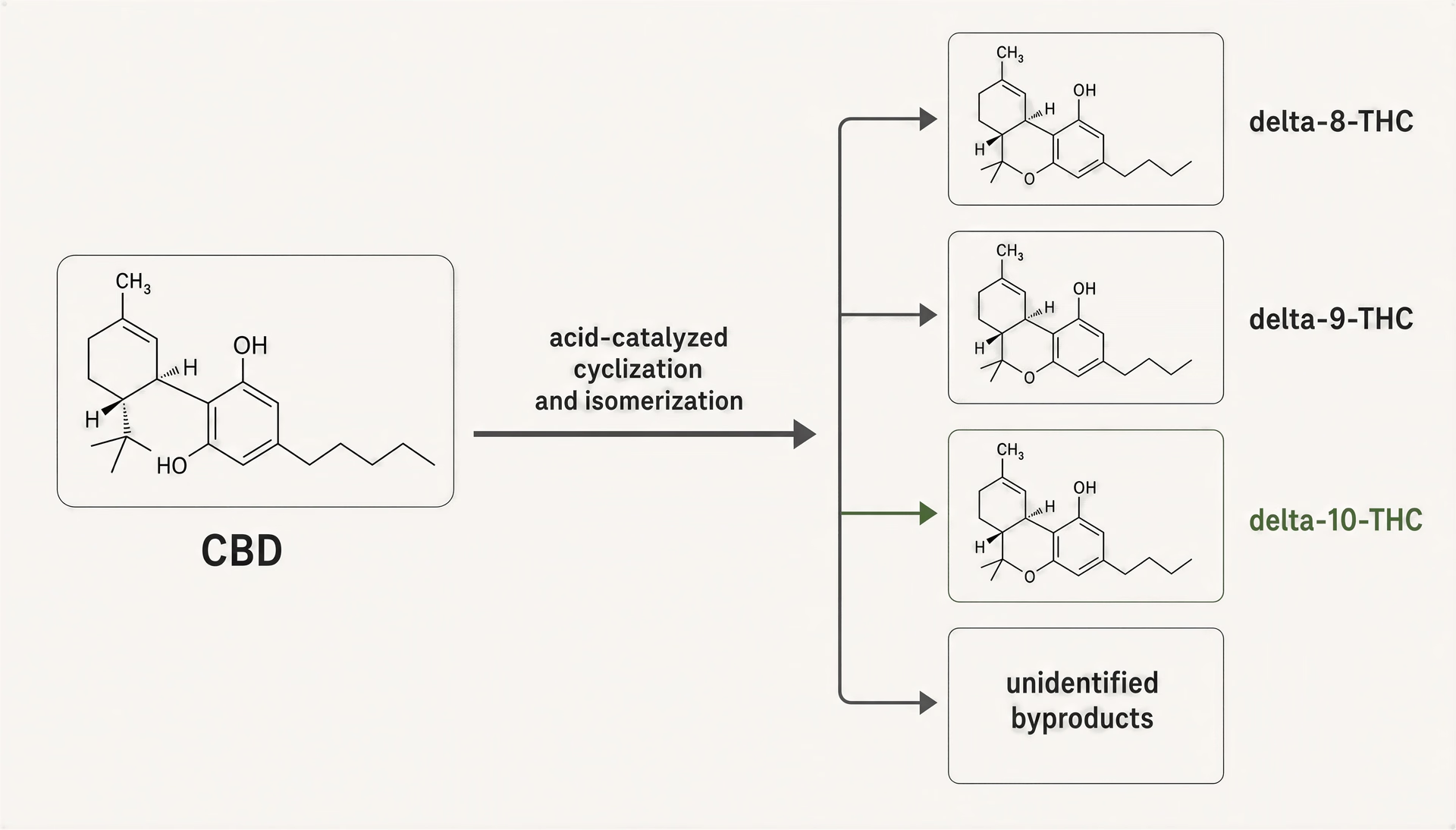
CBD-to-THC conversion, step by step
- Start with CBD Producers begin with hemp-derived CBD isolate.
- Apply acidic conditions Under acidic conditions, CBD can rearrange.
- Cyclize into THC-like ring systems The open-chain form of CBD closes into THC-type structures.
- Generate multiple outcomes Depending on solvent, temperature, time, and purification, different THC isomers can form.
- Refine the mixture Processors then try to separate delta-10 from delta-8, delta-9, and other byproducts.

CBD-to-THC conversion chemistry in plain language
At a high level, the process is an isomerization reaction. CBD and THC share the same molecular formula, C21H30O2, but their atoms are connected differently in three-dimensional space. Under acidic conditions, CBD’s structure can rearrange. The open-chain form of CBD cyclizes into THC-like ring systems, and depending on reaction conditions, the resulting double bond can end up in different positions on the ring. That is where labels such as delta-8, delta-9, and delta-10 come from.
Plainly put: the same starting molecule is being nudged into a different shape.
That sounds tidy on paper. In practice, it is not. Small shifts in acid strength, solvent, temperature, time, and purification can change which isomers form and in what ratio. Commercial naming makes this look simpler than the chemistry is. Older scientific literature also uses naming conventions that do not map neatly onto retail language, so “delta-10” in the marketplace often carries more ambiguity than consumers realize.
Because this is an intoxicating THC isomer made through conversion rather than simple extraction, the manufacturing pathway matters as much as the target molecule. There are still no controlled human trial data establishing a clear delta-10 dose-response curve, impairment profile, or specific risk pattern. That leaves safety assessment leaning heavily on chemistry and product testing.
Why purity is difficult and mixed-isomer products are common
High-purity delta-10 is hard to make because the reaction does not politely stop at one desired endpoint. It tends to generate a mixture: delta-8-THC, delta-9-THC, other positional isomers, degradants, and sometimes compounds that are poorly characterized outside analytical labs. This is the central fact often left out of consumer-facing descriptions.
The challenge is not only making delta-10. It is separating it cleanly from near relatives that have very similar chemical behavior. Positional isomers can be difficult to distinguish and isolate, especially when production quality varies. A label may highlight delta-10 while the actual formulation contains substantial amounts of delta-8 or other byproducts.
That is a consumer-risk issue, not a technical footnote. If the material is a mixed-isomer blend, then any claimed effect profile specific to delta-10 becomes shaky from the start. The person is not experiencing delta-10 alone. They are experiencing whatever survived the conversion and purification process.
Regulators have already signaled why this matters. The FDA reported 104 adverse-event reports involving delta-8 products between December 2020 and February 2022, and the CDC documented 2,362 delta-8 exposure cases reported to U.S. poison centers from January 2021 through February 2022. Delta-10-specific surveillance is thinner, but the manufacturing logic is similar enough to justify caution: converted hemp intoxicants can carry contamination, mislabeling, and unintended potency problems.
So when delta-10 appears in commercial products, the first question should not be whether it is “energizing” or “milder.” The first question is what else is in it.
Safety profile and contamination concerns
The first safety question with delta-10-THC is easy to state and hard to answer cleanly: are the risks coming from the cannabinoid itself, or from the way the commercial ingredient is made? For delta-10, that distinction matters more than it does for traditional cannabis. There is almost no controlled human literature defining delta-10 dose-response, impairment, psychosis risk, cardiovascular effects, or therapeutic index. That means any confident claim that delta-10 is predictably “clear-headed,” “energizing,” or otherwise distinct in safety terms is ahead of the evidence.
What can be said with reasonable confidence comes from three places: THC toxicology as a class, adverse-event data from the closely related delta-8 market, and the chemistry of converted hemp intoxicants. On the first point, delta-10 is a THC isomer with the same molecular formula as delta-9-THC and delta-8-THC, but a different double-bond position on the ring system. Small structural shifts can change receptor affinity and potency. They do not make the compound exempt from the basic liabilities associated with CB1-activating intoxicants.
What can reasonably be inferred from THC toxicology
Intrinsic risk means the pharmacology of the cannabinoid itself. Even without delta-10-specific trials, it is reasonable to infer that intoxication, impaired reaction time, short-term memory disruption, anxiety, panic, tachycardia, and dose-related dysphoria remain plausible effects. Those are class effects seen with THC-like cannabinoids, especially in inexperienced users, at high doses, or when combined with other intoxicants.
Dependence belongs in that picture too. NIDA commonly cites an estimate that about 9% of cannabis users develop dependence. That figure is not specific to delta-10, and it should not be misused as if all THC isomers carry identical dependence liability. Still, it is a fair anchor: being “hemp-derived” does not erase abuse potential if a compound activates the same broad receptor systems that make delta-9 intoxicating.
The weaker part of the evidence is any claim that delta-10 has a reliably different psychological profile from delta-8 or delta-9. Jessica Kruger and Daniel J. Kruger’s 2022 studies on delta-8, including a survey of 521 respondents from 38 states, found users often described delta-8 as producing less anxiety and paranoia than delta-9. Useful, but limited. Those were self-reports, not blinded, controlled trials with verified products. Delta-10 has even less published human evidence than delta-8. So the common internet taxonomy — delta-8 for sedation, delta-10 for stimulation — should be treated as marketing folklore, not established toxicology.
That uncertainty matters because the broader cannabinoid market is already huge: SAMHSA estimated 61.8 million Americans used marijuana in the past year in 2023, UNODC estimated 228 million global cannabis users in 2022, and the EUDA estimated 24 million European adults used cannabis in the last year. In a market of that scale, novel intoxicants spread faster than the clinical literature can catch up.
Residual solvents, acids, heavy metals, and unknown byproducts
Extrinsic risk is the bigger concern for delta-10. Commercial delta-10 is generally not present in cannabis in meaningful concentrations. It is usually produced by chemically converting hemp-derived CBD through acid-catalyzed reactions and repeated refinement steps. That manufacturing pathway is the central safety issue.
When chemists push CBD through isomerization conditions, the output is often a mixture, not a neat single molecule. Depending on reagents, temperature, solvent, reaction time, and cleanup quality, the material may contain delta-8-THC, delta-9-THC, unreacted CBD, degradants, minor isomers, and compounds that are difficult to identify without high-level analytical work. High-purity delta-10 is hard to make. That is not a small technical footnote; it is why “delta-10” on a label may describe a category of converted material more than a chemically clean ingredient.
Residual solvents are one obvious hazard. If extraction or conversion uses hydrocarbons or other organic solvents and purification is poor, traces can remain. Acids used to drive isomerization are another issue. So are heavy metals introduced by contaminated equipment, catalysts, or processing environments. Then there are unknown byproducts, which may be present at low levels but still matter if inhaled or ingested repeatedly.
Regulators have reacted most visibly to delta-8, but the warning applies more broadly to converted hemp intoxicants. The FDA said it received 104 adverse-event reports involving delta-8 products from December 1, 2020, to February 28, 2022. The CDC reported 2,362 delta-8 exposure cases to U.S. poison centers from January 1, 2021, through February 28, 2022; 41% were unintentional exposures, and 82% of those unintentional exposures involved patients younger than 18. Those figures do not prove impurities caused every event. They do show why agencies are uneasy with intoxicating products entering the market through hemp loopholes while manufacturing standards remain inconsistent and product identity is often uncertain.

Why certificates of analysis matter and what they often miss
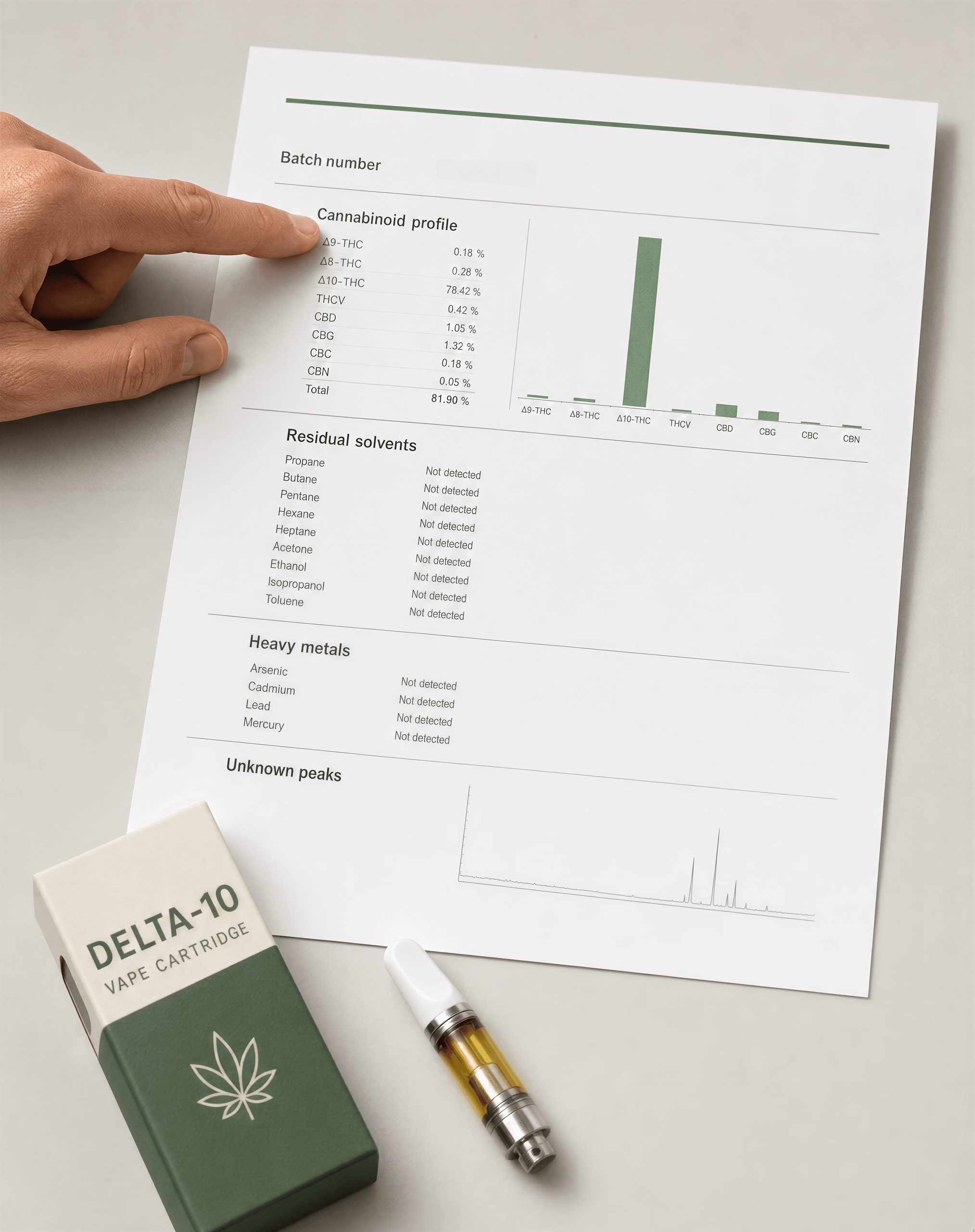
Certificate of analysis (COA) A lab report tied to a specific batch that lists what was tested and what was found. For delta-10 products, a useful COA should identify the lab, sample date, batch linkage, cannabinoid levels, and contaminant testing such as residual solvents and heavy metals.
A certificate of analysis, or COA, is the bare minimum for evaluating a delta-10 product. Without one, there is no serious basis for trusting the stated cannabinoid profile. A useful COA should identify the lab, sample date, batch linkage, methods used, and quantified levels of major cannabinoids, not just a pass/fail badge.
Even then, COAs have limits. Many panels are better at measuring known cannabinoids than discovering unknown reaction byproducts. A report may quantify delta-8, delta-9, CBD, and perhaps delta-10, while missing minor synthetic artifacts created during conversion. Not every lab validates methods equally well for unusual THC isomers. Naming can be messy too, because commercial “delta-10” terminology is simplified and older cannabinoid literature used different conventions. Misidentification is possible.
A solid COA should also include residual solvent, heavy metal, pesticide, and microbial testing where relevant. Yet even a clean report cannot guarantee absence of every contaminant if the lab did not look for it. That is the uncomfortable reality with delta-10: the intrinsic risks probably resemble THC-like intoxication, but the larger unknown may be everything around the molecule rather than the molecule alone.
Legal status: federal law, state law, and the synthetic-cannabinoid question
Delta-10 sits in a legal category built less by pharmacology than by drafting choices, agency interpretation, and state reaction. That is why simple claims like “hemp-derived means federally legal” are shaky. Delta-10 is usually not present in cannabis in commercially meaningful amounts; it is typically made by chemically converting hemp-derived CBD, often producing mixed THC isomers and other reaction products. That manufacturing fact is central to the legal debate.
What the 2018 Farm Bill did and did not legalize
The Agriculture Improvement Act of 2018 removed “hemp” from the federal definition of marijuana. Congress defined hemp as Cannabis sativa L. and its cannabinoids, extracts, and derivatives with no more than 0.3% delta-9 THC on a dry-weight basis. That wording opened a large market for hemp-derived compounds because it focused on delta-9 concentration, not on intoxication generally and not on every THC isomer individually.
But the Farm Bill did not say that every cannabinoid made from hemp is lawful in every form. It did not create an express federal safe harbor for chemically converted delta-8 or delta-10. It also did not override the Food, Drug, and Cosmetic Act, state controlled-substance laws, or federal analog and adulteration concerns. That gap matters because commercial delta-10 is usually a manufacturing phenomenon, not a traditional harvested hemp constituent.
This is where the plain-language reading often goes wrong. People see “derivatives” and assume the issue is settled. It is not. If a product begins with lawful hemp CBD isolate but then goes through acid-catalyzed isomerization into delta-10-rich mixtures, regulators may ask whether the end product is still just a hemp derivative or whether it has become a synthetically derived tetrahydrocannabinol. Federal statute does not answer that cleanly.
DEA interpretation of synthetically derived tetrahydrocannabinols
The DEA’s 2020 Interim Final Rule became a flashpoint because it stated that “all synthetically derived tetrahydrocannabinols remain Schedule I controlled substances.” That sentence did not name delta-10 specifically, but it shaped the entire argument around converted hemp cannabinoids. Later DEA correspondence often cited by industry lawyers has pointed in the same direction: if THC is created through chemical conversion rather than extracted as such from the plant, DEA may treat it as synthetic.
That does not end the matter either, because “synthetic” is doing a lot of work here. Delta-10 sold in the US is usually produced from hemp-derived CBD, not built from petrochemicals from scratch. Supporters of legality argue that this still counts as a hemp derivative. Critics answer that once CBD is chemically rearranged into another intoxicating THC isomer, source material no longer resolves the scheduling question.
The practical result is federal ambiguity with real enforcement risk. FDA and CDC actions around delta-8, while not delta-10-specific scheduling decisions, show why regulators are uneasy with this market. FDA said it received 104 adverse event reports involving delta-8 products between December 1, 2020 and February 28, 2022. CDC reported 2,362 delta-8 exposure cases to poison centers from January 2021 through February 2022; 41% were unintentional, and 82% of those involved patients under 18. Those numbers do not prove delta-10 has the same profile, but they help explain why converted intoxicating cannabinoids attract scrutiny.
Why state-level bans often matter more than federal ambiguity
For actual legal exposure, state law often matters more than unresolved federal theory. Many states have amended hemp laws or controlled-substance rules to restrict intoxicating hemp cannabinoids directly, often naming delta-8 and delta-10 or using broader language that captures THC isomers produced through conversion. Some states fold them into marijuana programs; others ban them outside licensed systems; others leave a gray area that can change quickly through agency rulemaking.
That state response makes sense. Legislatures and regulators are reacting not just to the molecule, but to the production model: CBD converted into hard-to-purify mixtures sold under simplified labels. A product can appear to fit the Farm Bill’s delta-9 threshold and still violate state law.
Outside the US, the picture is usually simpler and stricter. Most countries do not have delta-10-specific carve-outs. General THC or controlled-drug rules usually apply, especially in markets already watching semi-synthetic cannabinoids, as EUDA has noted. So the legal question is rarely “is delta-10 special?” Usually it is “is this an intoxicating THC-type substance?” In many jurisdictions, that is enough.
Consumer guidance without hype
Delta-10 is not a category where branding should substitute for chemistry. Because most commercial delta-10 is made by converting hemp-derived CBD rather than extracting meaningful amounts directly from cannabis, the label alone tells you very little. A certificate of analysis, or COA, is the minimum starting point.
How to read a lab report for a delta-10 product
Start with the basics: who ran the test, when, and on what batch. A useful COA names an independent laboratory, gives a sample or lot number that matches the package, and shows recent test dates. If the report cannot be tied to the exact batch in hand, treat it as generic paperwork.
Then read the cannabinoid panel closely. A delta-10 product may contain delta-10-THC, delta-8-THC, delta-9-THC, CBD, CBN, and other minor cannabinoids. That is not automatically deceptive; it may reflect how hard delta-10 is to produce cleanly. What matters is whether the label matches the report. If the package presents itself as mostly delta-10 but the COA shows a mixed-isomer product, believe the lab, not the marketing.
A serious COA should also include contaminant testing. For this category, that means residual solvents, heavy metals, pesticides, and microbial results where relevant. Since delta-10 is commonly produced through chemical conversion, solvent data matter a lot. So do “unknown” peaks or unexplained chromatographic signals. If a report lists cannabinoids only and says nothing about contaminants, it is incomplete.
Legal review belongs here too. In the United States, hemp under the 2018 Farm Bill is defined by delta-9-THC concentration not exceeding 0.3% on a dry-weight basis. That federal definition did not settle state legality, and it did not erase debate over whether converted tetrahydrocannabinols may be treated as synthetic. A compliant delta-9 number on a COA does not guarantee lawful possession where you live.
| Red flag | Why it matters |
|---|---|
| Implausible near-total delta-10 purity claims | The article notes that high-purity delta-10 is difficult to make, so unusually clean claims need unusually strong lab proof. |
| Missing contaminant panels | A cannabinoid-only report can miss residual solvents, heavy metals, pesticides, or other conversion-related contamination. |
| Vague 'hemp-derived' sourcing | Source language alone does not explain conversion chemistry, purification, or what else may be present in the final material. |
Red flags: implausible purity claims, missing contaminant panels, vague sourcing
Be skeptical of near-total purity claims. High-purity delta-10 is widely described as difficult to make, so labels implying almost nothing but delta-10 deserve extra scrutiny. If the chemistry is messy, the paperwork should be unusually clear. Often it is the opposite.
Another warning sign is silence about contaminants. FDA and CDC warnings on delta-8 are relevant by analogy because the manufacturing pathway overlaps. The FDA reported 104 adverse-event cases tied to delta-8 products between December 2020 and February 2022, and CDC documented 2,362 poison-center exposure cases from January 2021 to February 2022. Those data are not delta-10-specific, but they are a reminder that converted cannabinoid products can carry real quality-control failures.
Vague sourcing is also a problem. “Hemp-derived” does not tell you which inputs were used, how conversion occurred, or what purification followed.
Practical risk reduction for inexperienced users
Assume impairment. Delta-10 may be marketed as lighter or more “energizing” than delta-9, but controlled human data are too thin to make that a reliable safety rule. Individual response varies by dose, body size, tolerance, route of use, and co-use with alcohol or other drugs.
Do not combine it with driving, cycling in traffic, operating tools, childcare, or other safety-sensitive tasks. If you are inexperienced with THC, start with a very small amount and wait long enough before taking more, especially with edibles, which can have delayed effects. If you have a history of panic, psychosis, significant heart disease, or problematic cannabis use, extra caution is warranted. NIDA’s long-cited estimate that about 9% of cannabis users develop dependence is not specific to delta-10, but it is a reminder that “hemp-derived” does not mean risk-free.
What researchers still do not know
Missing human pharmacokinetic data
For delta-10-THC, basic human pharmacokinetics are still largely absent. That means no solid clinical map of how fast it is absorbed, how much reaches circulation after inhalation versus ingestion, which metabolites dominate, how long impairment-related concentrations persist, or how strongly it binds CB1 and CB2 receptors in living humans. Delta-10 is a positional isomer of delta-9 and delta-8, so small structural shifts could change receptor affinity and metabolic fate. But “could” is doing a lot of work here.
This gap is made worse by how commercial delta-10 is usually produced. It is typically generated by chemical conversion of hemp-derived CBD, not extracted from cannabis in meaningful natural abundance. In practice, that often yields mixtures rather than a clean single compound. So even if a person reports a certain effect, researchers often cannot tell whether delta-10 caused it, whether delta-8 or delta-9 contributed, or whether reaction byproducts changed the result.
Missing controlled trials on cognition and adverse effects
There are no well-established controlled human trials defining delta-10 dose-response, impairment thresholds, psychosis risk, cardiovascular effects, long-term safety, or drug-drug interactions. Claims that delta-10 is “stimulating” or clearer-headed than delta-9 are not backed by blinded dosing studies. They are mostly market narratives.
The contrast with delta-8 is telling. Kruger and Kruger’s 2022 survey covered 521 respondents across 38 states, which at least offers structured self-report data. Delta-10 lacks even that level of published human evidence. Safety concerns therefore have to be inferred from other THC isomers and from what regulators have seen with converted cannabinoids. The FDA reported 104 delta-8 adverse-event cases from December 2020 to February 2022, and the CDC documented 2,362 poison-center exposure cases, with 41% unintentional and 82% of those involving minors. Those numbers are not delta-10-specific, but they show what happens when intoxicating hemp derivatives spread faster than toxicology research.
Why this gap matters more for delta-10 than for delta-9
Delta-9 has decades of pharmacology, impairment, dependence, and adverse-effect literature behind it. Delta-10 does not. Yet it entered a huge market shaped by the 2018 Farm Bill’s delta-9-based hemp definition, while 61.8 million Americans used marijuana in 2023 and 228 million people used cannabis globally in 2022. The hard truth is this: delta-10 is not just under-studied THC. It is often an under-characterized manufacturing category sold ahead of chemical, clinical, and toxicological certainty.
References
- [1] Delta-8-THC: Delta-9-THC's nicer younger sibling?. Journal of Cannabis Research, 2022. https://doi.org/10.1186/s42238-021-00115-8