













What THC-O acetate actually is
THC-O acetate, often shortened to THC-O or THCO, is not simply “THC from hemp.” Chemically, it is an acetate ester of THC: a THC molecule that has been modified through acetylation, usually after the starting cannabinoid has already been converted from hemp-derived CBD or another hemp feedstock. That distinction matters because it separates THC-O from classical plant cannabinoids such as delta-9 THC, CBD, or CBG, which are produced by the cannabis plant itself and then extracted. THC-O is typically made in a lab process. It is not directly harvested from flower in any ordinary commercial sense.
THC-O is three times stronger than delta-9 THC. Preliminary evidence
The acetate group may change how the compound behaves. In theory, esterification can alter lipophilicity and possibly onset or subjective character. But the evidence is thin. There are no modern randomized human trials that establish THC-O pharmacokinetics, impairment profile, or any precise potency ratio against delta-9 THC. The familiar claim that THC-O is “three times stronger” looks more like recycled lore than established fact.
Why THC-O is not a naturally occurring cannabinoid in ordinary commercial terms
Some cannabinoids do appear naturally only in trace amounts, and marketers sometimes use that fact to blur categories. With THC-O, that framing is misleading. Even if one argues that related acetate forms could exist in minute, disputed, or artifact-level contexts, THC-O is not a naturally abundant phytocannabinoid available through routine extraction. Commercial THC-O products are made through chemical conversion.
That puts THC-O outside the normal scientific and regulatory conversation around plant-derived cannabinoids. The National Academies’ 2017 report found substantial evidence for certain medical uses of cannabis and cannabinoids, including chronic pain and chemotherapy-related nausea, but that evidence concerns studied cannabis preparations and known cannabinoids, not THC-O. Borrowing credibility from cannabis research and applying it to THC-O is not justified.
THC-O belongs more to the post-2018 intoxicating hemp derivative wave than to established phytocannabinoid science. That market expanded after the Farm Bill defined hemp by delta-9 THC concentration, not by whether every downstream intoxicant was naturally produced. The legal opening was real. The scientific equivalence was not.
Semi-synthetic versus synthetic: the classification problem
THC-O is often called semi-synthetic because producers usually begin with a cannabinoid obtained from hemp, then chemically convert it into a different intoxicating substance and acetylate it. That is a fair descriptive label. It tells you the source material started in the plant but the final molecule did not.
Regulators, though, do not always care about that distinction in the way marketers do. In 2023, the DEA stated that delta-8-THC-O acetate is synthetic and therefore not within the Farm Bill definition of hemp. That is a major problem for the popular “federally legal THC-O” narrative. Semi-synthetic in trade language can still be synthetic in drug-control language.
The same tension shows up in safety. In 2023, Munger and colleagues in Chemical Research in Toxicology reported ketene formation when cannabinoid acetates including delta-8-THC acetate and delta-9-THC acetate were vaped or dabbed. After the EVALI period, when CDC reported 2,807 hospitalized cases or deaths by February 18, 2020, acetate inhalation chemistry stopped being a side issue. It became a red flag.
Why the hemp origin claim confuses source material with final molecule
“Hemp-derived” describes where the carbon skeleton may have started. It does not settle what the finished compound is. A cannabinoid made from legal hemp input can still end up as a chemically altered intoxicant with a different legal and toxicological profile.
Claims that do not automatically follow from “hemp-derived”
- Natural The article states that hemp origin describes feedstock, not whether the final molecule is a naturally abundant plant cannabinoid.
- Studied Evidence for cannabis or established cannabinoids does not transfer automatically to THC-O.
- Legal A compound made from hemp input can still be treated as a synthetic or controlled intoxicant.
That is the core confusion around THC-O. People hear “from hemp” and assume “natural,” “studied,” or “legal.” None of those follow automatically. The hemp claim refers to feedstock. THC-O refers to the final molecule. Those are not the same thing, and treating them as if they were is how THC-O got marketed as ordinary hemp rather than what it actually is: a lab-made THC acetate sitting in a very unstable gray zone.
Chemistry and production
THC-O acetate is not a naturally abundant cannabinoid found in meaningful amounts in the cannabis plant. It is generally a semi-synthetic ester made through chemical conversion. That distinction matters because it separates THC-O from compounds such as delta-9 THC, CBD, or minor native cannabinoids that can be isolated directly from plant material. In practice, THC-O entered the market through the same post-2018 hemp pipeline that also produced large volumes of delta-8 THC: legally defined hemp under the Agriculture Improvement Act of 2018 could be extracted for CBD, then chemically transformed into intoxicating THC analogs and derivatives.
Typical production sequence described in the article
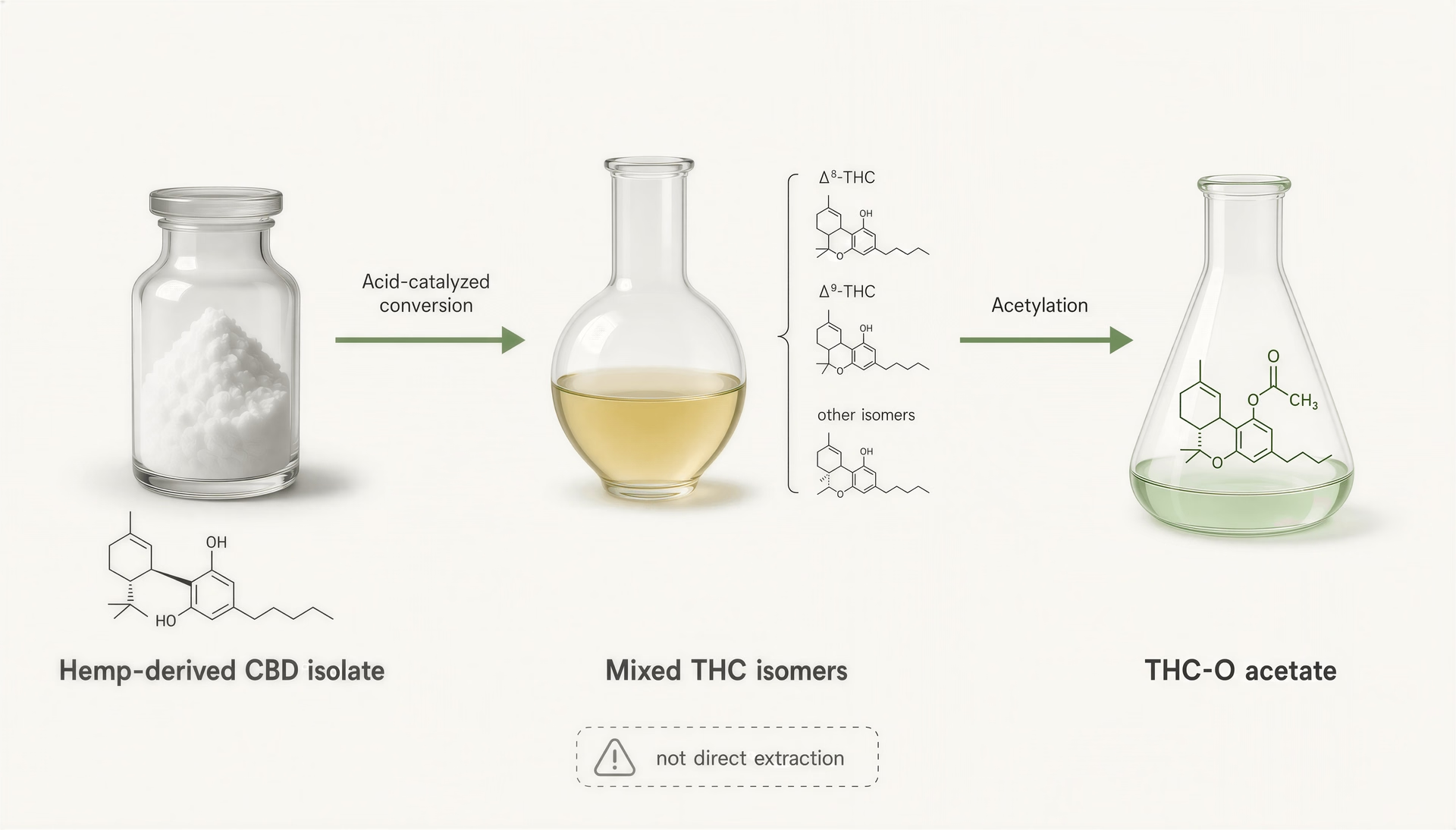
- 1 Start with hemp-derived CBD isolate or an already converted THC isomer.
- 2 Convert CBD into a THC mixture by acid-catalyzed cyclization; possible products include delta-8 THC, delta-9 THC, delta-10 THC, exo-THC, and degradants.
- 3 Isolate a THC intermediate that still has a free phenolic hydroxyl group.
- 4 Acetylate that hydroxyl, commonly with acetic anhydride, to form a THC acetate ester sold as “THC-O.”
- 5 Purify and test the batch to remove residual reagents, solvents, catalysts, and side-products.

From hemp cannabinoids to THC intermediates
The usual starting point is hemp-derived CBD isolate. CBD is abundant in hemp, while delta-9 THC is capped at 0.3% dry weight under federal hemp law. Chemists can convert CBD into THC isomers through acid-catalyzed cyclization. Depending on reaction conditions, solvent choice, acidity, time, and purification, the product mixture may contain delta-8 THC, delta-9 THC, delta-10 THC, exo-THC, and other positional isomers or degradants. That is already a warning sign. These are not single-step, naturally tidy transformations.
Another route starts from already-converted delta-8 THC or delta-9 THC rather than CBD itself. In either case, the immediate precursor to THC-O is generally a THC molecule with a free phenolic hydroxyl group. Once a producer has delta-8 THC or delta-9 THC in hand, that hydroxyl can be acetylated to form delta-8-THC acetate or delta-9-THC acetate. “THC-O” is often used loosely in commerce, but it usually refers to one of those acetate esters rather than a unique naturally occurring cannabinoid.
This is why the phrase “natural hemp THC-O” is misleading. Hemp may be the legal starting biomass, but THC-O is produced by chemical steps that go beyond extraction. The DEA’s 2023 position on delta-8-THC-O acetate reflected exactly that point: a synthetic acetate derivative does not simply become hemp because the feedstock originally came from hemp. Popular marketing flattened a real chemical difference into a legal slogan. The chemistry does not support that slogan.
Acetylation chemistry and what the acetate group changes
Acetylation is a standard organic reaction. A hydroxyl-containing molecule is treated with an acetylating reagent, commonly acetic anhydride, to replace the hydrogen on the oxygen with an acetyl group. For THC, that means converting the phenolic OH into an acetate ester. The core cannabinoid skeleton remains, but one functional group changes, and functional groups often determine behavior.
Prodrug A compound that is converted in the body into another active drug. In this article, THC-O is described as prodrug-like because esterases may cleave off the acetate group and regenerate THC after administration.
That acetate group can increase lipophilicity and alter how the compound crosses membranes, dissolves in oils, or survives initial metabolism. For that reason, THC-O is often described as a prodrug-like derivative: after administration, esterases in the body may cleave the acetate and regenerate THC. That is plausible chemistry, and it parallels the logic of other acetylated drugs. But plausible is not the same as well characterized. Modern human pharmacokinetic data on THC-O are sparse. There are no strong controlled trials establishing absorption, time to peak blood levels, metabolic rate, receptor-level activity of the intact ester versus deacetylated THC, or a reliable potency ratio against delta-9 THC.
That gap is why the old “three times stronger than THC” claim should be treated skeptically. It persists because it is memorable, not because it has been demonstrated in contemporary clinical research. The acetate group may change onset, duration, and subjective profile. It may not. Route of administration likely matters a lot. Oral use, inhalation, and dabbing do not expose the compound to the same temperatures, first-pass metabolism, or hydrolysis conditions. So the right scientific position is restraint: THC-O’s altered chemistry suggests altered pharmacology, but the precise effects remain poorly mapped.
Impurities, residual reagents, and why manufacturing quality matters
Poorly controlled synthesis can leave behind far more than the target acetate ester. If CBD was first converted into THC isomers, the batch may already contain a complicated mixture before acetylation even begins. Add an acetylation step, and now residual acetic anhydride, acetic acid, catalysts, solvents, side products, and incompletely reacted intermediates become relevant. Without validated purification and analytical testing, there is no reason to assume a retail material labeled “THC-O” is chemically clean or even compositionally simple.
This is not a theoretical concern. The low-evidence hemp-intoxicant market expanded much faster than toxicology, surveillance, or manufacturing oversight. FDA warnings about delta-8 THC products noted increasing adverse events and poison-center cases; in 2022, the agency cited 2,362 exposure cases reported to poison centers between January 2021 and February 2022, with 41% involving patients younger than 18. THC-O circulated through the same conversion-based ecosystem.
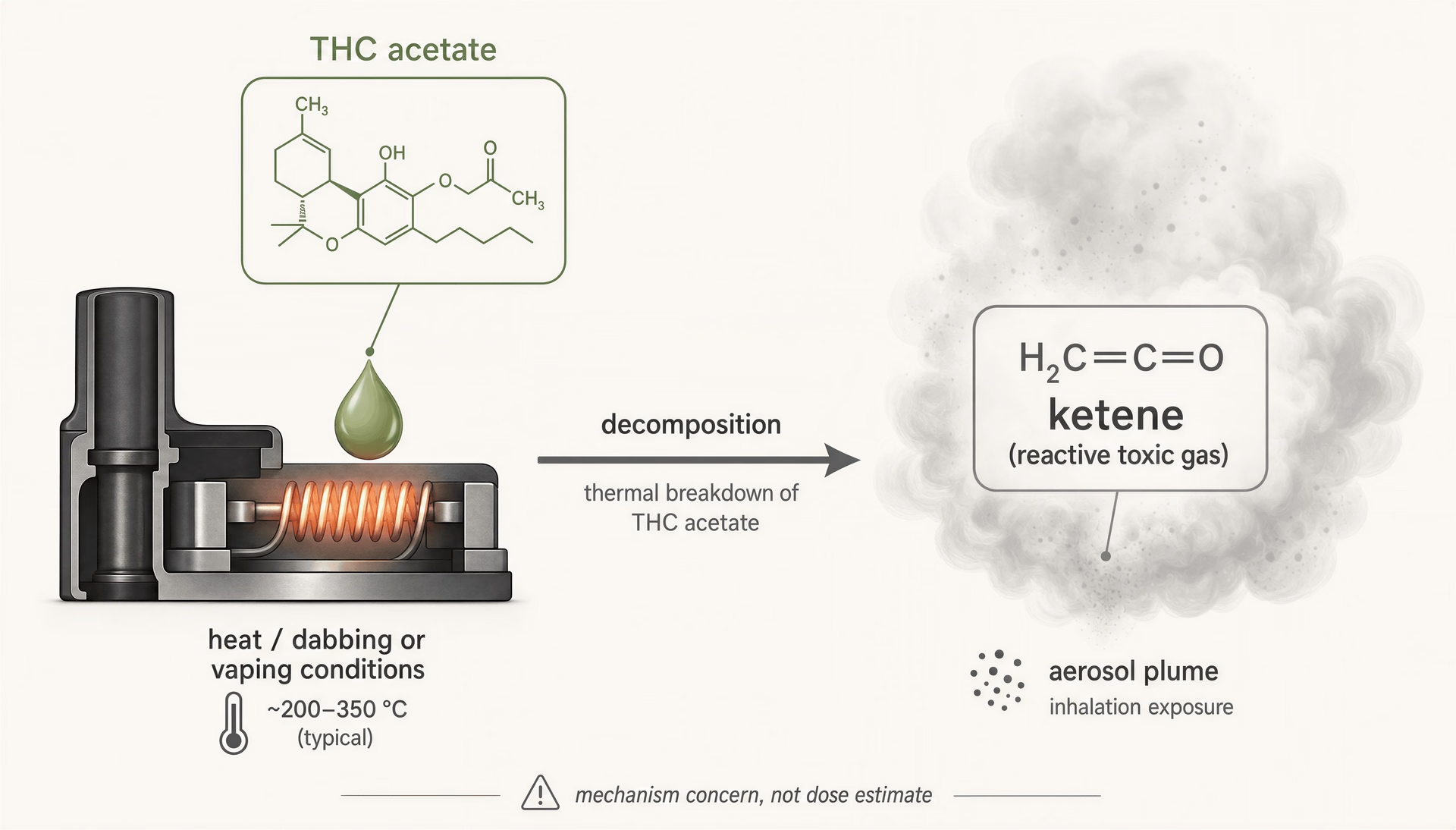
For inhaled products, the acetate group itself adds another layer of concern. During the EVALI period, CDC reported 2,807 hospitalized cases or deaths as of February 18, 2020, and vitamin E acetate became the best-known example of why heated acetate-containing materials deserve scrutiny. THC-O is not vitamin E acetate, but the pyrolysis issue is real. In 2023, Munger and colleagues in Chemical Research in Toxicology showed that vaping cannabinoid acetates, including delta-8-THC acetate, delta-9-THC acetate, and CBD diacetate, can generate ketene, a highly reactive toxic gas, under dabbing or vaping conditions. That finding does not prove a specific clinical risk at every dose, but it does establish a mechanism for harm that ordinary THC products do not share in the same way.
So manufacturing quality matters twice over: first because synthesis can leave contaminants behind, and second because the intended molecule may itself pose heat-related toxicology concerns. With THC-O, chemistry is not background detail. It is the center of the risk profile.
Pharmacology: what is known, inferred, and still unproven
THC-O acetate sits in an awkward scientific category: it is discussed as if its effects are settled, yet the direct evidence base is thin. Most of what can be said with confidence comes from chemistry, from what is already known about delta-9 THC, and from cautionary toxicology work on acetate esters under heat. That is not the same thing as having modern human pharmacology data. We largely do not.
The distinction matters because public knowledge about cannabis is broad, while knowledge about THC-O is narrow. Cannabis use itself is common: SAMHSA estimated 61.8 million past-year marijuana users in the United States in 2023, UNODC estimated about 228 million global cannabis users in 2022, and the EUDA estimated 22.8 million adult last-year users in Europe in 2024. By contrast, THC-O entered the market through the post-2018 hemp-derivative pipeline with little formal clinical characterization. The National Academies’ 2017 report identified substantial evidence for some medical uses of cannabis or cannabinoids, but that evidence concerns studied products, not THC-O. Borrowing those findings and attaching them to THC-O is not pharmacology. It is substitution by association.
Likely relationship to CB1-mediated intoxication
Conceptually, THC-O is easiest to understand as a modified THC molecule rather than a wholly distinct pharmacological class. The acetate ester changes the structure of THC and likely changes how the compound moves through the body, but the expected intoxication profile still points back to CB1 signaling. Delta-9 THC produces its characteristic psychoactive effects mainly through partial agonism at cannabinoid CB1 receptors in the central nervous system. THC-O is commonly assumed to produce intoxication by reaching the same endpoint, either directly or after metabolic conversion.
The leading hypothesis is that THC-O may function at least partly as a prodrug. In plain terms, the acetate group may be cleaved off in vivo by esterases, yielding the underlying THC molecule that then engages CB1 receptors in a more familiar way. This prodrug idea is plausible. It also remains insufficiently characterized. There are no widely cited modern randomized human studies that map THC-O absorption, deacetylation rate, active metabolites, receptor binding, impairment profile, or blood-level correlations with effects.
That gap leaves room for two possibilities that are not mutually exclusive. One is simple deacetylation: THC-O acts mostly as a delivery form of THC, with the acetate group affecting timing and tissue distribution more than receptor pharmacology itself. The other is that the ester changes lipophilicity enough to alter brain penetration or subjective onset in a way users perceive as “different” or “stronger,” even if the final common pathway still involves CB1-mediated intoxication. Both are reasonable inferences. Neither is firmly proven in humans.
Why potency claims are weaker than the marketing suggests
The popular claim that THC-O is “three times stronger than THC” should be treated as unestablished. Not controversial. Unestablished.
That number has been repeated so often that it now sounds like settled science, but it does not rest on modern controlled human trial data. It appears to trace back to historical repetition from earlier analog-era descriptions and later internet copying, not to contemporary dose-ranging studies comparing THC-O head-to-head with delta-9 THC across matched routes of administration. There is no credible basis for a precise 3:1 equivalence ratio.
This matters because potency is not a single property. It depends on route, dose, formulation, metabolism, tolerance, and what outcome is being measured. Is “stronger” supposed to mean more receptor affinity, greater intoxication at the same milligram dose, longer duration, more impairment, or simply stronger subjective reports from self-selected users? Those are different questions. THC-O marketing usually treats them as interchangeable. They are not.
There is also a selection bias problem. Many reports about THC-O came from the same low-evidence ecosystem that rapidly normalized other hemp-derived intoxicants before toxicology could catch up. Kruger and Kruger’s 2022 survey of 440 delta-8 THC users is useful context here, not because it studied THC-O, but because it showed how consumer narratives can spread faster than formal science. That pattern helps explain why potency lore around THC-O hardened so quickly.
If anything, the honest pharmacological position is narrower: THC-O may feel stronger or more enveloping to some users, possibly because of route-specific absorption and delayed deacetylation, but the evidence does not support a universal multiplier. Precision without data is just branding disguised as pharmacology.
Onset, duration, and route-specific uncertainty
Route of administration likely matters even more for THC-O than for conventional delta-9 products. If THC-O is partly a prodrug, then onset may depend on how quickly the acetate group is removed and how rapidly the compound reaches circulation and the brain. That could produce delayed effects compared with inhaled delta-9 THC, at least in some preparations. Reports of a slower onset and longer build are therefore plausible. They are still not well quantified.
Inhalation is the most fraught route. Not only is the pharmacokinetic profile poorly described, but the acetate chemistry raises a separate toxicology concern. After the EVALI outbreak, in which the CDC recorded 2,807 hospitalized cases or deaths as of February 18, 2020, acetate-containing inhalants drew much more scrutiny. The analogy is not that THC-O caused EVALI; it is that acetate pyrolysis became impossible to ignore. In 2023, Munger and colleagues in Chemical Research in Toxicology showed that vaping cannabinoid acetates, including delta-8-THC acetate, delta-9-THC acetate, and CBD diacetate, can generate ketene under dabbing or vaping conditions. Ketene is a highly reactive toxic gas. That finding does not establish exact real-world exposure from every device or formulation, but it makes “THC-O vaping is basically the same as regular THC vaping” an unsafe assumption.
Oral use is not exempt from uncertainty either. If deacetylation occurs before or during first-pass metabolism, oral THC-O could end up behaving more like delayed THC exposure than a uniquely potent cannabinoid. But without controlled pharmacokinetic studies, even basic questions remain open: when peak effects occur, how variable they are between individuals, whether impairment outlasts the subjective high, and whether blood or saliva testing tracks exposure in predictable ways.
So the current picture is uneven but clear enough in outline. THC-O probably relates to delta-9 THC through the same CB1-centered intoxication pathway, perhaps after metabolic deacetylation. Claims of dramatically higher potency are not backed by modern clinical evidence. And route matters a lot, especially for inhalation, where acetate-specific toxicology concerns are materially different from those of ordinary delta-9 THC products.
Effects reported by users versus effects demonstrated in research
THC-O has an unusually wide gap between what people say it does and what research has actually shown. That gap matters. Public knowledge about cannabis mostly comes from far more studied exposures—plant cannabis, delta-9 THC, and some pharmaceutical cannabinoids—not from acetylated THC esters that entered the hemp market with little human data behind them.
Commonly reported subjective effects
Across forum posts, social media, and informal reviews, THC-O is often described as heavier, slower, and less predictable than ordinary delta-9 THC. The recurring themes are delayed onset, stronger intoxication once it arrives, and a greater chance of sedation or dissociation-like effects. Some users compare inhaled THC-O to a product that “creeps up” and then hits harder than expected; others describe edibles as especially easy to overdo because the first effects may feel muted before building.
Those reports are plausible in a limited sense. THC-O is an acetate ester, not naturally abundant cannabis THC, and that chemical modification may affect lipophilicity and subjective timing. But plausible is not proven. The popular claim that THC-O is “three times stronger than delta-9 THC” has never been established in modern controlled human trials. No accepted dose-response study has pinned down a reliable potency ratio across inhaled and oral routes.
So the honest description is narrower: people often report stronger intoxication, delayed onset, and more sedation than they expect, but research has not confirmed a stable THC-O signature.
Why anecdote dominates this topic
Anecdote dominates because the market moved faster than the science. After the 2018 Farm Bill defined hemp by delta-9 THC concentration rather than by all intoxicating cannabinoids, chemically converted hemp derivatives spread rapidly through the US. THC-O emerged through that same post-Farm Bill channel. Yet there are still no well-established randomized human trials defining THC-O pharmacokinetics, impairment profile, long-term safety, or precise equivalence to delta-9 THC.
That leaves users to compare notes in real time, often without verified product chemistry. This is not a small detail. “THC-O” on a label may coexist with delta-8 THC, delta-9 THC, residual reagents, by-products from conversion, terpenes, or inconsistent concentrations. Route of administration changes the picture again: inhaled products may feel different from oral products, and tolerance can radically alter what “strong” means from one person to another.
Research on adjacent hemp intoxicants shows how common this pattern became. Kruger and colleagues in 2022 surveyed 440 delta-8 THC users and documented a market where consumer experience was circulating faster than formal evidence. THC-O followed that same path, only with even thinner data.
What cannot be concluded from online reports
Online reports cannot prove that THC-O has a fixed potency multiplier over delta-9 THC. They cannot separate the effect of the acetate ester from poor labeling, mixed cannabinoids, high tolerance, low tolerance, or expectation effects. They also cannot establish safety.
That last point deserves emphasis. The strongest research signal around THC-O is not proof of superior effects but a toxicology warning for inhalation. Munger et al. in Chemical Research in Toxicology (2023) found that vaping cannabinoid acetates, including delta-8-THC acetate and delta-9-THC acetate, can generate ketene under vaping or dabbing conditions. After the EVALI era—CDC reported 2,807 hospitalized cases or deaths by February 18, 2020—acetate chemistry in inhaled products cannot be brushed aside.
Internet testimonials can tell you what some people felt. They cannot tell you, with scientific confidence, what THC-O does, how potent it is, or how safe it is.
Safety concerns that deserve more attention
THC-O safety is often discussed as if it were just a stronger version of ordinary THC. That framing misses the main problem. THC-O acetate is a semi-synthetic acetate ester, and that chemistry creates a hazard profile that is not identical to delta-9 THC from cannabis flower or even standard THC extracts. The evidence base is thin, the product category developed faster than toxicology research, and the most serious concerns sit exactly where casual explainers tend to be weakest: heated inhalation, acute over-intoxication, and chronic unknowns.

Ketene formation and the acetate inhalation problem
| Risk area | What the article says | Why it matters |
|---|---|---|
| Heated inhalation | Acetate-containing cannabinoids can generate ketene under vaping or dabbing conditions | Adds a mechanism for harm that ordinary non-acetylated THC products do not share in the same way |
| Acute intoxication | Delayed or uneven onset can encourage redosing | Raises the chance of panic, confusion, vomiting, impaired coordination, and emergency visits |
| Manufacturing quality | Conversion and acetylation can leave residual reagents, solvents, catalysts, and by-products | Retail material labeled “THC-O” may be chemically messy or mislabeled |
| Long-term effects | No well-established randomized human trials define chronic safety | There is no solid basis for confident statements about repeated-use risk |
The acetate group is not a trivial detail. It is the reason inhaled THC-O raises a separate toxicology question from inhaled delta-9 THC. When acetate-containing compounds are heated, they can decompose in ways that generate ketene, a highly reactive toxic gas. That issue became impossible to ignore during the EVALI era, even though EVALI itself was primarily linked to vitamin E acetate in illicit vape products rather than THC-O specifically.
The CDC reported 2,807 hospitalized EVALI cases or deaths as of February 18, 2020. Public-health investigators eventually focused heavily on vitamin E acetate as a major driver in many cases. That does not mean THC-O caused EVALI. It does mean the broader lesson from that outbreak still applies: inhaling heated acetate chemistry is not something to wave away with “it’s hemp-derived.”[1] Vaping Cannabinoid Acetates Leads to Ketene Formation. Munger et al.. Chemical Research in Toxicology, 2023.
The strongest direct evidence here is analytical, not epidemiologic. In 2023, Munger and colleagues published a study in Chemical Research in Toxicology showing that vaping cannabinoid acetates, including delta-8-THC acetate, delta-9-THC acetate, and CBD diacetate, generated ketene under dabbing or vaping conditions. THC-O acetate belongs to that same acetate class. That does not instantly quantify real-world injury risk for every device, dose, or temperature. It does establish a credible mechanism for harm.
That is the corrective many THC-O summaries fail to make. Vaping THC-O is not merely “like vaping THC, but stronger.” The acetate ester changes the conversation. If a product is intended for inhalation and contains a cannabinoid acetate, combustion and high-heat aerosolization are part of the risk equation from the start.
The uncertainty cuts both ways. We do not yet have large clinical datasets linking THC-O inhalation to a defined syndrome with clear incidence figures. But the absence of that dataset is not reassurance. It mostly reflects how new and weakly studied the market is. With a compound this under-researched, mechanistic red flags matter a lot.
Over-intoxication, delayed onset, and emergency risk
The second major safety issue is acute intoxication. THC-O is widely marketed as unusually potent, sometimes with the repeated claim that it is “three times stronger than THC.” That number is not established by controlled human trials. Still, uncertainty itself can raise risk. People dose more recklessly when they think they understand a product and do not.
THC-O is often described by users as having a slower onset than inhaled delta-9 THC, especially in edible or oral forms, and sometimes even in vaporized products. The acetate modification may alter lipophilicity and subjective onset, but hard pharmacokinetic data are sparse. This matters because delayed effects invite redosing. A person takes one inhalation or one edible dose, feels less than expected, takes more, then gets hit later by a much stronger cumulative effect.
That pattern is familiar across cannabis intoxication, but THC-O adds two complications. First, there is no reliable dose equivalence standard. Second, many products entered the market through the same low-evidence channels that pushed delta-8 products at scale. Kruger and colleagues’ 2022 survey of 440 delta-8 users was not about THC-O, but it showed how quickly hemp-derived intoxicants spread while formal safety knowledge lagged behind consumer use. THC-O followed that same template.
Acute over-intoxication can mean severe anxiety, panic, confusion, dysphoria, vomiting, impaired coordination, tachycardia, and dangerous judgment errors. In some cases it means an emergency department visit. The FDA’s warnings on delta-8 products are relevant context here: the agency reported adverse event reports and 2,362 poison-center exposure cases involving delta-8 products between January 1, 2021 and February 28, 2022, with 41% involving patients under 18. Those figures do not measure THC-O directly, but they show what happens when intoxicating hemp derivatives spread faster than labeling, education, and regulation.
The biggest practical risk may not be exotic toxicity. It may be ordinary intoxication made less predictable by weak product standards and false potency folklore.
Product contamination, mislabeling, and unknown by-products
THC-O is generally produced through chemical conversion and acetylation rather than extracted as a naturally abundant constituent of the plant. That means manufacturing quality matters more than marketing language. The pathway from hemp-derived CBD or other cannabinoids to THC analogs can involve reagents, solvents, acids, catalysts, and multiple conversion steps. Every one of those steps can leave behind contaminants or create side-products if the process is poorly controlled.
This is where the phrase “hemp-derived” becomes misleading. The starting material may come from legal hemp under the 2018 Farm Bill’s definition of cannabis with no more than 0.3% delta-9 THC by dry weight. But that statutory definition did not somehow validate every downstream synthetic or semi-synthetic derivative as safe. It certainly did not certify purity.
Independent surveillance data on THC-O product quality are still limited. That is part of the problem. We do not have enough published batch testing to confidently describe the prevalence of residual solvents, unreacted precursors, mislabeled cannabinoid content, heavy metals from hardware, or unintended by-products created during synthesis. The retail category grew first; the analytical map came later, if at all.
That makes label claims especially shaky. If a product says it contains a specific amount of THC-O, there may be little assurance that the actual contents match the label, or that the rest of the formulation has been characterized properly. With a semi-synthetic cannabinoid, “unknown impurity profile” is not a theoretical issue. It is a direct safety issue.
What long-term safety data do not yet exist
The long-term data gap is huge. There are no well-established randomized human trials defining THC-O pharmacokinetics, dose-response, impairment profile, receptor behavior in real-world use, or chronic safety. There is no credible basis for precise statements about repeated-use risks to cognition, mood, dependence, cardiovascular health, lung health, or reproductive health. There is also no meaningful long-term inhalation dataset for cannabinoid acetates that would settle the ketene concern in either direction.
This is where borrowing evidence from ordinary cannabis becomes deceptive. The National Academies’ 2017 report found substantial evidence for certain medical uses of cannabis or cannabinoids, including chronic pain in adults, chemotherapy-induced nausea and vomiting, and multiple sclerosis spasticity symptoms. None of that is evidence for THC-O. Plant cannabis has a large epidemiologic footprint. THC-O does not.
Scale makes the contrast sharper. SAMHSA estimated 61.8 million people in the United States used marijuana in 2023. UNODC estimated about 228 million global cannabis users in 2022. Public-health knowledge about cannabis comes from those populations, using familiar plant products and established cannabinoids. THC-O sits outside that evidence base.
So the honest position is simple. THC-O safety is not well characterized. Inhalation raises a specific acetate-related toxicology concern, acute intoxication can be unpredictable, product quality may be unreliable, and long-term human safety data are largely absent. For this compound, uncertainty is not a footnote. It is the headline.
| Aspect | THC-O acetate | Delta-9 THC |
|---|---|---|
| Origin | Usually made by chemical conversion and acetylation | Naturally occurring phytocannabinoid in cannabis |
| Typical market pathway | Post-2018 hemp-derivative pipeline | Flower, extracts, regulated cannabis products |
| Human evidence base | Sparse; no modern controlled trials establishing PK or potency ratio | Large clinical, epidemiologic, and toxicology literature |
| Potency claim | “3x stronger” is unestablished | Reference standard for ordinary THC intoxication |
| Inhalation toxicology | Acetate ester raises ketene-formation concern under heat | Does not carry the same acetate-specific pyrolysis issue |
| Legal footing | Federally contested; DEA took a restrictive synthetic view in 2023 | Varies by jurisdiction but not dependent on acetate-derivative arguments |
THC-O versus delta-9 THC
THC-O and delta-9 THC get lumped together because both are intoxicating cannabinoids that interact, directly or indirectly, with the same broad endocannabinoid signaling system. That shortcut hides the central difference. Delta-9 THC is a naturally occurring phytocannabinoid found in cannabis and studied for decades. THC-O acetate is generally a semi-synthetic ester made by chemically acetylating THC, often from hemp-derived intermediates in the post-2018 market. Those are not trivial distinctions in chemistry, toxicology, or law.
Chemical structure and metabolism
Delta-9 THC is the familiar plant cannabinoid. THC-O acetate is an acetate ester of THC. Adding that acetate group changes the molecule’s physical properties, especially lipophilicity, and may affect how quickly it crosses membranes and how it is processed in the body. It is often described as a prodrug-like form that must be deacetylated to yield active THC, but the human pharmacokinetic data needed to map that process with confidence are missing.
That gap matters. With delta-9 THC, there is a large literature on inhaled and oral onset, peak effects, metabolism to 11-hydroxy-THC, and expected duration. With THC-O, there are no modern controlled human trials establishing reliable onset curves, dose equivalence, or blood-level relationships. The popular claim that THC-O is “three times stronger” than delta-9 THC does not rest on that kind of evidence. It appears to descend from older anecdotes, not contemporary clinical data.
The acetate group also raises a specific inhalation concern. In 2023, Munger and colleagues in Chemical Research in Toxicology reported ketene formation from cannabinoid acetates under vaping or dabbing conditions, including delta-8-THC acetate, delta-9-THC acetate, and CBD diacetate. Ketene is a highly reactive toxic gas. That finding does not prove a given THC-O exposure will cause injury, but it does mean inhaled THC-O cannot be treated as toxicologically interchangeable with ordinary delta-9 flower or non-acetylated THC extracts.
Subjective effects and impairment expectations
A careful comparison has to be modest, because direct THC-O human data are sparse. What can be said is this: anyone expecting THC-O to behave like standard delta-9 on a milligram-for-milligram basis is relying on guesswork. Reports often describe a slower onset and then a strong psychoactive effect, especially with ingested products, but those impressions come mostly from user anecdotes and uncontrolled marketplace experience.
Delta-9 THC gives a much firmer basis for impairment expectations. Inhaled delta-9 tends to act quickly; oral delta-9 is slower, more variable, and often feels stronger per session because first-pass metabolism produces 11-hydroxy-THC. Clinicians, researchers, and public-health agencies understand that pattern reasonably well. THC-O lacks that calibration. There is no credible equivalence table for inhaled THC-O versus inhaled delta-9, or oral THC-O versus oral delta-9.
The practical implication is simple: impairment from THC-O may be delayed, hard to predict, and easy to underestimate. That uncertainty alone makes it different from conventional delta-9, even before accounting for purity issues in semi-synthetic products.
Why delta-9 has a far stronger evidence base
The evidence gap is enormous. Delta-9 THC sits inside a much larger cannabis research literature built from clinical studies, epidemiology, toxicology, and decades of policy surveillance. The National Academies’ 2017 report found substantial evidence for certain cannabis or cannabinoid effects, including chronic pain in adults, chemotherapy-related nausea and vomiting, and patient-reported multiple sclerosis spasticity symptoms. Those findings do not validate THC-O. They concern studied cannabis preparations and established cannabinoids, not an acetate derivative with minimal direct research.
Scale matters too. SAMHSA estimated 61.8 million people in the United States used marijuana in 2023. UNODC put global cannabis use at about 228 million people in 2022, and EUDA estimated 22.8 million last-year users in Europe. Public-health knowledge grows from exposure at that scale. THC-O has nothing close to that surveillance history.
Legal claims are also weaker than many summaries suggest. The 2018 Farm Bill defined hemp by delta-9 THC concentration, not by a blanket approval of synthetic analogs. In 2023, the DEA stated that delta-8 THC-O acetate is synthetic and therefore not within the Farm Bill’s hemp definition. That reasoning cuts directly against the idea that THC-O is simply “legal hemp THC.” It is not. It is a semi-synthetic cannabinoid carrying more uncertainty than delta-9, not less.
Legal status: federal ambiguity, DEA hostility, and state bans
THC-O is not a simple “hemp THC” category that became lawful the moment Congress legalized hemp. That slogan confuses a plant definition with a finished-product rule, and the gap between those two ideas is where most of the legal risk sits. THC-O acetate is generally made by chemically converting hemp-derived cannabinoids into THC isomers and then acetylating them. That production pathway matters. It pushes THC-O away from the image of a naturally occurring hemp constituent and toward the far less secure territory of semi-synthetic cannabinoids.
What the 2018 Farm Bill did and did not do
The 2018 Agriculture Improvement Act removed “hemp” from the federal definition of marijuana. Congress defined hemp as Cannabis sativa L. and its derivatives, extracts, and cannabinoids with “a delta-9 tetrahydrocannabinol concentration of not more than 0.3 percent on a dry weight basis.” That language opened the commercial lane later used by makers of delta-8 THC, delta-10 THC, HHC, and THC-O products.
But the statute did not say that every cannabinoid made from hemp is automatically lawful. It also did not create a blanket safe harbor for chemically altered intoxicants. The key point is simple: the Farm Bill’s core threshold is about delta-9 THC concentration in hemp material, not a federal endorsement of every post-harvest conversion chemistry built from hemp inputs.
That distinction has been blurred for years in online marketing. If a company starts with hemp-derived CBD, converts it into a THC isomer, then acetylates that molecule into THC-O acetate, it is no longer talking about a naturally abundant phytocannabinoid in raw hemp flower. It is talking about a manufactured derivative whose status turns on controlled-substance law, analog questions, agency interpretation, and state rules. Those are not the same thing as the hemp definition.
Federal food and drug law adds another layer. Even where sellers claimed Farm Bill protection for intoxicating hemp products, FDA repeatedly warned that delta-8 THC products had not been evaluated or approved for safe use, and the agency cited adverse event reports and poison-center cases. That warning was directed at delta-8, not THC-O specifically, yet the regulatory logic is similar: lack of approval, uncertain safety, and a market moving much faster than toxicology.
DEA's position on THC-O as a synthetic controlled substance
The clearest federal marker came from DEA in 2023. In correspondence responding to an attorney inquiry, DEA stated that delta-8-THC-O acetate does not fall within the Farm Bill definition of hemp because it is synthetic. On DEA’s reading, that means it remains a controlled substance under the Controlled Substances Act.
That letter did not magically resolve every possible legal argument, and it was not a Supreme Court opinion. Still, it is a serious signal. Anyone claiming THC-O is plainly federally legal has to explain away the agency charged with enforcing federal drug law saying the opposite. Most cannot.
DEA’s position also tracks the chemistry. THC-O acetate is generally not extracted from hemp in meaningful natural quantities. It is produced through chemical transformation. The “synthetic” label is not random hostility; it reflects how the material is actually made in the post-2018 hemp market.
Could future litigation test that position? Yes. Could Congress rewrite the rules? Also yes. For now, though, the most defensible reading is not “federally legal THC-O.” It is “federally contested, with DEA taking a restrictive view.”
State-level restrictions on intoxicating hemp cannabinoids
Even if federal law were cleaner than it is, state law would still break the idea of nationwide legality. States have moved aggressively against intoxicating hemp derivatives, often without bothering to distinguish much between delta-8, delta-10, THC-O, and other lab-made or converted cannabinoids. Some ban specific compounds. Others restrict total THC isomers, intoxicating hemp products, or chemically modified cannabinoids more broadly.
This trend makes political sense. State regulators watched a lightly regulated market emerge outside licensed marijuana systems, often with weak age controls, inconsistent testing, and novel compounds that lacked human safety data. Kruger and Kruger’s 2022 survey on delta-8 THC use showed how quickly low-evidence hemp intoxicants spread through retail channels. THC-O followed that same path, only with even thinner data and a more troubling inhalation toxicology profile.
That toxicology issue matters legally as well as medically. After the EVALI outbreak, in which CDC counted 2,807 hospitalized cases or deaths by February 18, 2020, acetate chemistry stopped looking abstract. EVALI was primarily linked to vitamin E acetate, not THC-O, but the lesson carried over. In 2023, Munger and colleagues in Chemical Research in Toxicology reported ketene formation when vaping cannabinoid acetates including delta-8-THC acetate and delta-9-THC acetate. A state legislature looking at THC-O does not need a human trial proving harm before deciding that inhalable acetate esters are a regulatory problem.
So the practical answer is jurisdiction-specific. A product may be marketed as “hemp-derived” and still face bans or restrictions under state controlled-substance schedules, hemp acts, consumer safety rules, or marijuana regulations.
How Europe is likely to treat THC-O
Europe is unlikely to be friendlier. The European Union Drugs Agency reported 22.8 million last-year cannabis users in Europe in 2024, yet that broad cannabis exposure should not be mistaken for acceptance of semi-synthetic hemp intoxicants. European drug frameworks have generally been less tolerant of gray-market cannabinoid innovation than the U.S. hemp sector was after 2018.
THC-O would likely attract scrutiny on several fronts at once: narcotics law, novel psychoactive substance rules, medicinal product law, consumer product safety law, and chemical safety rules. Authorities in many European countries tend to focus less on the marketing phrase “derived from hemp” and more on whether a psychoactive compound is manufactured, novel, intoxicating, and unsupported by safety data. On that standard, THC-O is in a weak position.
Country-level outcomes will vary. Some jurisdictions may treat it as an illicit THC-related substance. Others may fold it into broader controls on synthetic cannabinoids or novel psychoactive compounds. Either way, the likely European posture is restrictive, not permissive.
The legal bottom line is not a neat yes or no. It is that THC-O sits on unstable ground: a hemp-era product category built from chemical conversion, opposed by DEA’s 2023 position, vulnerable to state bans, and unlikely to receive generous treatment in Europe. Laws change, and they vary by jurisdiction. For THC-O, that caution is not boilerplate. It is the main story.
Where THC-O fits in the broader cannabinoid market
Why low-evidence cannabinoids proliferated after hemp legalization
THC-O sits in the same post-2018 lane as delta-8 THC, delta-10 THC, HHC, and other intoxicating hemp derivatives that appeared after the Agriculture Improvement Act redefined hemp as cannabis containing no more than 0.3% delta-9 THC by dry weight. That law opened a commercial path built around source material, not around strong clinical evidence. If a compound could be made from hemp-derived cannabinoids, it often entered the market long before its pharmacology or toxicology was mapped.
That helps explain THC-O’s rise. It is not a naturally abundant phytocannabinoid found in meaningful amounts in the plant. It is generally made by chemically converting THC and then acetylating it, which makes it semi-synthetic. That alone should have tempered the “natural hemp THC” narrative. It rarely did.
The pattern was already visible with delta-8. Kruger and Kruger’s 2022 survey in Cannabis and Cannabinoid Research collected 440 user reports and showed how quickly hemp intoxicants spread through informal consumer education rather than formal science. THC-O followed the same route, except with even less evidence behind dosage, impairment, onset, and safety.
Consumer demand, regulatory lag, and laboratory blind spots
The wider cannabis market is enormous: SAMHSA estimated 61.8 million past-year marijuana users in the United States in 2023, while UNODC put global cannabis use at 228 million people in 2022. Against that backdrop, THC-O is a fringe product borrowing legitimacy from a much larger and much better studied category.
The lag is obvious. The National Academies’ 2017 report found substantial evidence for some medical uses of cannabis and certain cannabinoids, but that evidence does not transfer to THC-O. Claims that it is “three times stronger than THC” also lack modern controlled human trials.
Meanwhile, the risks are easier to identify. Munger and colleagues reported in Chemical Research in Toxicology in 2023 that vaping cannabinoid acetates can generate ketene, a highly reactive toxic gas. After the CDC documented 2,807 hospitalized EVALI cases or deaths by February 2020, acetate inhalation chemistry stopped looking like a minor footnote.
What a cautious evidence-based conclusion looks like
A cautious reading is not hard: THC-O is a case study in novelty outrunning evidence. Law has not settled in its favor either. In 2023, the DEA stated that delta-8-THC-O acetate is synthetic and outside the Farm Bill’s hemp definition, undercutting the claim that hemp origin makes THC-O federally lawful.
So where does THC-O fit? Not as a proven upgrade on delta-9 THC. Not as a stable legal workaround. It fits among under-studied semi-synthetic cannabinoids whose benefits are mostly asserted, while their toxicology, manufacturing variability, and legal vulnerability are easier to document.
References
- [1] Vaping Cannabinoid Acetates Leads to Ketene Formation. Chemical Research in Toxicology, 2023. https://doi.org/10.1021/acs.chemrestox.2c00330