













Why cannabis history is harder to write than it looks
Cannabis history is difficult because there is no single cannabis story to tell. There are several, and they only sometimes overlap: a story about fiber and rope, another about seeds and food, another about ritual smoke, another about medicine, another about leisure and intoxication, and still another about policing, empire, race, and treaty law. When popular histories compress all of that into a neat arc — ancient wisdom, modern panic, scientific redemption — they replace evidence with myth.
That flattening matters. A hemp textile from ancient China does not prove widespread drug use. A colonial report on bhang in India does not stand for all cannabis use everywhere. A 20th-century arrest campaign in the United States cannot explain Islamic legal debates about hashish, or vice versa. This article will keep those strands separate where the record requires it, and connect them only where the sources justify doing so.
Terms that should not be collapsed into one category
- Cannabis
- The plant genus, not a single use pattern or legal category.
- Hemp
- An industrial category usually referring to Cannabis grown for fiber, seed, or other non-intoxicating purposes.
- Bhang
- Preparations usually made from leaves and sometimes other plant parts, often consumed orally in South Asia.
- Ganja
- A term commonly used for flowering tops.
- Charas
- A resin-rich preparation with its own regional history and social meaning.
- Hashish
- A resin-rich preparation from different regional histories that should not be treated as identical to charas in every period.
The problem of treating hemp, hashish, and herbal cannabis as the same thing
Part of the confusion starts with language. Cannabis is the plant genus. Hemp is not a separate genus or even a stable historical term; it is an industrial category, usually referring to Cannabis grown for fiber, seed, or other non-intoxicating purposes. Psychoactive preparations are something else again. Bhang usually refers to preparations made from leaves and sometimes other plant parts, often consumed orally in South Asia. Ganja commonly refers to flowering tops. Charas and hashish refer to resin-rich preparations, though the words come from different regional histories and should not be treated as interchangeable in every period.
Those differences are not pedantic. They are historical facts with consequences. A society can cultivate hemp for cordage, sailcloth, textiles, and seed oil without having a major tradition of intoxication. It can also have ritual or medicinal use without routine recreational use. Early East Asian evidence strongly supports long-standing utility use: fiber, textiles, and seeds appear far earlier and more consistently than proof of deliberate intoxication. The innovation story begins with labor and subsistence as much as with altered consciousness.
The same need for precision applies later. William Brooke O'Shaughnessy's 1839 paper on “Indian hemp” helped move cannabis extracts into 19th-century British and American medicine, but the medical form was not the same as smoked hashish in Cairo or bhang in Banaras. Potency, route of administration, and social meaning differed sharply. By the time Harry Anslinger built federal marijuana prohibition in the United States, “marihuana” had become a bureaucratic and political category shaped by xenophobia and enforcement priorities, not a neutral botanical description.
What archaeologists can prove and what later writers merely infer
Ancient evidence is real, but it is often thinner than online timelines pretend. Archaeologists can prove things like the presence of Cannabis pollen, fibers, seeds, plant remains, or chemical residues in specific places and dates. That tells us human interaction occurred. It does not always tell us why.[1] Cannabis smoking: an ancient tradition in Eurasia?. Yimin Ren, Robert N. Spengler III, Nicole Boivin, Hongen Jiang, et al.. Science Advances, 2019.
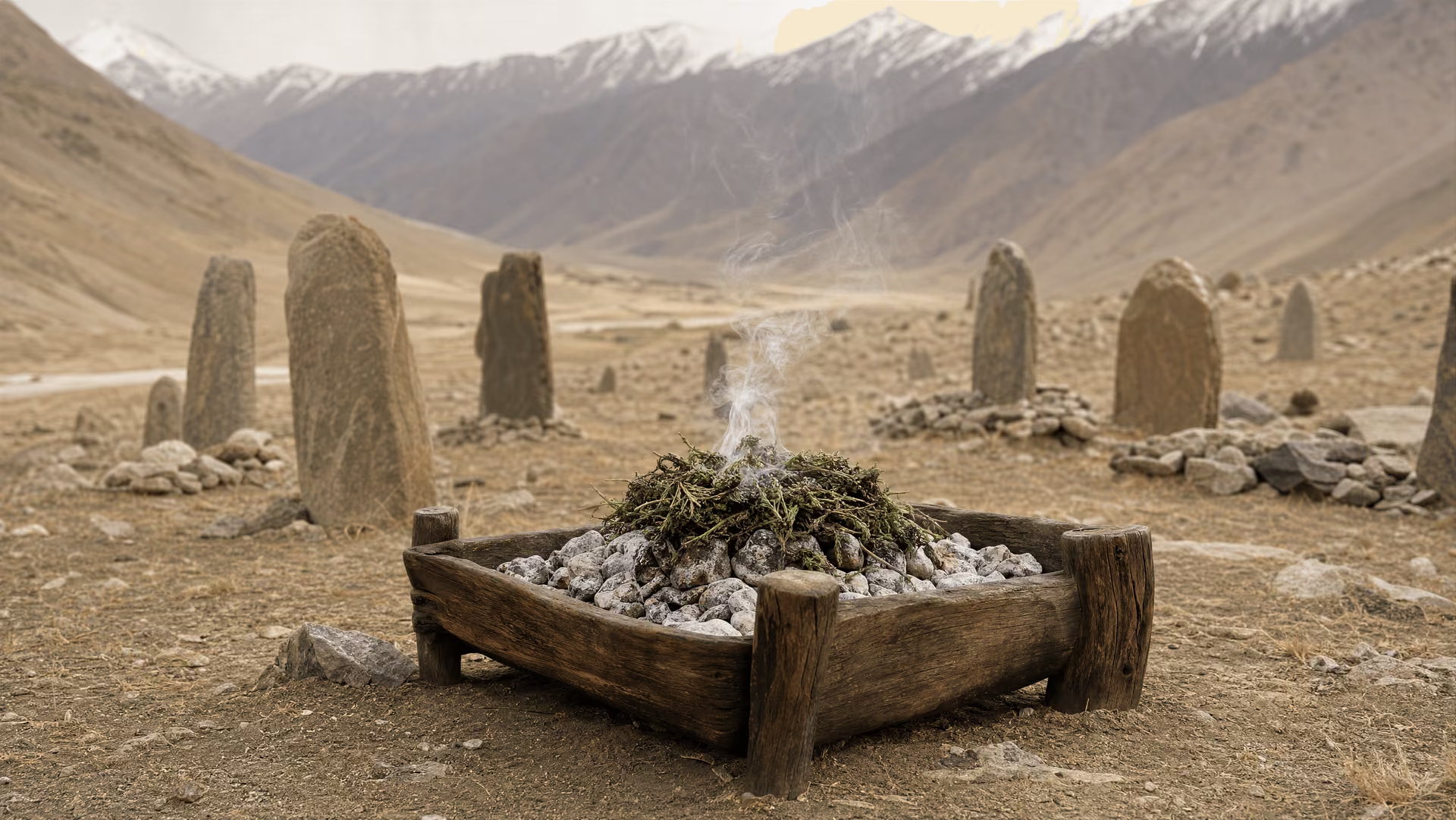
The Jirzankal Cemetery in the Pamirs is a good example of strong evidence. Ren et al., writing in Science Advances in 2019, identified residues from higher-THC cannabis burned in wooden braziers dated to about 500 BCE. That supports ritual combustion of psychoactive cannabis. It is one of the clearest archaeochemical findings of its kind. But clear cases like Jirzankal should not be projected backward onto every earlier discovery of Cannabis remains.
Materia medica A historical body of medical knowledge describing substances used in treatment, including their preparation, properties, and indications.
This is where many secondary accounts go wrong. They take a seed find, a fiber impression, or a passing textual reference and read intoxication into it. They also treat classical medical texts as if they were modern clinical records. In Chinese history, cannabis appears in materia medica traditions, including texts linked to the Shennong Bencao Jing, but exact claims about indications, dosage, and psychoactive effects are often retrospective and overstated. Compilation dates are contested; transmission is layered. Certainty is often fake.
The same caution applies to literary and travel sources. European colonial observers in North Africa, the Middle East, and South Asia often described hashish or ganja through orientalist assumptions, overstating exotic excess while missing ordinary use patterns. Serious history has to rank sources, not just collect anecdotes.
The popular myths this article will correct
One myth says cannabis was universally revered in antiquity. No. Ancient attitudes varied by region, preparation, class, and context. Some uses were practical, some medicinal, some ritual, some frowned upon, and much of the evidence is simply silent.
Cannabis prohibition happened because of one newspaper mogul or one moral panic campaign. Limited evidence
Another says prohibition happened because of one newspaper mogul or one moral panic campaign. That is too easy. Historians such as David T. Courtwright and Isaac Campos show that prohibition grew through state-building, international diplomacy, racial politics, and administrative ambition. In the United States, Anslinger mattered, but so did anti-Mexican racism, local police politics, and the wider architecture of drug control. Internationally, the 1925 International Opium Convention and the 1961 Single Convention mattered as much as any headline.
A third myth says the counterculture ended criminalization. It did not. Past-month marijuana use among US 12th graders reached 37.1% in 1978, according to Monitoring the Future, yet punitive enforcement persisted for decades after normalization. In 2019, the FBI recorded an estimated 545,602 marijuana arrests, 92% for possession.
The last myth is triumphalist: legalization is now sweeping the world in one direction. Also false. Uruguay, Canada, Germany, and US states have adopted very different models, while international control still exists even after the WHO Expert Committee's 2019 recommendation and the 27-25 UN vote in 2020 removing cannabis from Schedule IV of the 1961 Convention. This article will treat documented history as documented history, and retrospective mythology as mythology.
Ancient origins: plant utility, ritual smoke, and early cultural meaning
The oldest history of cannabis is not a single story about intoxication. It begins with a plant that was useful before it was clearly psychoactive in the historical record: stalk for fiber, seed for food and oil, perhaps leaves and flowers in some medicinal or ritual settings, with different uses emerging unevenly across regions. That distinction matters. Ancient people interacted with Cannabis in many ways, and archaeology rarely lets us assume that every seed, fiber fragment, or pollen grain points to deliberate drug use.
Early domestication in East and Central Asia
Most scholars place the earliest domestication history of Cannabis sativa in East Asia, with Central Asia also important in its spread, diversification, and later drug-use history. The evidence is messy because cannabis is biologically plastic, has both wild and cultivated forms, and leaves behind traces that are hard to interpret. Pollen can travel. Seeds can be gathered without cultivation. Fiber remains tell us the plant was processed, but not whether its resin-rich flowers were valued for smoke.
Even so, East Asia gives the clearest early signs of routine human use. Neolithic sites in China have yielded hemp fibers, cord impressions on pottery, and seeds suggesting that cannabis was among the old “utility crops” of settled life. At sites associated with the Yangshao culture, hemp fibers appear in contexts tied to textile and cordage production. Later Chinese traditions retained this practical emphasis: hemp cloth, rope, paper, and seed foods all belong to the long history of cannabis in China far more securely than any sweeping claim that ancient Chinese society centered ritual intoxication on the plant.
That does not mean psychoactive varieties were absent. It means the early record does not justify inflating them into the main story. Domestication often follows the most straightforward incentives first. Strong bast fiber matters for rope, fishing gear, nets, and coarse textiles. Nutritious seeds matter for food and oil. Those uses leave more common archaeological traces and fit what early agrarian communities reliably needed.
Central Asia enters the picture as both corridor and crucible. The mountain and steppe zones linking western China, the Pamirs, and the Eurasian grasslands created conditions for exchange in plants, technologies, and ritual practices. This matters for cannabis because high-altitude and marginal environments may have favored local populations with different chemical profiles, including greater tetrahydrocannabinol, or THC, the main intoxicating cannabinoid identified in modern drug-type cannabis. By the first millennium BCE, the Inner Asian world was already a zone where mobility, trade, and funerary ritual could carry cannabis well beyond any single origin point.
| Evidence found | What it can support | What it cannot prove on its own |
|---|---|---|
| Fiber fragments | Textile or cordage use | That users sought intoxication |
| Seed caches | Food, oil, or sowing stock | High-THC drug use |
| Pollen spikes | Possible local cultivation | Preparation, potency, or motive |
| Burned botanical remains | Combustion occurred | Whether smoke was psychoactive without chemical testing |
| Residue chemistry tied to cannabinoids | Cannabis was burned and chemically identifiable | Exact original potency or frequency of use |
Archaeobotanical evidence for fiber, seed, and psychoactive use
Archaeobotany forces a useful discipline on cannabis history: ask what, exactly, was found. Fiber fragments point to textile use. Seed caches may suggest food, oil, or sowing stock. Pollen spikes can indicate local cultivation, though not always. Burned botanical remains may hint at combustion, but not at the strength or purpose of the smoke. To move from “people had cannabis” to “people sought psychoactive effects” requires tighter evidence.
For fiber and seed use, that tighter evidence exists early. Hemp was one of the old workhorse plants of East Asian societies. Its bast fibers are long and strong; its seeds are edible and can be pressed for oil. These are ordinary, repeatable, non-sensational uses, which is exactly why they matter historically. They show sustained human selection and processing long before any secure proof of drug use.
Claims about early medicine are harder. Later Chinese materia medica traditions do mention cannabis, but internet summaries often turn difficult textual history into false certainty. The Shennong Bencao Jing is traditionally linked to deep antiquity, yet the text was compiled much later, and its transmitted form reflects layers of editing and interpretation. It cannot simply be treated as a transparent window into Neolithic or Bronze Age practice. Ancient medical references may show that cannabis entered pharmacological thinking; they do not automatically tell us dose, preparation, cannabinoid content, or whether the desired effect was sedation, pain relief, bowel regulation, or intoxication.
For psychoactive use, archaeochemistry becomes decisive. Drug use is not proven by the mere presence of cannabis achenes or fibers. Seeds themselves contain little THC. Fiber cultivars may have low psychoactive potential. Even flowering tops, if not chemically tested, tell us less than many popular accounts pretend. Historians who collapse all ancient hemp finds into evidence of intoxication are not making a bold inference. They are skipping the hard part.
The clearest ancient case for ritual cannabis combustion comes from the Jirzankal Cemetery in the eastern Pamirs. Strong evidence

Jirzankal and the strongest current evidence for ancient ritual combustion
The clearest ancient case for ritual cannabis combustion comes from the Jirzankal Cemetery in the eastern Pamirs, in present-day western China. In 2019, Yimin Yang, Robert Spengler, Nicole Boivin, Hongen Jiang, and colleagues published a paper in Science Advances led by Ren et al. that changed the discussion. They analyzed wooden braziers recovered from burials dated to roughly 500 BCE and detected biomarkers indicating cannabis had been burned in them.
What made the finding stand out was not just the presence of cannabis residue. It was the chemical profile. Using gas chromatography–mass spectrometry, the team identified cannabinol, or CBN, an oxidative degradation product of THC. CBN does not prove exact original potency, but it strongly suggests that the burned plant material had been relatively rich in THC compared with ordinary low-THC hemp. The authors argued that people at Jirzankal were selecting, cultivating, or exploiting cannabis with elevated psychoactive properties and burning it during mortuary ritual.
That is a major step beyond speculation. A cemetery context. Braziers clearly used for burning. Residue chemistry tied to cannabinoids. And a ritual setting that makes social sense of the act.
The wider setting matters too. The Pamirs sat within exchange networks that linked oases, mountain corridors, and steppe populations. The Jirzankal evidence fits a world in which plants, ritual forms, and ideas circulated across Inner Asia. It also suggests that psychoactive use may have emerged or intensified in specific ecological and ceremonial contexts rather than as a universal trait of early cannabis culture. Ritual smoke is not the same thing as everyday recreation. Ancient users may have valued altered states for funerary communication, divination, status display, or communal ceremony. The evidence does not let us flatten those motives into a modern category like “drug use.”
Scythians, Herodotus, and the problem of reading classical texts literally
The famous literary passage comes from Herodotus, writing in the fifth century BCE about the Scythians. In Histories 4.73–75, he describes hemp seeds thrown on hot stones inside a tent-like enclosure, producing vapor so intense that the Scythians, he says, “howl” with pleasure. It is one of the most cited ancient cannabis passages in existence. It is also not a laboratory report.
Herodotus is valuable because he preserves a Greek account of steppe ritual bathing or fumigation that sounds strikingly like cannabis inhalation. The description has enough specificity to deserve serious attention. He distinguishes the plant from flax. He places the act in a social ritual context. He emphasizes vapor and bodily reaction. Since archaeological finds from Scythian-related contexts have included cannabis remains, the text is not floating free of material evidence.
Still, reading it literally creates problems. First, Herodotus often wrote from second-hand reports and shaped foreign customs for a Greek audience that expected marvels. He was observant, but not neutral. Second, his phrase usually translated as “seeds” may not map neatly onto modern botanical distinctions in everyday ancient speech. People handling whole flowering tops could easily describe the contents loosely. Third, even if the passage reflects a real practice, it does not tell us cannabinoid content, frequency of use, or whether the purpose was funerary purification, bathing, pleasure, or all three at once.
This is the broader rule for ancient cannabis history: literary description can suggest; chemistry can confirm. Without archaeological context, texts invite overreading. Without texts, archaeology can be mute about meaning. Put together, they allow cautious reconstruction, not certainty.
So the old world record is real but uneven. Cannabis was used very early by human communities, especially for fiber and seed in East Asia. Psychoactive use also appears to be ancient, and by the first millennium BCE it is visible in ritual combustion at Jirzankal and plausible in steppe fumigation practices described by Herodotus. But not every hemp find proves intoxication, and not every mention of smoke means routine recreational use. The ancient evidence points to plurality: work plant, food plant, medicine, and sometimes ritual intoxicant. That is a stronger history than the myth of one timeless, universally revered drug.
Cannabis in the medical traditions of Asia and the Islamic world
Long before cannabis entered 19th-century European pharmacopeias through William Brooke O'Shaughnessy’s 1839 report on “Indian hemp,” it already had medical, ritual, and social lives across Asia and the Islamic world. But those lives were not the same thing. Fiber hemp, edible seed, leaf preparations, flowering tops, and resin each belonged to different practices, and the surviving evidence is uneven. That is why broad claims that “ancient Asia used cannabis as medicine for everything” are usually bad history. Some traditions did assign it real therapeutic value. Some linked it to asceticism, festivity, or altered states. Some treated it with suspicion. Preparation mattered. Context mattered more.
Chinese materia medica and the risk of anachronism
China is often presented online as the place where cannabis was fully described as a medicine in the deep ancient past, usually by citing the Shennong Bencao Jing as if it were a modern pharmacological manual. That overstates the evidence. The Shennong Bencao Jing is a foundational text of Chinese materia medica, but it is not a straightforward window into a single early date, and its compilation history is complex. Retrospective translations also create problems. Terms rendered today as “cannabis” or “hemp” may refer to different plant parts and uses than modern readers assume.
What the Chinese record does show clearly is long familiarity with cannabis as a useful crop. East Asian evidence points early to cordage, textiles, and seeds. That is not trivial background; it changes the historical picture. Human engagement with Cannabis in northern China began with utility. Any story that starts with intoxication is already distorted.
Medical references do exist. Later materia medica traditions discussed hemp seed and other parts of the plant in relation to bowel function, pain, or disturbed states. Yet even here, caution is needed. Seed use does not equal psychoactive drug use. Nor does mention of “hemp” prove that physicians were routinely prescribing high-THC preparations. In many premodern contexts, the seed was nutritionally and medicinally more important than resin-rich flowers.
This is where archaeochemistry helps trim the myths. One of the clearest pieces of evidence for ritual combustion of stronger cannabis comes not from classical Chinese medicine but from the Pamirs: Ren et al., writing in Science Advances in 2019, identified residues from higher-THC cannabis burned in wooden braziers at Jirzankal Cemetery, dated to about 500 BCE. That finding matters because it demonstrates selective use of more psychoactive material in a ritual setting. It does not prove that all of ancient China had a settled culture of smoking potent cannabis. It proves something narrower, and more interesting: some ancient communities in Inner Asia used cannabis in ceremonial burning practices, likely with an interest in psychoactive effect.
So the Chinese case is significant, but not in the mythic way often claimed. Cannabis belonged to the materia medica tradition. It also belonged to agriculture. The textual record supports both points. It does not support the lazy internet fantasy of a fully documented ancient cannabinoid science.
Ayurvedic, ritual, and social uses in South Asia
South Asia offers a denser record of differentiated cannabis use, especially by the early modern and colonial periods. Here the plant was not only listed in learned medical traditions; it was woven into ritual life, seasonal observance, ascetic practice, and ordinary sociability. That made it harder to classify neatly as either “medicine” or “vice.”
Ayurvedic literature includes references to cannabis preparations, though dating and interpretation again require care. Texts compiled across centuries do not always allow simple claims about continuous practice. Even so, by the second millennium and certainly by the early modern period, cannabis had a recognizable place in South Asian therapeutics. It could be described as digestive, analgesic, sedative, or useful in certain compounded remedies. These uses were often framed within broader humoral and energetic logics rather than isolated chemical action.
Religious use also mattered. Associations between cannabis and Shaiva asceticism became especially visible in later periods. Bhang in particular was linked to festivals such as Holi and Shivaratri, and to the practices of some sadhus. That does not mean all Hindus endorsed cannabis, or that every ritual reference implied daily use. It means the substance had legitimate ritual settings in which intoxication was not understood in the same way as drunkenness from alcohol.
The colonial state eventually studied this world in exceptional detail. The Indian Hemp Drugs Commission Report of 1894, a seven-volume inquiry based on nearly 1,200 witnesses, remains the single most important source for cannabis in the subcontinent under empire. Its value lies partly in its refusal to flatten the subject. The Commission distinguished between preparations, classes of users, and degrees of use. It concluded that moderate consumption was generally not associated with the catastrophic social breakdown that some prohibition advocates alleged, though it did recognize harms from excessive use, especially among vulnerable individuals. That is a serious empirical finding, not a romantic defense of cannabis.
| Preparation | Typical plant material | Usual historical route | Relative historical framing in the article |
|---|---|---|---|
| Bhang | Leaves and sometimes other plant parts | Drink or edible mixture | Often treated as relatively milder, context-dependent, and integrated into festival or social use |
| Ganja | Flowering tops of the female plant | Smoking | More strongly associated with intoxication than bhang |
| Charas | Collected resin | Concentrated resin use | Often treated as the most potent of the three |
Bhang, ganja, and charas as distinct historical preparations
The Commission’s most useful lesson is terminological. “Cannabis” in South Asian history was not one thing.
Bhang usually referred to preparations made from leaves, often consumed as a drink or edible mixture. It was widely integrated into festival culture and everyday social settings in parts of India. Colonial observers repeatedly noted that bhang was seen as relatively mild compared with other forms, though “mild” is contextual and depended on dose and preparation.
Ganja referred to the flowering tops of the female plant, generally used for smoking. It was more strongly associated with intoxication than bhang and often carried different social meanings. Patterns of use varied by region, caste, occupation, and urban versus rural setting.
Charas was resin, collected and concentrated, and in many settings was the most potent of the three. Its history links South Asia to wider circuits of resin use across Central and West Asia. Charas was never simply interchangeable with bhang, and historical actors knew that. They ranked forms by strength, effect, and propriety.
That distinction matters because modern debate often collapses all premodern cannabis use into a single inherited tradition. The subcontinental record shows the opposite. The same plant could yield a festive drink, a smoked herb, or a concentrated resin, each with its own moral reputation and practical role. Any serious history has to preserve that difference.
Hashish in the Islamic world: law, mysticism, and urban consumption
In the Islamic world, cannabis most often appears historically through hashish and related preparations rather than through the South Asian categories of bhang and ganja. The legal and cultural story here was mixed from the start. Islamic law did not speak with one voice, and jurists had to reason by analogy: was hashish covered by the Qur’anic prohibition on wine, or by broader principles against intoxication and social harm? Many condemned it. Some treated it as clearly forbidden. Others debated degree, effect, and category.
This was not merely abstract law. Hashish circulated through medical practice, Sufi milieus, and urban leisure. In some accounts it was used to ease pain, quiet distress, or induce states valued by mystics, though many Muslim scholars sharply criticized such uses. Claims that Sufis as a class “used hashish” are as sloppy as claims that Islam uniformly banned all cannabis everywhere. Some mystics used it; many did not; many authorities denounced the practice.
Urban consumption became especially visible in medieval and early modern Middle Eastern and North African cities, where hashish could be associated with artisans, laborers, dervishes, and marginal or bohemian spaces. Periodic crackdowns occurred. So did toleration. Rulers and jurists often worried less about abstract doctrine than about disorder, idleness, and public morality. That pattern should sound familiar: drug control has often been about governing populations as much as evaluating pharmacology.
European writers later covered hashish through an orientalist filter, turning it into proof of an exotic East supposedly given over to dreaminess and excess. That literature is historically revealing mostly for its prejudices. It obscured the ordinary fact that cannabis in Islamic societies, like alcohol in Christian ones, moved through a spectrum of acceptance, regulation, and stigma.
The larger point is simple. Across Asia and the Islamic world, cannabis had real medical and ritual histories before modern Western medicine codified it in extract form. Those histories were plural. Chinese materia medica cannot be read as a blank check for modern claims. South Asia shows how one plant generated several socially distinct drugs. Islamic societies debated hashish through law, ethics, and everyday practice rather than a single ban or a single embrace. The past was not unanimous. That is what makes it worth taking seriously.
Empire, trade, and the 19th-century reinvention of cannabis as Western medicine
The 19th-century Western medical career of cannabis did not emerge from a timeless global tradition finally being recognized by science. It was a colonial translation project. British doctors in India encountered established South Asian practices involving bhang, ganja, and charas, then recast those materials into the forms respectable European medicine preferred: tinctures, extracts, measured doses, case reports, and pharmacopoeial entries. That shift mattered. It moved cannabis from a substance associated in European writing with “Oriental” custom into the language of modern therapeutics.
This was not a simple act of discovery. Indian practitioners and users already knew cannabis in several preparations and social settings, from ritual use to ordinary intoxication to medicine. What changed under empire was who got to define valid knowledge. Colonial medicine filtered local practice through hospital wards, laboratory benches, and metropolitan journals. The result was a new object: “Extractum Cannabis,” standardized on paper if not always in fact, detached from many of the contexts in which cannabis had long been used.
William Brooke O'Shaughnessy and the Bengal connection[2] On the Preparations of the Indian Hemp, or Gunjah. W. B. O'Shaughnessy. Transactions of the Medical and Physical Society of Bengal, 1839.
No figure is more closely tied to this transformation than William Brooke O'Shaughnessy. An Irish-born physician working in British India, he published “On the Preparations of the Indian Hemp, or Gunjah” in 1839 in the Transactions of the Medical and Physical Society of Bengal. That paper is the hinge. Not because cannabis was unknown before 1839, but because O'Shaughnessy supplied the kind of evidence 19th-century British medicine recognized as authoritative: animal experiments, clinical observations, named indications, and pharmaceutical preparation.
He did his work in Bengal, and the Bengal connection is not incidental background. Calcutta was a colonial knowledge hub where trade, military medicine, botany, and chemistry met. O'Shaughnessy was positioned to observe Indian cannabis use directly while also participating in imperial scientific networks that could carry his findings back to London, Edinburgh, and beyond. He described preparations from Indian hemp resin and tested them in cases involving rheumatism, infantile convulsions, tetanus, and rabies-related symptoms. Some of his claims now read as overextended, especially in severe conditions where later medicine found little durable value. Yet his reports on analgesia, sedation, muscle relaxation, and anticonvulsant effects were influential because they seemed plausible, repeatable, and useful.
What he really accomplished was translational. He took substances embedded in Indian categories and rendered them legible to Western pharmacy. Resin became extract. Traditional use became dose. Observation became publication. Empire made that circulation possible, and empire also shaped its distortions. European physicians often treated Indian knowledge as raw material to be refined rather than as a medical system in its own right.
- O'Shaughnessy paper
- 1839
- U.S. Pharmacopoeia inclusion
- 1850-1942
- British Pharmacopoeia status
- Listed extract and tincture
- Common forms
- Oral tinctures and extracts, not smoked flowers
Cannabis extracts in British and American pharmacopeias
After O'Shaughnessy, cannabis entered mainstream medicine in Britain, Europe, and North America with surprising speed. By the mid- to late 19th century it appeared in dispensatories and pharmacopoeias as a recognized drug. The Pharmacopoeia of the United States included cannabis preparations from 1850 until 1942. The British Pharmacopoeia listed cannabis extract and tincture as well. This was not fringe medicine or occult herbalism. It was official.
The favored preparations were not smoked flowers. They were oral tinctures and extracts, often made from cannabis resin dissolved in alcohol or processed into soft extract. That detail matters because later debates often project 20th-century recreational smoking backward onto 19th-century medical practice. Doctors prescribed cannabis more like they prescribed opium tincture or chloral hydrate than like a modern inhaled product. The pharmaceutical form reflected the habits of the period: bottled preparations, measured drops, compounded formulas.
American firms such as Parke-Davis and Eli Lilly produced cannabis extracts and tinctures in the late 19th and early 20th centuries. Pharmacies stocked them. Physicians learned about them in materia medica texts. By the 1890s, cannabis had become one item in a crowded therapeutic arsenal that also included opiates, bromides, chloral, belladonna alkaloids, and many drugs far harsher than cannabis. That context is easy to miss. Cannabis looked useful partly because 19th-century medicine had limited tools for chronic pain, neurological spasm, and insomnia, and because many available alternatives were dangerous.
Its medical legitimacy was still uneven. Potency varied by source and manufacturer, and doctors complained about inconsistency. But legitimacy is the point here: before the great drug-control treaties of the 20th century, cannabis was already sitting on the shelf of ordinary medicine.
Why doctors prescribed cannabis for pain, spasm, and sleep
Physicians turned to cannabis because it seemed to do several things at once, though unreliably. It could dull pain, calm agitation, reduce some spasms, encourage sleep, and in certain cases lessen convulsive activity. Those effects fit the needs of 19th-century practice.
Pain was one major indication. Cannabis was prescribed for neuralgia, migraine, dysmenorrhea, rheumatism, and other chronic painful conditions, especially when opiates were undesirable or poorly tolerated. Doctors often described it as less likely than opium to suppress appetite severely or cause the same degree of constipation, though comparisons were inconsistent and not based on modern trials. It was often tried when pain had a nervous or spasmodic character rather than an acute surgical one.
Spasticity and convulsion were another domain. O'Shaughnessy's Bengal cases helped build this reputation, particularly his reports on tetanus and infantile convulsions. Later doctors used cannabis in chorea, epilepsy, and various disorders then grouped under “nervous” diseases. Some of these uses rested on thin evidence and therapeutic optimism. Still, cannabis did have visible sedative and muscle-relaxant effects in at least some patients, enough to sustain medical interest for decades.
Sleep mattered too. Before modern hypnotics, physicians relied on opiates, bromides, chloral hydrate, paraldehyde, and other agents with serious drawbacks. Cannabis was sometimes prescribed for insomnia, especially where pain, anxiety, or nocturnal restlessness seemed to be the problem. It was not a uniform sedative. Some patients became calm; others became dysphoric, confused, or unaffected. Yet that did not distinguish it from much of 19th-century pharmacology, which was full of uncertain remedies judged by bedside experience.
Doctors also valued cannabis because it seemed broad-spectrum. One medicine might ease pain, reduce spasm, and promote sleep. In an era before receptor pharmacology or randomized trials, that versatility looked like an advantage rather than a warning sign.
Why the medical use faded before prohibition was complete
Cannabis did not disappear from Western medicine simply because lawmakers banned it. Its decline began earlier and had practical causes inside medicine itself.
The first problem was standardization. Cannabis is not a single stable chemical entity in raw plant form. Different batches varied by region, cultivar, storage, and preparation. Long before THC was isolated in 1964 by Raphael Mechoulam and Yechiel Gaoni, physicians were struggling with a basic fact they could observe but not fully explain: one extract might be active, another weak, another nearly inert. A drug with unpredictable strength is a headache for prescribers.
Oral dosing made matters worse. Tinctures and extracts had slow, erratic absorption and delayed onset. Doctors could give what looked like a reasonable dose and see little happen, then see strong effects later, or see a new bottle behave differently from the previous one. That unpredictability is deadly to clinical confidence. Physicians tend to abandon medicines they cannot dose with some reliability.
Degradation was another issue. Cannabis preparations lost activity over time, especially when storage was poor. A shelf-stable medicine can build trust; a medicine that quietly weakens in the bottle cannot.
Then came competition. Late 19th- and early 20th-century medicine increasingly favored drugs that acted faster, could be injected, or were chemically purer. The hypodermic syringe changed expectations. Opiates could be injected. Chloral and bromides had clearer, if imperfect, dose-response patterns for sedation. Aspirin arrived in 1899 and helped reshape pain treatment. Barbiturates, introduced in the early 20th century, offered physicians another class of sedatives and hypnotics that fit emerging pharmaceutical norms better than cannabis did. Cannabis was not forced out by one rival; it was crowded out by a changing therapeutic system.
Regulation amplified the decline but did not start it. As pharmaceutical standards tightened in the late 19th and early 20th centuries, doctors and regulators grew less tolerant of drugs that were difficult to standardize. By the time the 1925 International Opium Convention brought prepared cannabis and resin into treaty control, medical confidence had already eroded. In the United States, the Marihuana Tax Act of 1937 worsened access and stigma, and cannabis was removed from the U.S. Pharmacopoeia in 1942. But by then its place in routine practice was already weak.
That is the historical correction worth insisting on. Cannabis was a real medicine in 19th-century Britain and North America. Its later disappearance was not a simple story of enlightened therapy crushed overnight by prohibition. It was first made respectable through empire, then undone by pharmaceutical inconsistency, clinical frustration, and the rise of competing drugs, before prohibition finished the job.
How prohibition was built: race, bureaucracy, and international law
Cannabis prohibition did not appear all at once, and it was not the inevitable response to a clearly defined pharmacological danger. It was assembled. Colonial officials treated some forms of cannabis use as a governance problem. International diplomats folded cannabis into opium-era treaty machinery. American federal agencies converted scattered local fears into national policy. By the time later generations argued over medicine or personal liberty, a thick legal structure was already in place.
That history matters because it corrects two bad habits. One is to blame everything on one figure, usually Harry Anslinger. The other is to tell a simple morality tale in which a harmless drug was banned solely because politicians lied. There was lying. There was panic. There was racial scapegoating. But there was also paperwork, empire, institutional competition, and treaty law. David T. Courtwright and Isaac Campos have both shown, in different ways, that drug prohibition grew out of state-building as much as out of moral crusade.
Colonial anxieties and early local restrictions
Long before the United States built a federal cannabis regime, colonial states were already sorting psychoactive substances into categories of tolerated custom and suspicious disorder. Those distinctions were rarely neutral. They reflected who was using a substance, under what labor conditions, and whether officials saw that use as ordinary, taxable, or threatening.
British India is a good place to start because it shows that the story could have gone another way. The Indian Hemp Drugs Commission Report of 1894, produced after examining nearly 1,200 witnesses across seven volumes, did not endorse panic. It distinguished bhang from ganja and charas, noted differences in potency and pattern of use, and concluded that moderate consumption generally did not cause the social collapse prohibitionists claimed. It did describe heavy-use harms. Still, this was a major imperial inquiry finding complexity where later prohibitionist politics preferred slogans.
Elsewhere, colonial authorities were less patient. In parts of the French and British empires, cannabis became entangled with fears about labor discipline, soldierly reliability, urban disorder, and allegedly unruly native populations. European writing on hashish in North Africa and the Middle East often filtered everyday use through orientalist fantasy. Cannabis users appeared as decadent, idle, or dangerous “others,” a familiar move in imperial governance.
In the United States, the early local restrictions that mattered most came out of the Southwest. Here anti-Mexican politics were central. After the Mexican Revolution of 1910, migration northward increased, and with it the visibility of the term “marihuana” or “marijuana” in Anglo-American public discourse. The foreign-sounding word itself helped detach the drug from older pharmaceutical “cannabis” tinctures found in medicine chests. El Paso passed an ordinance against marijuana in 1914. Other municipalities and states followed in the 1910s and 1920s.
These measures did not arise because doctors had discovered a new chemical menace. They arose because local officials, police, and newspapers linked marijuana to Mexican laborers, crime, knife violence, and supposed racial degeneracy. That framing was politically useful. It converted xenophobia into public safety policy. Campos has shown that this was not a side note; anti-Mexican fear in the borderlands helped create the cultural script that national prohibitionists later amplified.
The 1925 International Opium Convention and global control
The first decisive multilateral move came in the 1925 International Opium Convention at Geneva. Cannabis was not the center of that treaty. Opium and its derivatives were. But “Indian hemp” entered the agreement through provisions aimed at controlling cannabis resin and “prepared” cannabis for international trade, especially after pressure from states such as Egypt, where hashish had become a visible political issue.
The treaty did not impose a modern-style total prohibition. It did something subtler and, in the long run, more durable: it put cannabis inside the architecture of international drug control. Once a substance enters treaty administration, it becomes subject to reporting, certification, customs controls, and diplomatic expectations. Bureaucracy does the rest.
That bureaucratic shift is easy to miss because the 1925 convention sounds modest compared with later UN drug treaties. Yet it created a path dependency. Governments could now justify domestic restriction as compliance with international obligations, even where local evidence was weak. Drug control became part of respectable statecraft.
Schedule IV of the 1961 Single Convention A category within the UN Single Convention on Narcotic Drugs used for substances judged especially harmful and of limited medical value; cannabis was removed from this schedule in 2020 but remained internationally controlled.
This mattered enormously after the Second World War. The 1961 UN Single Convention on Narcotic Drugs consolidated earlier agreements and placed cannabis and cannabis resin under strict international control, including Schedule IV, then reserved for substances viewed as especially harmful and of limited medical value. That scheduling helped lock many countries into restrictive legal frameworks, even when their domestic histories of cannabis use had been varied and old. Only in December 2020 did the UN Commission on Narcotic Drugs, following a 2019 recommendation from the WHO Expert Committee on Drug Dependence, vote 27-25 to remove cannabis and cannabis resin from Schedule IV. Even then, cannabis remained controlled under the Single Convention. The change was real, but narrow. It did not dismantle the treaty system.
Harry Anslinger, media panic, and the Marihuana Tax Act of 1937
Harry Anslinger, appointed the first commissioner of the Federal Bureau of Narcotics in 1930, did not invent anti-cannabis sentiment. He inherited local bans, racialized folklore, and the new treaty environment. What he did was nationalize and institutionalize them.
Anslinger was a bureaucratic entrepreneur. The Federal Bureau of Narcotics was a young agency, and agencies seek mission, budget, and authority. Cannabis gave the bureau room to expand. Anslinger collected lurid case stories, promoted claims linking marijuana to insanity and violence, and fed a press culture already primed for sensationalism. The film Reefer Madness became famous later, but the deeper problem was a wider media ecosystem that treated anecdote as evidence and racial fear as policy logic.
He also benefited from the gap between “cannabis” as a medicine and “marihuana” as a menace. Many Americans did not realize they were hearing about the same plant under different names. That linguistic split made it easier to demonize one form while avoiding immediate confrontation with the fact that cannabis extracts had been present in 19th-century Western medicine since the era of William Brooke O’Shaughnessy.
The Marihuana Tax Act of 1937 was the key federal hinge. Formally, it was a tax measure, not an outright criminal ban. In practice, it imposed registration, transfer taxes, and documentation requirements so burdensome that lawful handling became extremely difficult. Failure to comply could trigger prosecution. The American Medical Association, through legislative counsel Dr. William C. Woodward, criticized the bill, objecting that the evidence was thin and the legislation was rushed. Congress moved ahead anyway.
The Supreme Court later struck down the Tax Act in Leary v. United States (1969) on Fifth Amendment grounds, but by then the federal anti-cannabis apparatus was already entrenched. Anslinger mattered, then, not because he single-handedly created prohibition, but because he transformed scattered prejudice and treaty logic into durable federal administration.
From tax law to punitive drug law: Boggs, Narcotic Control, and the Controlled Substances Act
After 1937, cannabis policy in the United States became harsher and more openly punitive. The Boggs Act of 1951 introduced mandatory minimum sentences for drug offenses, including marijuana. The Narcotic Control Act of 1956 intensified that approach with even steeper penalties. These laws reflected Cold War politics as much as pharmacology. Drugs were cast as threats to moral order, national strength, and social discipline. Cannabis, despite its distinct effects and history, was increasingly folded into a generalized “narcotics” crackdown.
Then came the major reorganization: the Controlled Substances Act of 1970. This statute repealed the old Marihuana Tax Act framework and created the federal scheduling system still in use. Marijuana was placed in Schedule I, defined as having high abuse potential and no accepted medical use under federal law. That classification was contentious from the start. The Shafer Commission, appointed by President Nixon and reporting in 1972, recommended decriminalizing possession for personal use, but the administration rejected its advice.
Schedule I did more than signal disapproval. It shaped research, medicine, policing, and diplomacy. Scientists faced heavy administrative burdens in studying cannabis, even as cannabinoid science advanced. Raphael Mechoulam’s isolation of THC in 1964 and later work on cannabinoids changed the scientific conversation, but chemistry alone could not easily dislodge legal categories built for control. Law lagged behind evidence, and sometimes ignored it.
The punitive turn also outlived the counterculture moment that supposedly normalized marijuana. Yes, cannabis became a mass symbol of youth dissent, and Monitoring the Future recorded 37.1% past-month marijuana use among 12th graders in 1978. Yet normalization in culture did not end criminalization in law. Arrests remained enormous. In 2019, FBI Uniform Crime Reporting data cited by the ACLU counted an estimated 545,602 marijuana arrests nationwide, 92% for possession. Black people were 3.64 times more likely than white people to be arrested for marijuana possession, despite similar use rates, according to the ACLU’s 2020 report A Tale of Two Countries.
That is the real legacy of prohibition’s construction. It was not simply a mistaken idea about one drug. It was a layered system built through empire, xenophobia, agency growth, treaty commitments, and criminal law. Later reform had to fight on all of those fronts at once.
The Indian Hemp Drugs Commission and the evidence prohibitionists ignored
Long before the 20th century built a global prohibition system around cannabis, one of the largest official investigations ever conducted into the drug had already reached a far less alarmist verdict. The Indian Hemp Drugs Commission Report of 1894 was not written by radicals, libertarians, or later reformers trying to rescue cannabis from stigma. It was a British colonial inquiry, assembled by an empire worried about order, taxation, health, and administrative control. That is exactly why it matters.
The report is a standing rebuke to the claim that harsh prohibition emerged because no serious evidence existed. Evidence did exist. Officials gathered it. Then later prohibitionists often ignored it.
Why the Indian Hemp Drugs Commission mattered
- Scale It became a seven-volume inquiry rather than a short administrative memo.
- Witness base It examined nearly 1,200 witnesses across India.
- Comparative detail It distinguished bhang, ganja, and charas instead of treating all cannabis forms as identical.
- Policy significance It offered a large evidence record before the 20th-century treaty system hardened.
Why Britain launched the 1893–1894 inquiry
The inquiry grew out of imperial anxiety, not enlightened tolerance. British authorities in India governed a vast population in which bhang, ganja, and charas were already well-established, though used in different ways, by different classes, and in different regions. “Indian hemp drugs” was itself a bureaucratic category that bundled together distinct preparations: bhang, usually taken as a drink or edible from leaves; ganja, the flowering tops; and charas, the resin. These were not socially identical substances, and the commission knew that.
Pressure for investigation came from recurring claims that hemp drugs caused insanity, violence, moral ruin, and public disorder. Some of those claims circulated in missionary and medical circles; some came through asylum discussions; some reflected the broader colonial habit of explaining social difference through intoxication. Britain also had a fiscal stake. Cannabis preparations were taxed in parts of India, so any move toward suppression raised practical state questions: was the drug truly so dangerous that revenue should be sacrificed and enforcement expanded?
The Government of India appointed the commission in 1893 to answer those questions systematically. This was not a quick memo. It became a seven-volume report published in 1894, and it remains one of the most extensive state inquiries ever made into cannabis use. Its importance lies partly in timing. This was decades before the 1925 International Opium Convention brought prepared cannabis and resin into treaty control, and long before Harry Anslinger helped harden US federal prohibition. A major imperial government had the chance to build policy from a large evidentiary record. It chose caution over panic. Later regimes did the reverse.
What nearly 1,200 witnesses told the commission
The scale of the inquiry was extraordinary. The commission examined nearly 1,200 witnesses across India: medical officers, asylum superintendents, tax officials, soldiers, cultivators, sellers, religious figures, and users themselves. That breadth matters. It did not rely on a single profession, and it did not confuse elite opinion with the whole field of evidence.
Its method had limits, of course. This was still a colonial investigation shaped by administrative categories, uneven medical knowledge, and the biases of the late 19th century. It was not a modern epidemiological study. There were no randomized trials, no cannabinoid assays, no distinction between THC and CBD, no receptor science of the sort later associated with Raphael Mechoulam’s era. Yet for its time, the commission asked unusually concrete questions: how common was use, in what form, among whom, with what visible effects, and with what relation to crime, insanity, and physical decline?
Witnesses did not present a single simple picture. They described routine, socially tolerated consumption in some settings, especially of bhang, alongside heavier use that could produce obvious impairment. Many denied that moderate use commonly caused madness or violence. Others described harm among habitual heavy users. That split is the heart of the report, and it is exactly what later prohibition rhetoric erased.
The commission paid special attention to insanity because that was one of the strongest anti-cannabis claims. Here it rejected the wilder assertions. After reviewing asylum evidence, it did not deny that hemp drugs could in some cases be linked to mental disorder, especially with excessive use or among vulnerable individuals. But it found that the proportion of insanity fairly attributable to hemp drugs was much smaller than campaigners alleged, and that the evidence had often been overstated or poorly classified.
On crime, the report was similarly skeptical of panic. It did not endorse the fantasy that cannabis routinely transformed ordinary users into dangerous criminals. Nor did it present intoxication as a universal explanation for violence. In that respect the commission anticipated a pattern seen again and again in drug history: states and moral reformers tend to convert scattered worst cases into a general rule.
- Publication
- 1894
- Volumes
- 7
- Witnesses examined
- Nearly 1,200
- Core conclusion
- Moderate use was generally not associated with the catastrophic harms prohibitionists claimed
Moderate use, heavy use, and the commission's actual conclusions
The commission’s language was careful, and it should be quoted carefully. It did not say cannabis was harmless. It did not celebrate intoxication. It did not claim that all forms and levels of use were equivalent. What it did say, in one of the report’s most cited conclusions, was this: “The moderate use of hemp drugs is practically attended by no evil results at all.” That line is often isolated, but the sentence that follows is just as important: “In all but the most exceptional cases, the injury from habitual moderate use is not appreciable.”
That was a remarkable finding from a colonial government inquiry in 1894. It directly contradicted blanket claims that ordinary use inevitably caused degeneration, insanity, or crime.
At the same time, the commission drew a real distinction between moderate and excessive consumption. It accepted that excessive use could be harmful, physically, mentally, and socially. It also treated charas as more potent and more likely to cause serious problems than bhang. This differentiation was one of the report’s strengths. It refused the lazy category error of treating every cannabis preparation, every pattern of use, and every user as identical.
Its broader policy conclusion followed from that evidence. Total prohibition, the commission argued, would be hard to enforce, likely unjustified by the harms actually shown, and capable of producing its own social damage. Restriction and taxation were more defensible than outright suppression. That was not permissiveness. It was evidence-based restraint.
This is why the Indian Hemp Drugs Commission should sit near the center of cannabis history. It shows that before the international prohibition consensus hardened, officials had already assembled a huge documentary record and found the strongest anti-cannabis claims wanting. The later story was not one in which science finally discovered complexity after a long age of ignorance. Much of that complexity was visible in 1894. What followed was not the absence of evidence, but the political defeat of evidence by bureaucracy, empire, and moral panic.
Counterculture changed the image of cannabis, not the legal machinery
The counterculture years did not invent cannabis use, and they did not dismantle prohibition. What they changed was public meaning. A substance that federal officials had long cast as foreign, criminal, and racially suspect became, by the late 1960s, a marker of youth identity, music scenes, antiwar dissent, and everyday sociability on campuses and in suburbs. That shift was real. So was the contradiction beneath it: the law remained punitive, the federal schedule remained unchanged, and arrests continued on a huge scale.
Jazz, beat culture, and early 20th-century subcultural use
Before cannabis entered mass middle-class youth culture, it circulated in smaller urban scenes. In the United States during the early 20th century, marijuana use was associated in public rhetoric with Mexican migrants in the Southwest, with Black jazz musicians, and with bohemian circles that mainstream America already distrusted. Harry Anslinger, head of the Federal Bureau of Narcotics, built federal prohibition partly by weaponizing those associations. Isaac Campos and David T. Courtwright both show that this was not a simple response to pharmacology. It was a political project assembled from xenophobia, moral panic, bureaucratic ambition, and selective policing.
Jazz culture mattered because it gave marijuana a visible cultural home before it had anything like broad social legitimacy. Musicians used slang terms such as “reefer” and “muggles,” and cannabis appeared in songs, club talk, and vice policing. The image was double-edged. Within the scene, it could signify style, creativity, stamina, or group belonging. Outside it, officials treated it as proof of deviance. The same pattern carried into beat culture after World War II. Writers and artists interested in altered perception, nonconformity, and escape from suburban discipline helped keep cannabis linked to rebellion, but still on the margins.
That is the point often missed in retrospective storytelling. Cannabis was not yet “normal.” It was legible as subcultural. It traveled through music, nightlife, and bohemia long before it traveled through high schools and college dorms. The Marihuana Tax Act of 1937, followed by the Boggs Act of 1951 and the Narcotic Control Act of 1956, had already placed it inside a punitive federal framework. Counterculture inherited that framework; it did not erase it.
The 1960s and 1970s: antiwar politics, music, and generational identity
The 1960s changed scale. Cannabis moved from selective subcultures into mass youth culture, especially among students and young adults. Music was one vehicle, but not the only one. Antiwar protest, distrust of authority, the growth of campuses, and a widening generation gap all mattered. Marijuana became less a sign of urban vice and more a sign of refusal: refusal of the draft, of square conformity, of official morality, of the insistence that respectable citizenship required obedience.
That image spread fast. So did use. By 1978, past-month marijuana use among 12th graders reached 37.1%, according to Monitoring the Future. That number matters because it marks normalization, not fringe experimentation. A drug once linked by authorities to outsiders had become ordinary in parts of American youth life.
Public perception shifted with this expansion. Many middle-class parents, journalists, and politicians could no longer plausibly describe marijuana users as a tiny criminal underworld when users now included their children, classmates, and neighbors. The image of cannabis softened. It was increasingly compared with alcohol and often judged, by users at least, as less destructive. The rise of cannabinoid science also began to matter at the edges of debate. Raphael Mechoulam’s isolation of delta-9-tetrahydrocannabinol, or THC, in 1964 did not transform law overnight, but it did change how cannabis could be discussed: less as folklore, more as chemistry and pharmacology.
Yet image change is not law change. Congress passed the Controlled Substances Act in 1970 and placed marijuana in Schedule I, defined in federal law as having high abuse potential and no accepted medical use. That classification sat awkwardly beside expanding use and growing skepticism, but it was the law. The state was willing to tolerate cultural ambiguity far more than legal reform.
The Shafer Commission and the road not taken
The clearest proof that reform was thinkable came from inside the system. In 1970, Congress created the National Commission on Marihuana and Drug Abuse, chaired by former Pennsylvania governor Raymond P. Shafer. Its 1972 report, Marihuana: A Signal of Misunderstanding, recommended decriminalizing possession for personal use and ending criminal penalties for casual distribution without profit.
This was not a fringe manifesto. It was an official commission, appointed under federal authority, reviewing evidence at a moment when marijuana use had become too widespread to ignore. The report did not endorse a free-for-all. It argued that the harms of criminalization, especially for users whose conduct posed limited social danger, outweighed the harms of the drug itself. That was a sober institutional judgment.
President Richard Nixon largely ignored it. Politics explains why. Nixon had already folded drug control into a broader law-and-order strategy, one tied to backlash against protest, racial unrest, and the perceived disorder of the 1960s. A less punitive marijuana policy would have undercut that posture. Emily Dufton’s work on reform politics shows that public debate was opening, but elite political incentives still ran in the other direction. The Shafer Commission offered an off-ramp. The administration chose the highway.
That refusal mattered for decades. Had the recommendations been taken seriously, the United States might have moved toward decriminalization in the early 1970s, before the full institutional build-out of the modern drug war. Instead, the report became a historical might-have-been: evidence that the persistence of prohibition was a choice, not an inevitability.
Mass use, persistent arrests, and the War on Drugs backlash
The late 1970s exposed the contradiction. Marijuana had become common enough to be culturally familiar, yet enforcement never disappeared. Then came backlash. The Reagan era hardened drug policy, expanded punitive policing, and cast leniency as weakness. Marijuana was swept into that machinery even when public perceptions of it were less fearful than those attached to heroin or crack cocaine.
This is why the counterculture story needs restraint. It is easy to overstate liberation because the iconography is so vivid: Woodstock, underground papers, college smoke, album covers, Cheech and Chong. But symbolic normalization did not dismantle coercive institutions. Police departments, prosecutors, federal scheduling rules, and international treaty structures remained in place. The 1961 Single Convention on Narcotic Drugs still bound national policy. Domestic agencies still had budgets, arrest powers, and political incentives to keep marijuana illegal.[3] A Tale of Two Countries: Racially Targeted Arrests in the Era of Marijuana Reform. American Civil Liberties Union. ACLU Report, 2020.
The numbers make the point bluntly. In 2019, long after the counterculture had passed into nostalgia and even after some states had legalized, there were an estimated 545,602 marijuana arrests in the United States, according to FBI Uniform Crime Reporting data cited by the ACLU. About 92% were for possession. That is not the residue of a dead policy. It is active criminalization. The racial pattern was also unmistakable: in 2020 the ACLU reported that Black people were 3.64 times more likely than white people to be arrested for marijuana possession despite comparable use rates.
So the legacy of counterculture is mixed. It succeeded in changing the social face of cannabis. It helped move marijuana from the margins into mainstream awareness and, eventually, into reform politics. But it did not break the legal machinery built by Anslinger’s generation and reinforced by Nixon and Reagan. Mass use and mass arrests coexisted for decades. That, more than any tale of simple liberation, is the real historical pattern.
Science returned to the story: cannabinoids, receptors, and the medical revival
By the late 20th century, cannabis had a strange status. It was widely used, heavily policed, and still described in US federal law as a drug with no accepted medical use. That legal claim mattered. So did chemistry. Once researchers could identify specific active compounds, test them, and trace their effects through receptors and endogenous signaling molecules, cannabis stopped looking like an incoherent herbal relic and started looking like a legitimate object of modern pharmacology. That shift did not, by itself, undo prohibition. But it gave patients, clinicians, and reformers a new language that bureaucracies could not dismiss as easily.
Raphael Mechoulam and the identification of THC
The modern scientific revival usually begins with Raphael Mechoulam, the Israeli chemist who helped move cannabis research from crude extracts to defined molecules. Earlier chemists had isolated cannabidiol, or CBD, in the 1940s, but the main psychoactive constituent remained uncertain. In 1964, Mechoulam and Yechiel Gaoni published the isolation and structural elucidation of delta-9-tetrahydrocannabinol, THC, in the Journal of the American Chemical Society. That was a turning point.
Before THC was identified, cannabis research was plagued by the same problem that had weakened 19th-century medical use after O'Shaughnessy introduced Indian hemp to Western medicine: inconsistency. Plant material varied. Extracts degraded. Dose-response relationships were messy. Once THC was isolated, researchers could compare cannabis effects to a known compound rather than a shifting botanical mixture. That made laboratory work sharper and medical claims more testable.
Mechoulam's work did not prove that cannabis was safe or broadly therapeutic. It did something more basic and more powerful. It made serious research possible. Scientists could now ask which effects were driven by THC, which by CBD, and which by other constituents. They could distinguish intoxication from analgesia, antiemesis, appetite stimulation, and anticonvulsant action. They could also stop treating cannabis as a mystery plant beyond ordinary pharmacology.
That mattered politically because prohibition had long benefited from vagueness. Harry Anslinger's generation had used lurid rhetoric and category confusion to portray marijuana as a singular social menace. Chemistry cut against that style of argument. Once one could point to THC as a discrete molecule with measurable receptor activity, the old claim that cannabis had no place in medicine became harder to defend as a scientific proposition. It increasingly looked like a legal conclusion in search of evidence.
How the endocannabinoid system entered the record
- 1988 A specific cannabinoid receptor in the mammalian brain was identified, later termed CB1.
- 1990 The CB1 receptor was cloned.
- 1992 Anandamide was identified as an endogenous ligand.
- 1993 CB2 was identified, mainly in immune tissues.
- 1995 2-arachidonoylglycerol, or 2-AG, was identified by Mechoulam's group and independently by Sugiura and colleagues.
The discovery of the endocannabinoid system and why it mattered politically
If THC's identification opened the door, receptor science blew it off the hinges. In 1988, Allyn Howlett and William Devane identified a specific cannabinoid receptor in the mammalian brain, later termed CB1. In 1990, the CB1 receptor was cloned. In 1993, Munro, Thomas, and Abu-Shaar identified CB2, found mainly in immune tissues. Then came the endogenous ligands: anandamide in 1992, discovered by Devane, Hanus, Breuer, Pertwee, Stevenson, Griffin, Gibson, Mandelbaum, Etinger, and Mechoulam; and 2-arachidonoylglycerol, or 2-AG, identified in 1995 by Mechoulam's group and independently by Sugiura and colleagues.
Endocannabinoid system A physiological signaling system made up of cannabinoid receptors, endogenous ligands such as anandamide and 2-AG, and the enzymes involved in their synthesis and breakdown.
This was not a minor laboratory footnote. It established that the human body contains an endocannabinoid system: receptors, endogenous signaling molecules, and enzymes involved in synthesis and breakdown. Cannabis was no longer acting on the body in some vague, plant-specific way. THC was interacting with a preexisting physiological signaling network involved in memory, appetite, pain, mood, nausea, and immune function.
The political effect was immediate, even when laws did not change right away. Schedule I under the US Controlled Substances Act rested on the proposition that marijuana had no accepted medical use. Yet receptor science made that position increasingly brittle. A drug can still be dangerous even if it acts on a defined receptor system; that is obvious enough. But "no accepted medical use" became less credible when the underlying biology was being mapped in mainstream journals and discussed in ordinary pharmacological terms.
It also changed how regulators and physicians talked. Cannabis no longer had to be defended only through anecdote, tradition, or countercultural suspicion of the state. It could be discussed through receptor binding, antiemetic pathways, appetite modulation, spasticity, and seizure thresholds. The debate moved, at least in part, from moral panic to biomedical evidence.
That shift was never pure. Bureaucracy and treaty law still constrained research. The 1961 Single Convention and US scheduling rules kept cannabis under tight control. But the science created cracks in the wall. Decades later, when the WHO Expert Committee on Drug Dependence recommended in 2019 that cannabis be removed from Schedule IV of the Single Convention, and the UN Commission on Narcotic Drugs voted 27-25 in 2020 to do so, that decision rested on a long accumulation of pharmacological and clinical evidence, not on cultural fashion.
AIDS activism, cancer care, and patient-led reform
Laboratory science alone did not revive medical cannabis. Sick people did. The most important pressure came from patients living through AIDS and cancer, especially in the 1980s and 1990s, when wasting, nausea, chronic pain, and treatment side effects were often devastating and poorly managed.
For people with HIV/AIDS, appetite was not trivial. Weight loss and wasting could be life-threatening. For cancer patients, nausea and vomiting linked to chemotherapy could be so severe that treatment itself became hard to endure. Cannabis, and later synthetic THC products such as dronabinol, entered this landscape because patients reported that it helped them eat, reduced nausea, improved sleep, and made suffering more bearable. These were not abstract quality-of-life concerns. They were immediate bodily problems.
AIDS activism changed the politics of evidence. Activists had already challenged the pace and priorities of drug regulation in battles over antiretroviral access and experimental treatments. Cannabis fit into that broader struggle over patient autonomy, compassionate use, and the right to manage symptoms when official medicine was failing or moving too slowly. San Francisco became a center of this movement. So did other urban areas with strong AIDS service networks and gay activist communities.
Cancer care added another constituency: older patients, caregivers, and clinicians who would never have framed themselves as part of a drug reform movement. They did not need a theory of liberation. They needed antiemetic relief and calories. Once cancer and AIDS patients became the public face of medical-cannabis claims, opponents found it harder to reduce the issue to counterculture or delinquency.
This patient-led reform also exposed a contradiction at the core of prohibition. Governments insisted cannabis had no accepted medical use while patients, nurses, and some physicians were already using it for symptom management in plain view. The law was not tracking practice. It was trying to suppress it.
California Proposition 215 and the modern medical-cannabis era
That contradiction produced a legal break in California. In 1996, voters passed Proposition 215, the Compassionate Use Act, allowing patients and caregivers under a physician's recommendation to possess and cultivate cannabis for medical purposes. It was the first state medical-cannabis law of the modern US era, and it changed everything.
Proposition 215 did not emerge from science alone, and it did not rest on a neat chain from receptor discovery to ballot victory. It was built from overlapping forces: AIDS activism in San Francisco, cancer patient advocacy, distrust of the drug war, and a growing body of cannabinoid science that made medical claims sound less dismissible. Emily Dufton and other historians of reform politics have shown that medical marijuana succeeded in part because it moved the public conversation away from abstract rights and toward visible suffering.
The law also exposed the federal-state conflict that would define the next era. Marijuana remained in Schedule I. Federal agencies still treated it as prohibited. Yet one of the largest states in the country had created a medical exception grounded in physician judgment and voter approval. That was the hinge. After 1996, cannabis policy was no longer only a prohibition story. It became a contest between scientific credibility, patient need, state experimentation, and federal inertia.
From there, reform widened unevenly. But the pattern had been set. Chemistry named THC. Neuroscience mapped CB1, CB2, anandamide, and 2-AG. Patients with AIDS and cancer forced symptom relief into public view. California turned that pressure into law. Modern legalization would come later, through many different models, but the road to it ran through this medical revival.
From decriminalisation to legalisation: three different modern models
One of the biggest errors in modern cannabis history is treating “legalization” as if it names a single destination. It does not. States have moved along at least three different tracks: decriminalization, which usually removes or reduces criminal penalties for possession while leaving supply illegal; partial legalization, which allows some possession or cultivation but tightly restricts access; and full adult-use legalization, which creates a lawful supply system under state rules. Those differences matter because they produce different markets, police powers, and political narratives.
Decriminalization came first in many places, and it is often misunderstood. A decriminalized system may still seize the drug, fine the user, or leave production and sale in the hands of illicit suppliers. It can reduce arrests without resolving the basic contradiction of mass demand under forbidden supply. That contradiction helped push reform further. By the early 21st century, prohibition had plainly failed to eliminate use. The UN Office on Drugs and Crime estimated 228 million users worldwide in 2022. In Europe, the EU Drugs Agency reported 22.8 million adults aged 15 to 64 had used cannabis in the last year in the latest surveys summarized in the 2024 European Drug Report. Use remained widespread; legal systems diverged.
Uruguay: state-controlled legalization as a public-security project
Uruguay’s 2013 law was historically important because it made the country the first to legalize adult-use cannabis nationally. Just as important, it did so for reasons that differed from the North American script. This was not a celebration of consumer choice. It was framed as a state response to illegal trafficking, insecurity, and the failure of prohibition to control a common drug market.
President José Mujica’s government argued that cannabis should be taken away from criminal organizations and placed under public authority. The law created a highly managed system with three legal access routes for registered adult residents: home cultivation, membership in cannabis clubs, and pharmacy sales of state-regulated cannabis. Registration rules were strict. Advertising was barred. Potency and supply were controlled. Foreign tourists were excluded. The point was not to build a broad retail sector; it was to substitute a legal, monitored channel for part of the illicit market.
That design reflected Uruguay’s political diagnosis of the problem. Cannabis was treated less as a culture-war symbol than as one piece of a security and governance question. In Latin America, where drug-control policy had long been shaped by violence, trafficking, and US-led prohibition pressure, this mattered. Uruguay’s lawmakers were not claiming cannabis was harmless. They were claiming the illegal market was worse.
The model also revealed the limits of legalization under international treaty law. Uruguay remained a party to the 1961 Single Convention on Narcotic Drugs, whose structure sits uneasily with non-medical legalization. Rather than waiting for treaty reform, Uruguay moved first and accepted the legal tension. That was a significant break. It showed that national governments could challenge the old consensus without withdrawing from the entire international control system.
Yet Uruguay did not offer a simple template for others. Implementation was slow. Pharmacy participation was uneven. Banking rules complicated operations because international financial compliance still treated cannabis as risky. Even so, Uruguay established a distinct model: legalization without a large commercial industry, built around registration and state supervision, justified as a public-security intervention.
Canada: national legalization with a regulated commercial market
Canada’s 2018 Cannabis Act marked a different path. Where Uruguay built a tightly state-steered system to weaken illegal supply, Canada created a national legal market with licensed producers, retail distribution, product regulation, and provincial variation layered on top of federal law. The federal government presented legalization as a way to keep cannabis away from youth, displace illicit sellers, and protect public health. But unlike Uruguay, Canada accepted from the outset that lawful commercial production would be central.
This distinction matters. Canada did not merely stop punishing possession. It built an industry under administrative law. Producers had to meet federal standards for cultivation, processing, packaging, testing, and labeling. Provinces then decided how retail would work: public stores in some places, private stores in others, mixed systems elsewhere. Edibles and extracts were introduced later under separate rules. THC content, product forms, warning labels, and promotion restrictions all became objects of regulation.
That architecture made Canada the clearest example of full national legalization in a high-income democracy with a broad lawful supply chain. It also exposed the trade-offs that follow once the state regulates not just possession but production at scale. Price competition with illicit sellers became a policy issue. So did product potency, youth appeal, marketing limits, emergency presentations, and the concentration of ownership. Legalization did not end the public-health debate; it changed its subject.
Canada’s model also grew out of a legal and political history different from Uruguay’s. Court decisions on medical cannabis had already weakened absolute prohibition. Public opinion had shifted over years, not weeks. Reformers argued that criminalization was costly, unevenly enforced, and increasingly detached from ordinary social reality. That argument had force across North America. In the United States, where reform remained fragmented by federalism, the ACLU reported in 2020 that Black people were 3.64 times more likely than white people to be arrested for marijuana possession despite similar use rates, and that police made an estimated 545,602 marijuana arrests in 2019, 92 percent for possession. Canada’s legal setting was different, but the broader lesson was shared: mass use and selective enforcement are politically unstable companions.
Still, “regulated market” should not be confused with a free market. Canada’s system remained heavily rule-bound, and provinces retained broad control over retail access. Nor did legalization settle treaty contradictions. Like Uruguay, Canada moved beyond the strict logic of the Single Convention. The old international framework, already weakened by the WHO Expert Committee on Drug Dependence’s 2019 recommendation and the Commission on Narcotic Drugs’ narrow 27-25 vote in 2020 to remove cannabis from Schedule IV, no longer matched the policy landscape on the ground.
| Jurisdiction | Reform year in article | Access model | Commercial adult-use retail? |
|---|---|---|---|
| Uruguay | 2013 | Registered residents can use home cultivation, cannabis clubs, and pharmacy sales | No broad commercial retail model |
| Canada | 2018 | National legal market with licensed production and retail under federal and provincial rules | Yes, regulated commercial market |
| Germany | 2024 | Possession rights, home growing, and non-commercial cultivation associations | No nationwide broad adult-use retail market |
Germany and Europe: partial legalization, clubs, and cautious reform
Germany’s Cannabis Act, the KCanG, which took effect in 2024, represents a third model: limited legalization without a broad adult-use retail market. Adults may possess specified amounts, grow a small number of plants at home, and join non-commercial cultivation associations that distribute cannabis to members under strict rules. That is a major change from prohibition. It is not the Canadian system.
The German government originally floated a wider commercial model, then retreated under pressure from European Union law, treaty obligations, and domestic caution. The result was a compromise. Possession rules were relaxed. Home cultivation became lawful within limits. Associations, often called clubs, were allowed. But ordinary commercial sales for adult use were not opened nationwide. Germany chose controlled access over full market legalization.
That choice was shaped by Europe’s legal fragmentation. European states operate under overlapping constraints: UN drug treaties, EU law, Schengen rules, constitutional law, and local politics. So Europe has not converged on one cannabis regime. The Netherlands tolerated retail sale in coffee shops for decades while leaving production in a gray zone often described as the “back door problem.” Malta in 2021 legalized possession, home cultivation, and non-profit cannabis associations on a small scale. Luxembourg legalized home growing and possession in private while stopping short of a normal retail system. The Czech Republic has repeatedly debated broader reform without fully settling on a final model. Switzerland, though outside the EU, has moved through pilot programs rather than immediate nationwide legalization.
These are not minor procedural differences. They define what reform means in practice. A person may avoid criminal prosecution in one country, join a cultivation association in another, buy from a tolerated outlet in a third, or still face an illicit market almost everywhere despite nominal liberalization. “Europe is legalizing” is therefore too blunt to be useful.
Germany’s KCanG is best understood as cautious reform under constraint. It seeks to reduce criminal penalties and loosen access while avoiding a direct head-on collision with European and international law. Whether that middle path can displace illicit supply effectively remains an open question. So does the durability of club-based systems. They may satisfy political caution while struggling to meet demand.
What modern cannabis reform shows, then, is not a single march from repression to freedom. It shows competing state projects. Uruguay used legalization to weaken illegal markets through public control. Canada built a national regulated market. Germany legalized only in part, with possession rights, home growing, and associations standing in for full commercial access. Decriminalization remains something else again: often a reduction in punishment without a legal supply solution. That is why the modern history of cannabis cannot be told as one model spreading outward. The laws now carry the mark of each state’s fears, institutions, and limits.
What legalization corrected and what it did not
Legalization corrected a real failure. It did not erase the damage already done, and it has not settled the policy argument. That is the balance history demands.
By the time reform accelerated in the 2010s, prohibition had plainly failed at its most basic stated aim: stopping use. Cannabis remained the most widely used drug under international control, with the UN Office on Drugs and Crime estimating 228 million users worldwide in 2022. In the United States, SAMHSA estimated 61.8 million people aged 12 or older used marijuana in the past year in 2023. These are not fringe numbers. They describe a mass social fact that coexisted for decades with criminal penalties, police surveillance, and permanent records for low-level possession.
That does not mean every legalization model is succeeding. It means prohibition should no longer be treated as the neutral baseline.
- US marijuana arrests
- 545,602 in 2019
- Possession share
- 92 percent
- Arrest disparity
- Black people were 3.64 times more likely than white people to be arrested for possession
- Reform gap
- Automatic expungement works better than petition-based relief
Racial disparities, expungement, and the justice argument
The strongest argument for legalization and decriminalization is not that cannabis is harmless. It is that criminal enforcement produced harms of its own on a huge scale, and those harms were distributed unequally.
In 2019, US police made an estimated 545,602 marijuana arrests, and 92 percent were for possession, according to FBI data cited by the ACLU. That number alone should end any romantic claim that late-20th-century normalization made criminalization irrelevant. Counterculture visibility did not stop arrests. Medical legalization did not stop arrests. Even as cannabis became routine in many communities, possession enforcement remained a pipeline into court debt, probation, lost housing, job exclusion, immigration consequences, and family disruption.
Race sat at the center of that system. The ACLU’s 2020 report A Tale of Two Countries found that Black people were 3.64 times more likely than white people to be arrested for marijuana possession despite comparable use rates. This was not a side effect. It was one of the defining facts of prohibition in practice. A law can be facially neutral and still function as racially unequal social control.
Legalization has reduced some of that damage where it actually replaced arrests rather than merely narrowing priorities. Fewer possession arrests mean fewer people dragged into the criminal system for conduct that millions engage in. That matters. So do expungement and resentencing laws, which recognize that ending a prohibition offense prospectively is not enough if old convictions continue to shape a person’s life decades later.
Yet the justice record is uneven. Automatic expungement is far more effective than petition-based schemes, because petition systems assume time, legal knowledge, money, and trust in institutions that many affected people do not have. In state after state, lawmakers praised expungement while building procedures that left relief inaccessible. Some reforms also excluded people with prior convictions for sale, for multiple counts, or for charges bundled with other offenses, even though those are often the people most damaged by aggressive policing.
So legalization corrected one major injustice: the routine criminalization of possession. It has done much less, so far, to repair the long afterlife of prohibition.
Commercialization, potency, and public-health concerns
The weak version of the legalization case says that once criminal penalties recede, the rest will sort itself out. History gives little reason for that confidence. Removing criminal punishment and designing a sane cannabis market are different tasks.
Commercialization changes the product environment. In the illicit era, potency varied wildly, but the legal era has not simply standardized cannabis; in many jurisdictions it has encouraged concentration, branding, and product forms built around very high tetrahydrocannabinol, or THC, content. That matters because the public-health question is not just whether cannabis exists, but what kinds of cannabis are most available, how they are used, and by whom.
Raphael Mechoulam’s work isolating and characterizing cannabinoids helped reshape modern debate by moving discussion away from folklore and toward chemistry. That scientific turn cut both ways. It made medical research more precise, but it also helped create a market and policy vocabulary centered on measurable compounds, extraction, and strength. Once THC became a headline number, stronger often became the organizing logic.
Higher-potency cannabis products are associated with greater risks of acute adverse effects, heavy use, and in some users, more serious psychiatric problems. Limited evidence
That raises legitimate concerns. Higher-potency products are associated in the research literature with greater risks of acute adverse effects, heavy use, and in some users, more serious psychiatric problems. The evidence is not a morality play and should not be forced into one. Most users do not experience the worst outcomes. Still, it is evasive to pretend potency is irrelevant.
Youth prevention remains unsettled as well. Legalization advocates were right that age-regulated systems are more defensible than street markets with no formal age checks. But regulation on paper is not policy success in practice. Advertising restrictions, packaging rules, outlet density, price policy, and enforcement all shape youth exposure. So does the ordinary cultural signal sent when a formerly prohibited drug becomes normalized consumer inventory.
Impaired-driving policy is another unresolved area. Alcohol offers one model, but cannabis does not map neatly onto blood-level limits because THC pharmacokinetics and impairment do not align as cleanly as blood alcohol concentration does with intoxication. Per se limits may be administratively attractive, yet they risk punishing past use rather than actual driving impairment.
Why prohibition failed but full policy success is still unproven
The historical verdict on prohibition is harsh because the evidence warrants it. It did not eliminate use. It helped justify wide discretionary policing. In the United States, as scholars such as David T. Courtwright, Isaac Campos, and Emily Dufton have shown in different ways, cannabis control was never just a pharmacological response to a drug. It was bound up with bureaucracy, race, moral panic, and state-building.
But the opposite error is now common: treating legalization as self-validating. It is not. Uruguay’s state-centered model, Canada’s national legal market, and Germany’s 2024 Cannabis Act are not one thing. Their outcomes will differ because their structures differ. Access rules, taxation, home cultivation, nonprofit clubs, retail concentration, public-health messaging, and record-clearing policy all matter.
That is the real lesson. Policy design shapes consequences.
A narrow reform can succeed at reducing arrests while failing on equity. A broad legal market can shrink illicit supply while encouraging heavy promotion and high-potency consumption. Decriminalization can reduce criminal penalties but leave production and supply in criminalized grey zones. Legalization can be more just than prohibition and still produce new problems worth regulating hard.
The honest historical position is plain enough. Prohibition created major collateral harms and never came close to ending cannabis use at population scale. Legalization corrected part of that failure, above all by reducing low-level criminal enforcement and opening the door to expungement. What it did not correct, at least not automatically, were the deeper problems of unequal repair, concentrated industry power, product escalation, youth protection, and impairment policy. Those questions are still open.
Cannabis history in one sentence: a plant repeatedly reclassified by the needs of the state
The shortest defensible history of cannabis is not that people “discovered” a miracle plant, then forgot its value, then rediscovered it. It is that states, empires, medical professions, police agencies, and treaty bodies kept assigning different meanings to different cannabis materials at different moments. Hemp for rope and sailcloth mattered to naval power. Resin and flowering tops mattered to ritual, leisure, and later to narcotics control. Extracts mattered to 19th-century physicians such as William Brooke O'Shaughnessy, who helped move “Indian hemp” into Western medicine after his 1839 publication in Bengal. By the 20th century, Harry Anslinger and the Federal Bureau of Narcotics turned “marihuana” into an administrative problem that could justify federal reach. In the late 20th and early 21st centuries, reformers recast cannabis again: first as medicine, then as a test case for racial justice, and now, in some jurisdictions, as a tightly regulated legal commodity.
From crop to medicine to menace to taxable commodity
That sequence was never smooth, and it was never universal. Early evidence often points to utility before intoxication. East Asian finds show long use of cannabis for cordage, textiles, and seed. Not every ancient seed or fiber fragment proves psychoactive consumption. One of the clearest signs of intentional ritual combustion comes much later: Ren et al. in Science Advances (2019) identified high-THC cannabis residues in braziers from Jirzankal Cemetery in the Pamirs, dated to about 500 BCE. That is strong evidence for a specific rite, not proof that all ancient cannabis use was sacramental.
The medical phase was real, but it was limited by pharmacy. O'Shaughnessy's work helped popularize cannabis extracts as analgesic, sedative, antispasmodic, and anticonvulsant remedies in the 19th century. Yet doctors struggled with inconsistent plant material, degrading extracts, and erratic oral dosing. Cannabis did not disappear from medicine only because moral panic drove it out. It also lost ground because modern pharmacology preferred standardizable drugs.
Prohibition then gave cannabis a new official identity: menace. Isaac Campos and David T. Courtwright have both shown that this shift cannot be reduced to a single newspaper baron or one panic campaign. In the United States, anti-Mexican xenophobia, local anti-drug politics, sensational crime narratives, and Anslinger's bureaucratic empire-building all mattered. The Marihuana Tax Act of 1937 marked a turning point, followed by harsher federal laws in 1951 and 1956, and then Schedule I status in the Controlled Substances Act of 1970. Chemistry did not dictate those moves. Institutions did.
Counterculture did not end that story. It complicated it. Cannabis became a visible marker of youth rebellion, antiwar politics, and musical subcultures; Monitoring the Future recorded 37.1% past-month marijuana use among US 12th graders in 1978. Yet normalization in culture coexisted with punishment in law. Even as use became common, enforcement remained vast. In 2019, the FBI recorded an estimated 545,602 marijuana arrests, 92% for possession.
Now comes another reclassification. Some states treat cannabis as a taxable, licit-but-contained substance governed through licenses, potency rules, possession limits, and public-health messaging. Uruguay's 2013 model, Canada's 2018 Cannabis Act, and Germany's 2024 KCanG do not describe one shared endpoint. They show several administrative settlements. None simply “freed” cannabis. Each built a new apparatus around it.
Why cannabis keeps being reclassified
- Material diversity Fiber hemp, seed hemp, bhang, charas, hashish, tinctures, flower, and concentrates are not the same object in practice.
- Institutional needs States have classified cannabis differently when they needed naval fiber, medical extracts, criminal categories, or taxable products.
- Scientific change Chemistry and receptor science gave regulators new ways to distinguish compounds and effects.
- Political context Race, policing, treaties, and public-health priorities shaped which meanings became official.
Why the same substance keeps acquiring new meanings
Because “cannabis” has never been a single stable object in law or culture. Fiber hemp, seed hemp, bhang, charas, hashish, tinctures, smoked flower, purified cannabinoids, and high-potency concentrates have been bundled together or split apart depending on the needs of rulers and regulators. The Indian Hemp Drugs Commission of 1894, after examining nearly 1,200 witnesses, already understood this better than many modern polemics do. It distinguished among forms of use and found that moderate consumption generally did not produce the social collapse prohibitionists claimed, even while acknowledging heavy-use harms.
Science altered the debate, but did not settle it. Raphael Mechoulam's work on cannabinoids, including the isolation of THC in 1964, gave policymakers a new language of active compounds, receptors, and therapeutic mechanisms. That mattered. So did the WHO Expert Committee on Drug Dependence, whose 2019 recommendation led to the 2020 UN vote, 27 to 25, removing cannabis and cannabis resin from Schedule IV of the 1961 Single Convention. Still, chemistry changed policy only when institutions were ready to reinterpret what chemistry meant.
Race and governance shaped that readiness. The ACLU reported in 2020 that Black Americans were 3.64 times more likely than white Americans to be arrested for marijuana possession despite similar use rates. That fact did more than expose unequal policing. It shifted the moral center of reform.
The historical lesson for the next phase of policy
The next cannabis settlement will not be determined by THC alone, CBD alone, or any lab finding taken in isolation. It will be determined by the agencies that write rules, the treaties that constrain them, the tax systems that absorb legal markets, the courts that police federal-state conflict, and the public-health bodies that decide which harms count most. With 228 million users worldwide in 2022, according to the UN Office on Drugs and Crime, mass use is no longer the anomaly that law must explain away. The real question is which institutions will define that mass use: police, physicians, revenue departments, consumer-safety regulators, or international bodies still shaped by 20th-century prohibition.
That is the strongest lesson of the long record. Cannabis did not travel through history with one fixed essence waiting to be recognized. It was repeatedly sorted, named, feared, prescribed, taxed, and tolerated according to what states needed from it, and from the people associated with it. The next chapter will be written the same way.
References
- [1] Cannabis smoking: an ancient tradition in Eurasia?. Science Advances, 2019. https://doi.org/10.1126/sciadv.aaw1391
- [2] On the Preparations of the Indian Hemp, or Gunjah. Transactions of the Medical and Physical Society of Bengal, 1839. https://archive.org/details/bub_gb_FM8RAAAAYAAJ
- [3] A Tale of Two Countries: Racially Targeted Arrests in the Era of Marijuana Reform. ACLU Report, 2020. https://www.aclu.org/report/tale-two-countries-racially-targeted-arrests-era-marijuana-reform