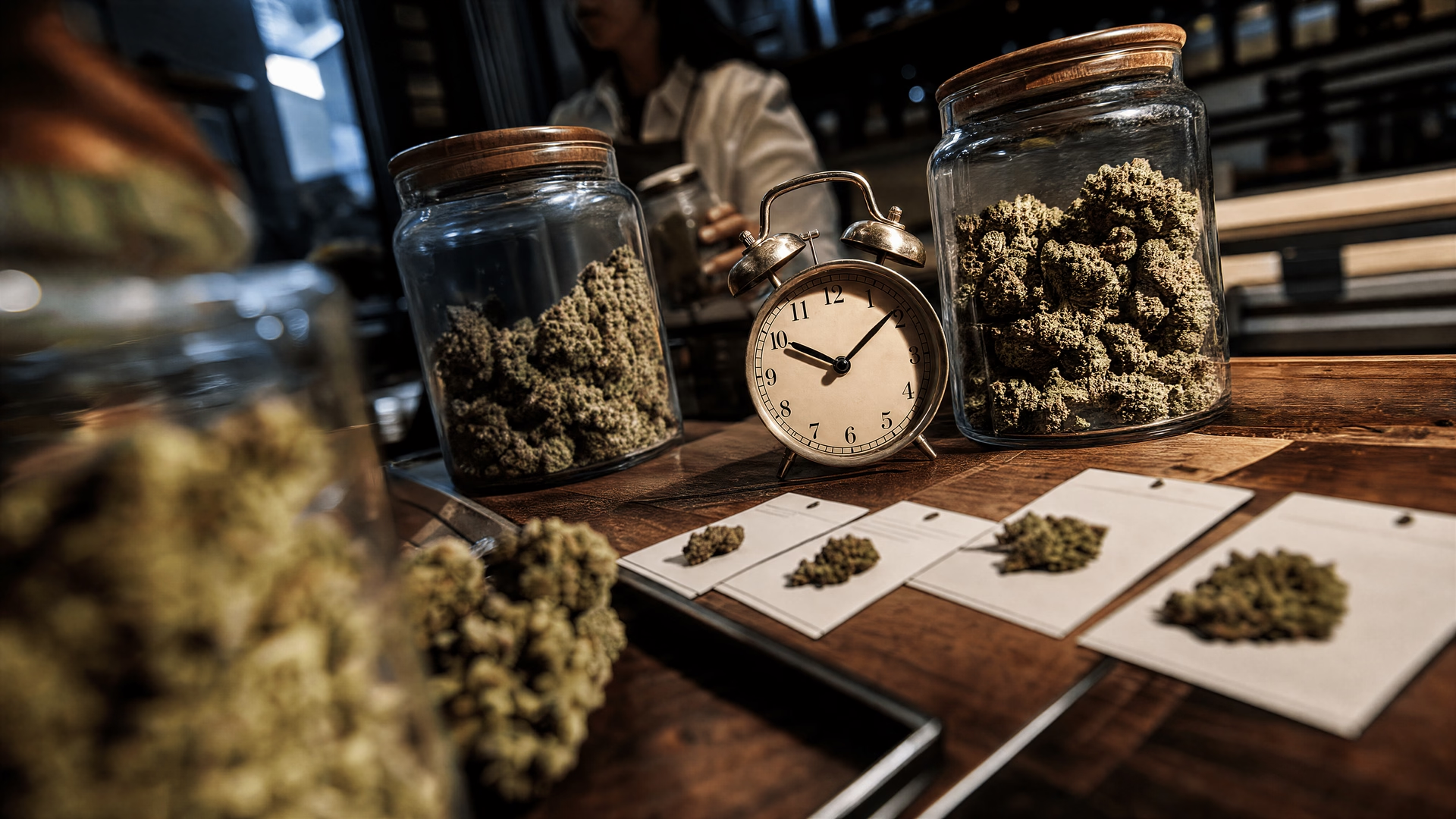














Why cannabis extraction is not one thing
Supersaturated extract An extract holding more dissolved target compound than would normally remain in solution under those conditions, allowing crystals to form when nucleation begins.
The biggest category mistake in cannabis concentrates is treating live resin, rosin, distillate, diamonds, and shatter as if they belong to the same level of classification. They do not. Some names describe feedstock. Some describe a separation method. Some describe a purification stage. Some describe texture. Distillate is not extracted in a still from raw flower; it is usually made after extraction, often after winterization and decarboxylation. Live resin is not a solvent class; it usually means fresh-frozen plant material extracted most often with hydrocarbons. THCA diamonds are not a raw expression of the plant; they are typically a crystallization outcome from a supersaturated extract. Shatter is not a chemistry category at all. It is a glassy physical form created by processing choices.
That confusion matters because concentrates are no longer a fringe topic. UNODC estimated 228 million cannabis users globally in 2022, reported in 2024. SAMHSA estimated 61.8 million people in the United States aged 12 or older used marijuana in the past year in 2023. Brightfield said concentrates made up 27.2% of U.S. cannabis sales in 2023. Once products are this common, sloppy language stops being harmless shorthand and starts blocking clear thinking about chemistry, safety, and quality.
| Step | What it does | Examples from the article |
|---|---|---|
| Extraction | First separation from plant material | Ethanol, hydrocarbon, supercritical CO2, sieving, ice-water washing, pressing |
| Purification | Removes unwanted components or enriches targets | Winterization, filtration, distillation, crystallization |
| Conversion | Changes one molecule into another by reaction | Decarboxylation of THCA to THC and CBDA to CBD |
| Formulation | Builds a finished product from refined fractions | Vape oil, sauce, edible oil, capsule oil |
Extraction, purification, conversion, and formulation are different steps
Extraction is the first separation: pulling target compounds away from plant material. That can mean ethanol dissolving cannabinoids and chlorophyll, butane and propane pulling resin with strong terpene retention, supercritical CO2 solubilizing compounds under tunable pressure, or solventless methods such as sieving, ice-water washing, and pressing that mechanically separate trichome heads and oils. ASTM D8449-23 is useful here because it treats extraction as process language, not branding.
Purification comes after. Winterization removes waxes and lipids. Filtration strips particulates. Distillation enriches cannabinoids by boiling-point behavior under vacuum, commonly in short-path or wiped-film systems. Crystallization can isolate THCA from a terpene-rich mother liquor. None of those steps are the same thing as extraction, even though consumers often collapse them into one word.
Conversion is different again. Decarboxylation changes THCA into THC and CBDA into CBD by heat and time. It is a chemical reaction, not a separation. Reviews in Molecules and Journal of Cannabis Research have repeatedly shown the tradeoff: more complete decarb usually means more terpene loss and, if pushed too far, more cannabinoid degradation. That is why “activated oil” and “raw THCA extract” can start from similar crude material but diverge sharply once heat is applied.
Formulation is the final build. A terpene-depleted distillate can be blended with cannabis terpenes, non-cannabis terpenes, minor cannabinoids, or carrier oils depending on the intended format. Sauce pairs crystals with a mobile terpene fraction. Vape oil, dab concentrate, edible input, and capsule oil may all originate from the same extraction platform and then split apart through downstream choices.
This process view also explains why method alone does not settle safety or quality. Hydrocarbon extraction is often described as inherently unsafe, which confuses chemistry with engineering. NFPA 1 treats butane and propane extraction as a Class I hazardous process requiring specially engineered spaces and explosion-control measures; the danger comes from flammable atmosphere risk, especially in illicit open-blast setups, not from some mystical defect in the solvent. Conversely, “solventless” does not mean consequence-free. NIOSH found delta-9-THC in 100% of personal air samples and 100% of surface wipe samples at two cannabis processing facilities in 2023, with respiratory symptoms reported by 66% of workers at one site and 40% at the other, and skin symptoms by 33% and 20%.
| Label term | Question it answers | Article example |
|---|---|---|
| Live | What was the starting material? | Fresh-frozen input |
| Rosin | How was resin separated? | Mechanical heat-and-pressure expression |
| Distillate | What cleanup happened afterward? | Purification by distillation |
| Shatter | What physical form was packaged? | Glassy texture from processing choices |
Why product labels confuse consumers
Retail language often mixes four different questions: What was the starting material? How was resin separated? What cleanup happened afterward? What physical form was packaged? “Live” answers the first question. “Rosin” answers the second. “Distillate” answers the third. “Shatter” answers the fourth. Put them side by side and consumers reasonably assume they are competing product species. They are not.
Take hydrocarbon extraction. The same butane-propane system can produce shatter, wax, budder, sauce, live resin, or diamonds depending on whether the input was dried flower or fresh-frozen material, how aggressively the extract was purged, whether THCA was encouraged to crystallize, and whether terpenes were separated and recombined. Ethanol can make crude oil for winterization, then distillation, then formulated vape oil or edible oil. Bubble hash can be sold as hash, freeze-dried and pressed into hash rosin, or fractionated mechanically into THCA-rich and terpene-rich portions. One platform, many outputs.
“CO2 is cleaner” is a reliable shortcut for product safety or quality. Limited evidence
This is also why claims such as “CO2 is cleaner” or “rosin is full-spectrum” are too blunt to be reliable. Cleanliness depends on validated controls, contaminant testing, and post-processing, not a label shortcut. California DCC, Colorado MED, Oregon OLCC/ODA, and CANNRA-style baseline rules all focus on residual solvents and contaminants because actual product safety is measured, not assumed from marketing vocabulary.
Working taxonomy used in the article
- Feedstock
- dried flower, cured trim, fresh-frozen flower, kief, bubble hash, sift
- Method
- ethanol, hydrocarbon, CO2, dry sift, ice-water hash, rosin pressing, distillation
- Post-processing
- winterization, filtration, solvent recovery, decarboxylation, distillation, crystallization, terpene fractionation, recombination
- Finished product
- crude oil, FECO-style extract, shatter, wax, budder, sauce, diamonds, distillate, isolate, live resin, hash rosin, live rosin, vape oil, edible input
The article's working taxonomy: feedstock, method, post-processing, finished product
The rest of this article uses a four-part map.
Feedstock: dried flower, cured trim, fresh-frozen flower, kief, bubble hash, sift. Method: ethanol, hydrocarbon, CO2, dry sift, ice-water hash, rosin pressing, distillation. Post-processing: winterization, filtration, solvent recovery, decarboxylation, distillation, crystallization, terpene fractionation, recombination. Finished product: crude oil, FECO-style extract, shatter, wax, budder, sauce, diamonds, distillate, isolate, live resin, hash rosin, live rosin, vape oil, edible input.
That map is stricter than common cannabis language, and that is a good thing. It keeps “live resin” where it belongs: a feedstock-plus-process outcome. It keeps “distillate” where it belongs: a purification result. It keeps “diamonds” where they belong: a crystallized product architecture. Once those categories are separated, the rest of cannabis extraction becomes much easier to understand.
The chemistry that determines what gets extracted
Extraction is a separation problem. Cannabis flower is not a single substance waiting to be “pulled out.” It is a wet or dry plant matrix made of resin glands, cellulose, sugars, proteins, pigments, cuticular waxes, lipids, water, and hundreds of small molecules with very different solubilities and thermal behavior. What an extractor gets depends on four interacting variables: the chemical form of the target compound, the condition of the plant material, the selectivity of the solvent or mechanical process, and what happens after the first separation.
That framing matters because product names hide the chemistry. “Live resin” points to feedstock. “Distillate” points to a purification stage. “Rosin” points to a mechanical separation driven by heat and pressure. “THCA diamonds” point to crystallization from a supersaturated solution. None of those names, by themselves, fully answer the key question: which molecules were selectively removed from the plant, and which ones came along for the ride?
Decarboxylation, step by step
- Start with acidic cannabinoids Fresh resin is dominated by THCA and CBDA rather than THC and CBD.
- Apply heat over time The reaction rate increases with temperature and duration rather than acting like an on-off switch.
- Shift the downstream process Neutral cannabinoids behave differently in distillation and formulation than acidic cannabinoids do.
- Risk overprocessing If heating continues too far, THC degrades and volatile terpenes are lost.

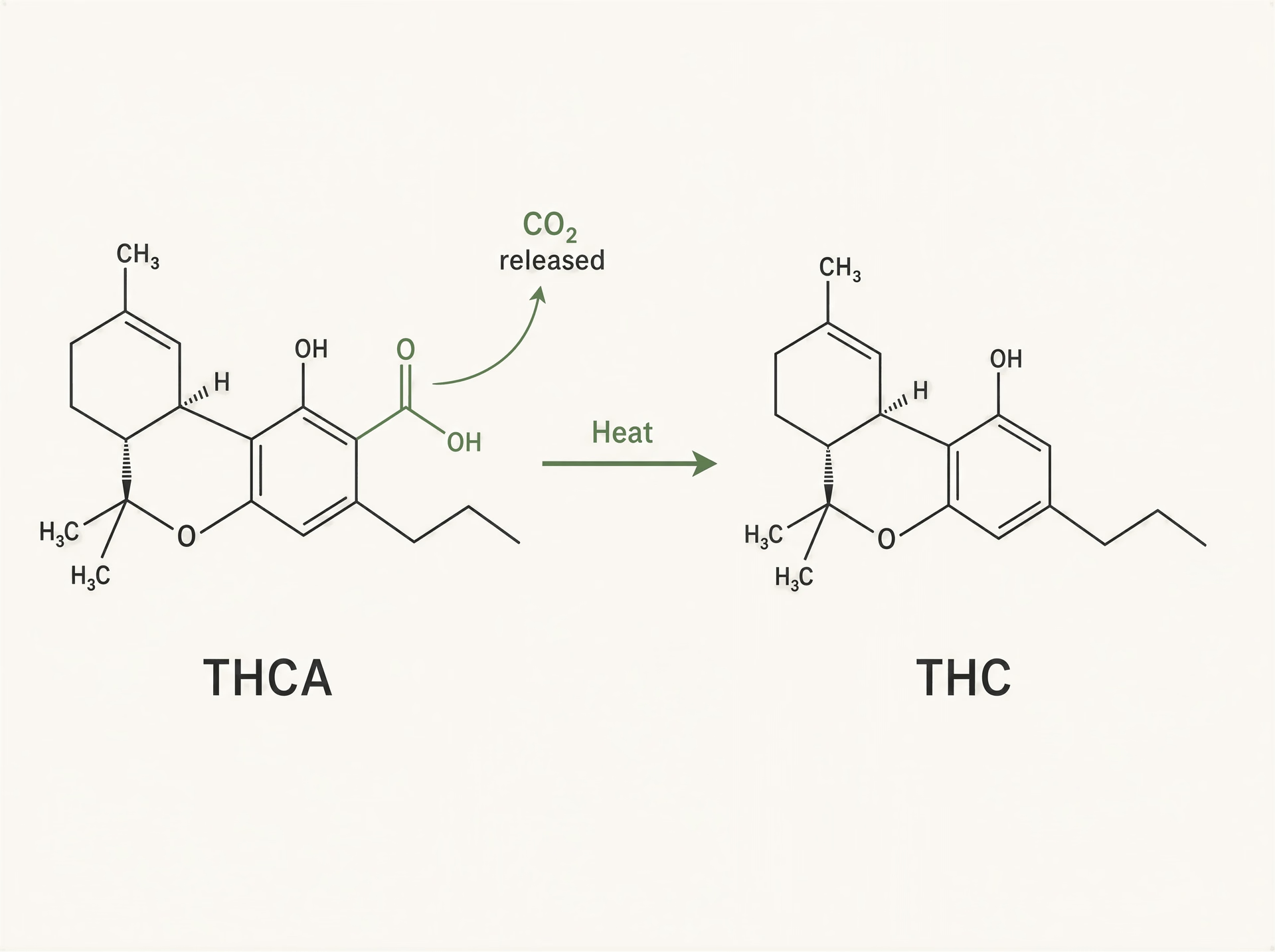
Cannabinoid acids, neutral cannabinoids, and why decarboxylation changes the target
Fresh cannabis resin is dominated by cannabinoid acids, not their neutral counterparts. In most chemotypes, the main molecules in the glandular trichomes are tetrahydrocannabinolic acid (THCA) and cannabidiolic acid (CBDA), with smaller amounts of cannabigerolic acid (CBGA), cannabichromenic acid (CBCA), and others. THC and CBD are usually produced later by heat-driven decarboxylation, which removes a carboxyl group as carbon dioxide.
That one reaction changes the extraction target in practical ways. THCA and CBDA are heavier, slightly less volatile, and differ in solubility behavior from THC and CBD. If the process goal is a high-THCA extract for crystallization, the operator avoids decarboxylating the material early. If the goal is distillate for vaporizer formulations or edible oil, decarboxylation is often intentional before or during downstream refinement because neutral cannabinoids behave differently in distillation and formulation.
THCA-to-THC conversion is time- and temperature-dependent rather than an on-off switch. Strong evidence
The kinetics are well established. Wang et al. in 2016, writing in Cannabis and Cannabinoid Research, reviewed decarboxylation behavior and showed that conversion is time- and temperature-dependent rather than an on-off switch. Raise the temperature and THCA converts faster. Keep heating and the process stops being selective: THC begins to degrade, commonly toward cannabinol (CBN) and other byproducts, while volatile terpenes leave the matrix. That is why decarb is not just “activate the extract.” It is a controlled tradeoff between conversion, terpene retention, color, and degradation.
This also explains why analytical labels can diverge from sensory ones. A low-temperature extract from raw flower may test high in THCA and preserve more native aroma. A decarbed oil may show high total THC potential but smell flatter because the extraction target shifted from acidic resin chemistry to neutral cannabinoid oil chemistry.
| Component group | What the article says it affects | Typical process consequence |
|---|---|---|
| Terpenes | Aroma and volatility | Warm extraction and prolonged recovery flatten bright top notes |
| Waxes and lipids | Cloudiness and crystallization behavior | Often removed later by winterization |
| Chlorophyll | Dark green color and bitter flavor | More likely in polar, warm ethanol conditions |
| Plant water | Solvent behavior and handling | Can increase polar pickup and complicate processing |
Terpenes, waxes, lipids, chlorophyll, and plant water
Cannabinoids are only part of the mixture. The rest often determines whether an extract smells fresh, tastes grassy, crystallizes cleanly, or needs heavy post-processing.
Terpenes are the main aroma drivers, but they are not all equally fragile. Monoterpenes such as myrcene, limonene, alpha-pinene, and beta-pinene are smaller and more volatile than sesquiterpenes such as beta-caryophyllene, humulene, and farnesene. Ethan Russo’s 2011 review in British Journal of Pharmacology is still widely cited for the practical point that terpene composition shifts during drying, storage, and heating. In plain terms, monoterpenes leave first. That is why warm extraction, aggressive solvent recovery, and prolonged vacuum steps tend to flatten the bright top notes before they erase the heavier terpene fraction.
Waxes and lipids are another major variable. Cannabis trichomes sit on a plant surface coated with cuticular materials, and colder nonpolar extraction tends to limit how much of that fraction is dissolved. Raise the temperature or switch to a more broadly solvating medium, and wax pickup increases. This matters because waxes cloud extracts, interfere with vaporizer performance, and complicate crystallization. Winterization exists largely to remove these co-extracted fats and waxes after the first extraction step.
Chlorophyll is the pigment people blame for dark green, bitter extracts, and the criticism is often justified. Chlorophyll is more likely to come along in polar extraction conditions, especially warm ethanol extraction with extended contact time. Cold ethanol can still pull chlorophyll, but less aggressively than warm ethanol. That is one reason cryogenic ethanol systems are used when the aim is to strip cannabinoids quickly while limiting green color and grassy flavor. “Ethanol extract” is therefore chemically incomplete as a description; the temperature and residence time change the composition a lot.
Plant water complicates all of this. Water in the biomass changes solvent behavior, increases the extraction of polar compounds, and can promote emulsion formation or ice-related handling issues depending on the method. Water also carries enzymatic and microbial implications before extraction even starts. A wet plant is not just dry flower plus moisture. It is a different chemical system.
Solvent polarity, temperature, pressure, and selectivity
The central rule is simple: like dissolves like, but real extraction is messier because cannabis contains amphiphilic molecules, resinous matrices, and shifting solvent properties under different conditions.
Hydrocarbons such as n-butane and propane are relatively nonpolar, so they preferentially dissolve hydrophobic resin components: cannabinoids, terpenes, and some lipids. That selectivity is why hydrocarbon extracts can preserve strong aroma and lighter color when run cold and recovered gently. It is also why they are often used for sauce, shatter, badder, and diamond precursor extracts. The method is not inherently tied to those products, but its solvent profile is well suited to resin-first separations.
Ethanol is more polar and more forgiving at scale, but less selective. It extracts cannabinoids efficiently while also pulling water-soluble or semi-polar compounds depending on temperature, proof, and contact time. Warm ethanol is especially prone to chlorophyll pickup. Cold ethanol narrows the extraction window and reduces waxes and pigments, though it does not magically eliminate them.
Supercritical carbon dioxide is the most misunderstood case. CO2 is not “clean” because of a marketing adjective; it is interesting because its density and solvating power can be tuned by pressure and temperature. Above the critical point, CO2 behaves neither like a normal gas nor a normal liquid. Increase pressure and density rises, often improving the solubility of heavier compounds. Adjust temperature and the result can favor different fractions depending on the pressure regime. That tunability allows fractionation: lighter volatile compounds can be collected under one set of conditions, heavier cannabinoids under another. But the idea that CO2 automatically preserves terpenes or avoids downstream cleanup is wrong. Poorly tuned runs can produce terpene-thin crude that still needs winterization and refinement.
ASTM D8449-23 reflects this process language well: extraction conditions are not cosmetic settings. They define the composition of the resulting crude.

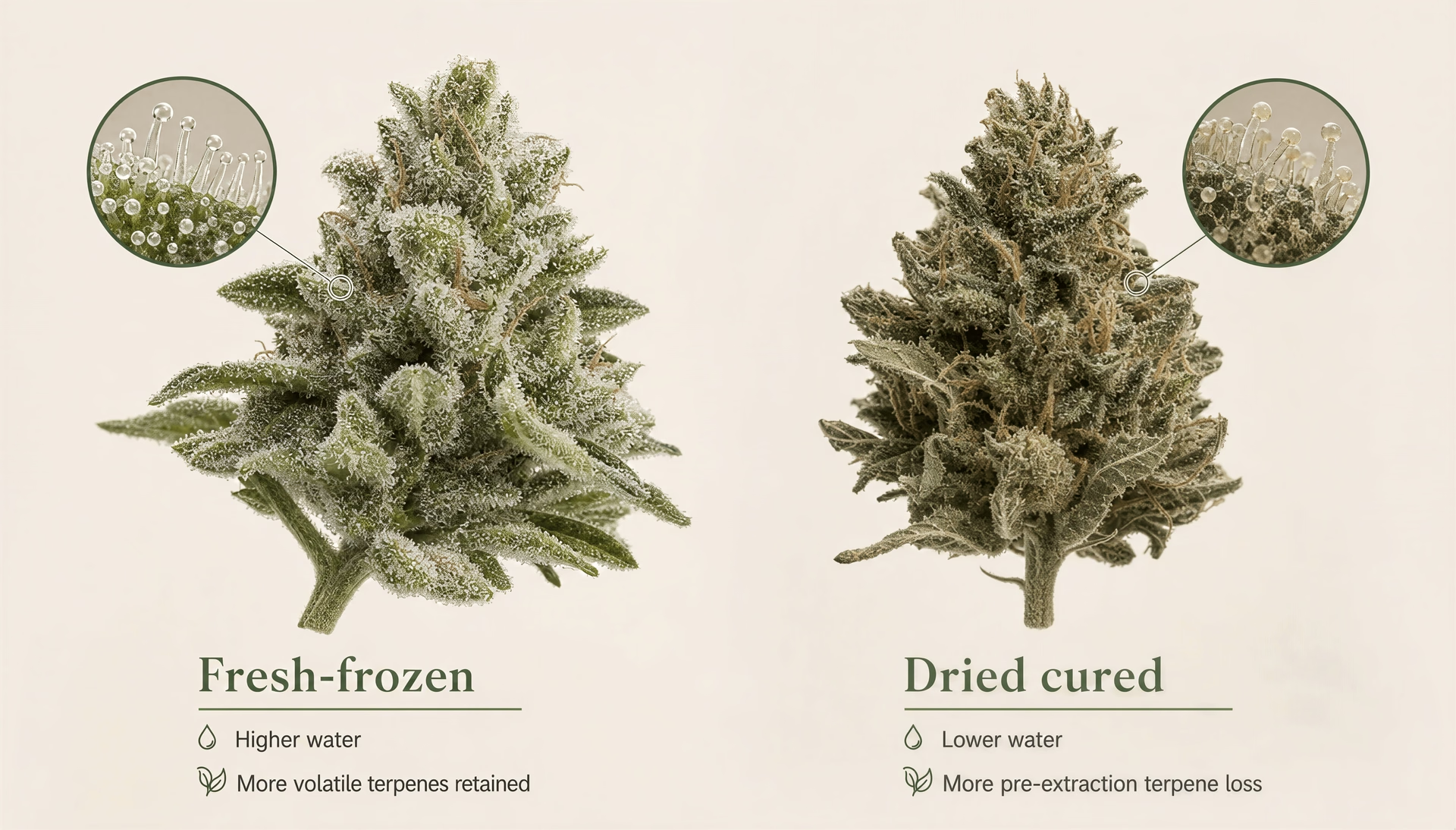
Why fresh-frozen material behaves differently from dried cured flower
Fresh-frozen cannabis has not gone through drying and curing, so its chemistry starts in a different place. The water content is far higher. The terpene profile is closer to the living plant. Enzymatic activity stops only once the material is frozen hard enough and handled correctly. That is why fresh-frozen feedstock is associated with “live” products: not because the extraction method is unique, but because the input material retains compounds that are partly lost during conventional drying.
The biggest sensory difference is terpene retention. Drying and curing drive off a meaningful share of the most volatile monoterpenes and can oxidize some aroma compounds before extraction begins. Fresh-frozen material can preserve more of those top notes if the cold chain is maintained. That is the technical basis for live resin and live rosin. The phrase describes the feedstock state first, then the extraction path.
Water, though, changes the process. Fresh-frozen biomass is usually unsuitable for standard dry-sift workflows and awkward for direct hydrocarbon extraction unless the system and procedure are designed for icy, water-rich material. In solventless production, it is commonly washed into bubble hash and then freeze-dried before pressing into rosin. In hydrocarbon systems, extractors account for water and ice because they affect flow, solubility, and downstream purge behavior.
Dried cured flower behaves more predictably in many extraction setups. Lower water content means easier handling, less risk of ice-related channeling, and often better storage stability before processing. The tradeoff is chemical loss before the extraction even starts. Some aroma is already gone. Some acids may have partly decarboxylated. Oxidation has already begun. That is why fresh-frozen and dried cured extracts can come from the same cultivar yet land in very different sensory and analytical territory.
Solvent-based extraction methods
Solvent extraction is just selective dissolution under controlled conditions. The solvent dissolves some parts of cannabis resin more readily than others, then later gets removed, leaving a concentrate that may still need filtration, winterization, decarboxylation, distillation, or crystallization. That sequence matters. Shatter is not a solvent. Distillate is not an extraction method. Live resin is not a solvent class. Those names describe feedstock choices and post-extraction handling as much as the initial wash.
The chemistry starts with polarity and volatility. Cannabinoids and many terpenes are lipophilic, so nonpolar solvents such as butane and propane tend to pull resin fractions with relatively little water-soluble baggage. Ethanol is more polar and miscible with water, so it can extract cannabinoids efficiently but also picks up chlorophyll, sugars, and plant waxes, especially when warm or when the biomass contains moisture. CO2 sits in its own category because its solvating power changes with pressure and temperature; operators can tune it, but tuning is not magic. Every platform makes tradeoffs between selectivity, speed, capital cost, fire risk, and how much cleanup the extract needs later.
At industrial scale, those tradeoffs matter well beyond product labels. Concentrates represented 27.2% of total U.S. cannabis sales in 2023 according to Brightfield Group’s 2024 market reporting, and BDSA projected U.S. concentrate sales at $4 billion in 2024. The safety footprint matters too. NIOSH’s 2023 health hazard evaluation of two cannabis processing facilities found delta-9-THC in 100% of personal air samples and 100% of surface wipe samples, with respiratory symptoms reported by 66% of workers at one site and 40% at the other, and skin symptoms by 33% and 20%. Extraction is chemistry, but it is also occupational hygiene and process engineering.
Ethanol extraction
Ethanol is the workhorse solvent for high-throughput cannabinoid recovery. It is relatively cheap, familiar to food and pharma processing, easy to recover with falling-film evaporators or rotary evaporation, and effective across a wide range of biomass qualities. If the target is bulk oil for edibles, tinctures, capsules, broad-spectrum refinement, or distillate feedstock, ethanol often wins on throughput and operating practicality.
Its weakness is selectivity. Ethanol extracts cannabinoids well, yet it also dissolves a lot of things many processors later try to remove. Chlorophyll is the headline problem, though waxes, lipids, pigments, and polar small molecules are part of the same burden. The warmer the ethanol and the longer the contact time, the more “green” the extract tends to become. Cold extraction changes that balance.
| Ethanol mode | Main goal | What the article says usually increases or decreases |
|---|---|---|
| Cold ethanol | Limit waxes and unwanted co-extractives while recovering cannabinoids | Cleaner crude; reduced burden on winterization and filtration |
| Room-temperature ethanol | Simpler setup and operation | More chlorophyll and co-extractives, especially with milled or moist biomass |
| Warm ethanol | Fast broad extraction | More green color and grassy flavor from chlorophyll pickup |
Cold versus room-temperature ethanol
Cold ethanol extraction usually means the solvent, biomass, or both are chilled well below freezing before contact. The goal is simple: reduce the solubility of waxes and other unwanted components while still recovering cannabinoids efficiently. In practice, cold runs often produce cleaner crude and reduce the burden on winterization and filtration downstream. They do not eliminate it. They only make the crude less messy.
Room-temperature ethanol runs are faster to set up and easier on equipment, but they pull more chlorophyll and co-extractives, especially if the plant material is finely milled or moist. This can be acceptable when the intended endpoint is distillate, because distillation will strip away much of the color and many minor compounds anyway. It is much less attractive when the goal is a flavor-forward extract. Ethanol is not the first choice for preserving a delicate monoterpene profile.
That terpene point is not just folklore. Ethan Russo’s work on cannabis terpenoids, including his 2011 review in British Journal of Pharmacology, helped anchor a practical reality processors already knew: monoterpenes are volatile and are readily lost during drying, heating, and aggressive solvent recovery. Ethanol extraction often involves later evaporation under heat and vacuum, and every warm step gives the lighter aromatics another chance to leave.
Crude oil and the winterization burden
The immediate product from ethanol extraction is usually crude oil. “Crude” here is descriptive, not pejorative. It means the extract still contains cannabinoids plus a broad mix of waxes, fats, pigments, and residual volatiles. Crude can be perfectly serviceable as an intermediate, but it is rarely the final target in regulated manufacturing.
This is why ethanol is so often paired with winterization. The crude is dissolved again in ethanol, chilled, and filtered so precipitated waxes and lipids can be removed. In a cold primary extraction system, some operators can reduce how much separate winterization is needed, but many still perform it because downstream equipment such as wiped-film stills runs better on cleaner feed. Less lipid load means fewer fouling problems and more stable distillation.
If the target is distillate, the typical path is ethanol extraction to crude, winterization and filtration, solvent recovery, then decarboxylation and distillation. Distillate is therefore a purification result after extraction, not a rival to ethanol, hydrocarbon, or CO2.
FECO and RSO-style extracts
Ethanol also sits behind many FECO and RSO-style products. FECO usually means full-extract cannabis oil, a dense whole-plant style concentrate made by extracting and then evaporating most of the solvent without pushing the oil through heavy refinement. “RSO” is used more loosely and often imprecisely, but in modern discussion it generally points to a dark, strongly flavored, less-refined full-spectrum oil. These oils preserve more of the plant’s non-cannabinoid material than distillate does. That can be a feature if the aim is broad composition rather than purity. It can also be a drawback if the starting material was poor or contaminated, because extraction concentrates what is present.
Ethanol’s strengths are clear: high throughput, comparatively moderate equipment cost, and strong cannabinoid recovery from large biomass volumes including hemp. Its liabilities are just as clear: weaker terpene retention than hydrocarbons, more chlorophyll pickup when warm, and a heavier downstream cleanup burden. For bulk cannabinoid production, it remains one of the dominant platforms for a reason.
Hydrocarbon extraction: butane, propane, and blended systems
Hydrocarbon extraction uses liquefied light hydrocarbons, most commonly n-butane, isobutane, propane, or blends, to dissolve resin from cannabis. Consumer vocabulary often collapses all of this into “BHO,” but that shorthand hides real process differences. Butane-heavy systems, propane-heavy systems, and mixed systems behave differently in solvency, pressure profile, temperature response, and how they carry terpenes and cannabinoids through the process.
Hydrocarbons excel at selective resin extraction. They are nonpolar, so they pull cannabinoids and terpenes efficiently while generally extracting less chlorophyll and fewer polar compounds than ethanol. That selectivity is a major reason hydrocarbon extraction became closely associated with aromatic resin products. When processors want vivid terpene expression, especially from fresh-frozen feedstock, hydrocarbons are often the tool of choice.

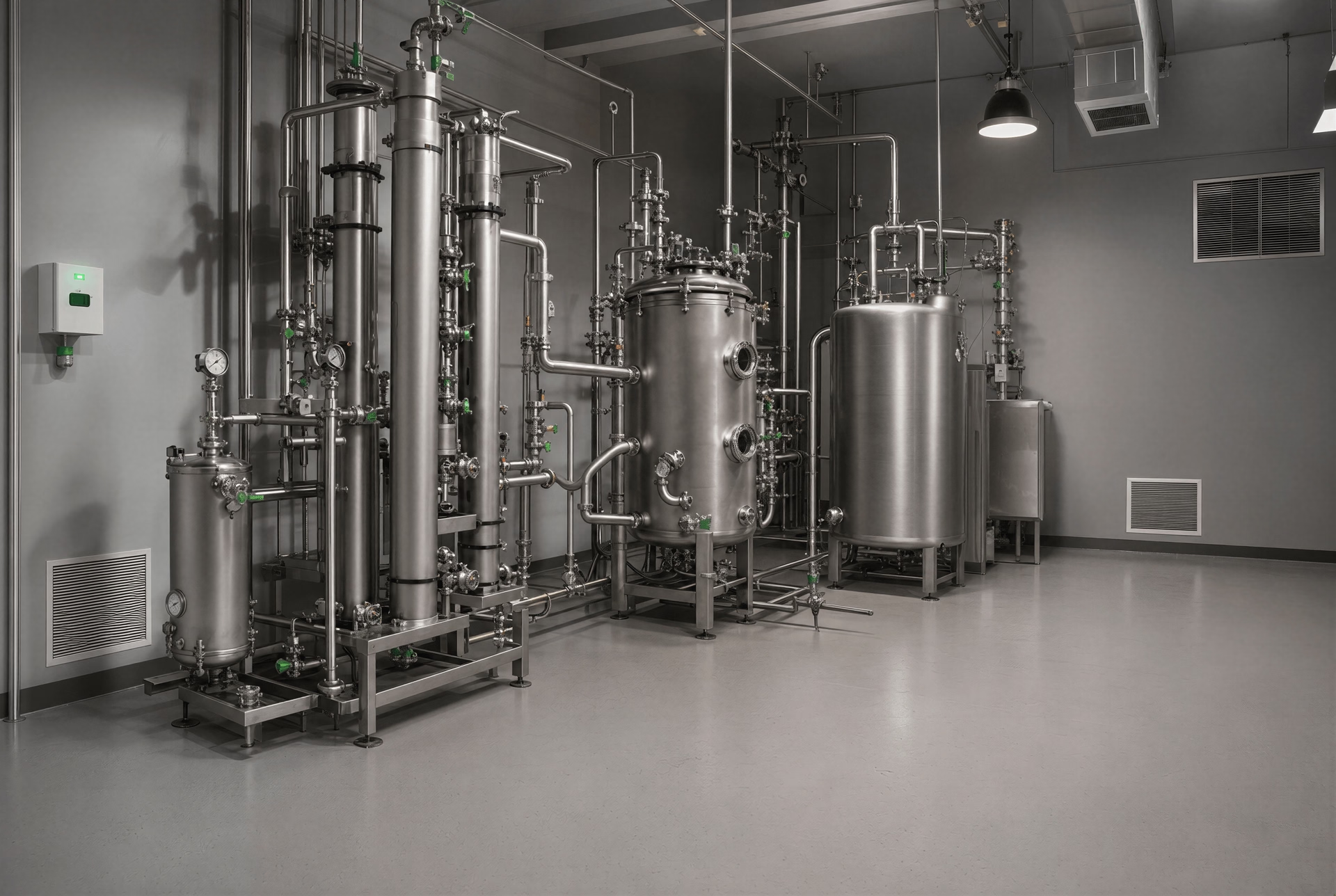
Closed-loop systems and actual safety
The chemistry is not the main safety problem. The engineering is. Butane and propane are highly flammable, and NFPA 1 treats hydrocarbon extraction as a Class I hazardous process requiring specifically designed rooms, explosion-control measures, and gas detection. That distinction matters because consumer discussion still confuses licensed closed-loop extraction with open-blast extraction. They are not remotely the same risk profile.
In a licensed closed-loop system, solvent is contained, recovered, and reused under pressure-rated conditions. The room is engineered for hazardous atmospheres. Ignition sources are controlled. Operators are trained. None of that makes the process casual; it makes it managed. Illicit open blasting, by contrast, vents flammable vapor into uncontrolled spaces and has caused repeated fires and explosions. Saying “hydrocarbon extraction is unsafe” is too blunt to be useful. Open blasting is unsafe. Properly engineered closed-loop extraction is an industrial hazardous process with controls.
Why hydrocarbons are so good at terpene-rich resin
Hydrocarbons’ reputation for flavorful extracts is earned. They dissolve resin components efficiently at relatively low temperatures, which helps preserve volatile monoterpenes that are easily stripped or degraded during warmer processing. Fresh-frozen feedstock strengthens that advantage. Because the material is frozen rather than dried and cured, more of the original volatile fraction remains available. That is why live resin is usually paired with hydrocarbon extraction: “live” refers to the fresh-frozen starting material, while the hydrocarbon process helps retain the terpene profile that survived harvest and freezing.
Butane and propane are not interchangeable. Propane tends to run at higher pressure under comparable conditions and can favor different texture outcomes and terpene movement through the system. Blended solvent systems let processors tune solvency and handling characteristics. That is one reason “BHO” as a single category is chemically sloppy. A butane-rich blend used on cured trim for shatter and a propane-leaning blend used on fresh-frozen whole flower for sauce are not the same process outcome.
Why similar hydrocarbon extracts finish as different products
- Shatter Glassy texture from undisturbed purge and an amorphous solid state.
- Wax or budder More agitation or different thermal history encourages nucleation and opacity.
- Sauce A higher terpene fraction keeps the extract wetter and more mobile.
- Diamonds THCA crystallizes from a supersaturated extract while terpene-rich mother liquor remains around it.
Shatter, wax, budder, sauce, and diamonds
Hydrocarbon extraction also makes it obvious why product names should not be mistaken for methods. The initial extraction may be similar, yet purge conditions, agitation, residual terpene content, nucleation behavior, and post-extraction handling can drive very different textures.
Shatter forms when the extract is kept relatively undisturbed and purged in a way that leaves a glassy, amorphous solid. More agitation or different thermal history can encourage nucleation and produce wax or budder. A higher terpene fraction can keep material wetter and less stable as a glass, pushing it toward sugar, batter, or sauce-like textures. None of these labels tells you the full process by itself.
Mother liquor The liquid phase left after crystals form; in cannabis processing it is often terpene-rich and still contains non-crystallized cannabinoids.
Diamonds make the point even more sharply. THCA diamonds are usually produced when a hydrocarbon extract rich in THCA becomes supersaturated and the THCA crystallizes out under controlled pressure and temperature. The surrounding terpene-rich mother liquor becomes the “sauce.” This is not a naturally occurring chunk of purity that simply fell out of the plant. It is a crystallization workflow after extraction. Other methods can produce high-purity THCA isolates too, but the retail “diamonds and sauce” format is usually a hydrocarbon post-processing architecture.
Hydrocarbon systems carry major fire and code burdens and usually cost more to build safely than basic ethanol setups. Throughput can also be lower for bulk biomass extraction. Yet for high-value resin products with strong terpene retention, the platform remains hard to beat.
Supercritical and subcritical CO2 extraction
CO2 extraction sits between marketing myth and real engineering merit. It is often called “clean” because carbon dioxide is nonflammable under the operating conditions used in extraction and leaves no hydrocarbon residue in the ordinary sense. That framing is incomplete. A CO2 extract can still be full of waxes, chlorophyll-derived pigments, or other undesired compounds if the process is not well tuned, and many CO2 extracts still need winterization and further refinement.
The attraction is tunability. Change pressure and temperature and you change density, diffusivity, and solvating strength. In subcritical conditions, CO2 is gentler and often used to pull lighter aromatic fractions. In supercritical conditions, it behaves as a stronger solvent for cannabinoids and heavier resin components. That allows staged extraction.
Subcritical terpene pulls
Subcritical CO2 generally runs at lower temperatures and pressures than supercritical extraction. Operators may use it as an initial terpene-focused pass, aiming to recover volatile compounds before exposing the biomass to more aggressive conditions. This can improve aroma retention compared with a one-pass supercritical run. It is still not effortless terpene preservation. Collection design, depressurization strategy, and time spent in separators all matter. Monoterpenes are easy to lose.
Done well, subcritical fractionation can produce a separate terpene cut that is later recombined with a more refined cannabinoid fraction. Done poorly, it yields weak terpene recovery and an extract that still needs substantial cleanup.
Supercritical cannabinoid extraction and fractionation
Supercritical CO2 is stronger and more versatile for bulk cannabinoid recovery. It can be tuned to extract cannabinoids effectively from dried biomass, including hemp at industrial scale. Fractionation vessels downstream of the extraction column help separate heavier oils from lighter fractions as pressure drops through the system. This tunability is the main technical advantage of CO2.
But there are tradeoffs. Equipment cost is high. Pumps, separators, pressure controls, and metallurgy are expensive. Throughput can be decent in large systems, yet many installations historically underperformed expectations because tuning a CO2 process well is difficult. It is not a “set and forget” platform. Small changes in moisture, grind size, and packing density can change extraction behavior noticeably.
And despite the popular shorthand, many CO2 crude extracts still require ethanol winterization because waxes and lipids remain in the oil. If the endpoint is distillate, the process may end up looking a lot like ethanol crude refinement after the initial extraction step. That is why “CO2 extract is always cleaner” is not technically sound. Cleanliness depends on validated process control, contaminant testing, and downstream purification, not on a marketing label.
CO2’s fire risk profile is lower than hydrocarbons because the solvent itself is not flammable in the same way, but high-pressure operation introduces its own engineering hazards. Vessel integrity, pressure relief, maintenance, and operator training are central. Lower fire risk does not mean low process risk.
Lesser-used solvent approaches and why some remain niche
Other solvents appear in patents, industrial hemp processing, or older extraction literature: hexane, pentane, heptane, acetone, isopropanol, and mixtures of these. They remain niche in regulated cannabis for good reasons.
Hexane and heptane are familiar in commodity oilseed processing and can be effective nonpolar solvents, but they carry toxicological and residual-solvent concerns that make regulators and processors cautious. They also do not offer a compelling enough advantage over hydrocarbons for terpene-rich resin products or over ethanol for bulk cannabinoid work. If a processor is already building a tightly controlled hydrocarbon room, butane or propane usually makes more sense for resin quality. If the goal is industrial biomass throughput, ethanol often wins on familiarity and workflow integration.
Acetone and isopropanol can extract cannabinoids, but they are generally less favored because they tend to bring along too much unwanted material or fit awkwardly into regulated residual-solvent frameworks and downstream purification schemes. Some may appear in laboratory-scale protocols or non-cannabis botanical extraction, yet they are uncommon in licensed cannabis manufacturing.
A final point matters here: niche solvents stay niche not because they fail to dissolve cannabinoids, but because extraction is only the first separation. The solvent has to fit the entire line afterward—recovery, worker safety, code compliance, residual testing, flavor preservation, and the intended output. On that full-process basis, the field keeps returning to three major platforms. Ethanol for throughput. Hydrocarbons for terpene-rich resin. CO2 for tunable, solvent-minimized high-pressure extraction where capital and refinement needs are acceptable.
Solventless extraction methods
“Solventless” has a specific meaning in cannabis processing, and it is narrower than marketing usually suggests. It means the resin is separated from plant material by mechanical or physical means such as sieving, agitation in ice water, heat, and pressure, rather than by dissolving cannabinoids and terpenes into ethanol, butane, propane, or supercritical CO2. That distinction matters because extraction, purification, and finishing are different operations. Dry sift is a separation. Bubble hash is a separation plus washing. Rosin pressing is a heat-and-pressure expression step. Mechanical THCA separation is a later refinement step. None of those names automatically tells you the final chemical profile.
Solventless also does not mean “untouched.” The resin still changes. Terpenes oxidize. Volatile monoterpenes can be lost during drying, freeze-drying, warm pressing, and storage. Ethan Russo’s work on cannabis terpenoids has been widely cited for this practical point: compounds such as myrcene, limonene, and alpha-pinene are mobile and easy to lose when temperature, airflow, and time are poorly controlled. Solventless products avoid residual solvent concerns, but they still concentrate whatever was already present in the trichomes and on the biomass, including pesticides, spores, or other contaminants if the starting material was poor.
The center of gravity in solventless processing is the trichome head. Capitate-stalked glandular trichomes contain the resin fraction processors are trying to isolate: cannabinoid acids such as THCA and CBDA, terpenes, flavonoids, waxes, and minor constituents. Melt quality depends heavily on head maturity. Immature heads are often smaller, less resin-dense, and less willing to cleanly separate. Overripe material can oxidize, darken, and smear. Cultivar matters just as much. Some plants produce large, sandy heads with brittle stalks that release easily and melt well; others make greasy resin that resists sieving or carries more cuticle and contaminating particulate. That is why “full melt” is not merely a processing skill claim. It is partly a genetics-and-harvest-timing outcome.
Dry sift and screened resin separation
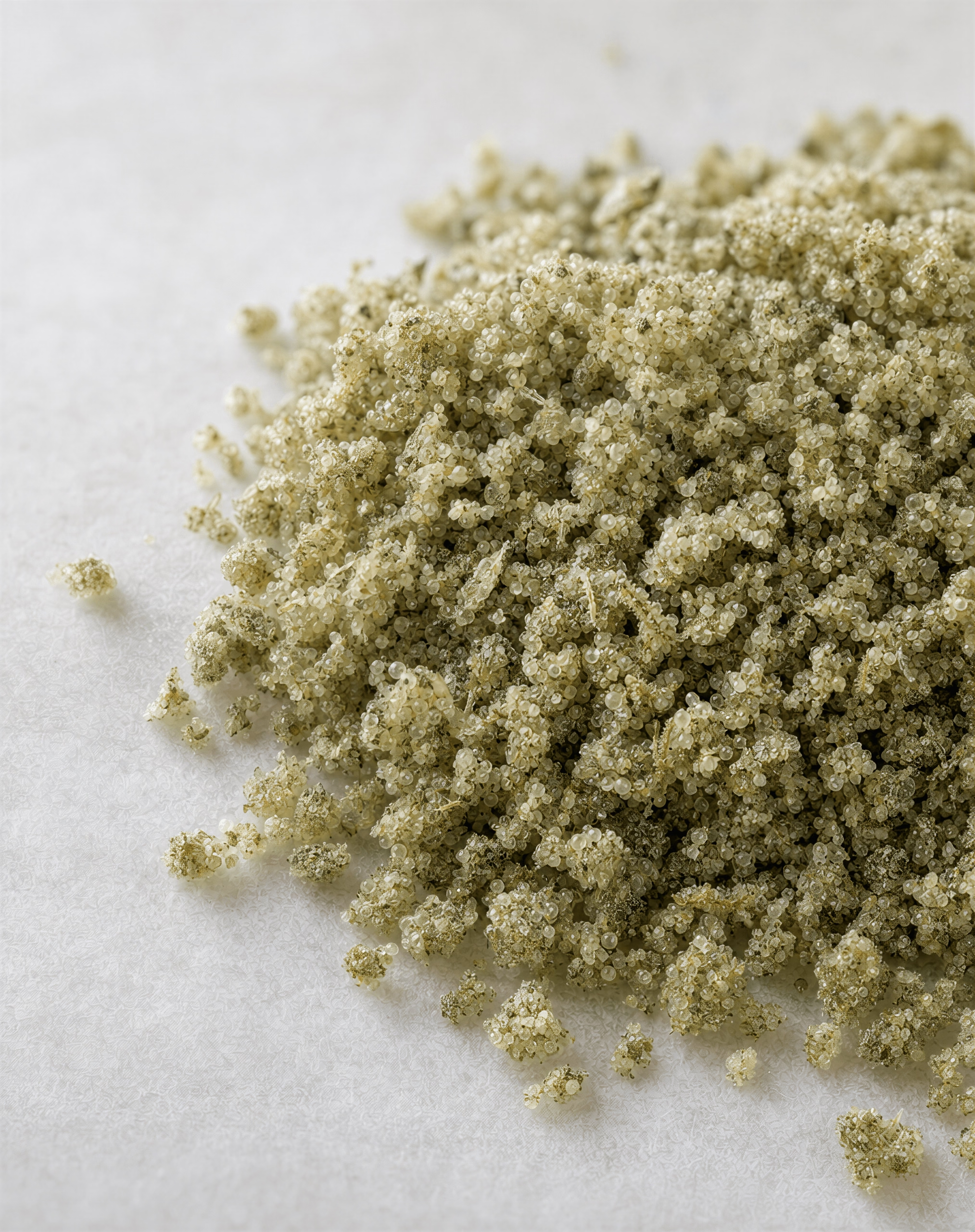
Dry sift is the oldest solventless method and still one of the most direct. Dried cannabis is moved across one or more screens so detached trichome heads fall through while larger pieces of plant tissue stay behind. The basic science is simple particle-size separation. The hard part is selectivity. Resin heads, stalk fragments, epidermal tissue, and broken leaf all overlap in size, so a screen alone never gives a chemically pure fraction.
Screen size is usually discussed in microns, but the micron number does not define quality by itself. It defines a gate. A 150 µm or 120 µm screen may release a broad fraction; tighter refinement often happens on finer meshes such as 90 µm, 73 µm, or 45 µm depending on cultivar and moisture condition. What matters is not collecting “the smallest powder.” It is isolating intact heads while limiting contaminants. With dry material, brittleness helps. Low temperature can also help because the stalks snap more readily and the heads release cleanly, though over-agitation can shatter plant tissue and lower purity fast.
The main advantage of dry sift is efficiency. No water. No drying phase after washing. Minimal equipment. It can preserve a strong aromatic profile when done cold and gently because the resin is not submerged, spun, or exposed to extended post-wash handling. The weakness is cleanliness. Dry biomass carries dust, epidermal debris, and fine plant particulates that are difficult to remove completely by screening alone. High-end dry sift therefore often relies on repeated carding, multiple screen passes, and later refinement steps such as static separation.
Compared with bubble hash, dry sift generally asks for more touch and more judgment from the operator. Done carelessly, it becomes kief: broad, potent, but dirty. Done carefully, it can approach melt-grade resin. The gap between those outcomes is large. This is where cultivar choice becomes decisive. Varieties with large, round, structurally resilient heads are far more forgiving.

Bubble hash and ice water washing
Bubble hash, often called ice water hash, uses cold water and agitation to detach trichome heads, then filters the slurry through sequential micron bags. Water here is not acting as a chemical solvent for cannabinoids in any meaningful processing sense. THCA and most other resin components are hydrophobic. The water is a transport medium and temperature-control tool. Cold conditions make trichomes more brittle and help limit resin smearing, while the wash physically separates the heads from the biomass.
A typical workflow starts with fresh-frozen or dried material in a wash vessel with ice and water. The agitation step can be manual or machine-assisted. The resulting suspension passes through a stack of filter bags, often from larger pore sizes down to 220 µm, 160 µm, 120 µm, 90 µm, 73 µm, 45 µm, and sometimes 25 µm. Those bag fractions do not correspond to universal quality tiers. They are simply particle-size cuts. One cultivar may produce its cleanest, most desirable resin in the 90 and 73 bags; another may shine in the 120; another may spread quality more broadly.
Bubble hash is usually cleaner than dry sift because water washing removes a lot of loose dust and fine plant particulates. It also allows processors to work with fresh-frozen biomass, which is central to live rosin workflows. The tradeoff is labor, water handling, and a delicate drying stage afterward. Wet hash is microbiologically vulnerable and physically fragile. If it clumps and air-dries slowly, it can oxidize, darken, and degrade. Freeze dryers changed this category by allowing rapid low-temperature drying of washed resin, which reduced terpene loss and spoilage risk compared with older air-drying methods.
Melt quality in bubble hash still comes back to trichome biology. “Full melt” means a hash that liquefies and bubbles away with minimal residue because the fraction is composed mostly of clean resin heads rather than plant solids. Not every cultivar can do that, and not every harvest window can support it. Slightly early harvests may have clearer heads and lower oil content. Late harvests may produce darker, greasier resin with more broken heads and oxidation. The common claim that good washing alone creates six-star full melt is wrong. Washing can reveal melt quality. It cannot invent it.
Rosin pressing and hash rosin workflows
Rosin pressing takes cannabis or hash and uses heated plates plus pressure to express resin through a filter bag or from between parchment sheets. It is still solventless because no chemical solvent dissolves the resin. Heat lowers viscosity; pressure drives flow. The result is rosin, a concentrated resin containing cannabinoids, terpenes, waxes, lipids, and small amounts of fine particulate depending on the feedstock and process settings.
Flower rosin and hash rosin are not equivalent. Flower rosin starts with cured flower. It is simpler to make, but it usually carries more waxes, cuticle material, chlorophyll-associated fines, and other non-resin constituents because the press is squeezing directly from plant tissue. It can be aromatic and potent, yet it is rarely as clean as hash rosin. Hash rosin starts with a pre-isolated resin fraction, usually bubble hash or refined sift, so the press is expressing from trichome heads rather than from whole flower. That single upstream separation changes the result dramatically.
Hash rosin is therefore better understood as a two-step solventless process: first isolate the resin mechanically, then express it. The cleaner the incoming hash, the cleaner the rosin. Press temperature and pressure matter, but the old idea that higher pressure always improves yield is crude and often counterproductive. Excessive pressure can force contaminants through the bag. Excessive heat increases terpene loss and darkening. Processors often balance lower temperatures for aroma retention against higher temperatures for flow and throughput. There is no universal setting because resin viscosity differs by cultivar, water activity, bag fill, and pre-press density.
Live rosin adds one more distinction: feedstock. The starting cannabis is fresh-frozen rather than conventionally dried and cured. Fresh-frozen material is washed into bubble hash first, dried carefully, and only then pressed into rosin. That sequence is what makes live rosin analogous to live resin while remaining solventless. “Live” refers to preservation of the fresh-harvest chemical state as much as possible, especially volatile terpenes that are often reduced during drying and cure. It is not a pressing style. It is not a guarantee of higher purity. It is a feedstock and handling choice.
Mechanical refinement: static tech, jar tech, and THCA separation
Modern solventless processing includes refinement methods that sit somewhere between craft practice and formal process science. The language moves faster than the literature here, so skepticism is healthy.
Static tech can materially improve sift cleanliness without water or solvent. Preliminary evidence
Static tech refers to using static electricity to help separate lighter contaminating particles from trichome heads in dry sift. In practice, processors use tools or surfaces that build charge and attract plant fines while heavier resin glands remain behind, or the reverse depending on setup. The principle is plausible and consistent with basic electrostatic behavior of small particles, but the exact protocols are mostly empirical. There is little peer-reviewed cannabis-specific literature standardizing this method. What can be said confidently is that skilled static refinement can materially improve sift cleanliness without water or solvent, especially for cultivars that release well-formed heads.
Jar tech usually means controlled post-press handling of rosin in sealed or semi-sealed jars to influence texture and phase behavior. At mild heat or room-temperature storage, rosin can nucleate, separate, or homogenize depending on composition. THCA-rich rosins may “budder up,” forming a more opaque semi-solid texture as crystals nucleate in a terpene-rich matrix. Some operators also use jarred warm curing to encourage visible separation into a THCA-rich solid fraction and a terpene-rich liquid fraction. The mechanisms are real enough: supersaturation, nucleation, viscosity changes, and phase partitioning. But the naming is informal, and claims are often overstated. There is no widely adopted ASTM-style method for “jar tech.”
Mechanical THCA separation in solventless processing usually means taking advantage of rosin’s tendency to partition into a THCA-rich crystalline or semi-crystalline fraction and a more terpene-rich fraction under time, heat, pressure, or filtration. This is not the same thing as hydrocarbon-grown diamonds, which are typically produced by controlled crystallization from a supersaturated extract solution. In solventless systems, the separation is less absolute. The THCA-rich portion is not inherently pure, and the terpene fraction is not chemically simple. Both still carry minor cannabinoids, waxes, and other resin components.
One common approach is to allow rosin to nucleate, then use fine filtration or pressing conditions to force out a more mobile terpene-rich phase while retaining a denser THCA-rich fraction. Another is to mechanically isolate granular THCA-rich material from cured rosin after texture changes have developed. These methods can produce interesting and useful fractions, but the published science is sparse. They are best described as informed process craft supported by general physical chemistry, not as settled analytical methods.
That distinction matters because solventless refinement now gets described with the same certainty people use for distillation or winterization, and the evidence base is not the same. Mechanical separation can absolutely reshape a resin. It can improve texture, adjust flavor intensity, and increase the proportion of THCA in one fraction. But it does not suspend basic chemistry. Heat still strips volatiles. Oxygen still drives change. Starting material still governs the ceiling. Solventless is a processing path, not a magic category.
Post-processing steps that matter more than consumers realize
Extraction gets the attention. Post-processing decides what the extract actually becomes.
That distinction clears up a lot of common confusion. A hydrocarbon run does not automatically produce “live resin,” “shatter,” or “diamonds.” Ethanol does not automatically mean crude oil for edibles. Rosin is not chemically finished the moment it leaves the press. Those labels often describe what happened after the first separation: wax removal, solvent recovery, decarboxylation, distillation, crystallization, or formulation.
This is why product names can mislead. Extraction is the opening move. Refinement sets potency, viscosity, color, aroma, and stability.
| Post-processing step | What it removes or changes | Why it matters |
|---|---|---|
| Winterization | Precipitates waxes and lipids from a chilled ethanol solution | Cleaner oil and better downstream behavior |
| Filtration | Physically removes the cold solids created during winterization | Reduces darker oil, fouling, and unstable texture |
| Solvent recovery | Removes ethanol under heat and vacuum | Concentrates the extract but can also strip volatile terpenes |
Winterization, filtration, and solvent recovery
Many crude extracts contain more than cannabinoids and terpenes. They also carry waxes, lipids, sterols, pigments, and fine particulates from the plant surface. Ethanol extracts are especially prone to this because ethanol is relatively broad in what it dissolves, particularly when extraction conditions are warm or contact time is long. CO2 extracts often need similar cleanup. Some hydrocarbon extracts need less winterization because butane and propane are more selective for resin, but “less” is not “never.”
Winterization A cleanup step in which crude extract is dissolved in ethanol, chilled so waxes and lipids precipitate, then filtered to remove those solids.
Winterization is a cleanup step, not a branding exercise. The crude extract is dissolved in ethanol, chilled to encourage waxes and lipids to precipitate, then passed through filtration media to physically remove the solids. After that, the ethanol is recovered, usually by rotary evaporation, falling-film evaporation, or other reduced-pressure recovery systems. What remains is a cleaner oil that behaves much better in downstream steps.
Why it matters: waxes cloud vape oils, foul distillation equipment, destabilize texture, and dilute cannabinoid concentration. They can also trap pigments and oxidized material. A winterized extract usually distills more efficiently and yields a more predictable final product.
Filtration is where the chemistry becomes mechanical. Cold temperatures create insoluble solids; filters remove them. The choice of pore size matters. So does dwell time at low temperature. Poorly chilled solutions leave waxes in suspension. Overloaded filters break through. Operators who rush this stage often pay for it later with darker oil, lower throughput, and stills that need extra cleaning.
Solvent recovery sounds mundane. It is not. Recovery conditions change the extract. Heat and vacuum strip ethanol, but they also strip volatile terpenes. Ethan Russo’s work on cannabis terpenoids has been cited for years because it points to the obvious but often ignored fact that monoterpenes are easy to lose during drying, warming, and evaporation. Myrcene, limonene, and alpha-pinene do not politely wait around while a processor boils off solvent.
This is also where safety enters the picture again. Solvent recovery is part of extraction manufacturing, not an afterthought, and the occupational stakes are real. NIOSH reported in 2023 that delta-9-THC was detected in 100% of personal air samples and 100% of surface wipe samples at two cannabis processing facilities. At those same facilities, 66% and 40% of employees reported respiratory symptoms, while 33% and 20% reported skin symptoms. Extraction starts the hazard profile; post-processing extends it.
Decarboxylation: kinetics, goals, and trade-offs
Cannabinoids in raw cannabis are mostly present in acid form: THCA, CBDA, CBGA. Decarboxylation removes a carboxyl group as CO2 and converts those acids into their neutral forms, such as THC and CBD. That sounds simple. In practice, it is a controlled thermal reaction with penalties for getting greedy.
The goal depends on the product. If the extract is headed into edibles, capsules, or a THC distillate workflow, decarboxylation is usually intentional and necessary because neutral cannabinoids are the desired endpoint. If the target is a high-THCA concentrate, decarb is the wrong move. THCA diamonds exist precisely because processors avoid that conversion until much later, if ever.
Kinetics matter. The rate of THCA-to-THC conversion depends on temperature, time, matrix, vessel geometry, and whether the material is under vacuum or exposed to air. Reviews in Molecules and Journal of Cannabis Research consistently show the same pattern: as heat rises, conversion speeds up, but so do terpene loss and secondary degradation. Push too far and THC itself degrades, with CBN formation becoming more significant in oxygen- and heat-stressed conditions.
That trade-off is not academic. A processor can decarb an extract efficiently and still ruin its aroma. Monoterpenes are the first casualties. Sesquiterpenes last longer, but they are not immortal either. This is one reason distillate workflows often end with externally added terpene blends or retained fractions from earlier recovery stages: the native volatile profile has already been thinned out by heat, vacuum, and time.
Consumers often assume decarboxylation is just “activation.” That is incomplete. It is conversion plus loss management. A good decarb profile aims for enough cannabinoid conversion to suit the formulation while avoiding unnecessary terpene stripping, oxidation, darkening, and cannabinoid breakdown.
Distillation: short-path and wiped-film
Distillate is not an extraction method. It is a purified fraction produced after extraction, often after winterization and usually after decarboxylation.
The principle is straightforward: cannabinoids and other components have different volatility under heat and vacuum. Distillation exploits those differences. In cannabis processing, the two common systems are short-path distillation and wiped-film distillation. Both reduce pressure to lower boiling temperatures, which helps separate cannabinoids from lower-boiling volatiles, heavier residues, pigments, and decomposition products.
Short-path systems are common at smaller scale and in development settings. Vapors travel a short distance to a condenser, limiting residence time compared with older batch approaches. Wiped-film systems are more industrial. A rotating wiper spreads oil into a thin film across a heated surface, which sharply cuts residence time and improves throughput. That matters because cannabinoids are heat-sensitive. Less time hot usually means less damage.
The result is cannabinoid enrichment, not preservation of the plant’s original character. Distillation strips and rearranges the profile. It can produce pale, potent oil with a narrow composition centered on THC or CBD, but much of the native aroma is gone. Calling distillate “pure cannabis oil” misses the point. It is purified in one sense and depleted in another.
That trade-off is why distillate became so important in edibles and standardized vape formulations. It offers consistency, viscosity control, and high potency. It is less convincing as a representation of the original flower.

Crystallization, sauce formation, and THCA diamonds
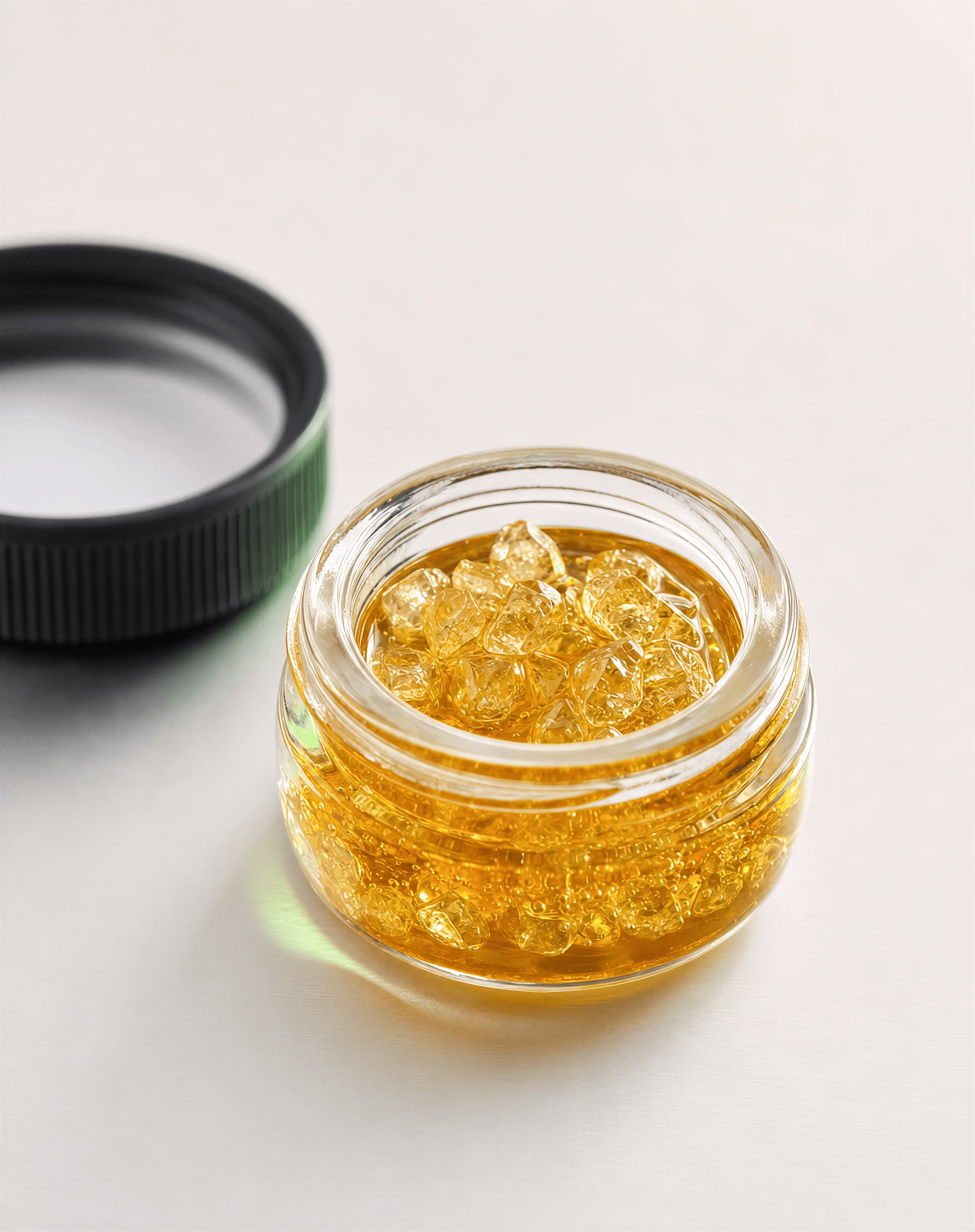
Crystallization is where cannabis processing looks most like classical lab chemistry. A cannabinoid-rich extract, usually hydrocarbon-derived and high in THCA, becomes supersaturated under controlled conditions. Given the right solvent balance, temperature, pressure, and time, THCA begins to nucleate and grow into crystals.
Those crystals are the “diamonds.” The surrounding liquid is the mother liquor, commonly called “sauce,” and it is enriched in terpenes plus non-crystallized cannabinoids. So “diamonds and sauce” is not one substance with a fancy name. It is a deliberately separated system: solid THCA fraction plus terpene-rich liquid fraction.
This matters because the product architecture is often mistaken for natural purity. It is highly processed. The chemistry is elegant, but it is still engineered. The extractor first creates a solution that can support supersaturation, then manages nucleation and growth. Change the solvent ratio or residual terpene content and the crystal behavior changes. Agitation, vessel headspace, and temperature swings can all alter the result.
Similar logic appears in solventless processing too, though with different mechanics. Some hash rosin workflows mechanically separate THCA-rich fractions from terpene-rich fractions using heat, pressure, and controlled curing rather than hydrocarbon crystallization. The endpoint may look analogous. The route is not.
Color remediation and the controversy around CRC
CRC, short for color remediation column or color remediation chromatography depending on who is speaking, is one of the most argued-over steps in modern extraction. The argument gets muddled because both sides are partly right.
At a technical level, CRC is just adsorptive filtration. The extract passes through media such as silica, bentonite, activated alumina, bleaching earths, or related blends chosen to capture pigments, oxidized compounds, soaps, and other unwanted constituents. Used intelligently, it can improve stability, remove harshness, and reduce color bodies that have nothing to do with potency. It is not automatically deception.
But abuse is real. CRC can also be used to cosmetically rescue poor material and make old, oxidized, or otherwise unattractive extract look cleaner than the input deserved. Pale color can signal good processing. It can also be staged. Color alone tells you very little.
CRC is neither inherently dirty nor inherently virtuous. Limited evidence
That is the position the evidence supports. CRC is neither inherently dirty nor inherently virtuous. It is a filtration strategy with legitimate process uses and obvious abuse potential.
The practical question is not whether CRC exists. It is what problem it is solving. Removing chlorophyll derivatives, oxidized pigments, or sulfur-like off-notes from an extract destined for distillation is one thing. Running tired biomass through aggressive media so the output looks fresher than it is, then implying quality from appearance, is another.
Post-processing is where extraction stops being a single act and becomes process engineering. Winterization cleans up crude. Decarb converts acids into neutrals and can erase aroma if mishandled. Distillation enriches cannabinoids while flattening the native profile. Crystallization builds high-THCA solids and terpene-rich liquid fractions. CRC can be smart filtration or cosmetic cover, depending on intent and execution.
That is why consumers so often misread labels. The finished concentrate in the jar is usually the result of several separations layered on top of one another, not one magical method.
Live resin, live rosin, distillate, shatter, sauce, and other product types mapped to process
Product names in cannabis are often a mess because they mix four different things: feedstock, extraction method, post-processing, and final formulation. That is why the same hydrocarbon extractor can produce live resin, shatter, badder, sauce, or diamonds, while the same ethanol crude can become distillate for a vape cartridge or an infused edible oil. Distillate is not an extraction method. Live resin is not a solvent class. Shatter is not a cultivar trait. “Diamonds” are not a raw plant expression. They are process outcomes.
| Product type | Feedstock | Primary separation | Important post-processing |
|---|---|---|---|
| Live resin | Fresh-frozen flower | Usually hydrocarbon extraction | Purge and texture-setting steps |
| Cured resin | Dried/cured flower or trim | Hydrocarbon extraction | Purge and texture-setting steps |
| Live rosin | Fresh-frozen material washed into hash | Ice-water hash then rosin pressing | Careful drying and pressing |
| Hash rosin | Hash, often bubble hash or refined sift | Rosin pressing | Texture curing or mechanical separation may follow |
| Distillate | Crude oil feedstock from extraction | Usually ethanol or hydrocarbon crude refined later | Winterization, decarboxylation, distillation |
| Diamonds and sauce | THCA-rich extract | Usually hydrocarbon extraction | Controlled crystallization into solid and liquid fractions |
A cleaner way to map the field looks like this:
- Feedstock choice**: cured flower/trim, fresh-frozen flower, hash, sift
- Primary separation**: hydrocarbon, ethanol, CO2, ice-water sieving, dry sifting, rosin pressing
- Post-processing**: winterization, filtration, solvent recovery, decarboxylation, whipping/agitation, vacuum purging, crystallization, distillation, terpene recombination
- Final formulation**: dabbable concentrate, vape oil, edible input, tincture base
That framing matters because concentrates are no longer a niche category. Brightfield reported concentrates at 27.2% of total U.S. cannabis sales in 2023 and BDSA projected $4 billion in U.S. concentrate sales in 2024. Scale raises the stakes for language and process control alike.
Feedstock-first products: cured versus live
“Live” refers to starting material, not magic. A live extract starts with fresh-frozen cannabis that is frozen shortly after harvest rather than dried and cured first. A cured-resin extract starts with dried flower or trim. The extraction solvent may be the same in both cases.
So:
- Live resin** = fresh-frozen feedstock + usually hydrocarbon extraction + purge/post-processing
- Cured resin** = dried/cured feedstock + hydrocarbon extraction + purge/post-processing
- Live rosin** = fresh-frozen material first made into ice-water hash, then pressed into rosin
- Hash rosin** = rosin pressed from hash, often but not always from cured material
Why does live material often smell more like the standing plant? Mostly terpene preservation. Ethan Russo’s writing on cannabis terpenoids has long emphasized that many monoterpenes are volatile and are lost during drying, storage, warm handling, and aggressive solvent recovery. Fresh-frozen material avoids the drying room stage where those losses begin. That does not mean every live product has a richer aroma than every cured product; poor freezing, thawing, oxidation, or sloppy post-processing can flatten a live extract fast. But the mechanism is straightforward: skip curing, lose fewer of the most volatile compounds up front.
This is also why “live resin” should not be treated as a potency synonym. It is a feedstock-plus-process label. A cured extract can test higher in total cannabinoids than a live one. The difference is usually compositional, not automatically strength-related.
What texture labels usually mean
- Shatter Glassy and brittle structure from controlled purge with minimal agitation.
- Wax / budder / badder More opaque, aerated textures encouraged by whipping, agitation, or nucleation.
- Crumble Drier, more friable texture linked to greater solvent removal or composition differences.
Texture and appearance products: shatter, budder, wax, badder, crumble
Texture terms usually describe physical structure created during post-processing, not species, not genetic lineage, and not direct potency ranking.
Shatter is a glassy, brittle concentrate. It is commonly linked to hydrocarbon extraction followed by careful solvent purge with minimal agitation so the material sets into an amorphous sheet. Lower residual moisture, limited nucleation, and controlled heat help maintain that snap.
Wax, budder, and badder sit on the opposite end of the texture spectrum. They are usually created when the concentrate is whipped, agitated, nucleated, or otherwise encouraged to form a more opaque, aerated structure. The exact naming is inconsistent across regions. One lab’s budder is another processor’s badder.
Crumble is drier and more friable. It often results from greater solvent removal, different lipid content, different cannabinoid composition, or more aggressive purge conditions.
These are not separate extraction sciences. They are different endpoints from similar starting extracts. Hydrocarbon extraction is the classic route, but rosin can also be cold-cured, whipped, jammed, or dried into textures that resemble badder or crumble. Texture reflects phase behavior, terpene content, cannabinoid ratio, residual volatiles, agitation history, and storage conditions. It does not reliably tell you whether the concentrate came from indica, sativa, or anything else equally blunt.
Purity-first products: distillate, isolate, diamonds
Here the process goal changes. Instead of preserving a broad resin profile, the operator is enriching one compound or one narrow fraction.
Distillate is a purification result, usually made after extraction. The common path is: extraction of crude oil, then winterization if needed to remove fats and waxes, then solvent removal, often decarboxylation, then short-path or wiped-film distillation. The output is cannabinoid-rich and analytically simpler than the original resin. Simpler is the point. But that simplicity has a tradeoff: less native terpene complexity.
That is why distillate often feels sensorially thin unless terpenes are added back. A high-THC number does not change the fact that much of the original volatile fraction was removed earlier in the workflow or separated during distillation. Calling distillate “pure cannabis oil” is misleading. It is purified cannabinoid oil, often dominated by one target cannabinoid and stripped of much of the plant’s broader aroma chemistry.
Isolate pushes that logic further. CBD isolate, THC isolate, or THCA isolate aims for near-single-compound output, commonly as a crystalline powder or refined solid. This can be reached by crystallization, repeated purification, or other separation steps depending on the cannabinoid.
Diamonds usually mean THCA crystalline produced from a terpene-rich extract through supersaturation and controlled crystallization. In common “diamonds and sauce” architecture, the crystal fraction is high-purity THCA while the surrounding liquid fraction carries terpenes and minor cannabinoids. Retail diamonds are usually post-hydrocarbon products, not spontaneous plant artifacts. Highly processed. Often impressive. Never “natural” in the casual sense people use that word.
Formulation outputs: vape oil, dabbable concentrates, edibles inputs, tincture bases
The same extract can branch into very different finished products depending on the last stage.
Vape oil is usually a formulation problem, not just an extraction result. Distillate is common because its consistency and potency are predictable, then terpenes or other diluent systems are blended for viscosity and flavor. Some live resin cartridges use minimally refined hydrocarbon extract instead, but that requires careful control of waxes, particulates, and viscosity. Rosin vapes exist too, though formulation is less forgiving.
Dabbable concentrates include shatter, budder, badder, sauce, jam, diamonds, live resin, hash rosin, and live rosin. Here the producer is preserving a semisolid or crystalline concentrate architecture rather than converting everything into a standardized fluid.
Edibles inputs often favor decarboxylated oil with predictable cannabinoid concentration over delicate terpene retention. Ethanol crude, winterized oil, or distillate are common intermediates because the target is dose consistency, not a volatile-rich aroma profile.
Tincture bases similarly depend on formulation. Ethanol-based tinctures may use extracted oil dissolved into alcohol; oil-based tinctures often rely on decarboxylated concentrate dispersed in MCT or another carrier.
One more point gets lost in product naming: safety and compliance live underneath all of these categories. ASTM D8449-23 gives a process framework for solvent-based extraction. CANNRA standards and state rules such as those from California DCC, Colorado MED, and Oregon OLCC/ODA require contaminant and residual-solvent testing for concentrates. NIOSH’s 2023 health hazard evaluation found delta-9-THC in 100% of personal air samples and 100% of surface wipe samples at two processing facilities, with respiratory symptoms reported by 66% of employees at one site and 40% at the other, and skin symptoms by 33% and 20%. Extraction and post-processing are chemistry operations with real occupational exposure, not just branding exercises.
If the label says live resin, ask about feedstock. If it says distillate, think purification. If it says shatter or badder, think texture. If it says diamonds, think crystallization. The product name makes sense only when mapped back to the sequence that made it.
Terpene preservation is where extraction methods separate themselves
If cannabinoids are the payload, terpenes are the first compounds a process tends to damage. That is why two extracts with similar THC or CBD numbers can smell, taste, and behave very differently. Ethan Russo’s 2011 review on cannabis pharmacology and terpenoids helped push this point into mainstream discussion: terpene content is not decorative. It shapes aroma, may influence subjective effects, and is especially vulnerable to heat, oxygen, and time. Extraction methods do not just remove resin. They decide how much of that volatile fraction survives the trip.
This is also where labels mislead people. “Live resin,” “distillate,” “rosin,” and “CO2 oil” sound like finished identities. Chemically, the more important question is what happened to the monoterpenes during harvest, drying, extraction, solvent recovery, vacuum exposure, and post-processing. A terpene-rich extract is usually the result of cold handling and restraint. A terpene-poor one is often the result of warm, efficient cleanup.
Which terpenes are easiest to lose
The first compounds to disappear are usually the small, volatile monoterpenes. Myrcene, limonene, and alpha-pinene are the usual examples because they are abundant in many cultivars and because they are easy to strip away by ordinary processing. Drying flower at room temperature already starts the loss. Warm extraction speeds it up. Solvent recovery under heat and vacuum can remove them even faster.
Russo and later terpene chemistry reviews in Molecules and Frontiers in Chemistry make the mechanism plain enough. Volatility matters, but oxidation matters too. Myrcene is not only prone to evaporation; it can oxidize into other compounds as plant tissue is disrupted and exposed to air. Limonene is similarly fragile, with oxidation products that alter aroma sharply. Pinene is highly volatile and can vanish early in drying and post-extraction concentration. What leaves the system is not always recorded on a label, and what remains is not always native to the original flower.
Sesquiterpenes such as beta-caryophyllene and humulene are generally less volatile than monoterpenes, so they often persist better through harsher processing. That is one reason heavily refined extracts can still show a terpene number on a certificate while smelling flat or generic: the terpene profile has shifted toward heavier compounds after the brighter monoterpenes were lost.
Decarboxylation makes the tradeoff even sharper. Converting cannabinoid acids to neutral cannabinoids requires time and heat. Those same conditions drive off monoterpenes and can push oxidative degradation. Studies on decarb kinetics consistently show that the more aggressively a producer chases cannabinoid conversion, the more terpene retention suffers. Distillate is the clearest example. It is typically cannabinoid-enriched precisely because so much else, including native terpene content, has been stripped away.
Fresh-frozen handling, low-temperature extraction, and vacuum effects
Fresh-frozen input matters because drying is itself a terpene-loss event. When cannabis is frozen soon after harvest, the plant is prevented from going through the long, oxygen-exposed drying and curing window that sheds monoterpenes. That is why “live” products are really feedstock stories before they are extraction stories. Live resin usually means hydrocarbon extraction of fresh-frozen material. Live rosin usually means fresh-frozen material turned into ice-water hash and then pressed. Different workflows, same underlying logic: start before the bright volatiles escape.
Hydrocarbon systems are good at preserving and separating terpene fractions when run cold and with careful solvent recovery. Butane and propane dissolve resin efficiently at low temperatures, and operators can pull a terpene-rich fraction early, before warmer cleanup steps flatten the profile. This is one reason sauce-and-diamonds products often carry a strong aroma: the THCA crystals and the terpene-rich mother liquor are separated and handled as different fractions.
Subcritical CO2 can do something similar, though consumer writing often gets this wrong by treating all CO2 extraction as one thing. Pressure and temperature tuning change what CO2 pulls and in what order. Run subcritical, and it can favor lighter volatile compounds more gently than a hotter supercritical pass. Run supercritical without careful fractionation, and terpene retention often suffers. CO2 is not automatically “cleaner” in an aroma sense. It is tunable. Those are not the same claim.
Vacuum is also double-edged. It lowers boiling points, which lets processors remove solvents at lower temperatures. That can protect cannabinoids from harsher heat. Yet vacuum also helps volatile terpenes leave the mixture. A vacuum oven does not know the difference between unwanted butane and wanted limonene. If the process is too warm, too long, or too deep in vacuum, the native aroma fraction will be thinned out along with the solvent. This is why terpene preservation is not just about the extractor. It is about the whole recovery pathway.
Native terpene fractions versus reintroduced terpenes
Once native terpenes are lost, processors can add terpenes back. That creates a different product, even when the label suggests continuity with the source flower. Distillate is the common case. After extraction, winterization, decarboxylation, and distillation, the resulting oil is usually cannabinoid-heavy and terpene-light. To make it usable in a vaporizer or to restore aroma, formulators may add botanical terpenes or cannabis-derived terpenes.
Those are not interchangeable. Botanical terpenes may reproduce a target list of compounds such as myrcene, limonene, linalool, and pinene, but cannabis aroma is not just a handful of headline terpenes. Minor terpenes, sulfur compounds, esters, and oxidation products all contribute. Cannabis-derived terpene fractions usually track the plant more closely, but even then the product is a reconstruction unless the fraction stayed paired with its original extract. Recombination changes ratios. It can also exaggerate certain notes because isolated fractions no longer sit in the same matrix they came from.
Labels rarely explain this difference clearly. “Cannabis terpenes added” sounds natural, but it may mean a terpene fraction stripped from one batch and blended into another. “Botanical terpenes” may produce a recognizable citrus or pine profile while having little relationship to the original cultivar. Neither is fake in a chemical sense. Both are formulation choices. They should not be confused with intact native preservation.
That is why terpene preservation marks a real dividing line between extraction systems. A process that captures volatile fractions early, limits oxygen, stays cold, and avoids prolonged warm recovery can keep more of the plant’s original chemical voice. A process built around maximum cleanup will usually silence it, then try to recreate it later. Those are not the same outcome, even if the package uses the same strain name.
Equipment overview by process scale
Equipment only makes sense when tied to a unit operation. Sieving is not pressing. Extraction is not distillation. Distillation is not formulation. That distinction matters because the same extract can branch into very different products depending on what equipment comes next. Hydrocarbon extraction can end as shatter, sauce, or THCA diamonds; ethanol extraction often feeds winterization and wiped-film distillation; solventless workflows can stop at sift or continue into hash rosin and mechanical THCA separation.
The hardware changes with scale, but the logic stays the same: separate resin from plant material, remove what you do not want, preserve what you do want, then verify the result analytically.
Bench-scale and artisanal equipment
At small scale, solventless setups are the clearest example of process-first equipment. Dry sift starts with screens or mesh sieves in different micron ranges, collection trays, and sometimes static-tech tools to refine trichome heads away from contaminant particles. Bubble hash uses wash vessels, paddles or gentle agitation systems, nested filter bags, drain tables, and cold-water handling gear. Freeze dryers have become almost standard for serious hashmakers because air-drying wet hash is slow and raises oxidation and microbial-risk issues.
Rosin workflows add presses, heated platens, pressure control, filter bags, and pre-press molds. A rosin press does not “make rosin” by magic; it applies heat and pressure to sift, flower, or hash, so upstream input quality still governs the output. Fresh-frozen input usually first becomes bubble hash, then hash rosin. That is why “live rosin” is really a feedstock-plus-workflow label.
Small ethanol or hydrocarbon work exists too, but this is where casual writing often becomes dangerous. NIOSH identified extraction as one of the higher-risk cannabis manufacturing steps, not because chemistry is inherently unsound, but because vapors, aerosols, and worker exposure are real. In its 2023 health hazard evaluation, delta-9-THC was detected in 100% of personal air samples and 100% of surface wipe samples at two processing facilities. Respiratory symptoms were reported by 66% of workers at one facility and 40% at the other; skin symptoms by 33% and 20%. Even a modest setup needs local exhaust, containment, sanitation discipline, and temperature control.
Licensed-lab extraction equipment
Once throughput rises, extraction starts looking less like kitchen hardware and more like botanical chemical processing. Licensed hydrocarbon systems are typically closed-loop extractors built around solvent tanks, material columns, collection vessels, recovery pumps, heat exchangers, and vacuum capability. The major safety point is engineering, not mythology. NFPA 1 treats butane and propane extraction as a hazardous process requiring classified rooms, gas detection, ventilation, and explosion-control design. Open-blasting and closed-loop extraction are not comparable practices.
Ethanol systems split into soak tanks and centrifuge-based extractors. Cold ethanol can pull cannabinoids efficiently at scale, but it also tends to bring along more waxes, lipids, and chlorophyll than hydrocarbon systems, especially if temperature control slips. That is why ethanol lines are often paired from the start with filtration, winterization, and solvent-recovery equipment. Basket centrifuges are common because they combine washing and solid-liquid separation in one machine.
CO2 extraction uses pumps, chillers, heaters, separator vessels, and pressure-rated skids designed for subcritical or supercritical operation. CO2 is often sold in public discussion as automatically cleaner. That is too simple. It avoids hydrocarbon residue, yes, but it is expensive, mechanically complex, and often still needs downstream cleanup. Without careful fractionation, terpene capture can be mediocre. Ethan Russo’s terpene work is a useful reminder here: monoterpenes are volatile enough that drying, warm extraction, and aggressive recovery can strip them quickly.
Downstream purification and finishing equipment
This is where crude extract becomes a defined ingredient or finished concentrate. Solvent recovery begins with rotary evaporators at bench or pilot scale and shifts to falling-film evaporators at larger scale for ethanol removal. Winterization commonly uses freezers, jacketed reactors, and filtration hardware to precipitate waxes and lipids before finer purification.
Decarboxylation uses heated reactors or vacuum-capable vessels to convert cannabinoid acids such as CBDA to CBD or THCA to THC, depending on the product target. Heat management matters. Push too hard and you drive off terpenes and increase cannabinoid degradation.
For concentration and refinement, vacuum ovens remove residual solvent from hydrocarbon extracts and help set textures such as shatter or badder through controlled heat and pressure conditions. Distillation comes later. Short-path stills are seen at smaller scale, while wiped-film systems dominate industrial cannabinoid distillation because they reduce residence time and handle viscous feed better. Distillate is therefore a purification result, not an extraction method.
Advanced labs may add chromatography, especially when trying to isolate a cannabinoid, remove unwanted fractions, or polish a distillate beyond what distillation alone can achieve. Crystallization equipment, often jacketed vessels with tight temperature control, is used in THCA diamond workflows and some isolate processes. Again, the equipment map exposes the error in product labels: diamonds are a crystallization outcome, usually after hydrocarbon extraction, not a separate extraction family.
| Analyte or quality target | Typical instrument named in the article |
|---|---|
| Potency and acidic/neutral cannabinoid profile | HPLC |
| Residual solvents | Headspace GC-FID or GC-MS |
| Pesticides | LC-MS/MS and GC-MS/MS |
| Heavy metals | ICP-MS |
| Water activity | Water activity meter |
| Microbial contamination | Culture-based methods or qPCR |
Analytical testing equipment and why it matters
Extraction without testing is guesswork. Potency is usually measured by HPLC because it can quantify acidic and neutral cannabinoids without forcing decarboxylation in the instrument. Residual solvents are commonly measured by headspace GC-FID or GC-MS. Pesticides often require LC-MS/MS and GC-MS/MS because the target list spans compounds with very different chemical behavior. Heavy metals are typically measured by ICP-MS. Water activity meters matter in hash and flower-derived inputs because microbial growth risk tracks available water, not just moisture percentage. Microbial contamination is checked by culture-based methods, qPCR, or both, depending on the jurisdiction.
These tools are not optional polish. CANNRA baseline standards and state rules such as those in California, Colorado, and Oregon require contaminant and residual-solvent testing for concentrates. That reflects scale as much as chemistry. UNODC estimated 228 million cannabis users worldwide in 2022, and SAMHSA reported 61.8 million past-year marijuana users in the United States in 2023. Brightfield put concentrates at 27.2% of U.S. cannabis sales in 2023. When extraction reaches that size, instruments stop being a lab luxury. They are how a process proves what it actually made.
Safety, contamination, and legal compliance
Safety failures in cannabis extraction usually come from bad process control, not from the abstract idea of dissolving resin. That distinction matters. Hydrocarbon extraction with butane or propane is not equivalent to an explosion, and solventless processing is not automatically free of hazards. Extraction is chemistry plus engineering plus hygiene. When any one of those fails, people get hurt or contaminated products reach the market.[1] World Drug Report 2024. United Nations Office on Drugs and Crime. United Nations publication, 2024.[2] 2023 National Survey on Drug Use and Health (NSDUH) Releases. Substance Abuse and Mental Health Services Administration. SAMHSA report, 2024.
The scale alone makes this a public-health issue, not a niche manufacturing detail. UNODC estimated 228 million people used cannabis worldwide in 2022, reported in its 2024 World Drug Report. SAMHSA estimated 61.8 million people aged 12 or older in the United States used marijuana in the past year in 2023, reported in 2024. Concentrates are a major part of that downstream supply: Brightfield Group said concentrates represented 27.2% of total U.S. cannabis sales in 2023, and BDSA projected $4 billion in U.S. concentrate sales in 2024. Those market figures are industry data rather than public-health surveillance, but they underline the point. Extraction safety is now industrial hygiene, fire protection, and contaminant control at scale.
Why illicit open-blast extraction is dangerous
Open-blast hydrocarbon extraction is dangerous for a simple reason: it releases large volumes of highly flammable vapor directly into the workspace. Butane and propane have low ignition energies and can travel to ignition sources that operators do not recognize as dangerous in the moment: switches, motors, heaters, static discharge, pilot lights, even non-classified refrigeration equipment. The chemistry is ordinary phase transfer. The hazard is vapor cloud formation.
NFPA guidance treats hydrocarbon extraction as a Class I hazardous process because the solvents form ignitable mixtures with air. That classification drives the engineering response: closed-loop equipment, classified electrical systems, mechanical ventilation, gas detection, pressure relief, and explosion-control design. Remove those controls and the process becomes exactly what illicit open-blast setups are known for: an unconfined flammable-gas release in an occupied room.
This is why “BHO is unsafe” is too blunt to be useful. Closed-loop butane extraction in a properly designed room is not the same event as spraying cans of butane through a tube onto plant material in a garage. One is a managed industrial process. The other is an accident sequence waiting for ignition. ASTM D8449-23 reflects this process language by treating solvent extraction as a controlled operation with defined equipment and recovery steps, not as improvised handling of fuel gas.
A second problem with illicit systems is the absence of solvent recovery and verification. If the operator cannot measure pressure, temperature, residual solvent, and leak integrity, they do not know what is in the output or in the room air. That uncertainty is itself a hazard. Fire risk and product risk rise together.
Worker exposure, inhalation, and contact hazards in legal facilities[3] Evaluation of Cannabis Employee Exposure to Delta-9-Tetrahydrocannabinol (Δ9-THC) and Other Hazards at an Indoor Cannabis Processing Facility. National Institute for Occupational Safety and Health. NIOSH Health Hazard Evaluation Report, 2023.
Legal facilities are much safer than illicit open-blast operations when they follow fire code and occupational controls. They are not hazard-free. NIOSH made that plain in a 2023 Health Hazard Evaluation of two cannabis processing facilities. Delta-9-THC was detected in 100% of personal air samples and 100% of surface wipe samples. Exposure was not occasional; it was ubiquitous in the evaluated work areas.
The worker symptom data were not trivial either. NIOSH reported respiratory symptoms in 66% of employees at one facility and 40% at the other. Skin symptoms were reported by 33% and 20%, respectively. Those numbers do not prove THC alone caused every symptom, because cannabis processing environments also contain dust, terpenes, cleaning chemicals, and possible allergens. They do prove that inhalation and dermal contact hazards are routine enough to measure consistently.
The exposure picture changes by task. Grinding, sifting, trimming, and bag dumping can aerosolize plant dust and biologically active particles. Rosin pressing reduces solvent hazards but can still generate thermal fumes and contact burns. Ethanol and hydrocarbon extraction add solvent vapor exposure potential. Decarboxylation and solvent recovery can release terpene-rich VOC mixtures if ventilation is poor. Even seemingly clean post-processing tasks such as distillation, cartridge filling, or concentrate handling can leave THC on benches, gloves, and door handles.
NIOSH’s findings support a straightforward hierarchy of controls. Enclose dusty or solvent-emitting steps where possible. Use local exhaust ventilation at transfer points and decarb ovens. Separate extraction rooms from general production. Validate cleaning protocols with wipe testing rather than assuming visible cleanliness means low exposure. Use gloves selected for the chemicals present, and change them often enough to prevent spreading residues from equipment to skin-contact surfaces. Respiratory protection has a place, but it should not substitute for ventilation and enclosure.
Residual solvents, pesticides, heavy metals, and microbial carryover
Contamination control starts with an uncomfortable fact: extraction concentrates what is present in the feedstock. If the starting material contains pesticide residues, heavy metals, or microbial toxins, the extract may contain more of them per gram than the flower did. Solventless products are not exempt. Rosin avoids residual hydrocarbon or ethanol issues, but it can still carry concentrated pesticides, fungal metabolites, and environmental metals from the original biomass.
Residual solvents are the contaminant category most strongly associated with extracts, especially hydrocarbons and ethanol. In regulated manufacturing, they are managed through solvent recovery, vacuum drying, time-temperature validation, and batch testing. The old consumer shorthand that “CO2 is cleaner” is too simplistic. Supercritical CO2 avoids hydrocarbon residue by design, yes, but cleanliness is not a brand attribute of the solvent. It depends on the whole process: source material, equipment materials, post-processing, and analytical release criteria. CO2 extracts can still require winterization, filtration, and contaminant screening.
Pesticides are harder. Some compounds survive extraction and may partition into the resin fraction efficiently enough to fail finished-product testing even when source material passed less stringent screening or was tested under a different matrix. Heavy metals are another matrix problem. Cannabis is a known accumulator of metals from soil and inputs, and processing equipment itself can add risk if low-grade metals, worn surfaces, or incompatible contact materials are used.
Microbial carryover is often misunderstood. Extraction can reduce viable microbial counts depending on solvent, temperature, and downstream heating, but it does not guarantee removal of microbial toxins or all contamination markers. A product can test low for live mold and still reflect poor hygiene upstream. Water-based hash workflows add their own sanitation demands because wet biomass, wash water, and drying stages create opportunities for contamination if temperature, moisture activity, and cleaning are poorly controlled.
Regulatory testing frameworks and jurisdictional variation
No single testing framework governs all cannabis extracts. Cannabis laws and processing rules vary by jurisdiction. That sentence is not boilerplate; it affects everything from action limits to sampling rules to whether a batch can be remediated after failure.
CANNRA’s baseline work has pushed some convergence in terminology and risk categories, but state rules still differ materially. California’s Department of Cannabis Control publishes action levels and testing requirements for residual solvents, pesticides, heavy metals, microbial impurities, mycotoxins, and foreign material. Colorado MED rules and Oregon OLCC/ODA rules also require contaminant testing for concentrates, yet the analyte lists, permitted limits, and retest pathways are not identical. A processor operating across states can make the same extract with the same equipment and face different legal outcomes depending on where the batch is tested.
That variation matters because extraction is a sequence of separations. One jurisdiction may focus heavily on residual butane, propane, ethanol, or pentane limits. Another may enforce broader pesticide panels or stricter microbial criteria. Sampling can be a weak point too. A homogeneous distillate batch is easier to sample representatively than jars of heterogeneous sugar, sauce, or mechanically separated fractions. If the regulatory system ignores matrix differences, compliance can become partly a sampling problem rather than only a chemistry problem.
The sound position is clear. Safe extraction requires engineered controls, exposure monitoring, validated cleaning, and contaminant testing matched to the actual process and product matrix. Hydrocarbon chemistry is not the villain. Bad engineering, poor hygiene, and weak oversight are.
How professionals choose an extraction method
Professionals rarely choose an extraction method by asking which label sounds cleaner or more artisanal. They start with a manufacturing question: what fraction of the plant do we want, at what scale, under what safety and regulatory constraints, and what happens after extraction? That last part matters because extraction is only the first separation. Winterization, filtration, decarboxylation, distillation, crystallization, and formulation often determine the finished product more than the initial solvent does.
That distinction explains a lot of market confusion. Live resin is not a solvent category; it is a fresh-frozen feedstock concept, usually paired with hydrocarbons. Distillate is not an extraction method; it is a purified output, often produced after ethanol or hydrocarbon extraction followed by winterization and wiped-film distillation. THCA diamonds are not “naturally pure” resin; they are usually a crystallization result from a hydrocarbon extract. Rosin is a mechanical expression method, but hash rosin, live rosin, and mechanically separated THCA are still downstream process choices, not one single thing.
Choosing for throughput and biomass efficiency
If the goal is moving a lot of biomass at low cost per kilogram, ethanol usually wins. Cold or room-temperature ethanol can wash cannabinoids from large volumes of milled flower or trim quickly, and the equipment can be scaled from small centrifuge systems to industrial countercurrent setups. It is not the most selective solvent. It often brings chlorophyll, waxes, and other co-extractives unless temperature and contact time are tightly controlled. Even so, for crude oil headed to winterization, decarboxylation, and distillation, selectivity is often less important than speed, recovery, and cost.
That is why ethanol remains central in large-format CBD and THC processing. It fits the logic of industrial input manufacturing: extract broadly, remove what you do not want later, then standardize. If the destination is edible oil, soft-gel fill, bulk distillate, or a cannabinoid ingredient for formulation, ethanol’s weaknesses are manageable. Its throughput advantage is not theoretical. It is operational.
Hydrocarbons can also be efficient, but the decision is different because the facility burden is different. NFPA 1 treats butane and propane extraction as a Class I hazardous process, which means engineered rooms, gas detection, explosion-control design, and trained operators. That does not make hydrocarbon extraction bad chemistry. It means the process engineering matters more than the internet cliché about “unsafe solvent extracts.” Licensed closed-loop systems are a different universe from illicit open blasting.
CO2 sits in the middle of many boardroom discussions because it sounds technologically advanced and avoids hydrocarbon residue. That reputation is overstated. Supercritical CO2 is tunable and scalable, and in some regulated or vertically integrated operations it fits well. But it is capital intensive, often slower than ethanol for bulk biomass, and frequently followed by ethanol winterization anyway. It is not a universal quality upgrade. It is a tool that makes sense when a facility can justify the equipment, the process development, and the product targets.
Scale also raises worker-safety questions that marketing language tends to hide. NIOSH reported in 2023 that delta-9-THC was found in 100% of personal air samples and 100% of surface wipe samples at two cannabis processing facilities. Respiratory symptoms were reported by 66% of employees at one facility and 40% at the other; skin symptoms were reported by 33% and 20%. Extraction choice is partly chemistry, partly industrial hygiene.
Choosing for flavor preservation and dabbable products
When the target is an aromatic resin for inhalation rather than a neutral cannabinoid ingredient, hydrocarbons usually have the edge. Butane and propane are good at dissolving cannabinoids and terpenes while pulling fewer polar compounds than ethanol. That is why they dominate the live resin, sauce, badder, wax, and diamond-and-sauce category. The feedstock can be tuned too: fresh-frozen material preserves volatile monoterpenes that are often lost during conventional drying and curing, a point long emphasized in terpenoid research by Ethan Russo and others.
This is also where people confuse product form with method. Shatter, budder, wax, sauce, and diamonds can all come from hydrocarbon extraction, with texture driven by purging conditions, agitation, crystallization, terpene content, and storage. Live resin is simply the fresh-frozen branch of that workflow.
Solventless methods win a different argument. Bubble hash, dry sift, and rosin appeal to operators who want no hydrocarbon or ethanol in the extraction step and who are chasing a particular sensory profile. The tradeoff is real: more labor, more dependence on cultivar-specific resin traits, and often lower overall recovery from the same biomass. Solventless is not chemically simpler in outcome either. Oxidation, heat, water quality, microbial cleanliness, and drying all matter. Rosin can be extraordinary when the starting hash is excellent, but it is expensive process logic compared with ethanol crude destined for distillation.
Choosing for edibles, vape oil, and pharmaceutical-style inputs
For edibles and many bulk cannabinoid ingredients, flavor preservation is often secondary. Consistency is the priority. That pushes operators toward extraction methods that feed standardized refinement. Ethanol is common here because it produces crude suitable for winterization, decarboxylation, and distillation at scale. Distillate then becomes the formulation input for gummies, capsules, tinctures, or neutral vape bases. It is terpene-depleted unless terpenes are reintroduced. Calling it “pure cannabis oil” misses the point; it is a cannabinoid-enriched fraction shaped by post-processing.
Vape oil splits into two broad philosophies. One is resin-forward, where hydrocarbons or solventless rosin preserve native volatile compounds. The other is formulation-forward, where distillate provides a stable potency base and the aromatic fraction is added later. Neither is automatically superior. The right choice depends on whether the device is meant to express cultivar character or deliver repeatable cannabinoid concentration with fewer sensory variables.
Pharmaceutical-style inputs usually reward reproducibility over romance. That means validated extraction, defined impurity control, residual-solvent testing, and stable formulation behavior. ASTM D8449-23 is useful here because it frames solvent extraction in process language rather than lifestyle language. State rules from California, Colorado, Oregon, and baseline standards from CANNRA all reinforce the same point: the method matters less than whether the process is validated and the output meets contaminant limits.
Why starting material quality can outweigh extraction technology
No extraction platform can turn weak, degraded, mold-damaged, or badly stored biomass into elite resin. It can only separate and concentrate what is there, including defects. If the flower lost monoterpenes during drying, the extractor cannot fully put them back. If pesticide residues or microbial byproducts are present, extraction may concentrate them rather than erase them. If trichome heads are sparse, solventless yield will suffer no matter how skilled the wash team is.
Fresh-frozen handling, water activity, oxygen exposure, cultivar choice, and harvest timing often matter as much as the machine. That is why “CO2 is cleaner,” “rosin is safer,” and “hydrocarbon means lower quality” are all shallow claims. Cleanliness comes from controlled processing and compliant testing. Sensory quality comes from preserving a good starting profile. Yield comes from resin content and process fit.
The hard truth is simple: process can protect quality, reveal quality, or strip quality. It rarely invents it.
Where cannabis extraction science is still unsettled
Extraction gets discussed as if the science were settled and the only remaining question were style: rosin or resin, CO2 or butane, live or cured. That is not how the evidence base looks. Cannabis extraction is closer to applied separation science than to a menu of finished goods, and the published literature still lags far behind the confidence of product labels.
Gaps in published comparative trials
Head-to-head, peer-reviewed comparisons are thinner than many people assume. There are many papers on optimizing one method in isolation — supercritical CO2 parameter tuning, ethanol wash temperature, decarboxylation kinetics, terpene volatility, wiped-film purification — but far fewer studies that take the same cultivar, same harvest lot, same moisture state, and run parallel extractions through matched post-processing before measuring cannabinoid profile, terpene retention, oxidation, contaminants, and sensory outcome.
That gap matters because post-processing can swamp the extraction step itself. Hydrocarbon extraction can lead to shatter, wax, sauce, or THCA diamonds depending on purge conditions and crystallization. Ethanol often feeds winterization and distillation. Solventless workflows still involve sieving, washing, drying, pressing, and sometimes mechanical separation of THCA from terpene-rich fractions. Comparing “BHO” to “rosin” without harmonizing those later steps is often not a scientific comparison at all.
Sensory quality and effect profile are especially under-studied. Ethan Russo’s writing on terpenoids has long pointed to the volatility of monoterpenes during drying, heating, and solvent recovery, yet controlled trials that connect a measured terpene loss pattern to blinded human sensory outcomes remain sparse. Claims that one method is inherently “cleaner,” “fuller,” or more representative of the starting flower usually outrun the published evidence.
The limits of consumer shorthand like full-spectrum and solventless
Consumer shorthand is useful until it starts replacing chemistry. “Full-spectrum” rarely has a stable technical meaning across jurisdictions or labs. Does it mean major and minor cannabinoids preserved? Native terpenes retained? No isolation step? No terpene reintroduction? A distillate with added cannabis terpenes can be marketed in language that sounds broad, even though distillation is usually terpene-stripping by design.
“Solventless” has the same problem. It accurately signals the absence of added hydrocarbon or ethanol solvents in the separation step, but it does not guarantee a simple chemical outcome or a safer concentrate. Rosin can still lose volatile monoterpenes under heat and vacuum. Bubble hash and dry sift can still carry contaminants from the starting material. Pesticides, heavy metals, and microbial byproducts do not vanish because a process is mechanical. California DCC testing rules, CANNRA baseline standards, and state residual-solvent limits exist because safety is a measurement question, not a branding question.
What future standardization would need to measure
ASTM D8449-23 helps with process language, but future standardization needs much tighter reporting. At minimum: cultivar or chemotype, fresh-frozen versus dried feedstock, water activity or moisture content, particle size, storage time before extraction, extraction temperatures and pressures, solvent-to-biomass ratio, terpene recovery strategy, decarb conditions, winterization conditions, residual solvents, and oxidation markers such as CBN increase or terpene oxidation products.
It also needs transfer data. Not just what was extracted, but what moved from biomass into concentrate: pesticides, mycotoxins, heavy metals, microbial contamination, and processing aids. NIOSH’s 2023 evaluation of two processing facilities found delta-9-THC in 100% of personal air samples and 100% of surface wipe samples, with respiratory symptoms reported by 66% of workers at one facility and 40% at the other. That study was about occupational exposure, not product quality, yet it underlines a wider point: cannabis processing is measurable, and many things currently discussed as identity or craft are still missing basic standardized measurement. We know enough to reject easy myths. We do not know enough to rank extraction pathways with the certainty that marketing language implies.
References
- [1] World Drug Report 2024. United Nations publication, 2024. https://www.unodc.org/unodc/en/data-and-analysis/world-drug-report-2024.html
- [2] 2023 National Survey on Drug Use and Health (NSDUH) Releases. SAMHSA report, 2024. https://www.samhsa.gov/data/report/2023-nsduh-annual-national-report
- [3] Evaluation of Cannabis Employee Exposure to Delta-9-Tetrahydrocannabinol (Δ9-THC) and Other Hazards at an Indoor Cannabis Processing Facility. NIOSH Health Hazard Evaluation Report, 2023. https://www.cdc.gov/niosh/hhe/reports/pdfs/2022-0061-3398.pdf