













Microdosing cannabis is not just 'using less'
What microdosing means in the cannabis context
Cannabis microdosing does not mean “a small amount” in the casual sense. It means a deliberately sub-intoxicating, or only minimally intoxicating, dose chosen to produce a specific effect without meaningful impairment. That distinction matters. Someone taking one puff out of habit is not necessarily microdosing. Someone taking a measured amount, waiting for onset, and stopping at the point where pain eases or anxiety softens without cognitive drag probably is.
Grella et al. (2020) captured this well in interviews with 39 adults who described microdosing as using enough cannabis for symptom control or functional benefit while avoiding the feeling of being impaired. That is a much tighter definition than the lifestyle version now circulating online. It treats microdosing as a dosing decision, not an identity.
Biphasic dose-response A dose pattern where the same drug can help at a lower dose but flatten out or reverse at a higher dose. In this article, THC may reduce pain or tension at one level, then increase anxiety, sedation, tachycardia, or cognitive impairment at a higher level.
The pharmacology supports that frame. THC has a biphasic dose-response pattern: lower doses can help in some people, while higher doses can push the same person into anxiety, dysphoria, sedation, tachycardia, or poorer working memory. Childs et al. (2017) showed this clearly in humans. Oral THC at 12.5 mg produced stronger negative subjective effects, including anxiety-related effects, than 7.5 mg. Wallace et al. (2007) found the same practical pattern in neuropathic pain: low-dose smoked cannabis reduced pain, while a higher dose did not add analgesic benefit and produced more adverse effects. That is the real logic of microdosing. Not restraint for its own sake. Better effects by staying below the point where THC starts working against the goal.
Why 1-5 mg THC is a useful range but not a universal rule
The commonly cited 1-5 mg THC range is a useful starting frame because it often captures the zone where noticeable effects begin without guaranteeing overt intoxication. Still, it is not a law of nature. It is a heuristic.
For a THC-naive adult using a regulated edible, 1 mg may already be active. For an experienced but low-tolerance user, 2-2.5 mg may still function as a microdose. At 5 mg, some people remain fully functional; others are clearly intoxicated. Route changes the picture even more. With inhaled flower, assigning an exact milligram number is difficult because delivered dose depends on THC percentage, puff size, inhalation depth, hold time, and combustion losses. Modern flower is also much stronger than older advice assumes; NIDA notes average THC content in seized U.S. flower rose from roughly 4% in 1995 to over 15% by 2021. A “small puff” today can be far less small pharmacologically than people think.
Edibles have the opposite problem. They are easier to quantify on paper, but slower and less forgiving in practice. Onset commonly takes 30-90 minutes, peak effects often arrive at 1.5-3 hours, and 11-hydroxy-THC formation can make a small dose increase feel disproportionately stronger and longer. Tinctures usually sit between inhalation and edibles, especially when partly absorbed sublingually.
So yes, 1-5 mg THC is useful. No, it is not the definition.
The minimum effective dose as the real target
Minimum effective dose The smallest dose that reliably produces the intended benefit. In microdosing, this is the dose that helps without adding meaningful impairment, anxiety, sedation, or cognitive drag.
The real target is the minimum effective dose: the smallest dose that reliably produces the intended benefit. Ethan Russo has long argued that cannabinoid therapeutics make more sense when dosing starts from this principle rather than from the assumption that more THC means more relief. The evidence backs him.
For anxiety, the useful window can be narrow. For chronic pain, the aim is not maximal psychoactivity but symptom reduction with a tolerable cognitive burden, especially during the day. Claims about creativity and focus are plausible at low doses, and users report them often, but direct randomized evidence remains thin. Honesty matters here.[1] Reversible and regionally selective downregulation of brain cannabinoid CB1 receptors in chronic daily cannabis smokers. Jonna Hirvonen, Dardo Tomasi, Nora T. Tyndale, et al.. Molecular Psychiatry, 2012.
This is also why microdosing often fails in heavy daily users. Repeated THC exposure shifts the threshold upward through tolerance. Hirvonen et al. (2012) found about a 20% reduction in CB1 receptor availability in daily cannabis smokers, with recovery beginning during abstinence. In plain terms, some people cannot feel a microdose because their system has adapted to much larger inputs. In that situation, microdosing is not “just use less.” It may require a tolerance break first, followed by careful titration: start below the expected threshold, change one variable at a time, wait long enough for that route to peak, and document the effect. That is dose-finding. And that is what cannabis microdosing actually is.
The pharmacology that makes microdosing plausible
Microdosing cannabis makes sense only if small changes in THC exposure can produce meaningfully different effects. They can. That is the core pharmacology.
In cannabis use, “microdosing” usually means taking a sub-intoxicating amount of THC, often around 1–5 mg per dose, though the exact number matters less than the outcome: measurable benefit without unwanted impairment. Grella et al. 2020 captured this well in interviews with 39 adults who described microdosing as using just enough cannabis for symptom relief or functional benefit while staying clear-headed. That definition fits the biology better than any fixed milligram cutoff. The real target is the minimum effective dose within a narrow personal window.

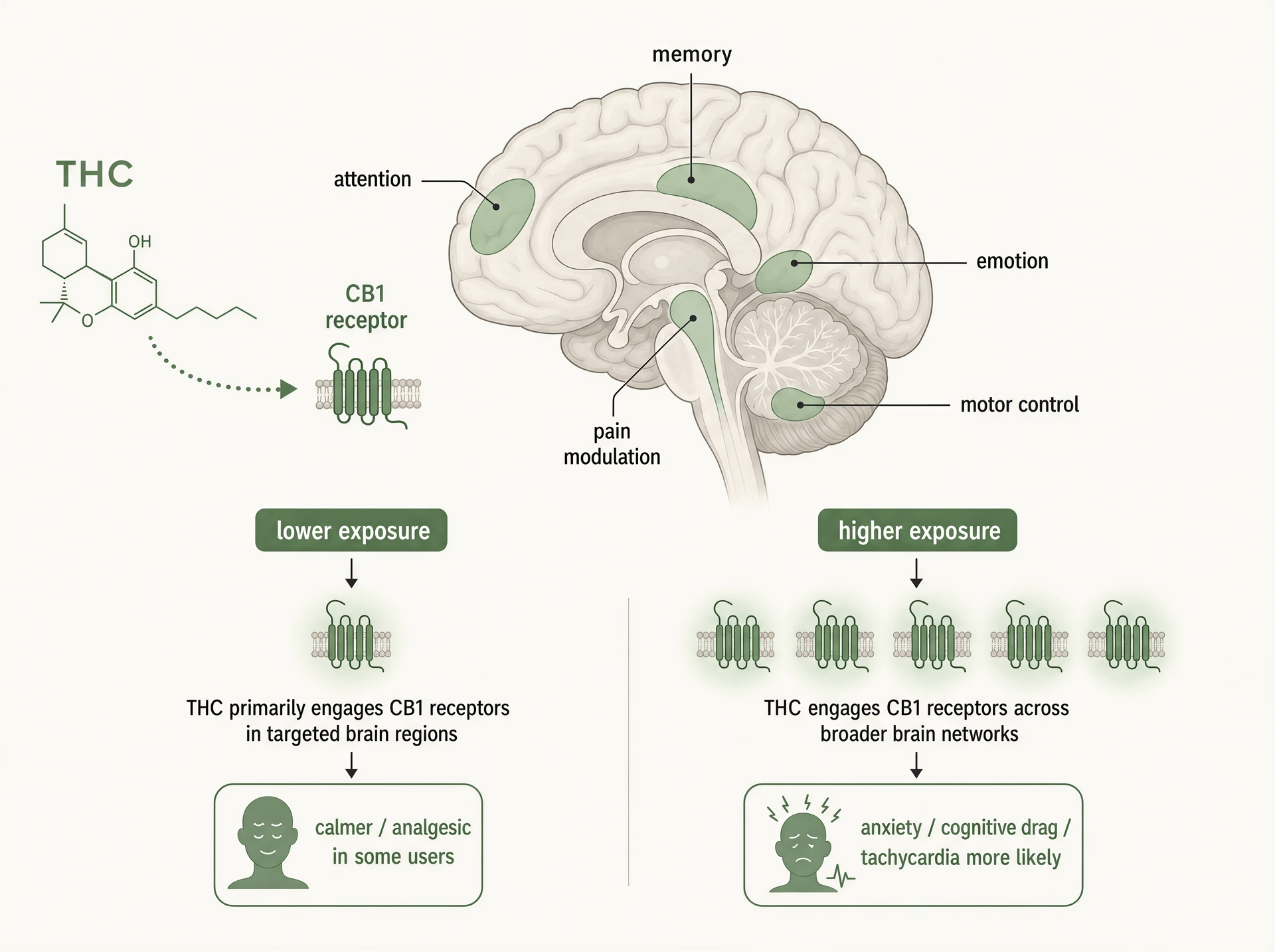
THC, CB1 receptors, and why small dose differences matter
CB1 receptor A cannabinoid receptor found densely in the brain. THC activates CB1, which changes neurotransmitter release and helps explain effects on memory, attention, pain, reward, motor control, and emotional processing.
THC produces most of its psychoactive effects by activating CB1 receptors, which are densely expressed in the brain, especially in regions involved in memory, attention, reward, pain modulation, motor control, and emotional processing. CB1 is a G protein-coupled receptor. In plain terms, when THC binds to it, the receptor changes how neurons release neurotransmitters. Usually this means less neurotransmitter release from the presynaptic neuron. That shift can alter glutamate, GABA, dopamine signaling indirectly, and downstream network activity.
Small dose differences matter because CB1 signaling is not an on-off switch. It is a graded system, and it sits inside circuits that are already balancing arousal, threat detection, pain, and cognition moment to moment. A little THC may slightly dampen noise in one circuit and feel calming or analgesic. More THC may suppress signaling too broadly, disrupt short-term memory, increase heart rate, impair attention, or push susceptible users toward anxiety and dysphoria.
That is why “just take less” is not a trivial instruction. With THC, small increments can move someone from helpful to unpleasant, especially when tolerance is low. Childs et al. 2017 gives a concrete example. In a randomized human laboratory study, oral THC at 12.5 mg produced more negative subjective effects, including anxiety-related responses, than 7.5 mg. Those are not giant dose differences. They sit squarely in the range many people casually describe as small.
Route of administration changes the picture. Inhaled THC reaches the brain within minutes, so feedback is fast, but actual delivered dose is messy. Puff size, inhalation depth, hold time, combustion loss, and flower potency all change exposure. That matters more now that average THC levels in flower are much higher than in past decades; NIDA summaries of federal potency monitoring show a rise from roughly 4% THC in 1995 to more than 15% by 2021. A “small puff” is no longer a stable unit.
Oral THC is more quantifiable, but less forgiving. Effects often begin in 30–90 minutes, peak around 1.5–3 hours, and can last 4–8 hours or longer. Because oral THC is metabolized into 11-hydroxy-THC, which is also psychoactive and can feel stronger, a small increase in the swallowed dose can produce a disproportionately larger and longer effect. Tinctures sit between inhaled and edible use, depending on how much is absorbed sublingually versus swallowed.
Individual biology shapes all of this. Prior exposure is a major driver. Daily users often need more THC to notice anything because repeated exposure reduces CB1 receptor availability and signaling efficiency. Hirvonen et al. 2012 found about a 20% reduction in CB1 receptor availability in daily cannabis smokers compared with controls, with normalization beginning during abstinence and approaching control levels by 28 days in several brain regions. That is why many heavy users cannot microdose in any meaningful sense until they stop long enough for sensitivity to recover.
Body composition, CYP metabolism, sleep, stress, expectations, and setting also matter. So does the THC:CBD ratio. CBD may soften THC tolerability for some users, but there is no reliable ratio that automatically turns an excessive THC dose into a microdose.
The biphasic dose-response curve
The pharmacologic model that makes microdosing plausible is the biphasic dose-response curve. Biphasic means the same drug can produce one effect at a low dose and the opposite effect at a higher dose. With THC, this is not speculative. It appears repeatedly in both animal and human literature.
At lower doses, THC may reduce pain, lower anxiety in some settings, elevate mood, or slightly increase sensory salience. At higher doses, those effects can flatten out or reverse. Analgesia may stop improving. Anxiety may increase. Sedation, tachycardia, dysphoria, and cognitive impairment become more likely.
Wallace et al. 2007 is one of the clearest practical demonstrations. In a controlled crossover trial in neuropathic pain, low-dose smoked cannabis containing 3.53% THC reduced pain, while a higher 7% THC dose did not produce added analgesic benefit and caused more adverse effects. That is the “less is more” pattern in real patients, not theory.
The same logic appears in subjective effect studies. Childs et al. 2017 showed that 12.5 mg oral THC was meaningfully rougher than 7.5 mg, with stronger drug effects and more negative mood responses. A person trying to stay functional during the day may experience those doses very differently even though both sound modest on paper.
This is where Ethan Russo’s writing on cannabinoid therapeutics remains useful. The goal is often not maximal receptor activation. It is finding the lowest dose that produces the desired clinical effect before adverse effects climb. That is the minimum effective dose problem, and microdosing is really one attempt to solve it.
Why low doses can feel stimulating while higher doses become sedating or anxiogenic
Low-dose THC can feel stimulating because modest CB1 activation may shift salience, mood, and sensory filtering without heavily disrupting working memory or psychomotor control. Some users report better focus, easier task initiation, or more fluid associative thinking at these doses. That is pharmacologically plausible. Strong proof from randomized trials on creativity or workplace performance is still thin, so claims here should stay modest.
Higher doses are different. As CB1 activation increases across wider networks, the balance can tip from selective modulation into broad interference. Attention fragments. Short-term memory worsens. Time perception changes. Internal sensations become louder. Heart rate rises. In some people, especially those prone to anxiety, that combination is interpreted as threat. The result is classic THC-induced anxiety: racing thoughts, self-consciousness, and unease.
Sedation can emerge through the same widening net. More THC does not simply mean more stimulation. It can mean slowed processing, heavier limbs, reduced initiative, and a desire to withdraw from demanding tasks. This is one reason the old “sativa for day, indica for night” shorthand is weaker than people think. Effects track dose, individual sensitivity, cannabinoid ratio, and product chemistry more than seed-bank labels.
Chronic pain is a good example of why this matters. Daytime pain control is not helped by a dose that reduces pain but also wrecks concentration. Wallace et al. suggests there may be a lower band where analgesia appears before side effects become dominant. Anxiety is another classic narrow-window use case. Some people get relief at very low doses and feel worse one increment later.
None of this means microdosing always works. It is often overmarketed. It is hardest to do accurately with flower, easier to quantify with low-dose edibles or tinctures, and often inaccessible to heavy daily users until tolerance drops. But the concept itself is pharmacologically sound. THC acts on CB1 receptors in a dose-sensitive, biphasic way, and that makes careful low-dose titration a rational strategy for adults seeking symptom control or mild functional effects without intoxication.
What the evidence actually says about microdosing
Microdosing cannabis is not just “using a little.” The scientific idea is narrower: using a dose low enough to stay below the user’s impairment threshold while still producing a measurable effect. In practice, that often means about 1–5 mg THC, but the real variable is not the label amount. It is the person-specific minimum effective dose.
That framing matters because THC has a biphasic dose-response. At lower doses, some people report less pain, less tension, or a mild lift in mood. Push the dose higher and those same effects may flatten out or reverse into anxiety, dysphoria, sedation, tachycardia, or cognitive drag. Microdosing is plausible because this pattern is well established. It is also easy to romanticize, and the evidence base is not equally strong for every claimed benefit.
Grella et al. 2020 and the real-world microdosing user
Karen E. Grella and colleagues’ 2020 qualitative study is one of the few papers that asked actual users what they mean by cannabis microdosing and how they try to do it. The study interviewed 39 adults and focused on motivations, dose-setting practices, and the practical realities of using very small amounts in daily life.
Participants did not define microdosing as chasing intoxication. They described it as taking enough cannabis to reduce symptoms or improve function without feeling impaired. That distinction is central. The goal was often symptom control with preserved daytime capacity, not a stronger subjective experience. Reported motives included managing anxiety, pain, sleep issues, mood, and stress while avoiding the heavy or disorganizing effects associated with larger doses.
The study is useful precisely because it is not a lab trial. It shows how messy real-world dosing still is. Users often relied on trial and error, body awareness, routine, and informal heuristics rather than exact milligram targets. That was especially true with inhaled flower, where “one small puff” sounds precise but usually is not. Actual THC delivery changes with flower potency, puff size, inhalation depth, combustion losses, and how long the smoke or vapor is held. Modern flower is also much stronger than legacy advice assumes; NIDA summaries of federal potency monitoring show average THC content in seized flower rising from about 4% in 1995 to more than 15% by 2021.
So Grella et al. support the concept of microdosing, but they also expose its weak point: users may be aiming for a minimum effective dose without having tools to measure it well.
Human pain studies showing that more THC is not always better
The clearest experimental anchor for microdosing logic comes from pain research. In a randomized crossover study of neuropathic pain, Wallace et al. 2007 tested smoked cannabis at different potencies and found a pattern that should have ended the simplistic “more THC equals more benefit” story. Cannabis with 3.53% THC reduced pain. A higher 7% THC dose did not produce extra analgesic benefit and caused more adverse effects.
That is the practical case for minimum effective dosing in one sentence: once the useful effect has been reached, increasing THC may add side effects faster than it adds relief.
Affective response studies point in the same direction. Childs et al. 2017 compared oral THC doses of 7.5 mg and 12.5 mg in a randomized human laboratory study. The 12.5 mg dose produced stronger drug effects and more negative subjective responses, including anxiety-related effects, than placebo, with a less favorable profile than 7.5 mg. Those numbers matter because they sit in the range many people casually call “small.” For anxiety-prone users, the gap between helpful and unpleasant may be narrow.
This is why microdosing is often a rational strategy for daytime pain or stress management. The target is not maximal psychoactivity. It is symptom reduction with the smallest cognitive and affective cost. Russo and others have long argued that cannabinoid therapeutics run into a minimum effective dose problem, and the human data support that view.
Where the evidence is thin: creativity, focus, and daytime performance
Claims about creativity, concentration, and productive daytime use are common. The direct trial evidence is not.
There is a plausible pharmacological argument. Low-level CB1 activation may shift salience, mood, sensory filtering, and subjective flexibility without triggering the working-memory disruption and psychomotor slowing that become more obvious at higher doses. That makes user reports believable. It does not make them proven. Controlled trials specifically measuring creativity, sustained attention, executive function, and occupational performance at microdose-level THC are sparse.
So the honest position is this: microdosing is scientifically plausible and sometimes sensible, especially for pain, anxiety-sensitive users, and people trying to preserve function. But many popular claims run ahead of the data.
Route of administration also shapes whether microdosing is even feasible. Inhaled cannabis has rapid onset, often within minutes, and peak subjective effects in roughly 15–30 minutes, which makes within-session titration easier. Yet it is hard to quantify. Edibles are easier to count in milligrams, but onset is delayed, often 30–90 minutes with peaks around 1.5–3 hours, and 11-hydroxy-THC can make small increases feel much stronger and longer. Tinctures sit between those extremes depending on how much is absorbed sublingually versus swallowed.
Tolerance complicates everything. Heavy daily users often cannot microdose effectively because repeated THC exposure reduces CB1 receptor availability and signaling. Hirvonen et al. 2012 found about a 20% reduction in CB1 receptor availability in daily smokers versus controls, with recovery beginning after abstinence and approaching normal in several regions by 28 days. In plain terms, if very small doses feel like nothing, that may be tolerance, not proof that microdosing “doesn’t work.”
That is why treating microdosing as a lifestyle trick misses the point. It is a dose-finding problem. Start low, change one variable at a time, wait for the route-specific peak, and identify the smallest dose that does something useful without pushing into impairment. That approach has a pharmacological basis. The hype around creativity and productivity often does not.
Why 'less is more' for some goals
Microdosing only makes sense if the goal is something other than maximal intoxication. That sounds obvious, but it gets missed all the time. The useful question is not “how little can I take?” It is “what is the minimum dose that changes the target symptom without creating a new problem?” For some goals, that minimum effective dose sits in a narrow window. Go above it and the same THC that seemed helpful can start working against you.
Karen E. Grella and colleagues made this point vividly in their 2020 qualitative study of 39 adults who described cannabis microdosing as taking enough to get symptom relief or functional benefit without feeling impaired. That definition is better than any fixed milligram rule. A dose is only a microdose if it stays below your impairment threshold while still doing something you can notice.
Anxiety: the narrow window between calm and too much
Anxiety is the clearest case where less can be more. THC has biphasic effects at CB1 receptors: lower exposure may reduce tension in some people, while higher exposure can increase anxiety, dysphoria, racing thoughts, tachycardia, and the sense that one has taken “too much.” This is not folklore. It shows up repeatedly in both animal and human research.
A useful human anchor is Childs et al. 2017. In that randomized laboratory study, oral THC at 12.5 mg produced stronger drug effects and more negative subjective responses, including anxiety-related effects, than 7.5 mg. That matters because many people casually treat both amounts as “small.” They are not the same experience, and for anxiety they may sit on opposite sides of the useful range.
This is why microdosing for anxiety is not simply “take THC because it relaxes people.” It is dose-finding under tight constraints. A person may feel calmer at 1 to 2.5 mg THC and clearly worse at 5 to 10 mg. Another may find even 1 mg uncomfortable. Individual sensitivity, prior tolerance, setting, and route all matter. Edibles add another complication: delayed onset and conversion to 11-hydroxy-THC can make a seemingly modest increase feel disproportionately stronger and longer. With inhaled flower, onset is faster, which helps within-session titration, but delivered dose is much harder to estimate because puff size, breath hold, combustion losses, and THC percentage all vary. Given that average THC potency in seized US flower rose from about 4% in 1995 to more than 15% by 2021, according to NIDA summaries, old advice about “just take a tiny puff” is less reliable than it used to be.
A fixed CBD:THC ratio will reliably turn an excessive THC dose into a functional microdose. Limited evidence
CBD may improve tolerability in some mixed cannabinoid preparations. That is plausible pharmacologically and often reported by users. But the evidence does not support a simple claim that a fixed CBD:THC ratio will reliably turn an excessive THC dose into a microdose. CBD can help some people, sometimes. It is not a guarantee, and ratio-based advice is ahead of the evidence.
Chronic pain: functional relief versus intoxication burden
Pain treatment raises a different issue. The objective is often not the strongest possible acute effect. It is enough symptom reduction to improve function without paying too much in sedation, slowed thinking, or balance problems. For daytime pain patients, that trade-off matters as much as pain scores.
| Study | Lower-dose condition | Higher-dose condition | What changed |
|---|---|---|---|
| Childs et al. 2017 | 7.5 mg oral THC | 12.5 mg oral THC | Higher dose produced stronger drug effects and more negative subjective responses, including anxiety-related effects |
| Wallace et al. 2007 | 3.53% THC smoked cannabis | 7% THC smoked cannabis | Higher dose did not add analgesic benefit and caused more adverse effects |
Wallace et al. 2007 remains one of the most practical studies here. In a randomized crossover trial of neuropathic pain, low-dose smoked cannabis containing 3.53% THC reduced pain, while a higher 7% THC dose did not add analgesic benefit and caused more adverse effects. That is a real-world microdosing lesson. More THC did not mean more relief. It meant more burden.
This pattern fits the broader cannabinoid “minimum effective dose” problem discussed by Ethan B. Russo and others. If pain improves at a sub-intoxicating dose, then escalating until the person feels obviously drugged is not efficient therapy. It is often worse therapy. Analgesia that preserves speech, memory, reaction time, and work capacity can be more valuable than slightly stronger analgesia that disrupts the rest of the day.
That is also why route matters. A regulated edible or tincture makes it easier to quantify dose than inhaled flower, even if onset is slower. For a THC-naive adult, 1 mg oral THC is a sensible baseline for testing tolerability. For someone with some experience but low tolerance, 2 to 2.5 mg may still function as a microdose. Then wait long enough for that route to peak before changing anything: roughly 30 to 90 minutes to onset and 1.5 to 3 hours to peak for oral products, versus minutes to onset and about 15 to 30 minutes to peak subjectively for inhaled THC. Change one variable at a time. Keep notes. The target is not a product category or “indica versus sativa.” It is the dose that reduces pain while preserving function.
Heavy daily users often struggle here. If CB1 signaling has been blunted by repeated THC exposure, the low dose that would count as a microdose may do nothing subjectively. Hirvonen et al. 2012 found about a 20% reduction in CB1 receptor availability in daily cannabis smokers, with normalization beginning after abstinence. In plain terms, some people need a tolerance break before microdosing becomes perceptible again.
Creativity and focus: plausible, popular, but under-tested
Low-dose THC improves creativity or focus in a reliable way. Limited evidence
Claims about creativity and focus are everywhere. The evidence is not. User reports do exist, including in Grella et al. 2020, where some participants described small doses as helping mood, task engagement, or mental flexibility without obvious impairment. That is plausible. Low-level CB1 activation could alter salience, reduce distracting tension, and shift sensory gating or associative thinking in ways some users experience as more creative or more absorbed.
But plausibility is not proof. At higher doses, THC is well known to disrupt working memory, time estimation, divided attention, and task performance. The microdosing hypothesis is that there may be a lower zone where mood and idea generation improve before those deficits become prominent. That may be true for some adults and some tasks. Controlled trials specifically measuring occupational focus, sustained attention, or creative output at sub-intoxicating THC doses are still sparse.
So the honest position is this: creativity and focus are reasonable experimental targets for carefully titrated microdosing, but they are not established clinical indications. People report benefits. Mechanisms are plausible. Controlled evidence remains thin. That gap matters, especially because many “helpful” reports may actually reflect relief from boredom, stress, or pain rather than a direct enhancement of cognition itself.

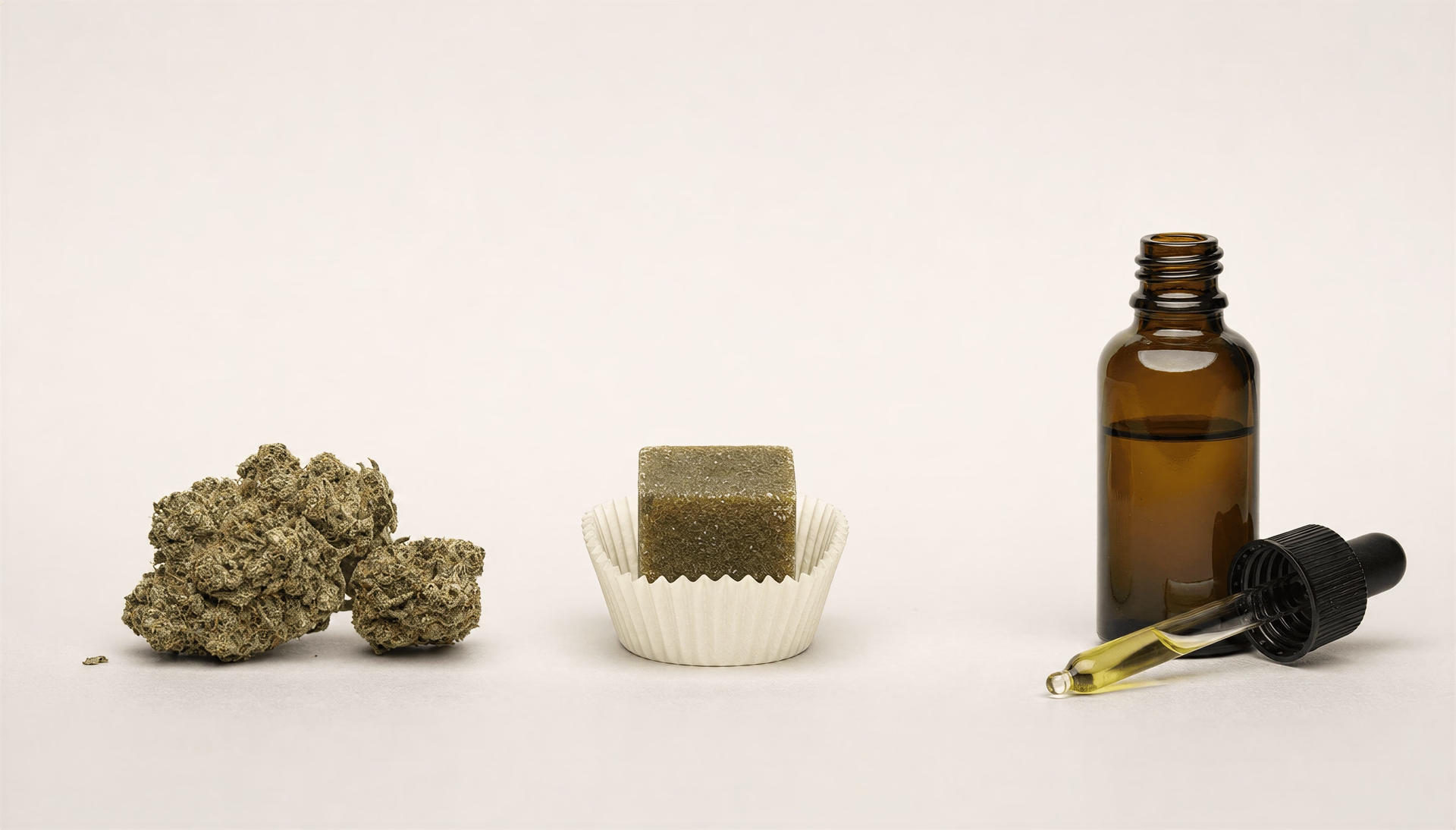
Route of administration changes everything
Microdosing is not just about how much THC you take. It is about how fast it arrives, how high blood levels climb, how long effects last, and whether you can correct a mistake before that mistake becomes a three-hour problem. Route of administration decides all of that.
That is why “1 to 5 mg THC” is only a rough starting frame. A 2 mg edible, one small inhalation of flower, and a 2 mg tincture dose may all sound similar on paper, yet they do not behave similarly in the body. If the goal is a true microdose — noticeable benefit without meaningful impairment — pharmacokinetics matter as much as the number on the label.
Grella et al. 2020 made this plain in interviews with 39 adults who described cannabis microdosing as taking enough to improve symptoms or function without feeling impaired. Participants often had that goal, but not always the tools to hit it consistently. The gap was widest with inhaled flower, where effects came quickly but dose precision was weak.
Flower: fast onset, poor milligram precision
Flower is the easiest route for rapid titration. It is also the hardest route for exact milligram control.
Inhaled THC typically begins to act within minutes, with peak subjective effects often arriving around 15 to 30 minutes. That speed is a real advantage. If one small inhalation is enough, you will usually know soon. If it is too much, you will know that soon too. This makes flower the most reversible route in practical terms. Errors still matter, but they usually declare themselves early rather than after an hour of false confidence.
The problem is dose delivery. A “small puff” is not a unit. The amount of THC actually absorbed depends on flower potency, grind consistency, combustion or vaporization losses, puff duration, inhalation depth, breath hold, and individual lung uptake. Modern flower is also much stronger than old folk wisdom assumes. NIDA’s potency summaries show average THC content in seized U.S. cannabis flower rising from roughly 4% in 1995 to over 15% by 2021. That means legacy advice based on weaker material can overshoot badly.
This is where many people fool themselves. They are titrating by sensation, not by precise milligram intake. That can still work, but only if they respect the waiting period and keep variables stable. One inhalation. Wait at least 15 to 20 minutes. Then reassess. For microdosing with flower, that is more useful than pretending you know the exact absorbed THC dose.
There is support for the “less is more” idea here. Wallace et al. 2007, in a randomized crossover neuropathic pain study, found that low-dose smoked cannabis with 3.53% THC reduced pain, while a higher 7% THC dose did not add benefit and produced more adverse effects. That is a practical microdosing lesson, not just a theory: more THC did not mean more analgesia.
Flower is therefore good for finding a threshold quickly. It is poor for documenting that threshold precisely.
Edibles: the most quantifiable route and the least forgiving one
Edibles flip the equation. They are usually the easiest route to quantify and the hardest route to fix when you overshoot.
In regulated low-dose products, THC content is labeled in milligrams, which gives edibles a major advantage for dose-finding. A person can start at 1 mg THC, wait, record effects, and repeat the same experiment later with much tighter control than inhalation allows. If the objective is to identify a minimum effective dose, this is powerful. It turns guesswork into something closer to a repeatable protocol.
But oral THC is slow. Onset commonly falls in the 30 to 90 minute range, peak effects around 1.5 to 3 hours, and duration often extends 4 to 8 hours or longer. That delay is exactly why edibles are unforgiving. People take 1 or 2 mg, feel little at 40 minutes, add more, and then discover that their “microdose” was really a layered dose that peaks much later and much harder than expected.
This is not a minor issue. Childs et al. 2017 showed clear dose-dependent differences in a randomized human laboratory study of oral THC. At 12.5 mg, participants had greater drug effects and more negative subjective responses, including anxiety-related effects, than at 7.5 mg. Those are not huge doses by recreational standards, but they are large enough to show how quickly oral THC can move from manageable to unpleasant. For someone aiming at sub-intoxicating effects, that margin matters.
Edibles are therefore the most scientific route for microdosing if the person is patient enough to use them properly. Start low, change one variable at a time, and wait for the full peak before deciding whether the dose was too small. For THC-naive adults, 1 mg is a sensible baseline. For low-tolerance users with prior experience, 2 to 2.5 mg may still qualify as a microdose. Above that, many people are already leaving the microdose range, especially for daytime use.
Tinctures and oils: the middle ground between inhalation and edibles
Tinctures and oils sit between flower and edibles, but only if they are actually absorbed sublingually.
This route is often described as precise and flexible, which is partly true. Droppers allow small measured increments, often by the milliliter or fraction of a milliliter, and that makes them easier to standardize than flower. If a tincture contains a known THC concentration, a person can often reproduce the same dose with reasonable consistency.
What matters is where the dose goes. If the liquid is held under the tongue long enough, some THC can be absorbed through the oral mucosa, which tends to produce a faster onset than a swallowed edible. If it is swallowed quickly, much of the dose behaves more like an edible, with delayed onset and longer duration. In real life, tinctures often produce mixed kinetics because some fraction is absorbed sublingually and some fraction is swallowed.
That makes tinctures useful, but not foolproof. They can be a good middle ground for people who want more precision than flower and less commitment than an edible. Onset is often faster than oral products, peak effects can be easier to read, and dose increments can be very small. Still, the exact response varies by formulation, carrier oil, time held under the tongue, and individual absorption.
For microdosing, tinctures reward consistency. Same product. Same measured volume. Same administration method. Same waiting period.
Why 11-hydroxy-THC makes oral microdosing feel different
Oral THC does not just arrive later. It becomes a somewhat different pharmacologic experience because of first-pass metabolism in the liver.
When THC is swallowed, a meaningful portion is converted to 11-hydroxy-THC, an active metabolite that crosses the blood-brain barrier efficiently and contributes substantially to the psychoactive effect of edibles. This is a big reason oral microdosing can feel different from inhaled microdosing even at similar labeled THC amounts. The rise is slower, but the eventual effect can feel deeper, heavier, and longer-lasting.
That also explains why small oral dose increases can feel disproportionately large. The shift is not only about more THC. It is about a different metabolic profile. Inhaled THC reaches the bloodstream quickly and lets users titrate in near real time. Swallowed THC subjects the user to a delayed metabolic cascade that is much harder to interrupt once underway.
So the route-specific question is simple: can this method let you identify a true microdose? Flower helps you find the edge quickly but imprecisely. Edibles let you quantify the experiment but punish impatience. Tinctures can work well if you administer them consistently and understand that sublingual and swallowed dosing are not the same event.
Any account of microdosing that ignores route is missing the central problem. The minimum effective dose is not an abstract number. It is a number expressed through a delivery system, and that delivery system changes everything.
A practical titration method that respects the science
Microdosing is not just “taking a little.” It is a dose-finding exercise aimed at the minimum effective dose: enough THC to produce a measurable effect, not enough to tip into anxiety, sedation, tachycardia, cognitive drag, or plain impairment. That distinction matters because THC has a biphasic profile. Low doses can help in some people and some settings; higher doses can reverse the result. Childs et al. 2017 is a clean human example: 12.5 mg oral THC produced more negative subjective effects and more anxiety-related effects than 7.5 mg. Wallace et al. 2007 found something similar in pain: a lower smoked dose reduced neuropathic pain, while a higher dose did not add benefit and caused more adverse effects.
That is why practical titration should be slow, boring, and systematic. Not intuitive. Not based on strain lore. Not based on what another person can tolerate.
A practical THC microdosing sequence
- 1. Pick one route Use one product type only for a trial block so you can learn from the result.
- 2. Start below expectation Use 1 mg oral THC if naive, 2-2.5 mg if experienced but low tolerance, or one small inhalation only with flower.
- 3. Wait for route-specific timing Inhaled THC should be reassessed after about 15-30 minutes; oral THC should be reassessed only after its much slower onset and peak window.
- 4. Track one target Measure one symptom or functional goal rather than a vague sense of wellness.
- 5. Keep the dose stable Repeat the same starting dose for two or three sessions unless unwanted effects appear.
- 6. Change one variable at a time Do not alter dose, route, ratio, and timing in the same experiment.
- 7. Stop at the minimum effective dose The best dose is the lowest one that helps without adding cognitive drag, anxiety, or sedation.
Choosing a starting baseline
Start below the dose you think will work. For THC-naive adults using a regulated oral product, 1 mg THC is a reasonable baseline. For adults with some prior experience but low tolerance, 2 to 2.5 mg may still fit within a microdose range. The point is not hitting an arbitrary “micro” number. The point is staying below your threshold for unwanted effects while checking whether a target symptom changes.
With inhaled flower, dose precision is much worse. A “small puff” is not a stable unit, especially now that average THC potency in cannabis flower is far higher than it was decades ago; NIDA summaries of federal monitoring show a rise from roughly 4% THC in 1995 to over 15% by 2021. Puff volume, inhalation depth, combustion losses, and the THC percentage of the flower all alter delivered dose. So the practical baseline with inhalation is behavioral, not milligram-based: one small inhalation only, then stop and wait.
Tinctures sit between flower and edibles. They can be easier to measure than inhalation if the label is accurate and the dose per milliliter is known. But the onset profile depends on how they are used. A preparation held under the tongue may come on faster than one swallowed immediately, which behaves more like an edible.
Change one variable at a time. If you alter dose, route, cannabinoid ratio, and timing all at once, you learn nothing. Grella et al. 2020, a qualitative study of 39 adults who described their microdosing practices, showed exactly how messy real-world cannabis dosing often is. Many people are trying to find “just enough” benefit without impairment, but inhaled methods especially make that guesswork unless the process is tightly controlled.
Heavy daily users need extra honesty here. They may not feel a microdose at all. Hirvonen et al. 2012 found about a 20% reduction in CB1 receptor availability in daily cannabis smokers, with normalization beginning during abstinence. If receptor sensitivity has been pushed down by repeated THC exposure, a sub-intoxicating dose may feel like no dose. In that situation, escalating upward defeats the purpose. A tolerance break may be necessary before microdosing becomes perceptible again.
How long to wait before adjusting
Redosing too early is the most common titration error.
For inhaled THC, onset usually occurs within minutes, with peak subjective effects often around 15 to 30 minutes. That means one inhalation should be followed by a full waiting period before another is considered. If the goal is microdosing, “I don’t feel much after three minutes” is not useful information.
For oral THC, patience matters even more. Review-level pharmacokinetic literature consistently places onset around 30 to 90 minutes, peak effects around 1.5 to 3 hours, and duration at 4 to 8 hours or longer. Oral THC is less forgiving because delayed onset encourages stacking, and first-pass metabolism generates 11-hydroxy-THC, which can feel stronger and longer than expected. If you redose before the peak, you are no longer microdosing in any disciplined sense.
A practical rule: keep the same starting dose for at least two or three separate sessions before deciding it is ineffective, unless clear unwanted effects appear right away. Day-to-day variability is real. Sleep debt, an empty stomach, stress, menstrual cycle phase, and recent cannabis exposure can all shift the experience.
Tracking effects to identify the minimum effective dose
The minimum effective dose is the lowest dose that produces the desired effect with acceptable tradeoffs. Not the strongest effect. Not the longest effect. The lowest useful one.
Pick one target symptom or one functional goal per trial block. Pain is easier to track than “general wellness.” Anxiety before a social event is easier to rate than “mood.” Focus is harder, and the evidence there is thinner; users often report benefits, but controlled data are sparse. That means self-observation has to be more disciplined, not less.
Rate the target symptom before dosing and again at expected peak. Use a simple 0 to 10 scale. If you are tracking pain, record pain intensity. If you are tracking anxiety, record anxiety and note whether physical symptoms such as heart racing or restlessness changed. If you are tracking daytime function, include whether the dose improved function without slowing thought, memory, or coordination.
If a dose helps but also causes mild cognitive fuzziness, that may already be above your minimum effective dose. “More noticeable” is not the same as “more useful.” This is where the biphasic model becomes practical: the useful window can be narrow, especially for anxiety.
| Field | What to record | Why it matters |
|---|---|---|
| Dose details | Route, time, exact THC and CBD if known | Lets you repeat or compare trials |
| Timing | Time to first effect, time of peak, duration | Shows whether you actually waited long enough |
| Target symptom | Baseline score and peak score | Helps identify the minimum effective dose |
| Unwanted effects | Anxiety, tachycardia, fuzziness, sedation, poor coordination | Shows where benefit starts turning into cost |
| Context | Home, work-like task, social setting, exercise, stress level | Setting changes subjective response |
| Food and sleep | Meal timing, fasting state, prior-night sleep quantity and quality | Oral effects and tolerability shift with these variables |
| Recent cannabis use | Whether use was recent or heavy | Helps explain tolerance-related nonresponse |
What a useful microdosing log should record
A useful log is not fancy. It is specific.
Record the date, time, route, and exact starting dose if known. For flower, note the product’s labeled THC percentage if available and describe the inhalation pattern as consistently as possible, such as “one 1-second inhalation.” For tinctures and edibles, record milligrams of THC and CBD.
Then log:
- target symptom or goal
- baseline symptom score before dosing
- time to first noticed effect
- time of peak effect
- symptom score at peak
- unwanted effects, even mild ones
- duration until effects largely resolved
- context: home, work-like task, social setting, exercise, stress level
- food intake, especially whether the dose was taken fasting or after a meal
- sleep quantity and sleep quality from the prior night
- recent cannabis use, including whether tolerance may be elevated
Those last items are not trivia. Food can delay or amplify oral effects. Poor sleep can make a dose feel rougher, more sedating, or more anxiogenic. Context shapes subjective response. If you ignore those factors, you may blame the dose for what was actually a bad testing condition.
The process is individualized. What works for one person may overshoot or undershoot for another, even at the same body size. For symptom management or any medical-use discussion, the right move is to involve a healthcare professional, especially if there is a history of anxiety disorder, psychosis risk, cardiovascular disease, pregnancy, or concurrent sedating medications. The science supports microdosing as a rational strategy. It does not support casual guesswork.
Why heavy users often cannot microdose successfully
Microdosing only works if a small dose is still biologically noticeable. That is the part many guides skip. For someone using large amounts of THC every day, a 1–2 mg THC dose may not land in the “sub-intoxicating but useful” window at all. It may land below any meaningful threshold. At that point, the ritual remains, but the pharmacology does not.
Grella et al. (2020), in interviews with 39 adults, found that people described microdosing as taking just enough cannabis to get symptom relief or functional benefit without impairment. That definition is sensible. It also exposes the problem heavy users run into: if tolerance has pushed the threshold upward, “just enough” may no longer be a microdose in any practical sense.
Tolerance, CB1 downregulation, and shifted thresholds
THC produces many of its effects through CB1 receptors in the brain. Repeated high exposure does not leave that system unchanged. The brain adapts. One adaptation is reduced CB1 receptor availability and altered signaling efficiency, which is a technical way of saying the same amount of THC starts doing less.
Hirvonen et al. (2012) put imaging data behind this. Daily cannabis smokers showed about a 20% reduction in CB1 receptor availability compared with healthy controls. That matters because microdosing depends on fine sensitivity to low-level CB1 activation. If receptor availability is reduced, the minimum effective dose moves upward. A dose that would feel distinct to a low-tolerance person may feel like nothing to a heavy daily user.
This is why “just take one tiny edible” is often bad advice for high-tolerance users. A 1 mg THC edible can be a real psychoactive threshold dose in a sensitive person. In a heavy user, it may be functionally invisible. Not mild. Invisible. If someone consumes, say, multiple high-THC inhalation sessions per day, or repeated edible doses in the tens of milligrams, expecting 1–2 mg to produce a detectable effect is usually unrealistic.
That does not mean microdosing is fake. It means dose windows are person-specific, and tolerance shifts them. Russo’s writing on cannabinoid therapeutics has long emphasized the minimum effective dose problem: more is not always better, but less only works if less still reaches the system. The biphasic data fit this framework. Childs et al. (2017) found that oral THC at 12.5 mg produced more negative subjective effects, including anxiety-related effects, than 7.5 mg. Wallace et al. (2007) found a similar pattern in neuropathic pain: low-dose smoked cannabis reduced pain, while a higher 7% THC condition added side effects without extra analgesic benefit. Small can beat larger. But only if the user can still detect small.
When a tolerance break is not optional
For heavy daily users, a tolerance break is often the difference between genuine microdosing and pretending to microdose. That is the blunt truth.
If a person cannot perceive any effect from a low dose after allowing for the route’s full onset and peak time, the strategy has failed. With inhaled THC, that means waiting after one small inhalation rather than stacking puffs every few minutes. With edibles, it means waiting the full 30–90 minute onset window and often 1.5–3 hours for peak effects. Tinctures fall in between depending on whether they are swallowed or partly absorbed sublingually. If, after proper timing, the dose still does nothing, tolerance is probably the issue.
In that situation, escalating the “microdose” until it becomes noticeable can defeat the point. Many heavy users end up calling a clearly intoxicating dose a microdose because it is small relative to their usual intake. That is not the same thing. Microdosing is not defined by personal bragging rights. It is defined by staying below the threshold for unwanted impairment while still achieving a measurable effect.
A tolerance break becomes hard to avoid when low doses are undetectable across multiple attempts, especially with quantified products like low-dose edibles or tinctures. Flower is less useful for this test because actual delivered THC varies with puff size, combustion losses, breath-hold behavior, and product potency. Modern flower is also far stronger than old folk wisdom assumes; NIDA summaries note average THC in seized U.S. flower rose from roughly 4% in 1995 to over 15% by 2021. “One small puff” is not a stable unit.

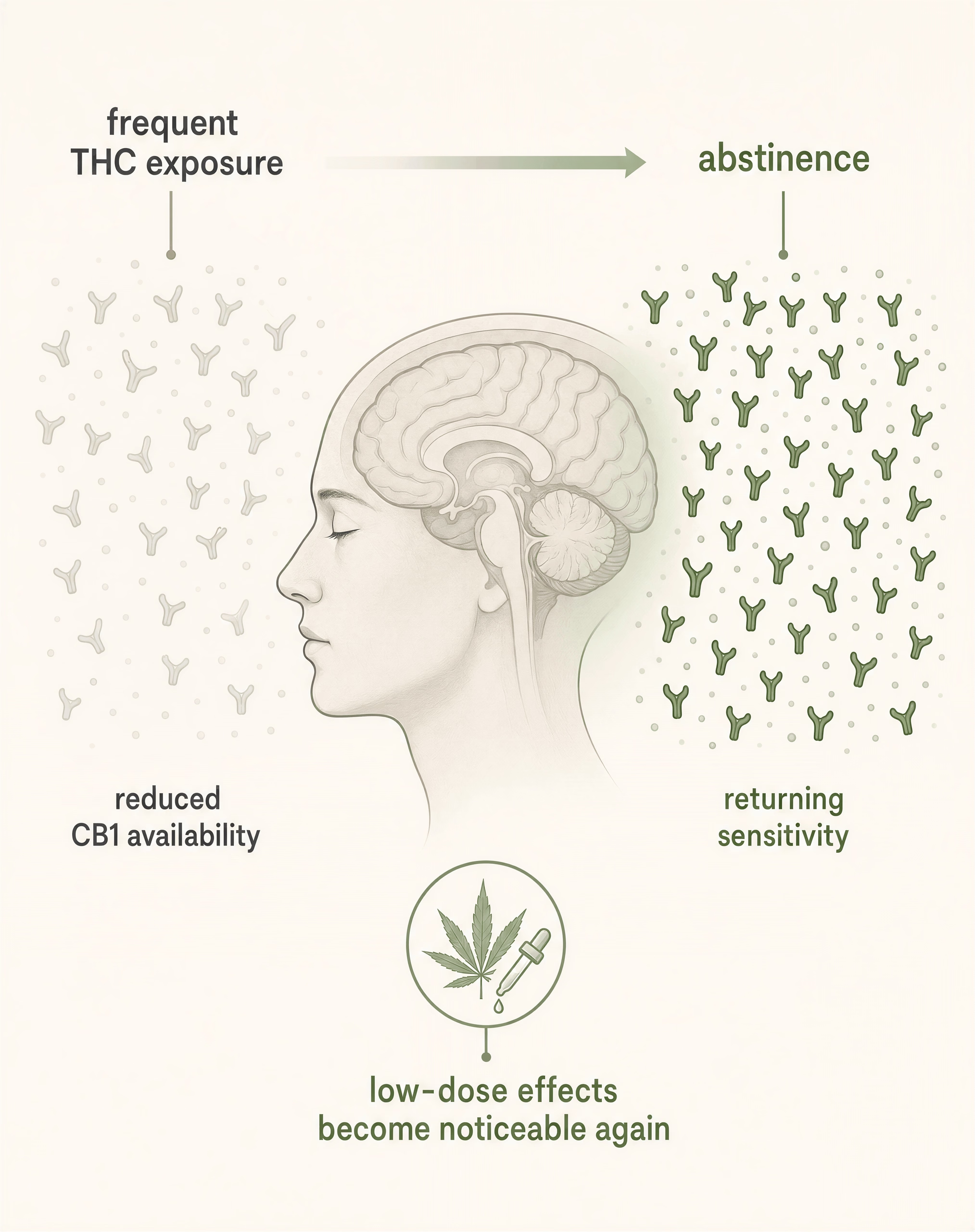
Sensitivity reset versus detox mythology
A tolerance break is about receptor sensitivity recovering. It is not about vague “cleansing” language.
Hirvonen et al. found that CB1 receptor availability began to normalize after just two days of monitored abstinence and approached control levels by 28 days in several brain regions. Other human work, including D’Souza and colleagues, points in the same direction: days to weeks of abstinence can materially reverse tolerance. That is the mechanism-heavy users need to understand. The goal is not to purge THC from the body in a mystical sense. The goal is to let the endocannabinoid system respond to low doses again.[2] Cannabis Withdrawal Syndrome Among People With Regular or Dependent Use of Cannabinoids: A Systematic Review and Meta-analysis. Oren Livne, Wilson M. Compton, Nora D. Volkow, et al.. JAMA Network Open, 2020.
Withdrawal can happen during this reset, and it should not be dismissed. Budney and others have characterized cannabis withdrawal clearly enough that DSM-5 recognizes it. Symptoms often include irritability, sleep disturbance, reduced appetite, restlessness, and craving. Livne et al. (2020) estimated pooled cannabis withdrawal syndrome prevalence at 47% among regular and dependent users. Real syndrome, real discomfort. But it is still separate from “detox” marketing language.
Once sensitivity starts to return, microdosing can become pharmacologically meaningful again. Then the usual rules apply: start below the expected threshold, change one variable at a time, wait long enough for the route to peak, and record the result. The target is not the smallest dose in theory. It is the minimum effective dose for that person, at that stage of tolerance.
Tolerance breaks, withdrawal, and returning to low-dose sensitivity
For people trying to microdose THC, tolerance is often the hidden variable. A dose that once felt clear and functional may become imperceptible after frequent use, not because microdosing is a myth, but because repeated THC exposure changes CB1 signaling. Hirvonen et al. 2012 found that daily cannabis smokers had about 20% lower CB1 receptor availability than controls. That matters. If receptor availability is down, the same 1–5 mg THC range may no longer produce a noticeable effect, which is why heavy daily users often report that “microdoses do nothing” until they stop long enough for sensitivity to recover.
Typical withdrawal features after frequent use
Cannabis withdrawal is real. DSM-5 recognizes it, and the old claim that cannabis does not produce a withdrawal syndrome is no longer defensible. The syndrome is usually milder than withdrawal from alcohol, benzodiazepines, or opioids, but “milder” does not mean trivial.
A 2020 meta-analysis by Livne et al. estimated pooled prevalence of cannabis withdrawal syndrome at 47% among regular and dependent users. The most common features are irritability, anxiety, restlessness, sleep difficulty, vivid dreams, reduced appetite, low mood, craving, and a general sense of discomfort or dysregulation. Some people also report headaches, sweating, chills, stomach upset, or feeling oddly bored and unmotivated for several days.
The timing is fairly consistent. Symptoms often begin within the first 24 to 48 hours after stopping, build over several days, and then gradually ease. Sleep disturbance can linger longer than mood symptoms. That pattern matters because many people interpret the first few days as proof they “need” cannabis, when in fact they are moving through a predictable withdrawal window.
For most adults, this is manageable with planning. It is still unpleasant. People with heavy daily use, co-occurring anxiety, insomnia, or strong cue-driven habits tend to have a harder time.
How long tolerance reduction may take
Tolerance breaks are not detox rituals. They are sensitivity-reset periods. The goal is to allow receptor function and subjective responsiveness to move back toward baseline so lower doses become detectable again.
The timeline is not instant, but it is not endless either. Hirvonen et al. observed that CB1 receptor availability began to normalize after just 2 days of monitored abstinence and approached control levels by 28 days in several brain regions. That gives a realistic frame: some recovery starts within days, while fuller normalization may take weeks.
In practice, people often notice meaningful changes before a full month. After one week, many report that THC feels stronger, especially if they had been using multiple times per day. After two to four weeks, the shift is usually more obvious. The heaviest users may need the longer end of that range. Dose history matters. Product potency matters too, especially now that modern flower commonly contains far more THC than older informal advice assumed.
How to restart with lower doses after a break
The biggest mistake after a tolerance break is resuming the old dose. If the aim is microdosing, restart as if sensitivity has returned, because at least some of it has.
For oral THC, 1 mg is a reasonable starting point for THC-naive or newly resensitized adults. Those with prior experience but now lower tolerance may try 2 to 2.5 mg. Then wait. Oral THC can take 30 to 90 minutes to begin and 1.5 to 3 hours to peak, so redosing too early is how “microdosing” turns into an accidental standard dose.
With tinctures, keep the dose constant for several sessions before increasing. With inhaled flower, precision is worse. One small inhalation, then a full waiting period of at least 15 to 30 minutes, is safer than chasing a target effect puff by puff. Grella et al. 2020 showed how imprecise real-world microdosing can be, especially with flower, where users often define success as symptom relief without impairment but cannot state the delivered THC dose with confidence.
The rule is simple: change one variable at a time, document the effect, and stop at the minimum effective dose. If you return from a break and immediately use your former amount, you are not testing microdosing. You are restoring tolerance.
What popular microdosing advice gets wrong
A lot of microdosing content reduces the whole idea to “just take a little.” That is too sloppy to be useful. Microdosing is not a vibe. It is a dose-finding exercise built around one question: can you get a measurable benefit without crossing into unwanted intoxication, anxiety, sedation, or cognitive drag? If the answer is no, the dose was not a microdose for you, even if it looked tiny on paper.
The myth that any tiny amount counts as a microdose
The weakest advice treats any very small amount of THC as a microdose. That misses the point. A microdose is not defined only by milligrams; it is defined by effect. If 2 mg THC makes one person foggy, inward, tachycardic, or obviously impaired, that was not a functional microdose for that person. Grella et al. 2020, interviewing 39 adults about cannabis microdosing, found that users themselves often framed it as enough for symptom relief or functional benefit without feeling impaired. That functional threshold matters more than internet folklore.
This is where the biphasic effect of THC matters. Low doses can help some people. More is not always better. Childs et al. 2017 showed a clear dose split with oral THC: 12.5 mg produced stronger drug effects and more negative subjective responses, including anxiety-related effects, than 7.5 mg. Wallace et al. 2007 found something even more practical in neuropathic pain: low-dose smoked cannabis reduced pain, while a higher dose did not add benefit and caused more adverse effects. That is the microdosing logic in one sentence: stay near the minimum effective dose, because pushing upward can erase the gain.
Why strain labels are weaker predictors than dose and route
Popular articles still lean far too hard on indica and sativa labels. For microdosing, that is mostly a distraction. Dose, route, timing, THC content, CBD content, and individual sensitivity predict the experience better than seed-bank categories do. A so-called sativa taken too high can absolutely impair focus. A so-called indica at a very low dose may not feel sedating at all.
Route matters because the same labeled THC amount does not behave the same way across products. Inhaled THC arrives within minutes and peaks fast, which makes it easier to stop early, but actual delivered dose is messy and variable. Edibles are easier to quantify on a label, yet less forgiving because onset is delayed and 11-hydroxy-THC can feel stronger and last longer. Tinctures sit in the middle. If someone is serious about finding a microdose, “what route, how much THC, how long did you wait?” is a better framework than “was it indica or sativa?”
Why modern high-THC flower complicates old dosing folklore
Old advice like “just take one puff” assumes a flower market that barely exists now. NIDA’s potency summaries show average THC in seized U.S. flower rising from roughly 4% in 1995 to more than 15% by 2021. That changes the meaning of a puff. Modern flower can deliver far more THC per inhalation than legacy users remember, and inhalation technique adds even more variability through puff size, depth, and hold time.
That is why flower is often the hardest format for true microdosing, not the easiest. One careful inhalation may work for a sensitive user. It may overshoot in another. The right lesson is not “microdosing is fake.” It is that inherited dosing folklore has not kept up with cannabinoid pharmacology or modern potency.
Who should be cautious or avoid experimenting with microdosing
Microdosing is often framed as gentle or low-risk because the target dose is small, usually somewhere around 1–5 mg THC. That framing can mislead. “Small” is not the same as harmless, especially with THC’s biphasic effects and the very narrow dose window some people have for anxiety, heart-rate changes, or cognitive disruption. This section is educational, not medical advice. Anyone with a significant medical or psychiatric history should discuss THC exposure with a licensed clinician who knows their case.
People with anxiety sensitivity or panic history
This is the group most likely to discover that microdosing is harder than internet advice suggests. THC can reduce anxiety at one dose and trigger it at a slightly higher one. Childs et al. (2017) showed that oral THC at 12.5 mg produced more negative subjective effects, including anxiety-related responses, than 7.5 mg. That matters because the line between “subtle” and “too much” is often thinner than expected.
People with panic disorder, severe anxiety sensitivity, trauma-related hyperarousal, or a history of feeling “too high” on very little THC should be especially careful. Even a nominal microdose may feel large if tolerance is low, if the product is stronger than labeled, or if it is eaten rather than inhaled. Modern flower is also much more potent than legacy advice assumes, so a “tiny puff” can still overshoot.
Groups that should be especially cautious with THC microdosing
- Anxiety-sensitive users People with panic history, severe anxiety sensitivity, trauma-related hyperarousal, or prior 'too high' reactions may overshoot even at low doses.
- Psychosis risk Anyone with a personal or family history of psychosis, schizophrenia-spectrum illness, or cannabis-induced paranoia should generally avoid THC self-experiments.
- Pregnancy and breastfeeding Risk tolerance should be very low because fetal and infant exposure questions are not settled in a reassuring direction.
- Cardiovascular instability Unstable angina, arrhythmia, poorly controlled hypertension, or recent cardiovascular events raise the stakes because THC can affect heart rate and blood pressure.
- Sedative co-use or safety-critical work Alcohol, benzodiazepines, sleep medications, opioids, driving, machinery, firearms, and zero-tolerance jobs all make experimentation less safe.
People with psychosis risk, pregnancy, or unstable cardiovascular disease
Anyone with a personal or family history of psychosis, schizophrenia-spectrum illness, or prior cannabis-induced paranoia should generally avoid THC self-experiments, including microdosing. The same caution applies during pregnancy and breastfeeding, where risk tolerance should be very low because fetal and infant exposure questions are not settled in a reassuring direction.
Unstable angina, significant arrhythmia, poorly controlled hypertension, or recent cardiovascular events also raise the stakes. THC can increase heart rate and alter blood pressure even at doses some users consider minor. If symptoms are unstable, “just try a little” is not a responsible approach.
Drug interactions, work safety, and legal considerations
THC can add to the sedating effects of alcohol, benzodiazepines, sleep medications, opioids, and other central nervous system depressants. It may also interact unpredictably with some antidepressants, antipsychotics, and mood stabilizers. That does not make every combination forbidden, but it does make unsupervised experimentation a bad idea.
Work safety matters too. If you drive, operate machinery, carry a firearm, provide patient care, or hold a zero-tolerance job, a microdose can still create impairment or policy exposure. Laws also vary sharply by jurisdiction. Possession, workplace testing, and impaired-driving standards differ by country, state, and employer, so check local law rather than assuming “medical” or “low dose” changes the rules.
References
- [1] Reversible and regionally selective downregulation of brain cannabinoid CB1 receptors in chronic daily cannabis smokers. Molecular Psychiatry, 2012. https://pubmed.ncbi.nlm.nih.gov/21747398/
- [2] Cannabis Withdrawal Syndrome Among People With Regular or Dependent Use of Cannabinoids: A Systematic Review and Meta-analysis. JAMA Network Open, 2020. https://jamanetwork.com/journals/jamanetworkopen/fullarticle/2764234