













Why humidity control in cannabis is really about transpiration
Stage-by-stage humidity tables are useful. They are also incomplete, and sometimes misleading. A cannabis crop does not respond to relative humidity in isolation; it responds to how air demand pulls water from the leaf. That means humidity control is really transpiration control.
The oversimplified RH chart problem
Most grow guides reduce climate to fixed bands: clones at 65-75% RH, veg at 55-70%, flower at 40-60%. Those ranges are not wrong. They are just missing the physics that makes them work. Relative humidity is descriptive. It tells you how full the air is with moisture compared with saturation at that temperature. It does not tell you how hard the plant is being asked to move water.
That omission matters because temperature changes RH even when moisture content stays the same. University of Georgia Extension noted in 2024 that air can hold about twice as much water vapor with each 20°F rise in temperature. Heat a room and RH collapses. Cool it and RH climbs. So a reading of 50% RH is not a stable biological condition. At 20°C, 50% RH creates a very different drying force than 50% RH at 28°C.
Keeping indoor relative humidity below 60% helps limit mold growth. Strong evidence
Pathogen risk also gets flattened by simple charts. The EPA and CDC both advise keeping indoor RH below 60% to limit mold growth. The Royal Horticultural Society states that powdery mildew is encouraged by high humidity and poor air circulation. UC IPM makes the same point for Botrytis cinerea, the gray mold behind many bud-rot losses in dense flowers. A room can sit inside a “safe” average RH range and still develop wet canopy pockets where disease starts.

Why VPD matters more than RH alone
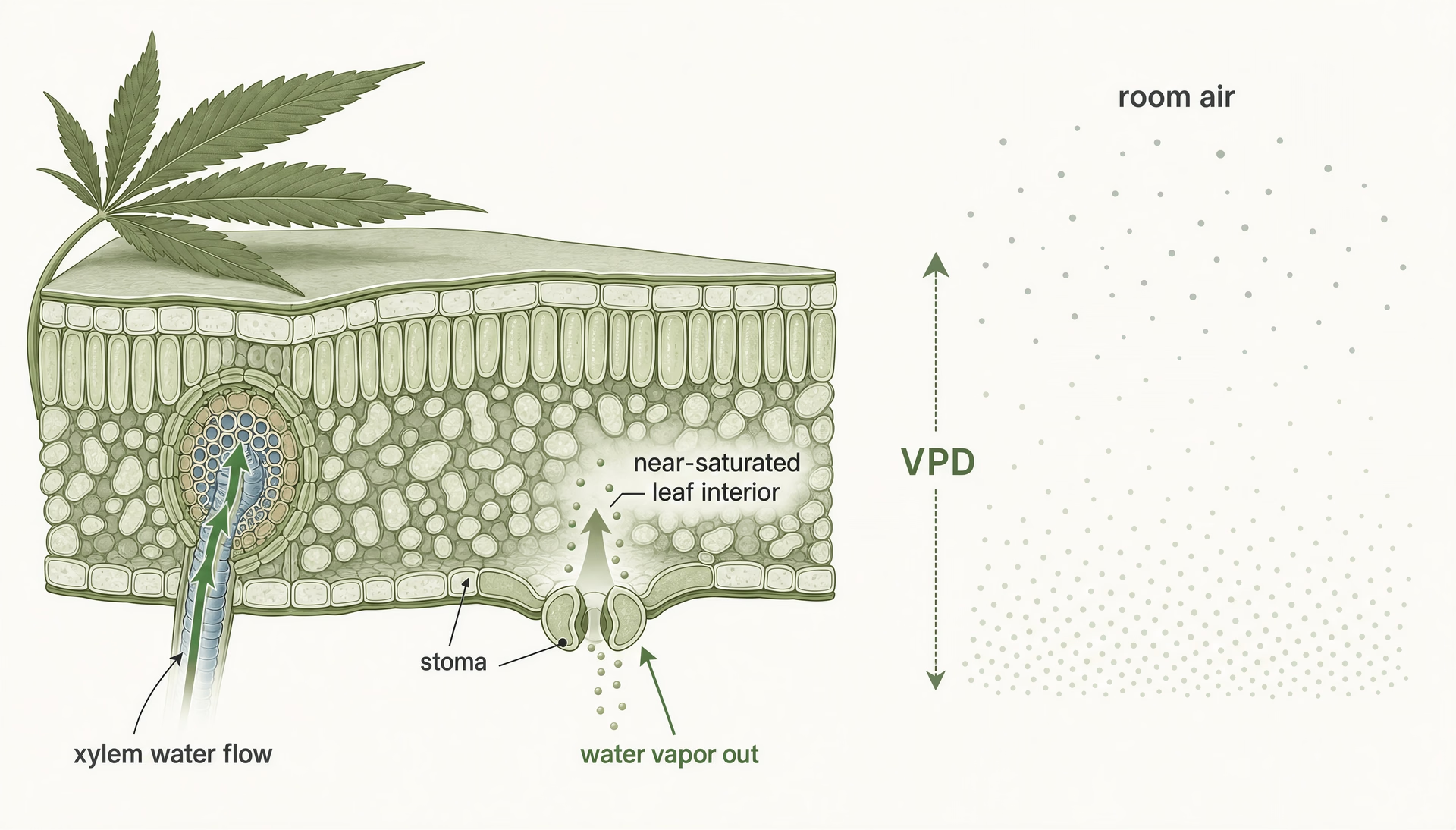
VPD, defined by ASABE as the difference between saturated vapor pressure and actual vapor pressure, is the working metric because it links temperature, humidity, and water loss from the leaf. In plain terms, RH says what the air is. VPD says what the air is doing to the plant.
That is why greenhouse engineers such as Kenneth A. Körner and Richard J. Stutto treat VPD as a crop-water-relations tool, not a trendy cannabis add-on. Propagation generally runs at lower VPD, often around 0.4-0.8 kPa in controlled-environment horticulture, because clones and seedlings have weak root systems. Vegetative crops usually tolerate roughly 0.8-1.2 kPa. Flowering plants are often steered higher, around 1.2-1.6 kPa in cannabis practice, to support stronger transpiration and lower mold pressure. These are heuristics, not clinical laws.
Leaf temperature complicates it further. Cornell CEA notes that leaves may be warmer or cooler than surrounding air depending on radiation load and transpiration. Under strong transpiration, a leaf may run cooler than room air, shifting the actual leaf VPD. That is one reason LED and HPS rooms can behave differently even at the same thermostat setting.
The central claim: many deficiency symptoms start in the air
A lot of “feeding problems” are climate problems wearing a nutrient mask. When VPD is too low, transpiration slows, calcium movement weakens, leaf surfaces stay wetter longer, and deficiency-like symptoms can appear even when the root zone contains enough nutrition. When VPD is too high, water loss outruns uptake, stomata tighten, CO2 intake falls, margins burn, and salts concentrate around the roots.
The plant is not just eating from the medium. It is drinking through the air. That is the frame to keep in mind for the rest of the guide: RH is a starting point, but transpiration is the process that decides whether the crop actually performs.
Relative humidity basics for cannabis growers
Relative humidity is where most growers start, and that makes sense. It is easy to measure, easy to chart, and easy to compare across growth stages. The problem is that RH by itself can mislead you. A room at 50% RH can be gentle on one crop and stressful on another, depending on temperature, leaf temperature, canopy density, and stage of growth. Treat RH as a starting band, not a law.
Relative humidity (RH) The percentage of water vapor in the air compared with the maximum amount the air could hold at that same temperature.
What relative humidity actually measures
Relative humidity is the percentage of water vapor in the air compared with the maximum amount the air could hold at that same temperature. Plainly: RH tells you how full the air is with moisture.
That “relative” part matters. Warm air can hold more water vapor than cool air. So RH is not a direct measure of how much moisture is actually present in the room. It is a ratio between current moisture and moisture capacity.
Dew point The temperature at which air becomes saturated and water starts to condense.
ASHRAE’s psychrometric framework is built on that relationship between temperature, saturation, dew point, and vapor pressure. Dew point, for example, is the temperature at which the air becomes saturated and water starts to condense. In a grow, that matters when humid air meets cooler surfaces, including walls, ducts, and sometimes even plant tissue.
For cannabis, RH matters because it shapes transpiration. If the air is already near saturation, leaves do not lose water easily. If the air is dry, they lose water faster. That shift affects calcium movement, nutrient flow, stomatal behavior, and disease pressure. This is why greenhouse engineering texts by Kenneth A. Körner and Richard J. Stutto put humidity control in the same conversation as irrigation and energy balance, not in a separate box.
| Condition | Temperature | RH | Interpretation |
|---|---|---|---|
| Cooler room | 20°C | 50% | Lower drying demand |
| Warmer room | 28°C | 50% | Higher drying demand |
| Same moisture content, warmer air | 20°F rise | RH falls | Air can hold roughly twice as much water vapor |
Why the same RH means different things at different temperatures
This is where many grow-room mistakes begin. University of Georgia Extension states that as temperature rises by 20°F, the water-holding capacity of air roughly doubles. So if a room heats up and the actual amount of water vapor in the air stays the same, RH drops sharply. Nothing magical happened. The air simply became capable of holding much more moisture.
That means 50% RH at 20°C is not the same environment as 50% RH at 28°C. The warmer room exerts a stronger drying pull on the plant. In VPD terms, the deficit is higher.
Leaves complicate it even more. Cornell Controlled Environment Agriculture notes that leaves may be warmer or cooler than the surrounding air depending on radiation load and transpiration. Under strong transpiration, a leaf can run cooler than room air. Under heavy radiation or limited transpiration, it may run warmer. So the plant does not experience the air conditions exactly as your wall-mounted hygrometer reports them.
This is why fixed RH charts can fail. They ignore the fact that temperature shifts moisture demand, and leaf temperature shifts it again.
- Seedlings and clones
- 65–75% RH
- Vegetative growth
- 55–70% RH
- Early flower
- 50–60% RH
- Late flower
- 40–50% RH
- Indoor mold ceiling cited
- Below 60% RH
Recommended RH ranges by stage
Useful starting bands for cannabis are:
- seedlings and clones: about 65-75% RH
- vegetative growth: about 55-70% RH
- early flower: about 50-60% RH
- late flower: about 40-50% RH
Those numbers are common because they loosely match how young plants, expanding canopies, and mature flowers handle water loss and disease risk. They are not universal truths. A cool room at the high end of a range may behave very differently from a warm room at the same RH. That is why serious environmental control moves from RH alone to VPD.
Seedlings and clones
Young plants need gentler drying conditions. Seedlings have tiny root systems. Fresh clones may have no functional roots at all for part of propagation. High-ish RH, usually around 65-75%, reduces transpirational demand while roots establish.
This aligns with broader controlled-environment practice, where propagation often runs at lower VPD than mature crops. If RH is too low at this stage, clones wilt fast, leaves lose turgor, and recovery slows. If RH is too high for too long, tissue stays wet and weak, and airflow problems show up quickly.
Vegetative growth
In veg, cannabis can usually handle roughly 55-70% RH, assuming temperatures are reasonable and the canopy is moving air well. Plants now have a stronger root system and can support more transpiration. Moderate RH supports active growth without forcing the plant into either stagnation or excessive water loss.
This is also the stage where climate errors start getting blamed on nutrients. If the air is too dry for the temperature, transpiration can spike, salts concentrate in the root zone, and leaf margins burn. If the air is too wet, transpiration slows, calcium delivery suffers, and the plant can look deficient even when the feed mix is fine.
Early flower and late flower
Early flower generally fits around 50-60% RH. By then, the plant is larger, the canopy is denser, and humidity trapped between leaves becomes more important than the room average. Lowering RH modestly helps keep transpiration moving while reducing fungal pressure.
Late flower usually calls for tighter control, often around 40-50% RH. The reason is simple: dense inflorescences trap moisture. Air can move across the room while staying damp inside the buds. That microclimate is where trouble starts.
The Royal Horticultural Society states that powdery mildew is encouraged by high humidity and poor air circulation. UC IPM gives the same warning in different language for Botrytis cinerea, the gray mold pathogen behind bud rot in many crops: it thrives in humid conditions, especially on crowded or aging plant tissue. That is exactly the risk profile of late flower cannabis. A room reading “safe” on RH can still produce mold if flowers stay damp internally.
For that reason, late-flower RH targets are tighter than seedling or veg targets. Not because 45% RH is magic, but because mature flowers leave less margin for error.
VPD theory without the math-phobia
Most grow-room mistakes blamed on nutrients are climate mistakes wearing a nutrient mask. A leaf with burnt edges, stalled growth, weak calcium movement, or recurring mildew is often reacting to the air first and the feed second. That is why RH tables, by themselves, are not enough. Relative humidity is only a partial description of the environment. VPD explains what the plant actually feels.
What vapour pressure deficit means in plant terms
In plain language, VPD is the drying power of the air around the leaf. It tells you how hard the atmosphere is pulling water out of the plant.
If that pull is gentle, a young clone or seedling can cope even with a tiny root system. If that pull is stronger, a mature plant can transpire well, move water and dissolved minerals upward, and support faster gas exchange. If the pull becomes excessive, the plant starts defending itself. Stomata narrow. Growth slows. Leaves may look stressed even when the root zone is wet.
This is why VPD has become standard greenhouse language. ASABE defines vapor pressure deficit as the difference between how much moisture the air could hold at saturation and how much moisture it actually contains. Greenhouse engineers such as Kenneth A. Körner and Richard J. Stutto treat it as a working metric for crop water relations, not a niche theory.
For cannabis, the practical translation is simple: VPD is not abstract physics. It is the link between room climate and transpiration. And transpiration is tied to calcium transport, turgor, cooling, and stomatal behavior.
The physical definition: saturation vapor pressure vs actual vapor pressure
Here is the stripped-down version.
Air at any given temperature has a ceiling for how much water vapor it can hold. That ceiling is the saturation vapor pressure. The moisture currently present is the actual vapor pressure. VPD is the gap between those two numbers.
A large gap means thirsty air. A small gap means air already close to full.
Relative humidity is part of this picture, but only part. RH is a percentage, not a direct measure of drying demand. Fifty percent RH sounds precise, but it is not a fixed plant experience. At 20°C, 50% RH gives one VPD. At 28°C, 50% RH gives a much higher VPD because warmer air can hold much more water. University of Georgia Extension notes that with each 20°F rise in temperature, air’s water-holding capacity roughly doubles. That one fact explains why RH can collapse when a room heats up, and why temperature and humidity cannot be managed separately.
ASHRAE’s psychrometric framework underpins these relationships. Dew point, saturation, vapor pressure, and RH all connect. Growers do not need to become HVAC engineers, but they should know this: RH alone hides the effect of temperature. VPD exposes it.
Why leaves respond to deficit, not humidity percentage
Plants do not read the wall-mounted hygrometer. They respond at the leaf surface.
That matters because the leaf is not always the same temperature as the surrounding air. Cornell Controlled Environment Agriculture has pointed out that leaves may run warmer or cooler than air depending on radiation load and transpiration. Under active transpiration, leaves often cool below air temperature. Under heavy radiation or restricted transpiration, they can run warmer.
That changes the real VPD at the stomata.
Many cannabis VPD charts assume leaf temperature equals air temperature, or they subtract 1 to 2°C as a rough correction. That is useful as a heuristic, not a biological law. Under LEDs, leaf-to-air relationships often differ from HPS because radiant heat load differs. The room may read one thing while the leaf experiences another.
This is why “50% RH is safe” is weak advice. Safe for what air temperature? What leaf temperature? What canopy density? What stage of growth? In late flower, 50% RH in a cool room might be manageable. In a warmer room with dense buds and poor airflow, that same RH can still support pathogen pressure inside the canopy.
How VPD drives stomata and water movement
Water moves from wetter places to drier ones. Inside the leaf, air spaces are near saturation. If the surrounding air is drier, water vapor exits through stomata. That vapor loss helps pull more water up from the roots through the xylem. Dissolved minerals travel with that stream.
So VPD acts like a throttle on transpiration.
At appropriately low VPD, clones and seedlings avoid drying out before roots are established. That is why propagation environments often sit around roughly 0.4 to 0.8 kPa in greenhouse practice. Once plants enter vegetative growth, many controlled-environment guides move toward roughly 0.8 to 1.2 kPa. Flowering crops are often run higher, around 1.2 to 1.6 kPa, partly to support generative growth and partly to reduce disease risk. Those are grower heuristics adapted from greenhouse control, not universal cannabis laws.
The mechanism is what matters. Low-to-moderate VPD supports steady water movement. That movement helps deliver calcium, a weakly mobile element that depends heavily on transpiration. When VPD is too low, calcium flow slows even if the nutrient solution is loaded with calcium. The plant can show twisted new growth, weak margins, or deficiency-like symptoms that are not fixed by simply increasing feed.
At the other extreme, very high VPD can yank water through the plant faster than roots can replace it. The plant responds by closing stomata to reduce loss. Once stomata close, CO2 entry drops. Photosynthesis falls. You may see leaf edge burn, wilting during the light period, and rising substrate EC as water demand and salt concentration stop matching.
Why low VPD and high VPD both hurt growth
Low VPD is not “safe” just because the plant is not wilting. Air that is too wet weakens the engine of transpiration. Growth can become soft and sluggish. Calcium transport suffers. Leaf surfaces and boundary layers stay damp longer. Disease pressure rises.
That disease piece is not theoretical. The Royal Horticultural Society states that powdery mildew is encouraged by high humidity and poor air circulation. UC IPM says Botrytis cinerea thrives in high humidity, especially on crowded and moist plant tissue. In cannabis, dense flower clusters and packed canopies make that warning more serious, not less. EPA and CDC guidance for buildings also keeps indoor RH below 60% to limit mold, a useful reminder that humid air generally favors fungal problems.
High VPD has its own trap. Growers often like the “hungry” look of a crop that drinks fast, but there is a line where productive transpiration turns into stress. The leaf loses water faster than roots and xylem can keep up. Stomata tighten. Leaf temperature can rise because evaporative cooling falls off. The plant may show clawing, margin scorch, or classic tip burn. Many call it nutrient burn or lockout. Sometimes it is really climate-driven over-transpiration followed by stomatal shutdown.
This is the conceptual spine to keep in mind: RH charts are a starting point, not the answer. Seedlings and clones usually want higher RH and lower VPD because roots are weak. Vegetative plants handle moderate RH and moderate VPD. Flowering plants, especially late in flower, generally need lower RH and somewhat higher VPD to limit mold pressure. But those stage targets only make sense when anchored to temperature, leaf temperature, and canopy conditions.
Serious cultivation treats climate control as part of plant nutrition. The air is feeding the plant’s water pathway every minute the lights are on.
How to calculate cannabis VPD step by step
VPD is not a cannabis-only invention. It is a greenhouse climate metric with a standard physical meaning: the gap between how much water vapor the air could hold at saturation and how much it actually holds. ASABE uses that definition because VPD tracks the drying power of the air, which in turn shapes transpiration.
For growers, that matters more than a fixed RH number. A room at 50% RH can be gentle or harsh depending on temperature. University of Georgia Extension makes the core reason plain: when air warms up, its water-holding capacity rises fast; a 20°F increase roughly doubles that capacity. So RH collapses when temperature rises unless moisture rises too.
VPD formula pieces
- SVP
- Saturation vapor pressure at the measured temperature.
- RH
- Relative humidity in percent.
- AVP
- Actual vapor pressure, estimated as SVP × RH/100.
- Leaf VPD
- SVP at leaf temperature minus AVP of the surrounding air.
The simplified grow-room formula
The practical formula most growers use is:
VPD (kPa) = SVP × (1 − RH/100)
Where:
- SVP** = saturation vapor pressure at the measured temperature
- RH** = relative humidity in percent
This is the stripped-down version that assumes leaf temperature equals air temperature. It is common because it is quick and often close enough for rough control.
A more complete formula is:
VPD = SVP_leaf − AVP_air
And since actual vapor pressure is estimated from RH:
AVP_air = SVP_air × RH/100
So the fuller expression becomes:
VPD = SVP_leaf − (SVP_air × RH/100)
That second equation is the one serious growers should understand. It separates the leaf from the room. Plants respond to the vapor pressure gradient at the leaf surface, not to a wall-mounted hygrometer reading alone.
| Temperature | SVP |
|---|---|
| 24°C | 2.98 kPa |
| 26°C | 3.36 kPa |
Saturation vapor pressure from temperature
To calculate SVP from temperature in Celsius, growers usually use this equation:
SVP (kPa) = 0.6108 × e^((17.27 × T) / (T + 237.3))
Where T is temperature in °C.
You do not need to memorize the derivation. Just know that warmer air has a higher saturation vapor pressure. That means the same RH at a higher temperature creates a larger drying force.
At 26°C, the saturation vapor pressure is about:
SVP ≈ 3.36 kPa
At 24°C, it is about:
SVP ≈ 2.98 kPa
That difference looks small on paper. In the room, it changes transpiration enough to matter.
Using RH to estimate actual vapor pressure
Once you know SVP at air temperature, actual vapor pressure is simple:
AVP = SVP × RH/100
| Scenario | Air temp | Leaf temp | RH | SVP air | AVP air | SVP leaf | VPD |
|---|---|---|---|---|---|---|---|
| No leaf correction | 26°C | 26°C | 60% | 3.36 kPa | 2.02 kPa | 3.36 kPa | 1.34 kPa |
| Drier room | 26°C | 26°C | 45% | 3.36 kPa | 1.51 kPa | 3.36 kPa | 1.85 kPa |
| Leaf cooler than air | 26°C | 24°C | 60% | 3.36 kPa | 2.02 kPa | 2.98 kPa | 0.96 kPa |
Example at 26°C and 60% RH:
- SVP at 26°C = 3.36 kPa
- AVP = 3.36 × 0.60 = 2.02 kPa
Then with the simplified formula:
- VPD = 3.36 − 2.02 = 1.34 kPa
Now compare that with 26°C and 45% RH:
- SVP at 26°C = 3.36 kPa
- AVP = 3.36 × 0.45 = 1.51 kPa
- VPD = 3.36 − 1.51 = 1.85 kPa
Same temperature. Very different plant demand.
That is why “keep flower at 45 to 50% RH” is not enough by itself. At cooler temperatures, that range may be moderate. At hotter temperatures, it can push the crop hard, driving excess transpiration, leaf edge burn, and root-zone EC rise. Many growers blame feed strength first. Often the room caused it.

Adding leaf surface temperature
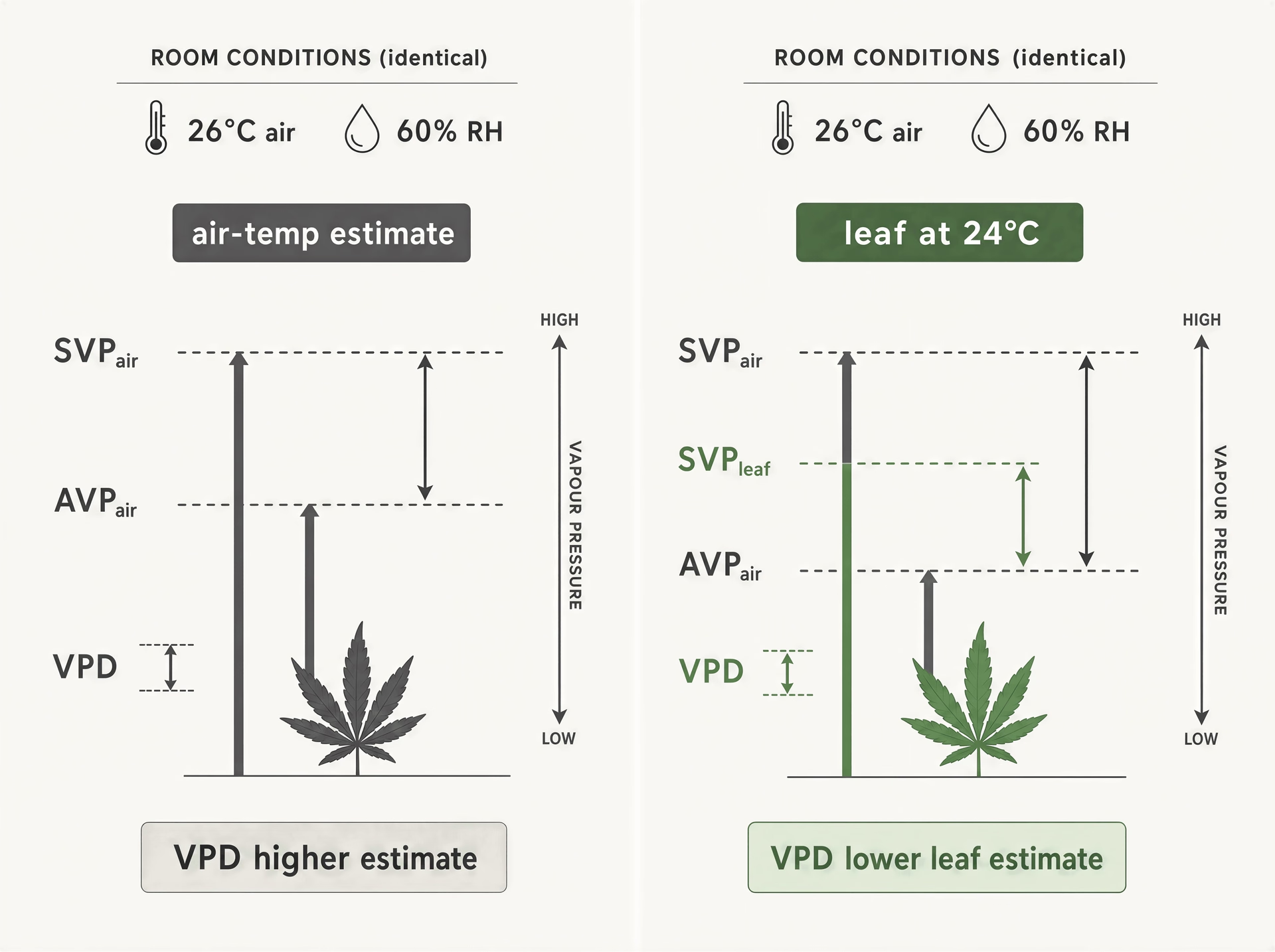
Leaf temperature changes the calculation because the leaf may not be at air temperature. Cornell CEA notes that leaves can run warmer or cooler than surrounding air depending on radiation load and transpiration. Under active transpiration, leaves are often a bit cooler. Under heavy radiant load, they can run warmer.
If the leaf is cooler than the air, SVP_leaf is lower, so true leaf VPD is lower than the simplified chart suggests.
Use the full formula:
VPD = SVP_leaf − (SVP_air × RH/100)
Suppose the room is:
- 26°C air**
- 60% RH**
- leaf temperature 24°C because the leaf is 2°C cooler than air
We already know:
- SVP_air at 26°C = 3.36 kPa
- AVP_air = 3.36 × 0.60 = 2.02 kPa
Now calculate leaf SVP at 24°C:
- SVP_leaf ≈ 2.98 kPa
So:
- VPD = 2.98 − 2.02 = 0.96 kPa
That is a big shift from the simplified estimate of 1.34 kPa. Same room. Different leaf. Very different interpretation.
This is where many online cannabis VPD charts go wrong. They quietly assume air temperature equals leaf temperature, or they use a blanket correction such as leaf = air minus 1 or 2°C. That can be useful as a heuristic, but it is still an assumption. LEDs and HPS can produce different leaf-to-air relationships because radiant heat load is different. Canopy density, air speed, irrigation timing, and light intensity all push leaf temperature around.
Worked examples for common grow-room conditions
Example 1: 26°C air, 60% RH, no leaf correction
- SVP_air = 3.36 kPa
- AVP = 3.36 × 0.60 = 2.02 kPa
- VPD = 3.36 − 2.02 = 1.34 kPa
This sits in a commonly used mid-range that many growers accept for established vegetative plants or early flower, depending on cultivar and irrigation.
Example 2: 26°C air, 45% RH, no leaf correction
- SVP_air = 3.36 kPa
- AVP = 3.36 × 0.45 = 1.51 kPa
- VPD = 3.36 − 1.51 = 1.85 kPa
That is much drier in plant terms. For late flower this may be intentional in some rooms, but it can be too aggressive for plants with weak roots, high EC media, or marginal irrigation frequency.
Example 3: 26°C air, 60% RH, leaf at 24°C
- SVP_air = 3.36 kPa
- AVP_air = 2.02 kPa
- SVP_leaf = 2.98 kPa
- Leaf VPD = 0.96 kPa
That value is substantially lower than the air-temp-only estimate. If you used the wrong chart, you might think the crop needs more humidity reduction when it does not.
How to read a VPD chart correctly
Most cannabis VPD charts are horticultural heuristics rather than cannabis-specific clinical proof. Limited evidence
Read a VPD chart as a decision aid, not a law of nature. Most cannabis charts are horticultural heuristics layered onto standard greenhouse psychrometrics, not cannabis-specific clinical proof.
First, find the air temperature and RH intersection. Then ask a second question: what is leaf temperature likely doing? If the chart does not mention leaf offset, assume it is simplified.
A few practical rules help:
- Seedlings and clones usually do better at lower VPD, often around 0.4 to 0.8 kPa**, because roots are weak and water loss must be limited.
- Vegetative plants often sit around 0.8 to 1.2 kPa**.
- Flowering plants are often run around 1.2 to 1.6 kPa**, especially later, when mold pressure matters more.
Those are ranges, not absolutes. High humidity and stagnant canopy air raise disease risk. The Royal Horticultural Society links powdery mildew to high humidity and poor circulation, and UC IPM identifies humid, crowded plant tissue as a favorable setting for Botrytis. EPA and CDC guidance for buildings also keeps RH below 60% to limit mold pressure. A cannabis room is not a house, but the biology of fungal growth does not care about that distinction.
The right way to use a chart is simple: anchor RH to temperature, check leaf temperature if you can, and treat climate as part of plant nutrition rather than a separate comfort setting.
Leaf surface temperature vs air temperature
A canopy does not live in the same climate your wall sensor reads. That is the mistake behind a lot of bad humidity advice.
Leaf VPD The vapor-pressure deficit at the leaf surface, where stomata exchange water vapor and CO2. It can differ from room VPD because leaves may be warmer or cooler than surrounding air.
Why the plant experiences leaf VPD, not room VPD
VPD is a vapor-pressure gradient, and the gradient that drives transpiration exists at the leaf surface, right where the stomata exchange water vapor and CO2. ASABE defines VPD as the difference between how much moisture the air contains and how much it could hold at saturation. In practice, growers often estimate that from room temperature and RH. Useful, but incomplete.
The missing variable is leaf temperature.
Cornell Controlled Environment Agriculture notes that leaves may run either warmer or cooler than surrounding air depending on radiation load and transpiration. A well-watered plant under active transpiration often has leaves 1-3°C cooler than air. Under heavy radiant load, weak airflow, water stress, or partial stomatal closure, leaves can instead run warmer. That shifts saturation vapor pressure at the leaf, so the actual VPD at the stomata changes even if the room probe shows no change.
A quick example shows why this matters. At 28°C and 60% RH, room VPD is not the same as at 24°C and 60% RH. University of Georgia Extension points out that air roughly doubles its water-holding capacity with each 20°F increase. So “60% RH” is not one condition. It is many different moisture-demand environments depending on temperature. Now add leaf temperature on top of that. If air is 28°C but leaves are 26°C, leaf VPD falls relative to a room-only estimate. If leaves are 30°C, leaf VPD rises. Same room. Different plant stress.
This is why fixed RH tables fail so often. A room at 50% RH is not automatically safe, productive, or disease-resistant. Low leaf VPD can suppress transpiration enough to slow calcium movement and mimic deficiency. High leaf VPD can pull water too aggressively, concentrate salts in the root zone, and show up as margin burn that gets blamed on nutrients.
How lighting technology changes leaf temperature
Light does more than drive photosynthesis. It changes the leaf energy balance.
Leaves absorb radiation, lose heat by convection to moving air, and cool themselves by transpiration. Kenneth A. Körner, Richard J. Stutto, and other greenhouse climate-control authors treat this as a standard engineering problem, not a cannabis mystery. Change the radiation source and you change leaf temperature.
That matters because most grower VPD charts quietly assume leaf temperature equals air temperature or sits about 1-2°C lower. Sometimes that assumption is close. Sometimes it is badly wrong.
| Environment | Typical leaf-to-air behavior described | Practical effect |
|---|---|---|
| HID/HPS | More radiant and ambient heat in the canopy zone | Growers often run higher room temperatures with active leaves |
| LED | Leaves often run cooler relative to air | Same air temp and RH can produce a different leaf VPD |
| Any room with wrong assumption | Leaf temp assumed equal to air temp | VPD chart can misread crop demand |
LED vs HID environments
HID systems, especially HPS, tend to add more radiant and ambient heat to the canopy zone. Under HPS, many growers got used to running higher room temperatures while still seeing acceptable leaf activity because the whole crop-air-light system was hotter.
LED rooms behave differently. Less radiant heat often means leaves run cooler relative to air, especially with strong transpiration and good airflow. Growers who switch from HPS to LED and keep the same air temperature and RH often end up with a lower leaf temperature than expected, which changes leaf VPD. The common result is a crop that “looks overwatered,” stalls, or shows calcium-related symptoms even though feed recipes did not change.
That is why an HPS climate recipe cannot just be copied into an LED room. You may need warmer air, different airflow, and different dehumidification timing to land the same leaf VPD.
How to measure the crop instead of just the room
- IR thermometer Spot-check several leaves across the canopy, not only top leaves under the fixture center.
- Thermal camera Find hot spots, cool transpiring zones, edge effects, and uneven irrigation response.
- Canopy-height probes Place RH and temperature sensors at canopy height, away from direct light, mist, heater blast, and exhaust streams.

Infrared thermometers and thermal cameras
If you want the plant’s climate, measure the plant.
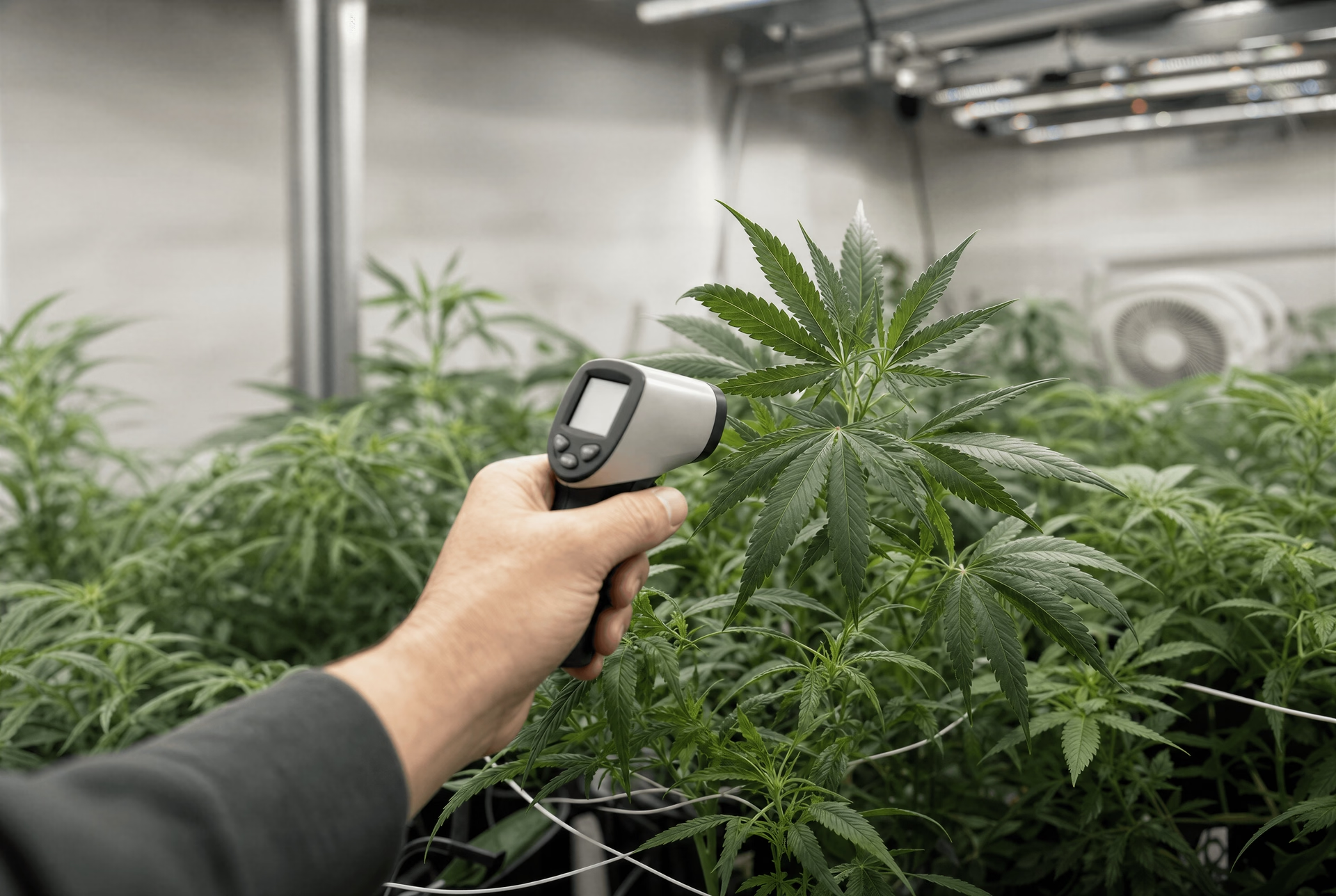
An infrared thermometer is the cheapest useful step. Spot-check several leaves across the canopy, not just top leaves under the fixture center. A thermal camera is better because it shows hot spots, cool transpiring zones, edge effects, and uneven irrigation response. Both are more informative than an ambient probe alone.
Use RH and temperature sensors at canopy height, shielded from direct light, mist, and heater or exhaust blast. Then pair those readings with leaf-surface measurements. That gives you a real working estimate of leaf VPD instead of a guess based on room air.
Ambient probes tell you the room climate. Infrared tools tell you what the crop is actually feeling. For VPD control, that difference is the whole game.
Optimal VPD ranges across the cannabis life cycle
VPD targets work better than fixed RH targets because plants do not respond to humidity in isolation. They respond to evaporative demand: how hard the air is pulling water from the leaf. ASABE defines vapor pressure deficit as the gap between saturation and actual vapor pressure, which is why a room at 50% RH can be gentle at one temperature and aggressive at another. University of Georgia Extension makes the same point from the humidity side: when temperature rises by 20°F, air can hold about twice as much water vapor. So RH can collapse fast during a warm light cycle even if absolute moisture barely changed.
For cannabis, stage-based VPD bands are useful heuristics, not laws. They assume normal leaf function, decent root health, and reasonable irrigation frequency. They also assume you understand that the leaf may not be the same temperature as the air. Cornell CEA notes leaves can run warmer or cooler depending on radiation and transpiration, which means the real leaf VPD can drift away from whatever a chart says.
Propagation and seedling targets
Clones, rooted cuttings, and seedlings generally perform well around 0.4 to 0.8 kPa. In RH terms, that often lands near 65 to 75% RH, sometimes a bit higher for unrooted cuttings, but only if temperature is controlled. The reason is simple: young plants have weak or incomplete root systems, so they cannot replace water as fast as mature plants. Low VPD reduces transpirational demand and buys time for roots to establish.
But too low is not harmless. A dome kept very wet for too long can stall hardening, soften tissue, and keep leaf surfaces damp. That increases disease pressure and produces weak plants that struggle when moved into open air. If clones are rooted but still look swollen, slow, or calcium-deficient despite adequate feed, the problem may be low transpiration rather than nutrient concentration.
A practical target is to start near the lower half of that band for fresh cuts, then edge upward as roots appear and new growth starts driving water movement.
Vegetative-stage targets
Once plants are rooted and actively growing, 0.8 to 1.2 kPa is a strong working range. That usually corresponds to roughly 55 to 70% RH, depending on temperature. This is where vegetative cannabis tends to balance water flow, nutrient transport, and stomatal opening without excessive stress.
Too low a VPD in veg can make plants look lush but fragile. Internodes may stretch, leaf surfaces stay wetter for longer, and calcium movement can lag because transpiration is weak. Too high a VPD pushes the opposite problem: rapid water loss, rising root-zone EC as water is pulled faster than salts are cleared, leaf-edge burn, and eventual stomatal closure. Many growers call that a feeding issue first. Often it is a climate issue wearing a nutrient mask.
Charts that treat 60% RH as automatically “veg safe” miss the point. At 22°C and 60% RH, the plant sees a very different demand than at 29°C and 60% RH. If LED lighting keeps leaves cooler than air, actual leaf VPD may climb further.
Flowering-stage targets
Early flower usually likes 1.0 to 1.4 kPa. In many rooms that means about 50 to 60% RH, though temperature and leaf temperature can shift the number. This range supports active transpiration and generative growth while starting to lower pathogen pressure as flowers stack.
That drop in humidity is not cosmetic. Dense canopies trap moisture, and flowers create their own humid microclimate. The Royal Horticultural Society warns that powdery mildew is encouraged by high humidity and poor air circulation. UC IPM says Botrytis cinerea thrives in high humidity and on aging or wounded tissue. Those warnings fit cannabis flower rooms exactly, especially once lower leaves are shaded and airflow weakens inside the canopy.
So early flower is where many growers should stop chasing “comfortable” RH and start managing for dry, moving air around the inflorescences.
Late-flower caution zones
In later flower, 1.2 to 1.6 kPa is often the safer band, particularly with bulky colas and tight spacing. A common RH equivalent is 40 to 50%, sometimes slightly lower if the room is cool at lights-off and condensation risk is high. EPA and CDC guidance for buildings keeps indoor RH below 60% to limit mold, and that general principle matters even more in a packed flower canopy.
Still, pushing VPD high just because buds are dense can backfire. Above the plant’s comfort range, stomata tighten, water uptake becomes erratic, and tip burn can intensify even when feed has not changed. That is one reason late-flower stress is often misread as lockout.
The danger zone is not a single number. It is the combination of high nighttime RH, cool surfaces, and trapped canopy moisture near ripening flowers.
How to adapt targets for cultivar structure and irrigation strategy
Broad-leaf, indica-leaning plants with dense flowers usually need the drier end of flowering targets sooner. Open, airier cultivars can often tolerate slightly lower VPD without the same mold risk. Greenhouses complicate this because solar gain, cloud cover, and sunset humidity swings can move VPD sharply within hours. Kenneth A. Körner and Richard J. Stutto, writing on greenhouse climate control, treat setpoints as dynamic responses to crop and weather, not fixed commandments. That approach fits cannabis.
Irrigation matters just as much. Frequent fertigations in inert media can support a higher VPD because the root zone is being replenished often. Large containers of slower-drying substrate may need a gentler VPD, or plants can outrun water supply during peak transpiration. If leaves pray early then droop hard by afternoon, the answer may be lower VPD or more timely irrigation, not stronger feed.
Use the chart. Then watch the plant, the leaf temperature, the root-zone moisture curve, and the disease pressure. That is the real target.
What goes wrong when VPD is wrong
A room can sit at a familiar RH number and still push the crop into stress. That is the trap. VPD, as defined by ASABE, is the difference between the moisture the air could hold at saturation and the moisture actually present. Plants respond to that evaporative pull, not to RH in isolation. A canopy at 50% RH and 20°C is in a very different water-relations state than a canopy at 50% RH and 28°C. University of Georgia Extension makes the reason plain: when temperature rises by 20°F, air can hold about twice as much water vapor. RH collapses or VPD jumps even if the absolute moisture content barely changes.
Leaf temperature shifts the picture again. Cornell Controlled Environment Agriculture notes that leaves can run warmer or cooler than ambient air depending on radiation load and transpiration. Under active transpiration they are often a bit cooler than the room, which raises the actual leaf-to-air deficit relative to what a simple air-temp chart suggests. Under low transpiration or strong radiant load, the opposite can happen. That is why fixed RH tables are only a starting point. The crop feels leaf VPD.
Too low VPD: slow transpiration, soft growth, and pathogen pressure
When VPD is too low, the air is already moist enough that the plant has little incentive to evaporate water from stomata. Transpiration slows. That sounds gentle, but it quickly becomes limiting.
Water movement from roots to leaves is not only about hydration. It is also the conveyor belt for dissolved minerals, especially less mobile ones such as calcium. In a low-VPD room, roots may be sitting in a feed with adequate calcium, yet the canopy acts like it is not receiving enough. Growth softens. Tissues stay lush and weak-walled. Leaves can look puffy, clawed, or oddly brittle at new growth points. Shoots stall.
The slowdown is often misread as overwatering or a mild deficiency. Sometimes both diagnoses are technically nearby but miss the cause. The plant is not moving water properly because the atmospheric demand is too low.
Low VPD also lengthens drying time on plant surfaces and inside dense canopy pockets. Once dew point and leaf temperature get close, condensation risk rises. ASHRAE’s psychrometric framework matters here: dew point is the temperature at which water vapor reaches saturation and condenses. If lights go off, canopy temperatures fall, and the room is already humid, you can cross that threshold in the flowers themselves.
Bud rot and Botrytis risk in dense flowers
Late flower is where sloppy VPD control gets expensive. Dense inflorescences trap moisture, restrict airflow, and create their own microclimate. Even if the room sensor reads an acceptable average, the interior of a thick cola may be sitting at a much lower VPD than the aisle air.
Botrytis cinerea, the gray mold behind classic bud rot, thrives under those conditions. UC IPM describes Botrytis as favored by high humidity and by senescing or wounded plant tissue. Those two conditions are common in mature flowers: aging inner bracts, slight mechanical damage, and trapped moisture after irrigation or night-cycle humidity rise. The fungus does not need a dramatic environmental failure. It needs a humid pocket that persists.
This is why “50% RH is always safe” is bad advice. Safe where? At what air temperature? With what leaf temperature? In what canopy density? A late-flower room at 50% RH and cool nighttime temperatures can still drift toward condensation in flower interiors, especially if dehumidification lags after lights off. Bud rot is a microclimate disease before it becomes a room-average disease.
Powdery mildew and stagnant boundary layers
Powdery mildew is often discussed as if it were simply a dirty-room problem. Climate has a major role. The Royal Horticultural Society states that powdery mildews are encouraged by high humidity and poor air circulation. Both are really boundary-layer issues.
Boundary layer The thin layer of air that sits against the leaf surface. If airflow is weak, this layer stays more humid and slows gas exchange and drying.
Every leaf has a thin film of air hugging its surface. If airflow is weak and the room is humid, that boundary layer stays moist, gas exchange slows, and the leaf effectively experiences a lower VPD than the room monitor suggests. In crowded canopies, this gets worse. Leaves overlap, transpiration adds local moisture, and fans may move air above the canopy while the interior remains stagnant.
Powdery mildew does not require dripping wet leaves in the way some pathogens do. It needs favorable humidity, susceptible tissue, and stagnant zones. Low VPD gives it that opening. Growers sometimes respond by stripping more leaves or spraying harder, while the real fix is often a drier, better-mixed canopy climate with appropriate day-night control.
Calcium transport problems and deficiency-like symptoms
Calcium is the classic climate-linked “deficiency” that often is not a feed deficiency at all. Calcium moves largely with transpiration stream rather than being remobilized easily from older tissue. When VPD is too low, that stream weakens. New growth suffers first because rapidly expanding cells need calcium for wall formation and membrane stability.
Symptoms can look familiar: twisted new leaves, small necrotic margins, weak tips, odd spotting on young tissue, malformed flowers. Growers often increase Cal-Mag, raise base nutrients, or chase pH swings. Sometimes the substrate already contains enough calcium. The plant just is not transporting it efficiently.
This same logic applies to other transpiration-linked imbalances. Low VPD can make a crop look underfed while the root zone tests fine. High VPD can make a crop look overfed even at reasonable input EC. Climate sits upstream of both pictures.
Too high VPD: over-transpiration, wilting, and tip burn
At the other extreme, the air pulls too hard. Water loss races ahead of root uptake. Initially the plant may transpire heavily and appear vigorous. Then the safety response appears: stomata begin to close to conserve water.
That single change causes several visible problems at once. Leaves pray and then canoe. Midday wilt appears despite a moist substrate. Margins burn because salts concentrate at the transpiring edge and because the root zone solution becomes stronger as the plant removes water faster than nutrients. CO2 uptake falls as stomata close, so photosynthesis drops even while the room looks bright and “dry enough.”
This is why high VPD can mimic both drought stress and nutrient toxicity. The leaves are losing water too fast, yet carbon gain is dropping. Growth slows, internodes shorten, and flowers can feel papery rather than properly filled. In severe cases, the canopy temperature rises because transpiration cooling fades, which pushes leaf VPD even higher. A bad feedback loop.
Nutrient concentration, root-zone EC, and apparent lockout
High VPD changes the root zone, not just the leaves. If irrigation frequency does not match atmospheric demand, the medium dries faster and its electrical conductivity rises as water is pulled out. The grower sees burnt tips, rusting edges, dark stressed foliage, or stalled flower bulking and assumes the formula is too strong or the pH is off.
Sometimes that is true. Often the climate started it.
As VPD climbs, a feed that was gentle yesterday can become effectively hot today because the plant and substrate are concentrating salts between irrigations. Root membranes then face higher osmotic stress, making water uptake harder. The crop may show what gets called “lockout,” but the mechanism is not mystical. It is salt concentration plus impaired root function plus stomatal closure. Lowering bottle strength without correcting room demand may blunt the symptom while preserving the cause.
How climate stress gets misdiagnosed as feeding error
This is the diagnostic hinge point many growers miss: climate control is part of plant nutrition. If VPD is wrong, nutrient symptoms become unreliable.
Low VPD can mimic deficiency because transpiration and calcium flow are weak. High VPD can mimic toxicity because water demand outruns uptake, root-zone EC rises, and leaf margins scorch. In both cases, the first instinct is often to change feed charts, add supplements, flush the medium, or chase runoff pH. Those actions may create a second problem on top of the first.
A better sequence is simple. Check air temperature, RH, leaf temperature if possible, and day-night swings before changing the recipe. Compare canopy readings rather than relying on one wall-mounted sensor. Ask whether irrigation timing matches evaporative demand. Ask whether the problem worsens after lights on, after dehumidifiers fall behind, or after a hot afternoon. Those patterns often reveal climate stress far faster than a nutrient bottle ever will.
The hard truth is that many “feeding problems” are room problems wearing nutrient symptoms. RH charts remain useful as rough stage guidance—higher humidity for clones and seedlings, moderate levels in veg, lower humidity through flowering—but they are not laws. Serious diagnosis starts with VPD, because transpiration is where climate and nutrition meet.
Measuring the room properly: sensors, placement, and calibration
A grow room does not have one climate. It has layers, corners, drafts, wet zones, hot zones, and a canopy that often lives in different conditions than the walkway. That is why a single wall-mounted humidity number is weak guidance. VPD depends on temperature and moisture at the leaf, not at the door.
Hygrometers and thermo-hygrometers
Basic hobby meters give a rough RH and air-temperature snapshot. Useful, but only as a starting point. Many are built around low-cost polymer capacitive sensors with wide tolerances, slow response, and poor long-term stability. A calibrated thermo-hygrometer is different: tighter stated accuracy, documented temperature compensation, and the option to verify or correct readings against a reference.
That distinction matters because small RH errors can shift VPD enough to change plant behavior. At warm flowering temperatures, a 5% RH error is not trivial. It can mean the difference between a crop that transpires hard and one that sits in a damp canopy with Botrytis pressure rising. ASABE treats VPD as a standard greenhouse water-relations metric for a reason: the plant responds to vapor pressure, not to a simplified RH chart.
If your meter cannot be checked, assume drift over time. Better instruments at least let you compare against a known standard and apply an offset.
Infrared leaf temperature tools
Air temperature is only half the story. Cornell Controlled Environment Agriculture has pointed out that leaves may run warmer or cooler than the surrounding air depending on radiation load and transpiration. Under strong transpiration, leaves are often a bit cooler than air. Under intense radiant loading or weak transpiration, they may not be.
An infrared thermometer gives a quick leaf-surface reading, and a thermal camera shows patterns across the canopy. That matters because leaf VPD is calculated from leaf temperature, not just room temperature. Many grower charts quietly assume leaf temperature equals air temperature or is 1–2°C lower. Sometimes that is close. Sometimes it is wrong enough to misread the whole room.
Data logging and remote monitoring
Single readings miss the real problem: swings. A tent can go from low VPD at lights-off to high VPD an hour after lights-on. Average numbers hide those transitions. Logging every few minutes shows whether dehumidification lags irrigation, whether humidifier cycles are overshooting, and whether dawn and dusk are your disease windows.
Remote alerts help too. If RH spikes after lights-out and stays there, powdery mildew and Botrytis risk rises fast in dense canopies. The Royal Horticultural Society links powdery mildew with high humidity and poor air circulation, and UC IPM makes the same basic point for Botrytis in moist plant tissue.
| Space | Recommended placement | Avoid |
|---|---|---|
| Grow tent | One sensor above canopy and one within canopy | Door area, direct mist, fixture exhaust stream |
| Indoor room | Multiple canopy-height zones | Floor, ceiling, dehumidifier exhaust, intake drafts |
| Greenhouse | Canopy zones accounting for solar gain and perimeter cooling | Single-point readings that miss night condensation zones |
Where to place sensors in tents, rooms, and greenhouses
Put primary sensors at canopy height. Not on the floor, not near the ceiling, and not beside the door. Keep them out of direct humidifier stream, away from intake drafts, and away from fixture hotspots or dehumidifier exhaust. In tents, one sensor above canopy and one within the canopy is often more informative than a single center reading. In rooms, use multiple zones. In greenhouses, account for solar gain, perimeter cooling, and night condensation zones.
Why cheap sensors drift
Heat, dust, fertilizer aerosols, oils, and repeated wetting all age humidity sensors. Cheap units often drift because the sensing film changes with contamination and temperature cycling. That drift may be slow enough to ignore for a week and large enough to mislead you by flower week six.
Check sensors regularly with a reference device or a salt-test method, replace weak units, and trust trends only when the hardware is trustworthy. Climate control is part of plant nutrition. Measure it like it matters.
How to control humidity and VPD in practice
Once you stop treating humidity as a single RH number, the control strategy changes. A room at 55% RH can be too wet, too dry, or just right depending on air temperature, leaf temperature, canopy density, irrigation timing, and whether lights are on or off. ASABE defines VPD as the gap between saturation vapor pressure and actual vapor pressure. That is the pressure gradient driving transpiration. So the job is not simply “raise RH” or “lower RH.” The job is to steer plant water movement.
That means moving from measurement to intervention. Put sensors at canopy height, shielded from direct mist and not parked under a fixture exhaust stream. If possible, track leaf temperature with an infrared sensor, because Cornell CEA notes leaves can run cooler or warmer than the surrounding air depending on radiation load and transpiration. In LED rooms, leaves often sit closer to air temperature than they did under HPS, but not always. A 1–2°C shift in leaf temperature changes leaf VPD enough to matter.
Stage RH ranges still help as a rough frame: clones and seedlings often sit around 65–75% RH, veg around 55–70%, early flower around 50–60%, late flower around 40–50%. But those numbers only mean something when tied to temperature and leaf temperature. University of Georgia Extension points out that air can hold about twice as much water vapor with each 20°F rise in temperature. Heat a room without adding moisture and RH falls fast. VPD rises with it.
Humidifiers: when they help and when they create trouble
Humidifiers are mainly a propagation and early vegetative tool. Young plants with weak roots cannot sustain aggressive transpiration, so a lower VPD often helps them stay turgid while roots catch up. That is why propagation targets around 0.4–0.8 kPa are common greenhouse heuristics, not cannabis laws but reasonable starting points.
The mistake is using humidification to fix every “dry” reading. If air temperature is high, raising RH may only be masking a heat problem. If leaf surfaces stay damp, you trade one problem for another. The Royal Horticultural Society warns that powdery mildew is encouraged by high humidity and poor air circulation. In dense canopies, foggers and ultrasonic units can create exactly that environment, especially if mist contacts leaves directly or runs into the dark cycle.
Humidifiers are useful when the room is genuinely over-drying plants, not when root zone issues, excessive light load, or poor airflow are the real cause. Use clean water where possible, maintain the unit, and never let visible mist soak the canopy.
Dehumidifiers and latent moisture removal
Flowering rooms usually need moisture removal, not added moisture. Plants transpire continuously while lights are on, and after irrigation they can dump surprising amounts of water into the air. This is latent load: water vapor that must be removed. It is not sized by floor area alone. It is sized by plant biomass, irrigation volume, substrate water content, and how hard the crop is transpiring.
That point gets missed all the time. A small room packed with mature plants can overwhelm a dehumidifier that looks adequate on paper. A larger room with fewer plants may be easy to manage. If you irrigate heavily late in the day, expect a humidity surge. If runoff is excessive, expect more.
Dehumidification is also disease control. EPA and CDC both advise keeping indoor RH below 60% to help limit mold, and many building-health guidelines favor 30–50% in occupied spaces. Those are not cannabis targets, but they support the basic pathogen logic. UC IPM identifies Botrytis cinerea as thriving in high humidity and on moist, crowded tissue. Late flower does not forgive weak moisture removal.
HVAC and sensible vs latent loads
HVAC handles temperature, but temperature control alone does not guarantee climate control. Greenhouse engineering texts by Kenneth A. Körner and Richard J. Stutto separate sensible load from latent load for a reason. Sensible load changes dry-bulb temperature. Latent load changes moisture content. A room can feel “cool enough” while still carrying too much vapor.
Air conditioners remove some latent moisture as they cool, but their dehumidification capacity depends on runtime and coil conditions. If your lights are efficient and sensible heat is modest, the AC may short-cycle, satisfy temperature quickly, and leave humidity behind. Then RH climbs, VPD collapses, and the grower blames nutrients when calcium transport slows and leaves twist or spot.
This is why some sealed rooms need both AC and dedicated dehumidification. ASHRAE psychrometrics makes the framework plain: dew point, RH, dry-bulb temperature, and vapor pressure are linked. Change one and the others move.
Airflow goals in practice
- Mix the canopy Move air through and under the canopy, not only above it.
- Thin the boundary layer Gentle leaf movement helps leaf temperature and transpiration stay more stable.
- Avoid wind stress Use uniform circulation rather than blasting the tops with constant strong airflow.
Airflow, circulation fans, and boundary-layer management
Air movement does not remove water from the room by itself, but it changes what the leaf experiences. Every leaf carries a thin boundary layer of humid air. Good circulation thins that layer, making transpiration more responsive and leaf temperature more stable. Poor circulation lets humidity accumulate inside the canopy even when room sensors look acceptable.
That is how growers get surprised by mildew at “safe” RH. The room average says 50%, but the flower cluster buried in stagnant air is much wetter. Circulation fans should create gentle, uniform leaf movement, not constant wind stress. Aim for mixing through and under the canopy, not a hurricane blasting the tops.
Environmental controllers and automation logic
Manual control works in a small tent until it doesn’t. Tents swing fast. Sealed rooms drift more slowly but carry larger moisture loads. In both cases, automation matters because VPD is dynamic. A controller that only chases RH will make bad decisions whenever temperature shifts.
Better logic uses temperature and humidity together, ideally with leaf temperature input. Day and night setpoints should differ. Propagation can tolerate lower VPD. Late flower usually needs a drier target because pathogen pressure rises as flowers tighten. Hysteresis matters too. If devices switch every minute, the room will hunt and overshoot.
Irrigation timing, plant load, and lights-off humidity spikes
The worst spike often comes after lights off. Air cools, saturation capacity drops, RH climbs, leaf surfaces can approach dew point, and transpiration slows. ASHRAE defines dew point as the temperature at which water vapor reaches saturation and condenses. That is not abstract. It is the path to wet flowers.
Irrigation timing strongly affects this. Watering late in the photoperiod loads the room with moisture right before temperature falls. A better strategy is earlier irrigation and a controlled dry-back before dark, especially in flower. Dry-back is not about stressing plants for its own sake. It is about preventing a soaked root zone and vapor-heavy room at the exact time Botrytis risk rises.
So control humidity and VPD as one system: heat, moisture removal, airflow, irrigation timing, and plant mass. RH charts are a starting point. The real target is stable transpiration.
Indoor room, grow tent, and greenhouse strategies are not the same
A 2×4 tent, a sealed flower room, and a greenhouse can all read 55% RH while exposing plants to very different water stress. That is why fixed humidity tables mislead. ASABE defines VPD as the gap between saturated and actual vapor pressure, and that gap changes with temperature, leaf temperature, and air moisture together. A room at 55% RH and 20°C is not behaving like a room at 55% RH and 28°C. If leaf temperature is 1–2°C below air, the plant is experiencing something else again.
Small grow tents: rapid swings and simple control loops
Tents are unstable by nature. Low air volume, thin walls, and little thermal mass mean the environment moves fast when lights switch on, when irrigation finishes, or when the exhaust fan ramps up. University of Georgia Extension notes that air can hold about twice as much water vapor with each 20°F increase. In a tent, that shows up as a sudden RH crash after lights-on even if no moisture was removed. Many growers misread that crash as “the room dried out.” Sometimes it just got warmer.
Control strategy in a tent should be simple and fast, not elaborate. You usually need a humidifier or dehumidifier, an exhaust fan, oscillating air movement, and a sensor at canopy height. Not by the door, not under a fixture exhaust stream, not in the direct path of mist. Cheap hygrometers are often inaccurate enough to push a small tent outside the intended range.
Because swings are large, stage targets need wider tolerance bands. Seedlings and clones often sit around 65–75% RH, vegetative plants roughly 55–70%, early flower around 50–60%, and late flower around 40–50%. Those are only starting points. If the tent runs hot under strong light, the same RH may create a much higher VPD than expected. If leaf temperature runs cool under LED lighting, leaf VPD may be lower than the room chart suggests.
Tents also punish overcorrection. A humidifier on a blunt timer can push an area of the canopy into saturation. That creates local condensation and disease pressure even when the room-average RH looks fine. The Royal Horticultural Society warns that powdery mildew is encouraged by high humidity and poor air circulation. Dense tent canopies provide both.
Sealed indoor rooms: integrated HVACD thinking
A sealed room is less twitchy than a tent, but far less forgiving when equipment is undersized. Once the room is sealed, plant transpiration becomes a mechanical load that must be removed. This is where climate control stops being a side issue and becomes part of irrigation and nutrition management.
HVAC alone is not enough. You need HVACD thinking: heating, ventilation where applicable, air conditioning, and dehumidification sized around lighting, plant count, irrigation volume, and room insulation. Kenneth A. Körner and Richard J. Stutto made this point repeatedly in greenhouse engineering texts: moisture balance is a system problem, not a single-device problem. Cannabis rooms prove it daily. Heavy feed and heavy irrigation increase latent moisture load. A dehumidifier that cannot keep up drives low-VPD conditions at lights-off and after irrigation events.
This matters in flower. UC IPM identifies Botrytis cinerea as a disease favored by high humidity and moist, crowded tissue. Bud structure makes cannabis especially vulnerable late in bloom when transpiration is lower inside dense flowers than at the top of the canopy. “Below 60% RH” is decent building-health advice; EPA and CDC both use that threshold for indoor mold control. It is not a guarantee of crop safety. In a sealed flower room, 58% RH with cool leaf surfaces and weak airflow in the interior canopy can still be risky.
Bad VPD in sealed rooms is often mislabeled as nutrition trouble. High VPD can drive excess transpiration, concentrate salts in the root zone, and produce edge burn that gets blamed on feed strength. Low VPD can suppress transpiration and calcium movement enough to mimic deficiency. The plant is not merely “underfed” or “overfed.” It is being mismanaged climatically.
Greenhouses: solar gain, condensation, and day-night inversion
Greenhouses add a variable indoor growers cannot fully escape: weather. Solar radiation changes leaf energy balance directly. Cornell CEA notes that leaves may run warmer or cooler than surrounding air depending on radiation load and transpiration. Under bright sun, leaf temperature can rise above air even when RH appears acceptable. Cloud cover then rolls in, leaf temperature drops, vents change position, and the VPD picture shifts within minutes.
At night, the problem flips. ASHRAE defines dew point as the temperature where air reaches saturation and water begins to condense. Greenhouses hit that boundary easily after sunset because air cools, outside humidity rises, and plant surfaces radiate heat to the colder sky. That day-night inversion is why a greenhouse can look dry at 3 p.m. and be dripping with condensation before dawn.
Condensation is not just a comfort issue. It wets tissue. It slows drying. It feeds disease cycles. For dense flowering cannabis, that is dangerous. Venting, heat input, horizontal airflow, and morning dry-down matter more than chasing a static RH number.
Seasonal adjustments and regional climate effects
No chart survives every season. Winter air in a cold continental climate may enter dry and require humidification in propagation, while a coastal summer may demand aggressive dehumidification even with modest temperatures. Monsoon periods, marine layers, and sharp desert day-night swings all change the sensible and latent loads in a space.
The practical rule is simple: use RH ranges as rough stage markers, then anchor decisions to VPD, leaf temperature, and disease risk in your actual environment. Tents need quick-response controls. Sealed rooms need properly sized moisture removal integrated with cooling and irrigation. Greenhouses need strategies for solar gain by day and condensation prevention by night. One humidity chart cannot cover all three, and pretending otherwise causes many of the “mystery” plant problems growers keep chasing in the feed tank.
Best-practice climate playbook for each stage
RH charts are only a starting point. The operating procedure is simple: check air temperature, leaf temperature, RH, and VPD together, then react based on stage and disease risk. A room at 50% RH is not automatically “safe.” At 20°C, 50% RH gives a very different vapor environment than 28°C, 50% RH. University of Georgia Extension notes that air can hold about twice as much water vapor with each 20°F increase, which is why RH can collapse when lights heat the room even if no moisture was removed.
Seedling and clone climate checklist
- Canopy air temperature Measure at plant height.
- Leaf temperature Check several leaves, not just one.
- RH at canopy Keep probes away from direct mist.
- Calculated VPD Use leaf temperature if possible.
Daily checklist for seedlings and clones
Run young plants in a gentler transpiration zone. As a working range, aim around 65–75% RH with VPD roughly 0.4–0.8 kPa. Keep air temperature stable, then verify leaf temperature with an IR thermometer or thermal camera. Cornell CEA has pointed out that leaves can run warmer or cooler than air depending on radiation load and transpiration, so leaf VPD matters more than a wall sensor reading.
Check each day, in order:
- canopy air temp at plant height
- leaf temp from several leaves, not one
- RH at canopy, away from direct mist
- calculated VPD using leaf temp if possible
If clones are limp while media is still wet, the first suspect is not feed strength. It is often excess VPD from warm, dry air or leaf overheating. If leaves are swollen, dull, and slow, with weak uptake, VPD may be too low.
Vegetative climate checklist
Vegetative plants can handle more demand. A useful range is about 55–70% RH and roughly 0.8–1.2 kPa VPD, adjusting for cultivar, light intensity, and irrigation frequency. Under LEDs, leaves often run closer to air temperature or slightly cooler than under HPS, so copying an old HPS climate recipe can push transpiration in the wrong direction.
Daily checks should include dry-back speed in the root zone. Climate and irrigation are linked. High VPD pulls more water through the plant and can concentrate salts in the media, which then gets misread as a nutrient problem. Low VPD reduces transpiration and can suppress calcium movement enough to mimic deficiency without any real shortage in solution.
Keep air moving through the canopy, not just above it. The Royal Horticultural Society warns that powdery mildew is encouraged by high humidity and poor air circulation. Dense veg rooms create that exact microclimate if fans are weak or leaves are packed too tightly.
Flowering and late-flower checklist
Flowering needs stricter moisture control because pathogen pressure rises as flowers densify. Early flower often sits around 50–60% RH and roughly 1.0–1.4 kPa VPD. Late flower usually shifts drier, around 40–50% RH and roughly 1.2–1.6 kPa. These are heuristics from greenhouse control practice, not cannabis laws carved in stone.
Night humidity deserves special attention. When lights go off, air cools, RH rises, and surfaces approach dew point. ASHRAE defines dew point as the temperature at which vapor condenses. That is where trouble starts. UC IPM notes that Botrytis thrives in high humidity and on moist, crowded tissue. Bud rot does not care that your daytime RH was acceptable.
If nighttime RH spikes, do not just lower daytime humidity harder. Raise lights-off temperature slightly, increase dehumidification during dark hours, improve air mixing inside the canopy, and reduce late irrigation if media is still saturated overnight.
Lights-on vs lights-off targets
Use separate targets. Lights on, accept somewhat higher temperature and a stage-appropriate VPD. Lights off, prioritize keeping RH below mold-friendly levels and staying away from dew point. EPA and CDC both advise keeping indoor RH below 60% to limit mold; flowering rooms should treat that as a ceiling, not a goal.
Watch the transition period. The hour after lights-off is where many tents and rooms drift into condensation risk.
Troubleshoot in this order
- Climate Confirm canopy air temperature, leaf temperature, RH, and VPD.
- Irrigation Check timing, runoff, and dry-back pattern.
- Root zone Inspect EC, pH, oxygenation, and root health.
- Nutrition Adjust feed only after climate and root-zone checks.
A practical troubleshooting sequence
Troubleshoot in this order: climate, irrigation, root zone, nutrition.
Start with climate. Confirm canopy air temp, leaf temp, RH, and VPD. Then inspect nighttime humidity trends and dew point approach. Next check irrigation timing, runoff, and dry-back. After that, inspect root-zone EC, pH, oxygenation, and root health. Only then adjust nutrition.
That order prevents a common mistake: trying to “fix” tip burn, weak calcium flow, stalled growth, or interveinal symptoms with bottles when the real cause is a bad vapor environment. Climate is part of plant nutrition. Treat it that way.
Where VPD charts help, and where they mislead
The value of charts as fast heuristics
VPD charts are useful because they compress greenhouse physics into a quick decision tool. If a grower sees 26°C and 65% RH, a chart can immediately show whether the room is sitting in a propagation-style zone or a drier flowering zone. That matters. ASABE defines vapor pressure deficit as the gap between saturated vapor pressure and actual vapor pressure, which is another way of saying how hard the air is pulling water from the plant. Charts turn that into something readable at a glance.
That speed is not trivial. Seedlings and clones usually do better in lower VPD ranges, often around 0.4 to 0.8 kPa, because their roots are weak and high transpirational demand can outpace water uptake. Vegetative plants tend to handle roughly 0.8 to 1.2 kPa. Flowering crops are commonly run higher, around 1.2 to 1.6 kPa, to keep water moving without letting dense canopies sit wet. Those are good heuristics, not laws.
The chart also corrects one bad habit: treating RH as a standalone target. It is not. University of Georgia Extension notes that air can hold about twice as much water vapor with each 20°F increase, so a room that warms up fast can see RH collapse even when the actual moisture content barely changed. “50% RH” means very different things at 20°C and 28°C.
Their blind spots: leaf temp, cultivar, airflow, irrigation, CO2
Most charts flatten a moving system. They usually assume leaf temperature equals air temperature, or maybe runs 1 to 2°C lower. Cornell CEA points out that leaves can be warmer or cooler than surrounding air depending on radiation load and transpiration. Under LEDs, leaf-to-air relationships often differ from HPS rooms because radiant heating differs.
Then there is plant variation. Some cultivars transpire aggressively; others stall sooner under stress. Airflow changes boundary layers. Irrigation volume changes stomatal behavior. Added CO2 can support higher leaf temperatures and somewhat different VPD operating windows. Disease pressure shifts the acceptable target too: the Royal Horticultural Society warns that powdery mildew is encouraged by high humidity and poor air circulation, while UC IPM notes Botrytis thrives in humid, crowded tissue.
A better rule: chart first, plant response second
Use the chart first. Then verify it against the plant. Measure leaf temperature, not just room temperature. Watch irrigation frequency, leaf posture, runoff EC, and how fast pots dry. High VPD can look like “nutrient burn” when the real issue is excessive transpiration and salt concentration at the root. Low VPD can look like deficiency because calcium flow slows when transpiration stalls.
The chart gives a target. The plant tells you whether that target is real.