














Why pH and EC matter more than most cannabis feeding charts admit
Most cannabis feeding charts flatten a chemistry problem into a dosage problem. That is the mistake. Plants do not read bottle labels; roots respond to the solution and substrate immediately around them, and that chemistry shifts hour by hour with irrigation, dry-back, water alkalinity, microbial activity, and nutrient uptake.
pH and EC are not side notes. pH governs hydrogen ion activity, and because the scale is logarithmic, a one-unit change means a tenfold shift in acidity, as the USGS notes. That matters because nutrient solubility, ionic form, microbial processes, and root membrane transport all change across the pH range. EC, by contrast, is not a nutrient recipe. It is an estimate of total dissolved ions in solution. Useful, yes. Sufficient on its own, no.
The result is that many cannabis problems are misread from the start. A grower sees interveinal chlorosis, assumes magnesium deficiency, adds more fertilizer, and pushes root-zone salinity even higher. Or sees purple stems and blames phosphorus shortage when the actual issue is high substrate pH reducing phosphorus and micronutrient availability. Generic feed charts encourage this because they assume neutral water, stable media, and clean measurement. Real gardens rarely fit that model.

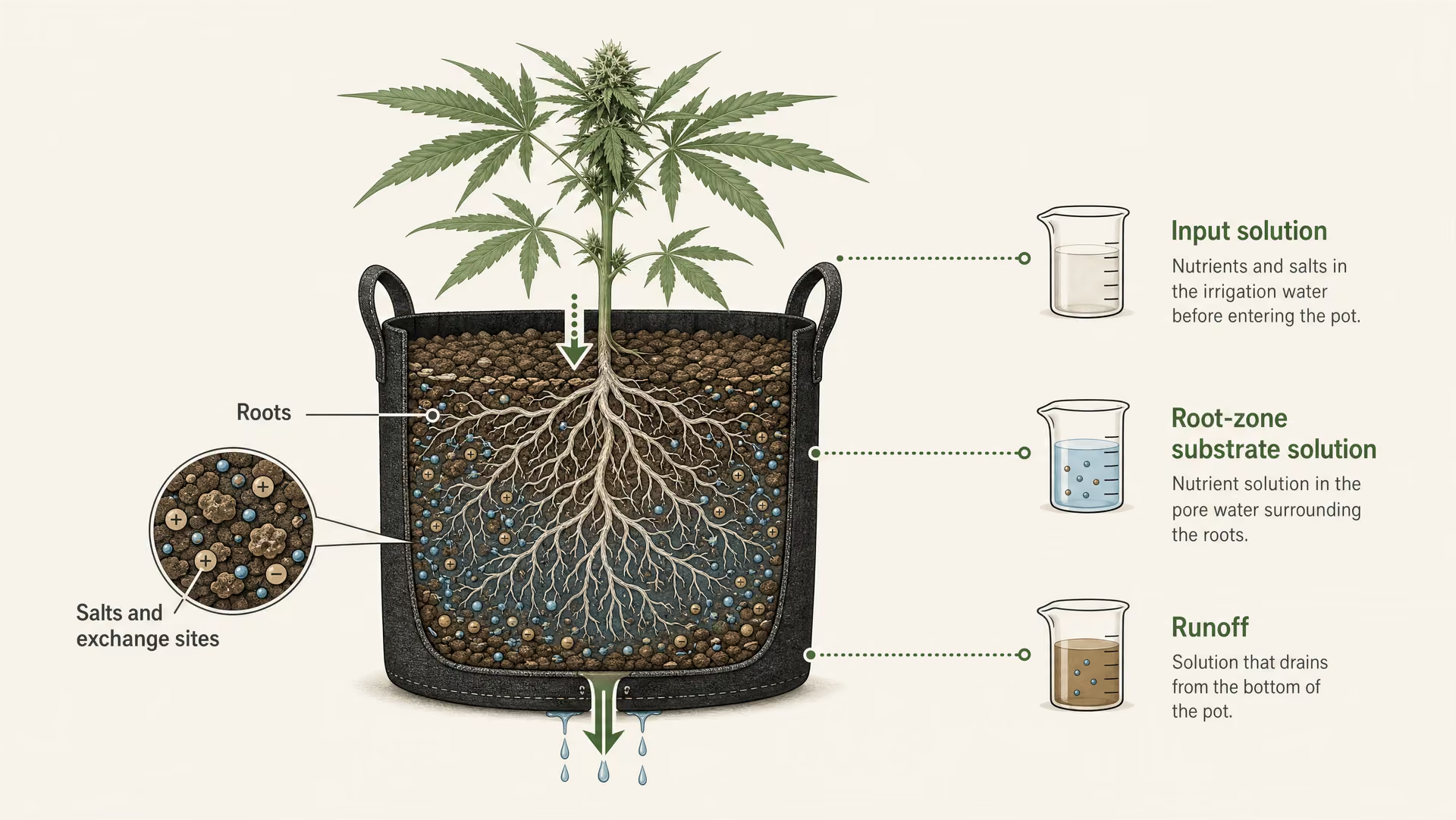
The root zone is the real measurement, not the bottle label
The number that matters most is not what went into the tank. It is what the roots are sitting in.
| Measurement | What it tells you | Main limitation | Most useful in |
|---|---|---|---|
| Input solution | What you intended to feed | Not the same as root-zone conditions after buffering and exchange | All systems |
| Substrate solution | What the root zone is actually holding | Harder to sample directly | Soil, peat, coco |
| Runoff | Rough trailing indicator of salt and pH trends | A sample, not a perfect mirror of the whole root zone | Coco and soilless systems |
That means separating three measurements: input solution, substrate solution, and runoff. Input tells you what you intended to feed. Substrate solution tells you what the root zone is actually holding after exchange reactions, buffering, and evaporation. Runoff is a rough trailing indicator of where salts and pH are trending. These are related, not identical.
This distinction changes by system. In hydroponics, roots are exposed directly to solution chemistry, so drift happens fast and consequences show quickly; Cornell CEA places most hydro nutrient solutions around pH 5.5 to 6.5 for that reason. In coco, feed may go in at 5.8, but the medium can still bind calcium, magnesium, and potassium through cation exchange, especially if the coir was poorly buffered. In soil or peat-based mixes, carbonate chemistry and cation exchange give more buffering, so short-term mistakes are less dramatic, but they still accumulate.
Alkalinity Water’s acid-neutralizing capacity, driven mainly by bicarbonate and carbonate. It predicts how strongly irrigation water will push substrate pH upward over time.
This is why copying a schedule can become overfeeding. If source water already carries calcium, magnesium, bicarbonates, sodium, or chloride, the chart is not starting from zero. High alkalinity water is especially deceptive: a pH reading alone may look manageable while bicarbonates steadily push the root zone upward.
Why deficiency symptoms are often chemistry problems, not fertilizer shortages
A yellow leaf does not automatically mean “feed more.” Often it means “read the root zone better.”
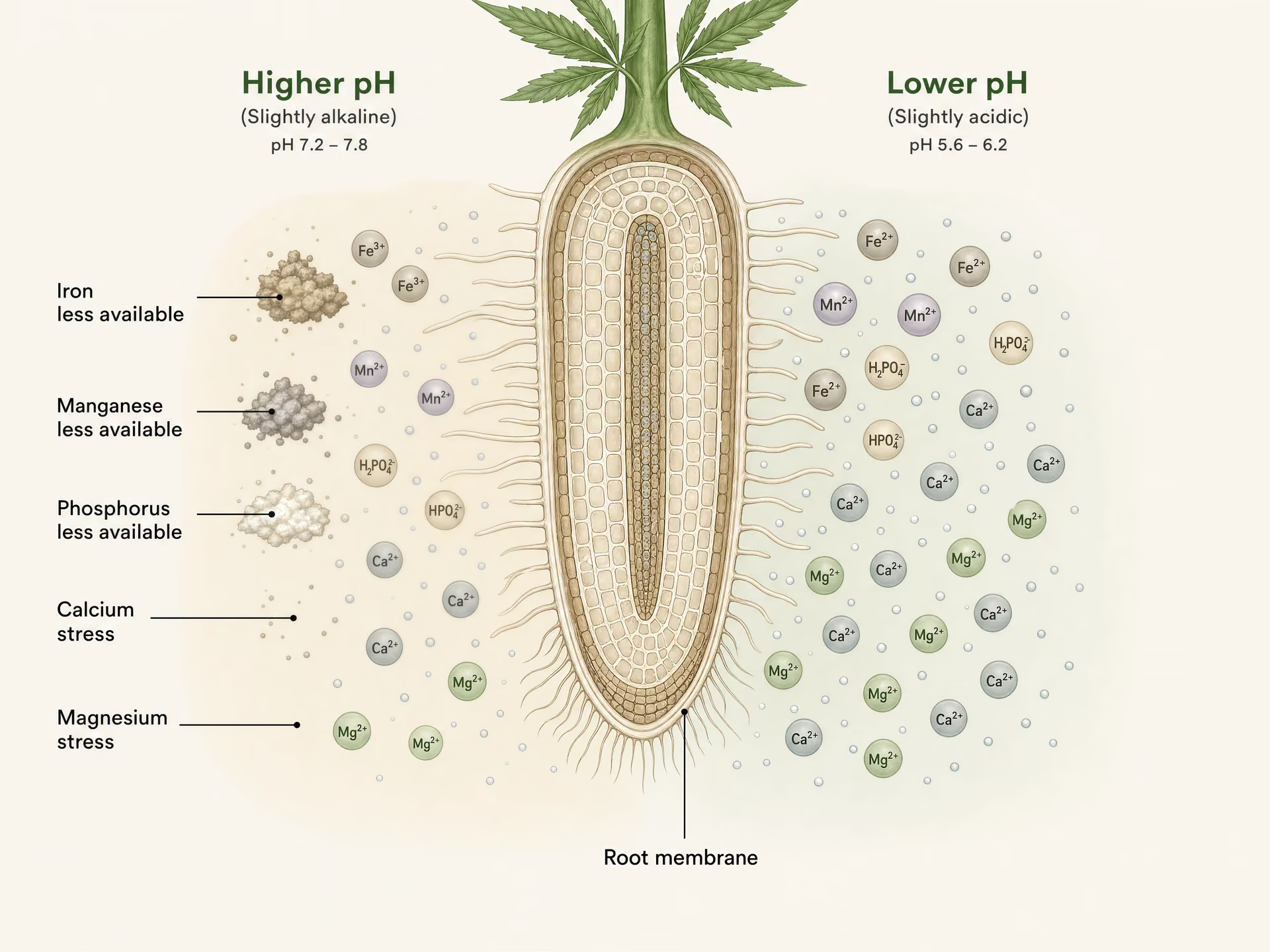
At high pH, iron, manganese, zinc, copper, and often phosphorus become less available. University of Florida IFAS has long warned that micronutrient availability drops as container-media pH rises above range. At very low pH, calcium, magnesium, and molybdenum uptake can suffer, and roots themselves become stressed. High EC compounds the issue by making water uptake harder and by increasing ion antagonism. Too much potassium can suppress magnesium. Excess ammonium can interfere with calcium. High overall salinity can mimic underfeeding because the plant cannot take up what is already there.
That is nutrient lockout in practice: not absence, but restricted availability or transport.
The article's central claim: pH and EC must be read in context
Context means substrate, water, irrigation style, plant stage, and measurement method. A seedling at 0.6 mS/cm in coco under moderate light is not comparable to a flowering plant at 1.8 mS/cm in hydro under high PPFD and added CO2. Even the unit can mislead if reported as ppm without scale; Hanna Instruments and Bluelab both note that 0.5, 0.64, and 0.7 conversion factors can display different ppm values from the same EC.
Generic cannabis feed charts cause overfeeding when growers ignore media chemistry and water quality. Limited evidence
So the position here is simple: generic cannabis feed charts cause overfeeding when growers ignore media chemistry and water quality. Input pH is not root-zone pH. Input EC is not runoff EC. “Deficiency” symptoms are often pH-driven unavailability or salt stress. Until those signals are interpreted in context, more fertilizer is often the wrong answer.
What pH actually measures in cannabis cultivation
Most cannabis pH advice reduces the subject to a target number on a meter. That misses the real issue. pH is not just a setting to hit before feeding; it is a chemical signal that changes what the root can access, what the medium holds onto, and how fast a problem shows up.
pH as hydrogen ion activity and why the scale is logarithmic
Strictly defined, pH is a measure of hydrogen ion activity in a solution. In plain terms, it describes how acidic or alkaline the solution behaves based on the activity of hydrogen ions, written as H+. Lower pH means higher hydrogen ion activity. Higher pH means lower hydrogen ion activity.
That “activity” part matters. pH is not merely counting hydrogen atoms floating around. It reflects how those ions behave in the solution, which is why pH is such a useful shorthand for nutrient chemistry and root-zone conditions.
The scale is logarithmic, not linear. The USGS notes that each one-unit change in pH represents a tenfold change in hydrogen ion concentration or activity. So pH 5 is ten times more acidic than pH 6, and pH 4 is one hundred times more acidic than pH 6. Small meter changes are not small chemically. A drift from 5.8 to 6.8 is a full order-of-magnitude shift in acidity.
That is why “close enough” can be misleading. A reservoir at 6.7 instead of 5.7 does not mean it is only a little higher. It means the chemical environment around the roots has changed dramatically.
For cannabis, there is no universal magic number because root environments differ. Cornell Controlled Environment Agriculture places most hydroponic crops in the 5.5 to 6.5 range, which fits hydro cannabis well. Container media often run differently. Peat-based substrates and soils have their own buffering chemistry, so a pH that works in deep water culture may not be the right reading in a living soil bed or coco drain-to-waste setup.

How pH changes nutrient solubility and ion form
Plants do not take up “fertilizer” in a generic sense. They absorb specific ions dissolved in water. pH affects whether those ions stay soluble, precipitate out, bind to the medium, or shift into forms that roots absorb less easily.
This is where deficiency charts go wrong. Yellowing leaves do not automatically mean the nutrient is absent. Quite often, the nutrient is present but chemically unavailable.
At higher pH, several micronutrients become less available. University of Florida IFAS guidance for container media is consistent on this point: iron, manganese, zinc, and copper lose availability as substrate pH rises above the intended range. Phosphorus also tends to become less accessible at elevated pH because it reacts with calcium and other elements to form less soluble compounds. In cannabis, that can look like iron chlorosis in new growth, dull foliage, weak tops, stalled development, or purple stems that growers misread as simple underfeeding.
At very low pH, the problem flips. Calcium, magnesium, and molybdenum uptake can become impaired, and root tissues themselves can be stressed. Low pH can increase the solubility of some ions to the point that they become excessive or damaging, while reducing efficient root membrane transport for others. Roots under acid stress do not function normally, even if the nutrient bottle says everything is present in the mix.
That is why adding more fertilizer to a pH problem often makes the crop worse. If iron is locked out by high root-zone pH, raising EC usually does not solve the chlorosis. It raises salinity and further burdens the root system. Same for a low-pH medium showing calcium or magnesium issues: more feed may only pile salts into an already stressed zone.
pH also affects biology. In soil and heavily amended mixes, microbial processes that mineralize organic nutrients and cycle nitrogen are pH-sensitive. So pH influences not only the chemistry of ions already in solution but also how quickly new nutrients become available.
Why root-zone pH matters more than reservoir pH in media-based grows
The number you mix into the irrigation tank is only the starting point. What matters most is the pH surrounding the root after that solution interacts with the substrate, existing salts, irrigation water alkalinity, and root uptake.
In hydroponics, solution pH and root-zone pH are often close because the roots are exposed directly to the nutrient solution. Drift can happen fast, and consequences show up fast. That is why hydro growers tend to monitor reservoirs closely and often allow a controlled drift within roughly 5.5 to 6.5 rather than forcing a perfectly static value.
In media-based grows, the picture is more complicated.
Soil has substantial buffering capacity. Cation exchange sites on clay and organic matter, along with carbonate chemistry and biological activity, resist sudden change. A slightly off irrigation pH may not cause an immediate issue because the medium absorbs some of that disturbance. But persistent high-alkalinity water can still push the root zone upward over time.
Coco sits in the middle. It behaves more like a soilless hydro medium than true soil, yet it is not inert. Coco has cation exchange properties and is especially interactive with calcium, magnesium, and potassium. A feed going in at 5.9 does not guarantee the root zone remains at 5.9. Dry-back, infrequent fertigation, poor buffering of the coir before use, and salt accumulation can all shift conditions around the root surface.
That is why solution pH is not the same thing as substrate pH. In peat mixes and soil, growers often use slurry tests or saturated media extract methods to estimate actual root-zone conditions. In coco and other soilless systems, runoff trends can offer clues, though runoff is not a perfect mirror either. It is a sample, not the whole root environment.
The practical lesson is simple: measure the feed, but diagnose the medium. If the reservoir reads fine and the plant still shows lockout symptoms, trust the root zone over the tank. Soil, coco, and hydro each buffer pH differently. Cannabis responds to that chemistry, not to the number on the bottle cap.
What EC and TDS measure—and what they do not
Growers often treat EC and ppm as if they were a nutrient panel. They are not. EC tells you how strongly a solution conducts electricity, which rises as dissolved charged particles increase. That makes it useful. It also makes it easy to overread.
A feed at 1.6 mS/cm is not automatically “stronger” in the way plants need. It may contain a balanced nutrient profile. It may also be inflated by bicarbonates, sodium, or chloride from source water. Same number, very different root-zone consequences.
Electrical conductivity as a proxy for dissolved ions
Electrical conductivity, or EC, is a proxy for the total concentration of dissolved ions in water. Fertilizer salts dissociate into ions such as nitrate, potassium, calcium, magnesium, ammonium, phosphate, and sulfate. Those ions carry electrical charge, so a meter can estimate solution strength by measuring conductivity.
EC is usually reported as mS/cm or µS/cm. The units are directly related: 1.0 mS/cm equals 1000 µS/cm, as Bluelab notes in its meter guidance. In practice, growers may describe a seedling feed as 0.6 mS/cm, or the same value as 600 µS/cm. Same solution. Different scale.
That part is straightforward. The limitation matters more.
EC cannot identify which ions are present. A reservoir reading of 1.8 mS/cm does not tell you whether the nitrogen is mostly nitrate or ammonium, whether calcium is adequate, whether potassium is excessive, or whether half that conductivity is coming from dissolved junk in the water supply. It is a total-load reading, not a nutrient assay.
This is where many feeding mistakes start. A plant can show interveinal chlorosis from iron unavailability while the feed EC looks fine. Or a coco crop can have a respectable input EC while the root zone is skewed by calcium and magnesium competition on the cation exchange sites in the media. The meter is not lying. It is just answering a narrower question than growers think.
Root-zone interpretation matters even more than input numbers. In hydroponics, the roots sit directly in the solution, so reservoir EC closely reflects what roots experience, at least until uptake shifts the chemistry. In coco or peat-based media, input EC is only the start. Dry-back, runoff percentage, salt accumulation, and media charge can all produce a root-zone EC that differs sharply from the feed.
Why ppm is not a universal unit
TDS, often displayed as ppm, sounds more concrete than EC. It is not. On most horticultural meters, TDS is not measured directly. The meter measures EC first, then converts that EC into an estimated TDS number using a built-in factor.
That conversion factor is where confusion enters. Hanna Instruments and other meter manufacturers document several common scales: 0.5, 0.64, and 0.7. If the same solution measures 1.0 mS/cm, one meter may display 500 ppm, another 640 ppm, and another 700 ppm. Nothing changed in the water. Only the conversion changed.
That is why “my plants are at 900 ppm” is incomplete information unless the meter scale is specified. On a 500 scale, 900 ppm equals 1.8 mS/cm. On a 700 scale, 900 ppm is only about 1.29 mS/cm. Those are not remotely the same feeding intensity.
The problem gets worse when growers compare notes across countries, brands, or old feeding charts written without scale disclosure. One person thinks another is feeding heavily; in reality they may be feeding almost identically.
For consistency, EC is the cleaner unit. It avoids the conversion ambiguity and matches how professional greenhouse and hydroponic guidance is usually written. If ppm is used, the scale should always be stated. Otherwise the number is half a measurement.
There is another subtle issue. “TDS” in water treatment can refer to actual dissolved solids determined by gravimetric lab methods. In growing, handheld “TDS meters” are almost always conductivity meters with a conversion table. Those are not the same thing.
When EC is useful and when it misleads growers
EC is very good at showing trends. It helps answer questions like these: Is the feed strength consistent from batch to batch? Is source water adding a meaningful mineral load before nutrients are mixed? Is runoff EC climbing, suggesting salt buildup? Is the reservoir getting stronger because plants are drinking more water than nutrients?
Used this way, EC is one of the most practical measurements in the grow room.
It is also excellent for troubleshooting overfeeding. If leaves look burned, runoff EC is high, and the medium has been run with minimal runoff, the likely issue is salinity. Adding more nutrients because the foliage looks pale is exactly how growers turn a manageable problem into lockout.
But EC misleads when it is treated as proof of balanced nutrition. A nominally acceptable EC can hide bad water chemistry, poor fertilizer ratios, or pH-driven unavailability. High bicarbonate water can push substrate pH upward over time even if the starting EC seems modest. Sodium and chloride can raise baseline conductivity while contributing little of value to the crop. The EPA secondary drinking-water limits—500 mg/L for TDS and 250 mg/L for chloride—are not crop-specific thresholds, but they are a useful reminder that dissolved solids are not automatically helpful solids.
A “good EC” can also coexist with deficiency symptoms when pH is off. University of Florida IFAS guidance for container media notes that micronutrients such as iron, manganese, zinc, and copper become less available as pH rises above the recommended range. In that situation, the answer is not necessarily more feed. It may be lower alkalinity water, a corrected root-zone pH, or a different fertilizer balance.
So EC deserves respect, not worship. It tells you how much ionic material is in solution. It does not tell you whether that material is the right material, in the right ratio, in the right root-zone conditions. That distinction is the difference between measurement and diagnosis.
Target pH ranges for soil, coco, and hydroponic cannabis
A cannabis root zone does not care about internet folklore. It responds to chemistry: hydrogen ion activity, cation exchange, alkalinity, microbial metabolism, and salt concentration. That is why “keep it at 6.0” is weak advice. The right pH target depends on the substrate, because soil, coco, and hydro do not present nutrients to roots in the same way.
pH is also logarithmic. A one-unit shift means a tenfold change in hydrogen ion concentration, as USGS notes. Small numeric changes are not small biological changes. Even so, the goal is not a frozen number. It is a workable range that matches the medium and allows nutrients to stay available without driving the root zone into lockout.
Just as important, feed-solution pH is not always root-zone pH. A pot of peat-based mix can buffer and alter what you pour in. Coco can adsorb calcium and magnesium and change the chemistry between irrigations. In hydro, the reservoir is much closer to the root environment, so mistakes show up faster.
Soil and peat-based mixes: buffering, biology, and broader tolerance
For container cannabis in soil or peat-based potting mixes, a practical target is usually pH 6.2 to 6.8. That is a safer range than the very broad 6.0 to 7.0 often repeated in grow guides. It aligns better with general container-crop science and with how micronutrients behave in organic matter-rich media.
Why the higher range than hydro? Buffering. Soil and peat mixes contain exchange sites that hold and release cations, and they often contain lime or other amendments that resist rapid pH swings. Carbonate chemistry matters too. If irrigation water carries bicarbonates, the medium can drift upward over time even if the input solution looks reasonable. Penn State Extension has long emphasized that alkalinity, not starting water pH by itself, is what predicts that upward pressure.
Biology changes the picture as well. In a living soil or heavily amended mix, microbes mineralize organic matter and alter nutrient forms around the root. That can make these systems more forgiving in the short term, but also less tied to the pH of any single watering. A biologically active bed reading 6.7 in a slurry can still feed a plant well if the rhizosphere is functioning. By contrast, a sterile peat/perlite container fed with bottled nutrients behaves more predictably and often wants tighter management.
There is a caveat here that many cannabis guides miss: “soil” is often not field soil. It is usually a peat-based substrate with perlite, compost, bark, and lime. University of Florida IFAS guidance for container media tends to place acceptable pH lower than mineral field soil recommendations for landscape plants. That matters because micronutrients such as iron, manganese, zinc, and copper become less available as substrate pH rises above the intended range. Once a peat mix creeps high, growers often mistake interveinal chlorosis for a feed deficit and add more fertilizer. Wrong move. If root-zone pH is already high, more EC can worsen antagonism without solving uptake.
Soil and peat mixes tolerate short-term deviation better than hydro. A single irrigation at 6.0 or 7.0 will not usually create instant damage. Chronic drift is the real problem. If water alkalinity is high, a medium that began near 6.3 can end up effectively running much higher, especially late in the cycle. In that situation, adjusting feed pH alone may not be enough; the underlying alkalinity load is pushing the substrate.
Coco coir: narrower feed-window and calcium-magnesium interactions
Coco works best in a slightly more acidic band, usually pH 5.8 to 6.2. Some growers stretch from 5.7 to 6.3, but the center of that range is where coco-fed cannabis generally stays easiest to manage.
Coco is often called inert. That is only half true. It does not buffer like a rich soil, yet it is not chemically passive like pure glass beads either. Coco has cation exchange behavior, and that matters a lot for calcium, magnesium, potassium, and sodium. Poorly buffered coco can initially hold onto calcium and magnesium while releasing potassium and sodium, which changes what the roots actually see. This is why coco-specific nutrient programs tend to run more Ca and Mg than generic hydro formulas.
That chemistry is one reason the pH window is narrower. In coco, frequent fertigation is common, sometimes multiple irrigations per day once the canopy is established. Under that style, you are not just watering; you are continuously steering the root-zone chemistry. Input pH and EC need to be interpreted alongside runoff or media testing. If feed goes in at 5.9 and runoff keeps coming out high in EC with rising pH, the issue is not “the plant needs more food.” It usually points to salt accumulation, uneven dry-back, poor runoff percentage, or source water alkalinity.
Coco punishes inconsistent irrigation. Let it dry too hard, and salts concentrate. Push feed too strong without enough runoff, and EC climbs in the root zone even if the tank number looks normal. Then deficiency symptoms appear from excess, not scarcity. Calcium and magnesium problems are common here because their uptake is already being negotiated by the media’s exchange sites and by competition from potassium.
So the useful rule for coco is simple: keep the feed mildly acidic, keep fertigations regular, and judge the system by trend rather than one reading. A single runoff number can mislead. Repeated runoff numbers tell a story.
Hydroponics: direct exposure, faster drift, tighter control
In hydroponic cannabis, the broad workable range is usually pH 5.5 to 6.5, which matches standard hydroponic guidance from Cornell Controlled Environment Agriculture. In practice, many growers aim for 5.8 to 6.2 and allow slight drift within that band.
Hydro is less forgiving because roots are exposed directly to solution chemistry. There is little buffering between the reservoir and the root membrane. If pH shifts, nutrient availability can shift within hours, not days. Iron, manganese, zinc, copper, and phosphorus become harder to access as pH rises too high; at the low end, calcium and magnesium uptake can suffer and roots can become stressed. Since the pH scale is logarithmic, chasing decimals aggressively is still a mistake, but ignoring drift is worse.
A static pH is not always the ideal. Slight controlled drift across the acceptable range can improve access to different nutrients over time. That is one reason experienced hydro growers often mix fresh solution near 5.7 or 5.8 and let it rise modestly before correcting. The target is stability inside the window, not obsessive correction every hour.
Drift happens fast in hydro for several reasons. Plants do not absorb cations and anions at identical rates. Nitrogen form matters; nitrate uptake tends to push pH one direction, ammonium the other. Reservoir temperature, microbial growth, dissolved bicarbonates, and poorly mixed nutrient concentrates all affect stability. Because of that, hydro requires tighter measurement habits than soil. Check after mixing, check again after equilibration, and make sure the meter is calibrated. Many “mysterious deficiencies” are meter failures or stale reservoirs.
| Medium | Typical pH target | Why it differs |
|---|---|---|
| Soil and peat-based mixes | 6.2-6.8 | More buffering, more biology, broader short-term tolerance |
| Coco coir | 5.8-6.2 | Cation-active soilless medium; calcium-magnesium interactions matter |
| Hydroponics | 5.5-6.5 | Roots are exposed directly to solution chemistry, so drift acts fast |
The practical takeaway is substrate-specific, not universal. Soil and peat mixes usually run happiest around 6.2 to 6.8 because buffering and biology widen the tolerance. Coco generally performs better around 5.8 to 6.2 because it is a cation-active soilless medium with less forgiveness and stronger calcium-magnesium interactions. Hydro commonly lives in 5.5 to 6.5, with 5.8 to 6.2 as a reliable working zone because roots see solution changes almost immediately. Different media, different chemistry, different target.
How to measure pH and EC correctly
A pH number from the reservoir is not the same thing as root-zone pH, and an EC number on a feed chart is not proof that the plant is actually receiving balanced nutrition. That distinction matters. In hydro, roots are exposed directly to solution chemistry, so mistakes show up fast. In coco, runoff trends tell you whether salts are accumulating or the media is staying in balance. In soil or peat-based mixes, direct solution testing is less informative than media testing because buffering and cation exchange can mask what roots actually experience.
Choosing and calibrating pH pens and EC meters
Buy meters that can be calibrated, not disposable gadgets you hope are “close enough.” A decent pH pen should support at least two-point calibration, usually pH 7.0 and 4.0 for nutrient work. If you run near neutral or test source water often, a three-point calibration can help. EC meters are simpler, but they still need periodic calibration with the correct conductivity standard.
pH probes are the fragile part. Store them in storage solution, not distilled water and definitely not dry. Distilled or reverse-osmosis water can damage the reference junction over time, and a dried glass bulb often reads slow, unstable, or flat-out wrong. That is why old neglected pens “lie.” Sometimes a dried probe can be revived with storage solution, sometimes not.
Clean probes before calibration if they have fertilizer crust, biofilm, or staining. Use probe-cleaning solution or the manufacturer’s method. Wiping aggressively with a paper towel can create static and damage the glass surface. Rinse gently, blot, then calibrate with fresh buffer solutions. Do not pour used buffer back into the bottle.
Temperature matters too. pH and EC readings shift with temperature, and EC especially must be temperature compensated if you want readings that mean anything. Many modern meters have automatic temperature compensation. Check that they do. Bluelab notes EC is reported in mS/cm, with 1.0 mS/cm equal to 1000 µS/cm. That is the cleaner unit. If a meter reports ppm, ask which scale: 0.5, 0.64, or 0.7. Hanna Instruments has long pointed out that the same EC can display as different ppm values depending on the conversion factor. “800 ppm” without the scale is incomplete data.
A practical testing sequence
- Mix fully Add nutrients completely and stir before measuring EC or pH.
- Check feed Measure the fresh solution after mixing, not halfway through.
- Let it equilibrate Wait a few minutes after pH adjustment, then recheck.
- Test the system In hydro, compare fresh feed and circulating reservoir; in coco, compare input and runoff.
- Use the right root-zone method Prefer slurry or saturated media extract for soil and peat-based media.

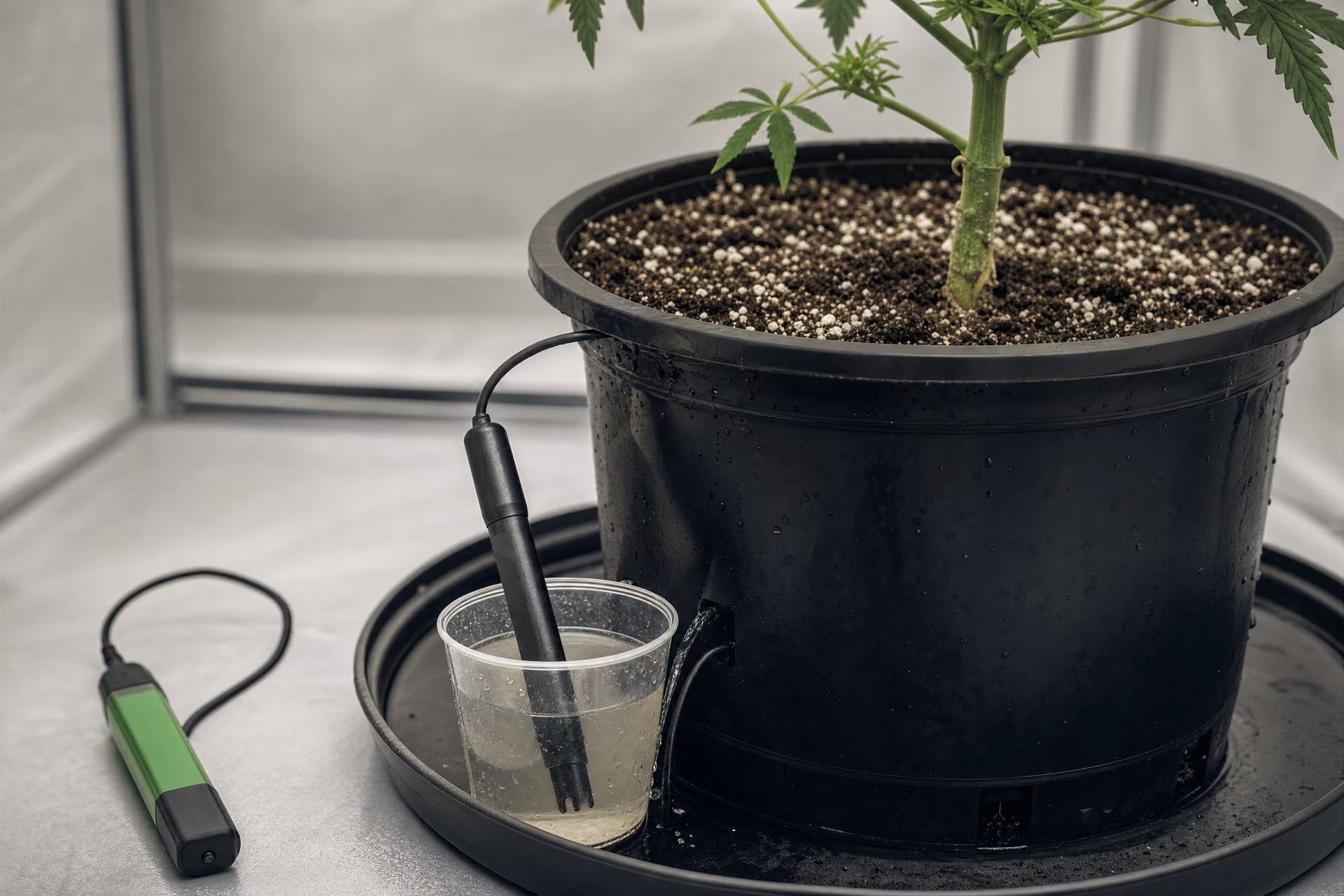
Reservoir, feed, runoff, slurry, and root-zone testing
For feed-solution testing, mix nutrients completely before measuring. Add base nutrients one at a time, stir thoroughly, then wait a few minutes before checking EC. Check pH after the solution is fully mixed, not halfway through. If you use silica, calcium nitrate, or concentrated two-part nutrients, order and dilution matter because incompatibility can cause precipitation and false readings.
After pH adjustment, wait again. Measure, stir, let the solution equilibrate, then recheck. Immediate readings after adding pH up or down are often unstable, especially in cold water or high-alkalinity water. Penn State Extension’s work on irrigation chemistry makes this point indirectly: alkalinity, not raw pH alone, drives how hard water pushes substrate pH over time. So a source water pH of 7.8 may be easy to correct if alkalinity is low, while 7.2 water with heavy bicarbonates can keep forcing drift.
In hydroponic reservoirs, test at least three things: fresh feed, reservoir after circulation, and drift over time. Cornell CEA places most hydroponic nutrient solutions in the 5.5 to 6.5 range. Letting pH move gently within that band is often healthier than forcing it to one static number.
In coco and other soilless systems, runoff is a practical root-zone proxy. Collect runoff after the pot is evenly wetted, not the first few drops and not old liquid sitting in a saucer. Compare runoff pH and EC to input. If runoff EC is consistently much higher than feed, salts are building up. If runoff pH keeps rising, high-alkalinity water, uneven fertigation, or media imbalance may be involved.
Saturated media extract A root-zone testing method in which container media is brought to saturation and the extracted solution is measured for pH and EC. It is more informative than casual runoff in many container substrates.
Soil is different. Runoff is much less reliable there because channeling and uneven wetting distort the picture. A slurry test is better: mix a representative sample of media with distilled water in a standard ratio, let it equilibrate, then measure. Even better, when available, is a saturated media extract, the greenhouse standard for container media interpretation used by labs and extension programs. That gives a stronger read on root-zone chemistry than casual runoff numbers.
Measurement mistakes that create fake deficiencies
- Dirty probes Fertilizer crust, biofilm, or staining can skew readings.
- Expired buffers Old calibration fluids make a meter drift without obvious warning.
- Measuring too soon Readings taken right after dosing acid or base are often unstable.
- Poor mixing Separated or precipitating nutrient solution gives misleading pH and EC values.
- ppm without scale A ppm number is incomplete unless the meter’s conversion factor is stated.
- Ignoring source-water EC Baseline conductivity may be coming from bicarbonates, sodium, or chloride rather than useful nutrition.
Common measurement errors that create false diagnoses
The biggest error is treating one number as a diagnosis. A plant can show iron deficiency symptoms because root-zone pH is too high, not because feed EC is too low. University of Florida IFAS notes micronutrients such as iron, manganese, zinc, and copper become less available as substrate pH rises above the recommended range.
Other common failures are more mundane. Dirty probes. Expired calibration fluids. Measuring right after dosing acid or base. Not stirring thoroughly. Testing nutrient solution that has separated, precipitated, or sat long enough for chemistry to shift. Reporting ppm without scale. Ignoring source-water EC, which means your “1.6 EC feed” might include 0.6 EC of bicarbonates, sodium, or chloride rather than useful nutrition.
That last point causes endless confusion. EC measures dissolved ions, not which ions they are. Hard water can contribute calcium and magnesium, but it can also bring alkalinity that drives pH upward. Poor water quality can mimic overfeeding, underfeeding, or lockout all at once.
So measure the right thing, in the right place, with a calibrated tool. Otherwise you are not troubleshooting chemistry. You are guessing.
Why pH drifts over time
pH does not “move” for no reason. It shifts because the root zone is chemically active all day: roots exchange ions, microbes transform nitrogen, substrates adsorb and release charged nutrients, and irrigation water keeps adding dissolved carbonates and salts. That is why a feed mixed to 5.9 can still produce runoff at 6.6, or a hydro reservoir set at 6.0 can wake up at 5.5 the next morning.
The first correction to make is simple: solution pH is not the same thing as root-zone pH. In hydro, they are close because roots sit directly in the nutrient solution. In coco, peat, and soil, the medium changes the chemistry between input and uptake. Buffering slows drift in soil, but it does not prevent it. Coco sits in the middle. It behaves more like a soilless hydro substrate than a mineral soil, yet its cation exchange sites still matter, especially for calcium, magnesium, and potassium.
Because the pH scale is logarithmic, small changes are not small in chemical terms. A one-unit shift means a tenfold change in hydrogen ion activity, as the USGS notes. That helps explain why a medium that drifts only half a point can suddenly start showing iron or manganese deficiency symptoms even when those elements are present in the feed.
Ion uptake and pH direction
- More cation uptake than anion uptake
- The rhizosphere usually acidifies.
- More anion uptake than cation uptake
- pH tends to rise around the roots.
- Nitrate-heavy feeding
- Often pushes systems upward over time.
- Ammonium
- Tends to drive pH downward.
Plant uptake of cations and anions
Roots do not absorb nutrients in electrically neutral chunks. They take up charged ions, and to keep charge balance they release either hydrogen ions (H+) or hydroxyl/bicarbonate equivalents. That exchange changes pH around the root surface.
Rhizosphere The thin zone of media and solution directly surrounding the roots, where uptake, exudates, microbes, and pH shifts interact most intensely.
When plants absorb more cations than anions, the rhizosphere usually acidifies. Common cations include potassium (K+), calcium (Ca2+), magnesium (Mg2+), and ammonium (NH4+). When plants absorb more anions than cations, pH tends to rise. The major anions are nitrate (NO3-), phosphate forms, and sulfate (SO4 2-). This is one reason nitrate-heavy feeds often push systems upward over time, while ammonium tends to drive pH downward.
In hydroponics, this shows up fast because there is little buffering. Cornell Controlled Environment Agriculture places most hydroponic crops in the 5.5 to 6.5 range, but inside that range some drift is normal and even useful. Different nutrients are slightly more available at different points. A reservoir that glides from 5.7 to 6.2 over a day is not automatically a problem. A reservoir that repeatedly climbs to 6.8 or crashes to 5.0 is.
Nitrogen form matters a lot here. If microbes convert ammonium to nitrate through nitrification, they release acidity. Warm reservoirs with biofilm can drift for that reason alone. Root exudates and microbial respiration add carbon dioxide, which can form carbonic acid in solution and nudge pH lower. In sterile-looking systems, biology still often finds a foothold.
Water alkalinity, bicarbonates, and reservoir chemistry
Growers often obsess over starting water pH and ignore alkalinity. That is backwards. Starting pH tells you what the water reads now. Alkalinity tells you how hard it is to change that water’s pH and how strongly it will resist staying changed after nutrients are added.
The main driver is usually bicarbonate. Penn State Extension greenhouse guidance has long emphasized that alkalinity, not raw water pH, predicts acid requirement and long-term substrate drift. Two waters can both test at pH 7.2, yet behave very differently. One may have low alkalinity and drop to 5.8 easily when nutrients are mixed, then stay there. The other may be loaded with bicarbonates and rebound upward after mixing or after irrigation events in the medium.
That is why high-alkalinity water often creates chronic upward drift in peat, coco, and soil-based containers. Every irrigation adds a little neutralizing capacity. Over time it pushes the root zone away from the target even if the input solution looks acceptable.
Reservoir chemistry adds another layer. Concentrates mixed in the wrong order can precipitate calcium phosphate or calcium sulfate, removing ions from solution and altering pH behavior. Letting nutrient solution sit with aeration can also change the reading as dissolved gases equilibrate and unstable reactions settle. Measuring right after mixing and again after equilibration can reveal whether the solution is actually stable.
Dry-back, salt buildup, and microbial effects in media
In media-based systems, drift is often a product of concentration, not just composition. As containers dry back, water leaves faster than salts do. EC rises in the remaining pore water. That concentrates bicarbonates, nitrate, potassium, sodium, chloride, and everything else present. The root zone the plant experiences late in the cycle may be much more alkaline or saline than the feed going in.
This is why inadequate runoff matters in coco and peat. Input EC is not runoff EC. If fertigation is light, infrequent, or uneven, salts accumulate in zones of the pot rather than being displaced. High-alkalinity water makes that worse by repeatedly depositing bicarbonate load. The result is a medium that trends upward in pH and upward in salinity at the same time. Then the plant shows interveinal chlorosis or rusty spotting, and the grower adds more feed. Wrong move. If iron, manganese, zinc, or phosphorus are being locked out by high pH, or calcium uptake is being antagonized by excess potassium and sodium, stronger feed deepens the problem.
Coco has its own twist. It is not inert like rockwool. Its exchange sites can hold and release cations, especially calcium, magnesium, and potassium. If the medium was poorly buffered to begin with, or if fertigation is inconsistent, those exchange reactions can distort both EC and pH trends in the root zone.
Microbes also push media pH around. In organic-rich substrates, decomposition, nitrification, denitrification in wet pockets, and organic acid production all alter local chemistry. Soil usually masks these swings better because of stronger buffering from cation exchange and carbonate reactions. Hydro exposes them faster. Coco sits between those worlds, which is why it rewards frequent measurement of both feed and runoff instead of faith in a single target number.

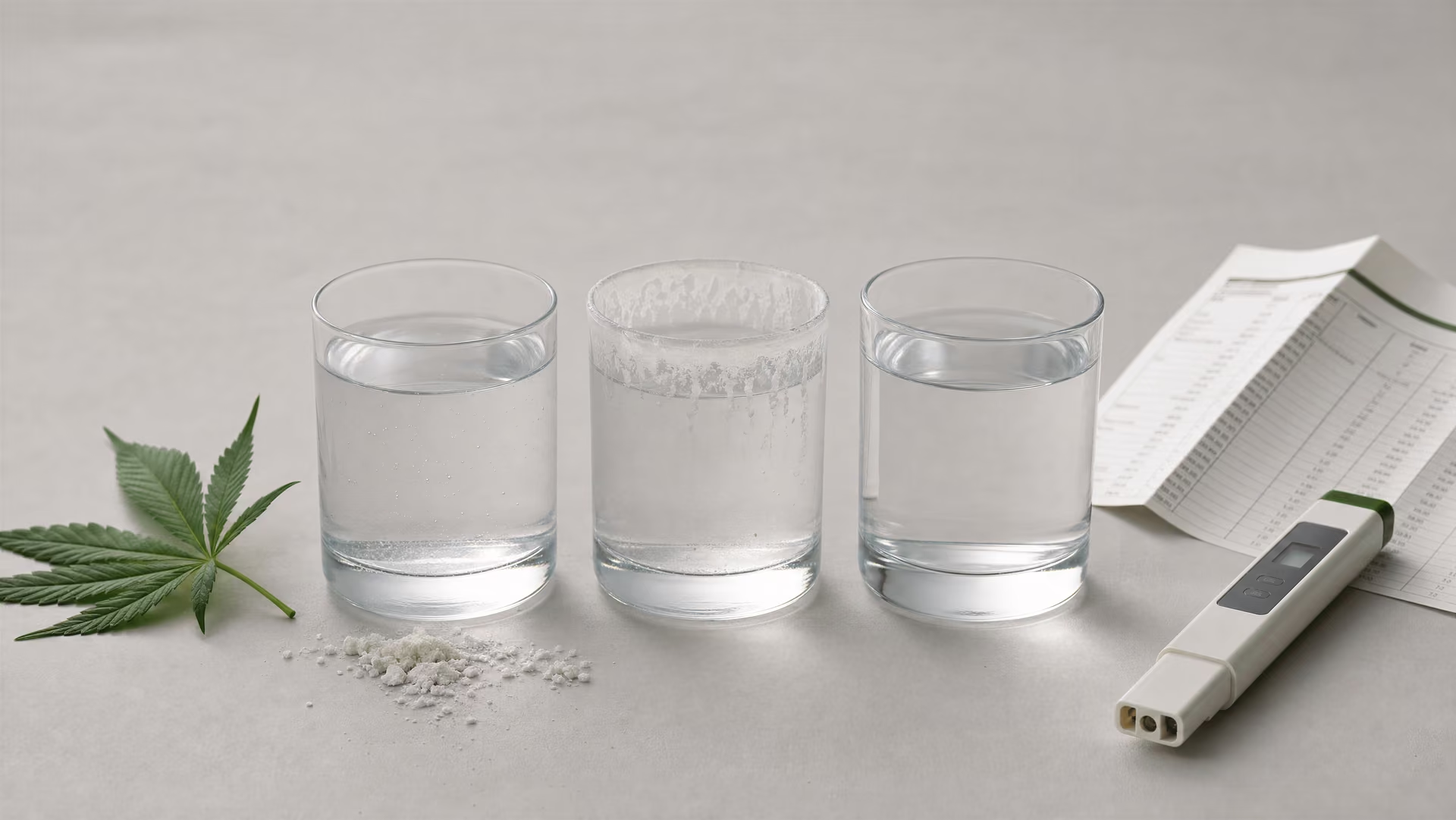
Water quality: the hidden variable behind unstable pH and EC
Water is not a blank canvas. It arrives carrying calcium, magnesium, bicarbonate, sodium, chloride, silica, iron, and whatever else your source picked up on the way to the tap. That starting chemistry sets the tone for every pH adjustment, every EC reading, and every diagnosis that comes later. Many growers blame the nutrient line first. Often the water report tells the real story.
A common mistake is treating source-water pH as the main variable. It matters, but not in the way people think. Water with a high pH can still be easy to manage if its alkalinity is low. Water with a lower pH can be a long-term headache if bicarbonates are high and keep pushing the root zone upward after every irrigation. The input number is only the opening scene.
| Water type | Typical effect on pH / EC management | Main risk or tradeoff |
|---|---|---|
| Hard water | Adds baseline EC and often calcium, magnesium, and bicarbonates | Can distort nutrient ratios and increase upward pH pressure |
| Naturally soft water | Easy to acidify, usually low buffering | May lack calcium and magnesium and can be unstable |
| Softened household water | May show modest EC but altered chemistry | Often higher in sodium because softeners replace Ca and Mg |
| Reverse osmosis water | Low baseline EC and reduced bicarbonate, sodium, and chloride | Useful calcium and magnesium must be added back intentionally |
Hard water, soft water, reverse osmosis, and baseline EC
Baseline EC is the conductivity of your water before nutrients are added. That number is not “free feed.” EC only tells you that ions are present, not which ones. Two waters can read the same and behave very differently.
Hard water usually contains meaningful calcium and magnesium, often with bicarbonates. That can help if your nutrient program runs light on Ca and Mg. It can also distort the recipe. If the water is already supplying a lot of calcium, adding a full-strength cal-mag product on top may push ratios out of balance and inflate EC without solving the real issue. In coco, where calcium and magnesium management already matters because of cation exchange, this gets messy fast.
Soft water is not automatically better. Naturally soft water may have low calcium and magnesium and very little buffering. That makes it easy to acidify, but also easier to destabilize. “Softened” household water is worse for plants than many people realize because softeners commonly replace calcium and magnesium with sodium. The EC may look modest. The chemistry is still poor.
Reverse osmosis strips almost everything out. That solves some problems at once: lower baseline EC, less bicarbonate pressure, less sodium and chloride. It also removes useful calcium and magnesium, so the nutrient formula must replace them intentionally. RO water is a reset button, not a complete solution.
For context, the EPA secondary standard for total dissolved solids in drinking water is 500 mg/L, and chloride is 250 mg/L. Those are aesthetic drinking-water references, not crop thresholds, but they are useful reminders that “clean enough to drink” does not mean agronomically neutral. If your tap water is already carrying a heavy mineral load, changing nutrient brands may do less than changing the water source.
Alkalinity versus pH: the number growers forget to test
Alkalinity is the water’s acid-neutralizing capacity, driven mainly by bicarbonate and carbonate. This is the number that predicts whether your substrate will drift upward over time. Penn State Extension has long emphasized this in greenhouse nutrition because alkalinity, not raw water pH, determines how much acid is required and how strongly the medium resists change.
That distinction matters. A source water pH of 8.0 with low alkalinity may be corrected easily and remain stable after mixing. A water pH of 7.2 with high bicarbonate alkalinity may look less alarming on paper, yet it keeps nudging the root zone higher after every feed. In peat mixes and soil, buffering may hide the problem for a while. In coco and hydro, it shows up sooner.
High bicarbonate water creates chronic upward pH pressure in container media and root zones over time. Strong evidence
High bicarbonate water creates chronic upward pH pressure. Over time that can reduce iron, manganese, zinc, and copper availability. University of Florida IFAS guidance on container media is clear: micronutrient availability falls as substrate pH rises above the recommended range. The leaves then show classic deficiency patterns, and many growers respond by adding more fertilizer. Wrong move. If root-zone pH is the blocker, more EC often worsens the stress.
This is where a water report beats endless bottle swapping. If bicarbonates are high, you need to know that before rewriting the feeding program.
Sodium, chloride, and bicarbonate as chronic stressors
Sodium and chloride are easy to overlook because they may not cause dramatic damage overnight. Instead they act as chronic stressors. Sodium competes at the root surface and degrades water quality for repeated irrigation. Chloride is an essential micronutrient in tiny amounts, but excess chloride contributes to salinity and can accumulate in closed or low-runoff systems.
Bicarbonate is different. It does not just raise EC; it pushes chemistry. Repeated use of high-bicarbonate water can turn a feeding schedule that looks correct on paper into a high-pH root zone with locked-out micronutrients and rising runoff EC. The grower sees yellowing and reaches for more nutrients. The medium becomes saltier. The plant gets worse.
Practical rule: if pH drifts up no matter what acid you add, runoff keeps climbing, or calcium and magnesium issues never quite resolve, stop blaming the nutrient brand and pull a water report. Source water shapes everything that follows. Ignore it, and pH and EC will keep looking “unstable” even when the real problem is stable, repeatable, and coming straight from the tap.
Nutrient lockout from pH imbalance
A leaf can look hungry while sitting in a root zone full of nutrients. That is the central mistake behind a lot of cannabis troubleshooting. Growers see interveinal chlorosis, tip burn, rust spots, or purple stems and assume the feed is too weak. Sometimes it is. Often it is not.
Lockout is what happens when nutrients are present in the medium or solution but become less available, less soluble, chemically antagonized, or harder for roots to absorb because the root-zone pH has shifted out of range. pH matters this much because it changes hydrogen ion activity on a logarithmic scale; one full pH unit is a tenfold change in acidity, as the USGS notes. That shift alters solubility, ionic form, microbial processes, and membrane transport at the root surface.
The phrase “nutrient availability curve” is useful here. Different elements are most available over different pH bands. In hydroponics and other low-buffer systems, Cornell Controlled Environment Agriculture places most crops around pH 5.5 to 6.5 for that reason. In peat and container media, University of Florida IFAS guidance similarly shows that micronutrient availability falls as pH rises above the recommended range. That is why chlorosis can develop in a well-fed crop with a full reservoir and a high runoff EC. The issue is not absence. It is access.
Just as important: the pH of the feed going in is not always the pH around the roots. Soil buffers. Coco exchanges cations. Hydro shifts fast. A reservoir at 5.9 can still produce a root-zone problem if alkalinity is high, salts are accumulating, or irrigation patterns are driving drift.
| Condition | Nutrients commonly affected | Typical symptom pattern | Common wrong response |
|---|---|---|---|
| High root-zone pH | Iron, manganese, zinc, copper, phosphorus | Pale new growth, interveinal chlorosis, stalled growth, dull foliage, possible purpling | Raising feed strength instead of correcting pH trend |
| Low root-zone pH | Calcium, magnesium, molybdenum | Twisted new growth, weak tips, interveinal chlorosis on older leaves, poor root function | Adding more salts to an already stressed root zone |
| High EC / salinity | Water uptake broadly restricted; antagonism increases | Burnt tips, dark foliage, clawing, slowed growth, apparent deficiencies despite rich media | Pushing EC even higher |
High-pH lockout: iron, manganese, zinc, copper, phosphorus
High root-zone pH is the classic cause of “mystery deficiency” in otherwise heavily fed plants. Iron is usually the first one noticed. New growth turns pale or yellow while veins stay greener, because iron is relatively immobile in the plant and deficiencies show up in fresh tissue first. Manganese and zinc problems can look similar, though manganese may progress to small necrotic specks and zinc can shorten internodes and distort new leaves. Copper issues are less common but can appear as twisted growth and loss of vigor.
This pattern is well established in container crop science. UF IFAS notes that iron, manganese, zinc, and copper become less available as substrate pH rises above the target range. Phosphorus can also become less available at elevated pH, especially where calcium levels are high, because it precipitates into less soluble forms. In practice, that can show up as dark dull foliage, reduced growth, and purpling that gets blamed on genetics or cool nights when chemistry is the real driver.
In cannabis, the trap is obvious: chlorotic tops appear, so the grower adds more micronutrients or increases overall feed strength. If the medium is already salty, that raises EC and worsens osmotic stress. The plant now has two problems instead of one: poor micronutrient availability from pH and reduced water uptake from excess salts.
The fix is not to chase symptoms with stronger bottles. Check root-zone conditions. In hydro, test the reservoir and watch daily drift. In coco or soilless media, compare input and runoff pH and EC. If runoff pH has climbed and runoff EC is already higher than feed EC, adding more feed is usually the wrong move. Correct the pH trend, reduce accumulated salts if needed, then resume a balanced program.
Low-pH stress: calcium, magnesium, molybdenum, root damage
Low pH causes a different set of failures. Calcium and magnesium uptake can become erratic, and molybdenum availability drops sharply in acidic conditions. Molybdenum gets less attention than iron, but it matters because it supports nitrate reduction inside the plant. When it is limited, plants can show odd deficiency patterns that look like a nitrogen problem even when nitrate is present.
Calcium issues under low-pH stress often appear in fast-growing tissues: twisted new leaves, marginal necrosis, weak tips, and poor root development. Magnesium shortages tend to show first on older leaves as interveinal chlorosis because magnesium is mobile. In coco, this gets even messier because the medium itself has cation exchange behavior and can hold onto calcium, magnesium, and potassium in ways that distort the simple feed-chart story.
Then there is direct root injury. Very acidic root zones do not just change nutrient availability; they can damage root membranes and suppress root growth. Once roots are stressed, uptake efficiency drops across the board. A plant may then present as multi-deficient even though the underlying issue is root health. This is why severe low-pH problems often look chaotic: calcium-like spots, magnesium-like yellowing, stalled growth, droop, and weak water uptake all at once.
In hydroponics, this can happen fast because roots are exposed directly to solution chemistry. In peat or soil, buffering slows the process, but chronic acidic drift still causes trouble over time. In coco, repeated low-pH fertigation plus high dry-back can create a hostile rhizosphere even when the input numbers seem “safe.”
Antagonism versus true deficiency
Nutrient antagonism A root-zone interaction where excess of one ion suppresses uptake of another, such as high potassium reducing calcium or magnesium uptake.
Not every deficiency symptom is caused by pH, and not every pale leaf means the recipe is too weak. The useful distinction is this: a true deficiency means the nutrient supply is genuinely insufficient. Antagonism means one ion interferes with the uptake of another. Lockout can involve both pH and antagonism at the same time.
A common example is excess potassium suppressing calcium and magnesium uptake. Another is excess ammonium competing with cation uptake more broadly. High sodium or chloride in source water can add background stress that pushes a borderline feed program into visible symptoms. High EC itself acts like a throttle on uptake by reducing the plant’s ability to pull in water. Since nutrients move with water, absorption suffers even when the medium tests “rich.”
That is why EC must be read as a salinity signal, not a nutrition guarantee. It tells you there are dissolved ions present, not which ions, and not whether the plant can access them. A high-EC root zone with yellow leaves often points to lockout or antagonism, not underfeeding. Pushing EC higher in that situation is one of the most common self-inflicted mistakes in cannabis cultivation.
Mechanistic troubleshooting is slower than guessing, but it works. Ask six questions. Is root-zone pH too high? Too low? Is EC accumulating? Is source water adding alkalinity, sodium, or chloride? Is the symptom pattern consistent with a mobile or immobile nutrient? Could the meter be wrong? Uncalibrated pH pens and ambiguous ppm readings cause plenty of fake deficiencies.
When symptoms show up, resist the urge to feed your way out immediately. First determine whether the crop is underfed, locked out by pH, or being blocked by antagonism in a salty medium. Those are not the same problem, and they do not respond to the same fix.
Optimal EC ranges by cannabis growth stage
EC targets are useful only when they are treated as starting points, not laws. Cannabis does not “eat” EC; roots absorb specific ions, and the same input EC can behave very differently in soil, coco, and hydro depending on dry-back, runoff, water alkalinity, and light intensity. That is why a feed chart can look reasonable on paper while the root zone is already too salty. Input EC matters. Root-zone EC matters more.
EC is measured in mS/cm, and 1.0 mS/cm equals 1000 µS/cm, as Bluelab notes. Stick with EC when possible. ppm figures create noise because Hanna Instruments documents multiple TDS conversion scales—0.5, 0.64, and 0.7—so two meters can show different ppm values for the same solution.
- Seedlings / clones
- 0.4-0.8 mS/cm
- Watch for accumulation
- If feeding 0.6 mS/cm and runoff climbs to 1.0-1.2 mS/cm, salts are building up
- Main goal
- Root establishment, not dark leaf color
Seedlings and clones: low-EC establishment
Freshly rooted clones and seedlings generally do better in the 0.4-0.8 mS/cm range. Often the lower half is safer at first, especially if the starting water already carries calcium, magnesium, bicarbonates, or sodium. A young plant has limited root mass, low transpiration, and a small margin for error. Push EC too early and you do not speed growth; you more often slow water uptake and stress tender roots.
This is the stage where growers create problems by feeding for leaf color instead of root development. Dark green seedlings are not the goal. Fast, steady establishment is.
Coco deserves extra caution here because it can hold onto calcium and magnesium while releasing potassium if it was not well buffered. That can tempt growers to raise EC aggressively. Usually that is the wrong response. Better to keep total EC modest, maintain frequent but not excessive moisture, and watch new growth quality. In hydro or plug production, consequences show up even faster because the roots are exposed directly to solution chemistry.
Low light and cool temperatures push the target down. So does a high-VPD mistake in the other direction: if the plant is not actually moving water well, more ions in solution can become a burden rather than a benefit. If cotyledons and first leaves look slightly pale but growth is steady, that is often preferable to a stalled seedling in a hot mix.
Runoff or media extract trends are valuable here. If you feed 0.6 mS/cm and runoff climbs to 1.0-1.2 mS/cm in a tiny container, you are accumulating salts. Back off. Young plants rarely need heroic feeding.
Vegetative growth: scaling EC to transpiration and light
Vegetative cannabis often lands around 0.8-1.4 mS/cm in lower-intensity environments and around 1.2-1.8 mS/cm in more aggressive systems. That split matters. A plant under modest LED intensity, no CO2 enrichment, and cooler leaf temperatures does not need the same concentration as one under high PPFD with strong airflow and frequent fertigation.
This is where many generic charts fail. They assume nutrient demand rises simply because the plant is older. In reality, demand rises when the environment allows the plant to move water and photosynthesize hard. High light, enriched CO2, warm but controlled leaf temperature, and regular irrigation can justify a higher EC because the plant is actually using more ions. Weak light, cool rooms, overwatered pots, or long dry-backs call for restraint.
In coco, a common mistake is running vegetative EC too low while watering too infrequently, then wondering why runoff EC spikes. That is not underfeeding. It is concentration through evaporation and root uptake. Conversely, in recirculating hydro, a rising reservoir EC often means plants are taking up water faster than nutrients, which points to an overly strong mix. If EC falls steadily, nutrient strength may be too low for the current growth rate. Trend interpretation beats one-off readings.
A practical stance: start veg at the lower end, then increase only if the plant is asking for it. Signs that it may tolerate more include rapid pale-green new growth, falling reservoir EC in hydro, or low and stable runoff EC in coco despite vigorous growth. Signs that EC is already high include clawing, burnt tips spreading beyond the oldest leaves, sluggish transpiration, and runoff that keeps climbing.
Flowering: why higher EC is not automatically better
Many flowering programs sit around 1.4-2.2 mS/cm. That range is common for a reason, but it gets abused. Late veg and flower do not automatically justify pushing feed to the ceiling. High EC can support high-output flowering only when the rest of the system supports high uptake: strong PPFD, adequate root oxygen, disciplined irrigation frequency, and, in some rooms, added CO2. Without those conditions, excess salinity can reduce water uptake, raise substrate osmotic stress, and mimic deficiency.
This is why “bloom deficiency” diagnoses are so often wrong. A plant showing interveinal chlorosis or marginal necrosis in mid-flower may not need more fertilizer. If root-zone pH has drifted or runoff EC is already elevated, adding more feed deepens the lockout. University of Florida IFAS guidance on container media is clear that micronutrients such as iron, manganese, zinc, and copper become less available as substrate pH rises above the recommended range. If pH is off, high EC is not a fix.
There is also a law of diminishing returns. Some growers can run above 2.2 mS/cm in hydro or coco under very high intensity and heavy irrigation, but copying that in a cooler room with fewer daily dry-back cycles is asking for trouble. More nutrient concentration does not force more yield.
Watch the plant, then the runoff, then the chart. If flowers are building well, leaves remain functional, and runoff EC is stable, there may be no reason to increase feed. If runoff climbs week after week, remedial leaching or a lower input EC makes more agronomic sense than doubling down. That kind of corrective flushing is different from pre-harvest flushing, which Rx Green Technologies reported in 2019 did not significantly change yield, potency, or terpene content across treatments.
The useful rule is simple: set stage-based EC bands, then let environment and root-zone data overrule them. Generic numbers start the conversation. Plant response ends it.
Adjusting pH and EC without creating new problems
Chasing a target number too aggressively causes a lot of self-inflicted damage. pH and EC are not dashboard lights that demand an instant hard turn. They are signals. In soil, coco, and hydro, the safer move is usually to correct the cause and steer the root zone back into range over one to several irrigations, not force a dramatic swing in one pass.
A basic rule comes first: mix nutrients fully, let the solution stabilize, then adjust pH. Never pH plain water first and assume the final feed will stay there after base nutrients, calcium-magnesium inputs, silica, or additives are added. Those ingredients change acidity, alkalinity, and ionic balance. Since pH is logarithmic, a one-unit move means a tenfold change in hydrogen ion activity, as USGS notes. That is not a small tweak.
How to raise or lower pH safely
Adjust pH after all nutrients are in solution and after the mix has had a few minutes to equilibrate. In reservoirs, longer is often better; a reading taken immediately after mixing may drift once gases exchange and concentrates fully disperse. Measure, wait, measure again.
When lowering pH, use small additions, stir thoroughly, then retest. Overshooting low is often worse than being slightly high for a short time, especially in coco and hydro where roots are exposed to the new chemistry quickly. The same applies when raising pH. A large correction can precipitate nutrients, destabilize chelates, or push calcium and phosphate toward insoluble forms if the mix is already concentrated.
The target depends on the system. Cornell CEA places most hydroponic nutrient solutions in the 5.5 to 6.5 range. For coco, many growers work around 5.8 to 6.2 because calcium and magnesium behavior in coir makes that band practical. Soil and peat-based container mixes usually run higher, often around 6.2 to 6.8, because buffering and microbial activity change nutrient availability. One number for every substrate is lazy advice.
If irrigation water has high alkalinity, repeated acid additions may only treat the symptom. Penn State Extension’s greenhouse guidance has long stressed that bicarbonate alkalinity, not raw water pH alone, predicts upward drift. Water at pH 7.8 with low alkalinity can be easy to manage; water at 7.2 with high bicarbonates can keep dragging the medium upward. In that case, smaller repeated corrections plus water treatment or blending make more sense than one severe acid hit.
For soil, avoid yo-yo watering with sharply acidic then sharply alkaline feeds. Soil buffers, but repeated swings can disturb biology and create misleading runoff readings. For hydro, slight controlled drift inside range is often healthier than trying to pin the reservoir at one decimal point all day.
Dilution, remixing, and staged corrections for EC
EC correction starts with interpretation. Input EC is not root-zone EC. Runoff EC in coco or a slurry test in container media tells you whether salts are accumulating where roots actually live. EC also does not identify which ions are present. It only reports total conductivity. Bluelab notes EC is measured in mS/cm, and Hanna Instruments points out that ppm values vary by meter scale: 0.5, 0.64, and 0.7 conversions are all common. If someone reports “900 ppm” without the scale, that number is incomplete.
If EC is too high in a fresh feed, the first fix is dilution with suitable water, then remix and retest. If source water already carries substantial baseline EC from bicarbonates, sodium, chloride, calcium, or magnesium, dilution may help less than expected. In recirculating hydro, a reservoir reset is often cleaner than trying to mathematically rescue a badly mixed tank. Drain, remix correctly, then recheck pH after nutrients have stabilized.
A 2019 cannabis trial reported no significant differences in yield, potency, or terpene content across pre-harvest flush durations. Limited evidence
In coco, chronic high runoff EC usually calls for staged correction rather than a panic flush with extreme volumes. Reduce feed strength, increase irrigation frequency if dry-back has been excessive, and produce enough runoff to move salts out over the next few events. If buildup is severe, a remedial leach has a clear agronomic purpose: lower root-zone salinity. That is different from pre-harvest flushing claims, which are much weaker. Rx Green Technologies reported no significant differences in yield, potency, or terpene content across flush durations in a 2019 cannabis trial.
If EC is too low, do not jump straight to a heavy feed unless the plant is clearly underfed and the root zone is otherwise stable. A pale plant in high runoff EC is not hungry. It is often locked out.
Why sudden corrections can shock roots
Roots adapt to their chemical surroundings. Fast changes in osmotic pressure, ion ratios, and acidity can damage root membranes and reduce uptake even when the final number looks “correct” on a meter. That is why a mild temporary deviation is often less harmful than a violent correction.
In hydro and coco, this matters most. The root system has less buffering than in mineral soil, so a rapid drop in EC can change water movement into cells, while a rapid pH swing can alter nutrient form and membrane transport within hours. Plants may respond with wilting, stalled growth, or new deficiency symptoms caused by the correction itself.
Make changes in steps. Recheck instruments before blaming the plant. Calibrate pH and EC meters regularly, store the pH probe in proper storage solution, and use educational, legal phrasing when sharing methods rather than treating any additive or brand as a cure-all. The safest adjustment strategy is simple: verify the reading, correct gradually, and watch the root zone rather than the bottle label.
Flushing, leaching, and the difference between a rescue tactic and a pre-harvest ritual
“Flush your plants before harvest” gets repeated so often that it is treated like settled science. It isn’t. The word flushing is doing two very different jobs in cannabis cultivation, and mixing them up leads to bad decisions. One is a corrective intervention for a root zone overloaded with salts. The other is a pre-harvest ritual meant to improve smoke quality. Those are not the same practice, and they do not rest on the same evidence.
Corrective flushing for salt buildup
When a medium has accumulated excess fertilizer salts, leaching can make agronomic sense. This is not folklore. It is basic root-zone chemistry.
In coco, peat mixes, and other container substrates, input EC is only the starting point. What matters is what roots are actually sitting in after repeated irrigations, dry-backs, evaporation, and uneven nutrient uptake. A grower may be feeding a moderate solution, yet runoff EC keeps climbing because water is leaving the pot faster than salts are being removed. That concentrated root zone can push plants into osmotic stress and nutrient antagonism. Leaves then show “deficiency” symptoms even though plenty of ions are present. Adding more feed at that point is often exactly wrong.
Corrective leaching aims to lower root-zone EC, not to “clean the plant out.” If runoff EC is far above input EC, tips are burning, and pH is drifting out of range, a heavy irrigation with properly pH-adjusted, lower-EC solution can reset the substrate enough to restore uptake. In coco or soilless systems, this may mean irrigating to substantial runoff until the leachate trends back toward a reasonable range. In severe cases, one pass is not enough. The goal is measurable change in the medium, not adherence to a ritual number of gallons.
This is where substrate matters. Soil buffers more strongly through cation exchange and carbonate chemistry, so aggressive leaching can create other problems, including waterlogging and nutrient depletion. Hydroponics is different again: you are usually not “flushing” a medium but replacing or diluting a reservoir. Same principle, different mechanics.
What the cannabis flushing research actually found
The most cited cannabis-specific dataset here is the Rx Green Technologies trial from 2019. It compared pre-harvest flush durations and reported no significant differences in yield, potency, or terpene content among treatments. That directly challenges the popular claim that flushing for a week or two reliably improves chemical quality.
It does not prove that flushing can never affect sensory experience under any condition. The trial has limits, as all trials do: one setup, one methodology, and finite scope. But it is still more informative than repeating inherited grow-room lore. If someone claims pre-harvest flushing produces smoother flower, sweeter aroma, or cleaner ash as a rule, published cannabis data do not strongly back that up.
That matters because the common explanation is physiologically shaky. Nutrients are not sitting in harvested flowers as loose “chemical residue” waiting to be washed out by plain water in the final days. Plant mineral status is tied to tissue composition, ongoing remobilization, senescence, and drying and curing conditions. Harsh smoke can come from many causes, including poor dry, chlorophyll retention from bad curing, immature harvest timing, and excess salts in the medium earlier in flower. Pre-harvest water-only feeding is a blunt tool for a problem that may not exist.
Use leaching when the mechanism fits
- Use corrective leaching When runoff EC is high, pH has drifted, tips are burning, or uptake has stalled from excess salts.
- Do not treat it as ritual Pre-harvest water-only feeding is not the same as rescuing an over-saline root zone.
- Match the method to the substrate In coco or soilless media, leach to measurable runoff improvement; in hydro, reset or dilute the reservoir; in soil, avoid waterlogging.
When flushing makes agronomic sense and when it may not
Use leaching when there is evidence of a root-zone problem: high runoff EC, recurring tip burn, stalled uptake, pH-induced lockout, or a medium that has become more saline than the plant can tolerate. In that context, flushing is a rescue tactic. It addresses an actual mechanism.
Do not assume pre-harvest flushing is automatically improving end product quality. In a healthy crop with balanced fertigation, stable root-zone pH, and manageable EC, switching to plain water simply because the calendar says so may reduce nutrient availability during a period when the plant is still metabolically active. Sometimes that has little visible effect. Sometimes it accelerates fade without delivering any proven gain.
A better rule is this: diagnose first, then irrigate with intent. If the medium is too hot, leach it. If the plant is finishing normally and the root zone is in range, ritual flushing is not a substitute for sound nutrition, dry, and cure.
Troubleshooting cannabis deficiencies caused by pH and EC errors
Many apparent “deficiencies” in cannabis are not feeding problems at all. They are access problems. Nutrients can be present in the pot, tank, or feed chart and still fail to reach the plant if root-zone pH has drifted out of range, salts have accumulated, or the medium is interacting with ions in ways the grower did not account for. This is why adding more fertilizer to a yellowing plant often makes it worse.
The first correction is conceptual: stop treating the number in the bottle or reservoir as the whole story. Solution pH is not necessarily root-zone pH. Input EC is not runoff EC. A plant in mineral soil, buffered peat mix, coco, and recirculating hydro can show similar leaf symptoms for very different chemical reasons.
USGS notes that the pH scale is logarithmic, so a one-point shift is a tenfold change in hydrogen ion concentration. That is not a minor swing. Cornell Controlled Environment Agriculture places most hydroponic crops in the 5.5 to 6.5 range, while UF IFAS guidance for container media reflects different buffering behavior and micronutrient dynamics. Cannabis advice that collapses all systems into one “correct” pH misses the point.
Six-step diagnosis workflow
- Verify the meter Calibrate pH and EC tools before trusting any reading.
- Check source water Review baseline EC and alkalinity, not just water pH.
- Inspect the input solution Mix in the right order and measure after equilibration.
- Test the root zone Use runoff trends in coco and slurry or media extract in soil and peat-heavy mixes.
- Review irrigation practice Look for chronic dry-back, too little runoff, or over-dilution.
- Review recent environment Light, VPD, root-zone temperature, and reservoir changes can alter uptake and drift.
A stepwise diagnosis workflow
Start with the tools before you diagnose the plant. If your pH pen is dry, out of calibration, or stored improperly, every conclusion that follows is suspect. Calibrate pH meters with fresh 4.0 and 7.0 buffers as directed by the manufacturer. EC meters need verification too. And if someone reports ppm without saying whether the meter uses a 0.5, 0.64, or 0.7 conversion, the number is partly meaningless; Hanna Instruments has warned about this for years. EC in mS/cm is cleaner.
Next, check the source water. Not just pH. Baseline EC matters, and so does alkalinity. Water with low pH but high bicarbonates can still push the root zone upward over time. Hard water may contribute useful calcium and magnesium, but it also raises starting EC and can complicate nutrient ratios. If source water is already unusually high in dissolved solids, the feed program has less room before salinity becomes a problem. EPA secondary guidance puts drinking-water TDS at 500 mg/L and chloride at 250 mg/L as nuisance thresholds; those numbers are not cannabis targets, but they remind you that water chemistry is not neutral.
Then inspect the input solution. Mix nutrients fully, in the right order, and measure both pH and EC right away. Measure again after short equilibration. If readings move sharply after sitting, you may have instability, precipitation, temperature effects, or poor concentrate mixing. In hydro, this can show up fast. In soil, it may take longer to notice.
After that, test the root zone rather than guessing from the feed tank. In coco and soilless systems, runoff pH and runoff EC are useful trend indicators, especially when tracked over several irrigations instead of interpreted from one random sample. In soil or peat-heavy mixes, a slurry test usually tells you more than runoff because channeling can distort runoff readings. If runoff EC is consistently much higher than input EC, salts are accumulating. If runoff pH is drifting out of range while feed pH looks fine, the medium and water chemistry are driving the problem.
Now check irrigation practice. Chronic dry-back in coco concentrates salts and often creates calcium and magnesium trouble that gets misread as underfeeding. Too little runoff in high-frequency fertigation systems allows EC to climb. Too much dilution in a heavily leached setup can create generalized hunger even when pH is acceptable. Frequency matters almost as much as formula.
Last, review environmental changes from the previous week, not just the previous day. Higher light intensity, increased vapor pressure deficit, root-zone cooling, a new reservoir temperature, or a sudden shift in transpiration can alter nutrient uptake patterns and pH drift. If symptoms appeared right after a hot, bright spell or after irrigation frequency was reduced, that timing is evidence.
| Pattern | Likely chemistry issue | Where it often appears first | Interpretation |
|---|---|---|---|
| Interveinal chlorosis in new growth | High pH limiting micronutrient availability | Young leaves and tops | Often iron or manganese access trouble, not simple underfeeding |
| Twisted weak new growth with mixed deficiency signs | Low pH stressing roots and reducing Ca/Mg/Mo function | Fast-growing tissues | Root zone may be chemically hostile rather than nutrient-poor |
| Burnt tips, dark foliage, clawing, high runoff EC | Chronic excess EC and salinity | Leaf tips and margins | Lockout by salinity and antagonism is more likely than hunger |
| Even pale growth with runoff below input EC | Underfeeding or over-dilution | Whole plant | A measured EC increase may be more appropriate than a flush |
Symptom patterns linked to high pH, low pH, and excess EC
High root-zone pH usually shows up first as micronutrient unavailability. UF IFAS consistently notes that iron, manganese, zinc, and copper become less available as container-media pH rises above the recommended range. In practice, cannabis often responds with interveinal chlorosis in new growth: young leaves turn pale between the veins while the veins stay greener. That pattern points strongly toward iron or manganese access issues, especially in hydro or coco where pH drift can bite quickly. If the grower responds by increasing feed strength, chlorosis may worsen because the problem was availability, not concentration.
Low root-zone pH creates a different cluster. Roots become stressed, calcium and magnesium uptake can suffer, and molybdenum availability can become limiting. New growth may emerge twisted or weak, while older leaves can show mixed deficiency-like symptoms that do not cleanly match a single element. In severe cases, the plant looks both hungry and burnt. That contradiction is a clue. The root zone is chemically hostile, so the plant cannot regulate uptake normally.
Coco deserves special suspicion when calcium and magnesium symptoms appear despite adequate feeding. Coco is not inert. Its cation exchange sites can hold calcium, magnesium, and potassium, particularly if the material was poorly buffered or if the fertigation strategy allows strong dry-back. The classic pattern is rusty spotting, marginal necrosis, weak new growth, and a plant that seems to want more Cal-Mag every time you look at it. Often the real fix is better buffering assumptions, steadier fertigation, and lower salt accumulation, not endless supplementation.
Chronic excess EC has its own look. Leaf tips burn first. Margins crisp. Foliage gets dark, sometimes too dark, and leaves may claw downward from osmotic stress and ammonium-heavy feeding. The medium reads “hot,” runoff EC stays elevated, and the plant slows even though nutrients are abundant. This is lockout by salinity and antagonism. Potassium can suppress calcium and magnesium uptake. Excess overall ions make water extraction harder for roots. The plant can sit in a sea of fertilizer and still act deprived.
Do not ignore the opposite case: generalized hunger from underfeeding or over-dilution. Pale plants with lower overall vigor, especially when runoff EC is below input EC and the medium is being heavily leached, may simply not be receiving enough nutrition. This is common after growers overcorrect from fear of burn. The distinction matters. Underfeeding usually lacks the sharp edge burn and clawing of salt stress, and it often improves with a measured increase in EC rather than a flush.
When the meter—not the plant—is the problem
A shocking number of pH and EC disasters start on the bench, not in the root zone. pH probes dry out. Calibration solution expires. Pens drift. Automatic temperature compensation is assumed but not verified. Nutrient solution is measured cold in one session and warm in another. Then a grower “fixes” a problem that never existed.
Watch for impossible stories. If every plant suddenly looks deficient right after the meter was dropped, trust the accident before the diagnosis. If your feed supposedly measures very low EC but leaves are clawed and runoff is sky-high, suspect the meter. If two ppm meters disagree, ask which scale each uses. Bluelab reports EC in mS/cm and notes that 1.0 mS/cm equals 1000 µS/cm; that unit consistency avoids a lot of confusion.
The strongest habit is not chasing daily numbers. It is building stable root-zone chemistry over time. When source water is understood, instruments are trustworthy, irrigation is consistent, and runoff or slurry trends stay within a sane range for the substrate, deficiency symptoms fall dramatically. Stable chemistry beats constant correction. Almost every time.