














Why cannabis training works at all
Cannabis training works for the same reason pruning, trellising, and canopy shaping work in other high-value crops: it changes plant architecture so the canopy captures light more evenly, exchanges air more effectively, and directs growth into sites that can actually finish well. It does not inject yield into the plant. It does not create potency by stress alone. If a method improves harvest weight, the gain usually comes from better use of photons, floor area, root volume, and time.
That distinction matters because cannabis culture often treats training as a bag of tricks. The physiology is less romantic and more useful. A plant with one dominant apex naturally builds a tall, uneven canopy. Indoor lights do not reward that shape very well. The top gets saturated or nearly so, the middle gets acceptable light, and the lower sites live on leftovers. Training is an attempt to flatten that inequality.
Peer-reviewed, head-to-head cannabis trials comparing topping, FIMing, supercropping, ScrOG, and mainlining under identical conditions are still sparse. Limited evidence
Peer-reviewed, head-to-head cannabis trials comparing topping, FIMing, supercropping, ScrOG, and mainlining under identical conditions are still sparse. So the strongest claims should stay narrow. Training can improve canopy uniformity, light distribution, harvest efficiency, and disease management. Whether it raises yield depends on cultivar structure, veg time, plant density, light intensity, container size, and environment. Stress by itself is not the yield engine.
Apical dominance The tendency of the main shoot tip to suppress growth of lower side branches, producing a taller and less even plant form.

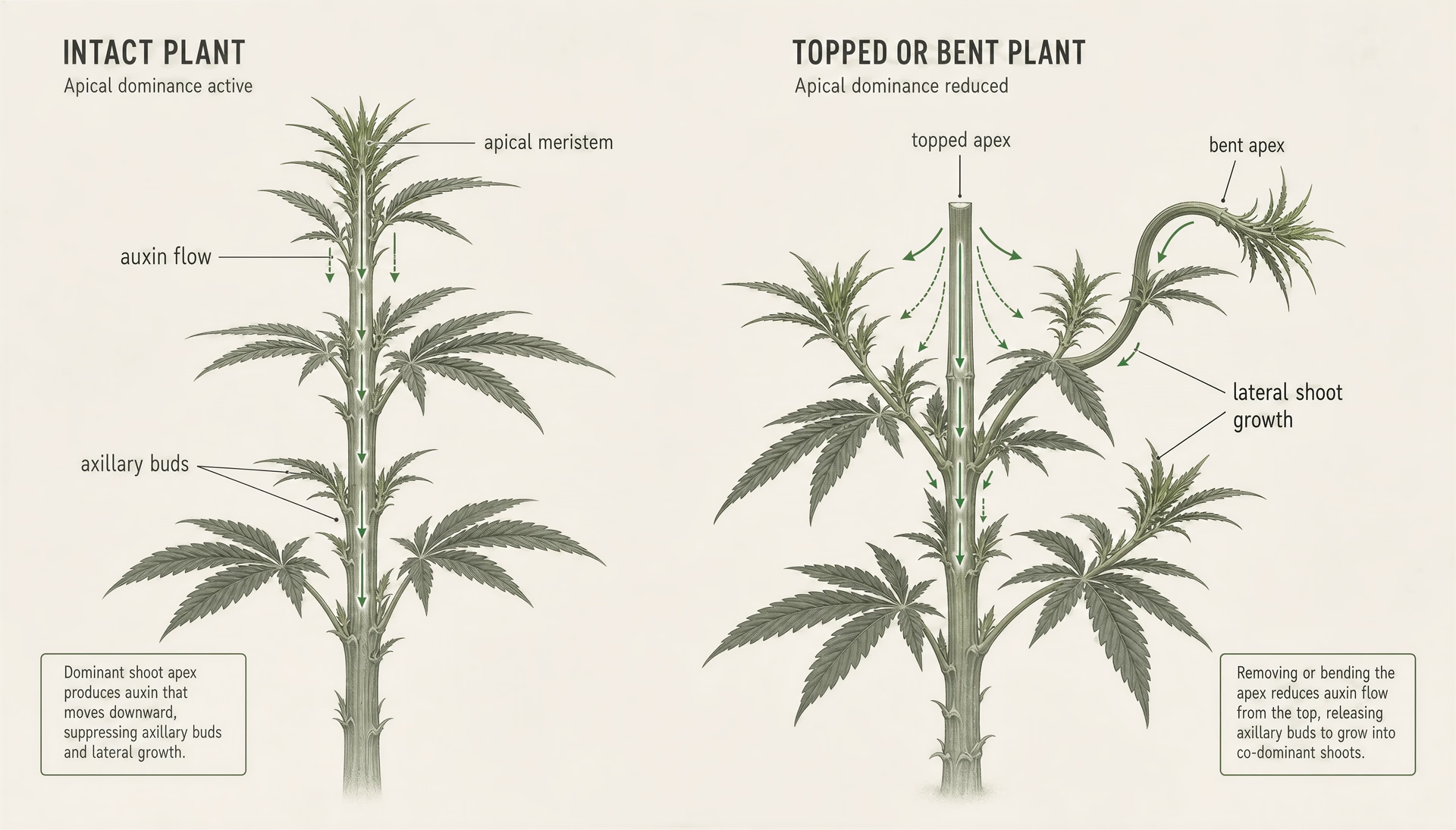
Apical dominance, auxin, and why the top cola usually wins
Branching signals mentioned here
- Auxin
- A hormone exported from the shoot tip that helps suppress lower axillary buds.
- Cytokinin
- A hormone group involved in promoting bud outgrowth and lateral development.
- Strigolactone
- A signaling group that interacts with auxin and cytokinin to regulate whether side buds stay dormant or grow.
- Axillary bud
- A bud formed at a leaf axil that can remain dormant or extend into a branch.
A cannabis plant is not trying to make an even indoor canopy. Left alone, it tends to express apical dominance: the shoot tip suppresses the outgrowth of lower lateral branches. The main hormonal driver is auxin exported from the apical meristem. That auxin flow interacts with cytokinin and strigolactone signaling to regulate whether axillary buds stay dormant or begin active extension growth. This mechanism is well established across horticulture, even if cannabis-specific training papers are limited.
That is why the top cola usually wins. The highest shoot tip has positional and hormonal advantages, so it grows faster, shades lower branches, and reinforces its lead. Indoors, that creates a steep vertical hierarchy of light exposure. David Potter’s work on medicinal cannabis production and later controlled-environment guidance from Youbin Zheng’s group at the University of Guelph both point in the same direction: upper inflorescences receive far more usable light than lower ones, and that difference drives uneven floral development.
Topping interrupts apical dominance by removing the shoot apex. The auxin source is cut off, hormone gradients shift, and dormant or slow-growing lateral meristems are released from suppression. Bending does something similar without cutting. When the highest point is pulled down below competing shoots, the plant’s signaling and growth pattern change because “top” is partly a geometric status, not just a fixed branch identity. This is why low-stress training can produce multiple co-dominant tops from a plant that would otherwise make one main spear.
None of this is magic. You are redistributing growth, not creating new energy. In fact, topping carries a short-term cost because the plant loses tissue and pauses to recover. If veg time is tight, that delay can erase the benefit. If veg time is available and plant count is limited, the trade can make sense because several medium-height tops inside the lamp’s sweet spot often outperform one tall apex plus a mass of shaded lower sites.
- Irradiance level 1
- 570 W/m²
- Yield at level 1
- 601 g/m²
- Irradiance level 2
- 930 W/m²
- Yield at level 2
- 907 g/m²
Light interception is the real yield driver
Yield follows light more closely than it follows any named training technique. Strong evidence
Yield follows light more closely than it follows any named training technique. The indoor cannabis data from Pradeep Chandra, Mahmoud ElSohly, and colleagues in HortScience (2008) make the point clearly: dry flower yield rose from 601 g/m² at 570 W/m² irradiance to 907 g/m² at 930 W/m². That does not mean more light always helps without limit, but it does show the hierarchy. First deliver enough photons. Then shape the canopy so more of those photons land on productive tissue at useful intensities.
This is the real argument for topping, LST, ScrOG, and selective pruning. Not “more tops” as a slogan, but more even PPFD across flowering sites. A flat, filled canopy keeps reproductively active tissue inside the fixture’s effective footprint. A lopsided plant wastes light on aisles, walls, and overlit upper leaves while lower flowers remain underexposed. Greenhouse canopy research outside cannabis has shown the same pattern for years: horizontal canopies often improve whole-canopy photosynthesis because they reduce self-shading and spread light more uniformly.
| Jurisdiction | Home-grow limit stated in article | Training implication |
|---|---|---|
| Germany | Up to 3 plants per adult | Large-plant methods such as topping plus LST or ScrOG become more attractive |
| Canada (most provinces) | Up to 4 plants per residence | Large-plant canopy-filling methods often make more sense than classic high-count SOG |
That is also why training cannot be judged apart from density and root-zone variables. Jonathan Caplan, Mike Dixon, and Youbin Zheng showed in 2017 that substrate volume, irrigation strategy, and fertigation regime materially affect cannabis growth and yield. A dense SOG can work because it reduces veg time and fills space quickly, but if plant counts are legally restricted or root volume is small, the system changes. In Germany, adults may grow up to three plants under the 2024 law. In most of Canada, the federal framework allows up to four plants per residence. Under those constraints, large-plant methods such as topping plus LST or ScrOG often make more agronomic sense than classic high-count SOG.
Canopy shape, airflow, and disease pressure
Canopy architecture also controls the air the plant lives in. Dense foliage slows airflow, traps humidity, and prolongs leaf wetness around flowers and interior leaves. That raises disease pressure, especially late in flower when transpiration is high and inflorescences become physically crowded. Training that opens the plant can lower that risk by improving convective heat loss, vapor removal, and air exchange through the canopy.
This is where defoliation gets badly overstated online. Leaves are source tissue. They capture light, assimilate carbon, and support flower growth. Remove too many healthy fan leaves and photosynthetic capacity drops. Ontario and University of Guelph extension guidance have repeatedly warned that aggressive defoliation can reduce yield unless it solves a real bottleneck such as severe self-shading or excess canopy humidity. Lollipopping and selective leaf removal are tools for managing unproductive lower growth and stagnant interiors, not a universal route to heavier harvests.
So every training method comes back to the same biological test. Does it improve PPFD uniformity, light interception, transpiration conditions, and airflow enough to outweigh recovery time and lost leaf area? If yes, yield may improve. If not, the plant was only stressed, not helped.
Before choosing a technique: the variables most guides ignore
Most training mistakes happen before the first bend or cut. Growers ask whether topping beats FIMing or whether ScrOG outyields SOG, but that is the wrong level of analysis. Training changes canopy architecture. Whether that architectural change pays off depends on recovery time, branch habit, root-zone capacity, light intensity, and the legal number of plants you are allowed to run.
That is why blanket claims about “20% more yield” from any one method are weak. The stronger claim, and the one supported by both cannabis work and general horticulture, is narrower: training helps when it improves whole-canopy light interception, airflow, and harvestable site uniformity without imposing more recovery cost than the crop can repay. Chandra, ElSohly and colleagues showed in 2008 that indoor cannabis flower yield rose from 601 g/m² at 570 W/m² irradiance to 907 g/m² at 930 W/m². The point is not that more light solves everything. It is that canopy management matters only if your canopy can capture and use the photons available.
Under the hood, the key mechanism is apical dominance. The shoot tip exports auxin, which suppresses outgrowth of axillary buds; cytokinin and strigolactone signaling help determine how strongly side branches respond once that tip is bent, damaged, or removed. Topping works by changing those hormone gradients. LST works by changing branch position and light exposure with less tissue loss. ScrOG and SOG are not magic yield hacks at all. They are layout strategies for arranging leaf area and flower sites inside a finite light footprint.
| Plant type | Recovery runway | Methods the article favors | Main risk called out |
|---|---|---|---|
| Photoperiod | Can stay in veg until canopy is built | Topping, manifolding, repeated LST, ScrOG | Only worthwhile if veg time is available |
| Autoflower | Short and fixed vegetative window | Early tie-downs, leaf tucking, slight repositioning, very selective pruning | A stalled week is a large fraction of the life cycle |
Photoperiod vs autoflowering plants
Photoperiod cultivars give you an option autos usually do not: time. If a plant can remain in vegetative growth until the canopy is built, topping, manifolding, repeated LST, and ScrOG become rational because there is enough recovery runway for the redistributed growth to pay back the pause. A photoperiod in a long veg cycle can absorb a topping event, rebuild apical structure from axillary meristems, and then enter flower with a flatter canopy.
Autoflowers are different because the clock is running regardless of recovery. Their short vegetative window narrows the margin for error. A hard topping on day 18 might work on one vigorous auto under ideal conditions, then reduce final size on another that stalls for a week. That unpredictability is the issue. Not dogma.
So the default split is straightforward. Photoperiods tolerate and often reward structural training if veg time is available. Autos usually respond better to gentler methods: early tie-downs, leaf tucking, slight repositioning of branches, and very selective pruning only when airflow or shading has become the actual bottleneck. High-stress work on autos is a higher-risk bet because any lost week is a large fraction of the life cycle.
Plant traits that change training choice
- Short internodes Often create dense crowns that benefit more from opening the canopy and reducing humidity pockets.
- Long internodes Often need topping or repeated bending to control vertical dominance and may fit ScrOG naturally.
- Stiff branches Make late tie-downs or net weaving more damaging, so early training matters more.
- Pliable branches Are more forgiving and easier to shape laterally with less breakage risk.
Genotype, internode spacing, and branch stiffness
“Cannabis” is too broad a category to make training rules from. Architecture matters. A broad-leaf, short-internode plant already builds a dense crown with many closely stacked sites. That type often benefits from opening the canopy and reducing humidity pockets more than from creating even more tops. Aggressive defoliation is still easy to overdo, but selective thinning and branch spread can be useful because self-shading is the problem.
A lankier plant with longer internodes behaves differently. It may need topping or repeated bending simply to stop vertical dominance from wasting light above the productive zone. It may also fit a ScrOG naturally because flexible branches can be guided laterally across the screen without repeated breakage.
Branch stiffness is one of the most ignored variables online. Some plants fold easily under LST. Others lignify early and resist bending, making late tie-downs or weaving through a net more damaging than expected. With stiff, upright plants, early training matters more because the window for low-stress shaping closes fast. With pliable, vine-like branches, delayed shaping is more forgiving.
This is also where FIMing, topping, and supercropping separate. Topping is more predictable. Supercropping can reshape a stubborn branch, but on brittle genetics it carries a real breakage cost. Mainlining and manifolding demand symmetry; they make little sense on a genotype that throws uneven laterals, variable vigor, or awkward node spacing.
| Constraint | Methods the article says fit best | Why |
|---|---|---|
| Low legal plant count | Topping, repeated LST, manifolding, ScrOG | Each plant must occupy more horizontal area |
| Permissive plant count and fast turnaround | SOG | Minimizes veg time and relies on many small plants |
| Low ceiling | Topping plus LST or modest ScrOG | Horizontal structure keeps more sites inside the useful PPFD band |
| Taller room | Larger plants without a full screen may be acceptable | Vertical space is less punishing |
Plant-count laws, veg-time budget, and room geometry
Legal limits change the training equation as much as plant biology does. Germany’s 2024 CanG allows adults to cultivate up to three plants for personal use. Canada’s federal framework allows up to four plants per residence in most provinces. Under those rules, classic high-count SOG becomes less rational for home growers, not because SOG stopped working, but because plant-count efficiency matters more than cycle speed.
If you can run only three or four plants, each plant must occupy more horizontal area. That pushes the decision toward topping, repeated LST, manifolding, or ScrOG. A wide, level canopy lets each legal plant intercept a larger share of available light. In that setting, a single untopped Christmas-tree plant is often an inefficient use of the count limit.
Reverse the constraints and the answer can flip. If plant counts are permissive and turnaround speed matters more than per-plant size, SOG may outperform slower training systems by minimizing veg time and relying on many small, single-cola plants. The architecture is simpler. The trade-off is density management, irrigation precision, and disease risk.
Room shape matters too. Low ceilings punish vertical methods and reward horizontal ones. A strong fixture in a short tent usually favors topping plus LST or a modest ScrOG because flattening the canopy keeps more sites inside the useful PPFD band. Tall rooms with weaker side-to-side light uniformity may tolerate larger plants without a full screen. Geometry is not decoration. It determines whether your chosen structure matches the light footprint.
Fertigation The delivery of nutrients through irrigation water, with frequency and substrate management affecting recovery, growth rate, and yield.
Container volume, root restriction, and irrigation strategy
Training advice often treats the canopy as if it floats above the pot. It does not. Root-zone size sets an upper bound on how much canopy a plant can support and how fast it can recover from pruning, topping, or hard bending.
Caplan, Dixon, Zheng and colleagues showed in 2017 that substrate volume and fertigation strategy significantly affected cannabis growth and yield. That finding has direct training implications. A heavily topped plant in a small container has less buffering capacity than the same genotype in a larger, well-managed root zone. If roots are restricted, recovery slows, transpiration becomes less stable, and aggressive canopy expansion can outrun water and nutrient supply.
Pot size also changes what defoliation and lollipopping do. In a large container with frequent fertigations, lower-site cleanup may redirect resources usefully and improve airflow. In a small pot watered infrequently, the same plant may already be resource-limited; removing healthy leaves can reduce source capacity more than it improves sink efficiency. Ontario and Guelph extension guidance has been consistent on this point: leaves are photosynthetic source tissue, so defoliation has a real cost.
Irrigation frequency matters just as much. High-frequency fertigation in small containers can support dense, fast-growing canopies that would struggle in hand-watered pots of the same size. If your watering strategy cannot keep pace with the transpiration demand created by a broad ScrOG canopy, the screen becomes a liability. The plant cannot be moved easily, drydowns become uneven, and local stress accumulates under the net.
So choose the root-zone system first, then choose the training method it can support. Not the other way around.
Low-stress training: bending the canopy without cutting the plant
Low-stress training, or LST, means physically repositioning stems and branches with little to no intentional tissue injury. No topping cut. No snapped knuckles. No deliberate crushing. The goal is architectural: lower the highest points, spread the canopy laterally, and expose shaded shoots to a more equal share of light.
That distinction matters because a lot of grow advice explains LST as if the plant “likes stress” and responds by producing more flowers. The better explanation is simpler. Cannabis yield indoors is tightly linked to intercepted light and how evenly that light is distributed across productive flowering sites. Chandra, Lata, Khan, and ElSohly showed in a 2008 HortScience study that dry flower yield rose from 601 g/m² at 570 W/m² irradiance to 907 g/m² at 930 W/m². Training only helps if it improves the canopy’s ability to use the photons already being delivered. Flattening the canopy does exactly that.
For many home growers, LST is the highest-value training method. It costs almost nothing, it is forgiving, and it works well where plant counts are capped. That legal context is not trivial. Germany’s 2024 cannabis law allows up to three plants for adult home cultivation; Canada generally allows up to four plants per residence under the federal framework. If you only get three or four plants, turning each one into a wider, more evenly lit canopy often makes more agronomic sense than growing many small, untrained plants.
Basic LST sequence
- Anchor the base Stabilize the container or stem base so the root ball does not twist in the medium.
- Lower the apex Pull the main stem away from vertical with a soft tie.
- Fix the top to the rim Secure the top sideways so lateral branches receive more light and compete.
- Retie as growth turns upward Adjust every few days because the plant will try to reassert vertical growth.

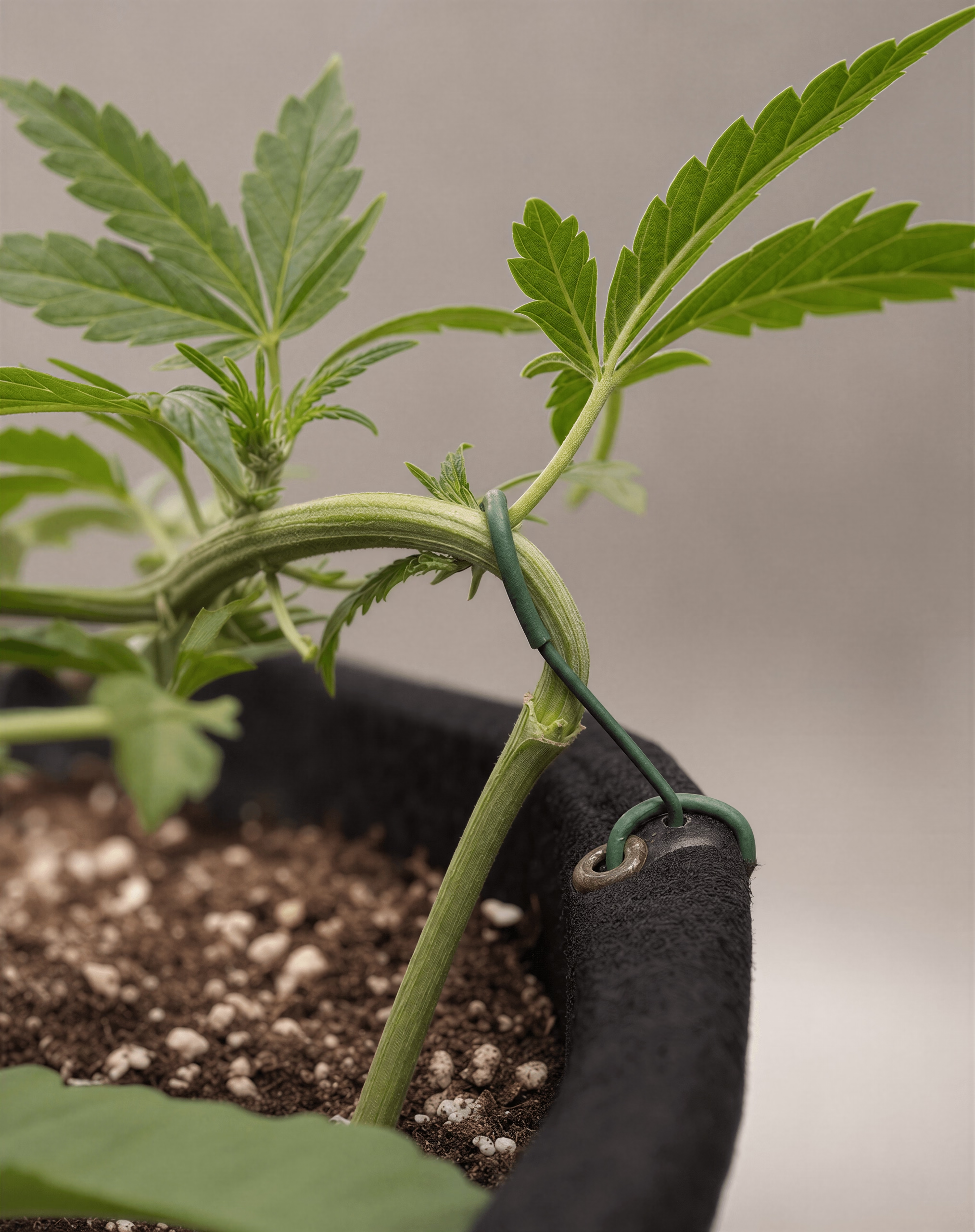
Classic LST and tie-down methods
Classic LST starts by pulling the main stem away from vertical and fixing it in place with soft ties. Garden wire with a rubber coating, pipe cleaners, fabric plant ties, or soft string all work if they do not cut into the epidermis. One anchor holds the container or stem base stable. Another pulls the top sideways. As the apex is lowered, lateral branches that were previously subordinate receive more light and a weaker apical signal. They begin to elongate and compete.
Apical dominance is driven largely by auxin export from the shoot tip, with branching also shaped by cytokinin and strigolactone signaling. LST does not remove the apex the way topping does, but it changes the plant’s geometry enough to weaken the top’s practical dominance over the rest of the canopy. Light exposure shifts. Branch angles shift. Growth priorities shift.
Phototropism Directional growth toward light. In practice, bent cannabis shoots keep turning upward, which is why LST needs repeated adjustment rather than one bend.
A basic sequence looks like this: anchor the base, bend the main stem gradually off-center, tie the top to the pot rim, then retie every few days as the plant turns back toward the light. Phototropism never stops. Cannabis will try to reassert vertical growth, so LST is not one bend; it is a series of corrections.
The details decide whether LST stays low-stress. Ties should pull outward and slightly downward, not sharply kink one node. Tension should be distributed across the branch, not concentrated at a single soft internode. Pot-rim holes, binder clips, drilled container edges, and stake loops all create better anchor points than improvised knots around fragile stems. If one branch is pulled hard while the opposite side is ignored, the canopy becomes lopsided and the root ball can twist in the medium. That is a common beginner mistake.
Another is tying too tightly. Stems thicken fast in veg. A tie that looked loose on Monday can girdle tissue by Friday.
When to start LST and how branch flexibility changes with age
Start early. That is the whole trick.
Young vegetative growth is pliable because tissues have not fully lignified. Internodes bend. Petioles swivel. Branches recover quickly. Once stems age, cell walls stiffen, bark-like outer tissues develop, and the same bend that was easy two weeks earlier becomes a split waiting to happen.
In practice, many growers begin once the plant has several established nodes and the stem can be guided without collapsing the seedling. Early veg is the sweet spot. By then the root system can support renewed growth, but the architecture is still easy to reshape. Wait too long and LST turns into accidental high-stress training.
Flexibility also varies by cultivar. Narrow-leaf plants with longer internodes are often easier to spread. Stocky broad-leaf types can be denser, shorter-jointed, and less forgiving at the base, even if their side branches respond well once opened up. Environment changes flexibility too. Fast, turgid growth under warm conditions and adequate irrigation bends more safely than drought-stiffened stems.
If a branch resists, do not force the final angle in one move. Bend a little, wait a day, then bend again. Rolling the stem gently between fingers before training can help assess stiffness, but the aim is not to crush tissue. If the branch creases, stop. A partial split can be taped and often heals, but that is no longer true LST.
This timing issue is one reason LST works so well for home growers with moderate veg periods. It fits the window when plants are small enough to manage and before the canopy turns into a crowded mass. It also stacks neatly with topping if that is planned later. Top once, then spread the resulting leaders with ties. That pairing is often more productive under low plant-count rules than either method alone.
| LST layout | How it is arranged | Main advantage | Main management issue |
|---|---|---|---|
| Radial training | Branches are spread outward like spokes from the center | Reduces self-shading and opens the middle for airflow | Needs even spacing so one branch does not sit above another |
| Spiral training | Main stem is guided around the container edge | Creates many upright tops from one stem without cutting | Requires frequent tie adjustment so inner shoots are not trapped |
| Edge management | Dominant shoots are restrained from overrunning the perimeter | Keeps the brightest central footprint filled | Without correction, vigorous tops can hog the edges and leave a hollow middle |
Radial training, spiral training, and edge management
Once the grower moves beyond one bent main stem, LST becomes a canopy layout system.
Radial training spreads branches outward from the center like spokes on a wheel. Each major branch is pulled toward a different point on the container rim so that no branch sits directly above another. This is one of the cleanest ways to build an even plant because it reduces self-shading and opens the middle for airflow. In square tents and under rectangular fixtures, radial layouts often match the light footprint better than leaving the plant as a cone.
Spiral training takes the main stem and guides it around the container edge in a circular path. As each node rotates into better light, lateral shoots rise from along the spiral and create many upright tops at similar height. It is an efficient way to turn one dominant stem into a ring of productive sites without cutting. The drawback is management complexity. If ties are not adjusted often, inner shoots can get trapped and outer growth can hog the perimeter.
Edge management is the underrated part. Under indoor lights, the center of the footprint usually receives stronger, more direct PPFD than the margins. Yet plants trained flat often push their most vigorous tops outward into the edges while leaving a hollow middle. Good edge management means resisting that drift. Pull dominant shoots back from the perimeter if needed. Fill dead space under the brightest part of the fixture. Do not let one quadrant surge ahead and cast shade across the rest.
This is where LST stops being “bend branches” and becomes canopy engineering. The target is not maximum width at any cost. The target is a canopy surface that fits the effective light footprint and keeps flowering sites at similar distance from the fixture.
What LST can and cannot fix
LST can fix poor canopy shape. It can fix light inequality caused by vertical growth. It can improve airflow by opening crowded interiors. It can make irrigation, inspection, and pruning easier. It can turn one legally permitted plant into a canopy that uses the tent properly.
It cannot fix weak lighting. It cannot compensate for a root zone that is too small, a point Caplan, Dixon, and Zheng highlighted in their 2017 fertigation and container-volume work. It cannot rescue genetics with extreme stretch if the veg period already ran too long. It cannot solve chronic overwatering, nutrient imbalance, or high humidity by itself.
And LST is not a license to strip leaves aggressively. Leaves are source tissue. Ontario and University of Guelph extension guidance repeatedly warns that heavy defoliation can reduce photosynthetic capacity unless there is a clear benefit in light penetration or disease prevention. If the canopy is flat and open because of LST, that often reduces the need for leaf removal in the first place.
The hard limit is time. LST works by steering growth as it happens. If flowering has advanced and stems have hardened, structural change becomes slower, riskier, and less useful. At that stage, selective support and minor repositioning may still help, but the plant’s basic architecture is already set.
Published cannabis trials comparing every training style head-to-head are still sparse. Limited evidence
So the honest position is this: LST is not magic, and published cannabis trials comparing every training style head-to-head are still sparse. But for small-scale growers, especially under three- or four-plant legal limits, it offers a rare combination of biological logic and practical upside. Cheap. Reversible. Effective when done early. That is why it remains the foundation technique against which the flashier methods should be judged.
| Method | What is done | Main structural goal | Key downside named in the article |
|---|---|---|---|
| Topping | Remove the shoot apex | Interrupt apical dominance and create competing laterals | Recovery pause and loss of young source tissue |
| FIMing | Partially remove the apical tip | Reduce dominance without full decapitation | Less reproducible branch architecture |
| Supercropping | Crush or bend inner stem tissue without severing the branch | Lower canopy peaks and redirect a tall stem | Breakage, infection risk, and variable payoff |
High-stress training: topping, FIMing, supercropping, and intentional injury
High-stress training is not magic. It is planned damage applied for a structural reason: to interrupt apical dominance, flatten canopy height, or force a stem into a more productive light field. That can help. It can also waste days of growth, reduce photosynthetic capacity, and trigger stress responses if the plant is weak, root-bound, overfed, underlit, or already deep into flowering.
The common mistake is to talk about HST as if the injury itself creates yield. It does not. The gain, when there is one, comes from what the injury changes afterward: hormone flow, branch hierarchy, light interception, airflow through the canopy, and the share of flower sites sitting inside useful PPFD. Chandra, Lata, Khan, and ElSohly showed in 2008 that indoor cannabis yield rises strongly with delivered light, from 601 g/m² at 570 W/m² to 907 g/m² at 930 W/m². That matters here because topping or supercropping only pays if the reshaped canopy captures more of that light efficiently. A damaged plant under weak light is still a damaged plant.
Topping and decapitation of the shoot apex
Topping has the strongest physiological basis of any common HST method because it directly removes the shoot apex, the main source of auxin export that maintains apical dominance. In intact shoots, auxin moving down from the apex suppresses the outgrowth of axillary buds, while cytokinin and strigolactone signaling help determine which side shoots stay dormant and which begin active elongation. Remove the apex and the hierarchy changes fast. Lateral meristems that were subordinate become competitive.
That is why topping is reproducible. You are not hoping for stress to “boost” growth. You are changing the command center at the top of the plant.
In practical canopy terms, topping trades one dominant vertical leader for two or more active branches near the cut site, depending on cultivar and subsequent management. If those branches are then spread outward with low-stress training or woven into a screen, the plant can occupy horizontal space more evenly. Under indoor lighting, that is usually the point. Potter’s work on medicinal cannabis production and later controlled-environment guidance from Youbin Zheng’s group at Guelph both support the same broad principle seen across greenhouse crops: a flatter canopy improves whole-canopy light distribution when it reduces self-shading and keeps productive sites inside the fixture’s effective footprint.
There are costs. Topping removes young source tissue and pauses extension growth while the plant reassigns resources. The size of that pause depends on genotype, vigor, root volume, irrigation stability, and environmental quality. Caplan, Dixon, and Zheng showed in 2017 that substrate volume and fertigation regime materially alter cannabis growth and yield. That means recovery from topping is not only about the cut. A plant in a small container with a marginal root zone has less buffer for imposed injury than the same clone in a larger, well-managed medium.
Cultivar architecture matters too. Narrow, strongly apical plants often respond well to topping because the intervention corrects a real structural imbalance. Short, branchy cultivars may need less severe intervention. If the plant already has good lateral development and the canopy is not too tall for the light footprint, topping can be unnecessary delay.
FIMing: what it is, why results are inconsistent, and how it differs from topping
FIMing is a partial removal of the apical growth tip rather than full decapitation. In theory, it damages the apex enough to reduce apical dominance without removing the whole meristem, often producing several new shoots instead of the cleaner two-way split expected after topping.
The problem is precision. FIMing is less reproducible than topping because the grower is trying to partially injure a tiny, still-developing apex, and small differences in cut depth and timing change the outcome. Sometimes it behaves like a weak topping. Sometimes it barely interrupts dominance. Sometimes it produces a cluster of uneven new shoots. Sometimes it simply deforms the newest growth for a few days and then resumes apical behavior.
That inconsistency is not a minor detail. It is the defining feature of the method.
Online guides often sell FIMing as a way to get “more tops” from one cut. The biology is messier than that. A topped plant has a clear hormonal event: the apex is gone. A FIMed plant has a damaged apex that may or may not retain enough meristematic function to continue as a leader. Because the intervention is partial, plant-to-plant variation is higher even within the same cultivar. For growers trying to build an even canopy, that is a disadvantage.
There are situations where FIMing can be useful, especially if one wants to soften apical dominance without the more abrupt pause of a full top. But it should not be presented as a superior version of topping. It is a less precise version with less predictable branch architecture. If the goal is symmetry, repeatability, and clean canopy planning, topping is the better tool.
This matters even more under legal low-plant-count systems. In Germany, adults may cultivate up to three plants under the 2024 law. In most of Canada, the federal framework allows up to four plants per residence. Where each plant must carry a large share of the total canopy, structural predictability has real value. A method that produces variable branch numbers and uneven vigor can be harder to manage than a simple top followed by deliberate branch positioning.
Supercropping and stem crushing
Supercropping is mechanical stem damage short of severing the branch. The stem is squeezed, rolled, or bent until inner tissues collapse enough for the shoot to fold over while the outer skin remains mostly intact. The aim is not to remove the apex but to redirect it.
This is structural manipulation, not a guaranteed yield enhancer.
The immediate effects are straightforward. The branch angle changes, vertical growth slows temporarily, and the shoot tip is repositioned into a lower plane. That can reduce canopy peaks, open space to light below, and help keep many flowering sites at similar height. The plant then forms a callused “knuckle” at the injury site as tissues heal and reinforce.
Growers often claim that the knuckle itself increases yield by increasing nutrient flow. That claim is overstated. What supercropping does reliably is alter geometry. If the new geometry improves light interception across the canopy, yield may improve. If the branch was already well placed, or if the bend creates crowding and shade, there may be no gain at all.
The timing is important. Supercropping works best on vigorous stems that are flexible enough to bend without snapping fully. Older, lignified stems are less forgiving. Very soft stems can collapse too easily. In either case, poor technique can split the branch, expose tissue, and increase infection risk. High humidity makes that worse.
Unlike topping, supercropping does not cleanly remove apical dominance. The tip remains alive and hormonally active, though its vertical advantage is interrupted by the bend and healing period. That makes it useful when the goal is height control without sacrificing the terminal flower site. It is often paired with LST or a screen, where a tall branch is simply brought back into the canopy plane rather than removed.
When HST is most likely to backfire
- Weak root support Low root volume or poor fertigation leaves less buffer for imposed injury.
- Late flowering The plant has less time to rebuild and topping removes productive tissue when flower development should be accelerating.
- Stacked stressors Heat, drought, high EC, pests, or hypoxia can turn manageable training into a bigger setback.
- Susceptible genetics Repeated injury and other stress can expose latent intersex instability in some cultivars.
Recovery costs, hermaphroditism risk, and timing errors
Every HST event has a recovery bill. The plant pays in time, assimilates, and stress signaling. Strong vegetative growth can absorb that bill. Weak plants struggle.
This is where many grow guides drift into fantasy. They discuss cuts and bends in isolation, as if recovery is automatic. It is not. A plant recovering from topping while also coping with low root volume, inconsistent irrigation, high EC, root-zone hypoxia, heat stress, or pest pressure is stacking insults. Caplan’s work on container and fertigation effects is a useful reminder that growth rate and yield are heavily shaped by the root environment. HST imposed on a plant with poor root support often magnifies the downside.
Timing errors are common. Aggressive HST late in flower is usually a bad trade because the canopy architecture is largely set, the plant has less time to replace damaged tissue, and reproductive sinks are already demanding assimilates. During early flowering stretch, moderate repositioning can still make sense, especially with supercropping of runaway stems. Hard topping deep into bloom usually does not. It removes productive tissue when flower development should be accelerating.
Stress can also increase the risk of intersex expression in susceptible cultivars. HST does not automatically cause hermaphroditism, and stable genetics often tolerate moderate training well. But repeated injury, severe pruning, light leaks, drought cycles, heat, and late-flower disruption can combine into the sort of stress load that exposes latent instability. Genotype is the hidden variable here. Some cultivars recover from topping with little drama and barely notice a bent stem. Others sulk for a week after a minor cut.
The practical rule is simple: use HST to solve a specific canopy problem, not because a schedule says every plant should be topped twice and supercropped on day 21. If the canopy is already even, the light intensity is modest, and airflow is acceptable, extra damage may bring no return. If one plant must fill a broad footprint because local law limits plant numbers, topping with follow-up LST or ScrOG often has a clear logic. If the crop cycle is short and plant count is not restrictive, slower recovery-heavy methods lose some appeal.
Intentional injury can be productive. It is still injury. Treat it that way.
Architected plants: mainlining, manifolding, and symmetrical scaffold design
Mainlining and manifolding sit at the far end of the training spectrum: slower, more deliberate, and much more architectural than ordinary topping or casual tie-downs. The aim is not simply to create “more tops.” It is to build a plant with a predictable hydraulic and hormonal layout, then hold that structure flat enough that the productive canopy stays inside the useful light footprint. Under fixed indoor lighting, that can make management easier and harvests more uniform. It also costs time. Often a lot of it.
Mainlining versus manifolding: terminology and overlap
Growers often use the two terms interchangeably, and in practice there is heavy overlap. Both methods combine repeated topping with low-stress training to create a symmetrical framework of primary branches radiating from a central hub. The plant is usually topped early, reduced to two opposing branches, then topped again to multiply those branches into four, eight, or sometimes sixteen mains. During that process, side growth below the intended scaffold is removed and the remaining shoots are tied out horizontally.
Where some growers draw a distinction, “manifolding” refers to the literal branch manifold: a central point from which equalized main branches emerge. “Mainlining” is often used for the whole process, including node stripping, topping sequence, and horizontal training. Biologically, the distinction matters less than the shared objective: reduce asymmetry, weaken apical dominance across the plant, and force growth into a limited number of similar tops.
That objective has real physiological logic behind it. The shoot apex exports auxin, which suppresses outgrowth of lower axillary buds; topping removes that apex and changes the hormone balance, allowing lateral meristems to compete more evenly. Cytokinin and strigolactone signaling also shape how strongly those branches respond. Cannabis-specific head-to-head trials on mainlining are scarce, so this mechanism is inferred partly from broader pruning literature and partly from grower observation. Still, the hormonal basis for redistributing growth after decapitation is well established in horticulture.
Building equal-length branch pathways
The signature feature of these systems is branch-path equalization. Each future cola is given a similar route from the root system to the canopy: similar branch age, similar distance from the trunk, similar light exposure during formation. That sounds fussy. It is fussy. But it is also the whole point.
A typical sequence starts after the plant has developed enough nodes to tolerate a hard reset. The main stem is topped back to a low node pair, lower growth is removed, and the two remaining branches are tied out flat in opposite directions. Once each side has extended equally, both are topped again at matching nodes to create four mains. Repeat the process and eight mains appear, all with roughly comparable vigor if the plant is healthy and the training is even.
This equal-length scaffold does two things at once. First, it reduces the tendency of one branch to outrun the rest. Dominance differences never disappear completely; genotype still matters, and some cultivars strongly favor one side shoot after topping. But when every retained branch has a near-identical structural position, the hormonal and light environment becomes easier to equalize. Second, it simplifies later decisions. Defoliation, support, irrigation, and final canopy leveling all become less improvisational when the plant has a planned geometry.
There is a limit, though. The more times a plant is topped and reset, the more vegetative time it needs to rebuild leaf area. Leaves are source tissue. Removing too much structure too often can leave the plant with a beautifully symmetrical frame and insufficient photosynthetic capacity to exploit it.
PPFD Photosynthetic photon flux density, a measure of light intensity reaching plant surfaces that helps explain why upper canopy sites often outcompete lower ones indoors.
Why symmetry matters for canopy evenness
Symmetry is not aesthetic. It is a light-management strategy.
Chandra, ElSohly and colleagues showed in 2008 that indoor cannabis dry flower yield rose from 601 g/m² at 570 W/m² irradiance to 907 g/m² at 930 W/m². That result does not prove mainlining increases yield, but it does underline the larger point: yield tracks intercepted and usable light. Training matters when it improves how the canopy receives that light. Potter’s work on medicinal cannabis production and controlled-environment guidance from Youbin Zheng, Mike Dixon, and Jamie Burr at the University of Guelph all point in the same direction. Upper canopy sites receive disproportionately more PPFD than lower ones, so flattening the canopy can convert vertical inequality into more even reproductive development.
A symmetrical scaffold helps because fixed lights punish uneven plants. One dominant spear that grows 15 cm above everything else captures a disproportionate share of photons while lower sites fall into mediocre PPFD. With an architected plant, tops tend to finish at a similar height, which makes dimming, fixture spacing, and support simpler. The harvest is often more uniform too, not because symmetry is magical, but because more flowering sites mature under similar conditions.
This is especially relevant in low plant-count settings. Germany’s 2024 law allows adults to grow up to three plants at home. In most of Canada, the federal framework allows up to four plants per residence. Under those constraints, large, highly managed plants make more sense than high-count sea-of-green layouts. Mainlining and manifolding are therefore not just horticultural choices. They are sometimes legal adaptations.
When the extra veg time is worth it
These methods earn their keep when plant count is limited, the cultivar responds well to topping, and the grower can afford a longer vegetative phase. They fit strong indoor lighting, moderate-to-large root volume, and growers who want a controlled canopy rather than the fastest turnover. They also pair well with screens, because the scaffold is already organized before flowering stretch begins.
They make less sense for autoflowers, short-cycle production, or any setup where time is the main constraint. Autos have a limited vegetative window and often do not repay repeated topping before flowering starts. Rapid clone turnover systems usually gain more from density and scheduling than from elegant branch symmetry. Caplan and colleagues showed in 2017 that substrate volume and fertigation strategy significantly affect cannabis growth and yield; that is a reminder that canopy architecture never acts alone. A meticulously manifolded plant in a small root zone or weak light environment may underperform a simpler plant with better overall conditions.
So the right view of mainlining is narrower than online hype suggests. It is a high-control, low-plant-count method for building an even canopy under fixed light. Not universal. Not automatically higher yielding. Sometimes exactly the right tool.
| System | Core idea | Best fit named in article | Main trade-off |
|---|---|---|---|
| ScrOG | Train a small number of plants across a horizontal screen | Low plant counts and strong lighting | Needs veg time and limits plant mobility |
| SOG | Use many small plants to fill the footprint quickly | Permissive plant counts and clone-based fast turnover | Higher density, more repeated units, and more disease pressure |
Screen-based and density-based systems: ScrOG and SOG
ScrOG and SOG are often presented as rival yield hacks. That framing misses the point. They solve different structural problems.
A Screen of Green turns a small number of plants into a broad, flat canopy so the fixture illuminates one flowering plane instead of a stack of uneven tops and shaded lower sites. A Sea of Green does the opposite: it uses many small plants, usually clones, to fill the same footprint fast with minimal vegetative time. One stretches plant architecture horizontally. The other compresses the crop cycle vertically in time.
Neither system creates yield out of nowhere. Yield still depends on light interception, environment, root volume, irrigation, and genetics. Chandra, Lata, Khan, and ElSohly showed this plainly in 2008: indoor cannabis dry flower yield rose from 601 g/m² at 570 W/m² irradiance to 907 g/m² at 930 W/m². Training matters because it changes how evenly the canopy captures available photons. If the light level, root zone, or cultivar limits production, no screen or dense layout rescues that.
The real comparison is not “which yields more?” It is “which matches the legal, biological, and labor constraints of the grow?”
ScrOG as horizontal canopy engineering
ScrOG is best understood as canopy architecture, not as a stress technique. The screen is a positioning tool. Shoots are tucked and redirected laterally during vegetative growth and early stretch so apical tips occupy separate spaces across a horizontal plane. The aim is simple: reduce height differences between flowering sites and keep as much productive tissue as possible within the lamp’s effective PPFD footprint.
That matters because indoor canopies are rarely lit evenly from top to bottom. David Potter’s work on medicinal cannabis production and later controlled-environment guidance from Youbin Zheng’s group at the University of Guelph both point toward the same practical truth: upper inflorescences receive much more light than lower ones. ScrOG attacks that vertical inequality. It does not “confuse” the plant into yielding more. It redistributes where growth happens and where light lands.
This is why ScrOG pairs naturally with topping or repeated low-stress training. Remove or suppress the dominant apex, spread secondary branches, and auxin flow no longer reinforces one central leader so strongly. Axillary shoots take over. The screen then fixes their position in space. From a physiological standpoint, that combination makes sense under limited plant counts because it converts branch potential into canopy area.
There are trade-offs. ScrOG needs vegetative time. A single plant cannot instantly fill a 1 m² screen unless it is already large, highly branched, and supported by a root zone big enough to sustain that top growth. Caplan, Dixon, and Zheng’s 2017 work on container size and fertigation is a reminder that density debates are inseparable from root-zone constraints. A heavily trained ScrOG plant in an undersized container often stalls or becomes irrigation-sensitive. Large canopies demand large root systems and stable watering.
Access is another issue. Once a screen fills in, moving plants becomes difficult. Inspection, cleaning, and rescue work are all less convenient. If a pest outbreak starts at the back of a dense screen, treatment is awkward. If humidity control is weak, a beautiful flat canopy can become a uniform layer of transpiring biomass with poor air exchange beneath it. ScrOG rewards growers who can manage the environment tightly and who do not need constant mobility.
Still, under low plant counts it is a rational system. If the law allows three or four plants, leaving them untrained wastes legal capacity. The screen converts each plant into a larger share of the total productive area.
SOG as a density and cycle-time strategy
SOG is almost the inverse logic. Instead of asking one plant to occupy a wide footprint, it asks many small plants to contribute one dominant cola each and fill the footprint quickly. The agronomic advantage is not magical productivity per plant. It is reduced veg time and faster turnover.
That distinction matters. A Sea of Green can outperform a ScrOG over a calendar year even when single-harvest yield per plant is unimpressive, because the crop reaches flowering faster. This is why SOG became popular in clone-based production. A rooted cutting with known architecture can be flowered almost immediately after establishment, with little training and less time spent shaping branches.
The canopy objective is still uniformity. It is just achieved through repetition rather than manipulation. If every plant is genetically identical, rooted at the same stage, and grown in the same container under the same irrigation regime, the resulting canopy can be remarkably even. That allows efficient use of light and straightforward labor. No weaving. Less topping. Fewer recovery delays after high-stress interventions.
But SOG shifts the burden elsewhere. Plant density rises, and with it come familiar horticultural risks: tighter spacing, less lateral airflow, faster humidity accumulation within the canopy, and more root-zone competition if containers are too small or irrigation is inconsistent. In crops where density is pushed hard, disease pressure often follows. Cannabis is no exception. Dense flowers plus stagnant air is a predictable problem, not bad luck.
SOG also assumes a labor model built around many repeated units. More pots. More transplant events. More irrigation points unless the system is automated. More opportunities for one weak or infected plant to break canopy uniformity. The labor per individual plant may be low, but the labor per room can be substantial.
This is where online yield claims usually go wrong. They compare “ScrOG yield” to “SOG yield” as if the training label explains the result. In practice, density, veg duration, clone quality, root volume, and environment explain much of it.
| Propagation source | Uniformity level described | Effect on SOG |
|---|---|---|
| Clones | High uniformity in stretch, vigor, and flowering time | Supports a dense and even single-cola canopy |
| Seeds | Variation in vigor, stretch, feeding, and finishing time | Creates holes, shading, and uneven harvest timing |
Clone uniformity, phenotype variation, and why SOG fails from seed
Classic SOG depends on uniformity. Clones deliver that far better than seeds.
A clone-only canopy starts with plants that share the same genotype and, if propagation is consistent, roughly the same growth rate, stretch behavior, internode spacing, and flowering time. That consistency is the entire point. SOG works when every plant contributes a similar top at a similar height, allowing a dense but even flowering field.
Seeds undermine that logic. Even within a stabilized cultivar, seedlings often differ in vigor, branching angle, stretch after the flip, nutrient demand, and finishing time. In a low-density garden those differences can be managed with topping, bending, staggered placement, or selective pruning. In a high-density SOG they become structural defects. A few tall phenotypes shade neighbors. A few slow plants leave holes in the canopy. A few late finishers complicate harvest timing.
This is why SOG from seed so often disappoints newer growers. The method is unforgiving of variation. It does not give much room for corrective training because the whole attraction is minimal veg and minimal manipulation. If half the tray stretches 30% harder after the photoperiod switch, the canopy is no longer a sea. It becomes a skyline.
Uniform clones also matter for irrigation and feeding. Caplan’s work showed how strongly substrate volume and fertigation practice affect cannabis growth. In a mixed seed crop, the large phenotypes and small phenotypes do not drink alike. Under dense spacing, that mismatch compounds. Some plants stay too wet. Others dry too fast. The more uniform the plant material, the more realistic a true SOG becomes.
This is one reason SOG is often a poor fit for personal growers starting from seed packs. Unless the genetics are exceptionally stable and the grower is willing to sort, cull, and accept unevenness, the system’s core advantage disappears.
Which system wins under plant-count limits
Under strict plant-count laws, ScrOG usually has the stronger case.
Germany’s 2024 cannabis law allows adults to cultivate up to three plants for personal use. Canada’s federal framework allows up to four plants per residence in most provinces. Those are not minor details. They reshape training decisions. A classic SOG may need many small plants to work as intended, which means it fits poorly or not at all under these limits. A three-plant “SOG” is usually just a small grow with short veg, not a true density strategy.
That pushes home growers toward large-plant systems: topping, low-stress training, manifolding, or ScrOG. If you only have three legal plants, each one needs to cover meaningful floor area. Horizontal canopy expansion is then more sensible than high-count replication.
SOG still wins in one specific setting: permissive plant counts plus reliable clone access plus a workflow that values short cycles over hands-on shaping. In that environment, minimizing veg time can beat the slower buildout of a screen. Commercial logic has often favored that model where regulations and propagation capacity allow it.
For personal cultivation, though, the balance often flips. Few plants. Mixed seed genetics. Limited clone access. Variable environments. In that reality, ScrOG is not fashionable; it is structurally appropriate.
So which system is superior? Neither in the abstract. ScrOG is a horizontal engineering solution for low plant counts and strong lighting. SOG is a density and turnaround solution for uniform, clone-based production where plant numbers are not tightly constrained. Choose by law, propagation source, canopy uniformity, and labor tolerance. Not by internet mythology.
| Practice | What is removed | Primary purpose in the article | Main caution |
|---|---|---|---|
| Lollipopping | Lower branches and low-value bud sites | Remove poorly lit lower growth and simplify harvest | Can be overdone if lower sites are actually productive |
| Defoliation | Fan leaves and other leaf area | Improve penetration or airflow when leaves are the bottleneck | Removes source tissue immediately |
| Pruning | Branches or weak shoots more broadly | Simplify plant structure for light access, airflow, and labor | Different cuts have different biological costs |
Selective biomass removal: lollipopping, pruning, and defoliation
These three practices get lumped together online as if they are interchangeable. They are not. Lollipopping removes lower branches and bud sites that are unlikely to receive enough light to produce dense, worthwhile flowers. Defoliation removes leaves, usually fan leaves, and therefore removes photosynthetic source tissue on the spot. Pruning is the broader category: cutting branches, thinning weak shoots, and simplifying plant structure for light access, airflow, and labor. Same scissors. Different biological consequences.
That distinction matters because cannabis yield is still governed by intercepted light and the canopy’s ability to turn that light into biomass. Chandra, Lata, Khan, and ElSohly showed in HortScience in 2008 that indoor dry flower yield rose from 601 g/m² at 570 W/m² irradiance to 907 g/m² at 930 W/m². The implication is plain: canopy work helps when it improves where photons land and how efficiently the canopy uses them. It does not create yield from nowhere. A leaf removed without a compensating gain in light distribution, disease reduction, or harvest efficiency is simply lost capacity.
Lollipopping and the economics of lower-canopy cleanup
Lollipopping is usually the easiest of the three to justify. Lower branches in a dense indoor canopy often sit so far below the productive light zone that they become maintenance costs rather than assets. They transpire, they respire, they demand nutrients, and they consume time at harvest, yet they may never receive the PPFD needed to form high-quality flowers.
This is not about punishing the plant into “sending energy upward.” That language is sloppy. What is actually happening is simpler: lower sites are poor economic performers in a vertically unequal canopy. Potter’s work on medicinal cannabis production and later controlled-environment guidance from University of Guelph repeatedly point to the same problem: top inflorescences receive materially more light than lower ones. If the canopy is deep and the fixture footprint is finite, shaded lower growth often remains stuck below its productive threshold.
So lollipopping is less a magic yield booster than a resource-allocation decision. Remove the weak lower third, and the crop becomes easier to irrigate, scout, spray if permitted, and harvest. You also reduce the number of low-value buds that dilute trim quality and increase labor. In high-density rooms this can matter as much as dry weight.
Where growers get carried away is removing lower growth too high up the plant, especially under strong side-lighting, high-reflectance walls, or well-trained canopies with shallow depth. If lower branches are actually receiving useful light, they are not “larf” by definition. They are productive. The right cutoff point is not a fixed percentage of plant height. It is the point below which light falls off enough that flowers become chronically underdeveloped.
Legal plant limits shift this calculation too. In Germany, adults may grow up to three plants under the 2024 CanG framework. In most of Canada, the federal framework allows up to four plants per residence. Under low plant-count systems, each plant usually carries a larger canopy, which increases the value of removing genuinely unproductive lower growth while preserving every healthy, well-lit upper site. A small-plant, high-count sea-of-green logic does not transfer neatly to a three-plant tent.
Defoliation as a photosynthesis trade-off
Defoliation is the most overpraised canopy practice in cannabis growing. It can help. It is not automatically helpful.
Leaves are source organs. They intercept light, fix carbon, buffer environmental swings, and support flower growth. When you remove a healthy fan leaf, you reduce photosynthetic machinery immediately. Any argument for defoliation has to clear that hurdle. The removed leaf was doing work. The question is whether its removal allows more total canopy photosynthesis than leaving it in place.
Sometimes yes. A large fan leaf can shade multiple flowering sites beneath it, especially in broad-leaf cultivars with dense internodes. If one leaf blocks light from several productive sites, removing it may improve whole-canopy performance even though individual leaf area declines. Greenhouse canopy research outside cannabis has shown this repeatedly: the metric that matters is not leaf count but canopy-level light interception and its distribution across productive tissues.
But online advice often turns a conditional tool into a rule. “Strip before flower.” “Strip again at day 21.” “Take everything below the tops.” Those recipes ignore cultivar architecture, plant spacing, light intensity, and recovery rate. A fast-growing plant in a high-DLI room with abundant root volume may tolerate modest, targeted defoliation. A slow plant in a small container may not. Caplan, Dixon, and Zheng’s 2017 cannabis work on container volume and fertigation made the larger point well: root-zone and irrigation variables strongly alter growth and yield. That means a plant’s ability to recover from leaf loss is not constant across setups.
Defoliation helps when leaves are the bottleneck. If the real problem is weak lighting, poor training, excessive plant density, or an overlong veg period that produced an overcrowded canopy, removing leaves treats the symptom, not the cause.

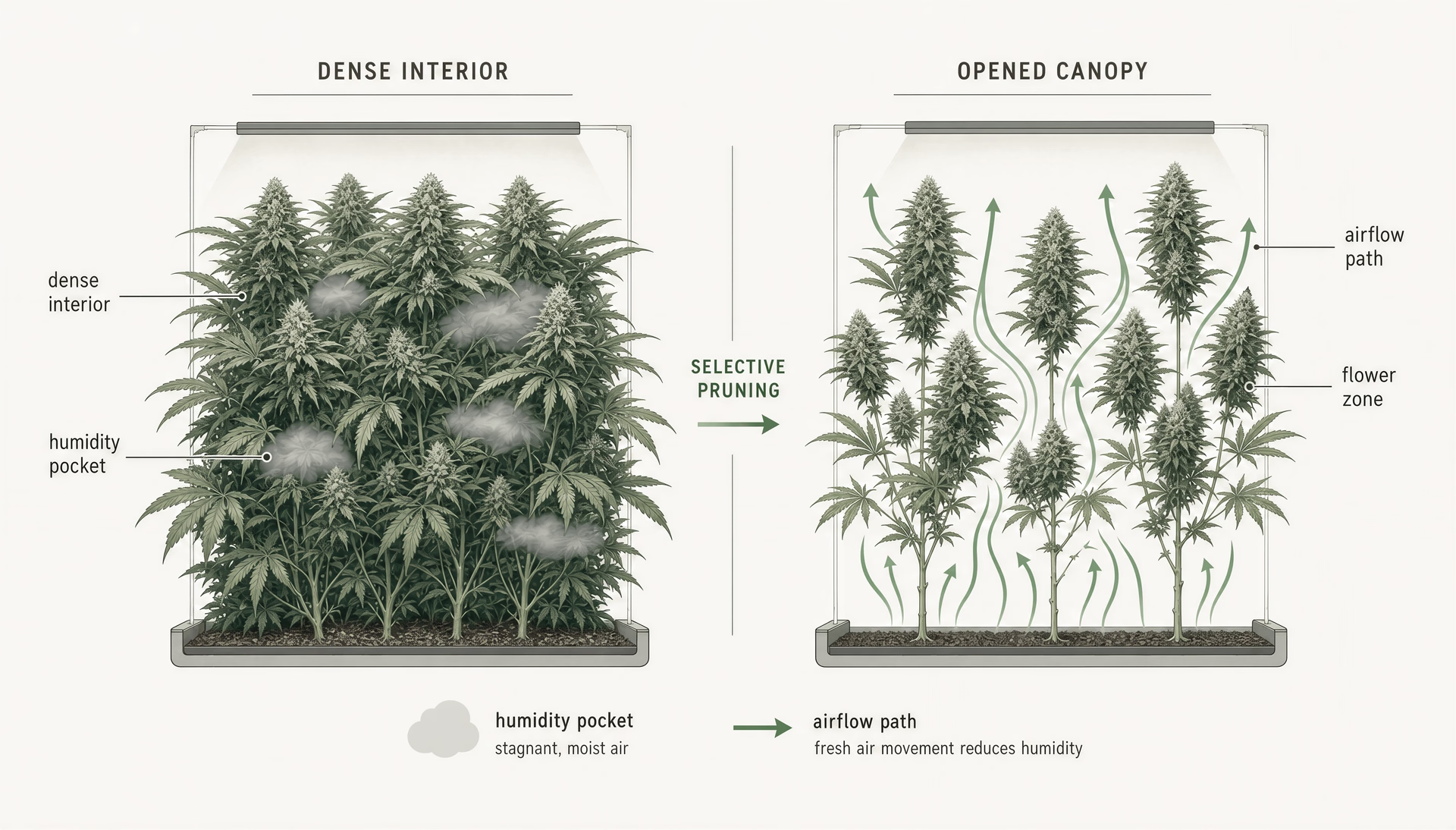
Humidity control, airflow, and botrytis prevention
There is one area where selective removal earns its place fast: disease management in thick canopies. Botrytis cinerea thrives in humid, stagnant microclimates, and dense cannabis flowers are vulnerable once transpiration, leaf overlap, and weak air movement push local humidity above room-average readings. A canopy can look fine from the aisle while the interior stays damp.
Here pruning and selective defoliation can be protective rather than yield-seeking. Removing internal shoots that never reach light, thinning congested branch junctions, and opening packed fan-leaf clusters can improve convective air exchange around stems and inflorescences. That lowers leaf wetness duration and reduces the odds that hidden moisture pockets persist after irrigation or lights-off transitions.
This is especially relevant late in flower, when large colas, falling vapor pressure deficit margins, and cooler night temperatures can create favorable conditions for grey mold. In that context, a leaf is not only a source organ; it is also a physical barrier to airflow. If it traps moisture around susceptible flowers, removing it may prevent a far larger loss than the carbon fixed by that one leaf.
Still, airflow problems should first be addressed as environmental and architectural failures. Better spacing, lower canopy depth, controlled humidity, proper air mixing, and irrigation timing usually matter more than aggressive stripping. Defoliation is not a substitute for climate control. It is a secondary adjustment when the canopy is too crowded for the room to manage safely.
How much leaf removal is too much
Too much is the point where the plant’s lost photosynthetic capacity is no longer offset by better light penetration, lower disease pressure, or easier management. That threshold arrives sooner than many growers think.
A useful practical rule is to remove with a stated reason for each cut. This branch never reaches the canopy. This leaf is shading a productive flower site. This cluster traps humidity in the center of the plant. If the reason is only “people say plants like being stripped,” stop. That is not physiology.
Heavy, repeated whole-plant defoliation often produces a temporary visual illusion of success. The canopy looks cleaner. Bud sites are suddenly exposed. Air movement feels better. But exposed is not the same as supported. Those sites now depend on fewer leaves to feed them, and new leaf regrowth costs carbohydrates and time. If the plant spends several days rebuilding source tissue, any gain from added light may be partly or fully canceled.
The risk rises in three situations: small root zones, low light, and short recovery windows. Under weak lighting, there is less extra photon capture to be gained by opening the canopy. In cramped containers, regrowth capacity is limited. Late in flower, the plant has less time to replace what was removed. That is why aggressive late stripping so often disappoints. It removes source tissue when sink demand from flowers is peaking.
The stronger position, supported by both cannabis extension guidance and general pruning physiology, is this: prune lower nonperforming growth early, maintain airflow through selective thinning, and defoliate conservatively. Keep healthy leaves unless they are clearly blocking more value than they create. More defoliation does not mean better buds. Better canopy function means better buds. Those are not the same thing.
Canopy management during flower
Flowering changes the job of training. In veg, you are still building architecture: breaking apical dominance, redistributing growth, widening the plant, and trying to place future tops into the light footprint. Once bloom is underway, the aim narrows. You are no longer trying to redesign the frame. You are trying to hold it together, keep productive sites evenly lit, and stop dense flowers from turning into shaded, humid disease pockets.
That shift matters because cannabis yield is tied tightly to intercepted light, not to “stress” by itself. Chandra, Lata, Khan, and ElSohly showed in HortScience (2008) that indoor dry flower yield rose from 601 g/m² at 570 W/m² to 907 g/m² at 930 W/m². Training only helps if it improves how the canopy captures and distributes those photons. During flower, that usually means reducing height inequality and preventing upper flowers from monopolising PPFD while lower sites fade into underlit larf.
The transition stretch and why training windows close fast
The first two to three weeks after the flip, or after autoflowers show clear pre-flower acceleration, are the last major window to shape canopy height. This is the stretch phase. Internodes extend quickly, branch angles change, and tops that looked level at the end of veg can separate by many centimetres in a few days.
This is the point for final LST corrections, branch spreading, and tucking under a screen if you are running ScrOG. Nothing dramatic. Just directional work. Bend the tallest shoots outward, pull weak laterals into light, and preserve spacing so each top has its own air and photon budget. If one branch surges above the rest, the canopy stops behaving like a canopy and starts behaving like a ladder, with the fixture feeding the top rung first.
Training windows close fast because flowering tissue becomes less forgiving. Stems lignify. Energy shifts toward inflorescence development. Recovery time starts competing directly with flower formation. Cannabis-specific head-to-head trials on flower-stage training are limited, so some of this comes from broader horticultural pruning physiology and controlled-environment work from groups such as Youbin Zheng, Mike Dixon, and Jamie Burr at Guelph. The general rule holds well: early interventions can redirect growth; late hard interventions mostly remove productive capacity.
Support methods: trellis layers, stakes, and netting
After stretch, canopy management becomes support management. A trellis is not just there to flatten the plant. It is there to lock branch spacing in place so flowers do not collapse into each other as mass increases.
One net can guide stretch. A second, higher net can catch weight later. That two-layer approach is often more useful than one tight screen because it separates training from support. The lower layer holds position. The upper layer prevents lean, stem splitting, and light-blocking pileups. If you are not using a full screen, bamboo stakes or plant yoyos can do the same job branch by branch.
Support also protects light distribution. Heavy colas that fall sideways shade neighbouring tops and create stagnant interior air. In dense canopies, that raises disease risk more than many growers admit. The goal is not to prop up every branch into a vertical spear. It is to maintain enough separation that flowers dry between irrigation cycles and enough openness that lower leaves still contribute.
Avoid these late in flower
- Major topping It removes established reproductive sites when the plant should be bulking flowers.
- Aggressive supercropping of loaded branches It adds wound stress and can compromise support and vascular flow.
- Mass fan-leaf stripping It removes source tissue during a stage when flower sinks are demanding the most assimilates.
Late-flower interventions to avoid
Once heavy flowering begins, draw a hard line. Do not major-top the plant. Do not aggressively supercrop thick, loaded branches. Do not strip large numbers of healthy fan leaves because a schedule said “day 21 defoliation.”
Those moves can work earlier. Late, they are often counterproductive. Topping removes established reproductive sites and forces recovery when the plant should be bulking flowers. Hard supercropping creates wound stress and can kink vascular flow just when demand for water and assimilates is peaking. Severe defoliation cuts source tissue. Ontario and Guelph extension guidance has been consistent on this point: leaves are engines, and removing too many reduces photosynthetic capacity unless the gain in light penetration or humidity control clearly outweighs the loss.
Late flower is for restraint. Remove the occasional leaf that is truly trapped, diseased, or blocking a valuable site. Clean up dying interior material. Support sagging branches. Keep airflow moving. By this stage, the target is no longer a new plant shape. It is a stable, dry, evenly exposed canopy that can finish without breakage, rot, or wasted light.
Training methods for specific grow contexts
Training decisions make sense only when tied to the room, the season, the plant’s growth tempo, and the legal frame around the crop. That sounds obvious, but a lot of advice still treats topping, ScrOG, supercropping, and defoliation as if they carry fixed yield bonuses. They do not. They change canopy shape, recovery time, and light distribution. Whether that helps depends on what is actually limiting production.
Chandra, Kim, and ElSohly showed in 2008 that indoor flower yield rose from 601 g/m² at 570 W/m² irradiance to 907 g/m² at 930 W/m². The plain implication is that training is not magic. A flatter canopy helps because it puts more reproductive sites into useful light, not because the plant was “stressed” into making extra flower. If the light is weak, root volume is small, or the crop is already crowded, many aggressive techniques just move growth around while adding recovery cost.
Small tents and low ceilings
This is the clearest case where plant training earns its keep. In a short tent, vertical growth is the enemy long before total biomass is. The problem is not only that a main cola can reach the fixture too early. It is that a steep canopy creates large PPFD differences between the top 10 cm and everything below it. Upper flowers drift into excess light or heat while lower sites remain underlit.
For that reason, low-stress training is usually the first tool to reach for. Bending the main stem early weakens apical dominance by changing the physical position of the apex and exposing side shoots to more similar light. Auxin export from the shoot tip still matters, but once the top is no longer the undisputed highest point, axillary shoots often accelerate. The result is a broader, lower plant that fits the fixture footprint.
Topping can help here too, provided the cultivar has enough vegetative time left to recover. One topping above the fourth to sixth node, followed by tie-downs, often does more for a small tent than repeated cutting. A small ScrOG can work even better if the aim is strict height control and a level canopy. The net is not productive by itself; it simply forces horizontal branch placement and stops one or two shoots from dominating the light field.
What usually gets oversold is defoliation. In cramped tents, airflow and humidity management are real concerns, so selective leaf removal has a place. But leaves are source tissue. Ontario and University of Guelph guidance has repeatedly warned that heavy stripping cuts photosynthetic capacity unless it solves a bigger problem, such as trapped humidity or deep self-shading. In a 60 × 60 cm or 80 × 80 cm tent, a few badly placed fan leaves may need removal. Routine mass defoliation usually reflects impatience more than plant science.
Outdoor plants with unrestricted root zones
Outdoors, the logic changes. A plant in open ground or a very large container can replace lost tissue far more readily than a plant in a small indoor pot, and long seasons create more room for recovery after topping or structural pruning. But sun angle, wind loading, rain, branch leverage, and support needs become more important than textbook canopy symmetry.
A large outdoor plant does not need to be as flat as an indoor plant under a fixed overhead fixture. The sun moves. Light reaches the canopy from changing angles through the day and season. That reduces the value of perfectly horizontal architecture and increases the value of structural stability. Topping once or twice early can still be sensible because it lowers the center of gravity, spreads branch angles, and reduces the single-spear habit that snaps in storms. LST also works outdoors, though the tie-down plan has to account for woodier stems and future branch thickening.
Supercropping is more context-dependent outside than online guides imply. Crushing and bending a stem can redirect growth and lower a runaway branch, but it also creates a mechanical weak point. In sheltered greenhouse production that may be acceptable. In exposed gardens with heavy late-season inflorescences, it can become a failure point unless supported.
Defoliation outdoors should be even more conservative than indoors. Air movement is usually stronger, disease pressure varies by climate, and leaves buffer the plant against heat and water stress. If a humid region produces dense internal foliage and persistent wet pockets, thinning can reduce botrytis risk. If the site is hot, bright, and dry, keeping healthy fan leaves often helps more than removing them.
Autoflowers and short-cycle plants
Autoflowers compress the decision window. Because flowering is age-driven rather than strictly photoperiod-driven, a week lost to recovery is a much larger share of the whole life cycle. That is why most autos respond better to gentle early LST than to repeated high-stress work.
There are few replicated cannabis trials directly comparing topped versus untopped autos under matched conditions. Preliminary evidence
The practical rule is simple: if the plant is growing fast in the first two to three weeks, soft bending can improve light distribution with little penalty. If growth is slow, roots are constrained, or the plant has already begun obvious floral transition, leave it alone. Topping an autoflower can work in experienced hands and with vigorous genetics, but the margin for error is narrow. There are few replicated cannabis trials directly comparing topped versus untopped autos under matched conditions, so certainty here should be modest.
Short-cycle photoperiod plants push the same logic, though less severely. If the production plan relies on minimal veg time, every recovery event has to pay for itself. In these crops, one topping may be justified if it prevents dominant apical growth from ruining canopy uniformity. Mainlining, manifolding, and elaborate multi-cut shaping usually make less sense unless the cycle is intentionally extended.
Medical-homegrow and low-plant-count legal settings
Legal plant limits reshape training strategy as much as biology does. Germany’s 2024 cannabis law allows adults to cultivate up to three plants for personal use. In most of Canada, the federal framework allows up to four plants per residence. Under those constraints, classic sea-of-green logic loses much of its appeal. SOG depends on many small plants, short veg, and density-driven canopy closure. If plant count is capped at three or four, the agronomic question becomes how to fill area with a few plants rather than how to flip many small ones quickly.
That is where topping, LST, manifolding, and ScrOG move from optional tricks to rational canopy-maximizing tools. With strong enough light and enough root volume, a wider plant can intercept far more of the available photons than an untopped Christmas-tree form. Caplan, Dixon, and Zheng’s work on substrate and fertigation variables in 2017 also matters here: root-zone volume and irrigation strategy strongly affect growth and yield. A low-count legal grow cannot rely on plant number to compensate for undersized roots or poor canopy fill.
There is also a risk hidden in low-count setups: overtraining the few plants you are legally allowed to keep. If one manifold stalls for ten days, that is not a small setback. It is a large fraction of total canopy potential gone. For that reason, conservative topping plus LST often beats elaborate symmetry work. The plant does not need to look elegant. It needs to occupy the light footprint evenly, maintain airflow, and recover quickly.
So the situational answer is not “use method X.” It is sharper than that. Small tents reward horizontal control. Outdoor plants reward structure and support planning. Autos reward restraint. Low-plant-count legal grows reward big-canopy methods and punish wasted recovery time.
Failure modes, myths, and the evidence gap
The weak point in most training advice is not that training never works. It is that the claims are usually far more precise than the evidence allows. Growers are often told that topping adds a fixed percentage, FIMing adds a larger one, ScrOG always beats SOG, or defoliation “unlocks” hidden yield. That is not what the research shows. Training changes plant architecture. Whether that architectural change pays off depends on light distribution, recovery time, cultivar branching habit, plant density, root volume, humidity pressure, and how long the crop is kept in vegetative growth.
The myth of universal yield multipliers
The internet loves exact numbers: “topping adds 20%,” “FIMing gives 30% more,” “supercropping doubles tops.” These figures rarely come from replicated, controlled cannabis trials. They usually come from anecdote, memory, or comparisons made across different runs.
A more defensible statement is narrower. Topping or FIMing removes or damages the apical meristem, disrupts auxin export from the shoot tip, and allows axillary branches to compete more strongly. That can flatten the canopy and reduce the gap in light intensity between top and lower flowering sites. Sometimes that raises yield. Sometimes it only redistributes it. Sometimes it lowers it because the plant spent too long recovering.
The hard ceiling here is intercepted light. In the indoor work by Pradeep Chandra, Mahmoud ElSohly, and colleagues published in HortScience in 2008, cannabis dry flower yield rose from 601 g/m² at 570 W/m² to 907 g/m² at 930 W/m². That is the frame growers should keep in mind. Training does not create yield from nowhere. It helps only if it improves how the canopy captures and uses available photons across reproductive sites.
This is also why plant-count law changes the answer. In Germany, adults may grow up to three plants under the 2024 CanG framework. In most of Canada, the federal framework allows up to four plants per residence. Under limits like that, low-count systems that expand each plant’s horizontal footprint—topping, LST, manifolding, ScrOG—often make more agronomic sense than classic high-count SOG. But if plant numbers are not the bottleneck and the production model relies on many small clones with minimal veg time, SOG can win through turnover speed rather than per-plant size.
Why online before-and-after comparisons are weak evidence
The classic social-media proof goes like this: one image of an untopped plant, one image of a topped or heavily trained plant, then a declared yield difference. The missing variables are usually the deciding ones.
Light is the largest confounder. If the trained run also used a stronger fixture, a better spectrum, or a more even hanging height, the comparison says little about the training method. Chandra’s 2008 data make that point bluntly: more usable light can move yield by hundreds of grams per square meter.
Veg time is another major confounder. A topped plant often gets extra days or weeks to recover and branch. If the untopped control was flowered earlier, the trained plant did not merely benefit from topping; it benefited from a longer production cycle. Phenotype differences matter too. One seed plant may naturally branch well, another may stay strongly apical. Comparing them as if they were identical is poor method.
Root-zone variables are just as important and often ignored. Caplan, Dixon, and Zheng showed in 2017 that container volume, substrate conditions, and fertigation regime significantly affect cannabis growth and inflorescence yield. A larger root zone or better irrigation program can easily masquerade as a “training result.”
Then there is survivor bias. Growers post the dramatic success, not the run where topping slowed a weak plant, aggressive defoliation reduced bulk, or a dense ScrOG trapped humidity and invited disease.
Stress responses, recovery debt, and hidden opportunity cost
“Stress increases yield” is one of the most persistent myths in cannabis cultivation. Stress is not a bonus signal that tells a plant to produce more flower. Mechanical training works when the architectural benefit exceeds the physiological cost.
Topping and FIMing remove active tissue. Supercropping damages vascular tissue and relies on repair. Defoliation removes source leaves that produce carbohydrates. Those leaves are not decorative. They are photosynthetic machinery. Ontario and University of Guelph extension guidance has repeatedly warned that excessive defoliation can reduce yield unless the removed leaf area was causing a larger problem, usually lower-canopy shading or elevated humidity.
The hidden cost is recovery debt. A plant that spends seven days repairing after topping has lost seven days of uninterrupted leaf area expansion. In a long veg under strong light, that debt may be repaid by a flatter, more efficient canopy. In a short-cycle crop, the same intervention may be net negative. This is why defoliation is probably the most overused method online. If humidity, airflow, and disease pressure are under control, stripping healthy fan leaves often reduces the very source capacity that builds flower mass.
- UNODC estimate
- 228 million users in 2022
- EMCDDA figure in article
- About 22.8 million young adults in Europe used cannabis in recent reporting cycles
- What is still scarce
- Peer-reviewed, replicated head-to-head trials of training methods under matched conditions
- What is better supported
- Canopy flattening can help when it improves light interception and reduces self-shading
What controlled cannabis research still has not answered
Cannabis is globally important—UNODC estimated 228 million users in 2022, and EMCDDA reported about 22.8 million young adults in Europe used it in recent reporting cycles—yet the agronomy literature is still thin where growers most want certainty.
There are not many peer-reviewed, replicated cannabis trials that compare topping versus FIMing versus supercropping versus ScrOG versus mainlining under identical genetics, plant density, root volume, PPFD, irrigation strategy, and crop duration. That absence matters. It means many confident rankings of training methods are still grower consensus, not settled science.
The mechanistic picture is better than the direct comparison data. Horticulture broadly supports canopy flattening when it improves light interception and reduces self-shading within the fixture footprint. Cannabis reviews by David Potter, Jonathan Caplan, Mike Dixon, Youbin Zheng, and colleagues support the importance of density, environment, substrate, and light management. But we still lack enough technique-versus-technique trials to issue exact, universal yield promises.
That honesty is not a weakness. It is the more credible position: training can improve canopy uniformity, light distribution, airflow, and harvest efficiency, but no single method wins across all cultivars and production constraints.
Decision framework by limiting factor
- Height
- Use topping, LST, and often ScrOG to flatten the canopy and reduce top-to-bottom light inequality.
- Plant count
- Use canopy-maximizing systems such as topping, manifolding, mainlining, or ScrOG because each plant must cover more area.
- Time
- Keep training light, because every cut adds recovery cost and extended veg may not repay it.
- Humidity and disease
- Use selective thinning and lower-canopy cleanup rather than broad leaf stripping, focusing on airflow and dry flower surfaces.
A practical decision framework for choosing the right training system
The right training system is usually the one that solves the thing actually holding yield back. That sounds obvious, but a lot of advice treats topping, ScrOG, supercropping, manifolding, and defoliation as if they carry fixed yield bonuses of their own. They do not. They change canopy shape, growth rate, and light distribution. Whether that pays off depends on what the room, the law, and the cultivar are asking the plant to do.
A good starting question is not “Which technique gives the biggest harvest?” It is “What is my limiting factor?”
If the limiting factor is height
When vertical space is tight, the main enemy is apical dominance. The shoot tip exports auxin downward, which suppresses lateral growth and pushes the plant into a taller, Christmas-tree form. Topping interrupts that signal. LST bends the apex below side branches and weakens it without cutting. ScrOG spreads multiple shoots into a flatter canopy so more flowering sites sit inside the lamp’s useful footprint.
That logic matches the light data better than the usual “more tops equals more yield” claim. Chandra, ElSohly, and colleagues showed in 2008 that indoor cannabis flower yield rose from 601 g/m² at 570 W/m² to 907 g/m² at 930 W/m². The point is not that training creates yield from nowhere. It is that training matters when it helps more of the canopy intercept and use delivered photons. In a tall, uneven plant, upper flowers monopolize PPFD and lower sites lag. In a flatter canopy, the light gradient narrows.
So if height is your constraint, start with topping once or twice, then use LST to spread branches outward. Add a screen if the footprint is wide and the veg period is long enough to fill it. Supercropping can also control height, but it is a corrective tool more than a first-choice framework. If the room is short, predictable structure beats repeated emergency bending.
If the limiting factor is plant count
Plant-count limits change the math fast. Germany’s 2024 CanG allows up to three plants for home cultivation. In most of Canada, the federal framework allows up to four plants per residence. Under those rules, classic high-count SOG loses much of its appeal. You cannot rely on many small single-cola plants if the law caps the number of stems you can run.
Low-count environments favor systems that maximize canopy area per plant: topping, manifolding, mainlining, and ScrOG. Manifolding is slow, but it creates symmetry and branch parity, which helps each top receive similar light and root support. ScrOG does something similar at the canopy level, using horizontal spread to turn a few plants into a full productive surface.
This is where many online guides ignore the hidden variable of time. A three-plant ScrOG can be highly rational under legal limits, but only if you can afford the extra veg needed to fill the net. If not, a simpler topped-and-tied plant may produce a better return per day. Caplan, Dixon, Zheng, and colleagues showed in 2017 that substrate volume and fertigation strategy significantly altered cannabis growth and yield. That matters here because low plant-count systems often depend on growing larger plants for longer, which raises demands on root volume, irrigation precision, and recovery management.
If the limiting factor is time
Time pressure changes everything. Every cut has a recovery cost. Topping slows vertical progress while axillary shoots assume dominance. Mainlining slows it more. ScrOG is not just a training method; it is a commitment to extended veg, repeated tucking, and canopy steering.
If your bottleneck is cycle length, keep training light. LST alone is often enough. A single topping can make sense if the cultivar is strongly apical and veg time is still adequate, but repeated high-stress shaping is usually the wrong answer. Where plant counts are legally permissive, SOG becomes attractive because it trades structural training for density and short veg. That is why SOG can outperform more elaborate systems in clone-based, fast-turn production: not because single-cola plants are inherently superior, but because fewer days are spent building architecture.
The key trade-off is simple. Longer veg can increase canopy quality, but only if the environment can support the larger plant and the extra days are worth it. If not, complexity is a drag.
If the limiting factor is humidity and disease
Humidity pressure is where growers most often reach for the wrong tool. They strip leaves because the canopy feels dense. Sometimes that helps. Often it goes too far.
Leaves are source tissue. Remove too many healthy fan leaves and you cut photosynthetic capacity just to make the plant look cleaner. University of Guelph and Ontario extension guidance has been consistent on this point: defoliation is justified when it improves airflow, lowers disease risk, and exposes shaded sites that otherwise contribute little, but heavy indiscriminate stripping can reduce yield. Under high humidity, the smarter move is selective thinning plus lower-canopy cleanup. Lollipopping weak, shaded lower growth reduces stagnant microclimates. Removing a limited number of interior leaves can improve air movement. Clearing leaf piles against the medium surface also helps.
What usually works is targeted subtraction, not aesthetic aggression.
Think of the decision matrix this way. If height is the problem, flatten the canopy with LST, topping, and often ScrOG. If plant count is the problem, make each plant architecturally larger with manifolding, topping, and screens. If time is the problem, avoid elaborate recovery-heavy methods; use minimal training or SOG where lawful plant counts allow it. If humidity and disease are the problem, thin strategically and clean the lower canopy rather than stripping leaves wholesale.
That is the strongest way to understand training. It is not a contest between named techniques. It is environmental optimization applied to plant form.