














Why outdoor cannabis growing is really a latitude-and-climate problem
Outdoor cannabis success is dictated far less by generic “grow tips” than by latitude, day length, autumn rainfall, root-zone conditions, and whatever the law allows you to do on your property. That is the starting point. A plant that can finish cleanly in Andalusia may stall, mold, or never properly mature in Hamburg. Spain, Italy, Germany, Belgium, and the Netherlands are not one outdoor growing zone. Treating them as if they were leads to bad timing, wrong cultivar choices, and predictable losses in late season.
Quantitative short-day crop A plant whose flowering is promoted by longer nights, but not by a single rigid day-length cutoff.
Cannabis in outdoor production is generally treated as a quantitative short-day crop: flowering begins as days shorten past a cultivar-dependent threshold. That is what photoperiod means here. Photoperiod plants respond to changing day length. Autoflowering plants do not depend mainly on shortening days; they flower according to age, which is why they can be a rational adaptation in short, wet northern seasons rather than a “beginner-only” option. The distinction matters more than most feeding charts ever will.
The mistake most outdoor guides make
Most outdoor guides flatten the problem into a calendar. Germinate in spring, transplant after frost, feed through summer, harvest in autumn. That sounds tidy, but it is false in ways that matter.
The first mistake is treating flowering as a generic late-summer event instead of a response to light and latitude. At roughly 40°N, summer day length peaks around 15 hours in June. At 50–55°N, days are longer in midsummer, yet the back half of the season often turns cooler and wetter earlier. So the same photoperiod cultivar can stay in vegetative growth for longer up north, then get pushed into flowering just as conditions become hostile to dense buds. Big plant, bad finish.
The second mistake is obsessing over nutrients while understating weather and roots. Yes, nutrition matters. Soil pH around 6.0–7.0 in mineral soil is a sensible practical target, and the FAO’s broader crop guidance of pH 5.5–7.5 supports that range. But outdoor failures in Europe are often not feed-chart failures. They are botrytis failures, waterlogging failures, drought-stress failures, or container heat-stress failures. USDA NRCS guidance on soil organic matter is more relevant than many bottle schedules: organic matter improves aggregate stability, infiltration, and water-holding capacity. In plain terms, that means fewer swings between soggy and bone-dry.
The third mistake is pretending “outdoor” is one method. It is not. It is a set of regional strategies. A giant, late-finishing photoperiod plant in open ground may make sense in southern Spain or parts of coastal Italy. The same approach in Belgium is often an invitation to powdery mildew in late summer and botrytis in October.
Why outdoor results differ more across Europe than most growers expect
Europe compresses very different growing realities into a small map. Mediterranean regions offer long, bright seasons, but they also bring heat extremes, dry winds, and heavy irrigation demand. Copernicus reported that 2023 was the warmest year on record in Europe, and that matters directly to outdoor cannabis: strong summer light is useful only if the plant can keep stomata functioning and roots cool enough to support transpiration. More sun does not solve everything. Heat and drought can stop growth just as effectively as cold.
Northern Europe has a different set of limits. Germany, the Netherlands, and Belgium often have enough midsummer daylight to drive strong vegetative growth, but the season can break against the crop. Rain arrives. Nights cool. Leaf wetness persists. Dense flowers hold moisture. Botrytis cinerea takes hold from inside the bud, sometimes before the plant looks obviously sick from a distance. UC IPM and RHS guidance on botrytis and powdery mildew maps well onto cannabis because the biology is the same: prolonged humidity, restricted airflow, damaged tissue, crowded canopies.
This is why the common belief that outdoor always means bigger plants is wrong. In a wet autumn climate, disease pressure and finish date cap biomass. A modest, early-finishing plant harvested cleanly in September can outperform a huge October plant that rots from the center out.
Autoflowers fit this reality better than many growers admit. In southern Europe, they are one option among many. In northern Europe, they are often a climate-management tool: faster cycle, lower exposure to autumn rain, and more flexible sowing windows. That trade-off is real. Usually smaller plants, often lower total yield per individual. But lower mold risk can make them the more rational choice.
A practical framework: photoperiod, weather, roots, disease, law
The five filters
- Photoperiod Match plant type to latitude and finish window.
- Weather Check autumn rainfall, humidity, night temperatures, and wind exposure.
- Roots Choose between in-ground buffering and container control based on drainage and heat.
- Disease Plan around powdery mildew, spider mites, and botrytis pressure.
- Law Plant count, visibility, and security rules shape the whole setup.
A useful outdoor plan starts with five filters.
Photoperiod comes first. Is the cultivar a photoperiod plant that needs shortening days to flower, or an autoflower that will bloom by age? If it is photoperiod, your latitude and expected finish window become central. If it is autoflower, the question shifts toward temperature, early vigor, and timing around stable weather.
Weather comes next, especially autumn weather, not just summer sunshine. Look at rainfall patterns, night temperatures, humidity, and wind exposure. Southern Europe rewards season length. Northern Europe rewards earliness and restraint.
Roots are third. In-ground plants get larger root volume and better buffering against drought, but poor site choice is hard to correct. Containers give control over media and drainage, yet they dry faster and heat up faster, a pattern repeatedly seen in horticultural container studies. Soil structure, drainage, mulching, and organic matter are not side issues. They shape the whole season.
Disease is fourth. Powdery mildew favors dense growth and weak airflow. Spider mites thrive in hot, dry spells. Botrytis defines many late-season failures in wet climates. Companion planting can support beneficial insects, but basil, marigolds, or dill will not rescue a crowded, rain-soaked canopy.
| Jurisdiction | Rule stated in the guide | Practical outdoor effect |
|---|---|---|
| Germany | Adults may cultivate up to 3 plants at their residence | Encourages smaller, well-managed plants where limits are tight |
| Malta | Up to 4 plants per household | Household counting matters in shared homes |
| Luxembourg | Up to 4 plants per household | Residence-based home growing remains the key condition |
| Spain | Less straightforward; tolerated practice is not the same as clear statutory protection | Visibility and scale can raise risk |
| Belgium | Less straightforward; tolerated practice is not the same as clear statutory protection | Low-profile growing is often the safer approach |
| Netherlands | Less straightforward; tolerated practice is not the same as clear statutory protection | Tolerance does not equal clear legality |
Law is the final filter because it changes plant count, visibility, security, and tolerance for risk. Germany’s 2024 Cannabis Act allows adults to cultivate up to three plants for personal use at their residence. Malta allows up to four plants per household. Luxembourg allows up to four plants per household. Spain, Belgium, and the Netherlands are less straightforward: tolerated practice is not the same as clear statutory protection. That legal reality can push growers toward smaller plants, less conspicuous training, or greenhouse use even where climate alone would suggest another route.
That is the frame for the rest of this guide. Not “how to grow outdoors” as a single recipe, but how to match plant type, timing, structure, and disease management to the place where the plant actually has to survive.
Photoperiod dependency, daylight hours, and how latitude triggers flowering
Outdoor cannabis is not governed by a universal “plant in spring, harvest in autumn” calendar. That shortcut hides the real driver: photoperiod. A cultivar that flowers safely in Valencia can still be green, swollen, and vulnerable in Rotterdam when the first long spells of cold rain arrive. Latitude sets the annual light curve, and that curve shapes not only when flowering starts, but whether flowering finishes before mold, frost, or weak late-season light take over.
Cannabis as a short-day crop in practical horticulture
In practical horticulture, photoperiod cannabis is treated as a short-day crop, more precisely a quantitative short-day plant. That means flowering is promoted when nights become long enough and uninterrupted enough to trigger the plant’s reproductive response. It is not a simple on/off switch. Shorter days push the plant toward bloom; genetics determine how strongly and how quickly it reacts.
That point matters outdoors because growers often repeat the indoor rule of “12 hours on, 12 hours off” as if nature follows a timer. It does not. Many photoperiod cultivars begin floral initiation before the day is exactly 12 hours long, while others continue vegetative growth longer under the same sky. What the plant is sensing is the seasonal shift toward longer nights, not a rigid date on the calendar.
This is why two common claims are wrong. First, “outdoor always means bigger plants.” Only if the plant gets enough vegetative time before flowering and enough dry, warm weeks to finish. Second, “more sun solves everything.” It does not solve a late-flowering cultivar placed in a wet northern autumn. Once dense inflorescences sit in persistent humidity, the limiting factor is no longer sunlight but disease pressure, especially Botrytis cinerea.
How day length changes from equatorial to temperate latitudes
Latitude changes the annual swing in daylight. Near the equator, day length is relatively stable through the year, hovering close to 12 hours. Move toward the Mediterranean, around 37–43°N, and summer days stretch much longer before gradually shortening after the solstice. Move farther north, into Germany, the Netherlands, Belgium, southern England, or Denmark, and summer days become very long indeed. The trade-off is that autumn deteriorates faster. Temperatures fall sooner, leaf wetness persists longer, and rain events are more likely to sit on ripening flowers.
The geometry is simple, but the horticultural effect is large. Around 40°N, day length can exceed 15 hours near the June peak. Around 50–55°N, midsummer days run longer still. That delays natural flowering in many photoperiod cultivars because the plant remains in vegetative mode deeper into summer. Long summer days sound favorable, but they can become a trap: the plant grows large, starts bloom relatively late, and then has to finish under colder, wetter conditions than the same genotype would face farther south.
Europe cannot be treated as one outdoor cannabis environment. Strong evidence
This is why Europe cannot be treated as one outdoor environment. Andalusia, Tuscany, Bavaria, and coastal Belgium are not variations on the same season. They are different production systems forced by latitude and weather.

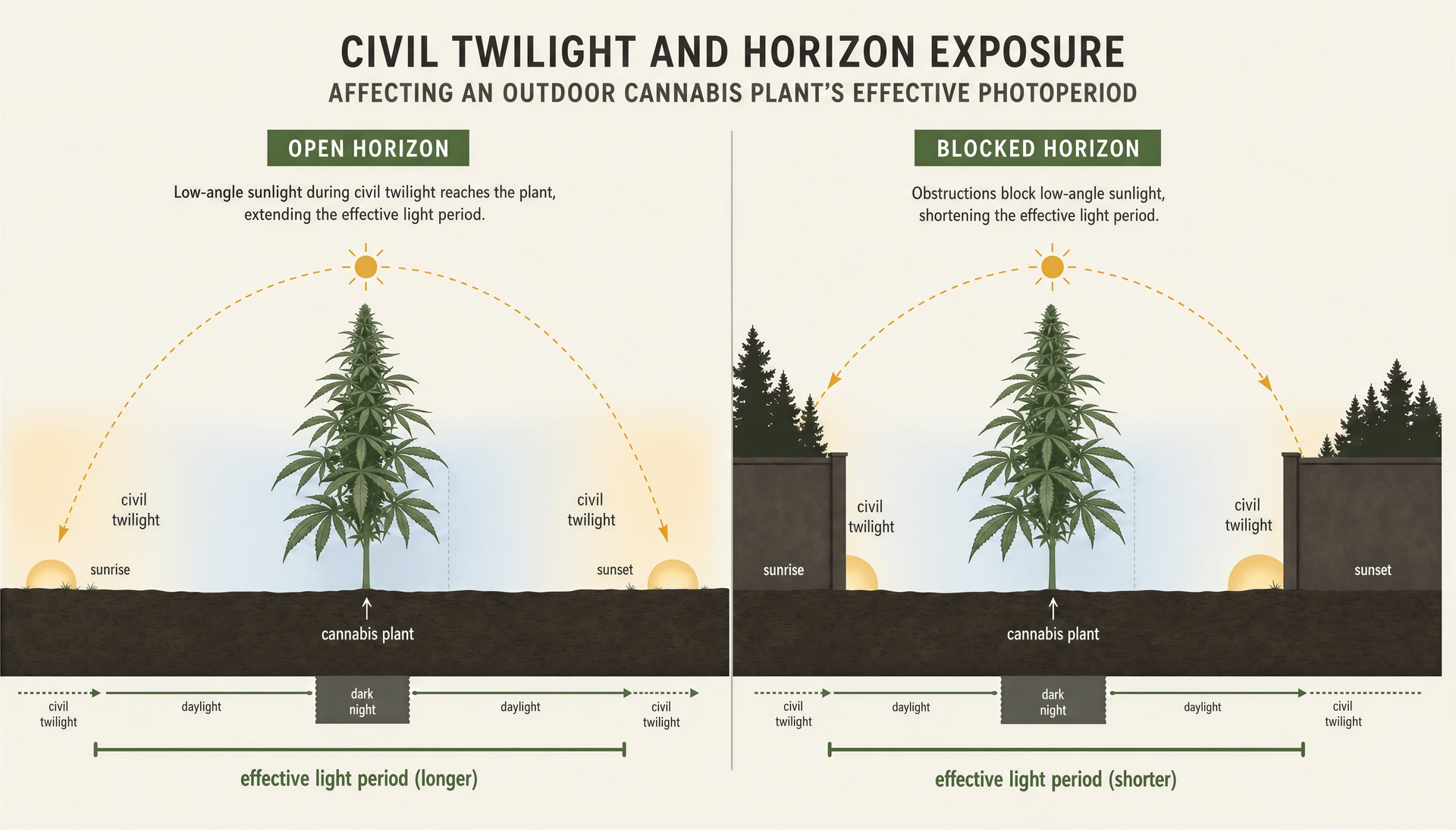
Why civil twilight, local weather, and genetics complicate the simple 12/12 rule
What the simple 12/12 rule misses
- Twilight
- Low-intensity light before sunrise and after sunset can affect flowering near the threshold.
- Weather
- Cool, hot, cloudy, or stressful periods can slow floral development after initiation starts.
- Genotype
- Different cultivars respond to the same outdoor light curve at different speeds.
The 12/12 shorthand leaves out three things that matter outdoors: twilight, weather, and genotype.
First, twilight. Day length tables usually refer to sunrise and sunset, but plants outdoors are not experiencing a laboratory black box. Civil twilight extends low-intensity light before sunrise and after sunset. That light is weak, yet photoperiod responses are sensitive to low light levels, especially when the plant is near its flowering threshold. A garden with an open western horizon may effectively experience a longer photoperiod than a site blocked by trees, walls, or hills. The difference is not academic. It can shift the onset of flowering by days or even weeks in borderline cases.
Second, local weather modifies what the plant does with the signal. A photoperiod response may begin, but cool temperatures, overcast periods, and stress can slow floral development. Hot nights can alter plant metabolism too. Climate now matters more than old rule-of-thumb calendars suggest. Copernicus reported in 2024 that 2023 was the warmest year on record in Europe. In southern Europe that can mean prolonged summer vigor but also heat stress, drought, and faster substrate drying. In northern Europe, warmer summers do not erase the late-season humidity problem. A warm July does not guarantee a safe October.
Third, genetics. Cannabis is not one photoperiod template. Narrow-leaf tropical types often need longer seasons and can be slower to finish outdoors in temperate latitudes. Many modern hybrids have been selected for earlier flowering and faster maturation. Some begin showing pistils quickly yet still require many weeks to ripen fully. Others transition decisively and finish before autumn weather collapses. Treating all photoperiod seeds as if they “flip” at the same daylight threshold is poor horticulture.
Equatorial, Mediterranean, and Northern European flowering timelines
Regional flowering pattern by latitude
- Equatorial Day length stays close to 12 hours, giving a steady annual light pattern.
- Mediterranean Spring and summer allow long vegetative growth before bloom develops through late summer.
- Northern Europe Long summer days can delay flowering, then wetter autumn conditions make finishing harder.
Near-equatorial environments produce the most even annual light schedule. Photoperiod plants there often begin flowering under day lengths that would still feel “too long” to growers trained on indoor 12/12 rules, because the nightly dark period is consistent and the seasonal swing is small. The advantage is predictability. The disadvantage is that many equatorial-adapted plants evolved for long flowering periods and can be difficult to finish cleanly in temperate Europe.
Mediterranean climates, such as parts of Spain, southern France, coastal Croatia, or much of Italy, offer a more forgiving outdoor window for photoperiod plants. Seedlings established in spring can enjoy a long vegetative season under strong light, then enter bloom as days shorten through late summer. In many of these regions, dry air and warm autumn conditions allow medium- to late-finishing cultivars to mature with less botrytis pressure than they would farther north. That does not mean immunity. Heat waves, water stress, and extreme late-summer temperatures can still reduce flower quality, especially in containers where root zones overheat and dry quickly.
Northern Europe is stricter. Longer summer days delay the floral transition of many photoperiod cultivars, then the finish line arrives under weaker sun, heavier dew, more rain, and cooler nights. The classic failure pattern is obvious: big vegetative plants in August, attractive flowers in September, then gray mold spreading inside dense colas in October. UC IPM and RHS guidance on botrytis maps directly onto this problem: prolonged moisture, poor airflow, wounded tissue, and dense floral structure increase infection risk. In this setting, “large yield potential” is often marketing language colliding with climate reality. Early-finishing photoperiod genetics, open canopy structure, and rain protection make more sense than chasing giant plants.
Why autoflowers change the calendar but not the climate
Autoflowering cultivars alter one variable: the trigger for flowering. Because they derive flowering behavior from Cannabis ruderalis ancestry, they bloom according to plant age rather than shortening day length. That is useful, especially in northern Europe, because it lets the grower run the crop in the brightest part of the year instead of waiting for late-summer photoperiod signals. A seed started after frost risk can finish in midsummer or early autumn, often before the worst mold window opens.
This is not a beginner gimmick. In Germany, the Netherlands, Belgium, and similar climates, autoflowers are often a rational adaptation strategy. They compress the season. They reduce exposure to October weather. They allow staggered sowing. They can also fit legal plant-count limits better in places where home cultivation rules exist, since the aim shifts from maximum plant size to timely completion.
But autoflowers do not repeal climate. They still face cold nights, waterlogging, wind damage, heat spikes, drought stress, spider mites in hot dry spells, and bud rot in wet bloom weather. Put an autoflower into a rainy, stagnant corner and it can still rot. Start one too early in cold soil and it can stall irreversibly because its life cycle keeps moving whether growth conditions are good or not. That is the hidden cost of age-based flowering: there is less room to recover from early stress than with a photoperiod plant that can stay in vegetative growth longer.
The practical lesson is blunt. Photoperiod tells you when the plant wants to flower. Latitude tells you what kind of season surrounds that decision. Climate then determines whether flowering ends in ripe flowers or in mold, stalled maturation, and weather damage. Autoflowers can sidestep the first issue, but not the second. In outdoor cannabis, the calendar is never just a calendar. It is astronomy meeting local disease pressure.
Climate zones and regional suitability across Europe
Europe does not offer one outdoor cannabis climate. It offers several, and each one punishes a different mistake. A plant that cruises through September in Andalusia can rot out in the Netherlands before it finishes, while a compact early cultivar that makes sense in Belgium may leave southern growers with an avoidably small harvest. That difference is not explained by “more sun” or “less sun” alone. Once flowering starts, humidity, leaf wetness duration, night temperatures, and harvest-season rainfall often matter more than midsummer brightness.
Latitude still sets the frame. Cannabis is grown in practice as a quantitative short-day crop, so the seasonal drop in day length drives flowering. But what happens after initiation depends on place. At around 40°N, common in southern Spain and parts of Italy, the season stays warm deep into autumn. At 50–53°N, where Germany, Belgium, and the Netherlands sit, plants may get long summer days yet face a far less forgiving finish: cooler nights, frequent rain, heavier dew, and persistent fungal pressure during bloom. Popular guides flatten all of this into a planting calendar. That is bad advice.
- Strength
- Long, bright season
- Main summer limit
- Heat and drought
- Useful system
- In-ground roots with mulch and irrigation
- Late-season issue
- Oversized plants can become structural and legal liabilities
Mediterranean climates: long seasons, drought, and heat load
Southern Spain, coastal southern France, and much of inland Italy share the classic Mediterranean advantage: a long, bright growing season with relatively dry summers and a late autumn. Big photoperiod plants are feasible there in a way they simply are not in Hamburg or Rotterdam. If a grower starts early, builds healthy soil, and has water available, the region can support long vegetative growth and extended flowering windows.
The trade-off is heat. Copernicus reported that 2023 was the warmest year on record in Europe, with heat stress increasing especially in southern regions. That matters directly for outdoor cannabis. High air temperature combined with strong solar load pushes transpiration hard, and in containers the root zone can overheat fast. People fixate on canopy size, but root-zone stability decides whether a plant keeps functioning through July and August. In-ground cultivation has an edge here because the soil buffers both moisture and temperature swings; containers dry faster and can become punishingly hot.
Drought is the second limiter. Mediterranean success depends less on fertilizer than on irrigation discipline, mulch, organic matter, and infiltration. USDA NRCS guidance on soil organic matter applies cleanly here: more organic matter improves aggregate stability, water-holding capacity, and infiltration. For cannabis, that means fewer extreme wet-dry cycles and a better margin during hot spells. Even so, “more sun solves everything” is false. There is a point where vapor pressure deficit climbs beyond what the cultivar and irrigation schedule can support. Leaves taco, growth stalls, and flower development loses momentum.
Southern France has another wrinkle: coastal influence. The light is excellent, but sea exposure can bring salt-laden wind and stronger gusts, which increase mechanical stress and evapotranspiration. Inland Italy is often less windy but can be brutally hot in midsummer, especially in enclosed valleys. So while these regions reward long-season genetics, they also reward open canopies, wind tolerance, and realistic irrigation planning.
- Main risk
- Moisture persistence
- Typical disease pressure
- Botrytis and powdery mildew
- Helpful structure
- Smaller, earlier, better-ventilated plants
- Useful protection
- Rain shelter or greenhouse with strong ventilation
Atlantic and maritime climates: humidity, wind, and fungal pressure
Western Germany, Belgium, and the Netherlands live under a different rule set. Summers can be pleasant enough. That does not mean outdoor flowering is easy. The defining threat is moisture persistence: repeated rain events, long dew periods, slower drying after showers, and a higher likelihood of humid nights in late flower. Botrytis cinerea thrives under those conditions. So does powdery mildew when airflow is poor and canopies stay dense.
This is why average temperature misleads. Two regions may post similar summer highs, yet one dries quickly after rain and the other stays wet for half a day. That difference in leaf wetness duration can decide whether flowers finish intact. UC IPM and the Royal Horticultural Society both describe the pattern clearly in other crops and ornamentals: dense tissue, stagnant air, and prolonged moisture sharply raise fungal risk. Cannabis buds are especially vulnerable because late flowers hold moisture deep inside the inflorescence, where air movement is weakest.
The Netherlands and Belgium often tempt growers into a false sense of security because long summer days can produce vigorous vegetative growth. Then September arrives. Rain frequency rises, nights cool, and giant colas become liabilities. In these climates, outdoor does not automatically mean bigger plants. Often the smarter move is smaller, earlier, better ventilated plants with restrained feeding and aggressive canopy management. A greenhouse or rain shelter can shift the odds dramatically, not by making the climate warm, but by reducing direct wetting and shortening drying time after humidity spikes.
Wind is the maritime bonus and problem at once. Good airflow helps suppress mildew; persistent gusts can shred leaves, stress stems, and increase water demand. Coastal exposure in the Low Countries and parts of the Atlantic fringe means structural support matters more than many guides admit. Tall, soft, nitrogen-heavy plants are asking for trouble.
- Summer pattern
- Hotter days with cooler nights
- Autumn problem
- Fast shift to colder, wetter conditions
- Soil risk
- Heavy ground can become waterlogged late in the season
- Cultivar lesson
- Late finishers are exposed when autumn turns quickly
Continental climates: hot summers, cooler nights, abrupt autumn shifts
Move inland and the pattern changes again. Continental climates across parts of central and eastern Europe often deliver hotter summer days than Atlantic regions, with cooler nights and larger swings between day and night temperatures. Some growers like that contrast, and it can support strong resin production and sturdy structure. The danger is not midsummer. It is the speed of autumn change.
A continental site may look ideal in August and become marginal by late September. Warm afternoons no longer compensate for cold nights, morning dew lingers, and the weather can break suddenly into rain and grey skies. That abrupt shift punishes late-finishing cultivars. It also exposes root problems. Heavy soils that were merely inconvenient in summer can become waterlogged in autumn, dropping oxygen at the root zone just when the plant needs stable uptake to finish.
Western Germany sits between maritime and continental influences, which is why generic advice fails there so often. One site may have enough airflow and drainage to finish an early photoperiod cultivar cleanly. Another, just a short distance away, may sit in a damp pocket where fog, dew, and cool nights make botrytis almost inevitable. Regional labels help, but local microclimate still decides outcomes.
Matching cultivar type to region instead of chasing yield claims
| Region pattern | Usually favored plant type | Why |
|---|---|---|
| Southern Europe | Longer-flowering photoperiods | The season is long enough to support extended bloom if heat and irrigation are managed |
| Belgium / Netherlands / wetter Germany | Early-finishing photoperiods | They reduce exposure to the wettest autumn period |
| Northern Europe generally | Autoflowers | They can finish before the peak mold window opens |
The right question is not “Which cultivar yields the most outdoors?” It is “Which cultivar can finish in my region before weather destroys quality?” Southern Europe rewards season length. Northern Europe rewards earliness and restraint.
In Spain, southern France, and much of Italy, longer-flowering photoperiod cultivars can make sense if they are heat-tolerant and the site has dependable water. In Belgium, the Netherlands, and wetter parts of Germany, early-finishing photoperiods and autoflowers are often the rational choice, not the beginner choice. That distinction matters. Autoflowers are frequently dismissed as small or simplistic, yet in northern Europe they act as climate adaptation: they can finish before the peak of autumn rain and mold pressure. That is a strategic advantage, not a compromise born of inexperience.
Ignore inflated breeder yield claims. They are often generated under friendlier conditions than your own and tell you very little about survival through a damp October. Architecture matters more. Loose to medium-density flowers, moderate plant size, and strong branching with good airflow beat giant, dense colas in maritime climates almost every time. In dry Mediterranean zones, larger plants are more realistic, but only if irrigation, mulch, and heat management are in place.
Across Europe, the winning strategy is consistent: match flowering time, canopy form, and disease tolerance to latitude and autumn weather, then build the soil and irrigation system around that plan. Climate is not a backdrop. It is the main filter.
Choosing a site: sun exposure, airflow, privacy, and water access
Site-selection checklist
- Light Aim for strong direct sun, with morning sun carrying special value for drying dew.
- Airflow Choose steady air exchange rather than a stagnant corner or a severe wind tunnel.
- Privacy Break sightlines without sealing the space shut.
- Water access Place plants where irrigation and inspection are realistic every day.
A good outdoor site does not need to be the brightest corner of the property. It needs to be the corner where light, air, concealment, and daily logistics all work at the same time. That sounds obvious, yet many failed grows start with one bad assumption: more sun fixes everything. It does not. In southern Europe, intense afternoon heat can push leaf temperature and root-zone stress far past what a plant can comfortably handle, especially in containers. In northern Europe, a hidden damp corner may protect against prying eyes while quietly setting up powdery mildew and botrytis for late season.
Site choice is where climate reality starts to matter.
How much direct sun outdoor cannabis actually needs
Outdoor cannabis generally wants full sun, and in practical terms that means at least 6 hours of direct light, with 8 or more usually producing stronger growth and denser flowering. But “full sun” is not a universal instruction. A plant in Andalusia facing brutal late-afternoon summer exposure is dealing with a different problem from one in Belgium trying to ripen before cold September rain.
Morning sun is especially valuable. It dries dew early, lowers leaf-wetness duration, and helps reduce fungal pressure. That matters because pathogens such as botrytis and powdery mildew are tied to moisture and stagnant canopy conditions, not just bad luck. A site with strong early light and some protection from the harshest late-afternoon heat can outperform an all-day reflective hotspot beside a white wall or paving.
Watch the surfaces around the plant. Stone patios, south-facing masonry, and dark containers can raise root temperature sharply. University extension work across container crops has shown again and again that pots dry faster and heat faster than in-ground soil. So if the only very sunny space is also a heat trap, plan for larger containers, mulch, lighter-colored pots, or partial shade during peak heat. More sun is not automatically more yield if the plant spends half the day under heat stress.

Air movement as disease prevention, not an optional bonus
Airflow is often treated like a nice extra. Outside, it is basic disease control.
The UC Integrated Pest Management program and the Royal Horticultural Society both point to the same pattern across horticultural crops: powdery mildew and botrytis thrive when foliage stays humid, dense, and poorly ventilated. Outdoor cannabis growers see this late in the season when large flowers trap moisture after rain, mist, or cool nights. In a sheltered dead-air pocket, problems compound fast.
That does not mean planting on an exposed hill and letting wind batter stems all day. Constant strong wind can shred leaves, increase transpiration, and snap branches once flowering weight builds. The right site has steady air exchange, not a tunnel effect. A gentle breeze that moves leaves occasionally is enough. If you stand in the area on a humid morning and the air feels still and muggy, the plant will feel it too.
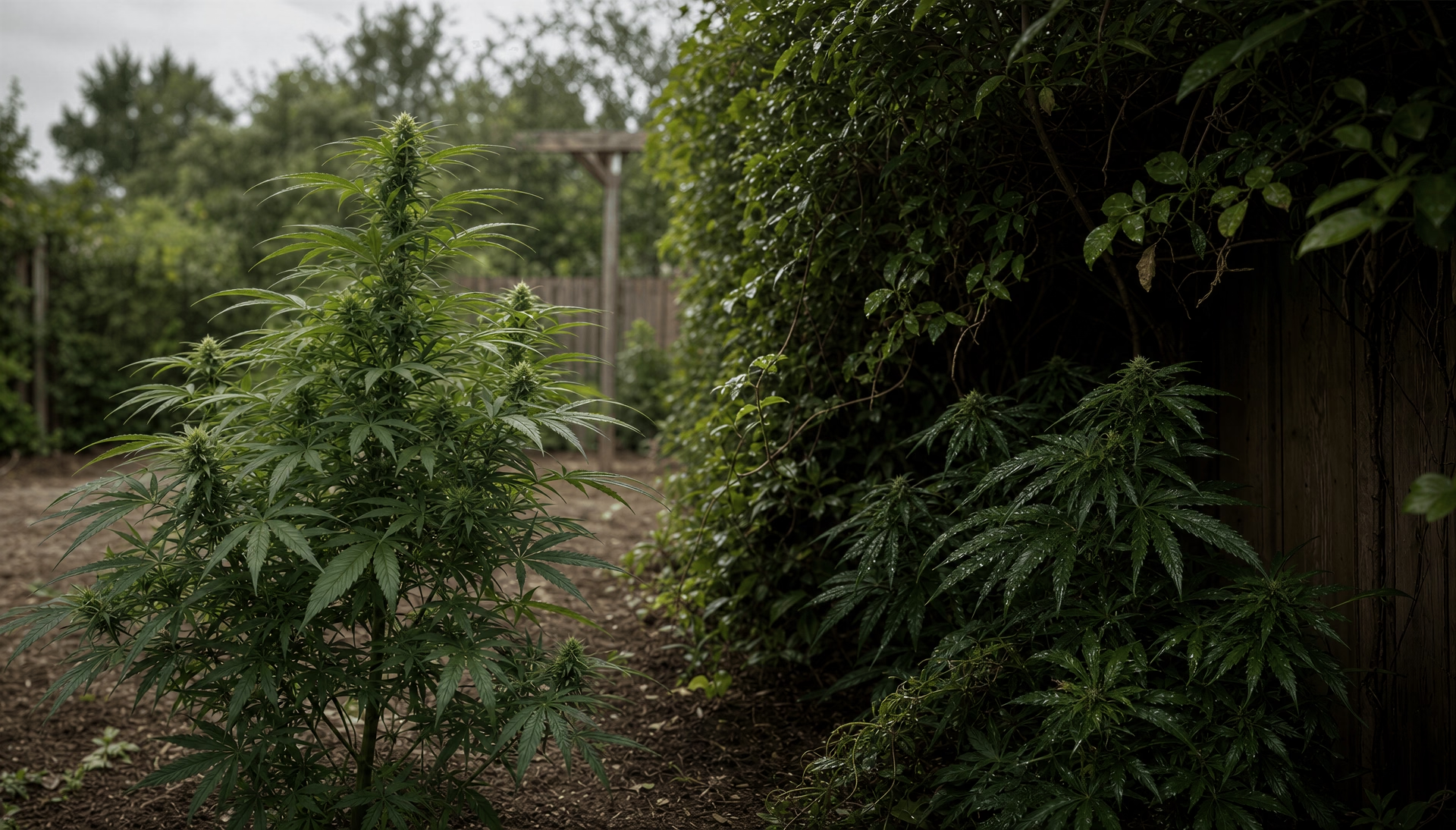
Avoid walls, dense hedges, and fence corners that block circulation on all sides. If privacy screening is needed, leave breathing room between the screen and the plant. Dense vegetation pressed right up against a flowering cannabis canopy is asking for mold trouble.
Security and stealth without damaging plant health
Privacy matters for legal and practical reasons, but concealment can easily become self-sabotage. The worst stealth site is often the one beginners choose first: a shaded corner behind a thick hedge. It hides the plant, yes. It also reduces sun, traps moisture, and blocks airflow.
A better approach is visual screening without sealing the space shut. Lattice, open fencing, mixed-height ornamentals, or positioning behind ordinary garden crops can break sightlines while still allowing light and wind through. Keep plants out of view from public paths, neighboring windows, upper floors, and any place where they are clearly visible from outside the property. That is not just etiquette. In parts of Europe, public visibility can turn a tolerated private grow into a legal problem.
Odor matters too. Flowering plants can carry a long way in still evening air. Downwind placement near a shared boundary, balcony edge, or frequently opened window is careless. Think in terms of who can see the site and who can smell it. Then check your local law, not online folklore. Germany’s 2024 Cannabis Act allows adults to cultivate up to three plants for personal use at their residence under specified conditions, while Malta and Luxembourg allow limited home growing under their own rules. Spain, Belgium, and the Netherlands are far less straightforward. “Private” and “tolerated” are not the same as clearly lawful.
Why water access should shape site choice from day one
If a site is hard to water, it is a bad site. Simple as that.
Outdoor plants in the ground buffer drought better than container plants, especially when soil organic matter is high and mulch is used; USDA NRCS guidance on soil function is clear that organic matter improves infiltration and water-holding capacity. But even healthy living soil does not eliminate irrigation needs in dry spells. Containers are less forgiving. In hot weather they may need water daily, sometimes twice daily, and hauling cans across a garden every afternoon becomes the weak point in the whole setup.
Convenience changes behavior. A plant 10 meters from a hose gets checked, watered, and inspected. A plant hidden at the far edge of a property gets neglected until stress is obvious. By then you may be reacting to droop, nutrient lockout from dry media, or split stems after a thirsty plant suddenly takes up too much water.
Rainwater collection can help, especially in dry summers, but storage has to stay clean and covered. Dirty roofs and stagnant tanks turn a useful water source into a contamination risk. Choose a site with realistic access to hose lines, water storage, and drainage. If irrigation is awkward on day one, it will be worse in August.
Soil preparation: pH, drainage, organic matter, and living soil
Outdoor results often get blamed on “hungry plants” when the real problem sits lower down: a root zone that is too acidic, too compacted, too wet, or too dead biologically to cycle nutrients well. That matters more outdoors than many guides admit, because rain, native soil texture, and seasonal temperature swings shape the root environment far more than a feeding chart does. A fertile soil that cannot drain will stunt plants. A biologically active bed with poor structure will still suffocate roots. Start there.
- Cannabis mineral-soil target
- 6.0–7.0
- FAO broad crop range
- 5.5–7.5
- Low-pH issue
- Phosphorus, calcium, and magnesium can become less available
- High-pH issue
- Iron, manganese, zinc, and sometimes phosphorus become harder to access
Why the practical soil pH target is 6.0 to 7.0
The commonly cited target of pH 6.0 to 7.0 for cannabis in mineral soil is one of the few repeated numbers in grow advice that holds up reasonably well. The FAO places optimal crop performance broadly in soils with pH 5.5 to 7.5, and cannabis horticulture has settled into the narrower 6.0 to 7.0 band because it balances nutrient availability, microbial activity, and root function without pushing availability extremes.
| Condition | What the guide says may happen |
|---|---|
| Low pH | Phosphorus availability drops; calcium and magnesium often fall; manganese and aluminum can become more soluble |
| High pH | Iron, manganese, zinc, and sometimes phosphorus become harder for roots to access |
At low pH, several things begin to go wrong at once. Phosphorus becomes less available. Calcium and magnesium availability often falls. Manganese and aluminum can become more soluble, which is not helpful in excess. At high pH, iron, manganese, zinc, and sometimes phosphorus become harder for roots to access. The plant may be sitting in a soil that contains those nutrients on paper while showing pale new growth, interveinal chlorosis, or weak vigor in practice. That is not always a fertilizer shortage. Often it is a chemistry problem.
This is why outdoor growers should be skeptical of dramatic amendment routines before they know the starting point. Native soils vary widely. A calcareous Mediterranean soil may already run alkaline. A sandy forest-edge soil in northern Europe may lean acidic and low in buffering capacity. Adding lime, ash, sulfur, guano, or concentrated bottled feeds without a soil test is guesswork dressed up as expertise.
The useful approach is simpler. Test the soil. If the pH sits roughly in that 6.0 to 7.0 range, do not chase tiny changes. If it is well outside it, correct gradually. Dolomitic lime can raise pH while supplying calcium and magnesium; elemental sulfur can lower pH, though not instantly. Compost helps buffer swings, but it is not a magic pH reset. The target is stability, not constant adjustment.
Organic matter, structure, and root-zone oxygen
Organic matter improves soil in more than one way, and that distinction matters. Compost does not merely “feed the plant.” It feeds soil biology, supports aggregate formation, improves water-holding capacity in sandy soils, and can improve infiltration and tilth in heavier soils. USDA NRCS guidance repeatedly links soil organic matter to aggregate stability, infiltration, and water relations. For outdoor cannabis, that translates into fewer drought swings and fewer waterlogged episodes when the soil is built properly.
But organic matter alone is not enough. Structure determines whether roots get oxygen after rain. A clay-heavy site amended with compost may still remain too dense if it lacks pore space. A sandy site may drain fast yet dry out so aggressively that roots cycle between stress and saturation with every irrigation. Texture sets the baseline; amendments only modify it.
That is why aeration materials matter in mixed beds and containers. Pumice, lava rock, coarse perlite, rice hulls, or other stable pore-forming materials help keep air in the root zone. In-ground sites with compacted subsoil may need physical loosening before planting, or even raised mounds, because adding a small amount of compost to the top 20 cm does little if water still hits a dense layer underneath and stalls there.
Healthy roots need both water and oxygen. That sounds obvious, yet many outdoor failures come from treating those needs as opposites when they are linked. A good soil holds moisture in fine pores and air in larger pores. When the profile stays saturated too long, root respiration drops, beneficial aerobic activity falls, and opportunistic pathogens gain ground. Growth slows fast. Leaves droop. The grower adds feed. The roots get worse.

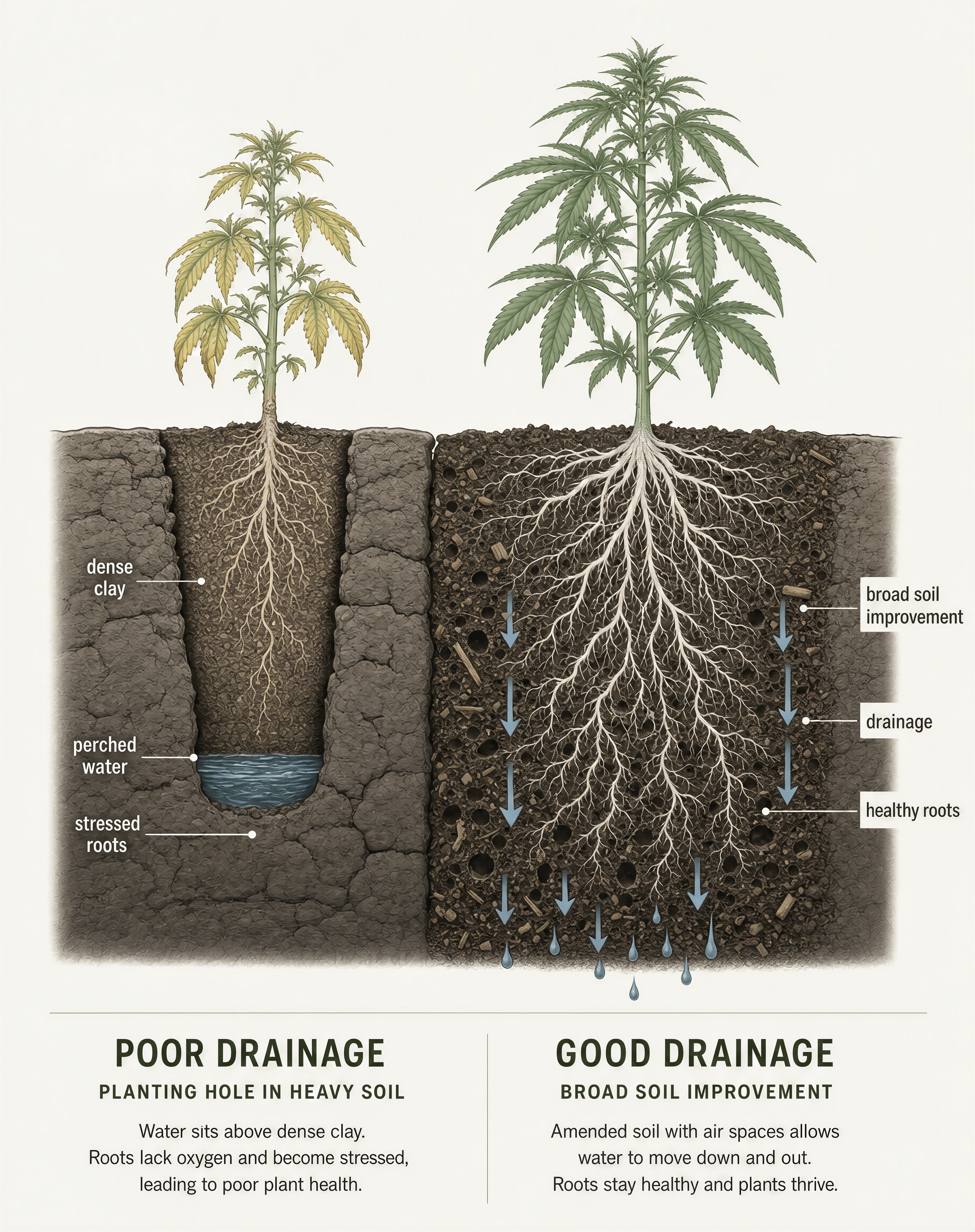
Drainage problems that look like nutrient problems
Poor drainage is one of the most common outdoor mistakes, and it is routinely misread as deficiency. Yellow lower leaves, stalled growth, purple petioles, dull foliage, and weak branching can all appear in soils where nutrients are present but roots are too stressed to absorb them well. The pattern often worsens after rain or after generous irrigation. That is the clue.
Waterlogged soil displaces oxygen. Once root-zone oxygen falls, uptake of nitrogen, potassium, and phosphorus becomes erratic. Root tips die back. Microbial processes shift. In severe cases the smell changes too: sour, swampy, anaerobic. No nutrient line fixes that.
Heavy autumn soils are especially risky in northern Europe, where cool temperatures already slow drying and repeated rain extends leaf wetness and raises disease pressure above ground. A plant with impaired roots is then less able to regulate water, maintain healthy tissue, and resist botrytis pressure later in bloom. The drainage issue starts in June and shows up as rot in September.
How to check and improve drainage
- Test the site Dig test holes and fill them with water to see how quickly the area drains.
- Avoid collection points Do not plant in low pockets where runoff gathers.
- Raise the root zone Use raised beds or mounded rows in wet regions.
- Prevent compaction Stay off wet soil so structure is not crushed.
- Do not make a bathtub Avoid digging a clay hole and filling only that hole with airy mix.
The practical fixes are not glamorous. Dig test holes and fill them with water to see how quickly the site drains. Avoid low pockets where runoff collects. Use raised beds or mounded rows in wet regions. Reduce compaction by staying off wet soil. Do not create a “bathtub” by digging a planting hole into clay and filling it with airy potting mix; water can perch at the interface and drown the root ball. In difficult native ground, broad improvement over a larger area works better than a single amended hole.
What ‘living soil’ means and what it does not mean
Living soil Soil with an active food web of microbes and soil animals that decompose organic inputs, cycle nutrients, and help build structure over time.
“Living soil” has become a catch-all phrase, often used as if biology can override basic physics. It cannot. In plain terms, living soil is soil with an active food web: bacteria, fungi, protozoa, nematodes, arthropods, earthworms, and roots interacting to decompose organic inputs, cycle nutrients, and build structure over time. That is real. It can improve resilience, reduce sharp feeding swings, and support steady growth. It is not mystical.
It also does not mean that any bagged mix loaded with amendments will run itself for a whole season. Biology needs oxygen, moisture balance, organic substrates, and moderate temperatures. Let the soil swing from drought to saturation and microbial performance drops. Pack it too tightly and aerobic life suffers. Dump in excessive high-salt amendments and the system can become chemically hostile despite being sold as “organic.”
The strongest case for living soil outdoors is not that it produces magic results. It is that a well-built, biologically active soil buffers stress better than a sterile, feed-driven setup, especially in ground where roots can explore a large volume. But restraint matters. More inputs do not automatically build more life. Mature compost, sensible mineral balancing, mulch, and time usually beat a long list of concentrated powders thrown together a week before transplanting.
Mulch, cover crops, and microbial stability outdoors
What mulch does outdoors
- Moisture Slows evaporation from the soil surface.
- Rain impact Softens raindrop impact and helps limit crusting.
- Temperature Moderates topsoil heat swings.
- Microbial stability Helps create steadier conditions for roots and soil life.
Outdoor soil is exposed to heat, rain impact, wind, and evaporation. Bare ground swings harder in moisture and temperature, and those swings destabilize both roots and microbes. Mulch is one of the most effective low-tech ways to reduce that instability. A surface layer of straw, leaf mold, shredded leaves, or other clean organic mulch helps slow evaporation, soften rain impact, limit crusting, and moderate topsoil temperatures. USDA NRCS principles on mulching and soil cover apply directly here.
That buffering matters more as European summers warm. Copernicus reported that 2023 was the warmest year on record in Europe. In southern climates, mulch can reduce severe drying around the feeder-root zone. In wetter climates, it must be used with judgment: piled against the stem or laid too thickly in already cool, wet conditions, it can hold excess surface moisture and invite stem and slug problems.
Cover crops play a related role. Low-growing clovers, seasonal legumes, or mixed covers can protect the soil surface, feed microbial life through root exudates, and improve structure over time. They are not free of trade-offs. In dry regions they can compete for water unless cut back or terminated. In humid regions they can reduce mud splash and erosion, which helps, but overly dense understory growth can also reduce airflow if neglected.
The sound position is this: living soil outdoors is built from physical structure first, biology second, and amendments third. Get pH into a workable range. Build a root zone that drains after rain yet holds moisture between irrigations. Add organic matter that improves aggregation rather than smothering the soil. Then protect that system with mulch or well-managed cover. When growers skip those steps and chase bottled corrections, they usually end up treating symptoms instead of the cause.
Container versus in-ground growing
| Method | Main advantages in the guide | Main drawbacks in the guide |
|---|---|---|
| Containers | Control over medium, mobility, easier quarantine, reliable drainage if built well | Dry faster, heat faster, need more frequent irrigation, salts can build quickly |
| In-ground | Larger root volume, better buffering, lower irrigation frequency, larger soil biology | You inherit native pH, drainage, and pest problems |
| Raised beds | More root volume than pots while bypassing poor native soil | Still need planning for fill, drainage, and irrigation |
Choosing between containers and planting directly in the ground is not a style preference. It changes root temperature, irrigation frequency, microbial stability, disease pressure, and final plant size. A plant in a 30-liter fabric pot and the same cultivar in deep, well-structured soil are not facing the same season, even under the same sun.
The lazy claim that “outdoor always gets bigger” falls apart here. Outdoor plants only become large when root space, season length, drainage, and autumn disease pressure all line up. In northern Europe, a huge plant in September can be a liability if rain and botrytis arrive before it finishes. In southern Spain or Sicily, the same root volume may be an advantage because the season is long enough to convert that vegetative mass into mature flowers.
Root volume, buffering, and final plant size
Root volume sets the ceiling for growth more than many growers admit. Bigger root zones usually mean larger canopies, better drought tolerance, and less day-to-day stress. In-ground plants have the obvious edge because their roots are not confined by hard walls or air-pruning boundaries. If the native soil is deep, aerated, and within a sensible pH range—outdoor practice usually targets about 6.0 to 7.0, which sits comfortably inside the FAO’s broad 5.5 to 7.5 crop range—plants can build extensive root systems and access a far larger water reserve.
That buffering matters. Soil in the ground changes temperature more slowly than potting media in a black container. It also dries more slowly. University extension work across container-grown horticultural crops has repeatedly shown that containers heat up faster and demand more frequent irrigation. On a hot, windy day, the root zone in a pot can swing from ideal to stressful in hours. In-ground soil is less dramatic.
Final plant size follows that logic, but not mechanically. A giant root system is only useful if climate allows a long enough finish. At 50°N or farther north, where autumn cools early and rain lingers on flowers, pushing for maximum biomass can be self-defeating. More plant means more interior humidity, more pruning work, and more sites for botrytis cinerea to take hold. Root volume raises potential. Weather decides whether that potential can be cashed in.

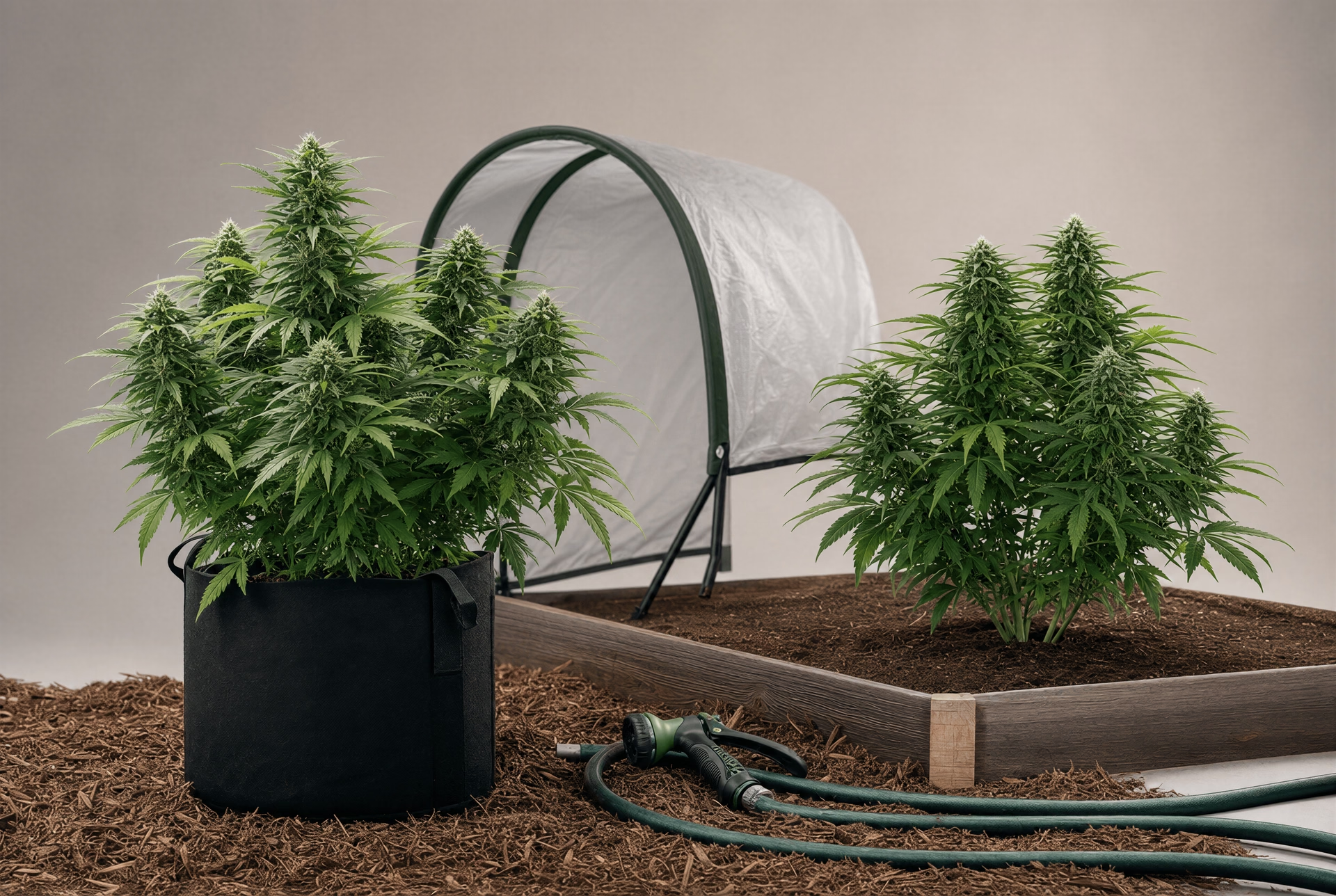
Container advantages: control, mobility, quarantine, drainage
Why growers choose containers
- Media control You can set drainage and structure from day one.
- Mobility Plants can be moved for sun, privacy, or rain protection.
- Quarantine A stressed or infested plant can be isolated.
- Bad native soil workaround Heavy clay, rubble, and compacted subsoil matter less when the root zone is built in a pot.
Containers win when control matters more than raw scale. You can build the exact medium you want, correct drainage from day one, and avoid gambling on poor native soil. That is a serious advantage if the site is heavy clay, rubble fill, compacted subsoil, or has a history of root pests.
Mobility is another major benefit. A container can be moved to chase sun in spring, shifted under cover during prolonged rain, or relocated for privacy and legal risk management where visible cultivation creates problems. That flexibility is not a minor convenience in Europe. In wetter northern climates, being able to pull plants under a simple roof during repeated autumn rain can be the difference between harvest and mold.
Containers also make quarantine easier. If one plant develops spider mites, fusarium symptoms, or a severe nutrient imbalance, you can isolate it. You cannot do that with a plant rooted into the garden itself. This becomes more important when growing multiple cultivars with different vigor and disease tolerance.
Drainage is often the deciding factor. Cannabis dislikes waterlogged roots. In a properly built container mix with coarse structure and enough air-filled porosity, excess water escapes fast. That is why pots often outperform bad ground in rainy regions. But the price is constant attention. Containers dry faster, accumulate salts faster if fed carelessly, and expose roots to sharper heat. Small pots are especially unforgiving. A container that looks manageable in June can become a twice-daily irrigation burden in August.
In-ground advantages: resilience, lower irrigation frequency, larger biology
In-ground growing is less reactive once the site is genuinely suitable. The larger soil mass buffers errors in feeding and watering, and plants usually need irrigation less often. USDA NRCS guidance on soil organic matter is useful here: organic matter improves aggregate stability, infiltration, and water-holding capacity. In practical terms, a well-amended in-ground bed with mulch is more drought-resilient and less prone to the feast-or-famine moisture swings common in containers.
There is also a biological upside. Native soil, when healthy, supports a larger and more stable food web than sterile or lightly colonized potting mixes. Fungi, bacteria, arthropods, and earthworms all contribute to nutrient cycling and structure. That does not mean “living soil” slogans make every garden productive. Bad soil is still bad soil. But where the ground is already functional, plants often show a steadier rhythm of growth than container plants forced through repeated wet-dry cycles.
The weakness is that you inherit the site’s problems too. Native pH may be off. Drainage may be poor. Root-knot nematodes, wireworms, or persistent fungal pathogens may already be present. Fixing those issues is slower and less precise than filling a pot correctly from the start. In-ground growing rewards good sites and punishes bad ones.
When raised beds make more sense than either extreme
Raised beds are the middle path, and in many gardens they are the rational choice. They offer more root volume and moisture buffering than containers while still letting you bypass hostile native soil. If the ground is compacted clay, prone to standing water, or contaminated with construction debris, a raised bed gives you an engineered root zone without the thermal instability of pots.
They also improve drainage by elevation. That matters in Atlantic and northern European climates where prolonged wet periods can suffocate roots and push disease pressure upward. At the same time, a raised bed does not dry as fast as a 20- or 30-liter pot, so irrigation is less punishing in heat.
There is no universally superior method. Containers suit growers who need control and mobility. In-ground planting suits sites with good soil and a climate that rewards full-season root expansion. Raised beds suit the many gardens where native soil is mediocre and weather is unreliable. That is the real choice: not which method is “better,” but which one fits the site, the latitude, and the kind of autumn waiting at the end of the season.
Starting outdoors: germination, seedling timing, and transplant strategy
Outdoor success starts weeks before a plant ever sees the garden. Seed timing is not a generic “spring job.” It depends on frost risk, night temperatures, soil warmth, latitude, and how soon local day length can push a young photoperiod plant into stress or premature flowering. A seedling that starts cleanly in Málaga may sulk, stretch, or flower oddly in Rotterdam if handled the same way.
Outdoor start timing by region in the guide
- Mediterranean climates Late March to April starts often establish more cleanly than very early spring exposure.
- Northern Europe Direct starts often make more sense from late April into May.
- Safer transplant window north Mid-May onward is often the safer move after the main frost window.
- Cool inland or elevated sites Waiting until late May is often the right call.
When to start seeds by region
In Mediterranean climates such as southern Spain, coastal Italy, and parts of southern France, outdoor starts can happen earlier because hard frost is rare and spring arrives with stronger light. Even there, early does not always mean smart. March sowing can work under protection, but many growers get better establishment by starting in late March to April and moving plants out once nights are consistently mild and soil has warmed. Earlier starts are more exposed to cold rain, wind, and erratic spring weather than most guides admit.
Northern Europe is a different calculation. In Germany, the Netherlands, Belgium, and similar climates, direct outdoor starts usually make more sense from late April into May, with transplanting often safer from mid-May onward after the main frost window has passed. In cooler inland or elevated sites, waiting until late May is often the right call. A week of patience beats a month of stunted growth.
Autoflowers and photoperiod plants also need different calendars. Autoflowers are often started later because their life cycle is fixed; losing two weeks to cold stress is a major loss. Photoperiod plants give more recovery time, but they carry another risk: if started too early indoors, then moved outside while days are still relatively short or the weather is unstable, they can enter flowering or show confused development before reverting to vegetative growth. That means wasted time and a misshapen plant.
Why cold soil and weak spring light stall young plants
Seeds do not care about calendar dates. They respond to conditions.
Cold soil slows water uptake, root metabolism, and microbial activity around the root zone. In practical terms, the seed takes longer to emerge, damping-off risk rises, and early growth becomes hesitant rather than explosive. A small plant in cold, wet ground often looks “hungry,” but the real problem is temperature, not fertilizer. Piling on nutrients will not fix a root zone that is simply too cold to function well.
Weak spring light creates a second problem. Early seedlings stretch when light intensity is low, especially during overcast northern springs or when they are started on a windowsill. Long internodes and thin stems are not harmless cosmetic flaws outdoors; they make plants more vulnerable to wind damage and transplant shock. Short, stocky seedlings handle the move outside far better.
This is one reason many experienced outdoor growers start seeds indoors, in a greenhouse, or under a simple protective setup. Not because outdoor germination is impossible, but because early root formation is easier to control in warmth. Once the weather stabilizes, that small head start matters.
Be careful with oversized indoor plants, though. Big plants raised too long under artificial schedules can behave unpredictably when moved outside. Cannabis is a quantitative short-day plant in cultivation practice, so day length matters. If a mature enough photoperiod plant is transplanted out while natural days are still not long enough for stable vegetative growth at that latitude, it may start flowering early, then revert as summer advances. That stop-start pattern costs vigor.
Hardening off and transplant shock prevention
A seedling grown under shelter is not ready for full outdoor exposure in one jump. Wind, ultraviolet light, and wider day-night temperature swings can damage tender tissue fast.
Hardening-off sequence
- Day 1–2 Give sheltered outdoor time in bright shade or gentle morning sun.
- Middle of the period Increase light and wind exposure gradually each day.
- Cold nights Bring plants back under cover if temperatures drop sharply.
- Transplant day Move them into moist soil on an overcast day or in the evening if possible.
Hardening off should take about 7 to 10 days. Start with a few hours of sheltered outdoor exposure, ideally in bright shade or morning sun. Increase light and wind exposure gradually each day. Bring plants back under cover at night if temperatures drop sharply. The aim is thicker leaf cuticles, stronger stems, and less shock at transplant.
Transplant into moist, not waterlogged, soil. Do it in the evening or on an overcast day if possible. Disturb roots as little as possible. A seedling that is slightly rootbound is manageable; a plant circling densely in a small pot is already paying a penalty. Water the planting hole first if the site is dry, set the plant at the same depth it was growing before, and mulch lightly once the surface has warmed.
Avoid moving plants out just before a cold snap, heavy rain, or hard wind. Good timing prevents more stress than any additive.
Direct sowing versus indoor pre-starting
Direct sowing is simple and avoids transplant disturbance. In warm, settled Mediterranean conditions, it can produce strong taproot development and vigorous establishment. The drawback is exposure. Seeds and tiny seedlings are vulnerable to slugs, birds, cold rain, crusted soil, and patchy germination.
Indoor pre-starting gives more control over temperature, moisture, and early protection. In Northern Europe, that control is often the difference between a healthy June plant and a runt that never catches up. It also lets growers reject weak seedlings before committing garden space.
Neither method is universally right. Direct sow when spring is reliably warm and the site is secure. Pre-start when frost risk lingers, light is poor, or the season is short. For much of Europe, especially north of the Mediterranean belt, the evidence-backed choice is clear: start small under protection, transplant only once the weather and day length are genuinely favorable, and resist the urge to begin too early.
Water management and irrigation outdoors
Watering outdoors is not housekeeping. It is crop steering. Get it wrong and the plant may survive, but aroma, flower density, disease resistance, and harvest timing all drift in the wrong direction.
Many outdoor guides obsess over feed charts and barely discuss irrigation beyond “water when dry.” That advice fails the moment climate, soil texture, pot size, and canopy size stop matching the writer’s backyard. A plant in sandy Andalusian ground behaves nothing like one in a 30-litre fabric pot on a Dutch patio. One can chase moisture downward. The other can swing from saturated to stressed in a day of wind and heat.
Water demand across growth stages
- Seedling and recent transplant
- Needs modest but regular moisture while remaining vulnerable to oxygen-starved media.
- Vegetative growth
- Demand rises with canopy size and daylight intensity.
- Early to mid-flower
- Peak demand often arrives while weather is still warm.
- Late flower
- Water may still be needed, but irrigation style must avoid long floral wetness and botrytis risk.
How cannabis water demand changes from vegetative growth to late flower
Young plants need modest but regular moisture because their root systems are still small. Seedlings and recent transplants are vulnerable to drought, yet they are just as vulnerable to oxygen-starved media. In heavy soils, overwatering at this stage is common. Wet, cold ground slows root expansion, and stalled roots mean stalled plants.
During vegetative growth, water demand rises with leaf area, stem mass, and daylight intensity. Long summer days at higher latitudes can drive strong transpiration even when temperatures are not extreme. In-ground plants often become easier to manage at this point because expanding roots access a larger soil reservoir. Containers move the other way. As roots fill the pot, the margin for error shrinks and irrigation frequency climbs.
Peak demand usually arrives from late vegetative growth through early to mid-flower, when the canopy is large and the weather is still warm. Then the pattern changes again. Late flower does not always mean less water, but it often means more caution. Dense inflorescences plus frequent overhead watering, evening irrigation, or persistent humidity increase botrytis risk. UC IPM and RHS guidance on Botrytis cinerea in ornamentals and fruit crops maps well here: prolonged floral wetness and stagnant air are exactly what you want to avoid.
Water stress also changes flower quality. Repeated severe drought during bloom can suppress growth, speed senescence, and blunt terpene expression. Heat plus dry roots pushes the plant into survival mode. On the other hand, constantly soggy roots reduce oxygen availability, flatten vigor, and can leave flowers looser and more disease-prone. The point is balance, not deprivation.
Deep watering versus shallow frequent watering
Roots follow water. Shallow, frequent irrigation trains much of the root mass into the upper soil layers, where moisture fluctuates fastest and temperatures run hottest. That is a poor setup for outdoor resilience.
Deep watering encourages roots to move downward, especially in well-structured soil with organic matter and decent infiltration. USDA NRCS guidance on soil structure and organic matter is directly relevant here: better aggregation improves water entry, storage, and root exploration. For outdoor cannabis, that translates into fewer stress swings and stronger performance during hot spells.
A practical rule is to water thoroughly enough that the moisture front penetrates the full active root zone, then wait until the soil has partly dried before watering again. Not bone dry. Partly dry. In mineral soils, that usually means checking moisture below the surface rather than trusting the top centimetre. The surface can look dusty while the root zone is still wet.
There is one major exception: heavy clay or compacted ground. Deep watering works only if the soil can drain. If it cannot, “water deeply” becomes “fill the root zone with stagnant water.” In that case, the fix is not a stricter schedule. It is better drainage, raised beds, added organic matter, and less volume per irrigation event until structure improves.
Containers need a separate mindset. They dry faster, heat faster, and can move from ideal to drought stress quickly, especially black pots in direct sun. Extension work across container crops has shown the same pattern for years: limited root volume means faster moisture depletion and larger root-zone temperature swings. Deep watering still matters in pots, but so does frequency. In midsummer, a large flowering plant in fabric pots may need daily irrigation, sometimes twice daily in very hot, dry weather. That is not overwatering if the medium drains properly and the plant is actually using the water.
Drip irrigation, hand watering, and simple low-tech systems
Hand watering gives control. You see each plant, spot wilt, catch mites, notice yellowing. For small gardens, that matters. The weakness is inconsistency. Busy week, missed day, sudden heatwave: containers suffer first.
Irrigation method comparison
- Hand watering High plant-by-plant awareness, but consistency can fail during busy periods or sudden heat.
- Drip irrigation Targets the root zone with less leaf wetting and better repeatability.
- Low-tech systems Gravity drip, hose rings, olla pots, and bottle drippers can help if they are calibrated.
Drip irrigation is the more disciplined option for larger outdoor grows. It delivers water to the root zone with less leaf wetting, lower evaporative loss, and better repeatability. That helps with disease prevention because dry foliage and dry flowers are safer foliage and flowers. A basic gravity-fed or low-pressure drip setup can work well if emitters are checked often for blockages and distribution is tested rather than assumed.
Low-tech systems can bridge the gap: perforated hose rings, clay olla pots, bottle drippers for temporary support, or simple header tanks feeding drip lines by gravity. None of these is magic. All need calibration. If one emitter delivers twice as much as another, your schedule becomes irrelevant.
Morning irrigation is usually the safer default outdoors. It prepares the plant for daytime transpiration and reduces the time that leaves, mulch, and the soil surface stay cool and wet overnight.
Rainwater collection: benefits, limitations, and hygiene
Rainwater is often well suited to garden use. It is typically lower in dissolved salts than hard tap water and can be gentler on soil biology over time. In regions with alkaline mains water, stored rainwater can also reduce the steady pH drift that frustrates nutrient uptake.
But rainwater harvesting is not automatically clean. Roof debris, bird droppings, dead insects, decaying leaves, and warm stagnant tanks all turn a useful resource into a contamination risk. Public water agencies and FAO-aligned garden guidance are clear on this: first-flush diversion, screened inlets, opaque storage, and regular tank cleaning matter.
Use covered barrels or tanks. Exclude light to limit algae. Clean gutters. Do not pull irrigation water from sludge at the bottom of a neglected barrel and assume “natural” means harmless. If water smells foul, has visible biofilm, or has been sitting hot and stagnant for long periods, do not spray it on foliage or flowers. Root-zone use is lower risk than foliar application, but hygiene still matters.
Rainwater storage also has a strategic limit in northern Europe: the wettest periods are not always the periods when plants need irrigation most. Storage volume, not just annual rainfall, decides usefulness.
Mulching, evaporation control, and drought resilience
Mulch is one of the simplest ways to improve irrigation efficiency outdoors, and many growers still skip it. That is a mistake.
A mulch layer reduces surface evaporation, buffers soil temperature, softens the impact of intense sun, and limits the wet-dry extremes that stress roots. In hot southern climates, this buffering can protect terpene retention indirectly by reducing heat stress and midday shutdown. In cooler regions, mulch also helps keep soil moisture more even after irregular rainfall instead of letting the surface bake, crack, and shed water.
Straw, leaf mold, composted bark, and other clean organic mulches all work if they are kept a little back from the stem base. Piling wet mulch against the crown invites rot and pests. In slug-heavy climates, inspect under mulch often.
Mulch is not a substitute for watering. It is a force multiplier for every litre you apply. Combined with better soil structure and sensible irrigation timing, it gives outdoor plants a much larger safety margin during drought, wind, and heat. That margin is often the difference between a plant that merely survives summer and one that finishes autumn with healthy flowers still worth drying.
Companion planting and habitat design for pest balance
Companion planting is one of the most romantic ideas in outdoor growing. Put a few fragrant herbs and flowers around cannabis, and the pests supposedly vanish. Real gardens do not work like that. A more honest view is also more useful: companion plants can improve habitat diversity, feed beneficial insects, soften monoculture effects, and in some cases interfere with pest finding. They cannot compensate for a damp canopy, neglected scouting, poor airflow, or flowers left wet through cool autumn mornings.
That matters outdoors because pest pressure is never only about the crop. It is about the whole site: surrounding vegetation, moisture, wind exposure, soil fertility, irrigation style, and seasonal timing. A dry terrace in southern Spain and a sheltered garden in the Netherlands will host very different insect and disease dynamics even with the same cultivar.
What companion planting can realistically do
Companion planting can support pest balance, but it does not act as a reliable stand-alone pest barrier. Limited evidence
Companion planting works best as ecological support, not as a force field. Diverse plantings can provide nectar, pollen, alternative prey, and shelter for predatory insects such as hoverflies, lacewings, ladybirds, and some parasitic wasps. That fits integrated pest management rather than folk magic.
There are plausible mechanisms. Strong-smelling plants may disrupt host-finding by some herbivorous insects. Flowering companions can attract beneficials that then move onto nearby plants and feed on aphids, whiteflies, or small caterpillars. Groundcover can reduce bare-soil heat and splashback. But these effects are inconsistent, highly site-specific, and often studied in vegetables or orchard systems rather than cannabis.
That distinction matters. Evidence from crop science does not automatically transfer to cannabis simply because the pest list overlaps. Spider mites, aphids, thrips, and caterpillars may respond to habitat diversification, but if a plant already has a dense, stagnant canopy, no ring of herbs will stop powdery mildew or botrytis. UC IPM and the Royal Horticultural Society both emphasize environmental prevention for these diseases: airflow, sanitation, and reduced leaf wetness. Companion plants do not replace any of that.
| Companion plant | Practical role described in the guide | Main caution |
|---|---|---|
| Basil | Adds scent diversity and can provide nectar when allowed to flower | Claims that it protects cannabis are mostly extrapolated from other garden contexts |
| Marigolds | Useful as an insectary and diversity plant | A few plants beside cannabis do not create broad pest immunity |
| Dill | Often the strongest choice for beneficial-insect support | Timing and placement matter, and dense growth can add humidity |
Basil, marigolds, and dill: evidence, folklore, and practical use
Basil is commonly recommended because of its aromatic oils, especially linalool, eugenol, and methyl chavicol, which may affect insect behavior. The practical case for basil is modest but reasonable: it can add scent diversity and, when allowed to flower, provide nectar resources. The weak point is the evidence. Claims that basil “protects” cannabis are mostly extrapolated from general garden practice and studies on other crops. Use basil because it adds habitat value and fits a mixed planting. Do not treat it as a shield.
Marigolds sit in a similar category, though the folklore around them is even louder. Tagetes species have a real research history in crop rotations and nematode suppression, especially through root exudates and residues, but that is not the same as saying a few marigolds beside a cannabis plant will repel every above-ground pest. Their strongest practical role is as an insectary and visual diversity element. They flower reliably, attract pollinators and some beneficial insects, and may help disrupt uniform planting patterns. That is useful. It is not pest immunity.
Dill is often the most defensible of the three for beneficial-insect support. Umbellifers are famous for attracting hoverflies and parasitic wasps because their flat, accessible flower clusters suit small beneficial insects. Dill can therefore serve as a feeding station near the crop. The catch is timing. If dill flowers too early or too far from the target plants, the effect weakens. If it grows too densely, it can also add humidity in already crowded beds. Placement matters.
Pollinator support versus pest deterrence
Many growers blur these two functions, but they are not the same. Pollinator-friendly flowers help bees and hoverflies, which is good for garden ecology, yet cannabis does not need insect pollination for sinsemilla production. So the value of these plants is mostly indirect.
The stronger argument is beneficial insect support. Hoverfly adults feed on nectar and pollen, while their larvae consume aphids. Some wasps need floral resources as adults. Lacewings also benefit from diversified habitats. This is where dill and flowering basil can earn their space. Marigolds can contribute too, though their role is often overstated in internet growing lore.
Pest deterrence by scent is harder to pin down. It may occur, but usually as a subtle reduction in host detection, not a binary repel-or-not effect. Wind, temperature, plant density, and pest species all change the outcome. A few herbs in pots will not stop a mite flare-up during hot, dusty weather.
Why insectary plants support IPM but do not replace scouting
A good outdoor layout may include dill, basil, marigolds, alyssum, or other insectary species around the perimeter or in breaks between larger plants. That is sound habitat design. It gives beneficials food and makes the site less like a single-species target. Still, integrated pest management begins with inspection.
Check leaf undersides. Watch for stippling from spider mites, white specks from thrips feeding, chewed tissue, eggs, frass, and localized mildew patches. Remove diseased material early. Thin overcrowded interiors. Water the root zone rather than the canopy. Avoid late foliar spraying in bloom, especially anything likely to leave residue on flowers.
That is the measured position. Companion planting is helpful as part of a diversified outdoor system. It is not a substitute for sanitation, canopy management, and regular scouting. In European outdoor conditions, especially where autumn humidity or summer drought drives pest and disease cycles, habitat design supports IPM. It does not replace it.
Natural pest and disease management outdoors
Outdoor disease control is rarely won with a miracle spray. It is won weeks earlier, when the canopy is built to dry fast after rain, irrigation is timed so leaves do not stay wet into the evening, and plants are spaced for the climate they actually face rather than for a photo on harvest day. That matters even more in cannabis than in many garden crops because the target tissue is the flower itself. Once dense buds are infected, especially late in bloom, options shrink fast.
This is where climate and latitude stop being abstract. A plant in Andalusia may finish under dry late-summer conditions with manageable mildew pressure. The same plant in Hamburg can hit peak flower under cool nights, long periods of leaf wetness, and repeated autumn rain. Disease pressure is not bad luck. It is often predictable.
Integrated pest management before any spray bottle comes out
Integrated pest management, or IPM, means preventing outbreaks first, monitoring constantly, and treating only when thresholds are crossed. UC IPM and RHS guidance across horticultural crops point the same way: sanitation, airflow, scouting, irrigation control, and habitat management do more than reactive spraying.
For outdoor cannabis, that starts with structure. Dense, overfed, dark-green plants with tangled interiors invite trouble. The old idea that bigger is always better is wrong in wet climates. In northern Europe, an oversized bush with poor airflow can become a botrytis incubator by September. A slightly smaller, better-pruned plant often yields more usable flower because less is lost to mold.
Scouting needs to be routine, not occasional panic. Turn over leaves and look at the undersides. Check lower interior growth where humidity lingers. Inspect after heat waves, after storms, and during transitions into flower. Use a hand lens if needed. The goal is to catch the first spots of mildew, the first mite stippling, the first dead sugar leaf poking from a cola.
Preventive IPM actions named in the guide
- Spacing Use wider spacing in humid regions.
- Selective pruning Open crowded interior shoots.
- Support Stake or trellis so branches do not collapse into a wet mass.
- Mulch placement Mulch the soil but keep it away from the stem crown.
- Irrigation timing Water the root zone early in the day instead of wetting foliage late.
- Sanitation Remove heavily infected material promptly and seal it away from the grow area.
- Nitrogen restraint Avoid excess nitrogen in flower.
Preventive IPM outdoors usually includes:
- wider spacing in humid regions
- selective pruning of crowded interior shoots
- staking or trellising so branches do not collapse into a wet mass
- mulching the soil to reduce splash and water stress while keeping mulch away from the stem crown
- watering the root zone early in the day rather than wetting foliage late
- removing heavily infected material promptly and sealing it away from the grow area
- avoiding excess nitrogen in flower, which can push soft, crowded growth
Companion planting has limits. Basil, dill, marigolds, yarrow, alyssum, and fennel can support beneficial insects and pollinators in mixed gardens, and that can help. But companion plants do not replace scouting, pruning, or weather response. If your canopy stays damp for 14 hours after rain, marigolds will not save it.
| Aspect | What the guide says |
|---|---|
| Identification | Small white or gray flour-like patches on leaves, petioles, or young stems |
| Favorable conditions | High relative humidity, moderate temperatures, crowding, and poor air movement |
| Prevention | Open shaded interiors, avoid plant-to-plant contact, and use morning sun plus airflow |
| Caution on treatment | Many foliar options become poor choices once flowering is advanced because residues may remain on harvested flowers |
Powdery mildew: identification, triggers, prevention, treatment
Powdery mildew usually begins as small white or grayish flour-like patches on leaves, petioles, or young stems. Early on it can be wiped with a finger, which is one reason growers underestimate it. Later it spreads fast, distorts leaves, reduces photosynthesis, and can move onto nearby tissue across the canopy. In outdoor cannabis, the danger is not only cosmetic leaf infection. It is the speed with which a dense plant can become broadly colonized once conditions favor the fungus.
Unlike many foliar diseases, powdery mildew does not need free water sitting on leaves to infect. It thrives with high relative humidity, moderate temperatures, crowding, and poor air movement. That catches growers off guard. A dry day followed by cool, humid nights can still be enough. RHS and UC IPM guidance on powdery mildew across garden crops consistently points to ventilation and plant spacing as first-line control.
Prevention is more effective than cleanup. Remove shaded interior growth that never dries well. Keep plants from touching each other. Avoid late-day overhead watering. Choose locations with morning sun so dew burns off quickly. Do not let weeds create a stagnant understory around containers or in-ground beds.
If mildew appears early in vegetative growth, sanitation and targeted treatment can often contain it. Common lower-residue tools in broader horticulture include potassium bicarbonate, sulfur products, horticultural oils, and some biological fungicides based on Bacillus species. Timing matters. Sulfur and oils can injure plants if misused, especially in hot weather, and they should not be mixed closely together because phytotoxicity risk rises. Once flowering is advanced, many foliar options become poor choices because residues can remain on the harvested flower. That is the hard line many home growers ignore.
Do not keep spraying infected buds and telling yourself it is “organic.” A residue can still be there after drying. On a product that will be inhaled, that is a safety issue, not a style preference.
| Topic | Guide summary |
|---|---|
| Typical pest | Two-spotted spider mite, Tetranychus urticae |
| Early sign | Tiny pale stippling on leaves |
| Late sign | Bronzing, decline, and fine webbing |
| Conditions that favor outbreaks | Hot, dry weather and stressed plants |
| Biological control named | Phytoseiulus persimilis and Neoseiulus californicus |
Spider mites: life cycle, hot-weather outbreaks, biological control
Spider mites are classic hot, dry weather pests. Two-spotted spider mite, Tetranychus urticae, is the usual suspect in gardens and greenhouses. Their outbreak pattern is brutal because they reproduce quickly. Eggs hatch into larvae, then nymphal stages, then adults, and under warm conditions that cycle can move fast enough for a light infestation to become a canopy-wide problem in a short period.
Early signs are subtle: tiny pale stippling on leaves where mites have pierced plant cells and sucked out contents. Later you may see bronzing, leaf decline, and fine webbing, usually on undersides or between leaflets and stems. By the time obvious webbing covers flowers, control has already become difficult.
Heat waves make this worse. Copernicus reported that 2023 was the warmest year on record in Europe, and hotter summers favor the exact dry-stress pattern that often precedes mite flare-ups. Plants in black plastic pots, against heat-reflecting walls, can become mite magnets because root stress and leaf stress rise together.
Biological control works far better when started early than when mites are exploding. Predatory mites such as Phytoseiulus persimilis are widely used in horticulture against spider mites, with Neoseiulus californicus often used in warmer, drier conditions or for preventive release programs. These beneficials need a strategy, not wishful thinking. Dusty leaves, broad-spectrum insecticides, and severe heat can undermine them. If you are going to use biological control, stop creating an environment that kills the predators and favors the pest.
For light infestations in veg, forceful water sprays on leaf undersides can reduce numbers, though repeated wetting of dense canopies in humid weather may trade one problem for another. In flowering plants, aggressive foliar treatment becomes less attractive. At that point, removing badly infested leaves, reducing drought stress, and preserving predators may be safer than coating flowers with soaps or oils.
| Early warning sign | Why it matters |
|---|---|
| A sugar leaf in the middle of a cola wilts or turns brown | Internal bud tissue may already be infected |
| Gray-brown dead tissue inside the flower | Rot can advance before the outside looks badly damaged |
| Dusty gray sporulation | The infection is active and should be cut out generously |
Botrytis and bud rot: why late flower is the danger zone
Botrytis cinerea is one of the defining outdoor cannabis losses in cool, wet autumn climates. It thrives on dense floral tissue, prolonged humidity, stagnant air, wounded plant material, and aging tissue. Viticulture research and greenhouse pathology map well onto cannabis here because the infection biology is similar: compact reproductive structures plus moisture retention equals trouble.
Late flower is the danger zone because buds are at their densest just as weather often turns worse. At higher European latitudes, long summer days delay photoperiod flowering into a season that may already be cooling and wetting down. This is why latitude matters in practical disease terms, not just in scheduling. The giant, long-finishing cultivar that coasts through a dry Mediterranean autumn can fail outright in Belgium or northern Germany.
Early signs of botrytis are easy to miss. A sugar leaf in the middle of a cola suddenly wilts or turns brown while surrounding tissue still looks normal. Gently open the bud and you may find gray-brown dead tissue inside, sometimes with dusty gray sporulation. Once established in a cola, it can spread internally while the outer surface still looks acceptable.
Prevention is blunt but effective: grow less density in mold-prone regions. Train branches outward. Defoliate selectively where airflow is blocked. Shake off standing water after heavy rain if practical. Use rain covers or simple greenhouse protection where legal and feasible. Harvest in stages if needed rather than waiting for every flower to reach the same maturity while rot advances. Losing a little ripeness is better than losing the crop.
Treatment options for active botrytis in flowers are limited. Infected buds should be removed generously, not trimmed narrowly. Sterilize tools between cuts. Do not compost diseased floral material near the garden.
Sanitation, pruning, spacing, and weather response
Most outdoor cannabis disease management is architecture plus vigilance. Sanitation means more than keeping the site tidy. Remove dead leaves, dropped plant matter, and badly infected tissues before they become inoculum sources. Clean stakes, scissors, and trellis materials. Do not handle a moldy plant and then move directly to a healthy one without cleaning up.
Pruning should fit the region. In dry Mediterranean conditions, heavy stripping can expose plants to sunburn and heat stress. In damp northern climates, a more open framework is often the right call. The same genotype may need very different canopy density depending on whether September is hot and dry or cold and wet.
Spacing is equally climate-specific. In arid areas, tighter planting can sometimes be tolerated if irrigation is controlled. In humid areas, crowding is asking for mildew and botrytis. Air must move through and around the plant. If branches are overlapping into a single wall of foliage, the canopy is too dense.
Weather response separates competent outdoor growers from optimistic ones. Check forecast models. If three days of rain are coming during late flower, thin vulnerable interior material beforehand, improve support, and inspect immediately after the event. If a heat spike is coming, irrigate early, reduce drought stress, and watch for mites. Outdoor growing is not passive. The weather is part of the pest program.
Avoiding chemical pesticide contamination on consumable flowers[1] Summary of adverse events reports for legal cannabis products: January 2018 to March 31, 2023. Health Canada. Government of Canada, 2024.[2] Summary of adverse events reports for legal cannabis products: January 2018 to March 31, 2023. Health Canada. Government of Canada, 2024.
This point needs to be stated plainly: inappropriate pesticide use on cannabis flowers is risky because residues can remain on material that is later inhaled. Health Canada’s 2024 adverse reaction reporting summary recorded 1,542 reports related to legal cannabis products from 2018 to March 31, 2023, with 282 classified as serious. Not all of those cases were pesticide-related, but the wider regulatory record, including residue recalls, shows that contamination is not theoretical.
Home growers often make two errors. First, they assume anything sold for gardens is acceptable on cannabis. It is not. Second, they assume “organic” means harmless when combusted or vaporized. It does not. Neem, pyrethrins, sulfur, soap residues, essential oil blends, and many fungicides may all be inappropriate on late flowers even if they have a place elsewhere in horticulture.
The safest approach is simple and demanding: do the hard preventive work early so you are not tempted to spray buds late. Use root-zone watering, spacing, sanitation, biological control, and cultivar choice as the main defense. If intervention is needed, favor methods with a known low-residue profile and apply them before flowering or very early in bloom, not as a last-minute salvage routine. Consumable flowers should be treated as inhalation products, because that is what they are.
Outdoor plant training: shaping plants for light, airflow, and survivability
Outdoor training is often explained as a way to make plants wider and more productive. That is only half true, and in wet climates it can be the wrong priority. Indoors, training usually aims to turn fixed light into more even flower development. Outdoors, the sun already moves across the sky and penetrates from shifting angles. The harder problems are wind, rain, branch failure, stagnant humidity inside dense foliage, and the fact that a huge plant in October can be a liability rather than an achievement.
Outdoor training goals in this guide
- Weather resilience Reduce breakage, wind leverage, and collapse under rain-heavy flowers.
- Airflow Keep the center open enough to dry after damp nights or rain.
- Reachability Make scouting and sanitation possible before disease spreads.
- Yield support Improve light access without creating a dense interior mold trap.
A plant that stands up to weather will usually outproduce a prettier but weaker one. That is why outdoor training should be judged by survivability first, yield second.
Why outdoor training is about weather resilience as much as yield
In southern Spain or parts of Italy, long dry summers let growers run larger frames and deeper canopies because late bloom often arrives under brighter, more stable conditions. In Germany, Belgium, or the Netherlands, the same architecture can become a mold trap by September. UC IPM guidance on powdery mildew and botrytis across horticultural crops points to the same basic drivers: dense canopies, poor airflow, prolonged wetness, and damaged tissue. Outdoor cannabis is not exempt from any of them.
Training should therefore match local disease pressure. A broad, flattened canopy can increase light interception in dry climates and make hand inspection easier. But if nights are damp and autumn rain is frequent, flattening without aggressive thinning can create shaded interior pockets where leaves stay wet longer and flowers dry too slowly after rain. That is how growers lose the middle of a plant while the outer tops still look healthy.
Wind matters too. A single dominant cola on a tall, untrained plant catches leverage like a sail. After late-season rain, when inflorescences gain weight, that main stem is more likely to split or snap. A lower, wider, multi-leader structure spreads load across the frame of the plant. It also keeps the canopy in reach, which improves scouting and sanitation. If you cannot inspect inner growth easily, you will find mildew and botrytis too late.
Low-stress training outdoors
Low-stress training, or LST, is the safest outdoor shaping method for most growers. It uses gradual bending and tying rather than cutting. The goal is simple: lower the main apex, redistribute hormonal dominance, and expose more side branches to direct light so they develop as serious leaders instead of weak undergrowth.
Outdoors, LST works best when it starts early, once the plant has enough stem flexibility to bend without creasing. Anchor the base, then pull the main stem outward and slightly downward. After that, adjust ties every few days as growth accelerates. Soft garden wire, coated training wire, or fabric ties are better than thin string, which can cut into expanding stems.
Why low-stress training works outdoors
- Lower wind profile A shorter plant catches less leverage in exposed weather.
- More central airflow Opening the middle helps humidity leave the canopy.
- Stronger branch angles Wider branch structure can support flowering weight better than tall vertical shoots.
This method has three major outdoor benefits. First, it reduces wind profile by lowering plant height. Second, it opens the center of the plant to moving air. Third, it builds a wider branch angle, which tends to produce stronger structural attachment than tall, vertical shoots racing for dominance.
There is a climate caveat. In very hot Mediterranean sites, exposing too much inner stem at once can increase heat stress and sunscald during peak summer afternoons. Bend progressively, not aggressively. In cool, humid regions, though, a more open center is usually worth it because airflow is often the limiting factor late in the season.
Topping and multi-leader structure
Topping removes the growing tip above a node, forcing the plant to redirect growth into two or more dominant shoots. Outdoors, this is less about making a textbook symmetrical bush and more about replacing one failure-prone spear with several manageable leaders.
One topping done early can be enough. Two rounds may make sense in long-season climates where the plant has time to recover and rebuild. Repeated topping in short northern summers is often a mistake. Every cut costs time, and season length is already limited by latitude and autumn weather. At 50–55°N, long summer days do not guarantee long finishing windows; flowering may begin under acceptable light but end under cold rain and heavy pathogen pressure.
A well-topped outdoor plant should have spacing between leaders, not a congested crown. Remove weak inward-facing shoots that will never reach useful light. This is not wasteful. It is canopy triage. Fewer, stronger branches with clean airflow beat a thicket of small, shaded flower sites that stay damp.
Super-cropping and branch support
Super-cropping is a higher-risk technique that involves crushing the inner tissue of a stem and bending it over while leaving the outer skin mostly intact. Done correctly, the branch heals with a swollen knuckle and often becomes more rigid. Done badly, it creates an open wound just before fungal season.
When super-cropping is used outdoors
- Height control It can lower tops that are becoming too visible or too wind-exposed.
- Branch spreading It can open the plant without severe pruning.
- Timing limit Use it in veg or very early pre-flower, not deep into bloom.
For outdoor use, super-cropping has a narrow but real role. It can lower over-vigorous tops that are outgrowing the rest of the plant, and it can spread branches without severe pruning. It also helps when a plant has become too visible or too exposed to wind. But it should be used earlier in vegetative growth or very early pre-flower, not deep into bloom when stems are more brittle and healing conditions are poorer.
Support matters as much as bending. Heavy outdoor flowers, especially after rain, can split crotches where two topped leaders diverge. Use stakes, tomato rings, bamboo canes, or horizontal trellis lines before branches are overloaded. Waiting until they sag is late. In windy gardens, support should not just hold weight; it should limit oscillation. Repeated whipping damages tissue and gives botrytis more entry points.
ScrOG adapted for outdoor gardens and greenhouses
Screen of Green, or ScrOG, was designed around indoor light management, but a modified version can work outdoors if used for control rather than dogma. The outdoor version is usually looser: wider mesh, higher screen height, and fewer attempts to fill every square. Think guidance grid, not woven carpet.
In greenhouses, an outdoor ScrOG can be very effective. It keeps branches separated, prevents collapse under flower weight, and improves access for leaf removal and disease inspection. It can also help maintain a lower profile where visibility matters. In dry climates, a flatter canopy under a greenhouse roof often gives good light distribution with little downside if side ventilation is strong.
In damp climates, the danger is obvious. A tightly netted, overly horizontal canopy can trap humid air beneath the screen and make it harder to remove decaying leaves or infected flowers quickly. That is why northern growers should leave more vertical spacing, prune under the net, and avoid weaving plants into an immovable mat. If botrytis appears, you need access immediately.
The wider lesson is that outdoor training is never one formula. The right shape in Andalusia may be the wrong shape in Hamburg. Build for your weather, not for photographs.
Mediterranean outdoor growing: Spain, southern France, and Italy
Spain, southern France, and much of Italy give outdoor growers something northern Europe often cannot: time. Not just warm days in July, but a long arc of usable light, sustained heat, and relatively dry summer weather that lets photoperiod plants keep building frame and root mass before autumn flowering fully takes over. This is why the same cultivar that finishes as a modest shrub in Belgium can become a tree in Andalusia, Sicily, or Provence.
That advantage is real, but it gets romanticized. Mediterranean outdoor growing is not easy mode. It swaps autumn mold pressure for heat stress, drought, mite pressure, irrigation demands, and, in many areas, legal and visibility risk from very large plants.
- Latitude band described
- Mid- to high-30s and low-40s north
- June peak day length near 40°N
- About 15 hours
- Main upside
- Long vegetative run and viable full-season photoperiods
- Main support needs
- Deep soil prep, irrigation, and structural support
The long-season advantage
At Mediterranean latitudes, roughly the mid- to high-30s and low-40s north, photoperiod plants benefit from a long growing window and a later, gentler seasonal transition than in northern Europe. Cannabis in horticultural practice is treated as a quantitative short-day plant: flowering is induced as days shorten, but the exact timing is shaped by latitude, cultivar sensitivity, twilight exposure, and weather. Around 40°N, summer day length peaks at about 15 hours in June, then declines gradually. In Spain or southern Italy, that usually means plants can remain in active vegetative growth for a long stretch before flowering sets hard enough to shift the canopy into reproductive mode.
That matters more than nutrient programs. Long vegetative time means thicker stems, wider lateral spread, and much larger root systems if the soil profile allows it. In-ground plants in well-prepared Mediterranean soil can exploit winter-stored moisture, deeper mineral layers, and a bigger thermal buffer than containers. If pH is kept in the broadly defensible 6.0-7.0 range used in cannabis horticulture, and organic matter is high enough to improve infiltration and water-holding capacity, the long season becomes much easier to convert into stable growth rather than alternating feast and drought stress. USDA NRCS and FAO soil guidance on organic matter and soil function maps directly onto this: better aggregation and infiltration are not theory here, they are what keep a July root zone from becoming brick.
The practical result is simple. Southern Europe can support full-season photoperiod cultivars that would be a bad gamble farther north. Long-flowering plants are viable here in a way they are not in Hamburg or the Netherlands, where the season often turns wet before the plant is physiologically ready.
Heat stress, sun intensity, and irrigation pressure
More sun does not solve everything. In Mediterranean climates, the main summer problem is often not lack of energy but too much evaporative demand. During heatwaves, leaf temperature climbs, transpiration accelerates, and containers dry with absurd speed. Copernicus reported that 2023 was the warmest year on record in Europe, and southern Europe is where heat stress trends are hitting hardest. That is not abstract climate reporting; it changes outdoor cultivation decisions right now.
Young plants are especially vulnerable. A seedling or newly transplanted photoperiod plant can stall badly if exposed too early to hard afternoon sun, hot wind, and a shallow, dry root zone. Harden off gradually. Mulch heavily. Water deeply, not cosmetically. Drip irrigation is not a luxury in many Mediterranean sites; it is the difference between steady growth and chronic stress.
Container culture is where many growers misread the climate. Pots offer control, but in Spain, southern France, and Italy they can become heat traps. Black containers in direct sun can push root-zone temperatures high enough to reduce water uptake just when the plant needs it most. Fabric pots help oxygenation but dry faster. In-ground planting usually wins on resilience if drainage is adequate, because the soil mass buffers both temperature and moisture swings.
Hot, dry conditions also favor spider mites. UC IPM guidance on mite outbreaks in dry weather translates well here: dusty conditions, heat, and stressed plants invite infestation. Dense late-summer canopies can still get powdery mildew, but Mediterranean growers should treat irrigation discipline, airflow, and mite scouting as first-order tasks, not afterthoughts.
Late-season potential and oversized plants
The upside of a long autumn is obvious: later-finishing cultivars can actually finish. In many Mediterranean locations, growers can let photoperiod plants continue well into October and, depending on microclimate and cultivar, sometimes beyond, without immediately running into the cold-rain collapse common in northern Europe. That opens the door to larger yields, but it also creates a structural and security problem.
Huge plants are hard to hide and harder to support. Once a plant has had months of vegetative growth followed by heavy floral set, branch failure becomes common. Wind, uneven irrigation, and late-season weight can split crotches or snap lateral arms outright. This is not rare. If a plant is expected to exceed human height, staking, trellis support, or ring supports should be installed early, before the canopy becomes rigid and crowded.
There is also a strategic question here: just because a Mediterranean site can grow a giant plant does not mean it should. Oversized plants attract attention from neighbors, aerial sightlines, and anyone who notices a sweet late-season odor plume. They also create denser interiors, which raises local humidity and makes sanitation harder. In regions where the legal situation is ambiguous, as in Spain, size itself can become a liability.
Wildfire smoke, drought restrictions, and practical risk planning
Mediterranean outdoor growing now sits inside a harsher climate reality. Heatwaves are longer. Drought restrictions are more common. Wildfire seasons are harder to ignore. Southern Europe has seen repeated water stress and temperature extremes, and practical planning has to reflect that.
Start with water. If local restrictions limit hose use or non-essential irrigation, a large thirsty canopy can become impossible to maintain legally or discreetly. Rainwater collection helps, but only if storage is clean and sufficient. Mulch, shade for root zones, and soil organic matter are not optional refinements in drought-prone zones; they are risk controls. A smaller plant that can be watered consistently will outperform a giant one that swings between saturation and wilting.
Smoke is another emerging issue. Wildfire smoke can settle on flowers and can complicate drying if ash and particulates are present near harvest. If fires are active in the region, monitor wind direction, inspect flowers closely, and avoid pushing plants unnecessarily late just because the climate usually allows it. A theoretically bigger harvest is not automatically the safer harvest.
The Mediterranean edge remains real: long seasons, strong light, and the ability to finish true photoperiod plants outdoors. But the winning strategy is no longer “plant early and let it explode.” It is controlled scale, deep soil preparation, disciplined irrigation, and a realistic reading of heat, water, and late-season exposure. In southern Europe, abundance is available. So is overreach.
Northern European outdoor growing: Germany, the Netherlands, and Belgium
Northern European outdoor growing is where generic “plant in spring, harvest in autumn” advice starts to fall apart. Germany, the Netherlands, and Belgium do get long summer days. That part is true. But long June daylight does not rescue a cultivar that is still stacking dense flowers when October brings cold rain, heavy dew, weak airflow, and repeated wet-dry cycles. In these regions, late-season weather is usually the real limiting factor.
That is the point many southern-Europe grow guides miss. Advice built around Andalusia, Sicily, or coastal Catalonia assumes a long, relatively dry finish. Move that same approach north and the whole risk profile changes. Huge plants become harder to ventilate. Long-flowering photoperiods become liabilities. Aggressive late-bloom feeding matters less than whether the flowers can stay dry enough to avoid Botrytis cinerea.
- Typical latitude discussed
- About 50–53°N
- Spring issue
- Cold, wet soil slows roots well into May
- Main late-season limit
- Wet bloom weather
- Best strategic fit
- Early finishers, autos, and covered rain protection
Shorter practical season and slower spring starts
On paper, northern latitudes can look favorable in summer because day length is long. Around 50–53°N, June days are longer than at 40°N. Yet “more daylight” is not the same as a longer practical outdoor season. In Germany, the Netherlands, and Belgium, spring often warms slowly, nights stay cool well into May, and soils can remain wet and sluggish after winter. Seedlings and young transplants do not just need light; they need active roots and steady growth.
This is why early-season patience matters more than bravado. Putting plants out too soon into cold, waterlogged soil often produces stalled growth, purple stress responses, and weak root development. The FAO’s general soil guidance places most crop performance in a pH range of 5.5–7.5, and outdoor cannabis practice usually aims around 6.0–7.0, but even well-balanced soil underperforms if it stays cold and saturated. Root-zone condition is often the hidden spring bottleneck in northern gardens.
Conservative planting dates usually beat ambitious ones. Many growers in these countries get better results by starting seedlings indoors or under cover, then hardening off once nights are reliably milder and the soil has warmed. The goal is not to chase calendar earliness. It is to avoid losing momentum in May.
Plant size should also be planned backward from the climate. In Spain, the “grow monsters outdoors” strategy can make sense because there is time to support and finish them. In Belgium or the western Netherlands, giant canopies are often a trap. They transpire heavily, become difficult to inspect, dry slowly after rain, and create interior humidity pockets. Moderately sized plants with open structure are often the smarter target.
Autumn rain, high humidity, and mold pressure
The main northern enemy is not weak summer sun. It is wet bloom.
Powdery mildew can appear earlier in the season when canopies are dense and airflow is poor, but the more devastating late-season problem is often botrytis, also called bud rot. UC IPM and the Royal Horticultural Society both describe the same broad pattern seen across many crops: fungal pressure rises with prolonged moisture, dense plant tissue, and stagnant air. On outdoor cannabis, that biology maps almost perfectly onto September and October in northern Europe.
A flowering plant can look healthy from the outside and already be rotting within the densest buds. One rainy week does not always cause disaster. Repeated leaf wetness, cool nights, morning dew that lingers, and thick flowers that never fully dry are what push infection pressure higher. This is why northern outdoor growing rewards restraint. Bigger buds are not automatically better if the climate cannot carry them safely to harvest.
Defoliation needs a careful touch here. Some leaf removal improves airflow and reduces damp interior zones. Too much, especially late, can damage tissues, slow recovery, expose flowers to stress, and trigger unnecessary handling wounds that invite infection. The northern rule is simple: open the plant, do not butcher it. Remove weak interior growth and obvious congestion, but do not strip a healthy plant bare because a social media video said “more light penetration” solves everything.
Water management matters even in rainy climates. That sounds contradictory until you see how many northern failures come from poorly drained sites. Saturated root zones weaken vigor and make every disease problem worse. USDA NRCS soil principles on organic matter, aggregation, infiltration, and mulching are directly relevant here: a living, well-structured soil can hold moisture without becoming a swamp. Raised beds, mounds, and drainage amendments often do more for final success than another bottle of bloom feed.
| Choice | Reason given in the guide |
|---|---|
| Early-finishing photoperiods | They move the highest-risk flowering stage earlier and often avoid the worst autumn humidity |
| Autoflowers | They can be timed to finish in midsummer or late summer instead of the wettest autumn period |
| Conservative plant size | Smaller plants dry faster after rain and are easier to inspect and protect |
Why early-finishing cultivars and autoflowers make strategic sense
In northern Europe, early-finishing photoperiod cultivars and autoflowers are not a beginner’s compromise. They are climate adaptation.
Photoperiod cannabis flowers as day length shortens, but the date when a plant begins serious reproductive development does not matter on its own. What matters is when it will actually finish relative to the local disease window. A cultivar that needs deep October to mature may be impressive on paper and totally impractical outdoors in Hamburg, Utrecht, or Antwerp.
That is why early photoperiod lines make sense. They shift the highest-risk flowering stage earlier, often allowing harvest before the worst autumn humidity settles in. The trade-off is usually smaller plants and less headline yield. In these climates, that trade-off is often rational. A smaller harvest that finishes clean is more valuable than a larger one that molds from the inside.
Autoflowers push this logic even further. Because they are not dependent on shortening day length in the same way, they can be timed to flower and finish during the more stable part of the season. A spring or early-summer start can place harvest in midsummer or late summer rather than the wettest part of autumn. That alone can remove much of the botrytis pressure.
This is where northern strategy clearly diverges from southern advice. In Spain, a long-season photoperiod may take full advantage of the climate. In Belgium, it may simply remain exposed too long. “Autos are only for small gardens” is lazy advice. In northern Europe, autos are often the more rational weather-avoidance tool.
Conservative plant sizing follows the same logic. Smaller autos or modest early photoperiods dry faster after rain, are easier to scout daily, and are simpler to protect with temporary shelter. Disease management improves when the plant is physically manageable.
Greenhouse and rain-shelter season extension
A simple greenhouse, polytunnel, or even a well-designed rain shelter can change the equation in northern Europe. Not by creating Mediterranean weather, but by reducing the one factor that destroys late crops most reliably: direct floral wetting.
Keeping rain off mature flowers is a major advantage. So is reducing dew persistence by improving cover and airflow. But shelter only works if ventilation is taken seriously. A sealed, humid greenhouse can become a botrytis incubator faster than the open garden. The structure should protect from rain while still exchanging air aggressively, especially during bloom.
For that reason, many northern growers do better with a roof-first concept than a fully enclosed box. Covered sides that can be opened, wide door vents, and enough spacing between plants usually outperform cramped, steamy setups. The goal is dry flowers, not tropical humidity.
Season extension also starts at the front end. Under-cover propagation lets growers avoid the slow spring start, build healthy root systems, and transplant stronger plants once conditions stabilize. At the back end, shelter can buy one to three safer weeks for an early photoperiod, which is often the difference between ripe and rotten.[3] Cannabis Act: cultivation and possession rules for adults. Federal Ministry of Health. Bundesministerium für Gesundheit, 2024.
Germany’s 2024 Cannabis Act framework allows adults to cultivate up to three plants for personal use at their residence, according to the Federal Ministry of Health. That small plant count makes northern strategy even more important. When legal limits are tight, losing one oversized, late-finishing plant to mold is not a minor setback. It can mean losing a third of the allowed garden. In the Netherlands and Belgium, where tolerated practice and legal reality remain less clear-cut, modest covered grows also reduce visibility and weather damage at the same time.
The northern lesson is blunt: do not copy Mediterranean outdoor methods and expect northern results. In Germany, the Netherlands, and Belgium, success usually comes from earliness, airflow, drainage, and protection from late-season moisture. Summer light is helpful. Autumn dryness is decisive.
Harvest timing: trichomes, weather windows, and the cost of waiting too long
Outdoor harvest is where theory meets weather. A plant may be one week away from fuller ripeness on paper, but if that week brings three days of rain, cold nights, and stagnant humidity inside dense colas, the real choice is no longer “peak maturity versus patience.” It is “acceptable ripeness versus botrytis.” That distinction matters far more outdoors than many guides admit.
Clear, cloudy, and amber trichomes in practical use
Trichome inspection is still the most useful field method for timing harvest, provided it is treated as an estimate rather than a lab report. You need magnification. A 30x–60x loupe works, and a small handheld microscope gives a clearer read. Naked-eye guesses are often wrong, especially on resin-heavy flowers where the whole bud can look frosty long before it is actually ready.
| Trichome appearance | Field reading in the guide |
|---|---|
| Clear | Still immature |
| Mostly cloudy or milky | Main harvest window |
| Increasing amber | Later maturity |
The practical rule used by growers is simple enough: clear gland heads suggest the plant is still immature, mostly cloudy or milky heads suggest the main harvest window, and increasing amber suggests later maturity. In field use, many growers aim for “mostly cloudy with some amber” rather than chasing a fixed percentage. That is sensible. Outdoor flowers rarely mature as evenly as indoor flowers, and trying to count trichomes with false precision can waste time while weather deteriorates.
Check the trichomes on the calyxes, not the sugar leaves. Sugar-leaf trichomes often turn amber earlier and can make a plant look further along than it really is. Sample several flowers from different parts of the canopy: top colas, mid-canopy buds, and shaded lower sites. On a large outdoor plant, those zones may be days apart, sometimes more.
A useful habit is to inspect the same plant every two to three days near the expected finish. One snapshot can mislead. A sequence shows movement. If the top flowers go from mostly clear to mostly cloudy over a week while the forecast turns wet, that trend matters more than a romantic idea of “one more week.”
What trichomes can tell you and what they cannot
Trichomes tell you that the flower is moving through maturation. They do not give you an exact cannabinoid assay. That claim is repeated constantly, but the evidence is thinner than grow folklore suggests.
Trichome color alone gives an exact readout of cannabinoid content. Limited evidence
Cloudy trichomes are commonly associated with peak THC timing, while amber is often treated as a sign of oxidation and degradation products increasing over time. There is truth in that broad pattern, but not a neat one-to-one equation. Trichome color can shift with cultivar, light exposure, handling, and observer error. Two plants can show similar trichome appearance and still test differently.
This is why trichomes should be read alongside the rest of the plant. Look at pistil behavior, calyx swelling, leaf senescence, aroma development, and the general slowing of water uptake. None of those signs alone are decisive. Together they give a better field judgment.
There is also a limit to what ripeness can fix. If a cultivar is poorly matched to your latitude and climate, no amount of waiting will turn a late, mold-prone plant into a safe October finisher in a wet northern site. Outdoor success starts months earlier, with genetics and timing. Harvest is only where the bill comes due.
Balancing ripeness against mold risk and forecasted rain
What to weigh before cutting
- Trichome trend Check the same plant every two to three days near the expected finish.
- Forecast Rain totals, damp-day sequences, humidity, wind, and morning drying conditions all matter.
- Canopy density Dense flowers in poor airflow justify an earlier decision threshold.
- Botrytis risk A slightly early harvest is often safer than waiting through wet weather once flowers are mostly cloudy.
This is the real outdoor skill. In dry Mediterranean conditions, growers can often afford to wait for a broader harvest window. In northern Europe, that luxury disappears fast. Cool autumn air, repeated rainfall, morning dew, and low airflow inside thick flowers create exactly the conditions Botrytis cinerea likes. UC IPM and the Royal Horticultural Society both describe the same pattern seen in gardens and vineyards: prolonged wetness plus dense tissue equals rot risk.
If heavy rain is forecast and the plant is already mostly cloudy, taking it slightly early is often the rational move. Not ideal. Rational. A partially early harvest still dries. Bud rot does not reverse. Once botrytis establishes inside a cola, you are not negotiating with it.
The cost of waiting too long is not only cannabinoid drift. It is direct biomass loss, contamination risk, and triage at trimming. Outdoor growers learn this the hard way: a plant can look excellent on Monday and reveal brown, dead inner flower tissue by Thursday after wet weather.
Watch the forecast like a horticultural input, not a background detail. Rain totals matter, but so do consecutive damp days, overnight relative humidity, wind, and morning drying conditions. A single shower followed by sun and airflow is not the same as three overcast days with saturated air. If your site already has poor airflow and a dense canopy, your decision threshold should be earlier.
Whole-plant, branch-by-branch, and staged harvest decisions
Harvest approaches compared
- Whole-plant harvest Useful when ripening is even or weather risk is rising across the entire plant.
- Branch-by-branch harvest Lets ready tops come down while lower branches continue if conditions still allow it.
- Staged harvest Fits topped or spread-out plants whose canopy zones finish at different times.
Not every outdoor plant should come down at once. In fact, uneven ripening is normal outdoors, especially on large trained plants with broad canopies. Tops finish first. Interior and lower branches lag behind. Pretending otherwise leads either to underripe lower buds or overexposed top flowers.
Whole-plant harvest makes sense when ripening is fairly uniform, weather is turning risky, or drying space is easier to manage with one cut. It is also often the safer move when botrytis pressure is rising across the entire plant.
Branch-by-branch harvest is better when upper flowers are ready but lower branches still need time and the forecast gives you a narrow but usable extension. Removing finished tops can improve airflow and light penetration to the remaining flowers. It also reduces the amount of dense, vulnerable tissue left on the plant.
Staged harvest is often the smartest compromise for outdoor canopies that were topped, low-stress trained, or spread wide through the season. Take the ripest sections first. Reassess after two to five days. If weather holds, let secondary buds continue. If humidity spikes, finish the plant.
The mistake is treating harvest as a ceremonial date. Outdoors, it is a risk-management decision. Trichomes help. Experience helps more. And in wet climates, the growers who bring home clean, sound flower are usually not the ones who waited longest. They are the ones who cut at the last sensible moment, not after it.
Drying and curing fundamentals after an outdoor harvest
Outdoor harvest does not end at the chop. It changes phase. The plant leaves the field carrying whatever the season put on it: dust, spores, insect fragments, pollen, rain residue, sometimes latent botrytis hidden deep in dense flowers. That is why post-harvest handling should be treated as contamination control and moisture management, not as a bag of old grow-room myths.
A bad dry can ruin clean flowers. It can also turn slightly compromised flowers into visibly rotten ones. Fast, harsh drying has its own cost: flattened aroma, rougher smoke, brittle texture, and uneven moisture that makes storage unstable. The middle path is the only sensible one.
Why drying failures are often microbial failures
When outdoor flowers mold after harvest, the error often started before harvest but finished in the drying room. Botrytis cinerea and other microbes do not need dramatic neglect. They need moisture, trapped air, plant density, and time. If buds came down from a rainy garden, a humid greenhouse, or a northern autumn with prolonged leaf wetness, assume microbial risk is already present until proven otherwise.
This matters because many growers think of drying as simple dehydration. It is not. It is controlled water removal from biologically active plant tissue. If that water leaves too slowly while relative humidity stays high, microbes keep working. Hidden bud rot can spread from the interior outward. Surface mildew can wake up. Insect-damaged tissue breaks down first.
Outdoor material deserves stricter inspection than indoor material. Split open suspect colas. Remove any gray, tan, or mushy sections. If a flower smells sweet and rotten, cellar-like, or oddly composty, treat it as contamination, not “funk.” Do not try to cure visible mold away. That never works.
Temperature, humidity, airflow, and darkness
- Temperature
- 15–21°C
- Relative humidity
- 55–60%
- Light
- Keep the room dark except for brief inspections
- Airflow
- Gentle room movement, not direct fan blast on flowers
The standard target is simple enough: cool, moderately dry air, gentle circulation, and darkness. A room around 15–21°C with relative humidity near 55–60% is a defensible working range for most home drying setups. Go much warmer and aroma loss accelerates. Go much wetter and microbial risk climbs. Go much drier and the outer tissues crisp before the inner stem moisture can move outward.
Darkness is not decorative. Light degrades cannabinoids and terpenes over time, and harvested flowers no longer have living defenses against that exposure. Keep the room dark except for brief inspections.
Airflow should move the room, not whip the flowers. A fan pointed directly at hanging branches dries the outside too fast and can lock moisture inside dense buds. Better to exchange air gently and consistently. Think of preventing stagnant pockets, especially around large colas. This is where outdoor harvests often fail: oversized flowers from late season, hung too close together, in a room with weak air exchange.
If the weather at harvest was wet, reduce branch size and spread material out more aggressively. Big wet colas are a mold trap. In dry Mediterranean conditions, the opposite problem can show up: flowers can overdry in a few days if the room is hot and arid. In that case, slow the process by lowering temperature and avoiding excessive ventilation rather than trying folk fixes like fruit peels or wet towels near the crop.
Trimming sequence and moisture release
Choosing a trimming sequence
- Wet trim Removes sugar leaves right away, speeds drying, and is often safer after a damp outdoor season.
- Dry trim Leaves more leaf on the flower, slowing moisture loss in very dry conditions.
- Partial wet trim Often the practical middle path for outdoor flowers carrying dust, debris, or minor insect damage.
Wet trim and dry trim are not rival religions. They are tools. The right choice depends on climate, flower density, and disease pressure.
Wet trimming removes sugar leaves immediately after harvest. That speeds moisture loss and lowers the amount of plant material holding water around the bud. In humid regions or after a damp outdoor season, that is often the safer option, especially for dense flowers with any botrytis risk. It also exposes hidden damage earlier.
Dry trimming leaves more leaf on the flower during drying. That can slow the rate of moisture loss and protect aroma in very dry environments, but it also raises risk when conditions are humid or airflow is weak. For outdoor plants carrying dust or minor insect debris, a partial wet trim usually makes sense: remove fan leaves and any damaged or dirty sugar leaves first, then finish detail trimming after drying.
There is no prize for hanging whole plants if the room cannot support it. Whole-plant drying slows moisture release. Sometimes that helps. Sometimes it just creates a damp core.
Curing as stabilization, not mysticism
Curing is often described in mystical language. It is much simpler than that. Proper curing is a stabilization step after drying. The goals are moisture equalization inside the flower, gradual reduction of harsh green character as pigments and residual plant compounds continue to change, and safer medium-term storage.
Once the outside of the flower feels dry and small stems begin to snap rather than fold, trimmed buds can move into clean glass jars or other food-safe airtight containers. They should not feel wet. If they do, they were jarred too early. For the first week or two, open containers regularly to release humidity and check for any ammonia smell, dampness, or renewed softness. Those are warning signs, not quirks.
Curing does not rescue poorly dried material. It refines adequately dried material. Over several weeks, moisture spreads more evenly from the center of the bud to the surface, smoke tends to become less harsh, and storage becomes more predictable. That is the real value. Not magic. Stability.
Legal context of home growing in Europe
Home growing law in Europe is fragmented, and outdoor growers ignore that at their own risk. The same plant that is horticulturally easy to raise in southern Spain may sit in a legal gray zone there, while a much less forgiving outdoor climate in Germany now operates under a clearer statutory framework. That contrast matters. Law, tolerated practice, police priorities, municipal rules, landlord restrictions, and visibility from public space do not line up neatly across the continent.
This is not a minor footnote to cultivation technique. It shapes where plants can be placed, how many can be grown, whether odor and visibility create risk, and whether harvested flower may exceed lawful possession limits even when the plant count itself was lawful. Readers should treat every rule below as a starting point for verification, not a final answer.
Germany after the 2024 Cannabis Act
Germany changed the European discussion because it moved home growing out of pure gray-zone folklore and into express legislation. Under the 2024 Cannabis Act framework, adults are allowed to cultivate up to three cannabis plants for personal consumption at their place of residence or habitual abode, according to the Federal Ministry of Health. The same official guidance states that adults may possess up to 50 grams of dried cannabis at home.
That sounds simple. It is simpler than Spain or the Netherlands. It is not simple enough to justify casual assumptions.
First, the allowance is tied to adults and personal use. Second, cultivation must take place at the residence or habitual abode, which matters for people using allotments, holiday properties, shared gardens, or land that is not clearly part of the home. Third, plant limits do not erase other restrictions. Germany’s reform framework includes rules aimed at limiting access by minors and reducing public nuisance. For outdoor growing, that can affect fencing, placement, and how exposed the crop is to neighbors or passersby.
A practical issue follows from the 50 gram at-home possession limit. Outdoor photoperiod plants can produce far more than that, especially in warm regions or in large in-ground beds. The law may permit three plants, but not every cultivation style fits comfortably within downstream possession rules. That is one reason many growers in Germany are likely to favor smaller plants, training, or autos rather than assuming “three plants” means three unrestricted trees in the garden.
Germany is now one of the clearest examples in Europe of formal legality for limited home cultivation. Clearer does not mean carefree. Federal law is only one layer; tenancy rules, condominium rules, child-access concerns, and local enforcement realities still matter.
Malta and Luxembourg home-grow rules
Malta and Luxembourg are often cited as proof that Europe has broadly accepted home cultivation. That overstates the position. Both countries allow limited personal cultivation, but both do so within narrow boundaries.
In Malta, the Authority for the Responsible Use of Cannabis states that adults can cultivate up to four plants per household for personal use. “Per household” is the phrase to watch. Two adults in one home do not automatically get separate four-plant allowances if the rule is framed at household level. That affects shared flats, couples, and multi-generational homes. Malta also regulates possession and handling conditions outside the simple plant count, so growers should not read the headline limit in isolation.
Luxembourg took a similar route. Government reform materials state that each household may cultivate up to four cannabis plants from seed at the place of residence for adults. Again, the household unit matters more than many quick summaries suggest. So does the location requirement. A plant on a balcony visible from the street, a shared courtyard, or a second property can raise issues if it falls outside the protected reading of private residential cultivation.
For outdoor growers, Malta and Luxembourg present a lesson that applies across Europe: a lawful plant count does not create a free-standing right to grow in any manner you choose. Home-grow rules are usually attached to privacy, residence, household, and personal-use conditions. They are narrow permissions, not open-ended cultivation rights.
Spain: tolerated private cultivation is not simple legality
Spain is the country most often misdescribed online. “Private home growing is legal in Spain” is too blunt to be reliable. The safer reading is that private cultivation for personal use may be tolerated under specific conditions, especially in genuinely private spaces, but Spain does not offer a simple nationwide statutory home-grow permission comparable to Germany’s three-plant model.
Spanish law and enforcement have long turned on distinctions between private consumption, public visibility, trafficking indicators, and administrative versus criminal consequences. A plant hidden from public view in a private home is one thing. Plants visible from the street, shared building areas, or places accessible to others are another. Quantity matters. So do signs that authorities might interpret as going beyond personal use.
This is why Spain’s reputation for relaxed cannabis culture can mislead outdoor growers. Social tolerance in some regions does not equal nationwide legal certainty. A secluded rural garden may present one risk profile; an urban terrace overlooked by neighbors may present another. Even where criminal prosecution is not the likely outcome, administrative sanctions or seizure can still be real possibilities.
For horticultural planning, that ambiguity has direct effects. Outdoor growers in Spain often have the climate for very large plants. Legally, that can be counterproductive. Bigger plants are harder to conceal, more odor-intensive, and more likely to trigger attention or allegations that exceed personal use. In Spain, legal risk is often shaped less by the abstract fact of cultivation than by context: visibility, access, scale, and evidence of distribution.
The Netherlands and Belgium: tolerated practice versus formal law
The Netherlands is famous for tolerance, but tolerance is not the same thing as legality. Dutch cannabis policy has long rested on a distinction between what is formally prohibited and what is sometimes not prosecuted under defined circumstances. That distinction is easy to misunderstand. A small home grow may be tolerated in practice in some cases, yet still remain legally precarious. Equipment, electricity issues, odor complaints, landlord action, and local policing priorities can shift outcomes quickly.
That means outdoor growers should be careful with the word “allowed.” In the Netherlands, many things people describe as allowed are better described as non-prioritized or conditionally tolerated. Those are very different legal positions.
Belgium has a similar problem of public misunderstanding. Decriminalization policy or low enforcement priority does not create a clear positive right to cultivate. Small-scale personal cultivation may receive limited enforcement attention in some circumstances, but that is not the same as straightforward legality. Local prosecution policy, aggravating factors, and public nuisance all matter.
Both countries show why growers need to separate three questions: what the statute says, what prosecutorial guidance says, and what actually happens on the ground. Those layers can point in different directions.
Why growers need jurisdiction-specific verification
Europe cannot be treated as one legal map. Germany, Malta, Luxembourg, Spain, the Netherlands, and Belgium all sit in different places on the spectrum between express legality, restricted permission, tolerated practice, and ambiguity. Plant limits vary. Household-versus-adult counting rules vary. Visibility from public space matters in some places more than others. Possession thresholds after harvest may be lower than what even a modest outdoor plant can produce. Tenancy, condominium bylaws, local nuisance rules, and child-access obligations can complicate matters further.
Verification should be specific and recent. Check national government sources first, then regional or municipal guidance where relevant. Do not rely on forum posts, old summaries, or country reputations. A tolerated practice can disappear under a different police district; a legal reform can add conditions that casual explainers leave out.
That caution is not paranoia. It is basic risk management. In a continent where 22.8 million young adults aged 15 to 34 used cannabis in the last year, according to the EUDA’s 2024 European Drug Report, governments are under steady pressure to clarify, tighten, or reinterpret policy. The result is movement, not stability. Anyone planning an outdoor grow should verify current local law on plant numbers, privacy and visibility rules, storage and possession limits, and any building or tenancy restrictions before a seed ever goes into soil.
References
- [1] Summary of adverse events reports for legal cannabis products: January 2018 to March 31, 2023. Government of Canada, 2024. https://www.canada.ca/en/health-canada/services/drugs-medication/cannabis/research-data/adverse-reaction-reporting-summary-legal-cannabis-products.html
- [2] Summary of adverse events reports for legal cannabis products: January 2018 to March 31, 2023. Government of Canada, 2024. https://www.canada.ca/en/health-canada/services/drugs-medication/cannabis/research-data/adverse-reaction-reporting-summary-legal-cannabis-products.html
- [3] Cannabis Act: cultivation and possession rules for adults. Bundesministerium für Gesundheit, 2024. https://www.bundesgesundheitsministerium.de/