













Borneol terpene in cannabis: the short version
Borneol is real. It is chemically interesting, pharmacologically active in preclinical research, and well known outside cannabis in traditional East Asian medicine and drug-delivery literature. But the correction matters: in cannabis, borneol is usually a minor terpene, not a clinically established driver of strain effects. The chemistry is on firmer ground than the entourage storytelling.
Why borneol gets mentioned at all[1] World Drug Report 2024. United Nations Office on Drugs and Crime. United Nations report, 2024.
Part of the reason is scale. Cannabis is used widely enough that even low-level constituents attract attention: UNODC estimated 228 million users worldwide in 2022, EMCDDA put last-year EU use at 22.8 million adults and 8.6% of those aged 15 to 64 in 2024 reporting, and Health Canada’s 2023 survey found 26% of respondents had used cannabis in the prior 12 months. When exposure is this common, small compounds get discussed.
There is also a legitimate scientific basis for interest. Cannabis is chemically crowded. ElSohly and colleagues wrote in 2017 that about 150 cannabinoids had been identified in Cannabis sativa, while Booth, Bohlmann, and Teramura counted about 200 terpenes in a 2017 Phytochemistry review. Borneol sits inside that large terpene field. It shows up in some cannabis chemovars at trace-to-low levels, usually detected by GC-MS, and more often trails far behind myrcene, limonene, beta-caryophyllene, or pinene.
Its aroma profile helps too: camphoraceous, minty, woody, herbal, cooling. Those descriptors are memorable, even if they are not unique to borneol.
What most cannabis articles get wrong
Two mistakes repeat constantly. First, they imply borneol is common or abundant in cannabis. Usually it is not. Second, they jump from preclinical borneol research to cannabis-specific claims about stress, pain, focus, or a certain strain feel. That leap is not supported.[2] Borneol: Pharmacological activities and its applications in traditional Chinese medicine. Xiaodan Chen, and colleagues. Molecules, 2023.
The stronger literature is broader and mostly non-cannabis. A 2023 Molecules review by Xiaodan Chen and colleagues summarized anti-inflammatory, analgesic, neuroprotective, antimicrobial, and blood-brain barrier permeability findings for borneol, largely from cell and animal studies. Reviews in Frontiers in Pharmacology describe borneol as a penetration enhancer in traditional Chinese medicine formulations. That is a better-supported claim than “borneol explains this cultivar’s effects.”
A certificate of analysis listing borneol does not prove a noticeable aroma contribution or meaningful human pharmacology. Dose matters. So do volatility, oxidation, route of administration, and stereochemistry: D-borneol and L-borneol are not interchangeable.
The evidence standard for the rest of the article
This article will treat borneol chemistry, natural sources, sensory profile, and preclinical pharmacology as the stronger evidence tier. Its presence in some cannabis chemovars is moderate evidence. Borneol-specific entourage claims are weak evidence unless backed by controlled human data.[3] Monitoring the Future: High-THC Products and Cannabis Potency Trends. National Institute on Drug Abuse. NIDA update, 2024.
That standard is necessary in a market increasingly dominated by THC. NIDA notes average THC in seized samples rose from about 4% in 1995 to about 15% in 2021. Compare that with actual clinical dosing standards: the FDA label for Epidiolex starts at 2.5 mg/kg twice daily, or 5 mg/kg/day. That is the gap this article will keep in view.
What borneol is chemically
Borneol is not a catch-all label for “minty cannabis.” Chemically, it is a specific oxygenated terpene: a bicyclic monoterpenoid alcohol with the molecular formula C10H18O. That places it inside the terpene fraction of cannabis, not the cannabinoid fraction. Cannabis itself is chemically crowded. ElSohly and colleagues wrote in 2017 that about 150 cannabinoids had been identified in Cannabis sativa, while Booth, Bohlmann, and Teramura the same year put the terpene count at about 200. Borneol is one member of that much larger terpene field, and usually a minor one.
That distinction matters because public cannabis writing often treats any listed terpene as if it were abundant, odor-dominant, and pharmacologically decisive. Borneol usually is none of those things in cannabis. It can be present at trace to low levels, often detected by GC-MS rather than by obvious sensory dominance in flower. In a market where exposure is large and terpene claims spread fast, precision matters. UNODC estimated 228 million cannabis users worldwide in 2022, the EMCDDA estimated 22.8 million adults aged 15 to 64 in the EU used cannabis in the last year in 2024 reporting, and Health Canada’s 2023 survey found 26% of respondents had used cannabis in the previous 12 months.
A bicyclic monoterpenoid alcohol

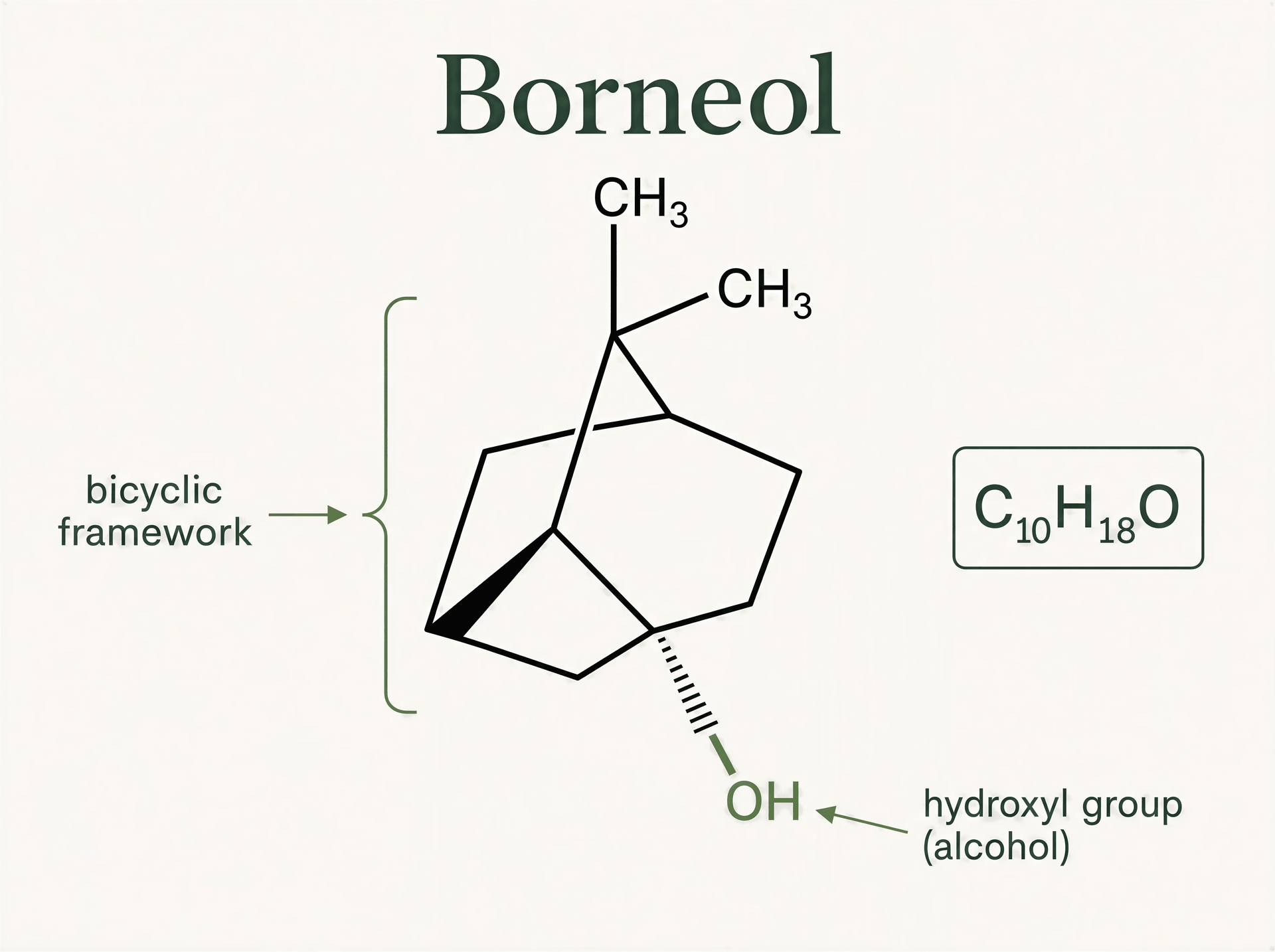
“Monoterpenoid” means borneol is built from a 10-carbon monoterpene skeleton, then modified to include oxygen. “Alcohol” means it carries a hydroxyl group, unlike hydrocarbon terpenes such as limonene or pinene. “Bicyclic” means the carbon framework contains two fused rings. Those three facts explain a lot about how borneol behaves: its odor is often described as camphoraceous, woody, herbal, mint-adjacent, and cooling, and its boiling behavior and volatility differ from simpler monoterpene hydrocarbons.
Because borneol is oxygenated, it belongs with compounds that often have sharper, more medicinal, or more resinous aromatic signatures than fruit-forward terpenes. Yet aroma attribution in cannabis is messy. A certificate of analysis showing borneol does not prove that borneol is what a person smells. Concentration matters. So does overlap with pinene, eucalyptol, terpineol, camphor-related compounds, oxidation products, and the fact that many retail labs report only the top 5 to 10 terpenes.
Glossary in context
- Enantiomers
- Molecules with the same formula and atom connectivity but different three-dimensional arrangement; the article uses D-borneol and L-borneol as the example.
- Stereochemistry
- The three-dimensional arrangement of atoms in a molecule, which can shift odor nuance, source, receptor interaction, and pharmacology.
D-borneol, L-borneol, and stereochemistry that consumer guides ignore
Borneol exists in different stereoisomeric forms, and that is not a trivial chemistry footnote. D-borneol and L-borneol are enantiomeric forms: same molecular formula, same atom connectivity, different three-dimensional arrangement. Consumer terpene guides usually collapse them into one entry, which is chemically sloppy. Enantiomers can differ in odor nuance, botanical source, receptor interaction, and pharmacology.
This matters because borneol’s preclinical literature is already more complicated than cannabis articles admit. A 2023 Molecules review by Chen and colleagues summarized anti-inflammatory, analgesic, antimicrobial, neuroprotective, and blood-brain barrier permeability-modulating findings, but that body of evidence is mostly animal or in vitro work, not cannabis-specific human data. If stereochemistry can shift biological behavior, then “borneol does X” is already an oversimplification before cannabis enters the picture.
| Compound | Chemical class | Key functional group | How the article characterizes it |
|---|---|---|---|
| Borneol | Oxygenated terpene / monoterpenoid alcohol | Hydroxyl group | Camphoraceous, minty, woody, herbal, cooling |
| Camphor | Related terpenoid ketone | Carbonyl group | Structurally related and partly similar-smelling, but not the same compound |
How borneol differs from camphor and other related terpenoids
Borneol is often conflated with camphor because the two are structurally related and smell partly similar. They are not the same compound. Borneol is an alcohol; camphor is a ketone. In practical terms, borneol has a hydroxyl group, camphor has a carbonyl. That changes reactivity, metabolism, odor character, and likely aspects of pharmacology. Camphor can be formed by oxidation of borneol, and borneol can be obtained by reduction of camphor. Close cousins, not synonyms.
That is why calling a cannabis sample “high in borneol” when the sensory impression is merely camphoraceous is weak chemistry. In modern cannabis, where average THC in seized U.S. samples rose from about 4% in 1995 to about 15% in 2021 according to NIDA, minor terpene claims should be made carefully. Even approved cannabinoid medicine operates on a different scale: the FDA label for Epidiolex starts at 2.5 mg/kg twice daily. Against that benchmark, broad effect claims built on tiny borneol readings in cannabis are speculative, not established.
Aroma profile: what borneol actually smells like
Camphoraceous, minty, woody, herbal notes
Borneol does not smell like “mint” in the simple, candy-fresh sense that many cannabis terpene menus imply. Its odor is better described as camphoraceous first: cool, sharp, slightly medicinal, with the dry lift associated with camphor tree relatives and certain traditional herbal liniments. Then come the secondary impressions. A mint-like chill can appear, but it is usually more austere than peppermint. There is also a woody backbone, often read as dry cedar shavings or resinous twig, plus an herbal edge that can lean toward sage, rosemary, mugwort, or Artemisia-type bitterness depending on the surrounding volatiles.
That matters because borneol is a bicyclic monoterpenoid alcohol, and oxygenated monoterpenoids often smell more structured and medicinal than the sweeter hydrocarbon terpenes people already know. Even here, stereochemistry complicates things. D-borneol and L-borneol can differ subtly in odor character as well as source, yet consumer-facing cannabis writing rarely mentions enantiomers at all. It should.
In cannabis, borneol is usually present at trace-to-low levels rather than dominating the profile. Booth, Bohlmann and Teramura counted about 200 terpenes in cannabis in their 2017 Phytochemistry review, while ElSohly and coauthors noted about 150 identified cannabinoids the same year. Those numbers are a useful correction. Borneol exists inside a crowded chemical field.
Why aroma attribution in cannabis is harder than terpene lists suggest
A certificate of analysis may show borneol, but that does not prove your nose will isolate it. Smell is mixture perception, not spreadsheet perception. In flower, borneol overlaps with other compounds that also read as cooling, piney, resinous, medicinal, or herbal, including pinene, eucalyptol, camphor-like oxidation products, and other oxygenated terpenes. At low concentration, borneol may function more as an accent than as a recognizable note.
This is where popular strain language often drifts away from evidence. Cannabis is used by an estimated 228 million people worldwide (UNODC, 2024), 22.8 million adults in the EU aged 15 to 64 used it in the last year (EMCDDA, 2024), and 26% of Canadians reported past-year use (Health Canada, 2023). Public terpene claims therefore matter at scale. Yet most retail terpene panels report only a handful of compounds, even though cannabis produces roughly 200 terpenes. If borneol appears below the lab’s display threshold, below the reporting cutoff, or below sensory relevance, it may still be chemically present without shaping lived aroma.
High-THC chemotypes add another layer. NIDA reported average THC in seized U.S. cannabis rose from about 4% in 1995 to about 15% in 2021. That does not change borneol’s smell directly, but it reminds us that modern cannabis is often discussed through potency-first categories that flatten subtle minor-terpene differences.
How drying, curing, and storage change what reaches the nose

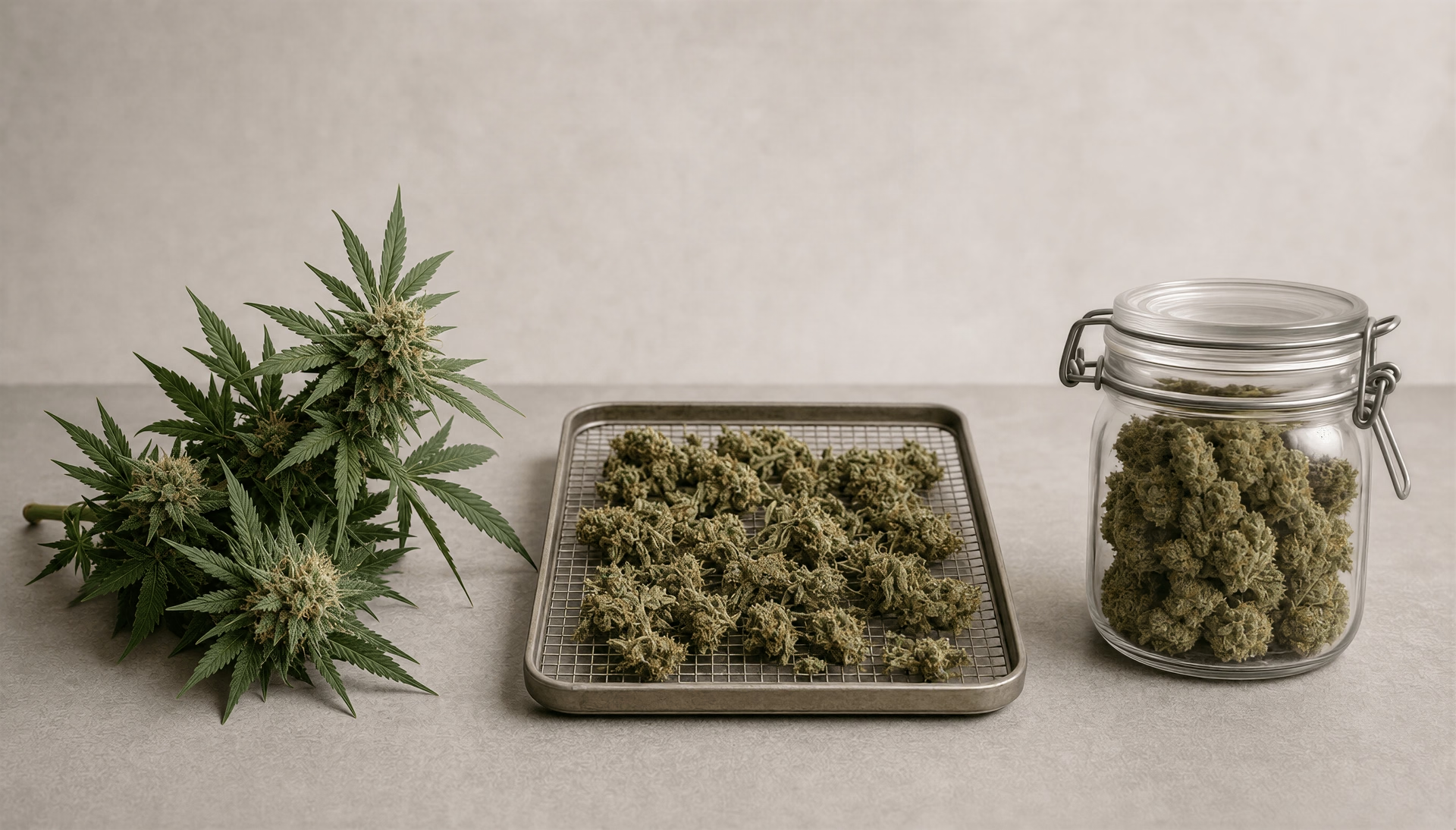
What reaches the nose is not identical to what was present at harvest. Drying drives off the most volatile molecules first. Curing reshapes the bouquet as plant tissue breaks down, moisture redistributes, and some compounds oxidize. Storage keeps the process going. Heat, oxygen, light, and time can all reduce freshness and shift balance toward flatter, dustier, sometimes more medicinal notes.
Borneol itself can be generated, lost, or perceptually masked within these changes, especially because oxygenated terpenes sit in a moving relationship with precursor compounds and oxidation products. A lab report is a chemical snapshot. Aroma is a moment of evaporation under real conditions: jar opened, flower ground, humidity variable, sample aging by the week. That gap is why borneol may be listed yet barely noticed, or noticed as part of a camphor-herbal haze rather than as a single, nameable smell.
Natural sources of borneol beyond cannabis
Traditional botanical sources in East and Southeast Asian materia medica

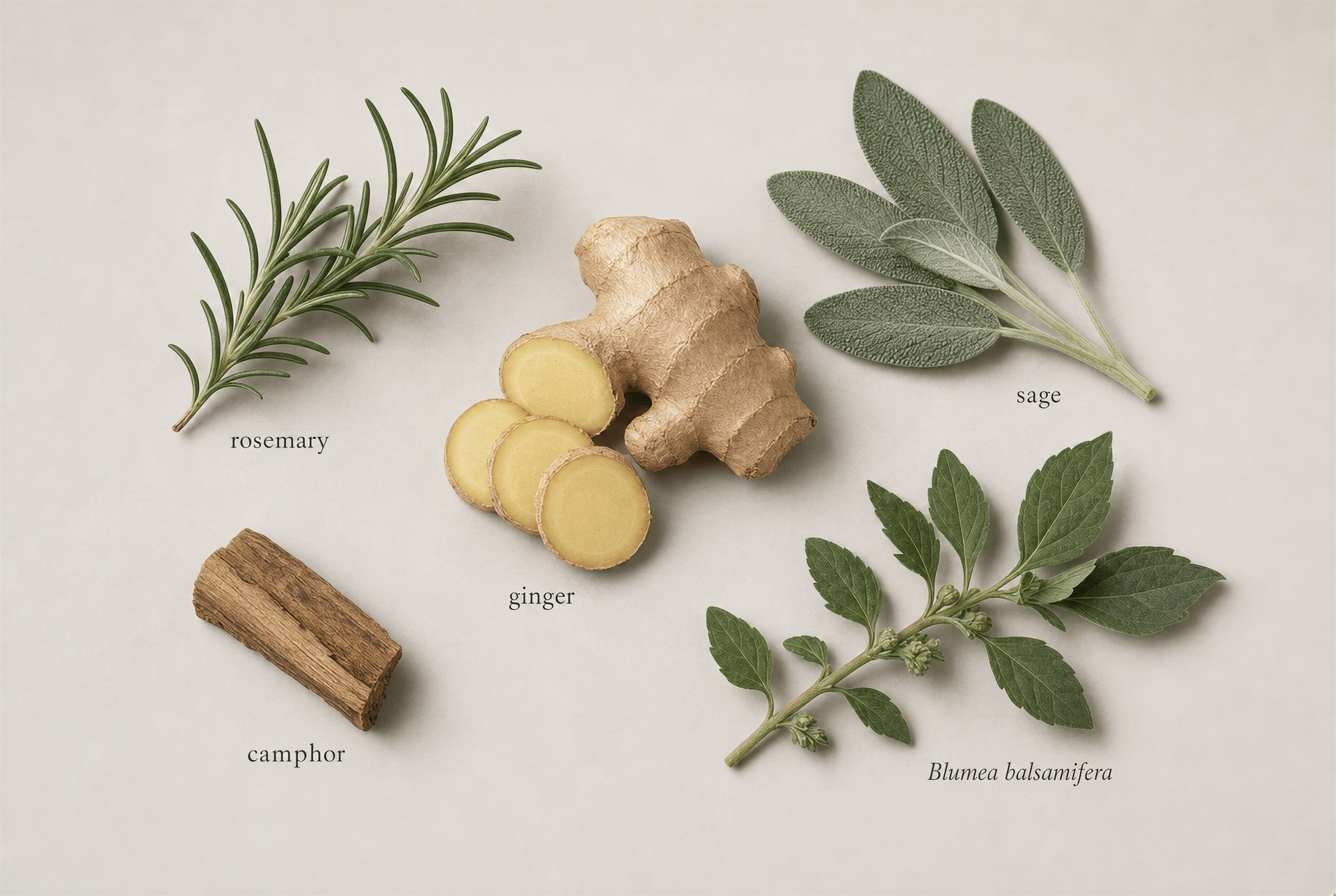
Borneol makes more sense when placed outside cannabis first. In traditional Chinese medicine and related East and Southeast Asian materia medica, borneol has long been associated with aromatic resins, woods, and essential-oil-rich botanicals rather than with Cannabis sativa. Natural borneol has historically been sourced from plants such as Blumea balsamifera and Cinnamomum camphora, and it appears in medicinal contexts as both a distinct compound and a constituent within broader herbal mixtures. That history matters because the pharmacology literature people cite for “borneol” usually comes from these traditions, from purified isolates, or from non-cannabis formulations.
Modern reviews reflect that older medicinal use. A 2023 Molecules review by Chen and colleagues summarized preclinical evidence for anti-inflammatory, analgesic, antimicrobial, neuroprotective, and blood-brain-barrier-modulating actions of borneol, but that paper did not show borneol-driven effects in human cannabis trials. Reviews in Frontiers in Pharmacology have made a similar point from another angle: borneol is studied as a penetration enhancer and delivery adjuvant in traditional formulations and experimental drug systems, which is a stronger evidence track than any cannabis entourage claim attached to it.
This broader context is easy to lose in cannabis writing. Booth, Bohlmann, and Teramura counted about 200 terpenes in cannabis in their 2017 Phytochemistry review, while ElSohly and colleagues noted about 150 identified cannabinoids by 2017. Borneol sits inside that large chemical field. It is not a flagship cannabis constituent.
Rosemary, sage, mugwort, ginger, and other aromatic plants
Outside formal materia medica, borneol occurs across aromatic plants that many people already know by smell. Reported sources include rosemary (Salvia rosmarinus), sage, Artemisia species such as mugwort, ginger, and valerian-associated aromatic mixtures, with actual levels varying by chemotype, plant part, harvest timing, and extraction method. Camphoraceous, minty, woody, and cooling notes often follow. Even then, sensory attribution is messy because borneol shares odor space with camphor, eucalyptol, pinene derivatives, and other oxygenated monoterpenes.
That is one reason casual claims about “you can smell borneol in this strain” should be treated skeptically. In cannabis, borneol is usually a trace-to-low terpene detected by GC-MS, not a dominant terpene on the level of myrcene, limonene, beta-caryophyllene, or pinene. Consumer-facing lab reports often list only the top 5 to 10 terpenes, so borneol may be absent from the report even if present in the flower. Stereochemistry adds another complication. D-borneol and L-borneol are not identical, and popular cannabis content almost never mentions that.
Why cross-plant occurrence matters for pharmacology claims
Cross-plant occurrence is not a trivia point. It is the main reason borneol claims need restraint. If a study gives borneol alone, or tests a rosemary-, mugwort-, or Blumea-derived preparation, that does not establish the same effect for a cannabis flower containing a trace amount of borneol inside a high-THC matrix. The scale of public exposure makes this distinction important: UNODC estimated 228 million cannabis users worldwide in 2022, EMCDDA estimated 22.8 million last-year users in the EU in 2024, and Health Canada reported 26% past-12-month use in 2023. At the same time, average THC in seized U.S. cannabis rose from about 4% in 1995 to about 15% in 2021, according to NIDA.
So yes, borneol has real pharmacology signals. But most of them come from non-cannabis plants, isolated compounds, or delivery-system research. That is the responsible baseline for interpreting cannabis claims.
How borneol appears in cannabis plants and lab reports
Borneol is real, measurable, and usually overplayed. In cannabis, it belongs to a very large chemical background rather than standing out as a defining constituent in most flowers. That matters because cannabis is not a two-compound plant. ElSohly and colleagues wrote in 2017 that about 150 cannabinoids had been identified in Cannabis sativa, while Booth, Bohlmann, and Teramura reported roughly 200 terpenes in a 2017 Phytochemistry review. Put plainly: routine strain descriptions are often built from a small visible slice of a much bigger phytochemical system.
That gap between chemistry and marketing language has scale. UNODC estimated 228 million cannabis users worldwide in 2022, the EMCDDA put last-year use at 22.8 million adults aged 15 to 64 in the EU in 2024, and Health Canada reported 26% of respondents used cannabis in the previous 12 months in its 2023 survey. Public claims about minor terpenes are not trivial when they are repeated to such a large audience.
Cannabis terpene biosynthesis and where borneol fits
Cannabis terpenes are built through standard plant isoprenoid pathways, mainly the MEP pathway in plastids for monoterpenes and the mevalonate pathway for many sesquiterpenes. Monoterpenes begin from geranyl diphosphate, then terpene synthases and later modifying enzymes reshape that precursor into familiar compounds such as limonene, pinene, myrcene, and oxygenated derivatives. Borneol fits here as a bicyclic monoterpenoid alcohol, not as one of the dominant hydrocarbon monoterpenes that usually define cannabis aroma headlines.
That distinction matters chemically and sensorially. Borneol’s odor is often described as camphoraceous, minty, woody, herbal, and cooling, but those notes overlap with eucalyptol, camphor-like oxidation products, pinene-rich profiles, and other oxygenated monoterpenes. So even when borneol is present, you cannot assume the nose can isolate it. A certificate of analysis can detect a compound that contributes little to what a person actually smells.
Stereochemistry complicates things further. Borneol exists as enantiomeric forms such as D-borneol and L-borneol, and those forms can differ in natural source and possibly pharmacology. Consumer-facing cannabis reports almost never specify that level of detail. Most simply list “borneol,” if they list it at all.
Why borneol is usually a minor or trace terpene
In cannabis, borneol is usually detected at trace-to-low concentrations rather than as a lead terpene like myrcene, limonene, beta-caryophyllene, alpha-pinene, or terpinolene. That is the rule, not the exception. Popular articles often imply otherwise because borneol has an interesting medicinal history outside cannabis, especially in traditional East Asian pharmacognosy and drug-delivery research. But outside importance does not equal abundance inside cannabis flower.
There are several reasons it stays minor. First, the plant’s biosynthetic machinery tends to channel more carbon into terpene families that dominate cannabis aroma across many chemovars. Second, oxygenated monoterpenes can be more sensitive to handling, oxidation, drying, and storage than simple “fresh flower” descriptions suggest. Third, high-THC modern chemotypes may drown out the practical relevance of trace constituents. NIDA noted in 2024 that average delta-9-THC concentration in seized cannabis samples rose from about 4% in 1995 to about 15% in 2021. In that kind of matrix, tiny amounts of borneol should not be treated as automatic drivers of experience.
This is where overconfident strain storytelling starts to fall apart. A profile can contain borneol without borneol being perceptible, pharmacologically meaningful, or specific enough to explain “focus,” “stress relief,” or “pain relief.” Reviews such as Chen and colleagues in Molecules in 2023 support preclinical anti-inflammatory, analgesic, neuroprotective, and antimicrobial signals for borneol. They do not support strong cannabis-specific claims in humans.
GC-MS Gas chromatography-mass spectrometry, an analytical method commonly used to detect and quantify cannabis terpenes, including minor compounds that may still be absent from simplified retail reports.
Testing limitations: GC-MS panels, reporting thresholds, and omitted minor terpenes

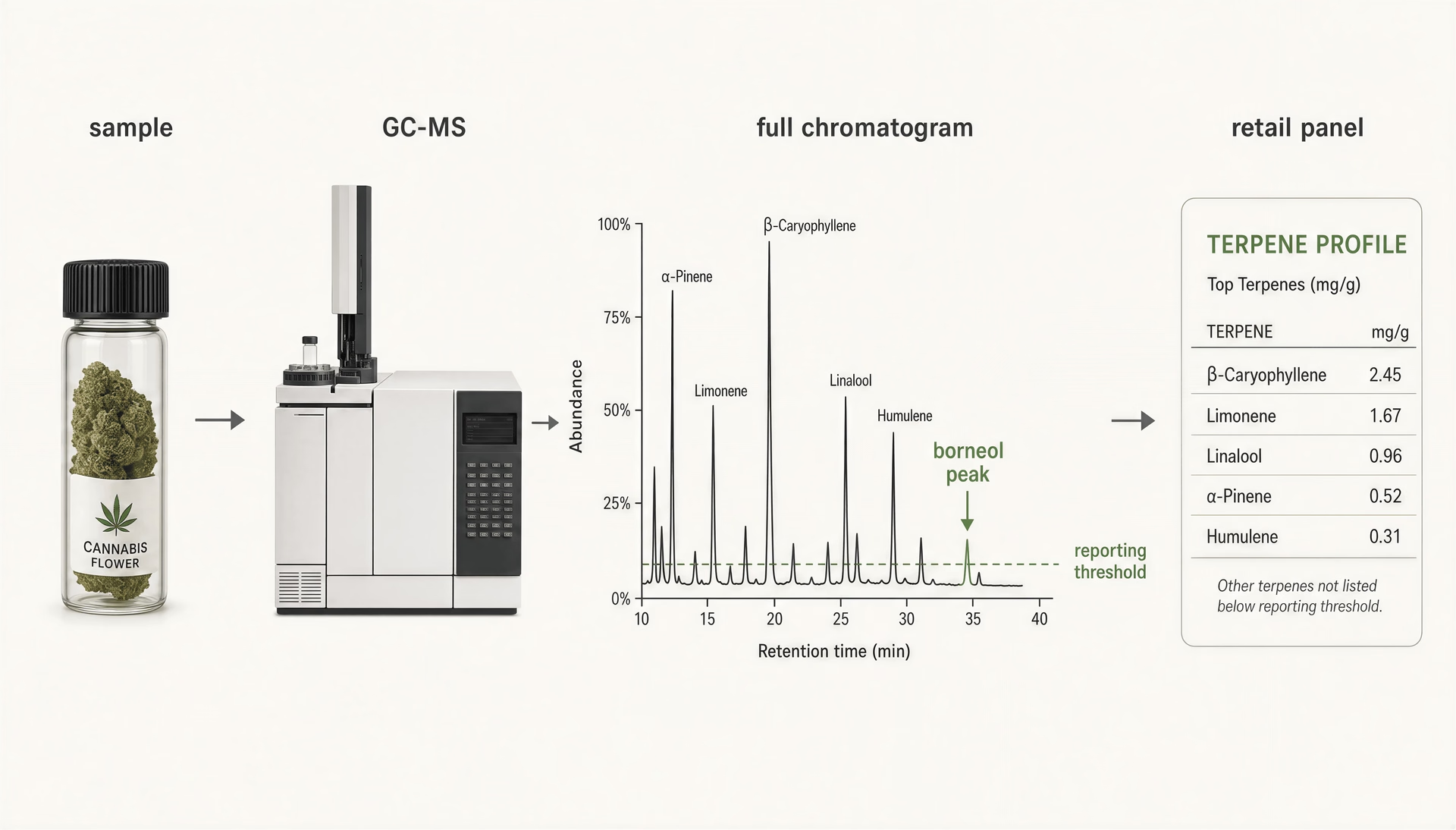
Most cannabis terpene testing relies on GC-MS or related gas chromatography methods. These are useful tools, but the report a consumer sees is often a simplified output rather than the full chromatographic picture. Many retail-facing lab summaries list only the top 5, top 10, or a fixed panel of expected terpenes. If borneol falls below the lab’s reporting threshold, is not included in the panel, co-elutes with another small peak, or is judged too low for confident quantitation, it may disappear from the final document even when present in the sample.
That is why borneol is often absent from menus. Absence on a menu is not proof of true absence in the flower. It may mean “below quantitation,” “not included,” or “not reported.” Those are different things.
The broader reporting culture encourages false certainty. Cannabis contains about 200 terpenes, yet public-facing reports usually emphasize a short list while ignoring the long tail of minor constituents. Even clinically grounded cannabinoid dosing shows how large the gap is between evidence and terpene speculation: the FDA label for Epidiolex gives a starting dose of 2.5 mg/kg twice daily, titratable higher, while borneol discussions in cannabis are often built on trace-level presence with no controlled human isolation studies. That is not a small evidentiary gap.
So when a strain description claims borneol explains a distinct effect, skepticism is warranted. In cannabis analytics, a listed terpene is not the same as an active driver, and an omitted terpene is not the same as nonexistence.
Pharmacology and reported effects: what the evidence supports
Borneol attracts attention because it has real pharmacology, but the cannabis internet often turns that into much larger claims than the data can carry. That distinction matters at population scale. The UNODC estimated that 228 million people used cannabis in 2022, and the EMCDDA estimated 22.8 million adults aged 15 to 64 in the EU used cannabis in the last year, about 8.0% of that age group, with 15.1% among those aged 15 to 34 in Europe (UNODC, 2024; EMCDDA, 2024). In Canada, 26% of respondents reported past-year cannabis use in the 2023 Canadian Cannabis Survey. When so many people are exposed to cannabis science claims, “minor terpene” should not be treated as a synonym for “clinically established.”
That is especially true for borneol in cannabis itself. Cannabis is chemically crowded: about 150 cannabinoids had been identified by 2017 according to ElSohly and colleagues, and Booth, Bohlmann, and Teramura counted about 200 terpenes in a 2017 Phytochemistry review. In most cannabis samples, borneol is a trace-to-low constituent, not a leading terpene on par with myrcene, limonene, pinene, or beta-caryophyllene. Retail reports often list only a handful of top terpenes anyway, so borneol can be absent from a certificate of analysis even when analytically detectable. Presence alone also says little about effect. Dose matters. Stereochemistry matters. D-borneol and L-borneol are not interchangeable in all settings.
Borneol shows anti-inflammatory and analgesic activity, but the support discussed here comes mainly from cell and animal studies rather than controlled human cannabis trials. Limited evidence
Preclinical evidence for anti-inflammatory and analgesic activity
The strongest support for borneol’s therapeutic relevance comes from preclinical work, not human cannabis trials. Reviews published in 2023, including work summarized by Xiaodan Chen and colleagues in Molecules, describe repeated anti-inflammatory and analgesic signals across cell and animal models. These reports include reductions in inflammatory mediators, modulation of oxidative stress pathways, and attenuation of pain-like behaviors in standard rodent assays.
That is promising, but still early-stage. Rodent analgesia is not the same thing as clinically meaningful pain relief in people using inhaled cannabis flower. Even less can it justify the common claim that a cannabis product feels “pain relieving because it contains borneol.” In actual cannabis exposure, borneol is acting inside a matrix that may include high concentrations of THC, and THC has changed dramatically over time in the illicit U.S. supply: average concentration in seized samples rose from roughly 4% in 1995 to 15% in 2021, according to NIDA’s 2024 update. That increase alone can swamp attempts to infer a borneol-specific contribution from consumer anecdotes.[4] Epidiolex (cannabidiol) prescribing information. U.S. Food and Drug Administration. FDA label, 2024.
There is also a route problem. Many borneol pharmacology studies use purified compound administration at doses and formulations that do not resemble smoking, vaping, or low-level oral terpene exposure from cannabis products. The FDA-approved purified CBD medicine Epidiolex starts at 2.5 mg/kg twice daily, or 5 mg/kg/day, and can be titrated higher. That is a useful benchmark: real cannabinoid pharmacotherapy is quantified carefully, while many borneol claims are based on trace terpene exposure with no comparable dose-response evidence.
Trace borneol in cannabis may alter CNS penetration or subjective effects of co-administered compounds, but this has not been shown in controlled human cannabis studies. Preliminary evidence
Neuropharmacology, sedation, and blood-brain barrier questions
Borneol’s neuropharmacology is one reason it keeps reappearing in discussions of the entourage effect. Preclinical literature suggests CNS activity that may include sedative, anticonvulsant, and neuroprotective properties, though the mechanisms are still being worked out and may vary by isomer, formulation, and co-administered compounds. Some studies and reviews in Frontiers in Pharmacology and related journals describe borneol as a penetration enhancer or blood-brain barrier modulator in traditional Chinese medicine formulations.
That claim is real in the non-cannabis drug-delivery literature. It is much weaker in cannabis-specific contexts. A formulation designed to increase CNS penetration of a co-administered drug is not the same thing as proving that trace borneol in cannabis flower changes cannabinoid delivery to the brain in a measurable way. The leap from “borneol can affect permeability in some experimental systems” to “borneol-rich cannabis hits differently because it opens the blood-brain barrier” is not supported by controlled human data.
Sedation claims need the same restraint. A camphoraceous or cooling aroma does not establish a sedative effect, and sensory attribution is messy because borneol overlaps aromatically with other oxygenated monoterpenes. There is plausible CNS activity here. There is not strong evidence that borneol meaningfully determines whether a given cannabis chemovar feels calming, focusing, or sleepy.
Antimicrobial and antioxidant findings
Borneol also shows antimicrobial and antioxidant activity in vitro. Reviews summarize effects against certain bacteria and fungi, along with free-radical-scavenging or oxidative-stress-modulating properties in laboratory systems. These findings fit its longer pharmacognosy history in aromatic medicinal plants such as rosemary, sage, mugwort, ginger, and Artemisia species.
Still, in vitro activity is a starting point, not an endpoint. A compound can inhibit microbes in a dish and fail to reach relevant tissue levels in people. It can reduce oxidative markers in a model system and still have no detectable clinical antioxidant effect after cannabis use. This is where borneol commentary often drifts off course: laboratory plausibility gets retold as settled therapeutic action.
Where human evidence is missing
This is the line that should stay bright. There are no controlled human cannabis studies showing that borneol, isolated as a variable, reliably reduces pain, lowers inflammation, improves focus, relieves stress, or enhances cannabinoid brain delivery. Ethan Russo’s broader entourage framework has been influential, and some terpene-cannabinoid interaction hypotheses are biologically plausible, but plausibility is not proof. For borneol specifically, the evidence grade is weak once the question becomes cannabis effects in humans.
So what can be said confidently? Borneol is a real bicyclic monoterpenoid alcohol with measurable preclinical anti-inflammatory, analgesic, neuropharmacological, antimicrobial, and antioxidant activity. It is present in some cannabis chemovars, usually at low levels. It may contribute to camphoraceous, minty, woody, or herbal notes in certain aromatic profiles. What cannot be said with confidence is that borneol by itself explains a strain’s subjective effects or that trace levels in cannabis produce clinically meaningful outcomes in people. That is not skepticism for its own sake. It is the evidence speaking plainly.
Medicinal properties: traditional use versus modern evidence
Borneol has a real medicinal backstory, but not the one usually told in cannabis marketing. In cannabis itself, it is usually a minor terpene detected at trace-to-low levels by GC-MS, not a dominant driver like myrcene, limonene, beta-caryophyllene, or pinene. That matters because cannabis is chemically crowded: ElSohly and colleagues wrote in 2017 that about 150 cannabinoids had been identified in Cannabis sativa, while Booth, Bohlmann, and Teramura reported roughly 200 terpenes in the same year. Any claim that one low-level terpene dictates a strain’s medical effect starts from a weak premise.
The public-health scale explains why precision matters. UNODC estimated 228 million cannabis users worldwide in 2022, the EMCDDA estimated 22.8 million adults aged 15-64 in the EU used cannabis in the last year in 2024 reporting, and Health Canada’s 2023 survey found 26% of respondents had used cannabis in the previous 12 months. At the same time, NIDA notes average THC in seized US cannabis samples rose from about 4% in 1995 to about 15% in 2021. In other words, borneol, when present, is acting inside a matrix that is large, variable, and often THC-dominant.
Borneol in traditional Chinese medicine
Borneol’s strongest medicinal credibility begins outside cannabis. In traditional Chinese medicine, borneol is known as bing pian and has been used for centuries in aromatic formulations associated with resuscitative, analgesic, and topical applications. Historical use does not prove efficacy by modern standards, but it does show consistent pharmacognosy: borneol was treated as an active aromatic substance, not just a fragrance.
That historical record is stronger than most cannabis-specific borneol claims because it is tied to named materia medica traditions and repeated formulation use. Modern reviews, including work summarized by Xiaodan Chen and colleagues in Molecules in 2023, describe anti-inflammatory, analgesic, antimicrobial, and neuroprotective signals in cell and animal models. Evidence grade: moderate for longstanding traditional use as a medicinal aromatic; low-to-moderate for specific therapeutic effects, because most supporting studies remain preclinical and are not cannabis-specific.
A detail often omitted in consumer articles is stereochemistry. D-borneol and L-borneol are not identical in origin or necessarily in biological behavior. If a cannabis article does not mention enantiomers, it is already oversimplifying the chemistry.
Drug-delivery and penetration-enhancer research
The most defensible modern medical story around borneol is formulation science. Reviews in Frontiers in Pharmacology and related journals describe borneol as a penetration enhancer and blood-brain barrier permeability modulator in non-cannabis drug-delivery research. This is where the evidence is better organized: borneol has been studied as an excipient-like helper that may improve transport of co-administered compounds across biological barriers.
That does not mean “borneol helps cannabinoids cross into the brain” has been clinically shown in people using cannabis flower or extracts. It has not. Still, among the many pharmacology claims attached to borneol, this is the one with the clearest mechanistic footing. Evidence grade: moderate for non-cannabis penetration-enhancer research; low for translating that directly to cannabis medicine.
A useful benchmark is CBD itself. The FDA-approved purified CBD product Epidiolex starts at 2.5 mg/kg twice daily, or 5 mg/kg/day, and may be increased to 10 mg/kg twice daily. That is a defined clinical dosing framework. By contrast, borneol in cannabis is typically present at far lower and less standardized amounts, often not even reported unless a lab lists more than the top five or ten terpenes.
| Claim area | Evidence tier in this article | Why |
|---|---|---|
| Borneol chemistry and identity | Stronger | Specific compound with defined structure and stereochemistry |
| Traditional East Asian medicinal use | Stronger | Longstanding pharmacognosy and formulation history |
| Preclinical anti-inflammatory / analgesic / neuropharmacology | Stronger | Supported mainly by cell and animal studies |
| Presence in some cannabis chemovars | Moderate | Detected in some samples, usually at trace-to-low levels |
| Borneol-specific entourage claims in humans | Weak | No controlled human cannabis studies isolating borneol as the causal factor |
What cannot yet be claimed in cannabis medicine
What borneol cannot yet support is the familiar list of strain-level promises: that it reduces stress, relieves pain, sharpens focus, or explains a particular cultivar’s medical profile. Ethan Russo’s entourage-effect framework remains influential, but borneol-specific human evidence inside cannabis is thin. There are no controlled clinical cannabis studies isolating borneol as the causal agent for those outcomes.
So the evidence grading is fairly clear. Stronger: borneol chemistry, historical East Asian medicinal use, preclinical pharmacology, and non-cannabis drug-delivery research. Moderate: borneol as a minor terpene in some cannabis chemovars and a possible contributor to camphoraceous, woody, minty, or cooling aroma. Weak: borneol-specific entourage claims and strain-effect claims in cannabis medicine.
A certificate of analysis showing borneol is not proof of perceptible aroma or clinical relevance. Concentration matters. Oxidation matters. Route of administration matters. And in modern cannabis, dominated more often by high-THC chemotypes than by trace oxygenated monoterpenes, borneol should be discussed with restraint rather than hype.
Borneol and the entourage effect
The short version is simple: borneol is a plausible contributor to cannabis effects, but the evidence for borneol-specific entourage claims is weak. That distinction matters because cannabis exposure is not niche. UNODC estimated 228 million people used cannabis worldwide in 2022 (UNODC, 2024). In the EU, the EMCDDA estimated 22.8 million adults aged 15 to 64 used cannabis in the last year, about 8.6% of that age group, and 15.1% of those aged 15 to 34 reported past-year use (EMCDDA, 2024). In Canada, 26% of respondents said they had used cannabis in the prior 12 months (Health Canada, 2023). When public-facing cannabis writing assigns pharmacological meaning to a minor terpene, it is not a trivial claim.
Entourage effect A hypothesis in cannabinoid science that cannabinoids and terpenes may interact to shape subjective or therapeutic outcomes; in this article it is treated as plausible in general but weakly supported for borneol-specific cannabis claims.
What the entourage effect means in the scientific literature
In scientific use, “entourage effect” does not mean “every terpene meaningfully changes every strain.” The term came from cannabinoid science associated with Raphael Mechoulam and colleagues, then was expanded by Ethan B. Russo to argue that cannabinoids and terpenes may interact in ways that shape subjective or therapeutic outcomes. Russo’s framework is useful as a hypothesis generator. It is not a blank check for any terpene claim.
That caution is especially important in cannabis because the plant is chemically crowded. ElSohly and coauthors wrote in 2017 that about 150 cannabinoids had been identified in Cannabis sativa. Booth, Bohlmann, and Teramura reported in Phytochemistry the same year that cannabis produces about 200 terpenes. So borneol is one small component inside a large matrix, not a starring molecule in most chemovars.
Clinical evidence for entourage effects also varies sharply by endpoint. There are better-supported examples for broad whole-plant versus single-molecule differences than for any one minor terpene. And human dosing benchmarks show how far speculative terpene commentary often drifts from established pharmacology. The FDA label for Epidiolex, a purified CBD product, starts at 2.5 mg/kg twice daily, or 5 mg/kg/day, with titration higher when needed (FDA prescribing information, 2024). By contrast, popular borneol claims in cannabis are often made without quantitative exposure data at all.
Why borneol is a plausible but unproven contributor
Plausible does not mean proven. Borneol has real pharmacological signals. A 2023 review in Molecules summarized preclinical work on anti-inflammatory, analgesic, neuroprotective, antimicrobial, and blood-brain-barrier-related effects. Reviews in Frontiers in Pharmacology and adjacent literature also describe borneol as a penetration enhancer in traditional Chinese medicine formulations. Those papers make borneol scientifically interesting.
But they do not show that borneol measurably changes cannabis effects in humans.
Part of the problem is abundance. Borneol can appear in cannabis, usually identified by GC-MS or similar terpene analytics, yet it is generally present at trace-to-low levels rather than in the leading tier occupied more often by myrcene, limonene, beta-caryophyllene, pinene, or terpinolene. A certificate of analysis listing borneol therefore tells you only that it was detected. It does not tell you that the amount was high enough to alter aroma perception, brain exposure, or THC response.
Another complication is stereochemistry. D-borneol and L-borneol can differ in source, odor nuance, and possibly pharmacology, but cannabis commentary almost never specifies the enantiomer. If a claim ignores chirality, dose, route, and concentration, it is usually outrunning the data.
Interaction hypotheses with THC, CBD, and other terpenes
The strongest interaction hypothesis is not that borneol “balances” THC in some vague way. It is that borneol, as a bicyclic monoterpenoid alcohol with documented effects in non-cannabis delivery research, might alter permeability, absorption, or CNS distribution of co-administered compounds under certain conditions. That is a serious mechanistic idea. It still lacks direct proof in cannabis.
With THC, the question is whether borneol changes onset, intensity, or duration by affecting transport, membrane behavior, metabolism, or receptor-level signaling indirectly. This remains untested in controlled human cannabis studies. The need for caution is obvious when THC exposure itself has changed so much: NIDA reports average THC in seized cannabis samples rose from about 4% in 1995 to about 15% in 2021. In modern high-THC products, any subtle borneol signal would have to emerge against a much louder cannabinoid background.
With CBD, the hypothesis is similar but more modest. Because CBD has broad pharmacology and established clinical dosing, borneol could, in theory, shift tissue penetration or alter subjective tolerability at low margins. Again, that is mechanistic plausibility, not demonstrated interaction.
With other terpenes, sensory overlap is a major confounder. Borneol’s camphoraceous, minty, woody, cooling profile overlaps with pinene, eucalyptol-like notes, camphor-related oxygenated terpenes, and oxidized monoterpene products. So when a flower smells “cooling” or “herbal,” borneol may contribute, or it may not. Aroma attribution is not pharmacology.
What stronger borneol entourage evidence would require
- 1. Quantify the terpene properly Measure absolute borneol concentration and report enantiomers, not just a generic 'detected' result on a limited terpene panel.
- 2. Measure exposure by route Collect inhalation and oral pharmacokinetic data to show whether realistic cannabis use produces relevant borneol concentrations in blood or brain.
- 3. Control the cannabis matrix Compare matched cannabis preparations that differ mainly in borneol while keeping THC, CBD, and major terpenes as constant as possible.
- 4. Predefine human endpoints Test specific outcomes such as pain, anxiety, attention, intoxication, memory, onset time, and adverse effects in randomized studies.
What evidence would actually be needed
If the field wants to make borneol entourage claims responsibly, it needs much better evidence than terpene lists and anecdote.
First, cannabis chemovars would need precise quantification of borneol, including enantiomeric analysis, not just “detected” on a panel that reports only the top 5 to 10 terpenes. Second, inhalation and oral studies would need pharmacokinetic data showing whether borneol reaches relevant concentrations in blood or brain when consumed in realistic cannabis doses. Third, randomized human studies would have to compare matched cannabis preparations that differ mainly in borneol content while holding THC, CBD, and major terpenes constant. Fourth, endpoints would need to be predefined: pain, anxiety, attention, intoxication, memory, onset time, adverse effects.
Until then, the honest position is this: borneol has enough preclinical pharmacology to justify interest, and enough non-cannabis literature to make interaction hypotheses reasonable. It does not yet have the cannabis-specific human evidence needed to support confident claims about strain effects, focus, calm, pain relief, or THC modulation. That is not a dismissal. It is where the evidence actually stands.
Which cannabis strains may contain borneol
Why famous strain lists are usually poorly sourced
Most “borneol-rich strain” lists online are not evidence-based. They often copy one another, cite no certificate of analysis, and treat a strain name as if it were a chemically stable category. It is not. A cultivar sold under the same name can vary by breeder, growing conditions, harvest timing, storage, and lab method. That matters because borneol is usually a minor terpene in cannabis, not a dominant one.
The broader phytochemistry makes the problem obvious. Booth, Bohlmann, and Teramura estimated in Phytochemistry (2017) that cannabis produces about 200 terpenes, while ElSohly and colleagues wrote in 2017 that about 150 cannabinoids had been identified in Cannabis sativa. In that crowded matrix, assigning a single low-level terpene to a famous strain without published lab data is weak practice. Popular content often acts as if borneol defines certain named cultivars. The evidence does not support that.
Scale makes this more than a minor editorial issue. The UNODC estimated 228 million people used cannabis worldwide in 2022 (2024 report). The EMCDDA estimated 22.8 million adults aged 15 to 64 in the EU used cannabis in the last year, and 15.1 million people aged 15 to 34 did so (2024). Health Canada reported 26% of respondents used cannabis in the previous 12 months (2023 survey). When public-facing strain chemistry is discussed at that scale, folklore is not good enough.
A safer way to phrase it is this: some lab-tested batches of some cultivars may show borneol, usually at trace-to-low levels. That is an example, not a fixed truth about the strain.
Herbal, woody, camphoraceous, cooling, or mint-adjacent aromas may suggest borneol presence, but smell alone cannot confirm it. Limited evidence
Aroma clues that may suggest borneol-rich profiles
If borneol appears in cannabis, it is more likely to show up in herbal, woody, camphoraceous, cooling, or mint-adjacent profiles than in overtly citrus or candy-forward ones. Think rosemary, sage, mugwort, or camphor-like sharpness rather than sweet fruit. Borneol is found in aromatic plants outside cannabis too, including rosemary, sage, ginger, and Artemisia species, so those sensory analogies are not arbitrary.
Still, smell is only a clue. Not proof.
Camphoraceous and cooling notes can also come from other monoterpenes and oxygenated terpenes. Pinene, eucalyptol, terpineol, and related compounds overlap heavily in perception. Oxidation changes the picture again. A flower that smells woody and medicinal may contain borneol, but it may also contain very little borneol and much more of something else. Even stereochemistry complicates things: D-borneol and L-borneol can differ in source, odor nuance, and pharmacology, yet cannabis-facing terpene menus almost never report enantiomers.
How to read certificates of analysis without overinterpreting them
A certificate of analysis can show borneol, but it should be read with restraint. First, check whether the lab reports only the top 5 to 10 terpenes. If so, borneol may be present but omitted. Second, look at the actual percentage. Trace detection does not automatically mean a major aroma driver or a meaningful pharmacological contributor.
That point is often lost in entourage talk. NIDA notes average THC in seized cannabis samples rose from about 4% in 1995 to about 15% in 2021. In many products, any borneol present is acting inside a matrix heavily dominated by THC and by more abundant terpenes such as myrcene, limonene, beta-caryophyllene, or pinene. A lab report is chemistry, not proof of a distinct effect.
Clinical context helps keep expectations realistic. The FDA label for Epidiolex lists a starting dose of 2.5 mg/kg twice daily, or 5 mg/kg/day, with titration higher when needed. That is what an evidence-based cannabinoid dosing framework looks like. It is very far from saying that a trace terpene on a flower COA will predict focus, calm, or pain relief.
So if a batch report shows borneol, treat it as a lab-dependent observation. Interesting, potentially relevant to aroma, but not a reason to mythologize a strain.
Risks, limitations, and common misconceptions
Public discussion of borneol matters because cannabis exposure is large: UNODC estimated 228 million users worldwide in 2022, EMCDDA estimated 22.8 million adults aged 15 to 64 used cannabis in the EU in the last year, and Health Canada reported 26% of respondents used cannabis in the previous 12 months in 2023. Large audience, small compound. That is exactly why precision matters.
Minor terpene does not mean major effect
Borneol is real, detectable, and pharmacologically interesting. It is also usually a minor cannabis terpene, not a defining one. Booth, Bohlmann and Teramura counted about 200 terpenes in cannabis in their 2017 Phytochemistry review, while ElSohly and colleagues noted about 150 identified cannabinoids the same year. That chemical crowding matters. A trace constituent sits inside a very busy matrix.
This is where popular terpene writing often jumps too fast. A certificate of analysis listing borneol does not show that it shapes the aroma, much less the experience. Many retail labs only report the top 5 to 10 terpenes, and borneol often appears, if at all, at trace-to-low levels by GC-MS. If the amount is tiny, the pharmacological contribution may be tiny as well, especially next to cannabinoids and more abundant terpenes such as myrcene, limonene, beta-caryophyllene, or pinene.
That skepticism is justified. NIDA notes average THC in seized cannabis rose from about 4% in 1995 to about 15% in 2021. In many modern high-THC samples, any borneol effect would have to occur in the shadow of a much larger cannabinoid dose. Claims that borneol explains a strain’s calming, focusing, or analgesic effect are not supported by controlled human cannabis studies.
Natural does not equal harmless
Borneol’s plant origin is not a safety guarantee. “Natural” says nothing about dose, purity, oxidation, contaminants, route, or vulnerability of the user. Preclinical reviews, including a 2023 Molecules review by Chen and colleagues, describe anti-inflammatory, antimicrobial, neuroactive, and blood-brain barrier effects. That is evidence of activity, not proof of harmlessness.
Activity cuts both ways. A compound that alters permeability or interacts with neural signaling may produce unwanted effects depending on dose and context. Stereochemistry adds another neglected layer: D-borneol and L-borneol can differ in source, odor character, and pharmacology, yet consumer-facing cannabis content rarely mentions enantiomers at all.
Why concentration and route of administration matter
Findings from isolated borneol studies do not map neatly onto inhaled cannabis flower. Inhalation delivers volatile compounds rapidly, but it also exposes them to heat, decomposition, and loss before they ever reach the user. Oral use is different again: slower onset, digestion, first-pass metabolism, and a very different concentration-time curve.
This is not a minor technicality. The FDA label for Epidiolex starts at 2.5 mg/kg twice daily, or 5 mg/kg/day, with titration higher. That gives a clinical benchmark for how explicit dosing looks when an active cannabis-derived compound is actually studied. By contrast, many borneol claims in cannabis are built on unspecified trace levels in flower, not measured human doses. Concentration matters. Route matters. And isolated-compound literature should not be used as a shortcut for proving borneol-driven effects in smoked or vaporized cannabis.
Why borneol still matters in cannabis science
Borneol matters, but not for the reason terpene marketing usually suggests. It matters because it exposes how quickly cannabis chemistry gets flattened into simple stories. That matters at population scale: UNODC estimated 228 million cannabis users worldwide in 2022, EMCDDA estimated 22.8 million EU adults aged 15 to 64 used cannabis in the last year and placed prevalence at 8.6%, and Health Canada reported 26% of respondents used cannabis in the previous 12 months in 2023. Public claims about minor compounds do not stay minor.
A useful marker of chemical complexity
The phytochemistry alone should slow down any attempt to make borneol a star molecule. ElSohly and colleagues wrote in 2017 that about 150 cannabinoids had been identified in Cannabis sativa. In the same year, Booth, Bohlmann and Teramura placed cannabis at roughly 200 terpenes. Against that backdrop, borneol is usually a trace-to-low-level oxygenated monoterpenoid alcohol, not a dominant terpene on most cannabis certificates of analysis.
That is exactly why it is useful. If a compound present at low levels is said to shape aroma, mood, pain, focus, or sedation, the burden of proof rises fast. Sensory attribution is messy because borneol’s camphoraceous, minty, woody, and cooling notes overlap with pinene, eucalyptol, terpineol, and other oxygenated volatiles. Pharmacology is messier still. Preclinical reviews, including 2023 work in Molecules by Chen and colleagues, describe anti-inflammatory, analgesic, antimicrobial, neuroprotective, and blood-brain-barrier effects. None of that shows that borneol in cannabis flower drives a specific human effect.
What future research should measure
Studies should stop treating “borneol present” as meaningful on its own. They need absolute concentration, not just rank order in a terpene list. They need stereochemistry too, because D-borneol and L-borneol can differ in source and biological behavior. They need route-specific exposure data, oxidation status, and storage conditions. Most of all, they need controlled human designs that compare matched chemovars while measuring THC, CBD, minor cannabinoids, and full terpene panels.
That standard is not excessive. NIDA notes average THC in seized cannabis rose from about 4% in 1995 to about 15% in 2021, so borneol now sits inside matrices increasingly dominated by high-THC chemistry. Compare that with an approved cannabinoid medicine: Epidiolex starts at 2.5 mg/kg twice daily, or 5 mg/kg/day, with titration upward. Clinical dosing looks nothing like speculative terpene storytelling.
The strongest evidence-based takeaway
The strongest defensible point is simple: borneol is not well supported as a strain-defining cannabis terpene, but it is a very good test case for scientific discipline. Minor constituents may matter. Some probably do. Yet a terpene appearing on a lab report does not prove perceptible aroma, meaningful receptor activity, or an entourage effect in humans. Borneol earns attention not as hype, but as a warning against oversimplified cannabis chemistry.
References
- [1] World Drug Report 2024. United Nations report, 2024. https://www.unodc.org/unodc/en/data-and-analysis/wdr2024.html
- [2] Borneol: Pharmacological activities and its applications in traditional Chinese medicine. Molecules, 2023. https://www.mdpi.com/journal/molecules
- [3] Monitoring the Future: High-THC Products and Cannabis Potency Trends. NIDA update, 2024. https://nida.nih.gov/research-topics/cannabis-marijuana
- [4] Epidiolex (cannabidiol) prescribing information. FDA label, 2024. https://www.accessdata.fda.gov/drugsatfda_docs/label/2024/210365s020lbl.pdf