













Why terpene profiles matter more than strain names
Terpene profiles usually tell you more than a strain name does. That is the correction. But they are not magic fingerprints that can forecast exactly how a product will feel.
The reason terpene profiles matter at all is straightforward: terpenes are volatile plant compounds, so they readily evaporate and reach the nose. That makes them major drivers of aroma and a meaningful part of flavor perception. If a flower smells sharp and citrusy, resinous and pine-like, peppery, floral, or musky, terpenes are doing much of that work. Compounds such as limonene, alpha- and beta-pinene, beta-caryophyllene, linalool, humulene, terpinolene, ocimene, and myrcene recur again and again in commercial cannabis datasets.
The strong version of the entourage claim still outruns controlled human evidence. Limited evidence
Where popular writing goes wrong is in treating labels as if they were biology. “Indica means sedating.” “Sativa means uplifting.” “This strain is high in myrcene, so it will definitely be sleepy.” Those statements compress a messy chemical system into a retail script. They also blur a real distinction: aroma prediction is on firmer ground than effect prediction. Terpenes can plausibly influence effects, and some have interesting pharmacology, but the strong version of the entourage claim still outruns controlled human evidence.
That matters because cannabis effects are never produced by terpenes alone. THC dose matters. CBD matters. Minor cannabinoids matter. Route of administration matters. Storage matters. So does the person using it.
| Comparison point | Retail story | Chemical reality in the article |
|---|---|---|
| Primary guide | Strain name and indica-sativa-hybrid tag | Measured cannabinoid-terpene composition |
| Effect prediction | Simple adjectives such as sedating or uplifting | Only partial clues; THC, CBD, route, storage, and user factors matter |
| Category stability | Assumed consistent across products | Names are often reused, relabeled, or drift over time |
| Dataset pattern | Clean separation by retail categories | Recurring chemotypes and co-occurrence patterns without neat retail bins |
The retail story versus the chemical reality
The retail story is neat because it is easy to remember. A strain name, an indica-sativa-hybrid tag, and a few effect adjectives create a simple map. The chemistry does not cooperate.[1] The reliability of cannabis strain names and lab testing data. Brian C. Keegan, et al.. PLOS ONE, 2022.
One of the strongest tests of this came from large commercial datasets rather than from folklore. In 2022, Keegan and colleagues published a chemotaxonomic analysis in PLOS ONE using 89,923 cannabis samples from six U.S. states. Their finding was blunt: commercial labels such as “Indica,” “Sativa,” and “Hybrid” did not consistently align with the observed chemical diversity. In other words, the labels were weak proxies for what was actually in the jar.
That result was reinforced by later large-scale work. A 2023 Scientific Reports analysis of 81,476 samples found recurring cannabinoid-terpene chemotypes and terpene co-occurrence patterns, but not clean separation by retail categories. Booth et al. also showed that a limited number of terpene combinations dominate legal-market flower, including pairings such as caryophyllene-limonene and myrcene-pinene. That is more useful than strain mythology because it focuses on measurable composition rather than inherited branding.
This does not mean all names are meaningless. Some named cultivars can be chemically more consistent than others, especially within a single producer using stable genetics and controlled cultivation. But the market as a whole is not organized like a botanical textbook. Names are often reused, relabeled, or drift over time. Sean Myles and other researchers working on cannabis genetics and chemotype consistency have made this point repeatedly: ancestry claims, naming practices, and measured chemistry do not reliably line up.[2] Taming THC: potential cannabis synergy and phytocannabinoid-terpenoid entourage effects. Ethan B. Russo. British Journal of Pharmacology, 2011.
Human evidence lags even further behind marketing language. The National Academies report in 2017 concluded there is substantial evidence for cannabis or cannabinoids in chronic pain, chemotherapy-induced nausea and vomiting, and patient-reported multiple sclerosis spasticity symptoms. It did not validate strain-by-strain terpene narratives. Russo’s 2011 British Journal of Pharmacology review remains the standard citation for the entourage hypothesis, especially the idea that cannabinoids and terpenoids may interact. But it was a review and hypothesis-building paper, not proof from randomized human trials.
So the balanced position is not “terpenes do nothing.” That would be wrong. The balanced position is that terpene profiles are chemically real, sensory-relevant, and pharmacologically plausible, while many retail effect claims remain under-tested.
What a terpene profile actually measures
A terpene profile is a lab snapshot of volatile compounds detected in a sample at a specific moment. Usually it reports the relative abundance of major terpenes, often as percent by weight or in mg/g. That sounds simple. It is not.
First, the profile mostly tells you about smell and flavor direction. Because terpenes are volatile, they contribute strongly to what reaches the olfactory system. A sample rich in limonene may lean citrus; pinene can read piney or resinous; beta-caryophyllene often gives pepper and spice; linalool can push floral notes; terpinolene may smell sweet, herbal, and bright. This is the strongest use of terpene data.[3] Beta-caryophyllene is a dietary cannabinoid. Jürg Gertsch, et al.. Proceedings of the National Academy of Sciences of the United States of America, 2008.
Second, the profile gives only a partial view of pharmacology. A high-myrcene result does not prove sedation. A limonene-dominant sample does not guarantee stimulation. Beta-caryophyllene is the most defensible mechanistic example because it showed selective CB2 agonist activity in a 2008 PNAS paper, making it unusual among common cannabis terpenes. Even there, translating receptor activity and preclinical findings into predictable human experience is another step entirely.
Third, a profile is not permanent. Terpenes are chemically fragile. Drying, curing, heat exposure, oxygen, light, and packaging all shift them. Flower loses volatile compounds over time, and oxidation can create degradation products that alter smell and perhaps effect. A certificate of analysis reflects the tested sample on the test date, not necessarily the chemistry months later when it is consumed.
Reading the profile well means looking past the single “top terpene.” Total terpene percentage matters. The gap between the first, second, and third terpene matters because a flower with 0.9% myrcene and little else may smell very different from one with 0.5% myrcene, 0.45% limonene, and 0.4% caryophyllene. The sample type matters too. Flower, extract, and finished products can show very different terpene patterns, especially after processing.
And cannabinoids remain a huge confounder. ElSohly’s long-running potency surveillance documented a rise in average THC concentration in U.S. confiscated cannabis from about 4% in 1995 to about 12% in 2014. If one product feels more intense than another, THC level and THC:CBD ratio may explain more than terpene differences do.
Why modern cultivars resist clean indica-sativa-hybrid sorting
Modern cannabis is heavily hybridized. That single fact breaks much of the old sorting system.
People often treat indica, sativa, and hybrid as if they describe one thing. They do not. They can refer, loosely and inconsistently, to morphology, claimed ancestry, or expected effects. Those are separate categories. A plant’s morphology is not the same as its chemotype, and neither one guarantees a specific terpene ratio.
This is why the common rule “indica equals myrcene-heavy and sedating, sativa equals limonene/pinene and uplifting” does not hold up as taxonomy. Large datasets show recurrent chemical clusters, yes. They do not show clean retail bins. Two flowers sold under opposite label categories may share very similar terpene-cannabinoid compositions, while two samples sold under the same category may differ substantially.
Chemotype is the more defensible organizing idea. It asks what compounds are present and in what ratios. That is still imperfect because cultivation conditions reshape expression. Genetics sets the range, but light intensity, temperature, nutrient regime, harvest timing, curing practice, and storage can all move the final profile around. The result is a dynamic chemical signature, not a fixed essence attached to a name.
So terpene profiles matter more than strain names because they are measured chemistry rather than inherited marketing. They are still only one layer of the picture. For aroma, they are highly informative. For subjective effect, they are clues, not destiny.
The chemistry of cannabis terpenes
Terpenes are small, volatile hydrocarbons that plants make from repeating five-carbon building blocks called isoprene units. In cannabis, they are a major reason one flower smells like citrus peel, another like pine resin, and another like clove, lavender, or fuel. That much is solid chemistry. Where discussions often go wrong is the leap from smell to certainty about effect. Aroma is where terpene evidence is strongest. Pharmacology is more mixed, and human data remain thinner than marketing language suggests.
That distinction matters because cannabis chemistry is not fixed. A terpene profile is not a permanent fingerprint stamped onto a strain name. It is a moving target shaped by genotype, growing conditions, harvest timing, drying speed, curing environment, packaging, oxygen exposure, and storage temperature. Two samples sold under the same cultivar name can smell noticeably different for exactly that reason. Large commercial datasets support this broader point. In a 2022 PLOS ONE chemotaxonomic study, Keegan and colleagues examined 89,923 commercial samples from six U.S. states and found that retail labels such as “Indica,” “Sativa,” and “Hybrid” did not map cleanly onto chemical composition. A 2023 Scientific Reports analysis of 81,476 samples found recurring chemotype clusters, including repeated terpene combinations, but again not tidy alignment with retail categories.
Core chemistry terms
- Terpene
- A hydrocarbon built from isoprene-derived units and containing only carbon and hydrogen.
- Terpenoid
- A modified terpene, often changed by oxidation or rearrangement so oxygen-containing functional groups appear in the molecule.
- Monoterpene
- A 10-carbon terpene made from two isoprene units; common examples include limonene, pinene, myrcene, terpinolene, and ocimene.
- Sesquiterpene
- A 15-carbon terpene made from three isoprene units; common examples include beta-caryophyllene, humulene, and farnesene.
Terpenes versus terpenoids
The terms are often used as if they mean the same thing. Strictly, they do not.
A terpene is the hydrocarbon skeleton itself, built from isoprene-derived units and containing only carbon and hydrogen. Limonene, myrcene, pinene, humulene, and beta-caryophyllene fit that definition. A terpenoid is a modified terpene, usually changed by oxidation or rearrangement, so oxygen-containing functional groups appear in the molecule. Linalool, for example, is often discussed as a terpene in cannabis shorthand, but chemically it is a monoterpenoid alcohol.
In everyday cannabis discussion, “terpenes” has become the umbrella term for the whole aroma fraction. That shortcut is understandable, but it hides an important fact: the profile does not stay chemically static after harvest. Exposure to oxygen, light, and heat can convert terpenes into terpenoids and other oxidation products. The smell changes because the molecules have changed.
Two big terpene classes dominate cannabis aroma chemistry. Monoterpenes contain 10 carbons, or two isoprene units. Common examples include limonene, alpha-pinene, beta-pinene, myrcene, terpinolene, and ocimene. Sesquiterpenes contain 15 carbons, or three isoprene units. Common cannabis examples include beta-caryophyllene, humulene, and farnesene. The practical difference is volatility. Monoterpenes are generally lighter and evaporate faster. They are often responsible for bright, fresh, top-note aromas. Sesquiterpenes are heavier and less volatile, so they tend to persist longer and contribute more woody, spicy, earthy depth.
That is why an older jar may lose some of its sparkling citrus or pine character while retaining a duller spicy base. It is not imagination. It is differential evaporation and oxidation.
Pharmacologically, some individual compounds are interesting, but the evidence has to be stated carefully. Beta-caryophyllene is the standout because it showed selective CB2 receptor agonism in a 2008 PNAS paper by Gertsch and colleagues. That gives it a direct cannabinoid-system link that most common cannabis terpenes do not have. Even so, that finding does not mean a caryophyllene-rich flower will predictably produce a specific human experience independent of THC dose, CBD content, route of use, and expectancy effects. Russo’s 2011 British Journal of Pharmacology review remains the classic source for the cannabinoid-terpenoid “entourage” hypothesis, but it was a hypothesis-building review, not proof from randomized controlled human trials.
How the plant makes terpenes
- Generate precursors The plant produces five-carbon isoprenoid units.
- Build carbon skeletons Two units form 10-carbon monoterpene precursors and three units form 15-carbon sesquiterpene precursors.
- Enzymatic conversion Specialized terpene synthase enzymes fold and convert those precursors into compounds such as limonene, pinene, myrcene, and caryophyllene.
- Trichome localization Most of this activity is concentrated in glandular trichomes on female inflorescences.

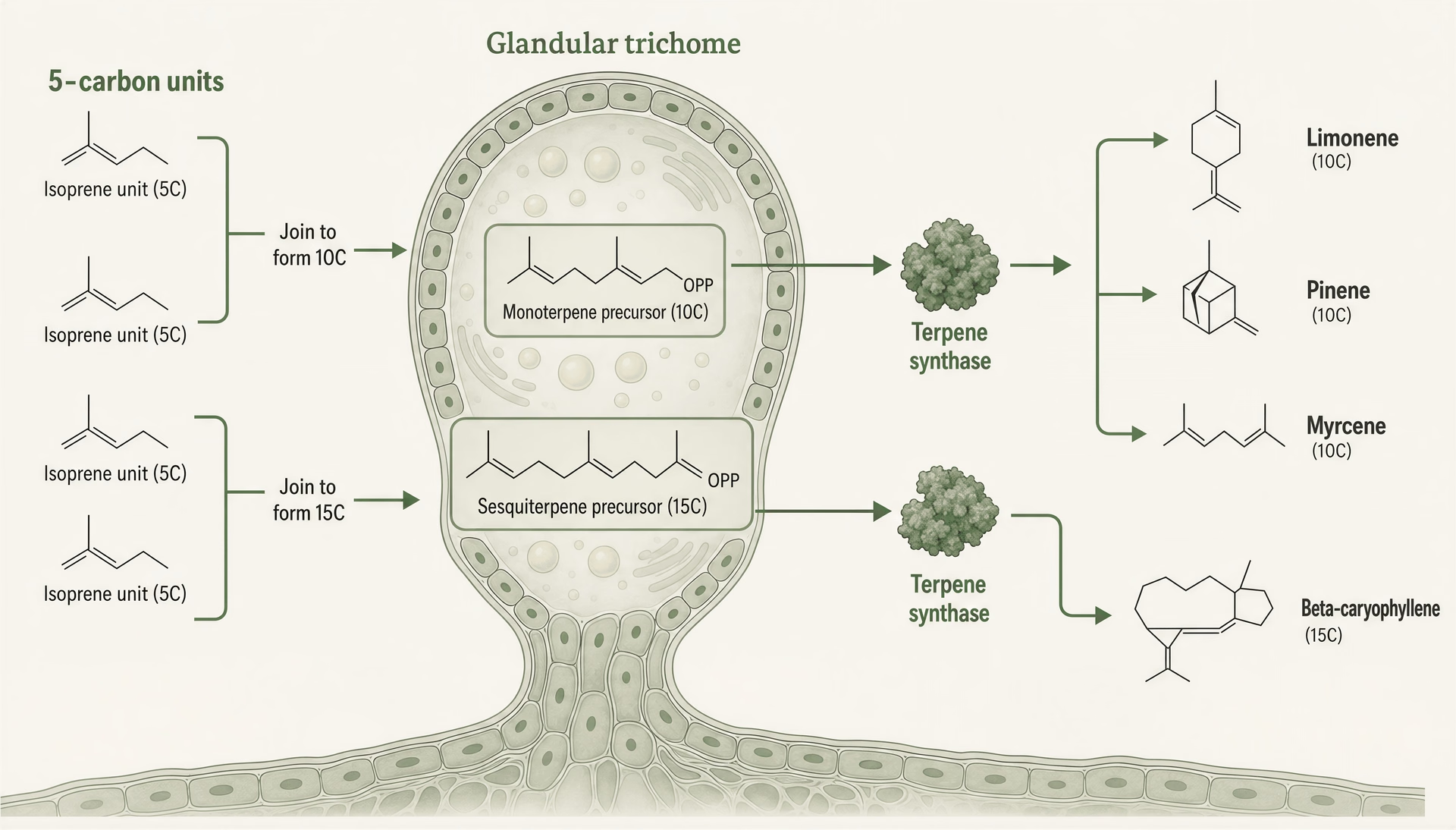
How cannabis synthesizes volatile compounds
Cannabis does not make terpenes at random. It builds them through enzyme-driven biosynthetic pathways using isoprenoid precursors. The short version is this: the plant generates five-carbon units, then links them into larger molecules. Two such units form the 10-carbon precursors for monoterpenes; three units form the 15-carbon precursors for sesquiterpenes. Specialized terpene synthase enzymes then fold and convert those precursors into specific end products such as limonene, pinene, myrcene, or caryophyllene.
Most of this activity is concentrated in glandular trichomes, the resin-producing structures on female inflorescences. Those same trichomes also produce cannabinoids, but through different branches of metabolism. They are neighbors, not the same thing. That matters because people often talk as if terpene content alone explains why a sample feels stimulating or sedating. It does not. Cannabinoid context can dominate the experience. ElSohly and colleagues, in long-running U.S. potency surveillance summarized in 2016, documented a rise in average THC concentration in confiscated cannabis from about 4% in 1995 to about 12% in 2014. If one flower has far more THC than another, subjective differences may be driven less by terpene nuance than by dose and THC:CBD ratio.
Biosynthesis is also sensitive to environment. Light intensity, nutrient status, temperature swings, water stress, pathogen pressure, and maturation stage can all shift how much of a given volatile compound the plant accumulates. Genetics set the range, but cultivation determines where inside that range a particular harvest lands. This is one reason “same strain name” does not guarantee same terpene profile. Another is simple naming inconsistency. Modern commercial cannabis is heavily hybridized, and naming practices are not standardized in a botanical sense.
Chemically, recurrent patterns do exist. Booth et al. in 2021 reported common pairings such as caryophyllene-limonene and myrcene-pinene in legal-market samples, and the 2023 Scientific Reports dataset also found recurring terpene-cannabinoid chemotypes. So the chemistry is not chaos. But it is also not a neat dictionary where one label always equals one profile.

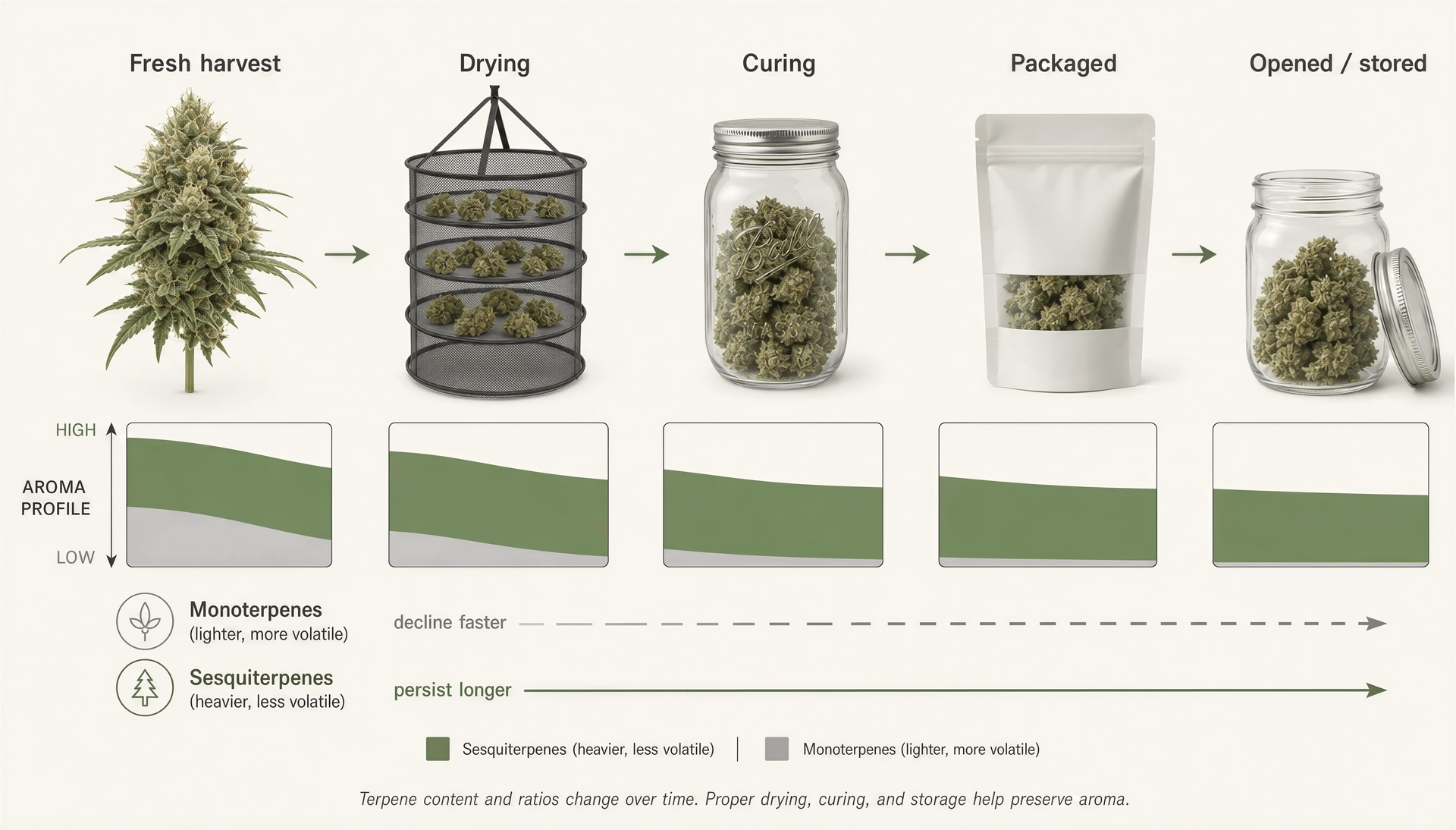
Why harvest, curing, and storage change the profile
Terpenes are volatile by definition. Many begin to evaporate as soon as the flower is cut, and the fastest losses tend to affect monoterpenes first. Heat speeds that process. So does moving air. Aggressive drying can preserve flower from mold while still stripping part of the brightest aromatic fraction. Slow, well-controlled drying usually retains more, but there is no magic point where chemistry freezes in place.
Harvest timing also changes what is present at the start. A plant taken earlier or later in maturity can differ not just in cannabinoids but in volatile composition. Trichome development, oxidation status, and enzymatic activity continue to shift near the end of flowering. Then post-harvest handling takes over.
Curing is partly about moisture redistribution and chlorophyll-related harshness, but it is also chemistry. During curing, some compounds dissipate, some transform, and some become more perceptible as water activity changes. Oxygen enters the story here. Terpenes can oxidize into alcohols, ketones, epoxides, and other derivatives that alter both aroma and, potentially, biological activity. Light accelerates certain degradative reactions. Warm storage accelerates many of them. Time does the rest.
This is why a certificate of analysis should be read as a snapshot, not an eternal truth. The report describes the tested sample on the test date, under that lab’s methods and reporting format. It does not guarantee what remains months later in a different package under different storage conditions. A flower lot tested at 2.3% total terpenes may not present that same profile after repeated opening, warm shelf exposure, and oxygen ingress. Even the ratio between top terpenes can shift over time as more volatile monoterpenes fade faster than less volatile sesquiterpenes.
The practical consequence is simple. Smell differences between two jars with the same strain name are not necessarily evidence of fraud, though mislabeling does happen. They may reflect real biochemical drift caused by cultivation, drying, cure length, packaging quality, and storage history. For reading terpene data, this is the right mindset: treat profiles as informative but temporary, better at describing aroma than forecasting effect, and always interpreted alongside cannabinoids rather than in isolation.
Major terpene groups found in cannabis
Cannabis terpenes are usually discussed as if they were a menu of mood buttons: myrcene for sleep, limonene for energy, pinene for focus. That framing is tidy and often wrong. Terpenes do matter, but first as volatile plant metabolites that shape aroma and flavor, and only second as candidate contributors to pharmacology. Even there, the evidence is uneven. A few mechanisms look plausible. Fewer are well demonstrated in humans.
The useful starting point is chemical taxonomy. Most of the recurring terpenes in cannabis flower fall into two broad groups: monoterpenes and sesquiterpenes. The split is not just academic. It helps explain why some aromas burst out of a jar and disappear quickly, while others linger longer in cured flower or remain more noticeable after handling and storage.
Just as important, no single terpene explains a whole effect profile. Ratios matter. THC level matters. THC:CBD ratio matters. Harvest timing, drying, curing, packaging, and age matter. So does oxidation. A lab report is a snapshot of chemistry on one date, not a guarantee of how the product will smell or feel weeks later.
Large commercial datasets support this profile-based view. Keegan and colleagues’ 2022 PLOS ONE chemotaxonomic analysis of 89,923 samples from six US states found that retail labels such as “Indica,” “Sativa,” and “Hybrid” did not consistently match chemical composition. A 2023 Scientific Reports analysis of 81,476 samples found recurring chemotype clusters and terpene co-occurrence patterns, but again not neat alignment with marketing categories. That is the backdrop for understanding the major terpene groups.
Monoterpenes: lighter, more volatile aroma drivers
Monoterpenes are smaller, more volatile molecules. In practical terms, they are often the first terpenes you smell and among the first to dissipate with poor storage, repeated opening, heat exposure, or extended curing. They tend to dominate the bright, fresh, citrusy, floral, herbal, or pine-forward notes associated with cannabis flower.
A myrcene-rich flower predictably produces sedation across users once THC dose and other variables are controlled. Preliminary evidence
Myrcene is one of the most common monoterpenes reported in cannabis. Its aroma is usually described as earthy, musky, herbal, sometimes clove-like or fruity depending on the matrix around it. It has become the poster compound for the “sedating indica” story, but that claim has outrun the evidence. Myrcene is indeed common in many commercial flower datasets, often appearing among the dominant terpenes alongside caryophyllene, limonene, or pinene. Preclinical work has suggested analgesic, anti-inflammatory, and sedative-like actions in animal models, and Russo’s 2011 review treated myrcene as a plausible contributor to relaxing or calming profiles. But there is no clean human evidence showing that a myrcene-rich flower predictably produces sedation across users once THC dose and other variables are controlled. The stronger claim should be rejected.
Limonene contributes citrus peel, orange, lemon, and sometimes sweet cleaner-like notes. It is another very common major terpene in commercial flower and often appears in recurring combinations with beta-caryophyllene. In preclinical and non-cannabis literature, limonene has been studied for anxiolytic, antidepressant-like, anti-inflammatory, and gastroprotective effects. That makes it biologically interesting. It does not justify saying limonene-rich cannabis is reliably “uplifting” in the clinical sense. Human mood responses to cannabis are influenced by dose, expectation, setting, prior exposure, and cannabinoids. Limonene may be part of the picture. It is not the whole picture.
Alpha-pinene and beta-pinene are responsible for pine, resin, rosemary, and forest-like notes. These two isomers are often grouped together in popular writing, though they are chemically distinct and may differ somewhat in biological activity. Pinene appears recurrently in market data, frequently paired with myrcene or limonene. One reason pinene gets so much attention is the long-running suggestion that it may offset memory impairment or mental fog associated with THC. That idea comes from plausible pharmacology, including acetylcholinesterase inhibition seen in some non-cannabis contexts, but direct evidence in cannabis users is sparse. Saying pinene “cancels out THC fog” goes too far. Saying it is a common terpene with a sharp conifer aroma and an interesting but under-tested neuropharmacology is fair.
Linalool is floral, lavender-like, sweet, and sometimes slightly spicy. It tends to appear in lower amounts than myrcene or limonene in many commercial flowers, but it is still one of the recurring named terpenes in lab reports. Linalool has one of the more plausible calming reputations because it has been studied outside cannabis for anxiolytic and sedative-like effects, including inhalation contexts. Still, translating lavender-related literature directly to cannabis products is messy. A flower with linalool is not automatically sedating, especially if it also carries high THC and stimulating co-terpenes.
Terpinolene smells more complex than the terpenes above: sweet, herbal, piney, floral, with occasional citrus or tea-tree associations. It is less uniformly dominant across the market, but when it is present at high levels it often defines the profile. Terpinolene-rich cultivars are frequently described as bright or energetic, yet the evidence basis is mostly observational and anecdotal. Chemically, terpinolene often marks a distinct profile cluster rather than a universal effect class. That distinction matters.
Ocimene contributes sweet, green, herbaceous, tropical, and sometimes slightly woody notes. It is generally less dominant than myrcene, limonene, or pinene in many commercial flowers, but it recurs often enough to be part of the core vocabulary of cannabis terpene reading. Proposed activities in the literature include anti-inflammatory and antifungal effects, though evidence specific to cannabis experience is thin. Ocimene is a good example of a terpene that can matter a lot to aroma without carrying strong human evidence for effect claims.
As a group, monoterpenes are the most obvious aroma drivers and among the most chemically fragile. That fragility has consequences. The bright top notes in a fresh flower sample may flatten over time, making an old terpene report less representative than people assume.
Sesquiterpenes: heavier compounds with different persistence
Sesquiterpenes are larger molecules and tend to be less volatile than monoterpenes. They often contribute heavier, deeper notes: pepper, wood, spice, hops, earth. Because they evaporate less readily, they may remain more evident after storage than the lightest monoterpenes, though oxidation and other degradation pathways still alter them.
Beta-caryophyllene is the standout sesquiterpene in cannabis. Its aroma is peppery, spicy, woody, sometimes clove-like. It is also one of the few common cannabis terpenes with a direct receptor-level story that holds up reasonably well in preclinical literature. A 2008 PNAS paper identified beta-caryophyllene as a selective CB2 receptor agonist in preclinical models. That is unusual and important. It does not mean caryophyllene-rich flower acts like a cannabinoid medicine in humans, but it does give this terpene a stronger mechanistic footing than most of its peers. In commercial datasets, beta-caryophyllene is among the most recurrent major terpenes and often appears alongside limonene or humulene. It is one of the clearest cases where a common aroma compound may also have relevant pharmacology.
Humulene is closely related to beta-caryophyllene structurally and often co-occurs with it. Its aroma is woody, earthy, hoppy, and slightly spicy. Humulene is familiar outside cannabis because hops are rich in it, which is why some cannabis samples smell distinctly beer-adjacent or hop-like. Proposed effects in preclinical literature include anti-inflammatory and possible appetite-related actions, but the popular claim that humulene is a reliable “appetite suppressant” in cannabis is not established by strong human data. It is better treated as a recurring sesquiterpene that shapes profile character and may contribute modestly to biological activity.
Nerolidol is woody, floral, fresh bark-like, and sometimes tea-like or fruity. It is usually not the loudest terpene on a report, but it appears often enough to deserve inclusion in the core set. Interest in nerolidol comes from preclinical work suggesting sedative-like, antimicrobial, antiparasitic, and skin-penetration-enhancing properties. The jump from those findings to confident cannabis effect claims is too large. Nerolidol may help explain why some flowers smell softly woody and floral rather than sharp or bright. That point is more secure than broad claims about how it will feel.
The heavier sesquiterpenes are often where “persistence” becomes visible to the nose. As monoterpenes fade, these compounds may make older flower smell duller, spicier, woodier, or flatter. That shift is chemical, not mystical.
The recurring major terpenes in commercial flower
Across legal-market datasets, a relatively small set of terpenes appears again and again near the top of cannabis flower reports: myrcene, limonene, alpha-pinene, beta-pinene, linalool, terpinolene, ocimene, beta-caryophyllene, humulene, and nerolidol. That does not mean every cultivar expresses all ten at meaningful levels. It means these compounds account for a large share of the recognizable aromatic diversity in modern flower.
Booth et al. in 2021, using legal-market cannabinoid and terpene data, found recurring combinations rather than infinite randomness. Caryophyllene-limonene pairings were common. So were myrcene-pinene clusters. The 2023 Scientific Reports dataset showed a similar pattern: profiles cluster chemically. This is more useful than talking about one terpene at a time, because flower effects and sensory qualities arise from ratios and context.
Consider two samples that both list limonene first. If one has limonene 0.9%, beta-caryophyllene 0.7%, linalool 0.3%, and moderate THC, while another has limonene 0.9%, terpinolene 0.8%, pinene 0.5%, and much higher THC, they are not chemically interchangeable. The shared top terpene does not erase the rest of the profile. Nor does it predict a single shared subjective effect.
This is also where simplistic strain folklore breaks down. The old shorthand says myrcene-heavy equals “indica-like” and limonene or pinene-heavy equals “sativa-like.” The large chemotaxonomic datasets do not support treating those labels as reliable guides. Modern commercial cultivars are heavily hybridized, and terpene distributions cut across retail naming conventions. Jahan Marcu and other cannabis scientists have repeatedly warned that effect claims tied to strain names move much faster than evidence.
A final caution: terpenes are easier to smell than to interpret clinically. The National Academies’ 2017 report found substantial evidence for some medical uses of cannabis or cannabinoids, including chronic pain, chemotherapy-induced nausea and vomiting, and multiple-sclerosis spasticity symptoms. It did not validate the usual strain-specific terpene stories. ElSohly’s long-running potency surveillance work adds another reason for restraint: THC concentrations have risen dramatically over time, making cannabinoid strength a major confounder whenever people attribute effects to terpenes alone.
So the core taxonomy is clear enough. Monoterpenes tend to drive bright, volatile top notes. Sesquiterpenes tend to add heavier, more persistent spice, wood, and earth. The recurring commercial cast is fairly stable: myrcene, limonene, pinenes, linalool, terpinolene, ocimene, beta-caryophyllene, humulene, nerolidol. What remains unstable is the human story built on top of them. Terpene profiles are useful chemical signatures. They are not destiny.
Aroma, flavor, and the sensory logic of terpene combinations
Cannabis aroma is easier to measure than cannabis effect, and that difference matters. Terpenes are volatile molecules, so they are strong contributors to what reaches the nose first. That does not mean one terpene equals one fixed experience. Aroma is pattern recognition. The brain reads mixtures, intensity, volatility, and contrast.
The simplest retail shorthand gets this wrong. “Limonene = citrus and uplift” or “myrcene = earthy and sedating” sounds neat, but it strips away the chemistry that actually shapes perception. Large dataset studies point in the opposite direction: recurring terpene clusters are real, yet they do not map cleanly onto “indica,” “sativa,” or “hybrid” labels. The 2022 PLOS ONE chemotaxonomic study analyzing 89,923 commercial samples found those labels were inconsistent with observed chemical diversity. A 2023 Scientific Reports analysis of 81,476 samples also found recurrent chemotypes rather than tidy label-based categories. If labeling is unstable, single-terpene storytelling is even less reliable.
Why single-terpene descriptions mislead
A single terpene can suggest a direction, not a finished sensory picture. Limonene is a good example. In isolation, people associate it with citrus peel. Yet limonene paired with beta-caryophyllene often reads as bright but grounded: orange zest over warm spice, peel over cracked pepper, sometimes with a dry resinous edge. Swap beta-caryophyllene for terpinolene and the profile changes sharply. Now the same limonene brightness can feel more lifted, airy, green, even perfumed, with notes closer to citrus blossom, fresh herbs, or cleaning-solvent sharpness depending on ratio and surrounding minors.
That is the important move: ratio, not presence alone.
Booth et al. in Scientific Reports (2021) found that certain terpene combinations recur in legal-market data, including caryophyllene-limonene and myrcene-pinene groupings. That supports a profile-level reading. The top terpene matters, but the gap between first, second, and third can matter almost as much. A sample with 0.7% myrcene, 0.6% limonene, and 0.5% caryophyllene will not smell like a “myrcene strain” in the simplistic sense. It may come across as rounded citrus-herbal with spice underneath. Another sample with 1.2% myrcene and everything else below 0.2% may smell much heavier, muskier, and less defined.
Myrcene especially gets flattened into a stereotype. It can dominate. It can also act as glue. In a profile rich in pinene and limonene, myrcene may soften sharp edges and add damp-earth or mango-like depth without taking over. In a profile with little contrast around it, the same terpene can become the whole impression: dense, humid, herbal, sometimes almost cellar-like. That is why “myrcene-heavy means X” is poor sensory advice and even worse pharmacology. Claims that myrcene content cleanly predicts sedation are not supported by modern commercial taxonomies, and they are confounded by cannabinoid strength. ElSohly’s potency surveillance work documented the rise in THC concentration over time; many reported “effects” attributed to terpenes are entangled with THC dose and THC:CBD ratio.

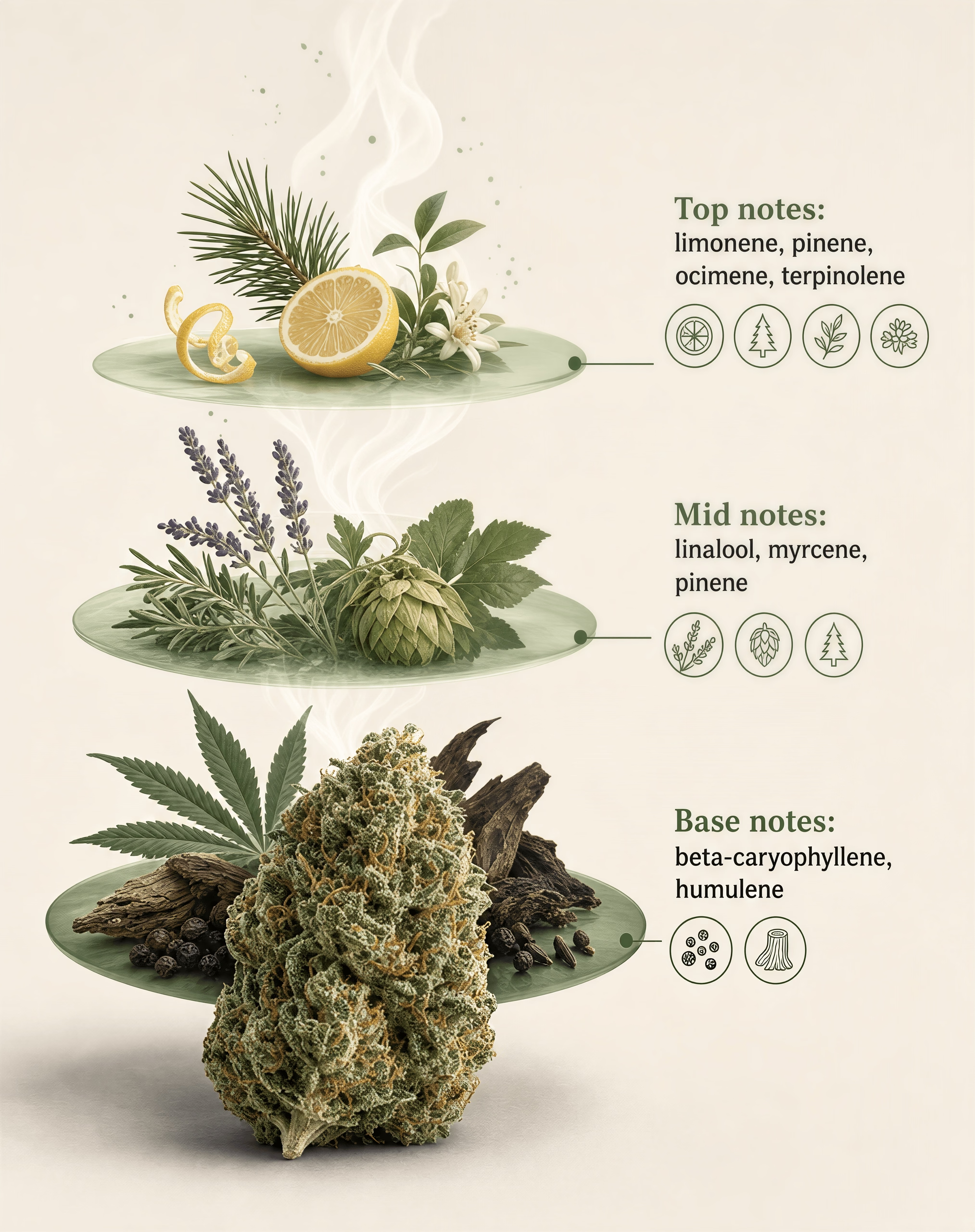
Top-note, mid-note, and base-note behavior in cannabis aroma
Borrowing perfume language helps if it is used carefully. Cannabis aroma has top-note, mid-note, and base-note behavior because its volatile compounds do not evaporate or oxidize at the same rate.
Top notes are the first impression. They tend to be brighter, more volatile, and more easily lost in drying, storage, or repeated opening of the container. Monoterpenes such as limonene, alpha-pinene, beta-pinene, ocimene, and terpinolene often contribute here. They announce citrus peel, pine needle, sweet herbs, floral lift, or a sharp fresh-cut quality. They are also fragile. A lab report captures a date-stamped snapshot, not the exact chemistry weeks later after air exposure and heat.
Mid notes give shape. Linalool, some pinene expression, and portions of myrcene or terpinolene can sit here depending on proportion. These notes make a profile feel floral, lavender-like, green, fruity, or leafy rather than merely “citrus” or “gas.” They often determine whether a bright aroma feels soft, tart, creamy, or piercing.
Base notes linger longest and give weight. Sesquiterpenes such as beta-caryophyllene and humulene often push profiles toward pepper, wood, dry spice, hops, or resin. A profile with strong base notes can smell denser and more serious even when it still has obvious top-note citrus. This is why limonene plus caryophyllene tends to read as deeper and warmer than limonene plus terpinolene. The first combination has a defined floor under it. The second can feel more vertical and volatile.
Flavor is trickier. People often use aroma and flavor as if they are interchangeable, but combustion creates pyrolysis products and smoke-derived notes that can mask or distort the original terpene pattern. Vaporization is gentler, yet heating still changes which compounds reach the senses and when. So flavor descriptions should stay modest: they are partly downstream of the original profile and partly downstream of the delivery method.
| Profile family | Compounds highlighted in the article | Typical sensory direction |
|---|---|---|
| Gas/skunk | Caryophyllene, myrcene, humulene, sulfur-containing volatiles, sometimes limonene or pinene | Fuel, rubber, onion, musk, acrid resin |
| Citrus | Limonene with caryophyllene, terpinolene, or pinene | Orange peel and spice, or brighter green/perfumed citrus, or lemon rind over conifer |
| Floral | Linalool, terpinolene, ocimene, smaller supporting compounds | Lavender, lilac, violet soap, sweet herbs |
| Pine | Pinene with myrcene and/or caryophyllene support | Conifer, forest floor, bark, spice |
| Herbal/pepper | Beta-caryophyllene and humulene with pinene, myrcene, or linalool | Kitchen spice, hops, sage, woody notes |
Examples of common profile families
Gas/skunk profiles usually rely on more than “one gas terpene,” because there is no single terpene that explains the whole effect. These profiles often combine caryophyllene, myrcene, humulene, sulfur-containing volatiles, and sometimes limonene or pinene accents. The result is fuel, rubber, onion, musk, or acrid resin. The sulfur compounds matter a lot here, which is another reason terpene-only summaries can miss the mark.
Citrus families often feature limonene up front, but they split into subtypes. Limonene with caryophyllene can suggest orange peel and spice. Limonene with terpinolene leans brighter, greener, and more perfumed. Limonene with pinene can read like lemon rind over conifer.
Floral profiles commonly involve linalool, terpinolene, ocimene, and smaller supporting compounds. Depending on ratio, they can smell like lavender, lilac, violet soap, or sweet herbs. Too much terpinolene without grounding notes can push the profile from floral into sharp or solvent-like.
Pine families are usually pinene-led but not pinene-only. Myrcene can add forest floor. Caryophyllene can add dry bark and spice. Without those supports, pinene may smell thin and fleeting.
Fruit profiles are broad: tropical, berry, orchard, stone fruit. Myrcene is often present, but so are limonene, ocimene, linalool, and esters or minor volatiles not always highlighted on retail labels. This is why a “fruit” aroma can range from mango-soft to candy-bright.
Herbal/pepper profiles often center on beta-caryophyllene and humulene, with pinene, myrcene, or linalool shaping whether the result feels kitchen-spice, hops-like, sage-like, or woody. Beta-caryophyllene is chemically interesting beyond aroma because Gertsch et al. showed in PNAS (2008) that it acts as a selective CB2 agonist in preclinical models. Still, that mechanism does not license sweeping claims about how a peppery-smelling flower will affect any given person.
The safer interpretation is this: terpene profiles are strong clues to sensory character, weaker clues to subjective effect, and poor stand-ins for old “indica versus sativa” folklore. Read them as combinations under changing conditions, not as fixed identities.
The entourage effect: what the evidence supports and what it does not
The entourage effect is one of the most repeated ideas in cannabis writing, and also one of the most overstated. At its strongest, the claim says that a product’s terpene profile can reliably explain whether it will feel sedating, clear-headed, anxious, euphoric, or focused. That version is not established by controlled human evidence. A narrower claim does hold up better: cannabis contains multiple active compounds, some of those compounds have plausible biological interactions, and whole-plant effects cannot always be reduced to THC alone. That is a real scientific proposition. It is not a blank check for every strain description attached to a floral aroma.
The distinction matters because cannabis chemistry is messy. Modern cultivars are heavily hybridized, retail labels are inconsistent, and the same named cultivar can test differently across growers, harvests, and storage conditions. Keegan and colleagues’ 2022 PLOS ONE analysis of 89,923 commercial samples from six U.S. states found that “Indica,” “Sativa,” and “Hybrid” labels did not map cleanly onto observed chemical diversity. A 2023 Scientific Reports analysis of 81,476 samples likewise found recurring chemotypes and terpene co-occurrence patterns, but not neat confirmation of retail categories. So if the claim is that terpenes matter, that is plausible. If the claim is that labels and folklore predict terpene-driven effects with high confidence, the data say no.
Where the term came from
The word “entourage” did not start in cannabis marketing. It comes from pharmacology. In 1998, Shimon Ben-Shabat and Raphael Mechoulam used the term “entourage effect” to describe how endogenous fatty-acid glycerol esters might enhance the activity of the endocannabinoid 2-AG without directly binding the same receptors in the same way. That original idea was broader than terpenes and was not about dispensary categories.[4] Taming THC: potential cannabis synergy and phytocannabinoid-terpenoid entourage effects. Ethan B. Russo. British Journal of Pharmacology, 2011.
The cannabis-specific popularization came later, above all through Ethan B. Russo. His 2011 review in the British Journal of Pharmacology, “Taming THC: potential cannabis synergy and phytocannabinoid-terpenoid entourage effects,” became the canonical citation. Russo argued that cannabinoids and terpenoids could interact in ways that influence clinical and subjective outcomes. It was influential because it assembled pharmacology, plant chemistry, and therapeutic hypotheses into one framework. It was not proof from randomized human trials. That point gets lost constantly.
Russo’s role is important because he helped shift the conversation from “THC percentage explains everything” to “minor compounds may matter too.” That was a useful correction. But the review was hypothesis-building. It drew on preclinical work, mechanistic reasoning, and indirect evidence. It did not show that a myrcene-heavy flower will predictably sedate one person while a limonene-pinene flower will predictably energize another. Those stronger claims require controlled human studies with matched cannabinoid doses, verified terpene compositions, blinding, and repeated outcome measures. There are still too few of those studies.
It also helps to separate two different meanings of entourage. One is broad: multiple cannabis constituents may shape effects together. That is plausible and probably true in some contexts. The other is narrow and commercial: a terpene profile can be read almost like a personality test for the product. That narrower version is where the evidence thins out fast.
Pharmacological mechanisms that are plausible
Mechanisms the article treats as plausible
- Beta-caryophyllene Direct CB2 receptor agonism in preclinical work.
- Linalool Possible anxiolytic and sedative-like actions through glutamatergic, GABAergic, and possibly serotonergic pathways.
- Limonene Studied for possible serotonin-related and stress-related effects in preclinical contexts.
- Alpha-pinene Discussed as a possible alertness or memory modulator through cholinergic mechanisms, though evidence is sparse.
- TRP channels Several terpenes interact with channels such as TRPV1 and TRPA1 that are relevant to pain, inflammation, and sensory signaling.
Some terpene mechanisms are biologically credible. A few are stronger than others. The clearest example is beta-caryophyllene. In a 2008 PNAS paper, Gertsch and colleagues reported that beta-caryophyllene acts as a selective CB2 receptor agonist in preclinical models. That matters because CB2 signaling is linked to immune and inflammatory pathways rather than the classic intoxicating effects associated with CB1 activation in the brain. Beta-caryophyllene is unusual among common cannabis terpenes because it offers a direct cannabinoid-receptor-linked mechanism rather than a vague aroma-based story. That does not mean a caryophyllene-rich product has a single predictable effect in humans. It means there is a receptor-level pathway worth taking seriously.
Other plausible routes are less direct. Myrcene is often described as “sedating,” and one reason given is that it may alter blood-brain barrier permeability. This idea has circulated for years, but the evidence is weak and often overstated. There are preclinical discussions and historical references suggesting myrcene may affect membrane transport or drug uptake, yet there is no strong controlled human literature showing that myrcene in common cannabis exposure ranges reliably increases THC delivery to the brain or produces a consistent sedative effect. It remains a hypothesis, not a settled mechanism.
Linalool has preclinical evidence suggesting anxiolytic and sedative-like effects, likely through glutamatergic, GABAergic, and possibly serotonergic pathways, though much of this work comes from animal models or from aromatherapy-adjacent literature rather than cannabis-specific trials. Limonene has been studied for possible effects on serotonin signaling and stress-related behavior in preclinical contexts. Alpha-pinene has been discussed as a candidate modulator of alertness or memory through cholinergic mechanisms, though claims that it “cancels THC memory impairment” are far ahead of the evidence. Humulene and beta-caryophyllene have both been linked to anti-inflammatory signaling in preclinical work. Several terpenes also interact with transient receptor potential channels, including TRPV1 and TRPA1, which are relevant to pain, inflammation, and sensory signaling.
CBD adds another layer. It has known pharmacology involving 5-HT1A serotonin signaling, TRPV channels, adenosine uptake, and indirect effects on endocannabinoid tone. So when people report that a “terpene-rich” product feels calmer or less edgy, terpene action may be one part of the picture, but cannabinoid ratio is often doing heavy lifting. A product with substantial CBD and modest THC can feel very different from a high-THC, low-CBD product even if both share some of the same major terpenes.
This is why profile-level thinking is more defensible than single-terpene storytelling. Booth et al. in 2021, analyzing legal-market cannabinoid and terpene data, found recurring combinations such as caryophyllene-limonene and myrcene-pinene clusters. The 2023 Scientific Reports dataset found similar repetition of chemotypes across tens of thousands of samples. Cannabis chemistry tends to appear in families of compounds, not in isolated notes floating independently. That means any plausible interaction is likely happening in a matrix: THC dose, CBD ratio, terpene set, minor cannabinoids, and degradation products all at once.
Still, plausible is not the same as proven. The National Academies report in 2017 concluded that there is substantial evidence for cannabis or cannabinoids in chronic pain, chemotherapy-induced nausea and vomiting, and patient-reported multiple-sclerosis spasticity symptoms. It did not validate the idea that specific terpene mixes reliably produce specific moods or levels of sedation. Regulators have accepted isolated cannabinoid medicines such as Epidiolex, dronabinol, and nabilone when evidence reached the required standard. Comparable terpene-rich, strain-specific claims are much less standardized clinically.
Why the strongest retail claims outrun the data[5] Changes in Cannabis Potency Over the Last 2 Decades (1995-2014): Analysis of Current Data in the United States. Mahmoud A. ElSohly, et al.. Biological Psychiatry, 2016.
The biggest problem is confounding. THC potency has risen substantially over time, as documented by ElSohly and colleagues’ surveillance work; average THC in U.S. confiscated samples rose from about 4% in 1995 to about 12% in 2014. When one product has twice the THC of another, or a radically different THC:CBD ratio, subjective effects can diverge for reasons that have little to do with terpenes. Tolerance matters too. A daily user and an occasional user may react very differently to the same product. So do dose, route of administration, prior meals, sleep, anxiety level, and setting.
Expectancy is another major issue. If someone is told a product is “uplifting citrus sativa,” that label can shape the experience before pharmacology even enters the picture. This is not a trivial factor. Psychoactive outcomes are especially sensitive to context. Blind, randomized designs are needed to sort true chemical effects from suggestion, yet much of the public narrative comes from unblinded self-report.
Chemistry itself is unstable. Terpenes are volatile and chemically fragile. Drying, curing, packaging, oxygen exposure, heat, and light can change the profile after harvest. Oxidation products may alter smell and perhaps effects. A lab report captures one tested sample at one time point. It does not guarantee the product’s chemistry remains identical weeks later. Reading a terpene certificate as a precise forecast of mood is too confident for a moving target.
There is also a taxonomy problem. “Indica = myrcene and sedation” and “sativa = limonene/pinene and stimulation” are folk rules, not reliable scientific categories. Large datasets do not support those labels as stable proxies for chemistry. Modern markets contain recurrent terpene clusters, yes, but those clusters do not line up neatly with old retail bins. Chemical data are more informative than names, and even chemical data have limits.
Terpenes are better predictors of aroma than of psychoactive effects. Limited evidence
So the clear position is this: the entourage effect is a valid research hypothesis and probably a real phenomenon in some narrow senses, especially where known pharmacology exists, as with beta-caryophyllene and CB2-related signaling or formulation-level cannabinoid interactions. What is not supported is the stronger claim that terpene combinations let you predict, with confidence, a specific human mood state or sedation profile across products and people. Terpenes are better predictors of aroma than of psychoactive destiny. That is the evidence-based line.
How to read terpene lab results without fooling yourself
A terpene report is a chemistry snapshot, not a personality test for the product and not a forecast of how any one person will feel. Read it that way and it becomes useful. Read it as a promise of “energizing,” “sedating,” or “creative,” and you are already stretching past the evidence.
That matters because commercial labels are weak guides. In a 2022 PLOS ONE chemotaxonomic analysis of 89,923 cannabis samples from six U.S. states, “Indica,” “Sativa,” and “Hybrid” labels did not reliably map onto chemical composition. A 2023 Scientific Reports analysis of 81,476 samples also found recurring chemotypes and terpene co-occurrence patterns, not tidy alignment with retail categories. So the lab report is usually more informative than the strain story attached to it. Even then, it has limits.
| Reported value | Equivalent value | Meaning |
|---|---|---|
| 1% | 10 mg/g | One gram of a terpene per 100 grams of sample |
| 0.1% | 1 mg/g | One tenth of a gram per 100 grams of sample |
| 5 mg/g | 0.5% | Five milligrams of a terpene per gram of sample |
Percent by weight, milligrams per gram, and total terpene content
Most terpene results are reported in one of three ways:
Percent by weight (% w/w). This means grams of a terpene per 100 grams of sample. If myrcene is listed at 0.70%, that is 0.70 grams per 100 grams, or 7 mg per gram.
Milligrams per gram (mg/g). This is often easier to compare directly. A result of 6 mg/g limonene equals 0.60%.
Total terpene content. This is the sum of measured terpenes in the panel. If a flower sample shows 0.7% myrcene, 0.6% limonene, 0.5% beta-caryophyllene, 0.3% linalool, and smaller amounts adding up to 2.5%, then total terpenes are 2.5% or 25 mg/g.
The conversions are simple:
- 1% = 10 mg/g**
- 0.1% = 1 mg/g**
- 5 mg/g = 0.5%**
If you do nothing else, learn that conversion. It prevents a lot of confusion when one lab uses percent and another uses mg/g.
- Common flower band
- About 1% to 4% total terpenes
- Interpret with caution below 1%
- May reflect age, storage, cultivar traits, drying losses, or panel limits
- Check claims well above 4% in flower
- Review methods and sample basis carefully
- Extract comparison
- A live resin at 6% total terpenes is not directly comparable to flower at 2.2%
For flower, total terpene content commonly lands around the low single digits by dry weight. Roughly 1% to 4% is a common real-world band, though there is no universal standard and methods differ. Values below 1% are not automatically “bad”; they may reflect age, storage, cultivar traits, drying losses, or a narrower reporting panel. Values well above 4% in flower should make you check the methods and sample basis carefully.
For extracts, the numbers can be much higher because terpenes may be concentrated, preserved, or reintroduced. A live resin at 6% total terpenes is not directly comparable to a flower sample at 2.2%. They are different matrices. Compare flower with flower, extract with extract, and if you must compare across forms, focus on ratios and context rather than absolute totals.
Also check whether the report is based on as-received weight or dry-weight corrected material. Moisture changes percentages. A flower sample with more residual water can show lower terpene percentage by total weight than a drier sample, even if the plant material started with a similar chemical profile. This is one reason side-by-side comparisons from different labs can mislead. If moisture content is listed, use it. If it is not, be cautious.
Age matters too. Terpenes are volatile. A certificate of analysis reflects the chemistry on the test date, not necessarily the chemistry months later when the product is opened. Storage temperature, oxygen exposure, light, and packaging all change the profile. That fruity limonene-rich top note may be lower now than when the sample hit the lab.
Reading ratios instead of chasing the top terpene
The most common mistake is to look at the single highest terpene and stop there. That is how you end up with cartoon interpretations like “myrcene = couchlock” or “limonene = daytime.” The chemistry is more layered than that.
Take two hypothetical flower profiles:
Profile A - Myrcene 0.7% - Limonene 0.6% - Beta-caryophyllene 0.5% - Linalool 0.2% - Alpha-pinene 0.15% - Total terpenes 2.4%
Profile B - Myrcene 1.8% - Limonene 0.15% - Beta-caryophyllene 0.1% - Pinene trace - Total terpenes 2.2%
If you chase only the top terpene, Profile B “wins” on myrcene. But these two profiles may smell and behave very differently because Profile A is more balanced across several abundant terpenes, while Profile B is heavily skewed toward one. The gap between first, second, and third terpenes matters. A narrow spread often means a more blended aromatic expression. A steep drop-off can mean one note dominates.
This does not prove a specific effect in a person. It does tell you the products are chemically different in a way that a one-word label cannot capture.
Quick reading checklist
- Scale Check total terpene content first.
- Top three Read the leading three terpenes, not just the top one.
- Spread See whether the profile is balanced or dominated by one compound.
- Supporting minors Look for lower-level linalool, pinene, humulene, terpinolene, or ocimene that can shift aroma.
- Cannabinoid context Interpret terpenes alongside THC and CBD, because cannabinoid strength is a major confounder.
A practical way to read a profile:
1. Check total terpene content. Is it 0.8%, 2.3%, or 7%? That sets the scale. 2. Look at the top three terpenes. Not just number one. 3. Check the distance between them. Is the profile balanced or dominated by one compound? 4. Scan for supporting minors. Small amounts of linalool, pinene, humulene, terpinolene, or ocimene can shift aroma sharply even at lower levels. 5. Put cannabinoids next to terpenes. THC and CBD levels are major confounders.
That last point is non-negotiable. Mahmoud ElSohly and colleagues documented the long-term rise in THC potency in U.S. cannabis samples; many user-reported differences that get credited to terpenes may actually be driven by THC concentration, THC:CBD ratio, dose, and route of administration. A 28% THC flower with 2.0% total terpenes is not meaningfully comparable in subjective effect to a 16% THC flower with the same terpene total.
There is some biologically plausible terpene pharmacology. Beta-caryophyllene, for example, showed CB2 agonist activity in a 2008 PNAS paper, which gives it a direct receptor-linked mechanism rarely claimed for common terpenes. Ethan Russo’s 2011 British Journal of Pharmacology review argued that cannabinoid-terpenoid interactions may matter. But that paper built a hypothesis from pharmacology and preclinical data; it did not prove that a specific terpene ratio predicts a specific human experience in randomized trials. Keep the scale of the evidence in proportion.
| COA issue | Why it matters |
|---|---|
| Tiny terpene panel | Can understate total terpenes and make the profile look simpler than it is |
| Non-detect without thresholds | You cannot tell whether a compound is truly absent or just below that method’s limit |
| Missing sample details | Flower, pre-roll fill, concentrate, vape oil, or age differences can change interpretation |
| No moisture value for flower | Cross-batch comparison becomes shakier because water changes percentages |
| Old test date | Terpenes evaporate and oxidize, so chemistry may have changed |
| Suspiciously round or repetitive numbers | May justify a closer look at data quality or reporting practices |
Red flags and limits in certificates of analysis
Some reports are more informative than others. The weak ones can still look technical.
A first red flag is a tiny terpene panel. If the certificate lists only myrcene, limonene, and caryophyllene, “total terpenes” may be understated and the profile can look simpler than it is. Better panels include at least the major recurring cannabis terpenes: myrcene, limonene, beta-caryophyllene, humulene, linalool, alpha- and beta-pinene, terpinolene, ocimene, and often nerolidol, bisabolol, valencene, and others.
Second: non-detect does not mean absent. It means below the lab’s limit of detection or limit of quantitation. If those thresholds are not shown, you do not know whether “ND” means truly negligible or just too low for that method. This matters for potent-smelling minor terpenes.
Third: missing sample details. Was the tested material flower, pre-roll fill, concentrate, vape oil, or finished edible? Was it fresh, cured, or months old? Was the sample homogenized? A whole flower lot can vary from top cola to lower buds. Batch variation is real.
Fourth: no moisture value for flower. Without moisture, cross-batch comparison is shakier. Drier flower often shows inflated percentages relative to wetter flower.
Fifth: old test date. Because terpenes evaporate and oxidize, a certificate from many months ago may describe what the product was, not what it is.
Sixth: suspiciously round or repetitive numbers. Real terpene data usually have uneven decimals and some messiness. Identical percentages across many batches deserve a second look.
Finally, remember what a COA cannot do. It cannot account for your dose, tolerance, metabolism, setting, expectations, or what else is in the product beyond the reported panel. It cannot translate chemistry into a guaranteed mood or medical outcome. The National Academies’ 2017 report found substantial evidence for some medical uses of cannabis or cannabinoids, but not for strain-by-strain terpene folklore. A terpene lab result is a useful map of volatile chemistry. It is not a clinical effect forecast.
Do indica, sativa, and hybrid cultivars have distinct terpene ratios?
Short answer: not in any clean, dependable way.
The familiar retail script goes like this: indica cultivars are myrcene-heavy and more physically calming; sativa cultivars lean toward terpinolene, limonene, and pinene and feel more stimulating; hybrids fall somewhere in between. There is a grain of truth in parts of that story. Some labeled groups in some datasets do show tendencies toward certain dominant terpenes. But as a rule for predicting chemistry, it breaks down fast. Modern commercial cannabis is too hybridized, too inconsistently named, and too chemically variable across growers, harvest windows, and storage conditions for indica, sativa, and hybrid labels to function as reliable terpene categories.
That does not make terpene data useless. Far from it. It means the chemistry itself is more informative than the label on the jar.
Why the old categories persist
Indica and sativa began as botanical terms tied to morphology and geographic history, not as precise forecasts of subjective effects. Over time, especially in retail and popular media, those words were repurposed into a shorthand for expected experience: indica for “sedating,” sativa for “uplifting,” hybrid for mixed effects. Terpene language was then layered onto that story, with myrcene often cast as the hallmark of indica-type flower and terpinolene or limonene as signatures of sativa-type flower.
People keep using the categories because they are simple, memorable, and socially reinforced. They also sometimes seem to work. A person may repeatedly encounter terpinolene-dominant flower sold as sativa or myrcene-dominant flower sold as indica, and that pattern feels persuasive. But repeated anecdotes are not the same thing as a stable classification system.
There is also a confounding problem that older strain folklore usually ignores: THC strength and THC:CBD ratio often vary enough to swamp subtler terpene-related differences. ElSohly and colleagues, in long-running potency surveillance published in 2016, documented a major rise in average THC concentration in U.S. cannabis over time. When one sample has far more THC than another, people may attribute the stronger or harsher effect to “sativa energy” or “indica heaviness” when the simpler explanation is dose and cannabinoid composition.
The evidence for terpene effects themselves is narrower than the folklore suggests. Ethan Russo’s 2011 review in the British Journal of Pharmacology made the case that cannabinoid-terpenoid interactions are biologically plausible and worth studying. That review is important, but it is a hypothesis-building paper, not proof from randomized human trials that myrcene-rich flower will reliably sedate or that pinene-rich flower will reliably sharpen attention across users. The National Academies report in 2017 found substantial evidence for cannabis or cannabinoids in a few medical indications, including chronic pain and chemotherapy-induced nausea, yet it did not validate strain-label effect claims. That gap matters.
Then there is chemistry drift after harvest. Terpenes are volatile and chemically fragile. Drying, curing, heat exposure, oxygen, and storage time can shift ratios before the flower is consumed. A cultivar that left the grow room with one profile may not reach the user with that exact same profile intact. So even if an indica- or sativa-labeled cultivar once had a typical terpene pattern, handling can blur it.
What large datasets say about terpene clustering
The strongest evidence against simple label-based expectations comes from large commercial datasets.
A 2022 PLOS ONE chemotaxonomic analysis led by Brian C. Keegan and colleagues examined 89,923 commercial cannabis samples from six U.S. states. Their central finding was blunt: commercial labels such as “Indica,” “Sativa,” and “Hybrid” did not consistently align with observed chemical diversity. If those labels truly mapped onto distinct terpene ratios, a dataset that large should have shown clearer separation. It did not.
A 2023 Scientific Reports analysis of 81,476 samples reached a related conclusion. The authors found recurring cannabinoid-terpene chemotypes and repeatable patterns of co-occurrence, but not neat correspondence with retail categories. In other words, cannabis does cluster chemically. It just does not cluster in the same way the market often says it does.
That distinction is the key one. There are real terpene clusters. They are simply not well captured by indica, sativa, and hybrid.
Booth et al. in Scientific Reports in 2021 also found that a limited number of terpene combinations dominate legal-market flower. Common pairings included caryophyllene-limonene and myrcene-pinene. This is useful because it moves the discussion away from single-terpene myths. Cannabis aroma and possible pharmacology arise from profiles, not from one molecule acting alone in a vacuum.
So where does that leave the common comparison? It leaves it in qualified territory.
Yes, many products labeled sativa are more likely than many labeled indica products to show terpinolene prominence, often alongside limonene or pinene. Terpinolene-dominant profiles are a real recurring class in commercial flower. And yes, many products labeled indica do skew toward myrcene with caryophyllene or limonene in the mix. Those tendencies show up often enough that the stereotype did not appear out of nowhere.
But overlap is large. Very large. You can find “indica” products with limonene-forward or pinene-forward profiles and “sativa” products that are myrcene-dominant. You can also find the same strain name showing materially different terpene ratios across producers. Sean Myles and colleagues, in work on cannabis naming consistency and genetics, have shown how unstable strain identity can be in practice. Once naming is inconsistent, any label-based terpene expectation becomes weaker still.
Another point often missed: some terpene classes may matter more for smell than for the broad effect labels attached to them. Myrcene has been linked in preclinical and folk discussions to sedative qualities, but human evidence is thin. Beta-caryophyllene is one of the few common cannabis terpenes with a direct receptor-linked mechanism proposed in the literature; Gertsch et al. reported in PNAS in 2008 that beta-caryophyllene acts as a selective CB2 agonist in preclinical models. That is biologically interesting. It still does not rescue the indica/sativa taxonomy.
A better way to talk about cultivars: chemovars and profile classes
If the question is whether indica, sativa, and hybrid cultivars have distinct terpene ratios, the scientifically defensible answer is: only loosely, inconsistently, and not enough to rely on the labels. A better vocabulary is chemovar language.
Chemovar A chemically defined variety identified by measured cannabinoid and terpene composition rather than a retail label or ancestry claim.
A chemovar is a chemically defined variety. Instead of asking whether a cultivar is indica or sativa, ask what its measured profile is: THC-dominant, CBD-dominant, or mixed cannabinoid type; total terpene percentage; dominant and secondary terpenes; and the ratio among them. A sample that is 24% THC with 0.1% CBD and a terpene profile led by limonene, beta-caryophyllene, and linalool says more than “hybrid” ever will.
| Profile class example | What it communicates better than indica/sativa/hybrid |
|---|---|
| myrcene-caryophyllene-limonene dominant | Shows the actual leading terpene set rather than a retail category |
| terpinolene-pinene dominant | Flags a distinct measured profile cluster |
| limonene-caryophyllene dominant | Highlights a common recurring pairing in commercial data |
| myrcene-pinene dominant | Describes a repeatable chemistry pattern without relying on strain folklore |
Profile classes are even more practical. For example: - myrcene-caryophyllene-limonene dominant - terpinolene-pinene dominant - limonene-caryophyllene dominant - myrcene-pinene dominant
Those classes reflect what the big datasets actually show: repeated chemical groupings. They also leave room for variables the old labels obscure, such as whether the total terpene content is 1.2% or 3.1%, whether the top terpene barely leads the second and third or dominates them sharply, and whether oxidation or age may have altered the original bouquet.
This approach also better matches the current state of evidence on the entourage effect. There is a plausible case that terpenes can shape the feel of a product in context, especially through sensory pathways, pharmacokinetics, and in some cases direct pharmacology. But the strong retail claim — that an indica terpene ratio reliably predicts sedation and a sativa ratio reliably predicts stimulation — outruns what controlled human evidence has shown. Chemovar language is less catchy, but it is more honest.
So the old categories persist because they are familiar and sometimes loosely correlate with common terpene patterns. Yet large datasets show that the overlap is too broad for those labels to serve as dependable guides. If someone wants to compare cultivars seriously, the question should not be “Is this indica or sativa?” It should be “What does the lab report say, and how stable is that chemistry likely to be?”
Why the same named strain can show different terpene profiles
A strain name is not a chemical guarantee. It is usually a cultivar label, sometimes a clone line, sometimes a breeder description, and sometimes just a market name that has drifted far from any stable genetic source. That is why one “Blue Dream” certificate of analysis can be rich in myrcene and pinene while another leans toward terpinolene or limonene, and why two samples sold as “OG Kush” may share a familiar aroma family yet differ sharply in their measured terpene percentages.
This instability matters because terpene profiles are often treated as fixed identities. They are not. They are snapshots of plant metabolism at one moment in time, shaped by genetics, growing conditions, harvest timing, and what happened after the flower was cut. Lab results are useful. They are just less final than strain databases imply.
Genotype, phenotype, and environmental expression
The first source of variation is biological. Genotype is the plant’s inherited genetic makeup; phenotype is how those genes are expressed in a given environment. Two plants descended from the same named cultivar can express different terpene ratios if they come from different seed stock, different clone selections, or different breeding histories. That is especially true in modern cannabis, where many commercial lines are heavily hybridized and naming practices are loose.
Even with a legitimate clone-only line, environment changes expression. Light intensity and spectrum can alter secondary metabolite production. So can temperature swings, root-zone stress, irrigation patterns, nutrient availability, and plant density. A cooler finish may preserve some volatile compounds better than a hot room late in flower. Nitrogen levels, sulfur nutrition, and general plant stress can all shift aromatic metabolism. Small changes add up.
Harvest timing matters too. Terpenes do not rise and fall in lockstep with cannabinoids. A plant taken earlier may show a brighter, more volatile profile; the same plant left longer may shift in both absolute terpene amount and relative ratios. That makes simplistic stories such as “this strain is always sedating because it is myrcene-heavy” hard to defend. Sometimes the chemistry changed because the plant was harvested later. Sometimes the THC content changed more than the terpenes did. ElSohly and colleagues’ long-running potency surveillance work is relevant here: rising THC levels are a major confounder when people assign subjective effects to terpenes alone.
Large datasets back up the idea that names are weak predictors. In 2022, Keegan and colleagues analyzed 89,923 commercial cannabis samples in PLOS ONE and found that retail labels such as Indica, Sativa, and Hybrid did not consistently match the observed chemical diversity. A 2023 Scientific Reports analysis of 81,476 samples found recurring chemotype clusters and terpene co-occurrence patterns, but not clean alignment with retail categories. Chemistry clusters. Names drift.
Drying, curing, packaging, and storage losses
Freshly harvested flower is not chemically identical to the product consumed weeks later. Terpenes are volatile. Some evaporate readily during drying if temperature, humidity, and airflow are poorly controlled. Others oxidize into new compounds that can change aroma and potentially alter subjective experience. A lab report often captures one time point, not the chemistry at use.
Drying too fast can drive off lighter aromatics. Curing too warm can flatten the profile. Excessive handling can physically knock off trichomes, reducing both cannabinoids and terpene-rich resin. Packaging matters more than many labels suggest. Permeable containers, repeated opening, headspace oxygen, heat exposure during transport, and bright light all accelerate loss or transformation.
Oxidation is part of the story, not a minor footnote. Monoterpenes such as limonene, pinene, and terpinolene are especially prone to loss because they are smaller and more volatile than sesquiterpenes like beta-caryophyllene and humulene. Over time, that can make an old sample appear “heavier” or duller, not because it began that way, but because its brighter fractions disappeared first. The result is that two test results for the same named cultivar, sampled at different stages of storage, may look like different products.
This is one reason online strain databases are often too confident. They usually present a strain as if its terpene ranking were fixed: myrcene first, pinene second, caryophyllene third. Real flower does not behave that neatly after harvest.
Why cross-market comparisons are messy
Comparing terpene profiles across regions, labs, and product categories is harder than many people assume. One lab may report weight percent, another mg/g. One may test trimmed flower, another whole inflorescences, another pre-roll material. Moisture content changes percentages. Sampling methods differ. Detection thresholds differ. So do terpene panels; one report may include ocimene isomers or nerolidol subtypes that another lab does not separate.
Then there is the naming problem. “Blue Dream” in one market may descend from a distinct mother plant; in another, it may be seed-grown material carrying only a family resemblance. Sean Myles and other researchers working on cannabis genetics and chemotype consistency have repeatedly shown the field still struggles with standardization between names, genomes, and chemistry. Jahan Marcu has made the same point in plainer language: strain names and claimed effects have raced far ahead of the evidence.
That does not mean terpene testing is useless. It means it should be read as a chemical snapshot with limits. A profile can tell you a lot about aroma family and about the relative prominence of compounds like myrcene, limonene, pinene, linalool, terpinolene, humulene, and beta-caryophyllene. It cannot, by itself, certify that every sample carrying the same name will smell, taste, or feel the same. Nor can it cleanly predict effect once THC dose, CBD level, minor cannabinoids, age of the sample, and route of use enter the picture.
What researchers still do not know
The strongest claims about terpene profiles still run ahead of the evidence. Researchers can now map cannabis chemistry at scale, and those datasets are useful. They show recurring terpene clusters, measurable variation across cultivars, and poor agreement between retail labels and actual chemotypes. Keegan and colleagues’ 2022 PLOS ONE analysis of 89,923 samples from six US states made that point hard to ignore: “Indica,” “Sativa,” and “Hybrid” did not reliably describe chemical composition. A 2023 Scientific Reports dataset covering 81,476 samples found recurring terpene-cannabinoid patterns as well. That supports chemistry-first classification. It does not prove that a given terpene ratio predictably causes a specific human effect.
The human trial gap
This is the central missing piece. The entourage hypothesis is biologically plausible, and Ethan Russo’s 2011 British Journal of Pharmacology review helped frame why cannabinoid-terpenoid interactions deserve study. But a hypothesis-building review is not the same thing as randomized human evidence.
What is missing are well-controlled trials that hold cannabinoids steady while altering terpene composition on purpose. For example: matched inhaled products with the same THC dose, same CBD dose, same minor-cannabinoid profile, same route of administration, and only one meaningful difference in terpene ratio, such as myrcene-rich versus limonene-pinene-rich formulations. Without that design, almost every real-world comparison is confounded. THC strength changes effects. THC:CBD ratio changes effects. Dose changes effects. Expectations change effects.
That matters because some terpene claims are stronger than the data behind them. Beta-caryophyllene is a good example of a terpene with a real mechanistic foothold: Gertsch et al. in 2008 reported CB2 agonist activity in preclinical work. But even there, translating receptor activity or rodent findings into consistent human cannabis experiences is a different question. Sedating versus stimulating strain folklore remains especially weak. The National Academies’ 2017 report found substantial evidence for some medical uses of cannabis or cannabinoids, but not for strain-specific terpene effect claims.
Standardization problems in cannabis research
Cannabis is a moving target. Flower changes after harvest. Terpenes are volatile and chemically fragile, so drying, curing, storage temperature, oxygen exposure, light, grinding, and packaging can all shift the profile before consumption. A lab report often captures one test date, not the exact chemistry a person inhales weeks later.
Then there is inhalation behavior. Puff duration, vaporizer temperature, combustion conditions, breath hold, and total inhaled dose all affect exposure. Two participants can use the same flower and receive meaningfully different terpene and cannabinoid delivery. Placebo control is hard too. Terpenes have strong aromas, so a terpene-rich active product may be easy to distinguish from a stripped or low-aroma placebo, which threatens blinding.
Product format complicates things further. Flower, extracts, and finished inhalable products do not express chemistry in the same way. Even before the first puff, a “myrcene-heavy” sample may differ from another sample in oxidized terpenes, degradation products, moisture, and total terpene percentage.
What better evidence would look like
Better evidence would be boring in the right way: preregistered, randomized, blinded, adequately powered human trials using matched THC/CBD formulations with deliberately manipulated terpene ratios. The products would need batch verification before and after storage, inhalation protocols that reduce dosing variability, and outcome measures that separate aroma liking from pharmacologic effect.
Until studies like that accumulate, terpene profiles should be treated as scientifically useful descriptors of cannabis chemistry and sensory character, not as complete explanations for subjective or clinical effects. They tell us a lot about what a product is. They do not yet tell us, with confidence, exactly what it will do in a human body.
References
- [1] The reliability of cannabis strain names and lab testing data. PLOS ONE, 2022. https://doi.org/10.1371/journal.pone.0267498
- [2] Taming THC: potential cannabis synergy and phytocannabinoid-terpenoid entourage effects. British Journal of Pharmacology, 2011. https://doi.org/10.1111/j.1476-5381.2011.01238.x
- [3] Beta-caryophyllene is a dietary cannabinoid. Proceedings of the National Academy of Sciences of the United States of America, 2008. https://doi.org/10.1073/pnas.0803601105
- [4] Taming THC: potential cannabis synergy and phytocannabinoid-terpenoid entourage effects. British Journal of Pharmacology, 2011. https://doi.org/10.1111/j.1476-5381.2011.01238.x
- [5] Changes in Cannabis Potency Over the Last 2 Decades (1995-2014): Analysis of Current Data in the United States. Biological Psychiatry, 2016. https://doi.org/10.1016/j.biopsych.2016.01.004