














Why ocimene matters more than its low concentration suggests
Ocimene matters because “ocimene” is not one simple scent tag. In cannabis chemistry, it is a small family of related monoterpene isomers, mainly alpha-ocimene, cis-beta-ocimene, and trans-beta-ocimene, and that distinction changes how the aroma is described and how the compound behaves in a sample over time. Flattening all of that into a single generic “sweet terpene” is a real mistake. It erases the difference between floral-bright, green-herbaceous, and lightly woody or citrus-adjacent notes that analytical and fragrance literature often separates.
That correction matters even more because ocimene is usually not a dominant terpene by percentage in cannabis. Large commercial chemistry datasets show that myrcene, limonene, and beta-caryophyllene recur far more often as leading terpenes. Jin et al. analyzed 89,923 commercial samples across six U.S. states and found strong clustering around those more common terpenes, not around ocimene as a major peak (Jin et al., PLOS ONE, 2021). Vergara et al., working with 81,428 samples, also showed that commercial labels and strain names often fail to predict actual chemistry with much precision (Vergara et al., PLOS ONE, 2021). So yes, ocimene is often low-abundance. No, that does not make it irrelevant.
| Topic | Why one-line 'ocimene' reporting is incomplete |
|---|---|
| Isomer identity | Alpha-ocimene and beta-ocimene are not the same molecule |
| Odor profile | Sweet-green, floral-herbal, woody, and citrus-adjacent notes can shift by isomer |
| Stability | Geometric isomers can differ in relative strain and practical fragility |
| Analytics | Some labs merge ocimene into one peak instead of separating isomers |
The common mistake: treating ocimene as one generic terpene
The lazy version of terpene writing treats ocimene as if it were interchangeable across samples, products, and cultivars. It is not. Alpha-ocimene and the beta-ocimene isomers are structurally related, but practical terpene chemistry does not treat isomers as cosmetic trivia. Different isomers can carry different odor impressions, different stabilities, and different analytical signatures.
That matters outside cannabis too. In plant biology, beta-ocimene is not just an aroma note but a known volatile signal. Fäldt, Martin, Miller, Rawat, and Bohlmann identified (E)-beta-ocimene among common herbivore-induced volatiles in conifers and other plants (Phytochemistry, 2003). Arimura, Kost, and Boland reviewed these airborne signals as part of plant defense communication in Trends in Plant Science (2005). Farré-Armengol et al. later described beta-ocimene as one of the most widespread floral volatile compounds across angiosperms (Trends in Plant Science, 2013). In other words, ocimene has a real biological identity: it is part of how plants signal stress, attract pollinators, and participate in indirect defense.
That history helps explain why ocimene’s aroma in cannabis often feels “alive” and fleeting. It belongs to a class of volatile compounds plants release for signaling. It was never built to sit still.
Why low-abundance monoterpenes can dominate aroma
Percentages mislead people. A terpene does not need to be abundant to be noticeable. Ocimene is a monoterpene, and monoterpenes tend to be more volatile than heavier sesquiterpenes. They escape into the air quickly, shape the first impression of aroma, and can carry low odor thresholds. So even when ocimene sits below myrcene or limonene on a lab report, it may still shape the opening nose in a major way.
This is why fresh flower can smell sharply sweet-green or floral-herbal and then lose that character after poor storage. Ocimene’s chemistry makes it a top-note contributor and also a fragile one. Ross and ElSohly documented terpene changes during cannabis handling and storage as far back as 1996, and later reviews on post-harvest terpene stability have reinforced the same point: heat, oxygen, light, and repeated opening all reduce volatile terpene integrity. Ocimene, with multiple double bonds and high volatility, is especially vulnerable to oxidation and evaporation.
So when people say a cultivar is “ocimene-forward,” that can be true at one moment and false a few months later. The profile depends not just on genetics but on post-harvest handling. This is one reason cultivar names like Strawberry Cough, Clementine, Golden Goat, Dutch Treat, or Space Queen should be treated as loose associations, not guarantees. Hazekamp and Fischedick argued for chemovar thinking over folk naming in 2012, and the huge 2021 datasets by Jin and Vergara support that position. Chemistry is more trustworthy than branding language or inherited strain lore.
The article's position on effects claims versus evidence
Preclinical Research done before human clinical trials, such as cell studies, animal experiments, or mechanism-focused lab work.
Here the line needs to be sharp. Ocimene has interesting preclinical literature around plant defense, antifungal activity, antiviral screening, and respiratory pharmacology. But preclinical does not mean proven for human cannabis use.
The antiviral claims are the easiest place for bad summaries to outrun the evidence. Ocimene does appear in essential-oil and terpene-screening discussions involving dengue and Zika, yet the evidence is mostly in vitro, often tied to whole essential oils rather than isolated ocimene, and sometimes mixed up with mosquito-repellent or vector-behavior studies rather than direct antiviral action. Those are not the same thing. The honest claim is limited: ocimene has shown up in preclinical antiviral research contexts, including flavivirus-related screening, but there is no sound basis for promising antiviral benefit to cannabis users.
Ocimene in cannabis acts as a clinically meaningful bronchodilator or decongestant. Limited evidence
The same restraint applies to bronchodilator and decongestant talk. Older animal and pharmacology literature on monoterpenes and aromatic plant constituents includes spasmolytic or airway-related findings, but isolated ocimene-specific data are sparse. That is not enough to call ocimene in cannabis a bronchodilator in any clinically meaningful sense.
Russo’s review on cannabinoid-terpenoid interactions in British Journal of Pharmacology (2011) remains useful here, not because it proves ocimene-specific effects, but because it frames a sensible middle position. Terpenes may matter pharmacologically and may interact with other constituents. That possibility is real. The evidence for strong, consumer-facing effect promises about ocimene is not.
So the defensible stance is straightforward: ocimene matters first as an aroma-relevant, plant-defense-linked, oxidation-sensitive monoterpene family, not as a magic effect marker. If a sample has a fresh, sweet-herbal, floral, citrus-adjacent lift that disappears quickly with age, ocimene may be part of the reason. That is a stronger claim than most effect hype, and better supported by the chemistry.
- Family label
- Ocimene refers to several related monoterpene isomers
- Formula
- C10H16
- Class
- Acyclic monoterpene hydrocarbon
- Important distinction
- Alpha-ocimene differs from beta-ocimene by double-bond placement
- Beta forms
- cis-(Z)-beta-ocimene and trans-(E)-beta-ocimene
The chemistry of ocimene: alpha, cis-beta, and trans-beta
Ocimene is often treated as if it were one terpene with one smell and one meaning. That is chemically sloppy. In practical terpene chemistry, “ocimene” usually refers to a small family of closely related monoterpene isomers, most notably alpha-ocimene, cis-beta-ocimene and trans-beta-ocimene. They share the same molecular formula, C10H16, but they are not arranged the same way in space, and that difference matters. It affects odor, volatility, and how the compound is reported on cannabis lab results.
That distinction is not academic hair-splitting. Beta-ocimene is one of the most widespread floral volatiles in nature, discussed in plant signaling and scent biology for years, including by Fäldt, Martin, Miller, Rawat and Bohlmann in Phytochemistry (2003), Arimura, Kost and Boland in Trends in Plant Science (2005), and Farré-Armengol and colleagues in Trends in Plant Science (2013). In cannabis, ocimene usually appears in smaller amounts than myrcene, limonene, or beta-caryophyllene, yet it can still shape the nose sharply because monoterpenes often have low odor thresholds. So if a flower smells sweet-green, lightly woody, and almost citrusy without being exactly lemon-like, ocimene may be part of the reason.
Core chemistry terms
- Monoterpene
- A 10-carbon terpene built from two isoprene units.
- Acyclic
- Open-chain structure with no ring.
- Unsaturation
- Presence of carbon-carbon double bonds that shape reactivity and odor.
- Top note
- A volatile aroma contribution noticed early and lost relatively quickly.
What makes ocimene an acyclic monoterpene
Monoterpene A terpene class with 10 carbons, commonly more volatile than heavier sesquiterpenes.
Acyclic Describes a molecule whose carbon framework is open-chain rather than ring-shaped.
Start with the category. A monoterpene is built from two isoprene units, giving a ten-carbon skeleton. “Acyclic” means the molecule has no ring structure. That separates ocimene from ring-containing monoterpenes such as limonene or alpha-pinene. Structurally, ocimene is a flexible, open-chain hydrocarbon with multiple carbon-carbon double bonds. That flexibility helps explain why it is so volatile and why it contributes bright top-note aromas rather than deep, lingering base notes.
The absence of a ring also makes the geometry of those double bonds especially important. In a ringed terpene, the skeleton itself can force a certain shape. In ocimene, the chain is more mobile, so slight changes in double-bond position or orientation alter the three-dimensional profile more noticeably. Same atoms. Different arrangement. Different sensory result.
This open-chain architecture also fits ocimene’s biological role in plants. It behaves as a volatile organic compound: easy to release into the air, easy to detect by insects and neighboring plants, and well suited to signaling under stress. Reviews of herbivore-induced plant volatiles repeatedly include beta-ocimene among airborne compounds linked to indirect defense and ecological communication rather than simple passive fragrance alone (Fäldt et al., 2003; Arimura et al., 2005). Floral biology literature says much the same thing from the pollination angle, with beta-ocimene standing out as a common floral scent constituent across angiosperms (Farré-Armengol et al., 2013).
So when ocimene shows up in cannabis, it is not some oddity. It belongs to a broad class of plant volatiles that plants use because they evaporate readily and carry information fast.
| Feature | Alpha-ocimene | Beta-ocimene |
|---|---|---|
| Structural difference | One double bond sits at a different position along the chain | Different constitutional arrangement from alpha-ocimene |
| Typical odor language | Sweet, green, herbaceous, lightly woody or floral | Green, sweet, floral, herbaceous, citrus-adjacent |
| Analytical issue | May be merged into a general ocimene line item | May be listed broadly or split into cis/trans forms |

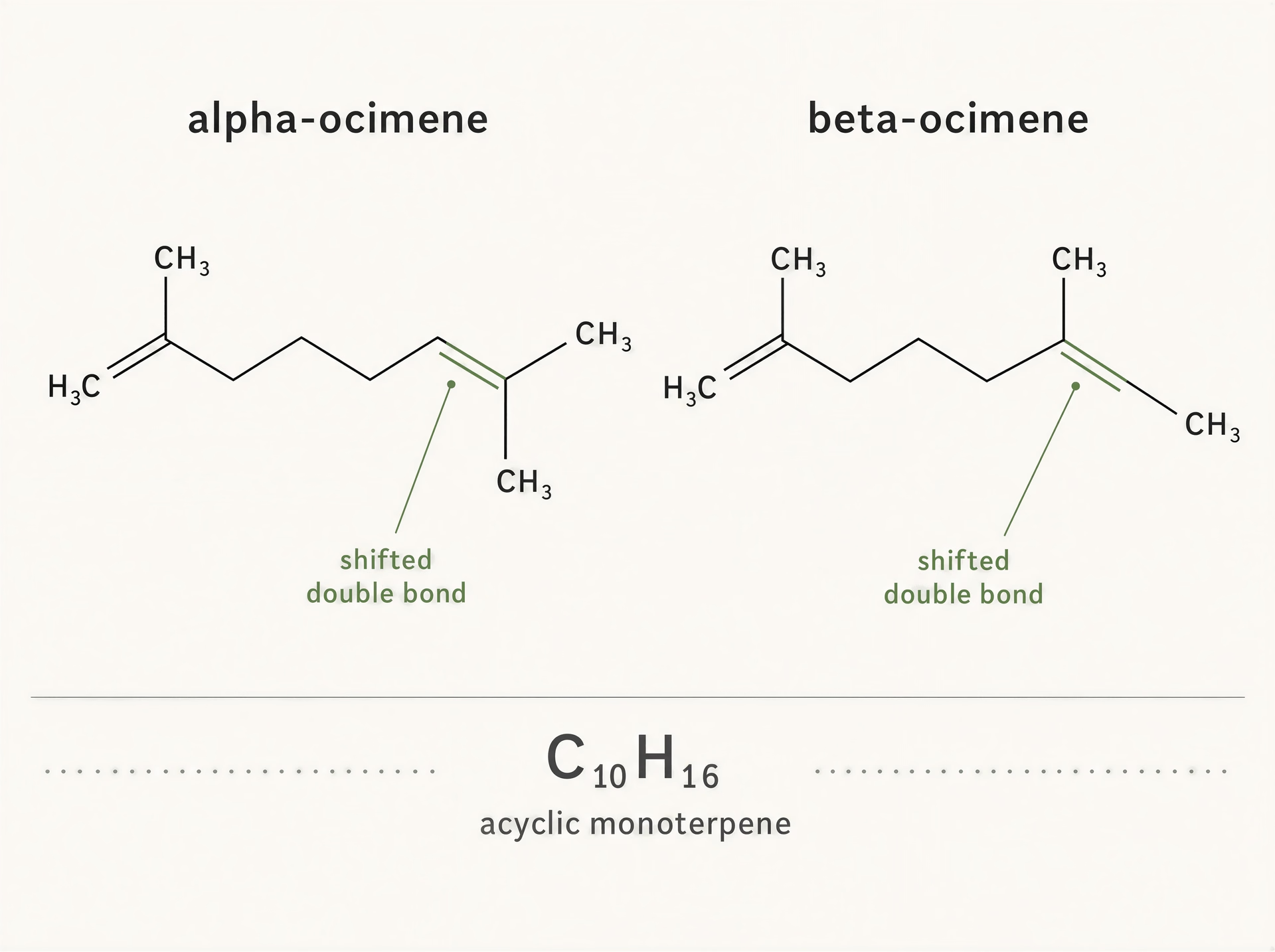
Alpha-ocimene versus beta-ocimene geometry
The difference between alpha-ocimene and beta-ocimene begins with where one of the double bonds sits along the carbon chain. They are constitutional isomers: same formula, different placement of unsaturation. In plain language, the carbon backbone is still ten carbons long, but one of the “locked” carbon-carbon links is shifted to a different position.
That shift changes the molecule’s preferred shape and how it interacts with odor receptors. It also changes how chemists describe it formally. Alpha-ocimene and beta-ocimene are not merely two names for the same substance. They are distinct members of the ocimene family.
In fragrance writing, alpha-ocimene is often associated with a sweet, green, herbaceous profile, sometimes with light woody or floral facets. Beta-ocimene, depending on isomeric form, is often described as green, sweet, floral, herbaceous, and citrus-adjacent. “Citrus-adjacent” is the right way to put it for many cannabis samples: not as direct or peel-like as limonene, not as aldehydic as citral, but still bright and uplifting on the nose.
That is why flattening all ocimene into one generic descriptor misses the point. A flower with alpha-ocimene prominence may smell slightly different from one where trans-beta-ocimene dominates, even if both are reported simply as “ocimene” on a certificate of analysis.
Why cis/trans changes matter
- Locked geometry A double bond limits rotation and fixes substituents into different spatial arrangements.
- Shape shift One form is more kinked and the other more extended.
- Odor response Odor receptors can respond differently to those shapes.
- Relative stability Trans forms are often less sterically strained than cis forms, though both remain storage-fragile monoterpenes.

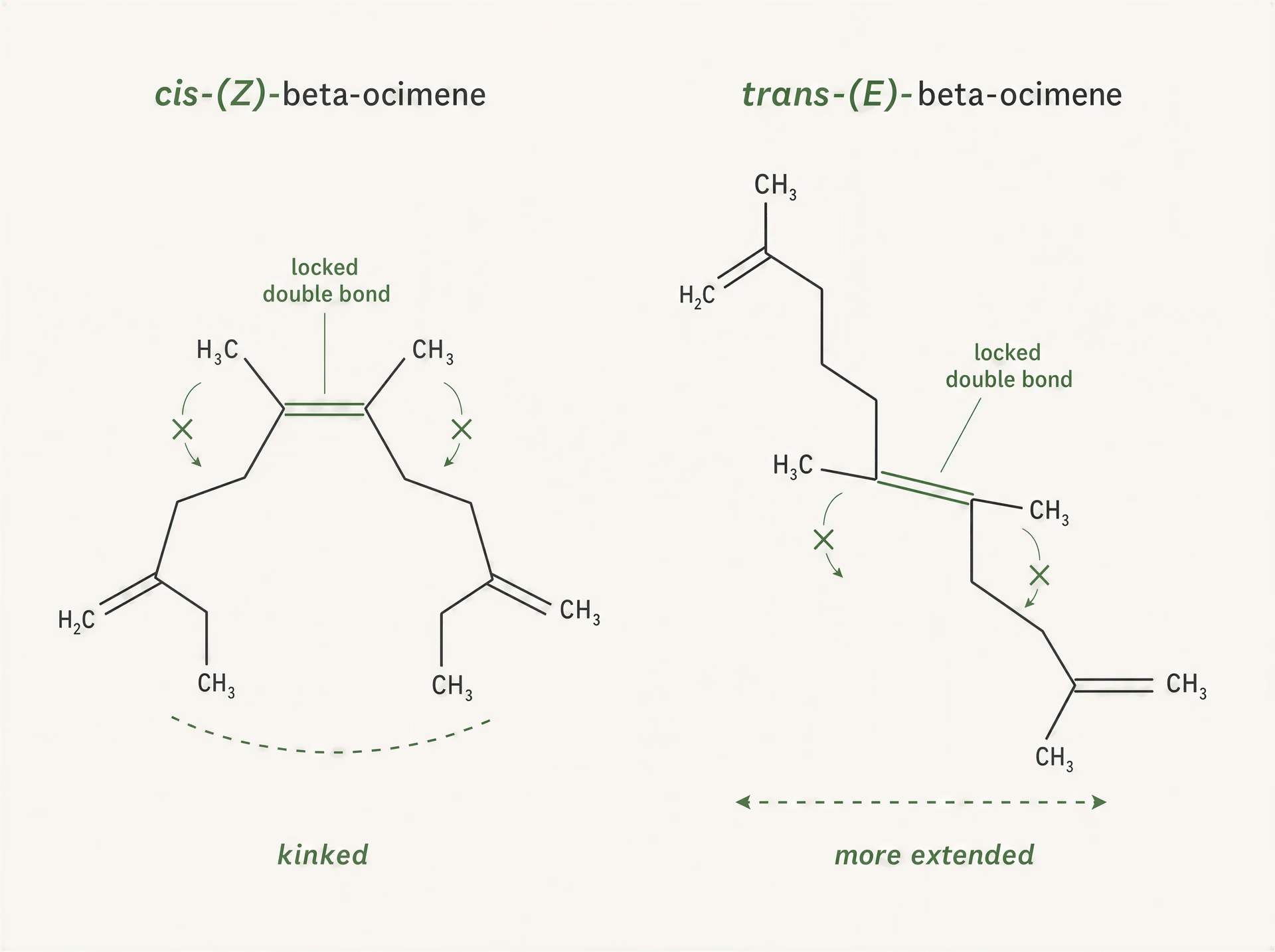
How cis and trans isomerism changes odor and stability
Geometric isomerism Isomerism caused by different spatial arrangement around a double bond, commonly described as cis/trans or Z/E.
Once you move from alpha-ocimene to beta-ocimene, another layer appears: geometric isomerism. Beta-ocimene occurs mainly as cis-(Z)-beta-ocimene and trans-(E)-beta-ocimene. “Cis” and “trans” describe how groups are arranged around a double bond, which cannot freely rotate. If the key substituents sit on the same side, chemists call that cis or Z. If they sit on opposite sides, that is trans or E.
Plain-language version: imagine a bend in the molecule that can be locked in two different poses. One is more kinked. One is more extended. Odor receptors can tell the difference.
They often do. Across flavor and fragrance literature, cis-beta-ocimene is commonly described as softer, sweeter, greener, and more floral-herbal. Trans-beta-ocimene is often described as sharper, fresher, more diffusive, sometimes woodier, and more clearly citrus-adjacent. These are tendencies, not universal laws, because odor perception depends on concentration and mixture context. Still, the distinction is real enough that perfumery and analytical chemistry do not treat the two as interchangeable.
Stability differs too. As a general rule, trans isomers are often thermodynamically more stable than cis isomers because they place bulky groups farther apart, reducing steric strain. That does not make trans-beta-ocimene “stable” in an everyday storage sense. Ocimenes are still unsaturated monoterpenes with multiple double bonds, which makes them oxidation-prone and relatively fragile under heat, oxygen exposure, and light. But among geometric variants, the trans form can be less strained.
For cannabis, the practical consequence is straightforward: the sweet-green lift associated with ocimene is often one of the first aromatic elements to fade in old or poorly stored flower. Ross and ElSohly documented terpene variation and losses in cannabis analytical work as far back as 1996, and later stability literature has only reinforced the same point. Open the jar repeatedly, leave large headspace, add warmth and light, and the bright top notes disappear first. Ocimene is a chemistry problem before it is a branding problem.
| Common COA label | What it may actually mean | Main limitation |
|---|---|---|
| Ocimene | Merged family value | No isomer breakdown |
| Beta-ocimene | Broad beta assignment | May hide cis/trans ratio |
| cis-ocimene and trans-ocimene | Geometric split reported | Alpha-ocimene may still be absent |
| Alpha-, cis-beta-, and trans-beta-ocimene | Fuller resolution | Still depends on method quality and standards |
Analytical chemistry: how labs report ocimene on cannabis COAs
Cannabis certificates of analysis often create more certainty than they deserve. One common example is the line item “ocimene” with a single percentage and no isomer breakdown. That may be enough for broad terpene profiling, but it is not enough if you actually care about whether alpha-ocimene, cis-beta-ocimene, or trans-beta-ocimene is driving the aroma.
Gas chromatography An analytical method that separates volatile compounds so they can be measured and identified, often used for terpene panels.
Most terpene panels use gas chromatography, usually GC-FID or GC-MS. In principle, these methods can separate isomers if the method is optimized well enough and the reference standards are in place. In practice, many commercial panels are designed for speed, consistency, and limited target lists. Labs may report a merged “ocimene” peak, identify only “beta-ocimene,” or list “cis-ocimene” and “trans-ocimene” without alpha-ocimene. Some methods can resolve all three. Many do not.
That inconsistency matters because strain names are not chemically dependable. Hazekamp and Fischedick argued for chemovar thinking over folk naming back in 2012. Elzinga and colleagues (2015) showed terpene variation across cannabis samples. Then the large 2021 commercial datasets made the point even harder to ignore. Jin, Jin, Yadav, Zamir-Piela and colleagues analyzed 89,923 commercial cannabis samples across six U.S. states in PLOS ONE and found recurrent terpene clusters dominated by compounds such as myrcene, beta-caryophyllene, and limonene, with ocimene generally less abundant. Vergara and colleagues analyzed 81,428 samples in another PLOS ONE paper and showed that market names did not map reliably onto chemical composition. If a sample is said to be from Strawberry Cough, Clementine, Golden Goat, Dutch Treat, or Space Queen, that may hint at an ocimene-forward profile, but it does not prove it.
So how should a careful reader interpret a COA? First, treat “ocimene” as a family label, not always a single-molecule measurement. Second, check whether the lab distinguishes alpha, cis-beta, and trans-beta. Third, pay attention to freshness and storage date, not just terpene percentage. A flower can test with measurable ocimene and still smell flatter months later if volatile top notes have dissipated. Fourth, remember that low percentage does not mean low sensory impact. A modest amount of ocimene can still push a profile toward sweet, green, herbaceous, lightly woody brightness.
That is the real chemistry lesson here. Ocimene is not a magic effect terpene. It is a family of structurally related, aroma-active, oxidation-sensitive monoterpenes whose details are often blurred by routine cannabis testing. If the isomers are collapsed into one line on a report, practical precision is lost.
| Isomer/form | Typical descriptors in the article |
|---|---|
| Alpha-ocimene | Sweet, green, floral, tropical, lightly herbaceous |
| cis-(Z)-beta-ocimene | Softer, herbaceous, green, fresh, leafy, sweet herbal |
| trans-(E)-beta-ocimene | Sharper, brighter, woody, sweet, herbaceous, citrus-adjacent |
Aroma profiles by isomer and why sensory language gets messy
Ocimene is often talked about as if it were a single smell. It is not. In practical terpene chemistry, “ocimene” usually means a small family of closely related acyclic monoterpenes: alpha-ocimene plus the geometric isomers of beta-ocimene, usually written as cis-(Z)-beta-ocimene and trans-(E)-beta-ocimene. That distinction matters because odor language in the fragrance and analytical literature shifts by isomer, purity, concentration, and context. A sample that reads as sweet and floral in one setting may come across as green, herbaceous, woody, or faintly citrus-like in another.
That is not sloppy science. It is how smell works. Volatile compounds do not announce themselves in isolation the way a line on a chromatogram does. They arrive as mixtures, in changing concentrations, against backgrounds shaped by other terpenes, esters, sulfur compounds, and oxidation products. In cannabis especially, ocimene usually appears at lower levels than myrcene, limonene, or beta-caryophyllene in broad market datasets, yet it can still shape the nose because monoterpenes are highly volatile and often odor-active at low concentrations (Hazekamp & Fischedick, 2012; Elzinga et al., 2015; Jin et al., 2021).
Alpha-ocimene: sweet-green and floral tendencies
Alpha-ocimene is commonly described with sweet, green, and floral language. Depending on source, you will also see tropical, fruity, or lightly herbaceous descriptors. Those terms are pointing at the same general sensory zone: bright top notes with a fresh plant-like lift rather than a dense resinous body.[3] Floral volatile organic compounds: between attraction and deterrence. G. Farré-Armengol, I. Filella, J. Llusià, J. Peñuelas. Trends in Plant Science, 2013.
The floral part makes biological sense. Beta-ocimene gets more attention in floral ecology, but ocimene-type volatiles more broadly are part of the scent vocabulary plants use for pollinator signaling and stress responses. Farré-Armengol et al. reviewed floral volatile organic compounds in 2013 and identified beta-ocimene as one of the most widespread floral scent compounds across angiosperms. That widespread floral association helps explain why alpha-ocimene is so often described in sweet-flower terms even when the exact isomer distribution in a plant sample is not fully broken out.
In cannabis, alpha-ocimene rarely defines the whole aroma by itself. More often it acts like a high, quick-opening note layered over heavier terpenes. If myrcene supplies musky fruit and beta-caryophyllene supplies pepper or dry spice, alpha-ocimene can add the “freshly opened” impression: sweet-green, lightly perfumed, almost airy. That kind of note is easy to lose with poor storage, which is one reason old flower can smell flatter even when total terpene numbers still look respectable on paper.
Beta-cis-ocimene: softer herbaceous and fresh notes
Cis-(Z)-beta-ocimene is often described more softly than the trans form. “Herbaceous,” “green,” “fresh,” and sometimes “leafy” or “sweet herbal” are typical descriptions. If alpha-ocimene leans toward floral sweetness, beta-cis-ocimene is often placed closer to fresh-cut stems, soft herbs, and damp green plant material.
That does not mean harsh or grassy in a negative sense. At low levels, these notes can read as clean and lively. In complex cannabis aroma, beta-cis-ocimene may be part of what people loosely call “sweet herbal” or “fresh garden” character. The problem is that these consumer phrases are broad and unstable. A sweet-herbal impression could reflect ocimene plus terpinolene, or ocimene plus pinene, or even a small amount of green-leafy aldehydes in processed material.
Plant volatile research helps frame why this isomer gets linked with freshness and signaling. Fäldt, Martin, Miller, Rawat, and Bohlmann (2003) described (E)-beta-ocimene among common herbivore-induced plant volatiles, and Arimura, Kost, and Boland (2005) summarized such volatiles as airborne defense signals. Those papers were not cannabis aroma studies, but they show where ocimenes sit in nature: mobile, high-volatility compounds that broadcast plant status into the air. “Fresh” is not just a perfume term here. It reflects the ecological role of a terpene family designed to travel.
Beta-trans-ocimene: brighter woody-citrus-adjacent character
Trans-(E)-beta-ocimene is usually described as the sharper, brighter isomer. Literature references often place it in a spectrum that includes sweet, herbaceous, woody, and citrus-adjacent notes. “Citrus-adjacent” is the right phrase because this is not limonene’s clean orange-peel profile. It is more like a green citrus lift, sometimes with a dry woody edge and sometimes with tropical or floral overtones depending on concentration and what else is present.
That apparent contradiction is normal. A bright woody note and a sweet tropical note can both come from the same isomer under different conditions. Concentration changes perception. So does matrix. In a perfume blotter, a purified standard may smell one way. In cannabis flower, mixed with myrcene, limonene, terpinolene, pinene, sulfur volatiles, and minor oxidation products, the same compound may read differently.
This is one reason online terpene charts are often misleading. They flatten beta-trans-ocimene into a single label when the lived sensory result is conditional. In fresh flower it may register as sparkling and sweet-green with a citrus edge. In aged material, after oxidation and volatilization have stripped away some of the lighter fraction, that sparkle can collapse, leaving less of the bright top note that made the sample distinctive in the first place.
Cannabis aroma reflects mixtures of many volatile compounds rather than one terpene acting alone. Strong evidence
Why cultivar aroma reflects mixtures, not single compounds
Cannabis aroma is mixture chemistry, not terpene mythology. Even when a cultivar is associated with ocimene-rich profiles, the smell is still being built by a stack of compounds in changing ratios. That is why sensory language gets messy and why it should get messy. “Sweet,” “herbaceous,” “woody,” “tropical,” and “citrus-adjacent” are not mutually exclusive camps. They are different ways observers describe overlapping impressions from volatile mixtures.
Large cannabis datasets support this view. Jin et al. analyzed 89,923 commercial cannabis samples across six U.S. states in 2021 and found recurrent terpene clusters dominated far more often by myrcene, beta-caryophyllene, and limonene than by ocimene. Vergara et al. analyzed 81,428 samples in 2021 and showed that strain names were inconsistent predictors of chemistry. Those findings matter. A name like Strawberry Cough, Clementine, Golden Goat, Dutch Treat, or Space Queen may be associated with ocimene-forward profiles in recurring lab reports, but the name alone cannot tell you whether a given sample’s bright top note comes from alpha-ocimene, one of the beta-ocimenes, terpinolene, a limonene-pinene mix, or some combination of all three.
Russo’s 2011 review on cannabis pharmacology discussed more than 200 terpenes and terpenoids in cannabis and framed the entourage hypothesis, but aroma is the simpler and better-supported point here: compounds interact perceptually long before anyone proves they interact pharmacologically. Ocimene usually behaves as an accent terpene in cannabis, not the whole performance. It can make a profile feel sweeter, greener, more floral, or more sparkling. Then it disappears fast if storage is poor.
So when sensory references disagree, they are often describing different truths at once. The better reading is not that ocimene has one fixed smell, but that its isomers push cannabis aroma toward a bright, volatile sweet-herbal-floral-woody register whose exact expression depends on ratio, freshness, and the rest of the bouquet.
Ocimene in plant biology: defense, distress signaling, and pollinator communication
Ocimene makes more sense when treated as plant language rather than as a promised human effect. That framing matters. In practical terpene chemistry, “ocimene” is a small family of acyclic monoterpene isomers, mainly alpha-ocimene plus the cis- and trans- forms of beta-ocimene, and plants do not release them at random. Across the plant-science literature, ocimenes appear again and again as volatile organic compounds involved in defense, stress signaling, and floral communication. That is the strongest biological case for why this terpene exists in cannabis at all.

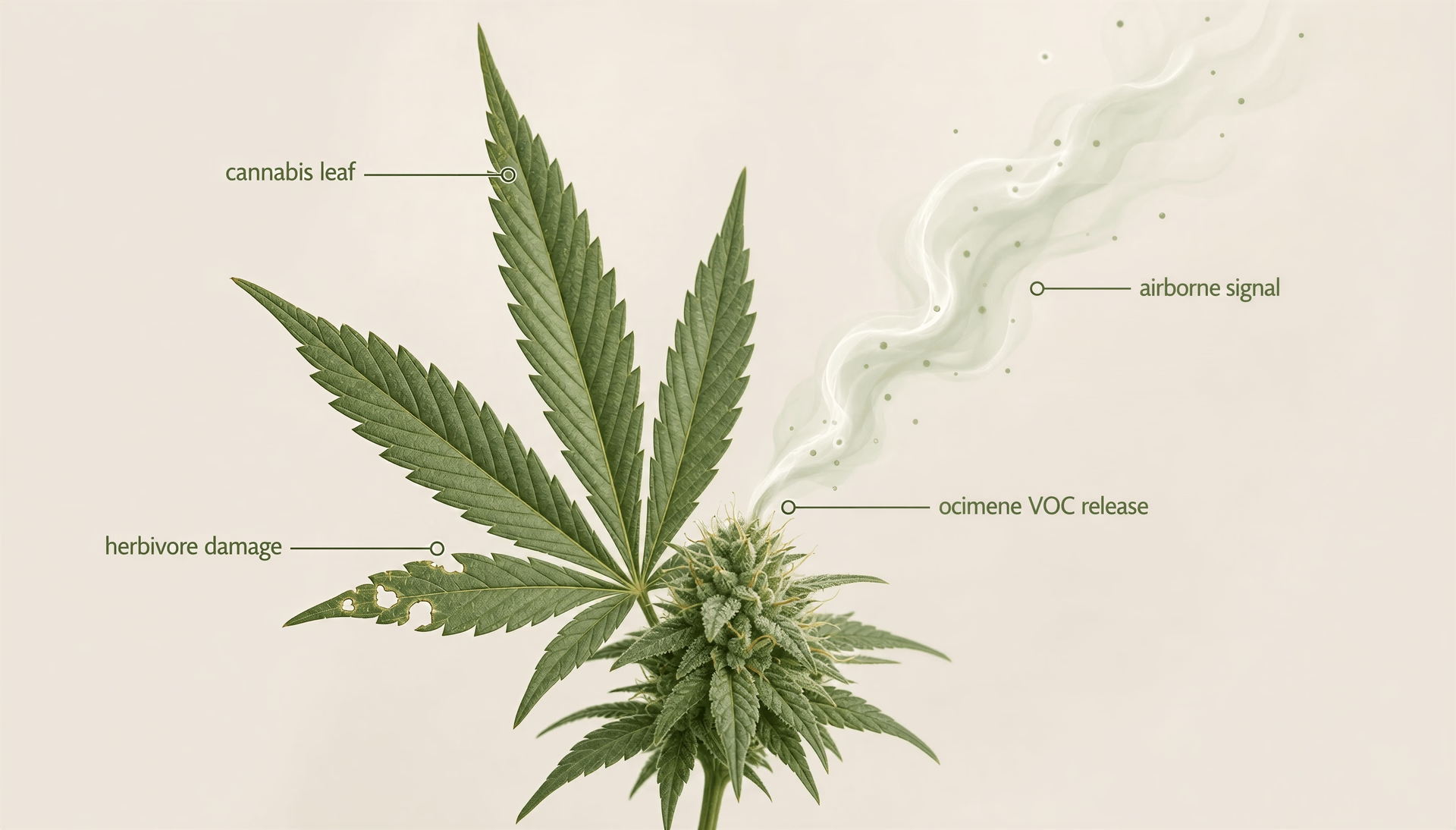
Ocimene as a volatile organic compound in plant defense
Volatile organic compound (VOC) A carbon-based compound that evaporates readily into air and can function in aroma or biological signaling.
Plants cannot run from insects, mechanical injury, drought, or infection. They respond chemically. One major part of that response is the release of volatile organic compounds, or VOCs, into the air around leaves, stems, and flowers. Ocimene belongs squarely in that category.
A widely cited review by Fäldt, Martin, Miller, Rawat, and Bohlmann in Phytochemistry (2003) described (E)-beta-ocimene as one of the recurring herbivore-induced plant volatiles seen in conifers and many other species. That point is easy to miss in cannabis writing, where terpenes are often discussed as if their job were to shape aroma for people. From the plant’s perspective, scent is often a broadcast signal. It can mark tissue damage, advertise that herbivores are present, or alter the behavior of nearby organisms.
Arimura, Kost, and Boland in Trends in Plant Science (2005) pushed this idea further by framing herbivore-induced volatiles as airborne defense signals. Ocimene was among the recurring examples in that literature. The basic concept is not controversial: a damaged plant releases a characteristic plume of volatiles, and that plume has ecological effects. Some compounds can act directly against attackers or pathogens. Others act indirectly, by changing how insects, predators, parasites, or neighboring plants behave.
That distinction matters. Direct defense means the emitted chemical itself harms or deters the threat. Indirect defense means the chemical recruits help, warns nearby tissues, or primes future responses. Ocimene has been discussed in both contexts, but the literature is stronger on signaling than on claims that ocimene alone is a stand-alone biocide in living plants.
This is where internet summaries often drift. Yes, ocimene appears in preclinical antimicrobial, antifungal, and even antiviral screening contexts. But that does not mean the plant is producing ocimene for human respiratory relief or as a broad-spectrum medicine. The better-supported interpretation is ecological. Plants emit ocimene because volatile monoterpenes are useful in interactions with insects, microbes, and neighboring plants.
Its chemistry fits that role. Ocimene is highly volatile and odor-active. It moves through air quickly, contributes bright sweet-green and herbaceous notes, and because it is unsaturated, it is also chemically reactive. Those are properties of a signal compound. They are not the profile of something built for long-term stability.
What indirect defense can include
- Predator recruitment Volatiles can help predators or parasitoids locate herbivores feeding on a plant.
- Within-plant warning Airborne signals may prime undamaged tissues for future attack.
- Neighbor signaling Nearby plants may alter defenses after exposure to the emitted blend.
- Blend dependence Ocimene usually acts as one component of a larger volatile plume rather than alone.
Herbivore-induced emissions and indirect defense
Indirect defense is one of the most interesting parts of ocimene biology. When herbivores feed on a plant, the plant’s emitted volatiles can attract predators or parasitoids of those herbivores. The plant is, in effect, sending a distress signal. It does not need to kill the attacker itself if it can make the attacker easier for an enemy to find.
That broader phenomenon is well established across plant systems, and ocimene is repeatedly listed among the compounds involved. Fäldt et al. (2003) placed ocimene among common induced monoterpenes in conifer defense emissions. Arimura et al. (2005) reviewed airborne signaling and emphasized that herbivore-induced volatiles can mediate tritrophic interactions: plant, herbivore, and the herbivore’s predator or parasitoid. Beta-ocimene is one of the classic names that shows up in those profiles.
This does not mean ocimene acts alone. Real plant odor plumes are blends. Green leaf volatiles, terpenes such as linalool or myrcene, sesquiterpenes, and stress-related compounds can all be released together. Even so, the repeated appearance of beta-ocimene across unrelated taxa suggests it is part of a common ecological vocabulary.
There is another layer. VOCs can also prime defenses in undamaged parts of the same plant or in nearby plants. A plant exposed to the right airborne cues may increase readiness for future attack. The literature on priming is larger than ocimene specifically, but ocimene belongs to the class of compounds implicated in those warning systems. Again, the point is not mystical. It is biochemical communication under selection pressure.
For cannabis, this changes the interpretive center of gravity. If ocimene shows up in a flower sample, the most defensible statement is not “this terpene is here to produce a specific psychoactive tone.” It is that cannabis, like many aromatic plants, makes volatile monoterpenes that likely serve ecological signaling and defense functions first. Human experience comes later.
Floral signaling and pollinator attraction
Ocimene is not only a distress signal. It is also a floral one. Farré-Armengol, Filella, Llusià, Peñuelas, and colleagues in Trends in Plant Science (2013) reviewed floral VOCs and identified beta-ocimene as one of the most widespread floral scent compounds in angiosperms. That is a big clue to its biological importance.
Flowers need to be found. They need to advertise reward, identity, timing, and sometimes species boundaries. Volatile scent is one of the main ways they do that, especially when visual cues are weak or pollinators are active under low light. Beta-ocimene is common in floral bouquets because it is both diffusive and conspicuous. It reads as fresh, sweet, green, herbaceous, and citrus-adjacent depending on isomer ratio and context, which makes it well suited to a top-note role in scent blends.
Its prevalence in flowers does not imply a single universal pollinator effect. Different pollinators respond to different blends, ratios, and temporal release patterns. Still, beta-ocimene appears so often in floral biology that it is fair to treat it as one of the general-purpose signal terpenes of flowering plants.
That helps explain why ocimene can have an outsized sensory impact even when present at modest concentration. Monoterpenes often have low odor thresholds. A little can matter. In cannabis, that is especially relevant because ocimene is usually not one of the dominant terpenes by mass. Large cannabis chemistry datasets show that myrcene, limonene, and beta-caryophyllene are more common leading players. Jin et al. analyzed 89,923 commercial U.S. samples in PLOS ONE (2021) and found recurrent terpene clustering around those more abundant compounds, with ocimene less frequent and generally lower in abundance. Yet lower abundance does not mean sensory irrelevance.
What this likely means for cannabis resin chemistry
The practical implication is that ocimene in cannabis is better understood as an ecological and aromatic marker than as a guaranteed effect driver. Cannabis produces a very large terpene and terpenoid repertoire; Russo’s review in the British Journal of Pharmacology (2011) discussed more than 200 terpenes and terpenoids in the plant. Those compounds likely evolved under pressures involving defense, attraction, stress tolerance, and development, not around modern consumer categories.
That does not rule out pharmacology. Terpenes can interact with perception, and Russo (2011) argued that cannabinoid-terpenoid interactions are worth studying. But the evidence for ocimene specifically is much thinner than the effect-heavy language often attached to it. The strongest science around ocimene is still plant science.
Cannabis chemistry data support caution with simplistic narratives. Chemovar thinking, as discussed by Hazekamp and Fischedick (2012), is more useful than relying on names. Elzinga et al. (2015) documented chemotaxonomic variation, and Vergara et al. analyzed 81,428 samples in PLOS ONE (2021), showing that commercial strain names map inconsistently onto chemistry. So even if certain named cultivars are repeatedly associated with ocimene-rich profiles, the terpene’s presence should be verified analytically, not assumed from branding.
One more point follows from ocimene’s plant role and chemistry: it disappears easily. Because it is volatile and oxidation-prone, fresh handling matters. A bright sweet-herbal top note is often the first part of the profile to fade under heat, oxygen, light, and repeated opening. So if ocimene is present in cannabis resin, that fact reflects not only genetics and cultivation but also post-harvest preservation.
That is the sober reading of the evidence. Ocimene is real, biologically meaningful, and aroma-active. Its main story in cannabis begins with plant defense and communication, not with inflated promises about what it will do in humans.
References
Arimura, G., Kost, C., & Boland, W. (2005). Herbivore-induced, indirect plant defences. Trends in Plant Science, 10(11), 529–534.
Fäldt, J., Martin, D., Miller, B., Rawat, S., & Bohlmann, J. (2003). Traumatic resin defense in Norway spruce and stem bark chemistry of conifer defense: herbivore-induced volatile monoterpene emissions including ocimene. Phytochemistry, 64(2), 305–315.
Farré-Armengol, G., Filella, I., Llusià, J., & Peñuelas, J. (2013). Floral volatile organic compounds: between attraction and deterrence. Trends in Plant Science, 18(6), 305–311.
Hazekamp, A., & Fischedick, J. T. (2012). Cannabis — from cultivar to chemovar. Drug Testing and Analysis, 4(7–8), 660–667.
Elzinga, S., Fischedick, J., Podkolinski, R., & Raber, J. C. (2015). Cannabinoids and terpenes as chemotaxonomic markers in cannabis. Natural Products Chemistry & Research, 3, 181.
Jin, D., Jin, S., Yadav, N. S., Zamir-Piela, C., et al. (2021). Chemotypic diversity in commercially available cannabis flower. PLOS ONE, 16(3), e0246878.
Russo, E. B. (2011). Taming THC: potential cannabis synergy and phytocannabinoid-terpenoid entourage effects. British Journal of Pharmacology, 163(7), 1344–1364.
Vergara, D., Bidwell, L. C., Gaudino, R., Torres, A., et al. (2021). Compromised external validity: federally produced cannabis does not reflect legal markets. Commercial chemistry datasets also show inconsistent name-to-chemistry relationships across 81,428 samples. PLOS ONE, 16(1), e0243567.
What the pharmacology actually shows: antifungal, antiviral, and respiratory evidence
Ocimene gets talked about online as if it were a settled “effect terpene.” The literature does not support that framing. What it does support is narrower and more interesting: ocimene is a real plant volatile with a documented role in defense signaling, and it does appear in antimicrobial, antiviral-screening, and respiratory pharmacology papers. But the strength of that evidence depends heavily on what was actually tested. In many cases, researchers studied whole essential oils rich in multiple monoterpenes rather than isolated alpha-ocimene, cis-beta-ocimene, or trans-beta-ocimene. That distinction matters.
It also matters that ocimene in practical chemistry is not a single compound. Alpha-ocimene and the beta-ocimene geometric isomers differ in structure and odor, and they may not behave identically in bioassays. Most papers do not give the level of isomer-specific detail that consumer-facing claims imply. So the honest position is this: there are preclinical signals worth reporting, especially in antifungal and antiviral screening contexts, but there is no clinical basis to present ocimene-rich cannabis as an antiviral treatment, an antifungal medicine, or a bronchodilator.
Antifungal findings from essential-oil and monoterpene studies
The antifungal side of the literature is stronger than the respiratory side, though still far from a human-use claim. Ocimene repeatedly appears in the broader antimicrobial and plant-defense literature because plants emit it as part of volatile defense responses. Fäldt, Martin, Miller, Rawat, and Bohlmann reviewed herbivore-induced volatiles in Phytochemistry in 2003 and identified beta-ocimene among recurrent emitted monoterpenes involved in indirect defense signaling. Arimura, Kost, and Boland in Trends in Plant Science (2005) described these herbivore-induced volatiles as airborne defense signals. Farré-Armengol and colleagues in Trends in Plant Science (2013) noted beta-ocimene as one of the most widespread floral volatile compounds. None of those papers claim that ocimene is a human antifungal drug. They do establish why it keeps showing up in defense-related biochemistry.
When researchers test antimicrobial activity directly, the results often come from essential oils containing ocimene alongside limonene, pinene, terpinene, linalool, citral, or other terpenes. Those mixtures may inhibit fungal growth in vitro against organisms such as Candida species or plant pathogens. The problem is attribution. If an ocimene-containing oil suppresses fungal growth on a plate, that does not prove ocimene was the active driver. It may have contributed. It may have been irrelevant. It may have changed membrane permeability and enhanced the action of other components. Many papers simply cannot disentangle those possibilities.
That limitation is not trivial. Essential oils often show antifungal activity because they are chemically dense mixtures of lipophilic compounds that disrupt fungal membranes, alter ergosterol-related function, increase leakage of intracellular contents, or interfere with spore germination. Monoterpenes as a class are plausible antifungal agents in vitro for those reasons. Ocimene belongs in that class. But class plausibility is not proof of clinically meaningful activity from cannabis flower that happens to contain a small amount of ocimene.
This is where cannabis chemistry has to be kept in view. In most modern cannabis samples, ocimene is a minor terpene compared with myrcene, limonene, or beta-caryophyllene. Hazekamp and Fischedick’s 2012 review on cannabis from cultivar to chemovar pushed the field toward chemistry-first thinking, and larger datasets later reinforced the point. Jin, Jin, Yadav, Zamir-Piela, and colleagues analyzed 89,923 commercial cannabis samples in PLOS ONE (2021) and found recurrent terpene clusters dominated by myrcene, beta-caryophyllene, and limonene, with ocimene generally less frequent and less abundant. So even if isolated ocimene showed interesting antifungal action in a dish, that would still not justify assuming comparable activity from inhaled or otherwise consumed cannabis material where ocimene may be present at much lower levels.
The defensible takeaway is narrower: antifungal activity has been reported in essential-oil and monoterpene literature that includes ocimene, and the compound makes biological sense as part of a plant defense toolkit. What we do not have is strong, isomer-specific, clinically translated evidence showing that ocimene-rich cannabis prevents or treats fungal infections in people.
Ocimene has proven antiviral efficacy in humans. Limited evidence
Antiviral screening, including dengue and Zika contexts
The antiviral evidence needs even stricter wording because this is where internet summaries drift fastest from the source material. Ocimene does appear in preclinical antiviral screening contexts, including literature related to flaviviruses such as dengue and Zika. But the phrase “appears in” is doing important work. In many cases, the tested material is again a whole essential oil, not isolated ocimene. In other cases, papers blend together three different ideas that should be separated: direct inhibition of viral replication, general cytotoxicity to infected cells, and mosquito-related effects that may change transmission risk without acting on the virus itself.
Dengue and Zika are useful examples because essential-oil research around these diseases often includes both antiviral and vector-focused studies. A terpene or oil may be discussed in a dengue or Zika paper because it repels Aedes aegypti, affects mosquito behavior, or alters vector survival. That is not the same thing as directly blocking viral entry, replication, assembly, or release in mammalian cells. Yet those categories get blurred constantly in low-quality summaries.
The direct antiviral literature is still preclinical. Some reviews of essential-oil constituents active against dengue or Zika mention monoterpenes such as limonene, alpha-pinene, citral, and at times ocimene depending on the oil composition being discussed. Even there, the isolated evidence for ocimene is thinner than the reputation suggests. A whole oil may reduce viral infectivity in vitro. A fraction enriched in certain monoterpenes may show activity at a given concentration. A docking paper may predict favorable binding to a viral target. None of those outcomes mean ocimene has demonstrated antiviral efficacy in humans.
That distinction matters even more once formulation and exposure are considered. Viruses in cell culture are exposed to defined concentrations under controlled conditions. Human use is not like that. Cannabis chemovars associated with ocimene do not deliver purified, stable ocimene at known antiviral concentrations to infected tissues. And because ocimene is both volatile and oxidation-prone, the amount present by the time a sample is opened and used may be lower than the certificate originally showed.
Editorially, the right position is conservative. Ocimene has been reported in preclinical antiviral screening contexts involving dengue- and Zika-relevant research, mostly through essential-oil or terpene-mixture studies. That is real literature. It is also a long way from a therapeutic claim. No human clinical trial establishes ocimene as an antiviral treatment. No clinical evidence supports promoting ocimene-rich cannabis for dengue, Zika, colds, influenza, or any other viral illness.
Decongestant and bronchodilator signals from animal data
Respiratory claims around terpenes often start with a grain of truth and end with a sales pitch. The grain of truth here is that older pharmacology and animal literature on aromatic plant constituents includes decongestant, spasmolytic, and bronchodilator-like observations. Some monoterpenes can relax smooth muscle in preclinical models. Some fragrant volatile mixtures can change airway responses in animals. Some herbal medicine traditions have long linked aromatic terpenes with easier breathing or a sensation of opening the airways.
What is missing is solid ocimene-specific human evidence.
The available respiratory literature is usually one of three things: broad essential-oil pharmacology, monoterpene class effects that do not isolate ocimene, or older animal work that is suggestive but not clinically decisive. “Bronchodilator-like” in an animal preparation does not equal bronchodilator efficacy in a person with asthma, COPD, or an acute respiratory infection. Nor does a subjective cooling or clearing aroma equal decongestion in the pharmacological sense.
That is especially important in cannabis, where inhalation itself complicates the picture. Even if a volatile terpene had airway-smoothing properties in isolation, that would not automatically make inhaled cannabis a respiratory aid. Combustion products and airway irritation are obvious confounders, and even non-combustion routes do not convert a sparse preclinical signal into a medical effect claim.
Russo’s 2011 review in the British Journal of Pharmacology is often cited in discussions of cannabis terpenoids and potential entourage interactions. It remains useful as a framework paper, but it is a hypothesis-generating review, not proof that ocimene-rich cannabis acts as a bronchodilator in clinical settings. The same caution applies to fragrance and herbal literature that associates sweet-herbal monoterpenes with respiratory relief. The sensation may be real. The leap to efficacy is not justified.
So yes, there are animal and preclinical respiratory signals in the monoterpene literature. They warrant mention. They do not warrant marketing language. At present, there is no clinical basis to present ocimene-rich cannabis as a decongestant or bronchodilator.
In vitro Tested outside a living organism, usually in cells, plates, or other lab systems rather than in people.
| Reason preclinical signals may not translate | How the article applies it to ocimene |
|---|---|
| Concentration mismatch | Cell-study levels may not be reached in human use |
| Mixture attribution | Whole essential-oil activity does not prove isolated ocimene was responsible |
| Isomer ambiguity | Papers may not separate alpha- from beta-ocimene forms |
| Stability loss | Fresh standards and stored cannabis material may not contain the same chemistry |
The in-vitro trap: why preclinical activity is not a human effect claim
This is the section most terpene articles skip. A compound can look impressive in vitro and still fail as a human intervention for basic reasons of dose, delivery, metabolism, stability, and tissue exposure. Ocimene checks every box for caution.
First, concentration. Cell studies may use terpene or essential-oil concentrations that are difficult or impossible to reproduce in vivo without irritation or toxicity. Second, mixture effects. A paper may report antiviral or antifungal activity for an oil containing ten or twenty relevant constituents. Pulling out one terpene from that result is guesswork unless the study actually tested it separately. Third, isomer ambiguity. “Ocimene” in a paper may not specify alpha-ocimene versus cis- or trans-beta-ocimene, even though those are distinct molecules. Fourth, stability. Ocimene is unsaturated and oxidation-sensitive. What is active in a fresh lab standard may not be what persists in stored plant material.
Cannabis data add another layer. Large datasets show why strain-name storytelling is unreliable. Vergara and colleagues analyzed 81,428 cannabis samples in PLOS ONE (2021) and found weak consistency between commercial names and chemical profiles across markets. Jin et al. (2021) similarly showed that major terpene structure across nearly 90,000 samples clusters around a few recurring profiles, with ocimene less common and generally lower in abundance. So even when names such as Strawberry Cough, Clementine, Golden Goat, Dutch Treat, or Space Queen are associated with ocimene-forward profiles, that is not a guarantee. Chemistry has to be verified on a current certificate of analysis, and even then storage matters. A repeatedly opened container can lose bright monoterpenes fast.
That leads to the strongest practical conclusion in this whole pharmacology section: ocimene is more defensibly treated as an aroma-relevant, oxidation-sensitive marker of certain fresh sweet-herbal-citrus-adjacent cannabis profiles than as a proven “effect terpene.” The science supports interest. It does not support promises.
References
Arimura, G., Kost, C., & Boland, W. (2005). Herbivore-induced, indirect plant defences. Trends in Plant Science, 10(11), 529–535.
Fäldt, J., Martin, D., Miller, B., Rawat, S., & Bohlmann, J. (2003). Traumatic resin defense in Norway spruce and methyl jasmonate-induced terpene synthase genes. Phytochemistry, 64(2), 433–440.
Farré-Armengol, G., Filella, I., Llusia, J., & Peñuelas, J. (2013). Floral volatile organic compounds: between attraction and deterrence of visitors under global change. Trends in Plant Science, 18(6), 313–323.
Hazekamp, A., & Fischedick, J. T. (2012). Cannabis - from cultivar to chemovar. Drug Testing and Analysis, 4(7-8), 660–667.
Jin, D., Jin, S., Yadav, N. S., Zamir-Piela, C., et al. (2021). Chemical phenotype markers for different cannabis varieties based on metabolomics. PLOS ONE, 16(2), e0246878.
Russo, E. B. (2011). Taming THC: potential cannabis synergy and phytocannabinoid-terpenoid entourage effects. British Journal of Pharmacology, 163(7), 1344–1364.
Vergara, D., Bidwell, L. C., Gaudino, R., Torres, A., Du, G., Ruthenburg, T. C., deCesare, K., Land, D. P., Hutchison, K. E., & Kane, N. C. (2021). Compromised external validity: federally produced cannabis does not reflect legal markets. Chemistry-pattern analyses of commercial samples also show inconsistent name-to-chemistry relationships. PLOS ONE, 16(2), e0243567.
Ocimene in cannabis chemotypes: usually minor, sometimes decisive
Ocimene has a strange status in cannabis. It is easy to notice when it is there, yet it is usually not one of the numerically dominant terpenes on a lab report. That mismatch matters. In modern cannabis flower, ocimene often functions less like a bulk terpene such as myrcene and more like a high-impact top note: small in percentage, sometimes large in sensory consequence.
That framing fits the broader chemistry. “Ocimene” in practical terpene analysis usually covers a small family of acyclic monoterpene isomers, mainly alpha-ocimene and the beta-ocimene geometric isomers, cis and trans. Those isomers are not odor-identical, and analytical labs do not always separate or report them with equal precision. So even before talking about cultivar patterns, there is a basic chemical reason not to reduce ocimene to a single number with a single aroma.
How often ocimene appears in commercial cannabis datasets
The best large-scale evidence says ocimene is real, recurring, and usually secondary. It is not absent from cannabis, but it is rarely the terpene that defines the center of gravity of the market.
A major reference point is Jin et al. in PLOS ONE (2021), which analyzed 89,923 commercial cannabis samples from six U.S. states. Their clustering work found recurring terpene profiles centered mainly on myrcene, beta-caryophyllene, and limonene rather than ocimene. That does not mean ocimene is unimportant. It means that if you take a market-wide view, ocimene is much more often a supporting volatile than the lead compound (Jin et al. 2021).
Vergara et al., also in PLOS ONE (2021), looked at 81,428 commercial samples with terpene and cannabinoid data and reached another practical conclusion: strain names are inconsistent predictors of chemistry. That point is especially relevant for ocimene, because it tends to appear in pockets rather than across broad market categories. A named cultivar may develop a reputation for an ocimene-forward profile, yet the next batch under the same name can land somewhere else chemically (Vergara et al. 2021).
Older chemovar literature points in the same direction. Hazekamp and Fischedick (2012) argued for thinking in terms of measurable chemovars rather than inherited folklore around cultivar names. Elzinga et al. (2015) documented chemotaxonomic variation across cannabis samples and showed that terpene expression shifts meaningfully across genetics and growing conditions. Ocimene fits that pattern well: present often enough to matter, inconsistent enough that assumptions fail.
This is where internet simplifications go wrong. If a cultivar is popularly linked with Strawberry Cough, Clementine, Golden Goat, Dutch Treat, or Space Queen type aroma, ocimene may indeed be part of the explanation. But those associations are pattern-level observations from commercial testing and market naming habits, not fixed botanical truths. The chemistry report matters more than the label.
| Sense of 'dominant' | Where ocimene usually stands |
|---|---|
| By percentage | Usually below myrcene, limonene, and beta-caryophyllene in broad market datasets |
| By first aroma impression | Can still matter strongly because it is a volatile top note |
| By persistence during storage | Often fades earlier than heavier or less volatile terpene fractions |
Why myrcene, limonene, and beta-caryophyllene usually dominate
There are two different senses of “dominant” in terpene talk: dominant by percentage and dominant by smell. Ocimene usually loses the first contest.
Commercial cannabis datasets consistently show myrcene, limonene, and beta-caryophyllene among the most abundant terpenes in flower. That is not an accident of one paper. It reflects how common these compounds are across many modern chemovars and how readily they accumulate to measurable concentrations. Myrcene often builds substantial mass in resin. Limonene is common across citrus-leaning and mixed-fruit profiles. Beta-caryophyllene, though chemically a sesquiterpene rather than a monoterpene, is also widely recurrent and often abundant.
Ocimene, by contrast, is usually lower and more erratic. Part of that likely reflects biology. In plants generally, ocimenes behave as volatile signaling compounds associated with floral scent, stress signaling, pollinator communication, and indirect defense. Farré-Armengol et al. in Trends in Plant Science (2013) described beta-ocimene as one of the most widespread floral scent compounds in angiosperms. Fäldt et al. in Phytochemistry (2003) and Arimura, Kost, and Boland in Trends in Plant Science (2005) placed ocimene among recurrent herbivore-induced volatiles in plant defense signaling. In other words, ocimene has the ecological profile of a mobile signal. That is not the same thing as a resin-heavy terpene that predictably accumulates to high percentages in cured cannabis flower.
Its chemistry also works against persistence. Ocimene is an unsaturated monoterpene and relatively oxidation-prone. It can disappear or transform faster than sturdier terpene fractions during drying, storage, and repeated exposure to air. So even if a living plant expressed a noticeable ocimene note, the finished flower may show less.
When a low-percentage terpene still changes the experience of aroma
Low abundance does not mean low impact. This is the place where sensory reality diverges from percentage rankings.
Monoterpenes can have low odor thresholds, and ocimene’s odor profile is bright enough to cut through a blend. Depending on isomer balance and matrix, it can read sweet, green, herbaceous, woody, or citrus-adjacent rather than bluntly “citrus” like limonene. In practice, a modest amount of ocimene can change how a flower opens aromatically, especially in the first impression from a freshly opened container. It often contributes lift, a fresh sweet-herbal edge, or a springlike floral-green note that can make a profile feel sharper and more alive.
That is why abundance rankings should not be treated as sensory rankings. A sample with 0.15% ocimene may smell more recognizably “ocimene-like” than a sample with far more myrcene smells “myrcene-like,” because the whole aroma depends on thresholds, volatility, contrast, and mixture effects. Russo’s review in the British Journal of Pharmacology (2011) discussed cannabis as a chemically complex matrix with more than 200 terpenes and terpenoids, and while that paper is often overused to make pharmacology claims, it is still useful here for a simpler point: mixtures matter, and small constituents can alter the character of the whole (Russo 2011).
That does not justify inflated claims about psychoactive outcomes. The evidence is much stronger for ocimene as an aroma-relevant terpene than as a proven driver of distinct human effects. Sensory influence is the defensible claim. Strong consumer-facing promises are not.
Lab variability, harvest timing, and post-harvest loss
Ocimene values move around for reasons that have nothing to do with marketing language. Genotype matters first. Some chemovars are simply more capable of expressing measurable ocimene than others, likely because of terpene synthase variation and downstream metabolic handling. Yet genotype is only the start.
Environment changes terpene output. Light intensity, temperature, water stress, nutrient regime, and pest pressure can all shift volatile expression. Given ocimene’s role in plant signaling and defense biology, it is plausible that environmental stressors alter its presence more readily than people expect, even when the cultivar name stays constant.
Harvest timing matters too. Terpene composition is not static across flower development. A crop taken earlier versus later may show different monoterpene balance, and a bright, fleeting top note like ocimene may be especially sensitive to maturity stage. Elzinga et al. (2015) described substantial variation in cannabis secondary metabolites, which supports this point even when a study is not focused on ocimene specifically.
Then post-harvest handling starts erasing the evidence. Ross and ElSohly (1996), along with later analytical reviews, documented changes in cannabis volatile composition during drying and storage. Heat, oxygen, light, time, and excessive headspace all work against monoterpene preservation. Ocimene, because it is both volatile and oxidation-sensitive, is a likely early casualty. A flower that once carried a sweet green ocimene sparkle may flatten into heavier base notes after poor curing or repeated opening.
Testing method adds one more layer of noise. Labs differ in sample preparation, calibration, chromatographic separation, reporting thresholds, and whether isomers are resolved cleanly or collapsed into broader categories. Some certificates of analysis list “ocimene” as a single line item. Others distinguish alpha-ocimene and beta-ocimene isomers. That limits exact cross-lab comparison.
So if ocimene appears low and variable, that is not a sign it is imaginary. It is what the chemistry predicts. In cannabis, ocimene is usually a minor terpene by mass. It can still be decisive in aroma. And because it disappears easily, fresh handling often tells you more than a strain name ever will.
References
Arimura, G., Kost, C., & Boland, W. (2005). Herbivore-induced, indirect plant defences. Trends in Plant Science, 10(9), 409-417.
Elzinga, S., Fischedick, J., Podkolinski, R., & Raber, J. C. (2015). Cannabinoids and terpenes as chemotaxonomic markers in cannabis. Natural Products Chemistry & Research, 3, 181.
Fäldt, J., Martin, D., Miller, B., Rawat, S., & Bohlmann, J. (2003). Traumatic resin defense in Norway spruce and methyl jasmonate-induced terpene synthase genes. Phytochemistry, 64(2), 399-409.
Farré-Armengol, G., Filella, I., Llusia, J., & Peñuelas, J. (2013). Floral volatile organic compounds: between attraction and deterrence. Trends in Plant Science, 18(3), 129-137.
Hazekamp, A., & Fischedick, J. T. (2012). Cannabis - from cultivar to chemovar. Drug Testing and Analysis, 4(7-8), 660-667.
Jin, D., Jin, S., Yadav, N. S., Zamir-Piela, C., et al. (2021). Chemical phenotype markers for different cannabis varieties based on metabolite profiling. PLOS ONE, 16(2), e0246878.
Ross, S. A., & ElSohly, M. A. (1996). The volatile oil composition of fresh and air-dried buds of Cannabis sativa. Journal of Natural Products, 59(1), 49-51.
Russo, E. B. (2011). Taming THC: potential cannabis synergy and phytocannabinoid-terpenoid entourage effects. British Journal of Pharmacology, 163(7), 1344-1364.
Vergara, D., Bidwell, L. C., Gaudino, R., Torres, A., et al. (2021). Compromised external validity: federally produced cannabis does not reflect legal markets. PLOS ONE, 16(2), e0243567.
| Named cultivar often associated with ocimene | How the article says to interpret it |
|---|---|
| Strawberry Cough | Common lead, not a guarantee; verify current COA |
| Clementine | Can show a bright citrus-green edge; chemistry varies by lot |
| Golden Goat | Reputation reflects repeated patterns, not a fixed identity |
| Dutch Treat | Reported terpene rankings vary by grower and batch |
| Space Queen | Useful heuristic only; storage and current chemistry still decide |
Strains associated with ocimene, and why names are weaker evidence than chemistry
Ocimene-rich cannabis does exist, but the internet habit of treating certain strain names as fixed chemical identities is not supported by the data. A better way to frame it is this: some named cultivars are repeatedly associated with ocimene on lab reports, yet the name is only a clue. The chemistry is the evidence.
That distinction matters because ocimene is usually a minor terpene in cannabis compared with myrcene, limonene, or beta-caryophyllene, as seen in large commercial datasets and earlier chemovar work on terpene variation (Hazekamp and Fischedick, 2012; Elzinga et al., 2015; Jin et al., 2021). Minor does not mean irrelevant. Ocimene’s sweet-green, herbaceous, and citrus-adjacent top notes can shape first aroma impressions even at modest concentrations, especially when the flower is fresh and well stored.
Strawberry Cough and the sweet-herbal profile
Strawberry Cough is probably the most commonly cited “ocimene strain,” and that reputation did not come from nowhere. Across commercial testing and repeated market descriptions, it often shows a bright aromatic profile that fits ocimene well: sweet fruit up front, then a green herbal lift rather than the heavier earthiness associated with myrcene-dominant flower. That profile also makes sense chemically. Ocimene is not one single odor note but a family of isomers, chiefly alpha-ocimene and beta-ocimene isomers, and fragrance literature describes them with overlapping sweet, herbaceous, woody, and floral-citrus facets.
Still, Strawberry Cough should be treated as an ocimene lead, not an ocimene guarantee. One producer’s Strawberry Cough may lean toward ocimene and terpinolene; another may express more myrcene or limonene instead. Post-harvest handling can blur the picture even more. Ocimene is volatile and oxidation-prone, so an older sample may have lost exactly the bright top notes that made the cultivar name famous in the first place. A stale jar can turn a genuinely ocimene-forward flower into something flatter and less distinctive.
Clementine, Golden Goat, Dutch Treat, and Space Queen
Clementine, Golden Goat, Dutch Treat, and Space Queen are also often named in ocimene discussions, usually because batches sold under those labels have repeatedly shown a sweet, lively, high-note terpene profile on certificates of analysis. Clementine often gets described in citrus terms, but that does not automatically mean limonene dominance; in some lots, ocimene appears alongside limonene and helps create a sharper, greener, more aromatic edge. Golden Goat and Space Queen are similar cases. Their reputations often reflect a mix of fruity brightness, floral lift, and herbal sharpness rather than one terpene acting alone. Dutch Treat is sometimes placed in the same camp for its sweet, fragrant nose, though reported terpene rankings vary substantially by grower and batch.
That last point is the important one. These names recur because they are useful heuristics, not because they define stable biochemical categories. The same named cultivar can shift terpene expression with genotype selection, environmental conditions, harvest timing, drying, curing, and storage. Ocimene is especially vulnerable to that last part. If a producer handles flower gently and limits oxygen, heat, and repeated opening, the sweet-green top note has a much better chance of surviving. If not, the flower may still carry the same name while no longer expressing the same terpene profile.
Why strain names fail as stable chemical categories
Large-scale evidence has made this hard to ignore. Vergara and colleagues analyzed 81,428 commercial cannabis samples with terpene and cannabinoid measurements and found that popular labels were not consistently tied to distinct chemistry across markets (PLOS ONE, 2021). Jin and colleagues examined 89,923 samples from six U.S. states and identified recurring terpene clusters dominated by compounds such as myrcene, beta-caryophyllene, and limonene, with ocimene appearing less often and generally at lower abundance (PLOS ONE, 2021). The pattern is plain: chemistry clusters exist, but strain names only imperfectly map onto them.
This is why “strain” has been a weak scientific category for years. Hazekamp and Fischedick argued in 2012 that chemovar thinking is more accurate than relying on vernacular naming, and Elzinga et al. in 2015 showed substantial chemotaxonomic variation within what people casually treat as stable varieties. The popular belief that a famous name reliably predicts terpene profile is mostly folklore propped up by repetition.
For ocimene, the gap between folklore and chemistry is even wider because it tends to be a secondary terpene. If a sample contains only a modest amount, small differences in cultivation or storage can push it from noticeable to nearly absent. That makes any promise based on name alone shaky.
Practical check sequence
- Check the date Use a current, batch-specific terpene report rather than an old screenshot.
- Check the label detail See whether the lab reports total ocimene only or distinguishes alpha and beta forms.
- Read the full profile Look at ocimene alongside limonene, terpinolene, pinene, and myrcene.
- Use aroma as a cross-check Fresh sweet-green top notes should still be present if storage has been good.
How to use a current COA instead of folklore
A current certificate of analysis is the practical fix. Not an old one. Not a screenshot passed around online. A current, batch-specific COA with terpene data. If the report lists ocimene explicitly, check whether it separates alpha-ocimene from beta-ocimene or groups them under one line item; many labs still use broad terpene reporting that hides isomer detail. Even when the isomers are not separated, the total ocimene value is more useful than the cultivar name.
Read the full terpene context too. Ocimene rarely acts alone in the nose. A sample with measurable ocimene plus limonene or terpinolene will usually smell brighter and more lifted than one where ocimene is absent and myrcene dominates. Then use your senses as a secondary check. Fresh ocimene-rich flower often presents a sweet-herbal, green, floral, or citrus-adjacent top note that seems to sit above the heavier base aromas. If that note is missing, age or poor storage may be the reason even if the name matches.
So yes, Strawberry Cough, Clementine, Golden Goat, Dutch Treat, and Space Queen are reasonable places to start. Just do not confuse a starting point with proof. For ocimene, names suggest. Chemistry confirms.
| Storage factor | What it does to ocimene-rich material |
|---|---|
| Heat | Speeds evaporation and oxidation |
| Oxygen | Drives oxidation reactions |
| Light | Promotes degradation, especially with clear packaging |
| Repeated opening | Vents volatile headspace and replaces it with fresh oxygen |
| Large headspace | Gives volatile terpenes more room to partition out of the flower |
Oxidation instability and storage: the practical reason ocimene disappears
Ocimene often vanishes from cannabis in a way that feels mysterious until you look at the chemistry. It is not just “a terpene” in the abstract. In practical terms, ocimene is a small family of acyclic monoterpene isomers—mainly alpha-ocimene and the cis- and trans-beta-ocimenes—and that structure matters. These are light, highly volatile molecules with multiple carbon-carbon double bonds. That combination gives them their bright sweet-green, herbaceous, and citrus-adjacent top notes. It also makes them fragile.
The result is simple enough to smell. Fresh flower can show a lifted, airy note that reads as sweet herbs, green peel, or soft wood. Weeks later, especially after warm storage and repeated opening, that top note is often the first thing gone. What remains may still test “terpy” on paper, but the profile is flatter, duller, and less ocimene-like.
Why unsaturated monoterpenes are chemically fragile
Ocimene’s instability starts with unsaturation. Molecules with several double bonds are more reactive than saturated hydrocarbons, and ocimene has three. Those double bonds make it easier for oxygen to attack, especially in the presence of heat or light. Once oxidation starts, the original odor-active terpene can be converted into other compounds with different aromas, lower volatility, or both.
That matters because ocimene contributes mostly to the top of the aroma profile rather than the dense base. In perfumery terms, it is a “lift” molecule. In cannabis terms, it can materially shape the first impression even when its concentration is lower than myrcene, limonene, or beta-caryophyllene. Large cannabis datasets support the idea that ocimene is usually not a dominant terpene by abundance. Jin et al. analyzed 89,923 commercial cannabis samples and found recurrent terpene groupings led far more often by myrcene, beta-caryophyllene, and limonene than by ocimene (Jin et al., 2021). Yet low abundance does not mean low sensory importance. Monoterpenes can have low odor thresholds, so a modest amount can still be noticeable.
Fragility also helps explain why ocimene can be real in the plant and still underwhelming in the jar. A flower that left curing with a distinct sweet-herbal top note may lose much of it before anyone smells it. Ross and ElSohly’s early analytical work already showed that cannabis terpene composition shifts with handling and storage (Ross & ElSohly, 1996). Later reviews and post-harvest work have reinforced the same point: volatile terpenes are not static.
Heat, oxygen, light, and repeated container opening
Headspace The air volume above the cannabis inside a container, where volatile terpenes can accumulate and then be lost when opened.
Heat speeds evaporation and oxidation. Oxygen drives the oxidation itself. Light, especially UV-rich light, can promote degradation reactions. Repeatedly opening a container does all three practical harms at once: it exchanges the headspace, introduces fresh oxygen, and lets the most volatile molecules escape first.
This is where ocimene gets punished harder than heavier, less volatile constituents. Each opening vents the aromatic headspace that has built up inside the container. If the flower is ocimene-forward, some of what made it smell vivid is literally in that air. Once released, it is gone. Then new oxygen enters and the cycle continues. A jar opened once a day for two weeks is not chemically equivalent to a sealed jar stored for two weeks, even if the flower began identical.
Light exposure adds another layer. Clear containers on a shelf may look tidy, but they are poor long-term housing for oxidation-prone monoterpenes. Warm rooms are no better. Storage near electronics, windows, or car interiors is especially rough on the bright upper-register terpenes.
This is why terpene certificates age badly. A lab report captures a sample at one moment. It does not guarantee that the same aromatic ratio survives transport, display, storage, and repeated opening. Vergara et al. examined 81,428 cannabis samples and showed that names alone are poor predictors of chemistry across markets (Vergara et al., 2021). The same skepticism should apply to old chemistry documents. A stale flower marketed with an old terpene certificate may once have been ocimene-rich. That does not mean it still smells or behaves that way now.
Fresh flower versus old flower versus extracts
Fresh, well-handled flower is where ocimene makes the most sensory sense. The sweet-green and citrus-adjacent notes associated with alpha- and beta-ocimene are volatile enough that freshness matters more than many consumers realize. If a cultivar is repeatedly associated with ocimene in commercial testing—Strawberry Cough, Clementine, Golden Goat, Dutch Treat, and Space Queen are common examples—that association is still conditional. It depends on current chemistry and current handling, not just the name.
Old flower tends to lose ocimene early. Not always all at once, and not always to the same degree, but enough to flatten the aromatic shape. The profile can drift toward whatever remains more stable or more concentrated. A once-bright sample may smell generically sweet, woody, hay-like, or muted. That does not mean the original certificate was false. It may mean the top-note monoterpenes degraded or evaporated faster than the rest.
Extracts are mixed. On one hand, a well-made, well-sealed extract can preserve volatile terpenes better than loose flower because there is less exposed plant surface and sometimes less trapped air. On the other hand, processing itself can strip or rearrange volatile compounds if heat, vacuum, purge conditions, or long post-processing storage are poorly controlled. Ocimene is not magically protected because it is in a concentrate. If anything, a terpene-rich extract stored warm and opened often can lose its brightest notes fast.
So the practical hierarchy is not “extracts always preserve terpenes better.” It is “fresh, sealed, cool, dark, low-oxygen handling preserves terpenes better,” whether the product is flower or extract.
Storage steps that help preserve ocimene
- Airtight container Slows evaporation and oxygen exchange.
- Minimal headspace Reduces room for volatile terpenes to leave the material.
- Cool conditions Slow oxidation and lower volatility.
- Dark storage Protects against light-driven degradation.
- Smaller jars for frequent access Reduces repeated opening of the full batch.


Storage protocols that actually preserve volatile terpenes
The good advice here is boring because it works. Store cannabis in airtight containers. Keep those containers cool and dark. Reduce headspace. Open them as little as possible.
Airtight matters because it slows both evaporation and oxygen exchange. Minimal headspace matters because a large pocket of air gives oxygen more room to sit with the material and gives volatile terpenes more space to partition out of the flower. If a container is much larger than the amount stored inside it, ocimene has more opportunity to leave the plant and enter the empty air volume each time the container is opened.
Cool storage helps twice over: lower temperatures slow oxidation reactions and reduce volatility. Dark storage protects against light-driven degradation. Frequent opening should be treated as real wear, not a harmless habit. If a batch is going to be accessed often, dividing it into smaller containers is smarter than repeatedly opening one large one.
The practical signs of ocimene preservation are sensory before they are theoretical. Fresh flower with retained ocimene should still show a distinct top note on first opening: sweet, green, floral-herbal, sometimes with soft citrus or woody edges depending on the isomer mix and the rest of the terpene profile. If that note is absent and the material smells flat or stale, an old certificate listing ocimene should not overrule the nose.
That is the central point. Ocimene is real, aroma-relevant, and often underestimated in cannabis. But it is also one of the easier terpenes to lose. When it disappears, the loss is not only numerical on a lab sheet. It changes the whole shape of the flower’s aroma. For ocimene-rich cannabis, storage is not a minor detail. It is the difference between a living top note and a historical record.
References
Arimura, G., Kost, C., & Boland, W. (2005). Herbivore-induced, indirect plant defences. Trends in Plant Science, 10(11), 529–536.
Elzinga, S., Fischedick, J., Podkolinski, R., & Raber, J. C. (2015). Cannabinoids and terpenes as chemotaxonomic markers in cannabis. Natural Products Chemistry & Research, 3, 181.
Fäldt, J., Martin, D., Miller, B., Rawat, S., & Bohlmann, J. (2003). Traumatic resin defense in Norway spruce and emission of herbivore-induced terpenes including ocimene. Phytochemistry, 64(6), 1131–1141.
Farré-Armengol, G., Filella, I., Llusià, J., Peñuelas, J. (2013). Floral volatile organic compounds: between attraction and deterrence. Trends in Plant Science, 18(8), 417–425.
Hazekamp, A., & Fischedick, J. T. (2012). Cannabis—from cultivar to chemovar. Drug Testing and Analysis, 4(7–8), 660–667.
Jin, D., Jin, S., Yadav, N. S., Zamir-Piela, C., et al. (2021). Chemotypic variation in commercially available cannabis flower. PLOS ONE, 16(3), e0246878.
Ross, S. A., & ElSohly, M. A. (1996). The volatile oil composition of fresh and air-dried buds of Cannabis sativa. Journal of Natural Products, 59(1), 49–51.
Russo, E. B. (2011). Taming THC: potential cannabis synergy and phytocannabinoid-terpenoid entourage effects. British Journal of Pharmacology, 163(7), 1344–1364.
Vergara, D., Bidwell, L. C., Gaudino, R., et al. (2021). Compromised external validity: federally produced cannabis does not reflect legal markets. Commercial chemistry pattern analysis dataset included 81,428 samples. PLOS ONE, 16(2), e0243567.
Entourage effect The idea that cannabinoids and other cannabis constituents such as terpenes may alter each other's effects when present together.
Entourage effect potential: plausible chemistry, limited proof
The entourage idea is attractive because cannabis is chemically crowded. Ethan B. Russo’s often-cited review in the British Journal of Pharmacology argued that cannabinoids, terpenoids, and flavonoids may modulate each other’s effects, and he placed that proposal inside a plant known to contain more than 100 phytocannabinoids and more than 200 terpenes and terpenoids (Russo, 2011). That framework remains useful. It is also frequently overstated.
With ocimene, restraint matters even more. Ocimene is not one fixed terpene but a small family of acyclic monoterpene isomers, mainly alpha-ocimene plus cis- and trans-beta-ocimene, each with somewhat different odor character. In plants, beta-ocimene is well established as a volatile signal involved in defense and ecological communication rather than as a proven human-active medicine. Fäldt, Martin, Miller, Rawat, and Bohlmann described (E)-beta-ocimene as a recurring herbivore-induced volatile in conifers and other species in Phytochemistry (2003). Arimura, Kost, and Boland reviewed similar airborne defense signaling in Trends in Plant Science (2005). Farré-Armengol and colleagues identified beta-ocimene as one of the most widespread floral scent compounds in Trends in Plant Science (2013). Those papers support ocimene’s biological importance in plants. They do not prove an ocimene-specific entourage effect in humans.
Ocimene has a specific, demonstrated therapeutic entourage effect with THC or CBD in humans. Preliminary evidence
What Russo's terpene-cannabinoid framework does and does not prove
Russo’s 2011 paper is best read as a pharmacological hypothesis paper grounded in chemistry, receptor biology, and prior terpene literature. It does not provide controlled human trials showing that alpha-ocimene, cis-beta-ocimene, or trans-beta-ocimene measurably changes THC or CBD effects in people. That gap is important, because “plausible interaction” and “demonstrated therapeutic synergy” are not the same claim.
The entourage framework does prove one basic point: whole-plant cannabis preparations are chemically more complex than isolated THC or CBD, and it is reasonable to test whether that complexity changes effect profile. It also supports a practical chemovar mindset, the one urged by Hazekamp and Fischedick (2012), where actual measured chemistry matters more than folk categories or names. But it does not let us say that an ocimene-rich flower will reliably produce a distinct pharmacological outcome, still less that ocimene itself drives a named effect.
Large datasets underline the problem. Jin, Jin, Yadav, Zamir-Piela and colleagues analyzed 89,923 commercial cannabis samples in PLOS ONE (2021) and found recurrent terpene clusters dominated mostly by myrcene, beta-caryophyllene, and limonene. Ocimene appeared less often and generally at lower abundance. Vergara and colleagues examined 81,428 samples in PLOS ONE (2021) and showed that strain names map poorly onto chemistry. So even before asking whether ocimene changes THC or CBD pharmacology, there is a simpler obstacle: many products carrying the same name do not share the same terpene profile.
| Possible interaction route | Status in the article |
|---|---|
| Sensory and expectancy effects | Plausible and easier to defend |
| Broader multi-compound pharmacology | Chemically plausible but unproven for ocimene |
| Marker for a larger chemovar package | Possible correlation rather than causation |
How ocimene might interact with cannabinoids and other terpenes
There are at least three plausible routes for interaction. First, ocimene could alter sensory perception. Because monoterpenes often have low odor thresholds, even modest concentrations can shift the nose of a sample. In cannabis, ocimene’s sweet, green, herbaceous, woody, and citrus-adjacent notes can brighten a profile otherwise dominated by heavier terpenes. That matters because smell strongly shapes expectation, and expectation can shape reported experience.
Second, ocimene could participate in broader multi-compound pharmacology without being a major driver on its own. This is chemically plausible but not proven. Monoterpenes can influence membrane behavior, absorption, or sensory pathways, and some terpene literature discusses preclinical antifungal, antiviral, decongestant, spasmolytic, or bronchodilator-like activity. Yet for ocimene, the isolated evidence is thin. Dengue- and Zika-related papers usually involve essential oils or screening systems rather than human trials, and sometimes they concern mosquito behavior rather than direct antiviral action. Respiratory claims are in a similar position: older animal and preclinical literature may justify investigation, not certainty.
Third, ocimene may serve as a marker for a larger chemical package. A sample rich in ocimene may also contain particular ratios of limonene, myrcene, terpinolene, or minor sulfur compounds that together create a recognizable chemovar character. In that case, the “ocimene effect” might partly be a correlation problem. Ocimene is present, noticeable, and useful for identification, but not necessarily the main pharmacological actor.
Why aroma synergy is easier to demonstrate than pharmacological synergy
Aroma blending is easy to observe because it happens at concentrations far below those typically required for systemic drug effects. If ocimene adds a bright sweet-herbal top note to limonene’s citrus and myrcene’s musky fruit, the result is immediately perceptible. No receptor-binding claim is needed. This is ordinary sensory chemistry.
Pharmacological synergy is harder. It requires controlled dosing, stable compositions, and a design that can separate cannabinoid effects from terpene effects and expectancy effects. With ocimene, that is especially challenging because it is usually a minor constituent and an unstable one. Its unsaturated structure makes it relatively volatile and oxidation-prone, so the measured amount at packaging may not be the amount present after storage. Ross and ElSohly’s cannabis analytical work and later stability literature make the basic point clearly: heat, oxygen, light, time, and repeated opening reduce terpene integrity. For ocimene, that likely means the aroma note disappears before anyone could cleanly test subtle contribution claims outside tightly controlled settings.
That is why the strongest defensible position is modest. Ocimene may contribute to the broader subjective character of a chemovar through aroma, expectation, and possible multi-compound interactions. It has a real ecological role in plants and a real sensory role in cannabis. But there is no solid controlled human evidence showing a specific ocimene-driven therapeutic entourage effect with THC or CBD. Treat the chemistry as plausible, the smell as meaningful, and the pharmacology as unproven.
References
Arimura, G., Kost, C., & Boland, W. (2005). Herbivore-induced, indirect plant defences. Trends in Plant Science, 10(11), 529–534.
Elzinga, S., Fischedick, J., Podkolinski, R., & Raber, J. C. (2015). Cannabinoids and terpenes as chemotaxonomic markers in cannabis. Natural Products Chemistry & Research, 3, 181.
Fäldt, J., Martin, D., Miller, B., Rawat, S., & Bohlmann, J. (2003). Traumatic resin defense in Norway spruce and volatile signaling compounds including ocimene. Phytochemistry, 64(2), 373–389.
Farré-Armengol, G., Filella, I., Llusia, J., & Peñuelas, J. (2013). Floral volatile organic compounds: between attraction and deterrence. Trends in Plant Science, 18(6), 287–294.
Hazekamp, A., & Fischedick, J. T. (2012). Cannabis — from cultivar to chemovar. Drug Testing and Analysis, 4(7–8), 660–667.
Jin, D., Jin, S., Yadav, N. S., Zamir-Piela, C., et al. (2021). Chemotypic diversity of commercially available cannabis in the United States. PLOS ONE, 16(3), e0246878.
Russo, E. B. (2011). Taming THC: potential cannabis synergy and phytocannabinoid-terpenoid entourage effects. British Journal of Pharmacology, 163(7), 1344–1364.
Vergara, D., Bidwell, L. C., Gaudino, R., Torres, A., Du, G., Ruthenburg, T. C., deCesare, K., Land, D. P., & Kane, N. C. (2021). Compromised external validity: federally produced cannabis does not reflect legal markets. PLOS ONE, 16(2), e0243567.
Practical guidance for identifying ocimene-rich cannabis
Ocimene is easy to miss on paper and easy to lose in storage. That is the practical reality.
In cannabis, it usually appears at lower concentrations than myrcene, limonene, or beta-caryophyllene, a pattern consistent with large commercial datasets rather than anecdote. Jin et al. analyzed 89,923 commercial samples across six U.S. states and found recurring terpene profiles led far more often by myrcene, beta-caryophyllene, and limonene than by ocimene (PLOS ONE, 2021). So if you are trying to identify an ocimene-forward flower or extract, the right approach is not to chase a cultivar name alone. It is to read the chemistry, then check whether storage likely preserved what the chemistry report once measured.
How ocimene can be underreported on a panel
- Merged line item The report may show only 'ocimene' without isomer detail.
- Partial split Some labs separate alpha- from beta-ocimene but not cis/trans beta forms.
- Reporting cutoffs Low-percentage ocimene may be omitted despite sensory relevance.
- Aged report The chemistry may describe a fresher sample than the one currently in hand.
Reading terpene panels and spotting underreported ocimene
Start with the certificate of analysis or terpene panel, but read it skeptically.
Some labs list “ocimene” as a single line item. Others separate alpha-ocimene from beta-ocimene, and a few may distinguish cis-beta-ocimene from trans-beta-ocimene. That matters because “ocimene” is not one molecule in practical terpene chemistry; it is a family of isomers with somewhat different odor profiles. If a panel gives only total ocimene, treat that as useful but incomplete. You know ocimene is present, not which isomer is pulling the aroma.
Also watch the reporting threshold. Ocimene can matter aromatically even when it is not a dominant percentage by weight, because monoterpenes often have low odor thresholds. A panel showing ocimene at 0.10% to 0.30% may still correspond to a noticeable sweet-green top note, especially when paired with terpinolene, limonene, or pinene. If the lab only reports top terpenes above a cutoff, ocimene may be missing from the sheet while still being present in the sample.
That is one reason strain names are weak evidence. Vergara et al. examined 81,428 commercial cannabis records and found inconsistent relationships between labels and chemistry across markets (PLOS ONE, 2021). Names such as Strawberry Cough, Clementine, Golden Goat, Dutch Treat, and Space Queen do show up repeatedly in ocimene-leaning discussions, but those associations are patterns, not guarantees. Confirm with a current test. “Current” is the key word, because an old terpene panel may describe a fresher sample than the one in hand.
What to smell for: sweet, green, herbaceous, woody, citrus-adjacent
Use aroma as a cross-check, not as a substitute for analytics.
Ocimene-rich cannabis often opens with a bright top note: sweet, green, herbaceous, sometimes lightly woody, often citrus-adjacent without reading as straight lemon or orange. Think fresh-cut stems, sweet herbs, spring blossoms, peel-like lift, and a volatile airy quality that sits above heavier resin notes. Alpha-ocimene and the beta-ocimene isomers are described differently across fragrance and analytical literature, so no single descriptor is enough. “Citrus” alone is too vague. “Sweet-herbal with green lift” is usually closer.
Be careful here. A sample can smell citrusy because of limonene, sharp because of pinene, or floral because of terpinolene. Ocimene tends to add brightness and sweet green volatility rather than carrying the whole profile by itself. When that top note is present at first opening but fades quickly, that can fit ocimene’s chemistry: unsaturated, volatile, oxidation-prone.
This also fits its biology outside cannabis. Beta-ocimene is one of the most widespread floral volatiles and a recurrent plant signaling compound, discussed in reviews by Fäldt et al. on herbivore-induced volatiles (Phytochemistry, 2003), Arimura, Kost and Boland on airborne defense signaling (Trends in Plant Science, 2005), and Farré-Armengol et al. on floral scent ecology (Trends in Plant Science, 2013). In plain terms, ocimene is built for the air. That helps explain why your nose may detect it vividly when fresh and barely at all after poor handling.
Questions to ask about harvest date, packaging, and storage
Freshness is not a lifestyle preference here. It is chemistry.
Ocimene is a monoterpene with multiple double bonds, which makes it relatively reactive and easy to lose through evaporation and oxidation. Ross and ElSohly documented terpene variation with drying and storage in cannabis as early as 1996, and later analytical work has repeated the same basic point: heat, oxygen, light, and time flatten volatile terpenes first.
So the practical questions are simple. How old is the sample since harvest? Since packaging? Was it stored cool and dark? Is the container well sealed? How much headspace is in the package? Has it been repeatedly opened? These are not minor details. They can determine whether a measured ocimene-rich profile still smells and behaves like one.
A well-preserved sample should retain that sweet-green top note on first opening. An older or poorly stored one may smell flatter, duller, or more generically woody and resinous even if the original panel showed meaningful ocimene. Repeated oxygen exposure is especially hard on delicate monoterpene expression. So is warm storage. So is clear packaging exposed to light.
What not to infer from an ocimene-heavy profile
Do not read too much into it.
An ocimene-heavy profile does not guarantee a particular mood, cognitive state, respiratory effect, or therapeutic outcome. Russo’s 2011 review in the British Journal of Pharmacology made terpene-cannabinoid interaction hypotheses famous, but hypothesis is the right word for many consumer-facing claims. The entourage idea is plausible and worth studying. It is not a license to make hard predictions from one terpene percentage.
The same restraint applies to pharmacology often repeated online. Ocimene has appeared in preclinical antiviral screening contexts involving dengue and Zika, and in antifungal literature, often through whole essential oils rather than isolated ocimene alone. Those are not human cannabis data. Respiratory claims need even more caution. There are animal and older pharmacology discussions around monoterpenes, decongestant activity, and bronchodilator-like effects, but isolated ocimene evidence is sparse and not equivalent to a clinically established bronchodilator effect in people.
So what can you infer with confidence? Mostly aroma and freshness. Ocimene is a defensible marker of a bright, sweet-herbal, green top note that can materially shape the smell of cannabis despite modest concentration. It is also one of the first parts of that profile to disappear when handling is sloppy. That is the useful takeaway: trust current chemistry, verify with the nose, and assume storage conditions matter at least as much as the cultivar name.
What remains unknown
Ocimene is real. It matters to aroma. It has a plausible biological story in plants. What cannabis science still lacks is the part many consumer claims skip over: direct human evidence, isomer-level measurement, and careful accounting for what happens after harvest. Those gaps are not minor technicalities. They determine whether “ocimene-rich” means anything more than a fleeting sweet-green note on a fresh jar.
There are no clinical trials showing that typical cannabis ocimene exposure reliably produces the consumer-facing antiviral, antifungal, bronchodilator, mood, or cognition claims often made online. Strong evidence
No clinical trials for most consumer-facing ocimene claims
The hardest line to draw is also the fairest one: there are no clinical trials showing that the amount of ocimene typically inhaled from cannabis flower produces reliable antiviral, antifungal, decongestant, bronchodilator, mood, or cognition effects in humans. That absence matters because the terpene’s public reputation has drifted far ahead of the evidence.
Some of the confusion comes from mixing very different literatures. In plant biology, ocimenes are well established as volatile signals involved in defense and stress responses. Fäldt, Martin, Miller, Rawat, and Bohlmann (2003) described (E)-β-ocimene among common herbivore-induced volatiles. Arimura, Kost, and Boland (2005) framed these emissions as airborne defense signals. Farré-Armengol et al. (2013) identified β-ocimene as one of the most widespread floral scent compounds. None of that tells us what inhaled cannabis ocimene does in a person.
The same caution applies to pharmacology. Antiviral discussions around dengue or Zika are almost entirely preclinical, often involving essential-oil mixtures rather than isolated ocimene, and often in vitro rather than in animals or humans. Vector-control studies involving mosquitoes are sometimes cited as if they proved direct antiviral action. They do not. Antifungal findings are somewhat more credible in the sense that ocimene appears repeatedly in antimicrobial and plant-pathogen papers, yet isolated-compound evidence still does not justify strong therapeutic claims about cannabis. Respiratory claims are even shakier. Older monoterpene and essential-oil literature includes spasmolytic or airway-related observations, but isolated ocimene-specific data are sparse and not equivalent to a clinically effective bronchodilator.
Russo’s review on cannabis pharmacology and the entourage hypothesis (2011) remains useful as a framework, not as proof. It argues that terpenes may shape effects in combination with cannabinoids, but that is a testable idea, not a settled answer. For ocimene, the unresolved question is simple: at realistic inhaled doses from cannabis, does any reproducible human effect survive careful controls?
The need for isomer-specific cannabis analytics
A second blind spot is analytical. “Ocimene” is often treated as one terpene on certificates of analysis, when in practical chemistry it is a family: α-ocimene plus the geometric isomers cis-β-ocimene and trans-β-ocimene. That flattening is a problem because the odor literature does not describe them as identical. Their scent impressions overlap, but sweet, herbaceous, green, woody, and citrus-adjacent facets can shift with isomer ratio.
Cannabis labs rarely report that level of detail. Large datasets are strong on broad terpene patterning but weak on this specific question. Jin et al. (2021) analyzed 89,923 commercial samples and found recurring chemotype clusters centered more often on myrcene, β-caryophyllene, and limonene than on ocimene. Vergara et al. (2021), using 81,428 samples, showed that strain names do a poor job predicting chemistry. Those papers are valuable, but they mostly reflect the limits of routine commercial testing: if α-ocimene and β-ocimene isomers are pooled, then any relationship between isomer profile, aroma, and perceived effect disappears into a single number.
That matters for named cultivars often associated with ocimene, including Strawberry Cough, Clementine, Golden Goat, Dutch Treat, and Space Queen. Those associations are patterns, not guarantees. Without isomer-specific quantification on the actual batch, the label “ocimene-forward” stays chemically vague.
Research gaps the article highlights
- Clinical testing Human trials for realistic cannabis exposure are missing.
- Isomer-specific analytics Alpha-, cis-beta-, and trans-beta-ocimene should be measured separately.
- Fresh-versus-aged comparisons Studies should track terpene changes after curing and during storage.
- Batch verification Named cultivars should be studied as chemistry-defined samples rather than folklore categories.
Why future research should test fresh versus aged material
The most neglected variable may be time. Ocimene is an unsaturated, volatile monoterpene, which makes it aromatically expressive and chemically fragile. Ross and ElSohly (1996) and later cannabis stability work showed that terpenes shift during drying, storage, and handling. Heat, oxygen, light, repeated opening, and excess headspace all push volatile loss and oxidation. Ocimene should be expected to suffer more than sturdier, heavier constituents.
That means two samples with the same cultivar name can diverge sharply in lived experience if one is fresh and well stored while the other is old and repeatedly exposed to air. The bright sweet-herbal top note often linked with ocimene may be the first thing to fade. If that happens, user reports about “effects” may partly be reports about degradation chemistry rather than original chemotype.
Future cannabis studies should stop treating terpene profiles as fixed properties of a named strain and start measuring them longitudinally: fresh flower, cured flower, and aged material, with α-ocimene, cis-β-ocimene, and trans-β-ocimene reported separately. Until that happens, the sharpest unanswered question is not whether ocimene exists in cannabis, but whether the ocimene people think they are smelling and responding to is still there by the time the material is consumed.
References
- [1] Chemotypic diversity in commercially available cannabis flower. PLOS ONE, 2021. https://doi.org/10.1371/journal.pone.0246878
- [2] Compromised external validity: federally produced cannabis does not reflect legal markets. PLOS ONE, 2021. https://doi.org/10.1371/journal.pone.0243567
- [3] Floral volatile organic compounds: between attraction and deterrence. Trends in Plant Science, 2013. https://doi.org/10.1016/j.tplants.2013.01.007