













Germany should include cannabis-related driving accidents in crash statistics, a move supporters say would clarify road-safety risks.

Germany should include cannabis-related driving accidents in its official statistics, according to reporting by Ärzteblatt. The argument is straightforward: without counting these cases separately, policymakers cannot see the scale of the issue clearly enough to judge it properly.
Why the numbers matter
The push is about Germany and the way its road-safety data is recorded. If crashes involving cannabis are not identified in the statistics, they remain folded into broader categories and cannot be tracked as a distinct problem.
That is the core of the demand reported by Ärzteblatt: cannabis-related accidents should appear in the data set so they can be analysed separately, rather than disappearing inside general accident figures.

What separate recording would change
Separate recording would not by itself solve the road-safety problem, but it would change what officials can see. Right now, the issue is visibility: if cannabis-related crashes are not counted as their own category, the evidence base for policy stays incomplete.
That is why this discussion is not about symbolism but about measurement. Better statistics would give Germany’s authorities a clearer basis for assessing whether cannabis is a relevant factor in driving accidents and how often it appears in road-safety cases.
How the issue fits into broader cannabis policy
The debate sits alongside other German cannabis-policy questions, but it is distinct from them. It is not about access, pricing or club regulation; it is about whether road incidents linked to cannabis are visible in the official record. Our earlier reporting on the wider legal debate in Germany’s cannabis rules and the pressure around them shows how many fronts this policy area now touches.
For readers looking at the broader legal landscape, Cannabivo’s overview of how cannabis law differs across Europe remains a useful background reference. But this specific issue is narrower: it asks only that Germany record cannabis-related driving accidents distinctly in its statistics.
| Issue | What supporters want | Why it matters | Source |
|---|---|---|---|
| Crash statistics | Cannabis-related driving accidents counted separately | Makes the scale of the issue visible in official data | Ärzteblatt report |
| Road-safety analysis | A clearer basis for evaluation | Helps policymakers assess whether cannabis is a relevant factor | Ärzteblatt report |
The statistical gap
The reporting case is ultimately a data-governance one. When a category is not tracked explicitly, it is harder to study, compare or debate on a factual basis. That is why the call to include cannabis-related driving accidents in statistics matters even before any wider policy change follows.
In practical terms, the request is simple: make the numbers visible first, then argue from there. Without that step, Germany’s road-safety picture remains less precise than it needs to be.
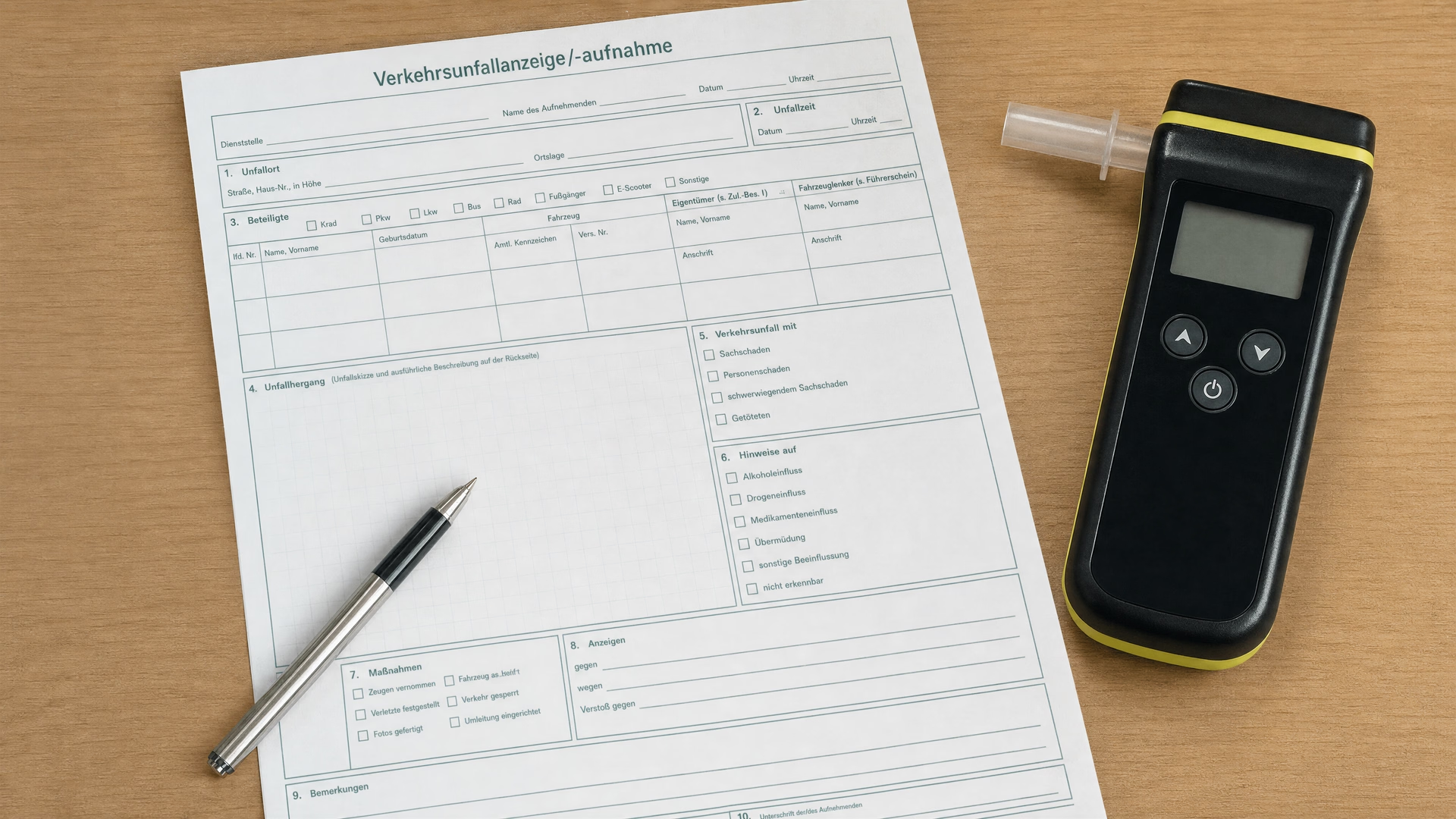
The debate in Germany is narrow but important: if cannabis-related driving accidents are not recorded separately, they cannot be measured clearly. Supporters of the change are therefore asking for a simple statistical fix before the argument about consequences can be meaningfully debated.
Sources
- Efforts to understand America’s drugged-driving problem stall under Trump (washingtonpost.com)
- A state survey found nearly a third of Virginians think using cannabis makes them better drivers, raising safety worries as legal market looms (whro.org)
- Virginia agency launches campaign against driving after using cannabis (whro.org)