













THCP in one sentence: a real cannabinoid, badly oversold
THCP is real, naturally identified, and pharmacologically interesting, but the stock line that it is “33 times stronger than THC” takes a receptor-binding result from Citti et al. (2019) and inflates it into a claim about confirmed human effects that the evidence does not support.
What THCP is chemically
THCP stands for Δ9-tetrahydrocannabiphorol. Chemically, it is a close homolog of Δ9-THC, with one change that matters a lot: THCP carries a seven-carbon alkyl side chain, while ordinary Δ9-THC carries a five-carbon chain. That sounds minor. It is not. Older cannabinoid structure-activity work, including Razdan’s 1984 review of classical cannabinoids, showed that side-chain length strongly influences CB1 activity, and longer chains often increase receptor affinity up to an optimal range.[1] A novel phytocannabinoid isolated from Cannabis sativa L. with an in vivo cannabimimetic activity higher than Δ9-tetrahydrocannabinol: Δ9-Tetrahydrocannabiphorol. Cinzia Citti, Giovanni Linciano, Francesca Russo, Luana Luongo, Marta Iannotta, Francesco Maione, Giuseppe Cannazza. Scientific Reports, 2019.
That is why the 2019 discovery by Giuseppe Cannazza, Cinzia Citti, and colleagues at the University of Modena and Reggio Emilia drew attention so fast. Using high-resolution mass spectrometry and NMR, they identified both THCP and CBDP in cannabis and quantified THCP in plant material at tiny levels: 29 micrograms per gram in one FM2 sample, with 64 micrograms per gram of its acidic precursor THCPA-A. So yes, THCP occurs naturally. No, it does not appear in amounts that explain dramatic differences between ordinary flower varieties.
Why it became famous so quickly
| Claim type | What the article supports | What it does not establish |
|---|---|---|
| CB1 binding affinity | THCP showed about 33-fold higher CB1 binding affinity than Δ9-THC in the 2019 assay | A fixed human potency ratio |
| CB2 binding affinity | THCP also showed higher CB2 affinity, often summarized as roughly 5- to 10-fold higher | Clinical benefit or safety |
| Human intoxication | Psychoactivity is plausible from CB1 activity | Exact onset, peak, duration, impairment, or adverse-event rates in people |
| Natural abundance | THCP was detected naturally in cannabis | That ordinary flower owes dramatic effects to abundant THCP |
Fame came from one number. In the original Scientific Reports paper, Δ9-THCP showed about 33-fold higher CB1 binding affinity than Δ9-THC. Online, that quickly mutated into “33 times stronger than THC,” which is a different claim.
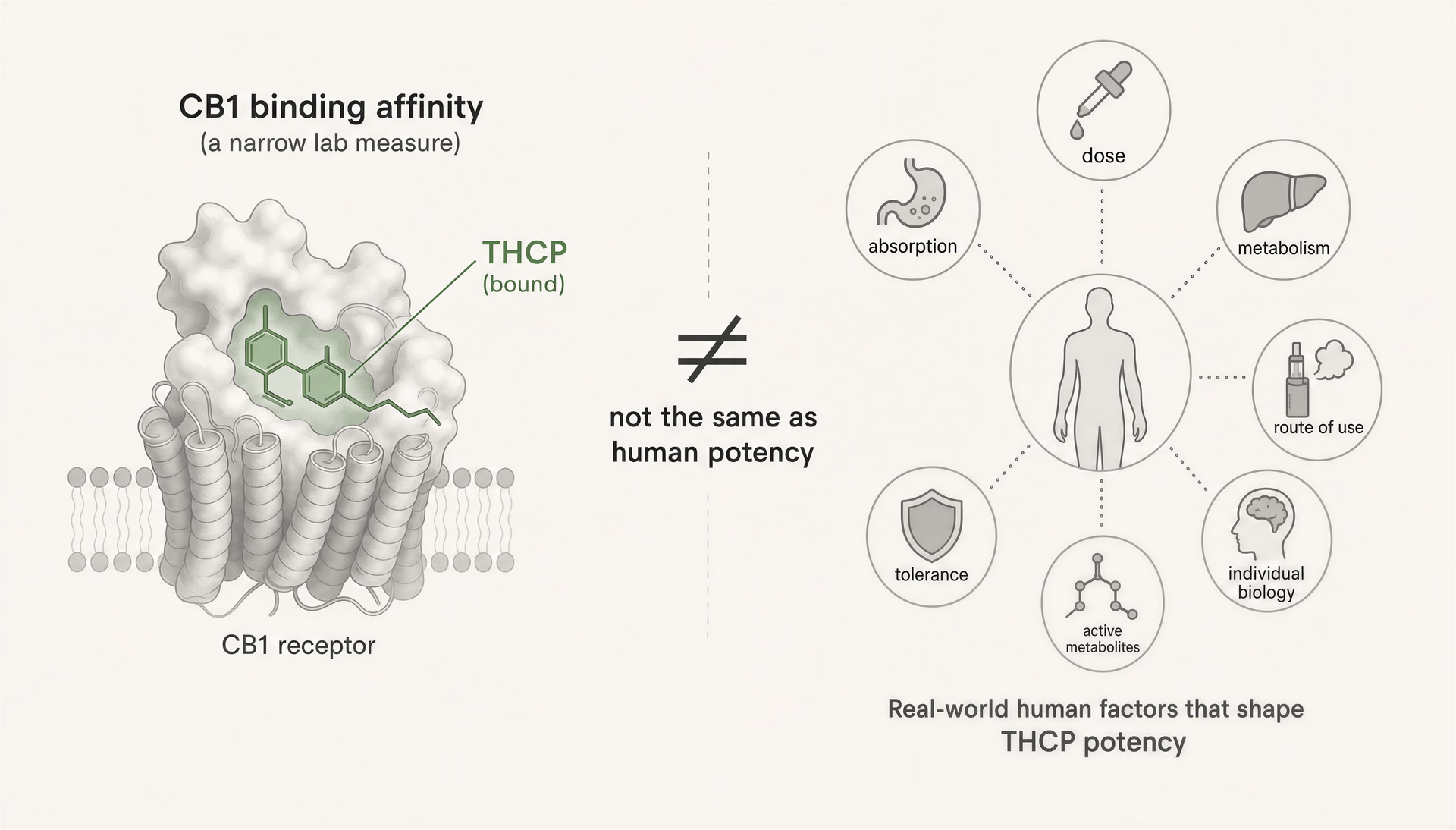
Binding affinity is a lab measure of how tightly a compound interacts with a receptor. It is not a settled human potency ratio. Real-world intensity depends on dose, absorption, metabolism, route of use, active metabolites, tolerance, and individual biology.
The claim this article will test
THCP is 33 times stronger than THC in humans. Limited evidence
This article treats “33 times stronger” as scientifically incomplete and often misleading. THCP may prove more potent than THC in some settings. Maybe much more potent. But there are still no randomized human trials defining dose-response, impairment, therapeutic value, or adverse-event rates. That gap matters more than the hype.
Discovery: how Italian researchers identified THCP in 2019
The Cannazza-Citti team and the Scientific Reports paper
THCP entered the literature in 2019, not through branding, but through analytical chemistry. The paper was published in Scientific Reports by Cinzia Citti, Giovanni Linciano, and colleagues from the University of Modena and Reggio Emilia, working with senior researcher Giuseppe Cannazza. Their study described two previously uncharacterized phytocannabinoids in cannabis: Δ9-tetrahydrocannabiphorol, or Δ9-THCP, and cannabidioliphorol, or CBDP.
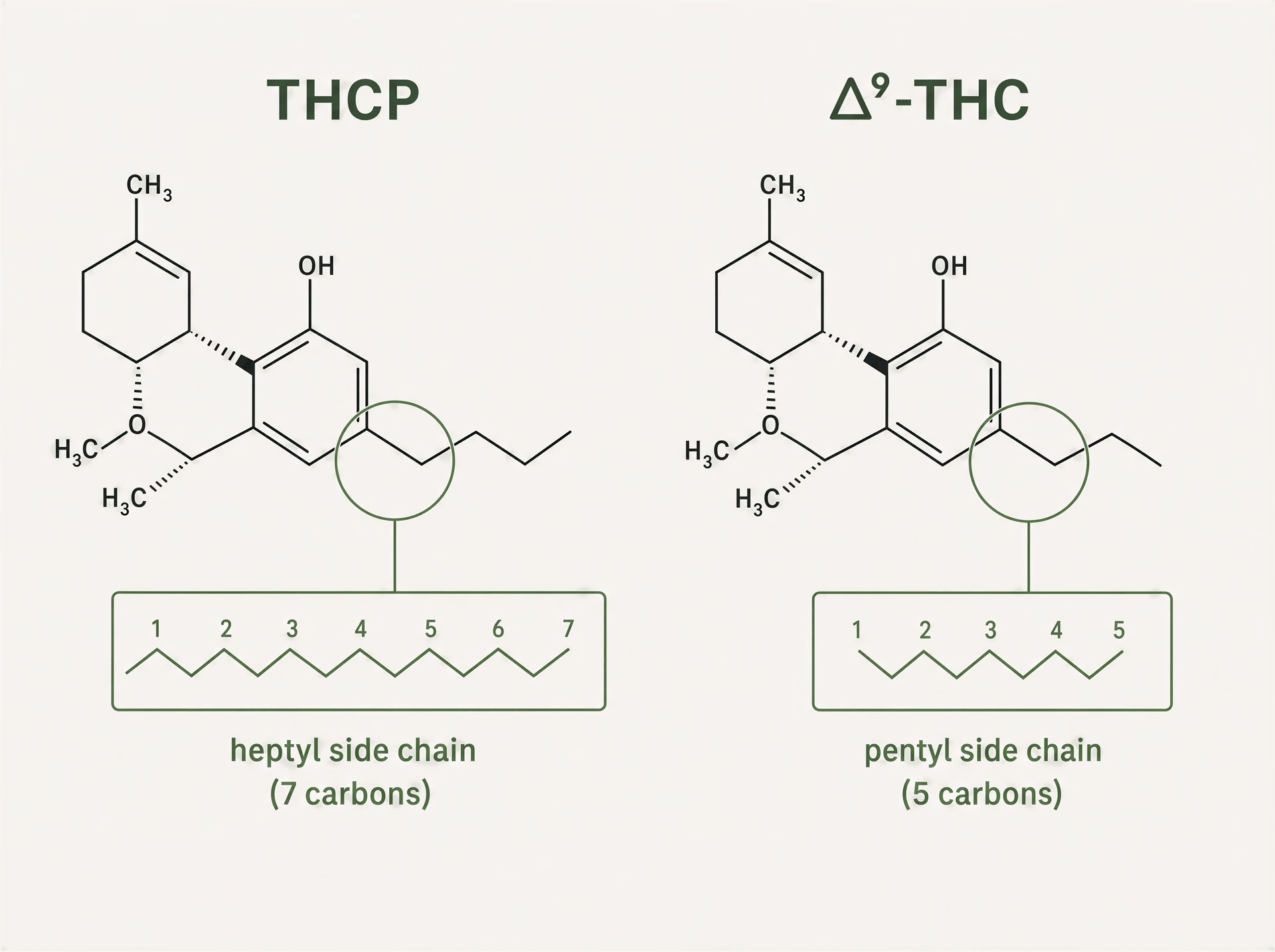
That matters because the compound was identified in plant material itself. It was not a name invented after the fact to market a novel extract. The team was examining cannabis chemotypes with modern instrumentation and found evidence for homologs of THC and CBD that differed in one specific way: the length of the alkyl side chain. Standard Δ9-THC carries a five-carbon pentyl side chain. THCP carries a seven-carbon heptyl side chain.
To cannabinoid chemists, that was immediately interesting. Earlier structure-activity work, including studies associated with Raphael Mechoulam’s generation of cannabinoid research and later SAR reviews such as Razdan’s 1984 work, had already shown that side-chain length strongly influences cannabinoid receptor activity. A heptyl analogue was not a random curiosity. It fit a known pharmacological pattern.
The same 2019 paper is also the source of the line that later became internet shorthand: THCP showed about 33-fold higher CB1 binding affinity than Δ9-THC in the authors’ receptor assays. That finding was real, but it was a binding result from a lab study, not a human potency trial. Discovery came first; hype came after.

Analytical methods: LC-HRMS, isolation, and NMR confirmation
How THCP was identified
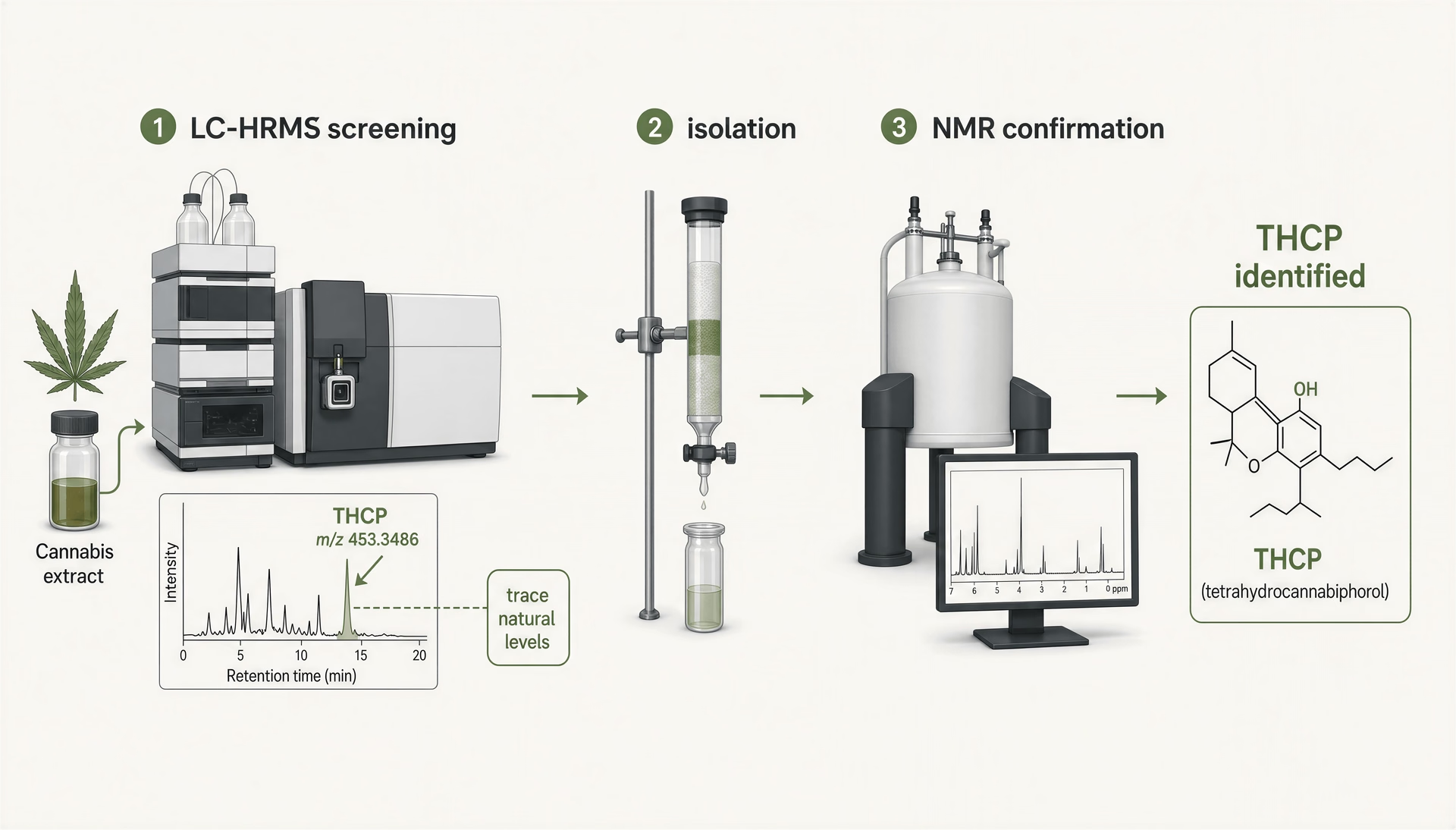
- 1. Screening Researchers used LC-HRMS to spot cannabinoid signals that did not match the expected profile.
- 2. Isolation The unusual compounds were separated from cannabis material for direct study.
- 3. Structural confirmation NMR established the seven-carbon side chain and distinguished THCP from Δ9-THC.
- 4. Quantification The paper reported trace natural levels, including 29 μg/g of THCP and 64 μg/g of THCPA-A in FM2.
The identification was methodical. The researchers used liquid chromatography coupled to high-resolution mass spectrometry, usually shortened to LC-HRMS, to screen cannabis extracts for compounds that did not fit the expected cannabinoid profile. High-resolution mass data allowed them to detect molecular features consistent with a homologous series related to THC and CBD.
That first signal was only the start. Mass spectrometry can suggest a formula and fragmentation pattern, but not settle the structure by itself. So the team isolated the compounds from cannabis material and carried out full spectroscopic characterization. Nuclear magnetic resonance, or NMR, was the decisive step. NMR confirmed the seven-carbon side chain and distinguished THCP from the far more familiar pentyl cannabinoid framework of Δ9-THC.
The paper also quantified how little of the compound was present. In the FM2 cannabis variety analyzed, Δ9-THCP was reported at 29 micrograms per gram, while its acidic precursor THCPA-A was measured at 64 micrograms per gram. Those are trace-level amounts. They help explain why THCP escaped routine detection for so long and why naturally occurring THCP is unlikely to account for dramatic differences between ordinary flower varieties.
Why THCP was missed for so long
THCP was late to the literature because cannabis analysis used to focus on the major cannabinoids. Labs were looking for THC, CBD, CBG, and a relatively short list of known targets. Trace homologs present at microgram-per-gram levels are easy to miss when methods are built around abundant compounds and lower-resolution instruments.
There was also a chemistry problem hiding in plain sight. If a lab does not expect a heptyl homologue, it may not flag an unusual mass signal as a distinct natural cannabinoid. Older workflows often emphasized targeted quantification, not broad untargeted screening. THCP became visible once researchers combined sensitive LC-HRMS screening with actual isolation and NMR confirmation.
So the 2019 discovery was not evidence that THCP suddenly appeared in cannabis. It was evidence that analytical tools had finally caught up. That distinction is important. THCP is real, naturally occurring, and pharmacologically interesting. But the discovery story is a story about better detection, not proof of sweeping claims about human effects.
Chemical structure and why the seven-carbon side chain matters
The chemistry is simple to state and easy to oversell. THCP is not some wholly alien cannabinoid; it is a close structural relative of Δ9-THC. The feature that made chemists pay attention in 2019 is one substitution on the molecule’s alkyl side chain. That small-looking change has a long pharmacological history behind it.

THCP versus THC: heptyl vs pentyl side chain
Heptyl vs pentyl side chain A pentyl side chain has five carbons; a heptyl side chain has seven. In cannabinoid SAR, changing this chain length can change receptor binding and biological activity.
In the 2019 Scientific Reports paper by Cinzia Citti, Giuseppe Cannazza, and colleagues, Δ9-tetrahydrocannabiphorol was identified as a natural cannabinoid in cannabis using high-resolution mass spectrometry and NMR. The defining difference from Δ9-THC was this: THCP carries a seven-carbon alkyl side chain, called a heptyl chain, while ordinary Δ9-THC carries a five-carbon pentyl chain.
That sounds minor. It is not minor.
Classical cannabinoids bind into a hydrophobic pocket on the CB1 receptor, and the side chain helps determine how well that fit happens. Add two carbons, and you change shape, lipophilicity, and receptor interactions all at once. In the Citti et al. binding assays, Δ9-THCP showed about 33-fold greater CB1 receptor affinity than Δ9-THC, with higher CB2 affinity as well. Those numbers explain the excitement, but they do not prove that THCP is “33 times stronger” in people. Binding affinity is a laboratory receptor measure, not a finished map of intoxication, impairment, duration, or dose response in humans.
That distinction matters because the natural amounts reported in cannabis were tiny. In the FM2 variety analyzed by the Italian team, Δ9-THCP was quantified at 29 μg/g, and its acidic precursor THCPA-A at 64 μg/g. Those are trace levels. So while THCP is real and chemically interesting, the discovery paper did not show that naturally occurring THCP is the hidden reason one ordinary flower sample feels dramatically stronger than another.
Structure-activity relationships in classical cannabinoids
THCP made sense the moment its structure was published because cannabinoid chemists had already spent decades mapping this exact question: what happens when you change side-chain length?
Older structure-activity relationship, or SAR, work on classical cannabinoids showed a repeating pattern. Very short side chains generally reduce CB1 activity. Extending the alkyl chain tends to increase potency and receptor affinity up to an optimal range, after which the effect can plateau or become less favorable depending on the analogue. This was not a surprise in 2019; it was an old medicinal chemistry lesson showing up in a newly identified natural compound.
Razdan’s 1984 review and related cannabinoid SAR literature laid much of that groundwork. Researchers working in the Mechoulam era and after it had already compared methyl, propyl, pentyl, and longer-chain analogues of THC-like compounds. Pentyl side chains often performed strongly. Heptyl analogues often looked stronger still in receptor and animal models. The reason is mechanistic, not mystical: the side chain contributes heavily to receptor recognition, especially at CB1, where hydrophobic interactions are central to agonist activity.
So the seven-carbon chain in THCP is not just a naming detail. It is the part of the structure most likely to explain why the compound drew immediate pharmacological interest.
What earlier SAR research predicted before THCP was discovered
Before anyone had isolated THCP from cannabis, the older SAR literature had already pointed in its direction. If a THC homologue with a longer alkyl chain were found in nature, researchers would expect stronger cannabinoid receptor engagement than standard Δ9-THC. That is basically what happened.
What the pre-2019 literature predicted well was receptor behavior. What it did not provide was a human evidence base. And that gap is where many THCP claims go wrong. A stronger-binding heptyl analogue should not be casually translated into a fixed real-world potency ratio. Human effects depend on far more than CB1 affinity: absorption, metabolism, formulation, dose, route of administration, active metabolites, tolerance, and interindividual variability all matter.
So the chemistry gives THCP a solid pharmacological rationale. The seven-carbon side chain fits decades of SAR data. The jump from that fact to sweeping consumer claims does not. At present, THCP is better understood as a compelling receptor pharmacology story than as a clinically characterized cannabinoid.
Potency versus affinity: where the '33 times stronger' claim goes wrong
The phrase “33 times stronger than THC” sounds definite. It is not. It compresses a narrow laboratory finding into a sweeping claim about human intoxication, dose, and risk that the evidence does not support.
That number comes from the 2019 discovery paper by Citti, Linciano, Russo, Luongo, Iannotta, Maione, and colleagues in Scientific Reports, led by Giuseppe Cannazza and Cinzia Citti at the University of Modena and Reggio Emilia. What the paper actually found was that Δ9-THCP showed about 33-fold greater CB1 receptor binding affinity than Δ9-THC in the assay they used. THCP also showed higher CB2 affinity, commonly summarized as roughly 5- to 10-fold higher depending on how the comparison is framed. Those are important pharmacology results. They are not a direct readout of how “strong” THCP feels in a person.
The seven-carbon side chain explains why researchers paid attention so quickly. THCP is a heptyl homolog of THC, while Δ9-THC has a pentyl side chain. Earlier cannabinoid structure-activity work, including Razdan’s 1984 review and related SAR literature descending from classical cannabinoid chemistry, had already shown that changing alkyl side-chain length can sharply alter cannabinoid receptor activity. A longer side chain can improve fit at CB1 up to an optimal range. THCP fits that pattern neatly. The chemistry makes sense. The clickbait leap does not.
What receptor-binding affinity actually measures
Binding affinity describes how tightly a molecule interacts with a receptor under defined experimental conditions. In plain terms, it asks: how well does this compound stick to CB1 or CB2?
That matters because CB1 is the receptor most associated with the classic intoxicating effects of THC. A compound with higher CB1 affinity may exert effects at lower concentrations than a weaker binder. But “may” is doing a lot of work there. Affinity is one dimension of pharmacology, not the whole picture.
A useful distinction is affinity versus efficacy. Affinity is how readily a compound binds. Efficacy is what it does after binding. Two cannabinoids can both attach to CB1, yet trigger different degrees of receptor activation. On top of that, some compounds act as partial agonists rather than full agonists, and downstream signaling can vary by tissue, receptor density, and signaling pathway. So even before getting to human experience, receptor pharmacology is more complicated than one number.
The 2019 paper did not claim that THCP is 33 times more intoxicating in humans. It reported a receptor-binding difference. Those are not interchangeable statements.

Why binding data do not equal intoxicating potency in humans
Human potency depends on far more than receptor affinity. Dose matters. Route matters. Metabolism matters. Bioavailability matters. So does formulation.
A vaporized cannabinoid reaches the bloodstream differently from an edible. Inhaled compounds can produce a faster rise in blood levels, while oral dosing passes through first-pass metabolism in the liver, often changing both timing and effect profile. A cannabinoid that binds strongly in vitro may still show lower-than-expected real-world impact if it is poorly absorbed, rapidly metabolized, unstable in a product matrix, or converted into metabolites with different activity.
Subjective effect is another missing variable in the “33 times stronger” slogan. Intoxication is not one thing. People report differences in onset, anxiety, sedation, perceptual change, heart rate, dysphoria, and duration even with the same cannabinoid at similar doses. “Stronger” could mean lower milligram dose, more impairment, a longer duration, a steeper dose-response curve, or simply more adverse effects. Those are not equivalent outcomes.
Natural abundance also complicates the story. In the FM2 cannabis sample analyzed by Citti et al., Δ9-THCP was present at 29 micrograms per gram, and THCPA-A at 64 micrograms per gram. Those are tiny amounts. This undercuts the idea that ordinary flower owes dramatic differences in effect to naturally abundant THCP. The compound is scientifically real, but in the plant material studied it appeared in trace concentrations.
Animal data, anecdote, and the missing human trial
What evidence do we have beyond receptor assays? Mostly preclinical work, plus anecdote. That is the heart of the problem.
The original 2019 paper included mouse data suggesting that THCP produced cannabinoid-like effects in vivo at lower doses than Δ9-THC, which is consistent with stronger CB1 activity. That finding supports biological plausibility. It does not establish a clean human potency ratio. Mouse tetrad-style outcomes are useful for early pharmacology, but they are not a substitute for randomized human trials measuring dose-response, cognitive impairment, psychomotor effects, adverse events, and pharmacokinetics.
And those trials do not exist in any meaningful way for THCP. There are no solid randomized controlled studies defining therapeutic use, standard dosing, safety margins, or impairment thresholds in humans. That absence is not a minor footnote. It is the main fact consumers should know.
So when labels, reviews, or social posts present THCP as flatly “33 times stronger than THC,” they are overstating what science has shown. The strongest evidence is still preclinical. Human claims are being built from chemistry, receptor assays, animal data, and market anecdote. That is a thin foundation for precise statements about potency.
THCP is scientifically interesting because its seven-carbon side chain fits established cannabinoid SAR logic and because its receptor affinity is unusually high. But consumer-facing potency claims outrun the data. The better summary is less flashy and more accurate: THCP appears to be a high-affinity cannabinoid with potentially strong effects, yet its real-world human potency remains poorly defined.
What research suggests about THCP effects
THCP became famous after Citti et al. published its discovery in Scientific Reports in 2019 and reported that Δ9-THCP showed about 33-fold higher CB1 binding affinity than Δ9-THC. That result is real. The way it gets repeated is often sloppy. Binding affinity is not the same thing as a dose-for-dose human potency rating, and it does not tell us exactly how intoxication, impairment, or adverse effects will play out in people. What the research supports, at this stage, is a cautious pharmacology-based inference rather than a settled clinical profile.
Psychoactive effects inferred from CB1 activation
The reason THCP drew immediate attention is structural. It has a seven-carbon alkyl side chain, while Δ9-THC has a five-carbon chain. Earlier cannabinoid structure-activity research, including work summarized by Razdan in 1984 and related SAR literature, had already shown that extending that side chain can increase cannabinoid activity at CB1 within an effective range. THCP fits that pattern unusually well.
CB1 activation is strongly associated with the familiar central effects of THC-like cannabinoids: euphoria, altered sensory perception, slowed reaction time, short-term memory disruption, impaired attention, and dose-related intoxication. On that basis, psychoactivity is plausible for THCP, and impairment is plausible too. Sedation may also occur, especially as exposure rises. But this is still inference. There are no dose-controlled human trials that map THCP’s onset, peak, duration, or impairment profile with the precision expected for a well-studied drug.
That gap matters more than the headline. “33 times stronger than THC” compresses receptor pharmacology into a claim about lived effects, and the evidence does not justify that shortcut.
Possible adverse effects at higher exposure
If THCP behaves like a high-efficacy CB1-active cannabinoid in humans, then adverse effects seen with THC and related intoxicating cannabinoids become reasonable concerns. Anxiety is one. Tachycardia is another. So are dizziness, heavy sedation, confusion, and cognitive disruption. In some people, especially those sensitive to THC-like compounds, stronger CB1 signaling could plausibly mean a narrower margin between wanted effects and unpleasant ones.
There is also a basic dosing problem: the natural levels reported in the 2019 discovery paper were tiny. In the FM2 cannabis sample, Δ9-THCP was measured at 29 micrograms per gram, with THCPA-A at 64 micrograms per gram. That makes it very unlikely that ordinary flower naturally delivers dramatic THCP exposure. Most meaningful exposure, where it occurs, is likely coming from concentrated or chemically converted products rather than from trace plant content.
Why product composition makes user reports hard to trust
A large share of THCP anecdotes comes from products that do not contain only THCP. Labels often list blends with delta-8 THC, delta-9 THC, HHC, or terpene additives. Some may include semisynthetic cannabinoids generated from hemp-derived CBD. Once multiple active compounds are present, attribution gets messy fast.
If someone reports intense psychoactivity, anxiety, or couch-lock-like sedation after a “THCP” product, was THCP the driver, or was it the delta-8, the delta-9, the HHC, the terpene mix, the actual dose, or contamination from manufacturing byproducts? Without verified lab data and controlled administration, user reports are weak evidence.
That is the core reality: THCP is scientifically interesting, probably psychoactive, and capable of causing impairment and adverse effects. Human evidence is still thin, and the market has moved much faster than the science.
Natural occurrence in cannabis versus commercial THCP products
The original concentration data in cannabis flower
THCP is not fictional. It was identified in cannabis by Giuseppe Cannazza, Cinzia Citti, and colleagues in Scientific Reports in 2019, using high-resolution mass spectrometry and NMR to characterize both Δ9-THCP and CBDP. That matters, because some marketing still blurs the line between a naturally occurring cannabinoid and a lab-made novelty. THCP does occur in the plant. Just not in amounts that support the hype.
In the FM2 cannabis chemovar analyzed in the discovery paper, Δ9-THCP was quantified at 29 micrograms per gram, while its acidic precursor THCPA-A was measured at 64 micrograms per gram. Put differently, that is 0.029 milligrams of THCP per gram of flower, or about 0.0029% by weight. Even if you include the acidic precursor before decarboxylation, the levels are still tiny.
Those numbers should reset expectations. They do not support the idea that ordinary cannabis flower owes dramatic differences in effect to naturally abundant THCP. A compound present at a few dozen micrograms per gram can be pharmacologically interesting and still be commercially negligible in raw plant material. Both can be true.
The 2019 paper is also where the much-repeated “33 times stronger than THC” claim starts, but that figure refers to CB1 receptor binding affinity, not measured intoxication in humans. So the discovery study established two things at once: THCP fits known cannabinoid structure-activity rules and binds strongly at CB1, yet it appears naturally only at trace levels in the cannabis sample tested.
Why extraction from plant material is impractical at scale
Once the concentration data are spelled out, the extraction problem becomes obvious. If a flower sample contains 29 μg/g of THCP, one kilogram of that material would contain only about 29 milligrams of THCP before any processing losses. Real extraction is never perfectly efficient, so the recoverable amount would be lower.
That is a terrible starting point for scale. You would need very large volumes of plant material to isolate even modest quantities of purified THCP, and the work would demand analytical-grade separation because THCP sits among far more abundant cannabinoids with closely related structures. From a chemistry and manufacturing standpoint, direct isolation from flower is possible in principle and unattractive in practice.
This is why “naturally derived THCP” claims deserve skepticism unless backed by unusually clear production data. The plant contains it. The plant does not contain much of it.
The rise of semisynthetic hemp-derived THCP
Most commercial THCP is therefore more likely to come from conversion chemistry than from direct extraction of cannabis flower. In the current intoxicating-hemp market, producers often begin with hemp-derived CBD, then use chemical steps to generate rarer cannabinoids or cannabinoid analogues that would be inefficient to isolate from the plant itself.
That does not make THCP imaginary. It means the retail supply chain probably reflects semisynthesis rather than agricultural abundance. Regulators in the United States and Europe have been tracking this broader shift for years across delta-8 THC and related products, and THCP fits the same pattern: strong commercial presence, thin human evidence, and a production story that is usually chemical, not botanical.
So the plain-language answer is simple. THCP is a real phytocannabinoid, but at trace levels. If a product contains meaningful amounts of THCP, direct extraction from flower is unlikely to be how it got there.
Pharmacology and the questions researchers still cannot answer
THCP became famous because Citti et al. reported in Scientific Reports in 2019 that it carries a seven-carbon side chain and shows far higher CB1 binding affinity than Δ9-THC. What that paper did not establish is the full human pharmacology. The basic ADME map — absorption, distribution, metabolism, and excretion — is still largely missing. That is a serious evidence gap, not a minor footnote.
Absorption and route-of-administration uncertainties
No human trials have defined how quickly THCP enters circulation after inhalation, oral ingestion, or sublingual use. That matters because route changes cannabinoid behavior dramatically. A vape may produce rapid onset and a steep early peak; an edible may delay onset, lower predictability, and extend effects through first-pass metabolism. With THCP, those expectations are still extrapolations from THC and other analogues rather than direct measurements.
The heptyl side chain suggests strong lipophilicity and potentially high tissue partitioning, but that does not tell us bioavailability in a real person using a cartridge or gummy. Nor does receptor affinity answer onset time, peak intensity, or duration. A compound can bind tightly in vitro and still behave unpredictably in humans because formulation, dose, and absorption kinetics shape the experience.
Metabolism and likely role of hepatic biotransformation
Researchers also do not yet know which THCP metabolites dominate in humans, whether any are pharmacologically active, or how strongly hepatic enzymes drive its effects. For orally consumed cannabinoids, liver metabolism can reshape potency and duration. THC’s better-known 11-hydroxy metabolite is the classic example. THCP may have an analogous story, but the evidence is not there yet.
That uncertainty becomes more important because many THCP products are edibles or semisynthetic formulations, where impurities, isomer mixtures, and conversion byproducts may complicate metabolism further. Without controlled pharmacokinetic studies, it is hard to say whether prolonged effects come from THCP itself, active metabolites, slow redistribution from fat, or all three.
Unknowns in drug testing, half-life, and impairment duration
There are no well-established human data for THCP half-life, elimination curve, detection window in urine or blood, or the relationship between blood levels and impairment. Standard cannabis drug tests may miss THCP-specific metabolites, cross-react unpredictably, or simply register use as generic THC exposure. No one should pretend this is settled.
The same goes for impairment duration. People are often told that THCP is “33 times stronger than THC,” but binding affinity is not a clock. It does not reveal how long someone may remain impaired after vaping, how late an edible may peak, or when driving or safety-sensitive work becomes unsafe. Those unanswered questions are exactly why THCP remains more chemically interesting than clinically understood.
Therapeutic potential: interesting hypothesis, not medical evidence
Why stronger CB1 activity tempts medical speculation
THCP invites medical speculation for an obvious reason: its chemistry fits older cannabinoid structure-activity research unusually well. Citti et al. reported in Scientific Reports in 2019 that Δ9-THCP has a seven-carbon side chain, not the five-carbon chain seen in Δ9-THC, and that it showed about 33-fold higher CB1 binding affinity in vitro. That sounds dramatic. It also gets overstated.
Higher receptor affinity is not the same thing as proven therapeutic value in people. It does not tell us the right dose, the duration of effect, the impairment burden, the interaction profile, or whether any benefit survives controlled testing. It tells us THCP is pharmacologically interesting. Nothing more.
Pain, appetite, and antiemetic hypotheses
Because CB1 signaling is involved in pain modulation, appetite, nausea, and vomiting, THCP is often discussed as a possible future analgesic, appetite stimulant, or antiemetic. Those ideas are not irrational. They are extrapolations from cannabinoid biology and from existing THC-based medicines, not evidence that THCP itself works clinically.
That distinction matters. A stronger CB1-active compound might help some symptoms at low doses. It might also produce more intoxication, anxiety, tachycardia, dizziness, cognitive impairment, or dose variability. A compound can be potent and still be a poor medicine. In fact, stronger psychoactive activity can make drug development harder, not easier.
At present, no approved medicine is based on THCP. There is also no solid human therapeutic dataset defining benefit for pain, cachexia, chemotherapy-related nausea, or any other indication.
What would count as real evidence
Real evidence would mean randomized, blinded, controlled human trials with verified THCP content, clear dosing, and clinically relevant endpoints. Researchers would need pharmacokinetic data, dose-response curves, adverse-event rates, impairment testing, drug-drug interaction studies, and comparison against existing treatments.
None of that exists in a meaningful way yet. So the honest position is simple: THCP is a plausible pharmacological candidate, not an established therapy. Plausibility is the starting line, not the finish line.
Legal status: controlled in some places, gray in others, unstable almost everywhere
THCP’s legal status is a moving target, not a clean yes-or-no question. That is partly because the compound is new to regulators—it was first described by Citti, Cannazza and colleagues in Scientific Reports in 2019—and partly because most legal systems were not designed with rare or semi-synthetic cannabinoids in mind. A label saying “not specifically scheduled” can sound reassuring. It should not. In drug law, silence often leaves room for analogue rules, broad THC definitions, synthetic-cannabinoid bans, medicines law, consumer-safety enforcement, or all of them at once.
The other source of confusion is market framing. THCP occurs naturally in cannabis, but the amounts reported in the discovery paper were tiny: 29 μg/g of Δ9-THCP and 64 μg/g of THCPA-A in the FM2 variety analyzed by the Italian team. That matters legally because many products sold as THCP are unlikely to be simple plant extracts. They are more often produced through chemical conversion from hemp-derived cannabinoids or through other laboratory processes. Once production shifts from trace natural occurrence to intentional synthesis or conversion, legal risk usually rises.
United States: Farm Bill, analogue risk, DEA and state law
At the federal level, THCP sits in contested territory. The 2018 Farm Bill removed “hemp” from the Controlled Substances Act definition of marijuana, so long as the plant and its derivatives contain no more than 0.3% delta-9 THC on a dry-weight basis. That opened the door for a wave of intoxicating hemp-derived cannabinoids. But the Farm Bill did not create a blanket safe harbor for every psychoactive compound that can be linked, however loosely, to hemp.
| Legal question | Why it matters for THCP |
|---|---|
| Named scheduling | THCP may not be listed by name in a jurisdiction even when other THC forms are. |
| Analogue rules | Authorities may treat a THC homologue with similar effects as controlled. |
| Synthetic-derived THC rules | If commercial THCP is made by chemical conversion from CBD or other hemp cannabinoids, separate controls may apply. |
| State or national law | Local hemp-intoxicant bans can be stricter than federal or EU-wide baseline rules. |
| Product law | Consumer-safety, medicines, food, or labeling law may still be used even without explicit narcotics scheduling. |
That is where THCP gets difficult. It is not expressly named in the federal schedules in the way delta-9 THC is. Even so, federal exposure can arise through at least three routes.
Why US federal risk can arise even without THCP being named in schedule text
- Federal Analogue Act A prosecutor may argue substantial similarity in structure and effect to a scheduled drug when intended for human consumption.
- Synthetic-derived THC position DEA has said synthetically derived tetrahydrocannabinols remain controlled even when hemp was the starting material.
- State law overlays Many states separately restrict hemp intoxicants, THC isomers, or analogues outside licensed cannabis channels.
First, the Federal Analogue Act. Prosecutors can argue that a substance is substantially similar in chemical structure and effect to a Schedule I or II drug and intended for human consumption. THCP is a tetrahydrocannabinol homologue with a seven-carbon side chain rather than THC’s five-carbon chain. That difference is pharmacologically important, but it does not make the molecule obviously dissimilar. If anything, the 2019 Citti paper—widely cited for reporting much higher CB1 receptor affinity than Δ9-THC—could strengthen an analogue-style argument about similar or stronger cannabinoid effect.
Second, DEA’s position on synthetically derived tetrahydrocannabinols. DEA has repeatedly taken the view, in delta-8 contexts and related statements, that “synthetically derived tetrahydrocannabinols” remain controlled substances even if the starting material came from lawful hemp. If THCP in commerce is made by chemical conversion from CBD or another hemp cannabinoid, that synthetic-derived issue becomes hard to ignore. The legal fight then shifts away from whether hemp was the input and toward how the final intoxicant was created.
Third, state law. Many states now regulate hemp intoxicants more aggressively than federal law does. Some ban or restrict all THC isomers and analogues outside licensed cannabis systems; others focus on delta-8 and broad intoxicating-hemp categories; some still leave gaps. So a product can look federally arguable and still be clearly unlawful under state law, or vice versa.
The practical point is simple: absence from a named federal schedule is not the same as legality. For THCP, that distinction is the whole story.
Europe: narcotics law, analogue frameworks, and novel cannabinoid policy
Europe does not offer one THCP rule. It offers a patchwork. National narcotics laws still matter more than any single EU-wide answer, and countries vary in how they capture new cannabinoids. Some use broad definitions that cover tetrahydrocannabinol derivatives or homologues. Others rely on generic or analogue controls designed to catch new psychoactive substances without listing each one individually. In still other places, the first enforcement hook may be consumer-product law, medicines law, or food law rather than classic narcotics scheduling.
EUDA, formerly EMCDDA, has been tracking the rise of semi-synthetic cannabinoids because they exploit exactly this gap between old cannabis law and new cannabinoid chemistry. Europe’s legal problem is not only whether THCP is intoxicating. It is whether regulators treat it as a narcotic, a controlled analogue, an unauthorized novel ingredient, an unsafe chemical conversion product, or some combination.
That creates unstable outcomes. A jurisdiction may not yet have placed “THCP” by name in its narcotics schedule, but broad THC wording can still capture it. If not, analogue provisions may. If those do not, authorities may still act against products on safety or medicines grounds, especially where manufacturing methods are unclear or labeling is unreliable.
Germany and Spain: why broader cannabis reform does not automatically legalize THCP
Germany is a good example of how cannabis reform can be misunderstood. The 2024 Cannabis Act, the KCanG, changed rules around possession, home cultivation, and cannabis associations. It did not create a general legal lane for novel intoxicating cannabinoids derived from hemp chemistry. THCP products do not become lawful just because Germany relaxed some rules for cannabis itself. Separate narcotics, medicines, consumer-protection, and product-safety questions remain very much alive.
Spain shows a similar mismatch in a different legal culture. Spain’s cannabis landscape has long looked more permissive in practice than in statute, especially around private use. That should not be confused with permission for novel cannabinoid commerce. THCP can still trigger scrutiny under narcotics law, analogue reasoning, health-product rules, or regional enforcement priorities. Tolerance toward some forms of cannabis possession does not equal acceptance of newly marketed THC homologues.
That mismatch matters beyond these two countries. Reform aimed at plant cannabis does not automatically legalize lab-made or chemically converted cannabinoids that arrive later through loopholes. THCP is scientifically real and legally fragile. Anyone describing it as plainly legal in Europe or the United States is leaving out the part that matters most: the law has not caught up, and when it does, it often tightens rather than relaxes.

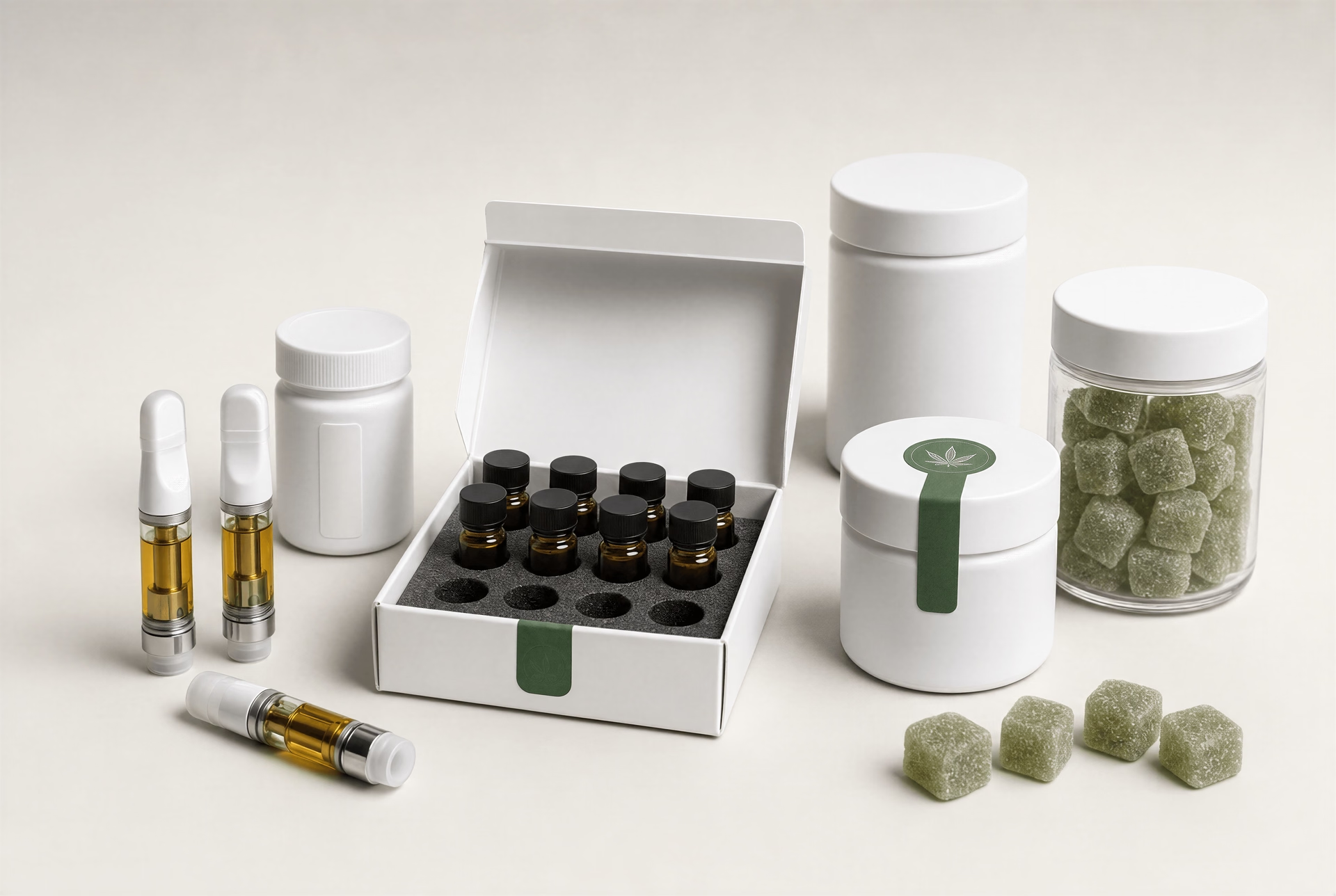
Safety, product quality, and why the supply chain matters more than the molecule
THCP risk is often framed as a simple receptor story: stronger CB1 binding, stronger effects, greater chance of overintoxication. That is only part of the problem. In practice, the bigger safety question may be how a THCP product was made, what else ended up in it, and whether the label reflects reality.
Citti et al. identified Δ9-THCP in cannabis in 2019, but at very low natural concentrations: 29 μg/g in the FM2 sample, with 64 μg/g of THCPA-A. Those numbers matter because they make a basic point hard to ignore. Most commercial THCP is unlikely to come from direct plant extraction in meaningful amounts. It is more often produced through hemp-derived conversion workflows or sold in formulations where THCP is one ingredient among many. That shifts the risk profile from plant chemistry alone to manufacturing chemistry.
Residual solvents, by-products, and labeling accuracy
When cannabinoids are synthesized or converted from CBD, the final material can contain more than the target molecule. Residual solvents, reaction acids, heavy metals from equipment, and unintended side-products can remain if purification is poor. With THCP, this matters even more because there is little published toxicology on the by-products that may arise in semi-synthetic production.
Mislabeling is a second hazard. Across the hemp-derived intoxicant market, independent labs and state regulators have repeatedly found products that contain different cannabinoids than claimed, much higher or lower concentrations than listed, or detectable Δ9-THC despite labels suggesting otherwise. A bottle marketed as “THCP” may actually be a blend of delta-8 THC, delta-9 THC, HHC, unidentified peaks, and trace THCP. If adverse effects occur, receptor pharmacology does not tell you which ingredient caused them.
Lessons from delta-8 regulation and adverse event reporting[2] 5 Things to Know about Delta-8 Tetrahydrocannabinol – Delta-8 THC. U.S. Food and Drug Administration. FDA Consumer Update, 2022.
Delta-8 THC is the clearest warning sign. It moved through the same hemp-derived gray zone now used for newer intoxicating cannabinoids, often without the controls expected in pharmaceutical manufacturing. In 2022, the FDA said it had received 104 adverse event reports involving delta-8 products from December 2020 through February 2022, while poison control centers logged 2,362 exposure cases over a similar period.
That does not prove THCP will produce the same pattern. It does show what happens when intoxicating cannabinoid products spread faster than standards, surveillance, and enforcement. DEA testimony in 2023 and monitoring by EUDA point in the same direction: the market evolves faster than the evidence base.
Why third-party certificates do not always settle the issue
A certificate of analysis can help, but it is not a magic shield. Results depend on the lab’s methods, accreditation, reference standards, and whether it even knows how to identify rare cannabinoid impurities. One COA may report potency while saying little about unknown by-products. Another may test one batch while the consumer receives another.
For THCP, where direct human evidence is thin and production routes vary widely, safety depends at least as much on analytical quality and chain-of-custody discipline as on the molecule itself. That is not a minor caveat. It is the central public health issue.
What the evidence actually supports right now
Claims supported by data
The strongest claims about THCP are chemical and pharmacological, not clinical. Citti et al. in Scientific Reports (2019), the paper that first identified Δ9-THCP and CBDP in cannabis, showed that THCP is a THC homolog with a seven-carbon side chain rather than THC’s five-carbon chain. That matters because older cannabinoid structure-activity research, including work summarized by Razdan in 1984, had already shown that CB1 activity tends to rise as the alkyl side chain lengthens into the pentyl-to-heptyl range. THCP did not appear out of nowhere as a biochemical mystery; it fit an established receptor-binding pattern.
The headline number from the 2019 paper is real, but often misused. THCP showed about 33-fold higher CB1 binding affinity than Δ9-THC, and higher CB2 affinity as well. That supports one narrow statement: THCP binds cannabinoid receptors unusually strongly in laboratory assays. It does not, by itself, prove that humans will feel effects that are 33 times stronger, 33 times longer, or 33 times riskier at matched doses. Binding affinity is one piece of pharmacology. Human potency depends on much more, including absorption, metabolism, route of administration, dose, formulation, and active metabolites.
THCP occurs naturally in cannabis, but the published discovery data show it at trace levels. Strong evidence
There is also direct evidence that THCP exists naturally in cannabis, but in tiny amounts. In the FM2 variety analyzed by Citti and colleagues, Δ9-THCP was measured at 29 micrograms per gram and THCPA-A at 64 micrograms per gram. Those numbers cut against a popular story that THCP is the hidden reason ordinary flower sometimes feels dramatically more intense. At least from the published discovery data, naturally occurring levels were trace-level, not dominant.
Claims that remain speculative
Almost everything consumers are told about THCP’s real-world effects belongs here. There are no randomized controlled trials establishing therapeutic uses, no standard human dose-response curve, no reliable impairment profile, and no good epidemiology on adverse events specific to THCP. Claims that it is predictably “far stronger than THC,” medically superior, or uniquely long-lasting in humans are not backed by serious clinical evidence.
Even product-level assumptions are shaky. Because natural THCP appears in cannabis at very low concentrations, many marketed THCP items are likely semi-synthetic or produced through conversion from hemp-derived cannabinoids rather than extracted directly from plant material in meaningful amounts. That places THCP in the same broader risk environment that has already troubled regulators reviewing intoxicating hemp derivatives. FDA warnings on delta-8 products and DEA attention to emerging hemp intoxicants do not prove THCP is unsafe, but they do show the channel is poorly characterized and often inconsistently labeled.
The most honest one-sentence summary of THCP
THCP is a real cannabinoid with unusually strong receptor pharmacology and a plausible structure-based reason for that strength, but human evidence is so thin that confident claims about its effects, dosing, safety, or medical value run well ahead of the science.
That is the evidence-based position: THCP is scientifically legitimate, the “33 times stronger than THC” line is incomplete at best, and the gap between laboratory pharmacology and human data is large enough that most retail certainty is not justified.
References
- [1] A novel phytocannabinoid isolated from Cannabis sativa L. with an in vivo cannabimimetic activity higher than Δ9-tetrahydrocannabinol: Δ9-Tetrahydrocannabiphorol. Scientific Reports, 2019. https://doi.org/10.1038/s41598-019-56785-1
- [2] 5 Things to Know about Delta-8 Tetrahydrocannabinol – Delta-8 THC. FDA Consumer Update, 2022. https://www.fda.gov/consumers/consumer-updates/5-things-know-about-delta-8-tetrahydrocannabinol-delta-8-thc