














Why cannabis nutrient management is more complicated than most feeding charts suggest
Brand charts are not agronomy. They are simplified dosing templates written to fit a product line, not a living root system in a specific substrate under a specific light load. A feed schedule can be useful as a rough starting point, but it cannot tell you whether your root zone is too acidic for iron uptake, whether salts are accumulating faster than the plant can use them, or whether your cultivar is a heavy potassium feeder that burns at the same EC another genotype handles easily. Nutrient demand in cannabis is conditional, not fixed. The same formula can drive healthy growth in buffered soil, calcium deficiency in coco, and tip burn in recirculating hydro.

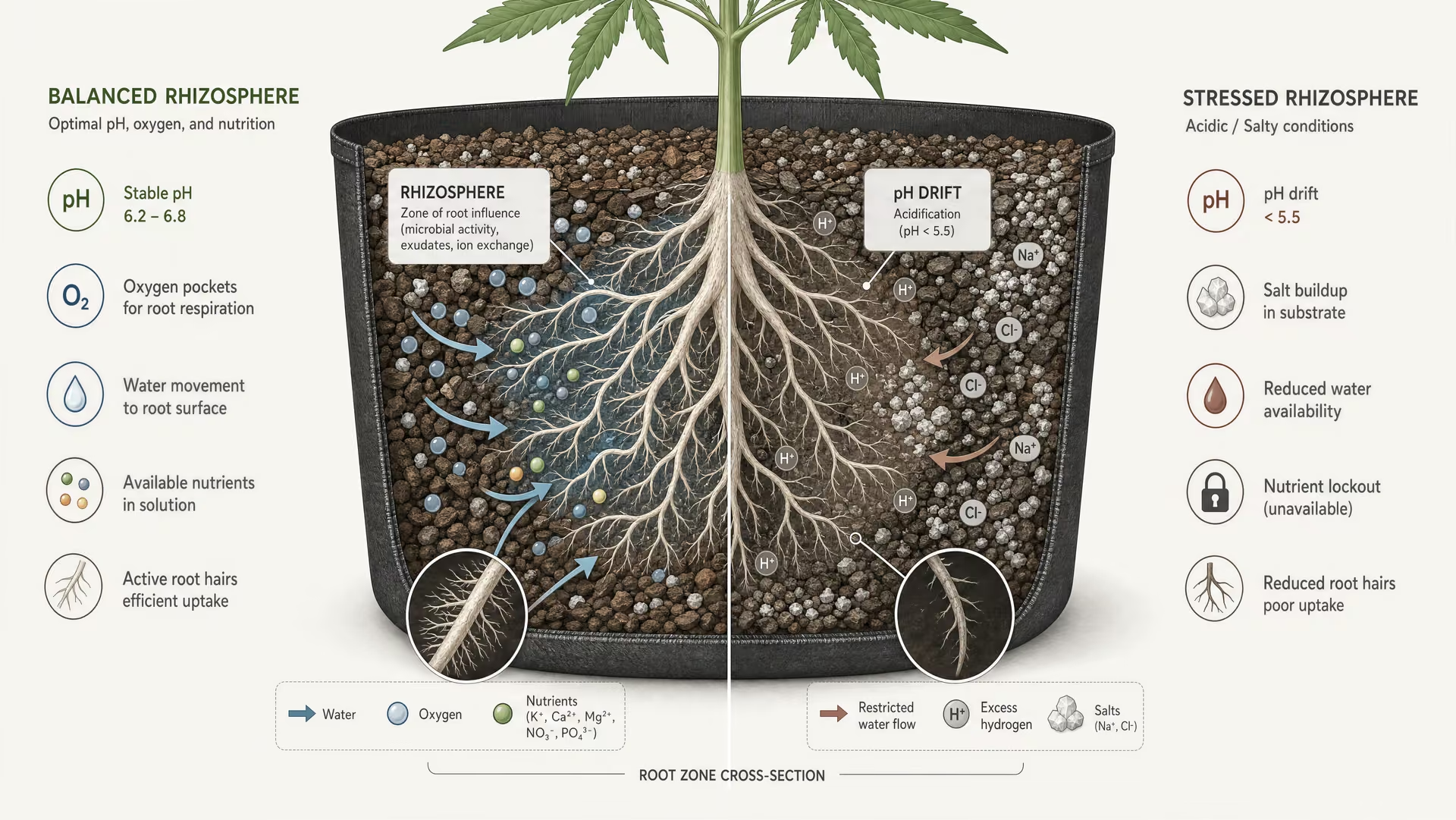
The real problem is root-zone chemistry, not just bottle instructions
What matters is not just what goes into the reservoir. It is what stays available around the roots after pH shifts, cation exchange, evaporation, microbial activity, and irrigation timing have done their work.
Lockout A practical grower term for a situation where nutrients are present in the root zone but cannot be taken up effectively because of pH, antagonism, salinity, or root stress.
That is why pH and EC are more informative than a week-by-week label. Cornell Controlled Environment Agriculture guidance continues to place most hydroponic crops in a pH band around 5.5 to 6.5 because nutrient availability changes sharply outside it. Cannabis behaves the same way. Iron, manganese, zinc, and copper become less available as pH drifts upward; calcium, magnesium, and phosphorus can also become functionally unavailable when the chemistry moves far enough off target. Many “deficiencies” are really lockout. Adding more fertilizer to a locked-out root zone often makes the problem worse.
EC helps, but only if you understand its limits. It measures total dissolved salts, not which ions are present. A high EC could mean productive feeding under intense light, or it could mean chloride-heavy buildup and osmotic stress. Still, controlled-environment fertigation work has shown for years that EC is a practical warning system for overfeeding and tip burn. In cannabis, salt accumulation is a common failure mode, especially in small containers, high-frequency feeding, and dry-back-heavy routines.
| Medium | Behavior described in the article | Common nutrition implication |
|---|---|---|
| Soil | Has buffering capacity and some mineral contribution | Slower response; recipe must account for substrate contribution |
| Rockwool | Comparatively inert and responds fast | Direct control, but mistakes show quickly |
| Coco | Meaningful cation exchange capacity; adsorbs Ca and Mg unless buffered | Higher risk of Ca/Mg issues if formulation or buffering is poor |
Cation exchange capacity The ability of a substrate to hold and exchange positively charged ions such as calcium, magnesium, potassium, and sodium. In coco, this strongly affects what roots actually receive.
Medium choice changes the chemistry again. Soil has buffering capacity and some mineral contribution. Rockwool is comparatively inert and responds fast. Coco sits in the middle and causes many of the problems that get mislabeled online as random “Cal-Mag issues.” Coir has meaningful cation exchange capacity and tends to adsorb calcium and magnesium unless properly buffered, which is why a formula that runs cleanly in rockwool can produce Ca and Mg shortages in coco.
What popular cannabis guides get wrong about NPK and bloom feeding
Cannabis flowering does not appear to require unusually high phosphorus relative to common bloom-feeding lore. Limited evidence
The largest mistake is treating phosphorus as the star of flowering. It is not. Cannabis needs adequate phosphorus, but the old “hammer PK in bloom” mindset is weakly supported. Bruce Bugbee of Utah State University has repeatedly argued that cannabis does not require unusually high phosphorus and that many grower recipes overapply it. That view matches general plant nutrition science. Excess phosphorus can antagonize micronutrients, especially zinc and iron, and can create deficiency symptoms in a plant that is technically being fed more, not less.
Nitrogen is also badly misunderstood. Growers are often told to slash it dramatically as soon as flowering begins. In reality, demand usually falls relative to vegetative growth, but it does not disappear. Cutting nitrogen too early can reduce canopy function and accelerate unhelpful chlorosis. Potassium often deserves more attention than phosphorus during reproductive growth because it supports osmotic regulation, enzyme activation, and transport processes tied to flower development.
Another myth: every yellow leaf is nitrogen deficiency. It can be pH lockout, magnesium antagonism from excess potassium, calcium suppression from excess ammonium, root hypoxia from overwatering, or ordinary late-flower senescence. Diagnosis without root-zone context is guesswork.
Mandatory pre-harvest flushing is not strongly supported as a universal way to improve cannabinoid content, terpene content, or yield. Strong evidence
The same skepticism should apply to flushing dogma. The Rx Green Technologies trial published in 2019 compared 0, 7, 10, and 14 days of pre-harvest flushing and found no significant differences in cannabinoid content, terpene content, or yield, with little sensory evidence for a universal quality benefit. That does not mean late-stage fertigation is irrelevant. It means the claim that mandatory flushing is always needed is overstated.
The variables that actually drive nutrient demand: light, VPD, CO2, genotype, and irrigation frequency
Plants do not eat according to calendar week. They eat according to growth rate.
VPD (vapor pressure deficit) A measure of the air’s drying power that influences transpiration. In the article, higher productivity under a suitable VPD is linked to greater nutrient demand.
Increase PPFD, tighten environmental control, enrich CO2, and maintain a productive vapor pressure deficit, and nutrient demand rises because transpiration and photosynthesis rise. Under weak light and low transpiration, the same EC can become excessive. This is why published commercial ranges are broad rather than universal: seedlings may do well around 0.8 to 1.3 mS/cm, vegetative plants around 1.2 to 1.8, and flowering crops roughly 1.8 to 2.4, but only if the medium, irrigation strategy, and environment support that concentration.
Genotype matters too. Some cultivars tolerate aggressive fertigation. Others claw, burn, or stall at modest EC. Irrigation frequency matters just as much. Frequent small fertigations in coco or rockwool can keep nutrients available and oxygen moving, but if runoff is inadequate, salts stack up. Infrequent heavy watering can swing EC and oxygen availability in the opposite direction.
That is why one schedule cannot fit soil, coco, and hydro. It is also why any feeding advice should be read against local law, since cultivation rules vary by jurisdiction.
Cannabis nutrient fundamentals: essential elements and what the plant uses them for
Plant nutrition starts with a strict definition. An element is considered essential if the plant cannot complete its life cycle without it, if the deficiency is specific to that element, and if the element is directly involved in plant structure or metabolism. That standard comes from general plant nutrition science, not cannabis folklore. By that definition, cannabis requires the same core mineral elements as other higher plants, even if its growth rate, flower production, and sensitivity to root-zone errors give those elements a cannabis-specific management profile.
That distinction matters because many feeding mistakes are not caused by “missing bloom food.” They come from misunderstanding what the plant actually needs, when it needs it, and whether the root zone can supply it at the current pH and salt level. Cornell Controlled Environment Agriculture guidance and broader extension literature are clear on this point: the familiar hydroponic pH band of roughly 5.5 to 6.5 exists because nutrient availability changes quickly across that range. A leaf can show deficiency symptoms even when fertilizer has already been added. The issue may be lockout, antagonism, or root stress.
Why nutrient mobility matters
- Mobile nutrients
- Can be moved from older tissue to newer growth when supply is short, so symptoms often begin on older leaves.
- Immobile nutrients
- Cannot be relocated easily, so symptoms tend to show first on newer leaves or growing tips.
- Diagnostic use
- Symptom location helps separate likely nutrient classes before any correction is made.
The next diagnostic concept is mobility. Mobile nutrients can be moved by the plant from older tissues to new growth when supply is short. Immobile nutrients cannot be relocated easily, so deficiency symptoms tend to appear first on newer leaves or growing tips. That is why symptom location matters. Yellowing low on the plant often points toward a mobile nutrient such as nitrogen or magnesium. Distorted new growth, tip dieback, or interveinal chlorosis on fresh leaves pushes suspicion toward calcium, iron, boron, manganese, or other less mobile elements. Misreading symptom location is one reason growers overcorrect with the wrong bottle.
| Nutrient | Main roles described | Typical first symptom location | Noted pitfall |
|---|---|---|---|
| Nitrogen (N) | Amino acids, proteins, nucleic acids, chlorophyll, vegetative growth | Older leaves | Too much ammonium can depress calcium uptake |
| Phosphorus (P) | ATP, nucleic acids, phospholipids, root development, flower formation | Older tissues | Often overapplied; excess can antagonize zinc and iron |
| Potassium (K) | Osmotic balance, stomatal function, enzyme activation, sugar transport | Older leaves | Excess can suppress magnesium and calcium uptake |
Macronutrients: nitrogen, phosphorus, and potassium
Nitrogen (N) drives vegetative growth more than any other single mineral element. It is a core component of amino acids, proteins, nucleic acids, chlorophyll, and many enzymes. When cannabis is growing stems, leaves, and canopy mass, nitrogen demand is high. Deficiency usually shows first on older leaves because nitrogen is mobile; the plant strips stored N from lower foliage to support new growth. Leaves pale, then yellow, and vigor drops.
Nitrogen form matters too. Nitrate and ammonium are not interchangeable in practice. A nutrient program with too much ammonium can depress calcium uptake and contribute to soft, overly lush growth, especially in warm, wet root zones. That is one reason competent formulations pay attention not just to total N, but to nitrate-ammonium balance.
Phosphorus (P) is the most overmarketed nutrient in cannabis culture. Yes, it is essential. Phosphorus is involved in ATP-driven energy transfer, nucleic acids, phospholipids, root development, and flower formation. But the common claim that cannabis needs massive phosphorus increases in bloom is weakly supported. Bruce Bugbee of Utah State University has repeatedly argued that cannabis does not require unusually high phosphorus and that many feeding programs overapply it. That matches general horticultural science. Once adequate P is present, pushing it higher does not automatically produce heavier flowers. It can create problems instead, including antagonism with micronutrients such as zinc and iron.
True phosphorus deficiency tends to appear first on older tissues because P is mobile, but it is less common in fed container crops than online advice suggests. Cool root zones, poor root health, or high pH can make a plant look P-deficient without an actual lack of phosphorus in solution.
Potassium (K) is often more practically important than phosphorus in real production. Potassium does not become part of plant structure in the way nitrogen does, but it regulates osmotic balance, stomatal function, enzyme activation, sugar transport, and stress response. In cannabis, adequate K supports water relations and the movement of photosynthates into developing flowers. Deficiency can show as marginal chlorosis and scorching on older leaves because potassium is mobile. Weak stems and reduced stress tolerance may follow.
The catch is that potassium cannot be considered alone. Excess K can suppress magnesium and calcium uptake. This is a common self-inflicted problem in bloom-heavy feeding programs that chase high potassium and phosphorus while creating induced Mg or Ca deficiency. So yes, potassium matters a lot. No, “more bloom K” is not automatically better.
| Nutrient | Main roles described | Typical first symptom location | Important context |
|---|---|---|---|
| Calcium (Ca) | Cell walls, membranes, root development, cell division, signaling | New growth | Delivery depends on transpiration; coco often complicates supply |
| Magnesium (Mg) | Center of chlorophyll, enzyme activity, phosphorus metabolism | Older leaves | Excess potassium and high EC can induce deficiency |
| Sulfur (S) | Amino acids, proteins, enzyme function | Newer growth | Can resemble nitrogen deficiency but usually appears higher on the plant |
Secondary nutrients: calcium, magnesium, and sulfur
Calcium (Ca) deserves more attention in cannabis than many beginner guides give it. Calcium is structurally important in cell walls and membranes, and it supports root development, cell division, and signaling. It is relatively immobile in the plant, so deficiency shows in new growth first: twisted leaves, necrotic margins, weak shoot tips, poor root growth, and irregular development. Because Ca movement depends strongly on transpiration, environmental conditions matter. High humidity, root damage, overwatering, and excessive ammonium can all interfere with delivery even when calcium is present in the feed.
Medium matters even more. Coco coir is notorious here. Coir has cation exchange behavior that tends to bind calcium and magnesium unless the substrate is properly buffered. That is why Ca and Mg issues show up far more often in coco than in inert rockwool under otherwise similar programs. The grower may think the plant “needs Cal-Mag” as a universal cure, but the underlying problem is often substrate chemistry.
Magnesium (Mg) sits at the center of the chlorophyll molecule and supports enzyme activity and phosphorus metabolism. It is mobile, so deficiency usually begins on older leaves as interveinal chlorosis: veins stay greener while tissue between them yellows. In cannabis, this pattern is common enough that growers often jump straight to magnesium supplements. Sometimes that works. Sometimes the real cause is excess potassium, root-zone EC that is too high, or pH drift reducing uptake. If the medium is coco, unbuffered exchange sites may be part of the story.
Sulfur (S) is frequently overlooked because it is needed in smaller amounts than N, P, or K, yet it is still a macronutrient in practical crop terms. Sulfur is part of certain amino acids and proteins and contributes to enzyme function and metabolic processes. Deficiency can resemble nitrogen deficiency, but there is a useful clue: sulfur is much less mobile, so symptoms often appear first in newer growth as a general pale green or yellowing, while nitrogen deficiency usually starts lower on the plant. That distinction helps separate a true N shortage from a sulfur issue or a pH-related uptake problem.
| Element | Primary role in the article | Typical symptom pattern or note |
|---|---|---|
| Iron (Fe) | Chlorophyll synthesis and electron transport | Interveinal chlorosis on new leaves; often pH-induced |
| Manganese (Mn) | Photosynthesis and enzyme systems | Younger-leaf chlorosis, sometimes with speckling |
| Zinc (Zn) | Enzyme activity and growth regulation | Stunted, distorted new growth; high P can interfere |
| Copper (Cu) | Enzymes and reproductive development | Young-leaf and shoot-tip problems; toxicity arrives fast |
| Boron (B) | Cell wall formation, membrane function, meristem health | Brittle malformed new growth and tip issues |
| Molybdenum (Mo) | Nitrate metabolism | Rare deficiency that can mimic nitrogen problems |
| Chlorine (Cl) | Osmosis and photosynthetic reactions | Essential in trace amounts; excess chloride can harm |
| Nickel (Ni) | Urease activity and nitrogen metabolism | Essential in trace amounts; deficiency is rare |
| Silicon (Si) | Often useful for structure and stress tolerance | Beneficial, but not generally essential in the strict sense |
Micronutrients and trace elements: iron, manganese, zinc, copper, boron, molybdenum, chlorine, nickel, and silicon
Micronutrients are required in tiny amounts, but tiny does not mean optional. Their management is harder because the line between deficiency and excess is narrow, and pH has an outsized effect on availability.
Iron (Fe) is essential for chlorophyll synthesis and electron transport. It is relatively immobile, so deficiency appears on new leaves first as interveinal chlorosis. In cannabis, iron deficiency is often not a feeding shortage at all. It is commonly induced by high root-zone pH or excess phosphorus.
Manganese (Mn) supports photosynthesis and enzyme systems. Deficiency can also produce interveinal chlorosis on younger leaves, sometimes with speckling. It becomes less available as pH rises.
Zinc (Zn) is involved in enzyme activity and growth regulation. Deficiency can stunt new growth and distort leaves. High phosphorus can interfere with zinc uptake, which is one reason exaggerated bloom-P programs backfire.
Copper (Cu) supports enzymes and reproductive development. Deficiency is less common but can affect young leaves and shoot tips. Toxicity arrives fast if overapplied.
Boron (B) is essential for cell wall formation, membrane function, and meristem health. It is poorly mobile, so deficiency shows at growing points: brittle new growth, tip death, and malformed leaves. Boron problems can look like calcium issues because both affect developing tissues.
Molybdenum (Mo) is needed in very small amounts for nitrate metabolism. Deficiency is uncommon but can mimic nitrogen problems because the plant struggles to process nitrate properly.
Chlorine (Cl) and nickel (Ni) are also essential in trace quantities. Chlorine has roles in osmosis and photosynthetic reactions; nickel is required for urease activity and nitrogen metabolism. Deficiencies are rare in most cannabis systems, but excess chloride from poor water quality can be harmful.
Silicon is often beneficial in cannabis culture, but it is not generally essential in the strict nutritional sense described in the article. Limited evidence
Silicon (Si) is the outlier. It is widely used and often beneficial for structural strength and stress tolerance, but it is not universally classified as essential for all higher plants. In cannabis culture it is treated almost like a required element. That overstates the case. Useful? Often yes. Essential in the strict nutritional sense? Not generally.
So symptom reading starts with plant age and tissue location, not with brand charts. Older leaves usually implicate mobile nutrients such as N, P, K, or Mg. New growth points to immobile or weakly mobile nutrients such as Ca, Fe, B, Cu, and Mn. Then the real question follows: is this a true shortage, or is the root zone preventing uptake? In cannabis, that is often the difference between solving the problem and making it worse.
Nitrogen, phosphorus, and potassium in cannabis: what each one actually does
NPK gets treated like a scorecard. More nitrogen for veg, more phosphorus for bloom, more potassium for weight. That framing is easy to remember and often wrong in practice. Cannabis nutrition is not just about how many ppm of each element go into the tank. It is about which ionic forms are present, how the root zone holds or releases them, whether pH keeps them soluble, and whether one ion is suppressing another.
That matters because many “deficiencies” are induced deficiencies. The fertilizer may already be there. The plant just cannot access it.
Bruce Bugbee of Utah State University has been especially direct on one point: cannabis does not appear to need the extreme phosphorus loading pushed by many bloom formulas. Controlled-environment horticulture backs that up. Nitrogen and potassium commonly drive demand more strongly through active growth, while phosphorus is often oversupplied. Once you stop looking at feeding charts and start looking at plant physiology, the picture gets clearer.
Nitrogen: chlorophyll, amino acids, canopy growth, and the difference between nitrate and ammonium
Nitrogen is the engine behind green growth. It sits in chlorophyll, so it directly supports light capture. It is also part of amino acids, proteins, nucleic acids, enzymes, and many of the compounds a fast-growing annual needs to build leaves, petioles, stems, and new meristems. When cannabis enters aggressive vegetative growth, nitrogen demand rises because the plant is expanding canopy area fast.
That is why true nitrogen deficiency usually shows first on older leaves. Nitrogen is mobile in the plant. If supply at the root falls short, cannabis will remobilize N from older tissue to support young leaves and shoot tips. The classic symptom is lower-leaf chlorosis that progresses upward. But even that pattern is not enough to diagnose by eye alone. Overwatering, poor root oxygenation, low root-zone temperature, high EC, and pH drift can all reduce N uptake and mimic “needs more grow feed.”
The form of nitrogen matters almost as much as the dose. Roots mainly absorb nitrogen as nitrate (NO3-) and ammonium (NH4+). These are not interchangeable.
Nitrate is usually the safer dominant form in cannabis fertigation. It supports steady vegetative growth without pushing the root zone acidic too quickly. Uptake of nitrate tends to raise rhizosphere pH because the plant often releases hydroxyl or bicarbonate equivalents to maintain charge balance. In hydro and soilless culture, that buffering effect helps explain why nitrate-heavy formulas are common.
Ammonium behaves differently. Plants can use it, and small amounts are useful, but too much ammonium often creates trouble. Ammonium uptake acidifies the root zone, can reduce cation uptake, and is associated in horticulture with softer growth and greater stress sensitivity when overapplied. One practical result matters a lot in cannabis: excessive ammonium can aggravate calcium problems. Calcium moves with transpiration and is already vulnerable under high humidity, rapid growth, or weak root function. Add heavy NH4+ and Ca uptake can be suppressed further.
This is one reason dark, glossy foliage is not always a sign of health. Nitrogen toxicity often shows as unusually dark green leaves, lush but overly soft growth, delayed maturity, and, in more severe cases, clawing. Internodes may lengthen in a way growers misread as vigor. It can also set up downstream problems: weaker stems, greater disease pressure, and a canopy that keeps demanding water and oxygen from a root system already dealing with elevated salts.
Stretch is where nitrogen management gets tricky. During the first phase of flowering, cannabis often still wants meaningful nitrogen because stem and leaf expansion continue even as reproductive development begins. Cutting N too hard at the flip can stunt canopy development and reduce photosynthetic capacity. Keeping it too high for too long can delay floral ripening and leave plants excessively leafy. There is no universal number here. Cultivar, light intensity, CO2, irrigation frequency, and medium all change the answer. But the pattern is consistent: cannabis usually needs a taper, not a cliff.
Phosphorus: ATP, root development, flowering, and why excess phosphorus is common
Phosphorus has a glamorous reputation in cannabis culture and a much less glamorous actual job description. It is fundamental, yes. It is part of ATP, ADP, nucleic acids, phospholipids, and phosphorylation reactions that drive energy transfer and metabolism. Without phosphorus, roots do not develop well, cell division slows, and flower formation suffers.
But “important” does not mean “needed in huge amounts.”
Phosphorus demand is real in early establishment and in reproductive development, yet the concentration required is commonly lower than bloom marketing suggests. Bugbee has repeatedly argued that cannabis growers often overapply P by a wide margin. Broader greenhouse science agrees: many crops perform well at phosphorus concentrations far below what bottle schedules recommend.
Why is excess phosphorus so common? Three reasons. First, the old grower mantra says buds require huge P inputs. Second, bloom boosters are typically phosphorus-heavy. Third, deficiency symptoms are feared more than toxicity symptoms, even though true P toxicity is often indirect.
That indirect damage is the bigger issue. Too much phosphorus can interfere with micronutrient uptake, especially zinc and iron, and sometimes copper. The leaves then show chlorosis or distorted new growth, and the grower responds by adding even more nutrients. This is how a simple oversupply turns into a diagnostic mess.
True phosphorus deficiency in cannabis is less common than online guides suggest, especially in warm, well-aerated root zones with a sane pH. In hydroponics and soilless culture, if pH is in range—Cornell CEA guidance commonly cites about 5.5 to 6.5 for hydroponic crops—and the solution actually contains P, outright deficiency is not the first suspect. Cold media, waterlogged roots, severe pH drift, and salt accumulation are more common causes of poor phosphorus uptake.
That is why purple stems are not a reliable standalone phosphorus test. Genetics, cool temperatures, high light, and anthocyanin expression can all produce coloration that has little to do with P status. Real phosphorus deficiency is more likely to involve stunted growth, smaller leaves, dull or darkened foliage, and poor vigor overall. In severe cases, necrotic patches can develop. But again, in a warm root zone with reasonable pH, it is rare.
Flowering does increase phosphorus use to a point. The mistake is assuming that floral development is primarily phosphorus-limited. Often it is not. If a plant has enough P to support energy transfer and tissue formation, pouring in more will not automatically increase flower mass.
Potassium: stomatal function, osmotic regulation, enzyme activation, and flower bulking
Potassium does not become part of plant structure the way nitrogen or phosphorus does. Instead, it acts more like a regulator. It is central to osmotic control, turgor, stomatal opening and closing, carbohydrate transport, and activation of many enzymes. In plain terms, potassium helps cannabis move water, manage transpiration, support photosynthesis, and shuttle sugars to growing tissues.
That is why K demand is often substantial during late vegetative growth and flowering. As canopy size increases and transpiration becomes a major driver of nutrient flow, potassium helps maintain cellular water relations. During flower set and bulking, it also supports the transport and use of photosynthates. This is the physiological basis behind the common observation that potassium matters for yield formation.
But “more K in bloom” can also go wrong fast.
Excess potassium is one of the most common hidden causes of magnesium and calcium issues. These are cations competing within the same root-zone system. When K is pushed too hard, especially in coco or in high-EC dryback-heavy programs, Mg uptake can fall and Ca uptake can weaken. Then the plant shows interveinal chlorosis, marginal necrosis, weak leaf edges, or blossom-like tissue disorders in rapidly growing tips. Growers often call this a Cal-Mag deficiency, but the deeper problem is antagonism.
Late veg and flower are where K-driven issues often appear because that is when many feeding schedules raise potassium while the plant’s transpiration patterns, substrate EC, and irrigation strategy are also shifting. In coco, this gets even messier because cation exchange behavior already affects how Ca, Mg, and K are held in the medium. A recipe that behaves fine in rockwool can behave very differently in coir.
True potassium deficiency usually starts on older leaves because K is mobile. Look for marginal chlorosis progressing to leaf-edge scorch, weak stems, and reduced vigor. Flowering plants may show poor bulk and reduced stress tolerance. But high substrate EC can produce burned margins too, so runoff EC and pH matter before making corrections.
The article’s core NPK takeaways
- Nitrogen form matters Nitrate and ammonium do not behave the same way in the root zone.
- Phosphorus is often oversold Adequate P is required, but extreme bloom-P loading is weakly supported.
- Potassium can backfire High K can induce magnesium and calcium problems through antagonism.
- Context decides outcome If the root zone is too acidic, alkaline, salty, wet, or cold, bottle ratios lose meaning quickly.
The practical lesson across all three macronutrients is simple. NPK ratios are not magic numbers. Nitrogen form changes root-zone chemistry. Phosphorus is commonly oversold and overapplied. Potassium supports heavy production but can easily create magnesium and calcium trouble when pushed too hard. If the root zone is too acidic, too alkaline, too salty, too wet, or too cold, the label on the bottle stops mattering very quickly.
Cultivation laws vary by jurisdiction, so readers should understand local regulations before engaging in cannabis-related activity.
Calcium, magnesium, sulfur, and trace elements: the nutrients that cause many of the hardest-to-diagnose problems
Secondary nutrients and micronutrients are where simple feed charts start to break down. A plant can receive “enough” on paper and still show deficiency in the canopy. That is not a contradiction. It usually means the problem sits in transport, root function, pH, substrate chemistry, or antagonism between ions rather than in the label guarantee of the fertilizer bottle.
This matters in cannabis because fast growth, high transpiration swings, and medium-dependent chemistry make these elements behave very differently from nitrogen or potassium. A yellow leaf is not just a yellow leaf. The age of the tissue, the exact vein pattern, the condition of new growth, and the root-zone context all matter.
Cornell CEA guidance for hydroponic crops keeps the common 5.5 to 6.5 pH range for a reason: the solubility and uptake of iron, manganese, zinc, copper, magnesium, calcium, and phosphorus all shift across that band. In other words, many “deficiencies” are induced deficiencies. The nutrient is present, but not physiologically available.
Calcium: cell walls, meristem health, transpiration dependence, and why deficiency often appears in fast growth
Calcium is structurally important. It stabilizes cell walls through calcium pectate, supports membrane integrity, and is required in the growing points where new cells are being formed. When calcium delivery fails, the first symptoms often show up in meristems and rapidly expanding tissue: twisted new leaves, irregular margins, tip burn, weak stems, distorted growth, or localized necrosis in fresh tissue.
The key point is that calcium moves mainly with the transpiration stream in the xylem. It is not very mobile once deposited. That is why deficiency tends to hit new growth even when older leaves still look acceptable. It is also why calcium deficiency can coexist with high calcium in solution. If transpiration is low, roots are damaged, root-zone oxygen is poor, or irrigation is too erratic, calcium transport to the shoot tip can still fail.
This is one reason fast vegetative growth and early flower set can expose calcium problems. Demand rises sharply in expanding tissues. If the canopy is growing faster than the plant can move Ca to the tips, symptoms appear. High humidity can worsen this by reducing transpiration. So can root diseases, chronic overwatering, or compacted media with poor gas exchange. In coco, the issue gets another layer: coir has significant cation exchange capacity and tends to adsorb calcium and magnesium unless it is properly buffered. That is why coco feeding programs nearly always carry more explicit Ca/Mg management than rockwool programs.
Antagonism matters too. Excess potassium can suppress calcium uptake. Excess ammonium can do the same. A grower can react to marginal leaf symptoms by raising EC broadly, then make the calcium problem worse through salinity stress or ionic competition. That is a common trap.
Water source changes the picture. Hard water may already contain substantial calcium and magnesium bicarbonates, while reverse osmosis water contains almost none. The same nutrient recipe can therefore be deficient in one facility and excessive in another. Looking only at the fertilizer line and ignoring source water is poor agronomy.
Magnesium: the chlorophyll center atom and the classic interveinal chlorosis pattern
Magnesium sits at the center of the chlorophyll molecule, so deficiency often shows first as loss of green color between veins. The textbook symptom is interveinal chlorosis on older leaves: veins remain greener while the tissue between them turns pale, then yellow, and in more advanced cases develops rusting or necrotic spotting.
The reason it starts on older leaves is mobility. Magnesium is mobile in the plant, so it can be remobilized from older tissue to support younger growth. That makes Mg deficiency look very different from iron deficiency, which usually appears in the newest leaves first.
In cannabis, magnesium problems are common in coco and in high-potassium feed programs. Again, coir chemistry is part of the story. Unbuffered or poorly buffered coco can tie up Mg, and heavy potassium feeding can induce Mg deficiency even when total EC looks reasonable. This is why a plant can read “well fed” on the meter and still show lower-canopy chlorosis. EC only tells you the total salt concentration. It does not tell you that K is crowding out Mg.
pH matters here as well. Magnesium availability drops when the root zone drifts out of range, especially when combined with salt buildup. A classic mistake is to see interveinal chlorosis, assume “Cal-Mag deficiency,” and add more fertilizer without checking runoff EC, substrate saturation, or recent pH history. If the real issue is root-zone imbalance, more concentrate may just sharpen the lockout.
Distinguishing Mg from Fe is one of the most useful diagnostic steps in the garden. Magnesium chlorosis usually begins on older or mid-aged leaves. Iron chlorosis begins on the newest growth. That age pattern is often more reliable than the exact shade of yellow.
Sulfur and the micronutrients: how iron, manganese, boron, zinc, copper, and molybdenum fail differently
Sulfur is sometimes overlooked because deficiency is less common than nitrogen or potassium issues, but it has a distinct profile. Sulfur is required for amino acids such as cysteine and methionine and for many enzymes. Deficiency often causes a pale, uniform chlorosis that shows first in younger leaves, because sulfur is less mobile than nitrogen. That is one reason sulfur deficiency can be mistaken for iron deficiency or even general underfeeding. The difference is pattern. Iron usually gives interveinal chlorosis on the newest leaves, often with veins staying greener. Sulfur deficiency tends to look more even and generalized across young tissue.
Iron is the classic pH-sensitive micronutrient. In hydro and soilless systems, Fe deficiency often appears when root-zone pH drifts high. New leaves emerge pale yellow to almost white while older leaves stay relatively green. The iron may be in the reservoir, but if pH is off, it is not effectively available. Chelation matters a lot here. Iron supplied as Fe-EDTA is less stable at higher pH than Fe-DTPA or Fe-EDDHA. In alkaline water or media, the chelate choice can determine whether iron stays soluble long enough to be useful.
Manganese can resemble iron at first glance because it also causes interveinal chlorosis, often on younger leaves, but Mn deficiency usually develops small necrotic specks sooner and is tied closely to elevated pH. Zinc deficiency tends to produce shortened internodes, smaller distorted leaves, and chlorosis on newer growth. It is also one of the micronutrients that can be antagonized by excessive phosphorus, which is one reason Bruce Bugbee and other controlled-environment researchers have pushed back on the oversized phosphorus levels common in cannabis feeding lore.
Boron deficiency affects growing points, cell wall formation, pollen function, and sugar transport. Symptoms can include brittle, thickened, or misshapen new growth, hollow or cracked stems, and death of shoot tips in severe cases. Copper deficiency is rarer but can show as dark, twisted young leaves, wilting of new growth, and poor reproductive development. Molybdenum is needed in very small amounts for nitrate reduction. Deficiency is uncommon, but when it occurs the plant may resemble nitrogen deficiency because it cannot process nitrate efficiently; it is also more likely at low pH.
Trace-element diagnosis is hard because several deficiencies cluster around the same root causes: pH drift, excess phosphorus, salt accumulation, damaged roots, and mismatched water chemistry. That is why foliar symptom charts are only a starting point. The sharper approach is to ask four questions at once: Which leaves are affected first, what is the exact chlorosis pattern, what happened to pH and EC over the last week, and what is the substrate doing with calcium and magnesium? Answer those well, and many “mystery deficiencies” stop being mysteries.
pH, EC, alkalinity, and water quality: the chemistry that determines whether nutrients are available
A feeding program only looks simple on paper. In the root zone, it is chemistry in motion: ions competing for uptake sites, substrate particles exchanging cations, water carrying bicarbonates and sodium, roots acidifying or alkalizing their immediate surroundings, and irrigation events concentrating or diluting salts. That is why two plants can receive the same bottle nutrients at the same labeled dose and show opposite results. One is actually being fed. The other is being locked out.
For cannabis, many “deficiencies” are not caused by too little fertilizer in the tank. They are induced by the wrong pH, too much accumulated salt, unstable source water, poor irrigation practice, or a substrate that changes the nutrient balance after mixing. Cornell Controlled Environment Agriculture guidance for hydroponic crops, UC ANR mineral nutrition references, and cannabis-specific production work all support the same basic point: nutrient availability depends on the root environment, not just the recipe.
| System | Working pH range cited | Why it differs |
|---|---|---|
| Hydro / inert media | about 5.5 to 6.5 | Low buffering; availability shifts quickly outside range |
| Coco | about 5.8 to 6.3 root zone; irrigation often 5.7 to 6.0 | Soilless behavior plus cation exchange affects what roots see |
| Soil | about 6.2 to 6.8, often near 6.5 | Greater buffering from mineral particles, organic matter, microbes, and lime |
pH targets in soil, coco, and hydro—and why they differ
pH is a measure of hydrogen ion activity. In plain language, it tells you how acidic or alkaline the root solution is. That matters because nutrient solubility is pH dependent. Iron, manganese, zinc, and copper become less available as pH climbs too high. Calcium, magnesium, and phosphorus behave differently across the range. Push pH far enough in either direction and the plant can sit in a nutrient-rich medium while showing deficiency symptoms.
The familiar hydroponic target of roughly 5.5 to 6.5 is grounded in horticultural research, not forum tradition. Cornell’s hydroponics guidance uses that band because it keeps most essential elements reasonably available. Within it, many growers allow a small drift rather than holding one fixed number, since slightly lower pH can favor iron and manganese availability while slightly higher pH can help calcium and magnesium uptake. In recirculating hydro and inert media such as rockwool, symptoms show fast because there is very little chemical buffering.
Coco sits in the middle. It is not soil, and treating it like soil creates endless calcium and magnesium problems. A practical root-zone target is often about 5.8 to 6.3, with irrigation solution commonly mixed around 5.7 to 6.0 depending on the fertilizer line and stage. Why the narrower acidic range? Coco behaves as a soilless substrate with meaningful cation exchange capacity. It can adsorb calcium and magnesium and release potassium and sodium if it was not properly buffered during manufacture. That exchange behavior changes what the roots actually see. A feed that looks fine on paper may not be what reaches the plant in the first days after irrigation.
Soil is different again because mineral particles, organic matter, microbial activity, and liming materials create much more buffering. A commonly workable irrigation pH is around 6.2 to 6.8, often with a target near 6.5 depending on soil composition. In a biologically active soil, nutrients are not supplied only by the bottle; they are also mineralized, adsorbed, released, and transformed in the medium itself. That buffering is helpful, but it also means pH changes more slowly and diagnosis takes more care.
“Lockout” is the term growers use when nutrients are present but unavailable. That phrase is informal, yet the phenomenon is real. Iron chlorosis at high pH is a classic example. So is phosphorus becoming less available outside its favorable range, or calcium and magnesium uptake being impaired by excess potassium or ammonium. Bruce Bugbee has repeatedly argued that cannabis recipes often oversupply phosphorus. That matters here because high phosphorus does not just waste input; it can intensify micronutrient antagonism, especially with zinc and iron.
Testing methods matter. Runoff pH is popular because it is easy. It is also limited. Runoff is not a clean sample of root-zone solution; it is influenced by channeling, dry pockets, fertilizer residues near the pot edge, and how much leachate you collected. In coco and hydro, runoff trends can still be useful if sampling is consistent over time. In soil, runoff is often a rough clue at best.
A soil slurry test is usually more informative. The standard approach is to take a representative sample from the root zone, mix it with distilled or low-EC water in a defined ratio, let it equilibrate, then measure pH and sometimes EC. Saturated media extract methods used in horticulture are even better when available. The point is not laboratory purity. It is to measure the medium itself rather than the first liquid that drips out of the pot.
| Metric | What it indicates | Main limitation |
|---|---|---|
| EC (mS/cm) | Total dissolved ionic concentration | Does not identify which ions are present |
| ppm / TDS display | Meter-converted estimate derived from EC | Different conversion factors can show different ppm for the same water |
| Runoff EC | Trend indicator for salt accumulation | Not a direct chemical breakdown of the root zone |
Electrical conductivity versus ppm: what these numbers tell you and what they do not
Electrical conductivity (EC) A measurement of how strongly a nutrient solution conducts electricity. In practice, it is used as a proxy for total dissolved salts in the root zone or reservoir.
EC measures how well a solution conducts electricity. More dissolved ions means higher conductivity. That makes EC a practical proxy for total dissolved salts, which is why so many greenhouse growers use it as a primary fertigation metric. University of Arizona CEAC materials place common greenhouse nutrient solutions broadly around 1.5 to 3.0 mS/cm depending on crop, stage, climate, and substrate. For cannabis, practical working ranges often land around 0.8 to 1.3 mS/cm for seedlings, 1.2 to 1.8 in vegetative growth, and 1.8 to 2.4 in flowering, but these are starting ranges, not laws. High light, added CO2, frequent irrigation, and a hungry cultivar can justify more. A weak root system, cool media, or infrequent watering can make the same EC excessive.
EC tells you one thing well: salt load. It does not tell you which salts are present. A solution high in nitrate, potassium, and calcium can read the same EC as a solution burdened with sodium and chloride. Both conduct electricity. Only one is a sensible feed.
That is why ppm charts create confusion. Most handheld meters do not directly measure ppm. They measure EC and convert it using a factor, often 0.5, 0.64, or 0.7 depending on the scale. The same water can display different “ppm” values on different meters. EC in mS/cm is the cleaner language because it avoids conversion-table arguments.
High EC in the root zone usually means one of three things: you mixed too strong, the substrate dried back enough to concentrate salts, or the plant is receiving nutrients faster than it can take them up. The visible result is often tip burn, marginal necrosis, dark overly lush leaves, clawing from excess nitrogen, or a plant that looks simultaneously overfed and deficient because osmotic stress is reducing uptake. EC is therefore a blunt tool, but an essential one. It helps identify whether the problem is concentration rather than composition.
Runoff EC has the same limitation as runoff pH but is still useful for trend monitoring. If input EC is moderate and runoff EC keeps climbing, salts are accumulating. In coco, that often signals too little runoff or too infrequent irrigation. In soil, it can reflect heavy feeding in a medium that is not being leached often. In hydro reservoirs, rising EC can mean plants are taking more water than nutrients; falling EC can mean they are taking nutrients faster than water. Context matters.
| Water factor | Meaning in the article | Why it changes feeding |
|---|---|---|
| pH | How acidic or alkaline the water is right now | Affects immediate nutrient availability and mixing target |
| Alkalinity | Resistance to pH drop, mostly from bicarbonates | Can keep pushing the root zone upward over time |
| Hardness | Dissolved calcium and magnesium | May reduce or increase need for supplemental Ca/Mg |
| Sodium | Unwanted dissolved ion that still adds EC | Consumes EC budget without feeding the crop and can compete with K and Ca |
| Reverse osmosis water | Water stripped of most dissolved minerals | Improves control but removes buffer and background Ca/Mg |
Alkalinity, hardness, reverse osmosis water, and why source water changes the whole feeding program
Alkalinity The water’s capacity to resist a drop in pH, usually because of bicarbonates and carbonates. It is not the same thing as the water’s current pH reading.

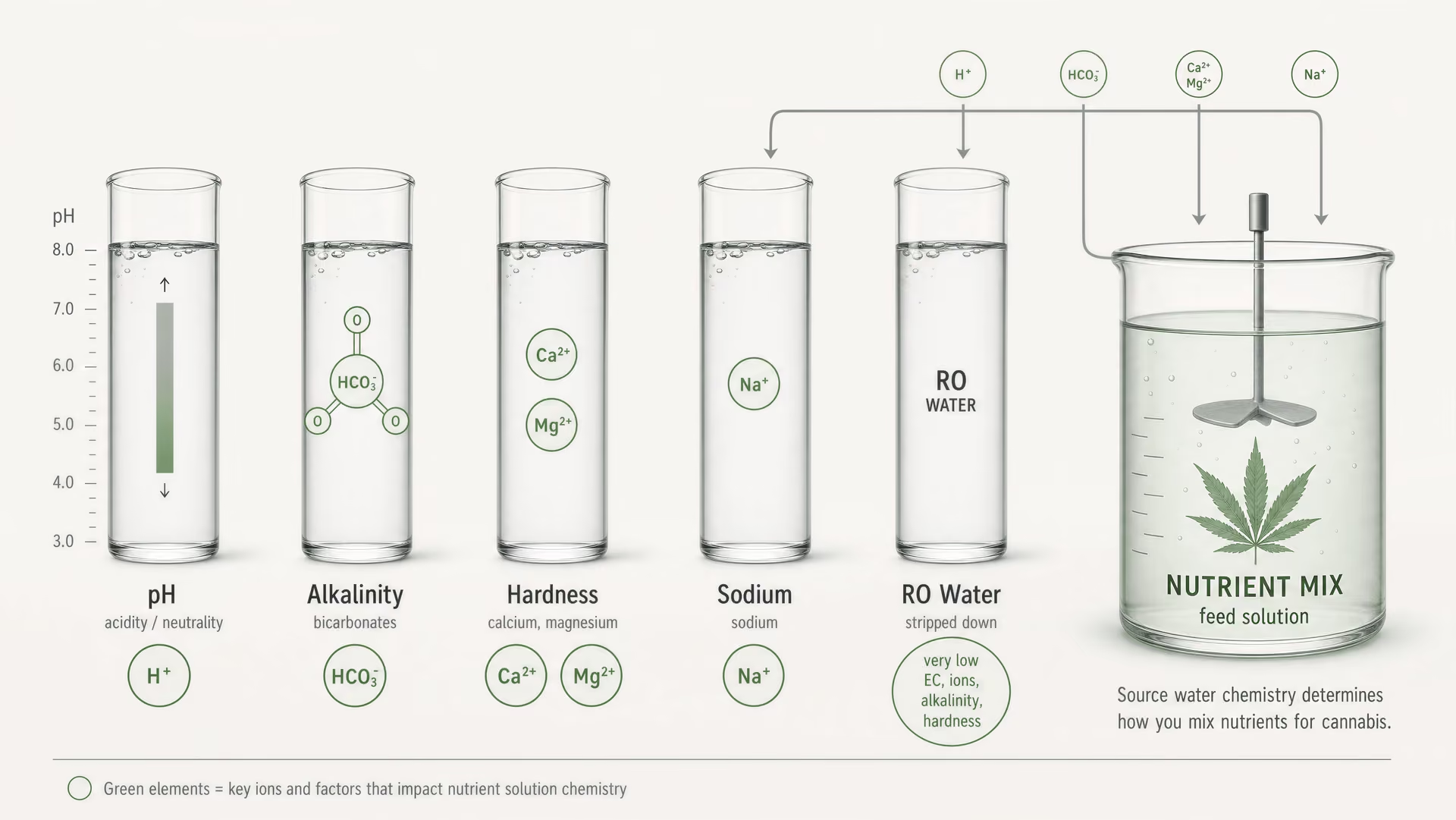
Many growers confuse pH with alkalinity. They are not the same thing.
pH is how acidic or alkaline the water is right now. Alkalinity is the water’s capacity to resist a drop in pH, usually driven by bicarbonates and carbonates. You can have water with a near-neutral pH and still have high alkalinity. That water will keep pushing the root zone upward unless enough acid is added to neutralize the bicarbonates. This is one of the most common reasons a feed mixed “to 5.8” drifts upward in practice.
Hardness is different again. It usually refers to dissolved calcium and magnesium. Hard water may be useful if its Ca and Mg content is known and sodium is low. It can also be a problem if bicarbonates are high, because then the grower is fighting alkalinity while trying not to oversupply calcium. A calcium-rich source can make standard Cal-Mag additions unnecessary or even counterproductive. In coco, where added calcium often is needed, the actual source-water calcium level determines how much supplemental Ca and Mg makes sense. Brand schedules rarely account for this well.
Bicarbonates deserve special attention. High bicarbonate irrigation water raises substrate pH over time. In hydro and coco, that can trigger iron and manganese deficiency symptoms even when those elements are present in the nutrient formula. In soil, limed mixes can buffer this for a while, but not indefinitely. Acid injection is a commercial solution; for smaller-scale growers, source-water testing and appropriate acidification do the same job in principle.
Sodium is often the hidden problem in poor-quality water. It adds EC without feeding the crop, competes with potassium and calcium, and can damage structure in true soils over time. If source water has meaningful sodium, blindly chasing an EC target is dangerous because part of that EC is already “spent” on an unwanted ion.
Reverse osmosis water strips most dissolved minerals out, including bicarbonates, calcium, magnesium, sodium, and chloride. That gives control. It also removes buffer. RO-fed systems can swing faster, and if the nutrient line assumes some background hardness, calcium and magnesium can end up low. Remineralization is the fix, usually by supplying a known amount of Ca and Mg through the base nutrient or a dedicated supplement, then setting pH after mixing. Starting from near-zero EC water is not automatically superior; it is simply predictable.
Predictability is the real goal. Stable source water matters more than brand choice because it determines the baseline chemistry every fertilizer must work against. If the water changes seasonally, the whole feeding program changes with it. A nutrient line that behaves calmly in low-alkalinity water can drift and precipitate in hard, bicarbonate-rich water. A formula that looks balanced in the tank can become calcium-heavy once hard water is counted. That is not a branding issue. It is water chemistry.
For any cannabis garden, regulated or otherwise, local cultivation laws vary by jurisdiction and should be understood before any activity. Agronomically, though, the rule is simple: test the source water first. pH, alkalinity, hardness, sodium, and starting EC set the boundaries for everything that follows. Ignore them, and every deficiency chart becomes guesswork.
Feeding by growth stage: seedlings, vegetative growth, flowering, ripening, and the controversial flush
Stage-based feeding works when it follows plant physiology and root-zone behavior, not a generic bottle chart. A seedling with two small leaves does not need the same EC as a mature plant under strong light and elevated CO2. A flowering plant does not suddenly become a phosphorus sink because the label says “bloom.” Medium matters too: a lightly amended soil can carry a plant longer than coco, while recirculating hydro shows mistakes much faster than either. Cultivation laws vary by jurisdiction, so anyone applying this guidance should understand local rules first.
The practical pattern is simple even if the chemistry behind it is not. Start light while roots establish. Increase nutrition and irrigation frequency as leaf area and root mass expand. In flower, reduce nitrogen from vegetative highs, keep calcium and magnesium available, and push potassium more than phosphorus. Near harvest, manage EC based on plant condition and substrate salt levels rather than on the folklore that all crops must be flushed for one to two weeks.
| Stage | EC range cited | Management emphasis |
|---|---|---|
| Seedlings / early establishment | 0.8 to 1.3 mS/cm | Protect roots; avoid excess osmotic pressure |
| Vegetative growth | 1.2 to 1.8 mS/cm | Support canopy expansion and rising irrigation frequency |
| Flowering | 1.8 to 2.4 mS/cm | Support reproduction without driving excess salts or phosphorus overload |
Seedlings and early establishment: why underfeeding is safer than overfeeding
The most common seedling mistake is trying to “speed up” growth with a strong feed. Young plants are poor candidates for that approach. Their root systems are tiny, transpiration is limited, and the seed itself still supplies part of the early nutritional demand. If the medium is already charged, aggressive feeding can raise osmotic pressure around the roots before the plant can use those ions. That is how a small plant gets burned while a larger one would have been fine.
For most seedlings in inert or lightly fertilized media, an EC around 0.8 to 1.3 mS/cm is a reasonable starting zone, with pH held in the appropriate band for the medium. In hydro and soilless systems, Cornell CEA guidance on nutrient availability lines up with the familiar 5.5 to 6.5 pH window because iron, manganese, zinc, copper, phosphorus, calcium, and magnesium all shift in solubility across that range. Many “hungry” seedlings are not hungry at all. They are sitting in a root zone that is too wet, too salty, or too far out of pH range.
Underfeeding is safer early because a slight deficiency is easier to correct than salt injury or root dysfunction. A pale seedling can usually be brought along with a small increase in feed. A seedling with burned tips, stalled growth, and waterlogged roots may lose a week or never recover fully. That is especially true in coco if the material was not properly buffered, since coir can tie up calcium and magnesium through cation exchange. What looks like weak genetics or damping-off sometimes starts as avoidable root-zone chemistry.
The target in this phase is not fast top growth at any cost. It is root establishment. Moderate moisture, high oxygen around the root zone, stable pH, and low to moderate EC beat heavy fertilizer every time. In soil, that often means watering less often than beginners expect. In plugs, rockwool, or small coco containers, it means avoiding the cycle of saturation and stagnation. Feed lightly. Watch new growth. Increase only when the plant is clearly using what is there.
Vegetative growth: ramping nitrogen, calcium, and irrigation frequency
Vegetative growth is when cannabis can justify a real increase in nutrition. Leaf area expands rapidly, demand for chlorophyll and protein synthesis rises, and nitrogen becomes the dominant macronutrient driver of canopy development. Potassium is also important here, but the plant’s appetite for nitrogen is what most visibly separates a healthy vegging crop from a weak one.
A practical EC range for veg is often about 1.2 to 1.8 mS/cm, sometimes higher in high-light rooms with strong environmental control, but there is no universal number. The same feed strength that works in cool conditions can be excessive in a dim room with poor transpiration. The safer method is to match input EC to runoff or reservoir trends, leaf color, growth rate, and irrigation frequency. EC is blunt. It does not tell you whether the ions are nitrate, potassium, sodium, or chloride. Still, it remains one of the most useful indicators of whether the crop is accumulating salts faster than it is using them.
This is also the phase where calcium mistakes become expensive. Rapidly expanding tissue needs a continuous supply, and calcium moves with transpiration. If the root zone is too wet, oxygen-starved, or high in ammonium, calcium uptake suffers. In coco, the issue is even sharper because the medium can hold onto Ca and Mg unless pre-buffered and consistently supplied. Many growers blame lighting or “cal-mag deficiency” as if it were a standalone event when the deeper problem is a mismatch between medium chemistry, irrigation practice, and nutrient formulation.
As roots fill the container, irrigation frequency should rise. That sentence matters. Many nutrient problems blamed on formula are really irrigation problems. In coco or rockwool, once the root mass is established, more frequent fertigation with appropriate dryback often gives a steadier root-zone EC than large, infrequent irrigations. In soil, the medium buffers more, so the rhythm is slower. One feeding schedule cannot fit all three systems because their water and cation behavior differ too much.
This is the point where brand charts often go off the rails. They push additive after additive when a complete base nutrient and disciplined irrigation would do more good. The real questions are whether the nitrogen form is suitable, whether calcium and magnesium are adequately supplied, whether the micronutrients are chelated, and whether the medium is being irrigated in a way that prevents salt stacking.
Flowering and ripening: shifting ratios without overloading phosphorus
When flower initiation begins, nutrition should shift, but not theatrically. Nitrogen usually comes down from vegetative highs because excessive N can promote leafy flowers, darker overly lush tissue, and delayed ripening. Potassium often deserves more emphasis as reproductive growth develops. Phosphorus should not be treated as a magic yield trigger.
During flowering, potassium often deserves more emphasis than dramatic phosphorus escalation. Limited evidence
This is where a lot of cannabis advice parts company with mainstream controlled-environment plant nutrition. Bruce Bugbee of Utah State University has repeatedly argued that cannabis does not require the extreme phosphorus levels promoted in many grow recipes. That position fits broader horticultural science. Plants need phosphorus, but not in the outsized quantities implied by “bloom booster” culture. Excess P can create antagonism with micronutrients, especially zinc and iron, and can contribute to hidden deficiencies that growers then chase with more bottles.
A practical flowering EC range is often around 1.8 to 2.4 mS/cm, adjusted for cultivar, light intensity, temperature, CO2, and medium. Some heavy-feeding cultivars under intense light can run higher, but trying to drive every plant to the upper edge is how tip burn and salt accumulation start. Watch the whole plant. If leaves are very dark, tips are burning, runoff EC is climbing, and lower leaves are not fading naturally but blotching irregularly, the issue may be excess, not lack.
Ripening is not the same thing as starvation. Late flower often includes some natural senescence, especially modest yellowing as nitrogen is remobilized from older leaves. That does not mean the crop should be stripped of all nutrition weeks in advance. Calcium, magnesium, sulfur, and micronutrients still matter because the plant is still metabolically active. Reducing N somewhat while keeping the root zone balanced makes sense. Flooding the medium with high-phosphorus boosters does not.
| Approach | What growers claim | What the article says |
|---|---|---|
| 7 to 14 day plain-water flush | Cleaner burn, better taste, whiter ash | Claim is popular but weakly supported |
| Reduced EC near harvest | Helps if salts have accumulated or uptake is slowing | Can be rational root-zone management |
| No flush | Risks poor quality if nutrition was mismanaged | Not shown to reduce cannabinoids, terpenes, or yield when feeding was sensible |
Flush before harvest: what growers claim, what the data says, and when reduced EC may still make sense
The common claim is familiar: stop feeding 7 to 14 days before harvest, run plain water, and the flowers will burn cleaner, taste better, and produce whiter ash. The evidence behind that claim is much weaker than its popularity suggests.
The most cited cannabis-specific test is the Rx Green Technologies trial released in 2019. It compared 0, 7, 10, and 14 days of pre-harvest flushing and found no significant differences in yield, cannabinoid content, or terpene content. Sensory results did not provide strong support for the idea that longer flushing created clearly superior product. That does not settle every question for every cultivar and every substrate, but it does undercut the claim that a mandatory one- or two-week flush is universally required.
So the stronger position is this: routine pre-harvest flushing as a quality law is overstated. If a crop has been fed sensibly, with stable pH and controlled EC, there is no solid evidence that replacing nutrient solution with plain water for many days reliably improves chemical composition or sensory quality.
Reduced EC near harvest can still make sense in specific situations. If runoff EC is high from accumulated salts, backing off feed can help bring the root zone back into range. If a plant is clearly finishing and uptake is slowing, maintaining peak feed strength may simply leave unused ions in the substrate. In coco or rockwool, a modest reduction in EC while preserving irrigation control can be a rational finishing strategy. That is not the same as saying plain-water flushing is mandatory. It is simply root-zone management.
The useful question is not “Did you flush?” It is “What was the substrate EC, what was the plant still taking up, and was the crop actually overfed?” That framing fits the data and fits practical fertigation logic.
Soil, coco, and hydroponics are not interchangeable feeding systems
A feeding program only makes sense in the context of the root zone it enters. That is why a bottle chart copied from social media can work in one setup and fail badly in another. Soil, coco, and hydroponics expose roots to nutrients in very different ways. They differ in buffering, cation exchange, oxygen supply, irrigation frequency, pH drift, and how quickly mistakes show up on leaves.
This is also why “just use less in soil” is not a serious translation of a hydro schedule. The chemistry is different. The biology is different. The pace of plant response is different.
If there is one broad rule that survives across all three systems, it is this: nutrient concentration, pH, and irrigation strategy matter more than any brand’s stage-by-stage chart. Bruce Bugbee of Utah State University has repeatedly argued that cannabis growers often overapply phosphorus, especially in bloom. That criticism lands even harder once you separate media properly, because excess phosphorus in a buffered soil is not the same event as excess phosphorus in a recirculating hydro reservoir. In both cases it can drive antagonism with iron and zinc. The timing, severity, and fix are not the same.
Cultivation laws vary by jurisdiction, so anyone applying cannabis-specific growing advice should understand local law first.
Why soil feeding cannot be translated directly from hydro charts
- Buffering Soil adsorbs and releases nutrients more slowly than inert media.
- Mineralization Microbes convert organic nutrients into plant-available ions over time.
- Slower response Symptoms and corrections both take longer than in hydro.
- Bottle mismatch A schedule written for inert media can overfeed a nutrient-contributing soil.
Soil and living soil: buffering, mineralization, microbial mediation, and the limits of bottle schedules
Soil is not simply a place to hold roots upright. Even a relatively plain potting soil has cation exchange capacity, organic matter, native mineral fractions, and some ability to buffer pH and nutrient swings. In a biologically active “living soil,” those effects become much stronger because microbes and fungi mediate mineralization: they convert organic nitrogen, sulfur, and other nutrients into plant-available forms over time.
That buffering changes everything. A soil-grown plant usually does not react to feeding mistakes as fast as a hydro-grown plant because the root zone is not seeing every input as an immediate dissolved salt event. Some nutrients are adsorbed onto exchange sites. Some remain tied up in organic matter until biology processes them. Some are released gradually. Symptoms often arrive later, and that can fool growers into thinking the system is forgiving. It is more buffered, yes. It is not magic.
Bottle schedules often fail in soil because they assume the substrate contributes nothing. Real soil does contribute. It may already contain nitrate, ammonium, phosphorus, potassium, calcium, magnesium, and sulfur. Compost, worm castings, manures, meals, and mineral amendments continue releasing nutrients after you stop adding liquid feed. A generic “week 5 bloom” recipe that might be tolerable in inert media can push soil EC too high and create salt accumulation, especially in containers with poor leaching.
Living soil pushes this even further. The plant is not fed only by what went into the irrigation can this morning. It is fed by a biological system that depends on moisture consistency, oxygen, temperature, and pH. Heavy doses of mineral salt fertilizer can disrupt that system. So can repeated wet-dry extremes. “Feed-water-water” formulas borrowed from coco or hydro miss the point if the root zone is meant to function as a mineralizing ecosystem.
This does not mean soil growers can ignore pH or EC. It means they should interpret them differently. Soil’s pH window is often broader than hydro’s because the medium buffers better, but pH still governs availability. UC Agriculture and Natural Resources materials on plant mineral nutrition have long shown that iron, manganese, zinc, phosphorus, calcium, and magnesium all shift in availability as pH changes. Many yellowing problems blamed on nitrogen shortage are really lockout, root stress, or overwatering.
The practical effect is slower symptom onset and slower correction. If a soil grower overdoes potassium for several irrigations, magnesium uptake may decline through antagonism, but the problem can take time to declare itself. Once it does, the fix is also slower because the medium still contains the excess. You are steering a heavier ship.

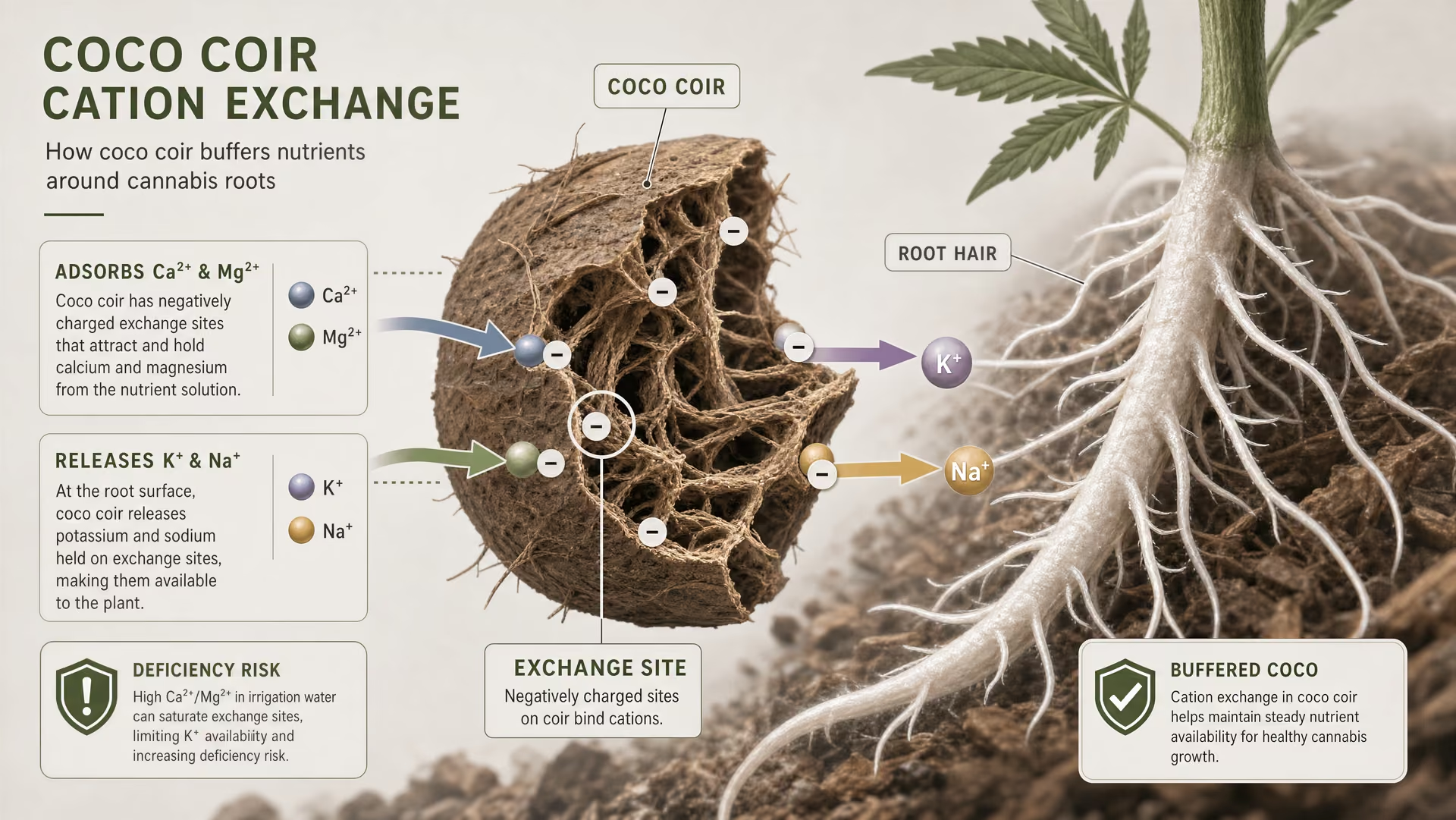
Coco coir: cation exchange, calcium-magnesium buffering, and frequent low-volume fertigation
Coco is often treated as “soil but faster.” That shorthand causes a lot of preventable problems. Coco is a soilless substrate, not a true soil, and its chemistry has one especially important quirk: cation exchange behavior that strongly affects calcium and magnesium.
Raw or poorly buffered coir tends to hold onto calcium and magnesium while releasing potassium and sodium. That exchange pattern is why growers so often see early Ca/Mg issues in coco. The medium itself can compete with the plant for those ions until exchange sites are satisfied. This is one of the clearest, most practical distinctions between coco and more inert substrates like rockwool.
A proper coco program usually accounts for that from the start. Pre-buffered coco helps, but it does not remove the need to think about calcium and magnesium in the fertigation plan. The nutrient line matters less than the formulation. Is there adequate calcium? Adequate magnesium? What is the potassium level relative to them? Excess potassium can further impair calcium and magnesium uptake, so blindly adding bloom boosters to coco is a common way to manufacture deficiency symptoms.
Coco also behaves best with frequent low-volume fertigation rather than alternating full-strength feed days with plain-water days. Because it is a soilless substrate with high air-filled porosity—often around 30% to 45% at container capacity depending on processing and particle size—it can support frequent irrigation while still keeping roots oxygenated. That physical property is one reason coco became so popular. But the same trait means the root zone is managed more like hydro than like peat-heavy soil.
Plain water in coco is often counterproductive once the plant is established. Repeated low-EC watering can destabilize the nutrient balance around the roots, contribute to pH drift, and strip ions from the substrate in uneven ways. A better default is consistent, appropriately diluted fertigation with runoff, especially in high-frequency irrigation setups. Seedlings and fresh transplants are the exception: they are easy to overfeed, and practical nursery ranges around 0.8 to 1.3 mS/cm are often safer during establishment than jumping straight to aggressive vegetative EC.
As the plant grows, many cultivars in coco perform well within broad greenhouse-style ranges such as roughly 1.2 to 1.8 mS/cm in vegetative growth and 1.8 to 2.4 mS/cm in flowering, but those are not commandments. Environment, CO2, cultivar vigor, pot size, and irrigation frequency all shift the usable range. EC is only total dissolved salts; it cannot tell you whether the solution is balanced.
Hydroponics and recirculating systems: direct uptake, faster growth, and faster mistakes
Hydroponics strips away much of the root-zone buffer. That is the appeal and the risk. Nutrients are delivered in dissolved form directly to roots in water, so uptake can be fast, growth can be fast, and corrections can be fast. So can disasters.
In deep water culture, aeroponics, nutrient film technique, and recirculating drip, roots are exposed to a tightly controlled solution where pH, EC, temperature, dissolved oxygen, and microbial load all matter every day. Cornell CEA guidance has long treated the 5.5 to 6.5 pH band as the useful working range for hydroponic crops because nutrient availability shifts quickly outside it. Cannabis follows that same chemistry. A plant can look deficient in iron, manganese, magnesium, or calcium while sitting in a reservoir full of those nutrients if pH has drifted out of range or root health has declined.
Hydro mistakes appear quickly because there is little cushion. Overconcentrated feed can burn tips within days. Underfeeding can flatten growth just as fast. Root disease can turn from subtle to catastrophic in a short window if solution temperature rises and dissolved oxygen falls. Reservoir hygiene is not optional here. Biofilm, dead roots, light leaks, and unstable temperatures all undermine nutrient uptake before the leaves tell you what is happening.
- Reported primary metrics
- EC and pH
- Share of U.S. hydroponic vegetable growers
- 66%
- Why it matters
- Hydro offers little buffering, so small chemistry errors show quickly
Recirculating systems add another layer: the plant changes the solution as it feeds. It may pull nitrate faster than calcium, potassium faster than magnesium, or water faster than ions, depending on stage and climate. That means the reservoir you mixed on Monday is not the same reservoir on Thursday. Regular verification matters. Measure pH. Measure EC. Check water temperature. Inspect roots. In 2024, 66% of U.S. hydroponic vegetable growers reported using EC and pH as primary fertigation monitoring metrics; that is not glamorous advice, but it reflects how controlled-environment crops are actually managed.
Hydro also exposes the weakness of universal bloom charts. If a schedule drives phosphorus very high during flowering, the plant may not reward you with bigger flowers; it may simply encounter more antagonism and less stable chemistry. Bugbee’s criticism of phosphorus excess applies strongly here. Potassium demand often rises materially in flower. Phosphorus demand is usually less dramatic than popular cannabis lore suggests.
The upside is precision. The downside is that precision has to be earned every day.
Organic versus synthetic cannabis nutrients: what changes in the root zone, and what does not
The argument is usually framed as “organic versus synthetic,” as if the plant is choosing sides. It is not. Roots take up nitrogen as nitrate or ammonium, potassium as K+, calcium as Ca2+, magnesium as Mg2+, phosphate as H2PO4- or HPO4^2-, and so on. They do not absorb “natural” in one channel and “chemical” in another. That matters because a lot of feeding advice treats labels as agronomy. The root zone does not care about branding language; it cares about ion supply, oxygen, pH, moisture, temperature, and salt load.
What changes between organic and synthetic programs is not the basic chemistry of uptake. What changes is how nutrients arrive in plant-available form, how fast the grower can correct a problem, and how much of the system’s behavior is mediated by biology and substrate buffering.
Organic nutrition: mineralization, biology, and slower correction speed
In an organic system, a significant share of fertility begins in forms the plant cannot use immediately. Nitrogen may be tied up in proteins, amino compounds, manures, seed meals, composts, or microbial biomass. Phosphorus can be bound in organic matter or sparingly soluble mineral forms. Before roots can take those nutrients up, microbes have to mineralize them into soluble ions. That makes the root zone a biological reactor as much as a feeding reservoir.
When it works, this can be stable and forgiving. A biologically active soil with decent cation exchange capacity buffers swings in EC and pH better than a bare mineral-salt solution in rockwool. It can also reduce the whiplash novice growers create when they chase leaf color with constant bottle adjustments. But there is a tradeoff. Corrections are slower. If a crop shows nitrogen deficiency in a living soil, the answer is rarely as simple as adding more total nitrogen on paper. Mineralization rate depends on temperature, moisture, oxygen, carbon-to-nitrogen ratio, and microbial activity. Cold, wet media can test “fertile” and still feed poorly.
This is why organic systems tend to fit soil better than recirculating hydro. Soil contributes buffering, habitat, and surfaces for nutrient exchange. In hydroponics, where Cornell CEA and University of Arizona CEAC guidance emphasizes direct control of pH and EC, relying on ongoing microbial conversion is harder to manage cleanly and consistently. Organic inputs can also vary more from batch to batch and often store less predictably once mixed into solution.
There is another misconception here: “organic” does not mean immunity from excess. Overapplying guano, fish hydrolysate, compost teas, or dry amendments can still create salinity issues, ammonium stress, or phosphorus excess. Bruce Bugbee has repeatedly argued that cannabis phosphorus demand is commonly overstated, and that aligns with broader horticultural nutrition literature. Push phosphorus too hard and zinc or iron uptake can suffer, even in an organic bed.
Synthetic mineral salts: precision, predictability, and higher salinity risk
Synthetic mineral programs are built around soluble ions that are already plant-available or nearly so. That is why they are faster. If magnesium is low in a fertigated coco crop, magnesium sulfate can change the root-zone solution immediately. If calcium is being outcompeted by excess potassium, the recipe can be rebalanced in the next irrigation. This precision is the main reason mineral salts dominate commercial hydroponics and fertigation.
Predictability is the second advantage. A mineral formulation can be analyzed, repeated, and monitored with ordinary tools. EC is imperfect because it measures total dissolved salts rather than specific ions, but it is still useful. Greenhouse research and extension guidance have shown that EC management tracks overfeeding risk reasonably well. In practice, many cannabis “nutrient burn” cases are salt accumulation cases. The tips burn not because a brand was “too strong” in the abstract, but because irrigation frequency, runoff fraction, climate, and substrate chemistry allowed salts to build.
That same precision makes synthetic systems less forgiving. Miss the pH in hydro or coco and apparent deficiencies can appear fast. Cornell’s commonly cited hydro range of pH 5.5 to 6.5 exists for a reason: iron, manganese, zinc, copper, calcium, magnesium, and phosphorus all shift in availability across that band. A plant can sit in a nutrient-rich solution and still show chlorosis if pH is wrong. Coco adds another layer. Its cation exchange behavior tends to adsorb calcium and magnesium unless properly buffered, which is why Ca/Mg issues are so common there and much less common in inert rockwool under the same recipe.
Storage stability tends to favor synthetic concentrates, though compatibility still matters. Calcium nitrate cannot be concentrated in the same stock as sulfates or phosphates without precipitation risk. Micronutrient chelation matters too. These are formulation questions, not ideological ones.
The false binary: many successful cannabis systems combine both approaches
Real-world systems often mix methods because each solves a different problem. A soil grow may use compost and dry amendments as the fertility base, then correct with a soluble calcium or magnesium input when demand outruns mineralization. A coco grow may run mostly mineral fertigation but include humic substances, amino products, or microbial inoculants aimed at rooting and rhizosphere function. Whether those additives help depends on the medium and management, not on the romance of the label.
This blended approach is often more honest than either camp’s slogans. Organic-heavy systems usually trade speed for buffering. Mineral-heavy systems trade buffering for control. Neither changes the basic fact that the crop responds to root-zone chemistry. Nutrient concentration, ratio, pH, oxygenation, and irrigation strategy still decide outcomes.
That is also why universal feeding charts fail so often. A recipe that works in a buffered soil with intermittent irrigation can be excessive in coco fed multiple times per day, and dangerously unstable in recirculating hydro. Seedlings, as commercial propagation practice repeatedly shows, need lower EC than established plants. Flowering crops often need more potassium, but not the cartoonishly high phosphorus sold in bloom folklore. And late-harvest management should not be confused with mandatory flushing. The Rx Green Technologies 2019 trial found no significant differences in cannabinoids, terpenes, or yield among 0-, 7-, 10-, and 14-day flush treatments.
So the useful question is not “organic or synthetic?” It is: what medium is being used, how buffered is it, how fast must corrections happen, and how tightly can the root zone be monitored? The answer changes the feeding strategy more than the label ever will.
Nutrient deficiencies, toxicities, and antagonisms in cannabis
Deficiency diagnosis in cannabis is less about memorizing leaf photos and more about reading a pattern. Where the symptom starts matters. How fast it spreads matters. Whether the medium is soil, coco, or hydro matters even more than many growers think. A pale plant can be underfed, overfed, locked out by pH, or sitting in a root zone that is too wet and low in oxygen. Those problems can look deceptively similar above ground.
That is why the first question should not be “what bottle am I missing?” It should be: what changed in the root zone?
A practical framework helps. Check symptom location, recent feed strength, runoff or reservoir EC, root-zone pH, irrigation frequency, and the medium’s chemistry. In hydro and soilless culture, Cornell CEA guidance keeps the common pH target for most crops around 5.5 to 6.5 because nutrient availability shifts sharply outside that band. EC is only a total-salts reading, not a nutrient breakdown, but it still flags overfeeding and salt accumulation well enough to prevent many self-inflicted problems.
| Symptom location or pattern | Primary suspects in the article | Important caution |
|---|---|---|
| Old leaves first | Nitrogen, magnesium, sometimes potassium | Can also reflect natural senescence or root stress |
| New leaves first | Calcium, iron, sulfur, certain micronutrients | Check pH before assuming the nutrient is absent |
| Leaf margins scorched | Potassium deficiency or salt stress | High EC shifts suspicion toward excess |
| Burned tips | Overfeeding / high total salts | Often the earliest common sign of excess EC |
| Interveinal chlorosis on old leaves | Magnesium | Antagonism from excess potassium is common |
| Interveinal chlorosis on new leaves | Iron | Often caused by elevated pH rather than low iron supply |
How to diagnose by symptom location: old leaves, new leaves, margins, tips, and interveinal patterns
Start with leaf age. Mobile nutrients can be moved by the plant from older tissue to new growth, so shortages show first on old leaves. Immobile or weakly mobile nutrients tend to show first on new growth.
Old leaves affected first points toward nitrogen, magnesium, and sometimes potassium. If lower leaves yellow evenly from the tip inward while new growth stays greener, nitrogen deficiency is plausible. If lower leaves show interveinal chlorosis, where veins remain green but the tissue between them yellows, magnesium is more likely.
New leaves affected first points toward calcium, iron, sulfur, and certain micronutrients. Twisted new growth, misshapen tips, and local necrosis often suggest calcium problems. Very pale new growth with green veins suggests iron deficiency or iron lockout.
Leaf margins tell a different story. Scorched or necrotic edges are classically associated with potassium deficiency, but margin burn also appears in salt stress. The distinction is context: if EC is high and tips are burned across the canopy, think excess before deficiency.
Burned tips are a red flag for overfeeding. Mild tip burn alone does not mean disaster, but it is the earliest common sign that fertilizer concentration is pushing beyond what the plant can use under current light, temperature, and irrigation conditions. Widespread tip burn plus very dark leaves usually means excess nitrogen or excess total salts.
Interveinal chlorosis narrows the field. On old leaves, think magnesium first. On new leaves, think iron first. If the whole plant looks hungry but EC is already high, induced deficiency from antagonism or pH lockout is more likely than true underfeeding.
The most common diagnostic mistake is treating every yellow leaf as nitrogen deficiency. Yellowing can come from overwatering, root disease, cold roots, high EC, bad pH, natural late-flower senescence, or simple light deprivation in the interior canopy. Another routine mistake is chasing symptoms bottle by bottle while ignoring medium-specific behavior. In coco, for example, calcium and magnesium issues are common because coir has a meaningful cation exchange capacity and can adsorb Ca and Mg unless properly buffered. What looks like a “hungry plant” may actually be a substrate chemistry problem.
The most common true deficiencies: nitrogen, magnesium, calcium, iron, potassium
Nitrogen deficiency usually starts on older, lower leaves. They lose green color evenly, not in a striped pattern, and may eventually yellow fully and drop. Overall growth slows. Stems may redden in some cultivars, though stem color is too genetic and environment-dependent to use as a main diagnostic sign. True nitrogen deficiency is common in underfed vegetative plants and less alarming late in flower, when some lower-leaf fade is normal. But dark green leaves with clawing are not nitrogen deficiency; they are often excess nitrogen.
Magnesium deficiency commonly appears as interveinal chlorosis on older leaves first. The leaf tissue between veins turns lime green to yellow while veins remain darker. Rusty spotting can follow. In cannabis, magnesium issues are frequent in coco and in feeds overloaded with potassium, because excess K can suppress Mg uptake. This is the classic induced deficiency: magnesium may be present in the solution, yet unavailable in practice because another ion is dominating uptake dynamics.
Calcium deficiency hits newer growth first because calcium is poorly mobile in the plant. Look for twisted or irregular young leaves, necrotic specks, weak shoot tips, and in severe cases stalled growth. Calcium problems are especially common in coco that was not adequately buffered or in systems using soft or reverse-osmosis water without proper Ca supplementation. Excess ammonium can also suppress calcium uptake. So can chronic overwatering, because calcium transport depends heavily on transpiration and healthy root function. A plant can show calcium-like symptoms even when the feed label says plenty of Ca is present.
Iron deficiency usually shows as bright chlorosis in the newest growth while veins remain green. It often looks dramatic at the top of the plant. In hydro and soilless setups, iron deficiency is very often not a shortage of iron in the tank but a pH problem. As pH rises, iron availability drops sharply. Bruce Bugbee has repeatedly argued that cannabis feeding recipes often overdo phosphorus; one reason that matters is antagonism. Excess phosphorus can contribute to micronutrient issues, including iron and zinc availability problems.
Potassium deficiency tends to show on older leaves as marginal chlorosis progressing to scorch, with weak stems and reduced vigor. Demand for potassium does increase substantially through active growth and flowering, but many growers misread salt burn as K deficiency because both can involve edge damage. A low-EC root zone with pale margins supports deficiency. A high-EC root zone with crispy tips and dark foliage points toward excess salts instead.
True phosphorus deficiency is less common than internet charts suggest. That matters because “bloom booster” logic often pushes phosphorus far beyond crop need. Controlled-environment crop science, including comments from Bugbee and general hydroponic literature, supports a more restrained view: cannabis needs phosphorus, but not in the exaggerated quantities often promoted. Too much P can create new problems faster than it solves old ones.
Toxicities and induced deficiencies: nutrient burn, dark clawed leaves, salt buildup, and lockout
Toxicity symptoms often arrive disguised as deficiency symptoms. That is the trap.
Nutrient burn usually starts at the leaf tips. The very end of the leaf turns yellow or brown, then necrosis advances if high EC persists. In mild cases, growth can still be strong. In more severe cases, leaves become brittle, margins scorch, and the plant drinks poorly because osmotic stress makes water uptake harder. If runoff EC in container culture is substantially higher than input EC, salts are accumulating in the medium. That is not a “feed more” situation.
Dark clawed leaves are strongly associated with excess nitrogen, especially ammoniacal nitrogen, though overwatering can produce some similar droop. The leaves turn deep green, tips hook downward, and growth can become lush but weak. This is often misdiagnosed as “healthy vigor” until flower quality suffers. Excess nitrogen also delays maturation and can worsen susceptibility to other imbalances.
Salt buildup is the hidden engine behind many lockout cases. Repeated feeding without enough runoff in coco, poor irrigation uniformity, high evaporation from small pots, or long drybacks can concentrate salts around roots. EC rises. The plant then behaves hungry because uptake is impaired, not because nutrients are absent. University of Arizona CEAC and greenhouse fertigation work have long treated EC as a practical control metric for exactly this reason. It is blunt, but useful. If the root zone is too salty, adding more fertilizer rarely fixes the symptom.
Lockout is grower slang, but the mechanism is real. It can mean pH-induced unavailability, osmotic suppression from excess salts, antagonism between ions, or root damage that prevents uptake. A plant with lockout symptoms may be sitting in a reservoir full of nutrients it cannot access. High pH commonly triggers iron and manganese issues. Low pH can impair calcium, magnesium, and phosphorus dynamics and increase risk of micronutrient excess. Excess potassium can induce magnesium and calcium deficiency. Excess phosphorus can interfere with iron and zinc. Excess ammonium can reduce calcium uptake. These are not edge cases. They are routine troubleshooting territory.
Root stress ties the whole picture together. Waterlogged media, low root-zone oxygen, cold substrate, root pathogens, and severe drybacks all reduce nutrient uptake and mimic deficiency. Coco and hydro generally show changes faster than soil because buffering is lower. Soil can mask mistakes longer, then release them more slowly.
The practical rule is simple: before correcting a “deficiency,” rule out excess EC, bad pH, and damaged roots. If the medium is out of range, the leaf symptom is often only the smoke, not the fire. Cultivation laws vary by jurisdiction, so anyone applying these practices should understand local rules before engaging in cannabis-related activity.
Feeding schedules and nutrient products: how to evaluate brands without treating charts as law
Brand feeding charts are usually written as if every plant, every light level, and every root zone behaves the same. They do not. A schedule printed on a bottle is a starting suggestion, not plant physiology. The real questions are simpler and more useful: what ions are being supplied, in what ratio, at what EC, in which medium, at what pH, and with what irrigation frequency?
That matters because the same bottle line can work reasonably well in buffered soil, run too hot in coco with infrequent watering, and become a lockout factory in hydro if pH drifts. Cornell Controlled Environment Agriculture guidance for hydroponics keeps returning to the same point: pH and concentration management drive availability. A bottle chart cannot see your runoff EC, root oxygen, or cultivar appetite.
The other problem is that many schedules are additive pyramids. Base nutrient, Cal-Mag, root stimulator, silica, bloom booster, sweetener, enzyme blend, finish product. By the end, the grower may be stacking duplicate potassium, phosphorus, magnesium, and sulfur sources without realizing it. EC rises, antagonisms appear, leaf tips burn, and the chart gets blamed for being “aggressive” when the real issue was total salt load and redundant inputs.
| System type | Main advantage | Main limitation or risk |
|---|---|---|
| One-part | Simple mixing and convenience | Less flexibility; concentrated compatibility constraints |
| Two-part | Separates incompatible calcium from sulfates/phosphates | Still requires correct mixing order and discipline |
| Three-part | More control over stage-specific ratios | Makes overcorrection easier if used reactively |
One-part versus two-part versus three-part systems
One-part feeds are convenient. Everything is in one bottle or powder, the mixing process is simpler, and they can work well in soil or low-complexity gardens. The limitation is chemistry. Calcium does not coexist happily in concentrated solution with sulfate or phosphate salts; given enough concentration, insoluble precipitates form. Once that happens, those nutrients are no longer available to the plant. That is why hydroponic fertilizers often separate “Part A” and “Part B.”
In a typical two-part system, calcium nitrate and iron chelates sit in one bottle, while phosphates and sulfates sit in the other. They stay soluble in concentrate form, then dilute safely in water. This is not branding theater. It is compatibility management.
Three-part systems go a step further by separating growth-related nitrogen from bloom-oriented potassium and phosphorus, giving the user more control over ratios across stages. That flexibility can be useful, especially in hydro or coco, but it also makes overcorrection easier. Many growers respond to the first sign of flowering by slashing nitrogen and flooding phosphorus. Bruce Bugbee has repeatedly argued that cannabis phosphorus demand is often exaggerated and that many recipes push far more P than the crop requires. Excess phosphorus is not harmless; it can suppress zinc and iron uptake and create deficiency symptoms in a plant sitting in a nutrient-rich reservoir.
So which format is “better”? None by default. One-part formulas trade flexibility for simplicity. Two-part systems solve incompatibility issues cleanly. Three-part systems allow ratio tuning but demand more discipline. The right choice depends less on marketing and more on whether you need precision, whether your medium already contributes nutrients, and whether you are likely to measure EC and pH consistently.
Cal-Mag supplements, bloom boosters, silica, enzymes, and other common additives
Cal-Mag is not nonsense, but it is badly overprescribed. It is most justified in coco coir, where cation exchange sites can tie up calcium and magnesium unless the coir was properly buffered. It also makes sense when using very soft water or reverse osmosis water with a base nutrient that assumes some background hardness. Outside those cases, routine Cal-Mag use can create excess calcium, excess nitrate, or both.
Bloom boosters deserve more skepticism than they usually get. Many are just concentrated phosphorus and potassium. If the base nutrient already supplies adequate PK, the “booster” may simply raise EC and distort ratios. Since cannabis often needs less extra phosphorus than online lore suggests, adding a heavy PK product just because flowers are forming is not automatically agronomic. Potassium demand can rise during flowering. That does not mean every bloom bottle is justified.
Silica is more defensible, especially in hydroponic and soilless systems where soluble silicon is often low. It may improve stem strength and stress tolerance in many crops, including cannabis, but it is not a rescue product. It also raises pH in some formulations, so it belongs in the mixing plan, not as an afterthought.
Enzymes, carbohydrate products, microbial blends, and “finish” additives often have the weakest case. Some may help under specific substrate conditions, especially with dead root material or biologically active media, but many schedules treat them as mandatory despite thin evidence. If a base nutrient is complete and the root zone is healthy, additive-heavy programs often duplicate nutrients already present in the feed.
How to compare nutrient labels
- Check nitrogen forms Separate nitrate-N, ammoniacal-N, and urea-N when listed.
- Look beyond NPK Confirm calcium, magnesium, sulfur, and full micronutrient coverage.
- Review chelation Iron form matters, especially across different pH ranges.
- Compare concentration Judge the amount needed to reach the same target, not bottle size.
- Match the medium A complete approach in soil may be incomplete or imbalanced in coco or hydro.
How to read a guaranteed analysis and compare products rationally
Ignore the label art. Read the guaranteed analysis.
Start with the NPK numbers, but do not stop there. Check total nitrogen and its forms: nitrate-N, ammoniacal-N, and sometimes urea-N. In hydro and coco, nitrate-dominant nitrogen is generally safer and more predictable than heavy ammonium or urea loading. Too much ammonium can suppress calcium uptake and contribute to soft growth.
Next, look for calcium, magnesium, and sulfur. Many deficiency complaints are really failures to notice that the base feed contains little or none of one of these. Then check micronutrients: iron, manganese, zinc, copper, boron, and molybdenum. Chelated forms matter, especially iron. Fe-DTPA and Fe-EDDHA stay available across different pH ranges better than weaker chelation systems.
After that, compare concentration, not bottle size. A product with lower percentages may require far more volume to hit the same ppm, and that matters for cost, mixing accuracy, and salt accumulation. Also check whether the product is actually complete. Some “bloom” formulas are not stand-alone nutrients at all; they assume another base feed is present.
Finally, compare the label to your medium. Soil can buffer mistakes and may supply some nutrients through mineralization. Coco often needs deliberate Ca and Mg planning. Hydro has little buffer and shows errors fast. If a schedule ignores those differences, treat it with caution.
A rational nutrient choice is boring. Complete formulation, compatible chemistry, sensible micronutrients, clear analysis, and a schedule you are willing to cut back when plant response or runoff EC says it is too much. That is a better framework than brand loyalty. Laws on cannabis cultivation vary by jurisdiction, so anyone applying this information should understand local rules before doing so.
Troubleshooting common cannabis feeding problems
Most feeding problems do not begin in the bottle. They begin in the root zone.
That distinction matters because cannabis symptoms are visually repetitive. Yellow leaves can mean nitrogen deficiency, yes, but they can also mean oxygen-starved roots, pH-induced iron lockout, chronic overwatering, salt accumulation, or ordinary late-flower senescence. Burnt tips can signal excessive EC, but the same plant may also curl or stall because the medium stays too wet between irrigations. Many growers respond by adding more fertilizer. That often makes a root problem worse.
Cannabis also reacts differently depending on substrate. Soil has buffering and biological mineralization. Coco behaves more like a managed soilless substrate with strong calcium and magnesium implications because of its cation exchange behavior. Hydro and rockwool show problems faster because the root zone has little chemical buffer. Universal feeding charts ignore that difference, which is why they fail so often.
Cultivation laws vary by jurisdiction, so anyone applying feeding guidance should understand local rules first.
Yellowing leaves: deficiency, senescence, overwatering, or pH lockout?
Start with pattern and plant age.
If older, lower leaves are paling first during vegetative growth, nitrogen deficiency is plausible. Nitrogen is mobile, so the plant reallocates it from older tissue to newer growth. But “yellow leaves = add nitrogen” is still too simple. If the medium is waterlogged, roots cannot maintain uptake even when nitrogen is present. The plant looks hungry while sitting in fertilizer.
Late in flowering, lower-leaf yellowing can be normal senescence. That is not the same as a deficiency that needs correction. As flowers mature, cannabis often remobilizes nitrogen from fan leaves. If the yellowing is gradual, concentrated on older foliage, and the plant is otherwise finishing normally, forcing a late nitrogen correction can delay ripening and leave tissue excessively green.
Now compare that with pH lockout. In hydroponics and soilless systems, the standard 5.5 to 6.5 range is grounded in nutrient availability data, not superstition. Cornell CEA guidance uses that same general band because iron, manganese, zinc, copper, calcium, magnesium, and phosphorus all shift in availability across it. A plant fed at adequate EC can still become chlorotic if root-zone pH drifts out of range. New growth that turns pale or yellow while older leaves remain relatively green points more toward iron-related lockout than simple nitrogen shortage.
Overwatering has its own look. Leaves may appear swollen, heavy, and dull rather than dry and papery. The medium stays wet too long. Growth slows. The yellowing can be diffuse because the real issue is poor root-zone oxygenation. In peat-heavy mixes or oversized containers, this is common. In coco, frequent irrigation can work well, but only if the substrate structure, runoff volume, and dryback are appropriate. Constant saturation without enough air exchange still causes trouble.
So ask four questions before changing feed: - Which leaves yellowed first: old or new? - What growth stage is the plant in? - Is the medium drying at a normal rate? - Is root-zone pH actually in range?
Without those answers, diagnosis is guesswork.
Leaf tip burn, tacoing, rust spots, and stalled growth
Tip burn usually means salts are too concentrated at the root surface. EC is not a full nutrient analysis, but it is still useful. If inflow EC is moderate and runoff or reservoir EC is climbing, salts are accumulating faster than the plant is using water and ions. That can happen from overfeeding, under-irrigation, high evaporation, poor runoff management, or all four at once. The first sign is often just browned tips. Push further and leaves darken, claw, and lose vigor.
Tacoing is less specific. Upward-curling leaf margins are often driven by environment before nutrients: excessive leaf temperature, high light intensity, low humidity, or strong airflow. Bruce Bugbee has repeatedly argued that growers blame nutrients for symptoms caused by environment and overlit canopies. If leaves taco near the top under intense light, check canopy temperature and vapor pressure deficit before reaching for calcium bottles.
Rust spots are where many growers get lost. Calcium deficiency, magnesium deficiency, pH lockout, and root damage can all produce necrotic spotting. In coco, calcium and magnesium issues are especially common because coir can adsorb these cations unless it was properly buffered. A feed program that works in rockwool may underdeliver available Ca and Mg in coco. But even here, more Cal-Mag is not automatically the answer. Excess potassium can antagonize magnesium and calcium uptake. Excess ammonium can suppress calcium uptake. Excess phosphorus can interfere with micronutrients such as zinc and iron. What looks like deficiency may be induced deficiency caused by imbalance.
Stalled growth narrows the field. Seedlings are often simply overfed. Commercial propagation practice for annuals and cannabis nursery stock supports lower EC early on, then gradual increases as roots establish. A seedling in 0.8 to 1.3 mS/cm is in a very different situation from a mature flowering plant at 1.8 to 2.4. If a young plant stalls after a strong feed, do not assume it needs “more bloom” or “more root stimulator.” It may need less total salt and better oxygen around the root zone.
A stepwise troubleshooting workflow: water first, roots second, chemistry third, nutrients last
A disciplined workflow prevents panic corrections.
First, verify environment. Check canopy temperature, root-zone temperature, relative humidity, VPD, and light intensity. If leaves are canoeing under high PPFD and hot tops, feeding changes may do nothing. If the room is cool and wet, roots may be functioning slowly even with a sound recipe.
Second, inspect irrigation and roots. Is the plant drinking? Is the container still heavy after an unusually long interval? In hydro, are roots white to cream colored, or tan, slimy, and sour-smelling? In soil and coco, gently inspect the root ball if possible. Healthy roots are firm and active. Diseased or chronically waterlogged roots do not recover because you raised EC.
Third, measure chemistry rather than guessing. Test source water pH, alkalinity if known, and EC. Hard water changes calcium, magnesium, and bicarbonate loading. Soft or reverse-osmosis water changes them in the opposite direction. Then test feed solution and, where relevant, runoff or reservoir. Remember what EC can and cannot tell you: it indicates total dissolved salts, not which ions are present. A high EC could reflect useful nitrate and potassium, or harmful accumulation from repeated poor runoff.
Fourth, review the substrate. In soil, pH drift may be buffered and slower to express. In coco, poor buffering and inadequate Ca/Mg provision are common. In hydro and rockwool, symptoms appear fast because there is little reserve. One schedule cannot fit all three.
Only fifth should you adjust nutrients. And even then, change one variable at a time. If the problem is mild salt buildup, reset the root zone with a lower-EC balanced solution rather than plain-water flooding. This matters especially in coco and hydro. Plain water can destabilize osmotic conditions, strip the medium of useful ions, and worsen imbalances. A mild nutrient solution, often around seedling-to-light-veg strength with correct pH, is usually a cleaner reset. In hydro reservoirs, replacing with a fresh, correctly mixed solution is often better than trying to rescue a drifting one through repeated add-ons.
The same logic applies near harvest. The 2019 Rx Green Technologies flushing trial found no significant differences in cannabinoid content, terpene content, or yield among 0, 7, 10, and 14-day flush treatments. That does not mean overfed plants should finish in a salty root zone. It means mandatory plain-water flushing is not a universal fix and should not replace proper EC management all the way through flower.
Stepwise troubleshooting workflow
- Environment Check heat, light, humidity, airflow, and VPD first.
- Watering practice Review frequency, dryback, runoff, and reservoir condition.
- Roots Inspect root color, smell, vigor, and signs of hypoxia or disease.
- Chemistry Measure source water, pH, EC, and runoff or reservoir trends.
- Substrate-specific factors Account for soil buffering, coco Ca/Mg behavior, or hydro speed.
- Nutrient recipe Adjust concentration first, ratios second, and additives last.
Use this decision framework: 1. Environment — heat, light, humidity, airflow. 2. Watering practice — frequency, dryback, runoff, reservoir condition. 3. Roots — color, smell, vigor, signs of disease or hypoxia. 4. Chemistry — source water, pH, EC, runoff or reservoir trends. 5. Substrate-specific factors — soil buffering, coco Ca/Mg behavior, hydro speed. 6. Nutrient recipe — concentration first, ratios second, additives last.
That order saves plants. It also saves growers from chasing phantom deficiencies with more fertilizer when the real problem is below the surface.
What evidence-based cannabis feeding looks like in practice
Evidence-based feeding is less about following a branded week-by-week chart and more about controlling the root zone with repeatable inputs. That means matching nutrient concentration, pH, irrigation volume, and dry-back to the medium in use, then adjusting only when plant response and measurements justify it. The right program is the one that fits the substrate, water source, environment, and cultivar. Not the one with the longest additive list.
Setting realistic targets instead of chasing maximal EC
A lot of cannabis nutrition advice treats higher EC as a sign of aggressive, productive feeding. That is backwards often enough to cause trouble. EC only tells you the total concentration of dissolved salts. It does not tell you whether the ions are useful, excessive, imbalanced, or locked out by pH. You can have a “strong” feed and still create deficiency symptoms if the ratio is wrong or salts accumulate in the medium.
For most growers, practical target ranges matter more than heroic numbers. Commercial hydroponic guidance and cannabis nursery practice usually land seedlings around 0.8-1.3 mS/cm, vegetative growth around 1.2-1.8, and flowering around 1.8-2.4, with higher or lower values depending on light intensity, CO2, cultivar appetite, irrigation frequency, and climate. These are starting ranges, not laws. A fast-drinking plant in high PPFD with supplemental CO2 can handle more than a lightly lit plant in a cool room. But pushing feed concentration before the plant has the environmental capacity to use it is just salting the root zone.
Phosphorus is where evidence and folklore part ways. Bruce Bugbee has repeatedly argued from controlled-environment crop science that cannabis does not need the extreme bloom phosphorus levels promoted in many feeding schedules. That aligns with broader plant nutrition literature: excessive phosphorus can antagonize iron and zinc uptake and turn a “bloom booster” into a micronutrient problem. Potassium demand often rises in flower. Phosphorus usually does not need dramatic escalation.
pH deserves the same disciplined treatment. Cornell Controlled Environment Agriculture guidance places the common hydroponic target band at roughly 5.5-6.5 because nutrient availability shifts quickly outside it. In practice, many “cal-mag deficiencies” and “iron deficiencies” are not shortages in the tank at all. They are pH problems in the root zone. If input pH, runoff pH, and media behavior are not being checked, changing bottles is guesswork.
Medium matters too. In coco, calcium and magnesium deserve more attention because coir has cation exchange behavior that can adsorb Ca and Mg unless properly buffered. In rockwool, the issue is less about exchange sites and more about direct control of irrigation and salt balance. In soil, buffering and mineralization slow everything down. One EC target cannot mean the same thing in all three systems.
Record-keeping, runoff trends, and cultivar-specific adjustments
The most useful feeding tool is often a boring one: a log. Record input EC, input pH, runoff EC, runoff pH, irrigation frequency, dry-back, room temperature, leaf temperature if available, and visible symptoms. Without that history, growers tend to react emotionally to leaf color and make the problem worse.
Runoff is not a perfect proxy for root-zone chemistry, especially in container systems, but trends are highly informative. If runoff EC keeps climbing above input EC, salts are accumulating. That usually points to under-irrigation, insufficient runoff, feed that is too strong for the environment, or a plant that is drinking water faster than nutrients. If runoff pH drifts steadily out of range, availability problems are coming next. Fixing that early is easier than diagnosing induced deficiencies later.
Cultivar differences are real. Some genotypes are heavy feeders in vegetative growth and surprisingly moderate in flower. Others are sensitive to potassium excess and show magnesium issues quickly. Broad-leafed, fast-growing plants may tolerate stronger nitrogen supply than narrow-leafed, lighter-feeding cultivars under the same room conditions. This is why generic schedules fail so often. They assume every plant responds like the average of a marketing department’s test room.
Observation still matters, but it has to be tied to measurements. A pale upper canopy with normal runoff EC and rising root-zone pH suggests something different from a pale lower canopy with low overall vigor and weak runoff numbers. Burnt tips with dark, clawed leaves point in a different direction again. The goal is not to memorize symptom charts. It is to connect symptoms to the medium, the numbers, and the recent changes.
When to change the recipe and when to leave the plant alone
Most feeding errors come from changing too much, too fast. A plant shows chlorosis, the grower adds cal-mag, bloom booster, silica, microbes, and extra base nutrient in the same week, then has no idea which variable mattered. Evidence-based practice prefers small corrections followed by observation.
Change the recipe when there is a pattern, not a single bad leaf. Rising runoff EC plus tip burn and slowed uptake justifies reducing concentration or increasing leaching fraction. Stable EC but out-of-range pH justifies fixing pH management before raising feed. Persistent interveinal chlorosis in coco with otherwise reasonable pH may justify reviewing calcium and magnesium supply or whether the coir was properly buffered. Repeated hunger signs in a vigorous cultivar under intense light may justify a modest increase in EC. Modest is the key word.
Leave the plant alone when symptoms are old, isolated, or already explained by a recent correction. Damaged leaves rarely heal. Chasing cosmetic recovery leads to overcorrection. Late-flower yellowing is another common trap; it is not automatically a nitrogen emergency. Nor is pre-harvest flushing automatically required. The 2019 Rx Green Technologies trial found no significant differences in cannabinoid content, terpene content, or yield among cannabis plants flushed for 0, 7, 10, or 14 days. That does not prove end-of-cycle fertigation never matters. It does mean universal flushing claims are overstated.
A defensible framework is simple: set stage-appropriate targets, measure the root zone, log trends, make one change at a time, and let the medium dictate strategy. Soil, coco, and hydro do not feed the same way because their chemistry is different. Water source matters. Environment matters. Cultivar demand matters. The feeding program that works is the one that matches those facts, not the one that looks most advanced on paper.