












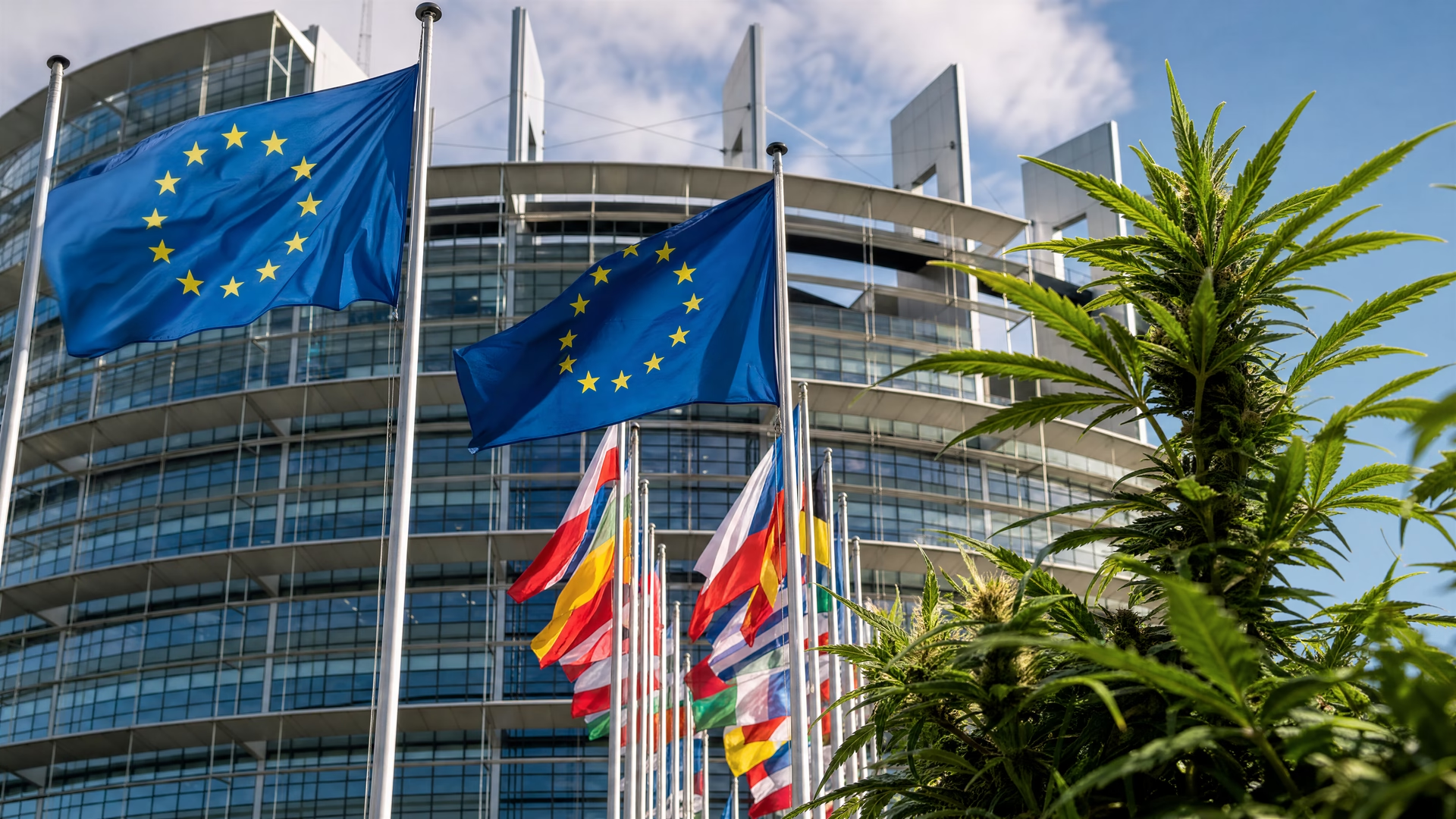
Germany’s club lawsuit, Spain’s licensing limits and the EU’s 2026 drug report show how cannabis policy is tightening and fragmenting across Europe.

Europe’s cannabis policy map is shifting on several fronts at once. In Germany, the German Cannabis Association and CSC Inntal are challenging Bavaria over building-law barriers to cultivation associations; at EU level, the 2026 drug report again places cannabis at the center of the continent’s drug market; and across the bloc, legal and commercial regimes remain uneven, from medical cultivation in Spain to court fights over CBD and cross-border policing.
Bavaria’s building-law fight over cultivation clubs
The newest clash in Germany is not about possession rules or retail models, but about whether cultivation associations can even get the approvals they need to exist. According to a German Cannabis Association news update, the German Cannabis Association and CSC Inntal are suing Bavaria after a refusal of a building-law permit. The group says the case is meant to secure a basic legal clarification on how such clubs should be treated under construction law in the state.
That point matters because Germany’s cannabis reform has not settled every administrative question. The same DHV update ties the action to a broader pattern of state-level resistance, with Bavaria having signaled opposition to the federal cannabis law even before it took effect. The complaint therefore lands at a sensitive intersection: national legalization on one side, local permitting practice on the other.

Germany’s reform remains contested beyond the courtroom
The Bavarian lawsuit sits inside a wider German debate that is still unresolved. Reporting on the country’s legalization battle has described the reform as politically unstable, with pressure to keep or repeal parts of the law and a final review due in 2028. That helps explain why administrative battles keep reappearing long after the headline reform was passed.
Two nearby developments underline how politically and institutionally uneven the German discussion still is: a federal-style first reading on health-insurance-related cannabis matters was scheduled for 12 June, and the DHV’s latest news bulletin also flagged model-project support from Streeck, alongside the Bavarian court fight. Even without assuming those items point in the same direction, they show a field in which legalization is still being interpreted, tested and argued over rather than simply implemented.
| Issue | What the facts say | Source |
|---|---|---|
| Bavaria permit dispute | DHV and CSC Inntal are suing after a building-law permit was refused | DHV news update |
| Federal reform debate | Germany’s legalization remains controversial and faces a review due in 2028 | The Guardian report |
| Parliamentary health item | A first reading on Blüten and GKV was listed for 12 June | DHV news bulletin |
The EU’s 2026 drug report keeps cannabis in the spotlight
At European level, cannabis remains the dominant reference point in the drug-market discussion. The European Drug Report 2026 says cannabis is still the most widely used illicit substance in Europe, while also pointing to high seizures, changing trafficking routes and a growing market for high-potency products. The Commission’s own announcement of the report highlighted new cannabis products and a broader rise in opioids and stimulants, suggesting that cannabis is only one part of a more complex market picture.
The reporting around the release gives a sense of scale. One summary says around 25 million people in Europe consume cannabis, while another cites about 24.9 million adults who used it in the past year. Separate coverage also says the EUDA estimated 24 million users in the previous year, and that cannabis appeared in wastewater in all 115 European cities tested in the agency’s 2026 study. Taken together, those figures do not tell the same statistical story, but they do point in the same policy direction: cannabis use remains widespread, and regulators are dealing with a large, persistent market rather than a marginal one.

How Europe’s policy models differ from country to country
If the EU report shows a common problem, national policy still looks highly fragmented. A European Parliament briefing says cannabis policy across selected member states ranges from strict prohibition to regulated adult-use models. Another industry guide says there is still no EU-level legalization, no harmonized medical prescribing pathway and no unified adult-use policy in 2026. That is the core reason the legal landscape keeps producing mismatches: one member state tightens, another liberalizes, and cross-border effects follow.
The clearest example in the supplied facts is Germany’s influence on neighboring Austria. After Germany liberalized limited recreational possession, Austria said it would step up police checks near the border, citing concerns about cross-border trade. Elsewhere, France was watching Germany’s legalization bill closely, while Italy’s low-THC market continued even after a court ruling narrowed the legal basis for the “cannabis light” segment. Each case reflects a different response to the same European reality: no single policy template governs the field.
- Some states remain close to prohibition.
- Some rely on medical-only systems with narrow access.
- Germany’s reform is still being tested in court and in politics.
- Neighboring states are reacting to possible cross-border spillovers.
- EU institutions can warn and interpret, but they do not set one continent-wide cannabis code.
| Jurisdiction | Policy or legal signal | Source |
|---|---|---|
| EU as a whole | No EU-level legalization, no harmonized medical pathway and no unified adult-use policy | Cannabis Europa guide |
| Austria | Border checks were stepped up after Germany liberalized limited possession | AP report |
| France | Authorities were said to be watching Germany’s legalization bill closely | Euractiv report |
| Italy | Low-THC business continued while a court ruling narrowed the legal basis | MJBizDaily report |
Sources
- DHV vs Bayern: Klage wegen CSCs & Baurecht | DHV-News # 510 (hanfverband.de)
- High times or low blows? Experts fail to clear air over German drug legalisation | Cannabis (theguardian.com)
- Cannabis – die aktuelle Situation in Europa (Europäischer Drogenbericht 2026) (euda.europa.eu)
- European Cannabis Regulations by Country: The 2026 Business Guide (cannabis-europa.com)
- Austria stepping up police checks in border areas after Germany liberalizes cannabis rules (apnews.com)
- Légalisation du cannabis : la France va suivre « de près » le projet de loi allemand (euractiv.com)
- Despite Italy's 'cannabis light' court ruling, low-THC business continues as usual (mjbizdaily.com)