












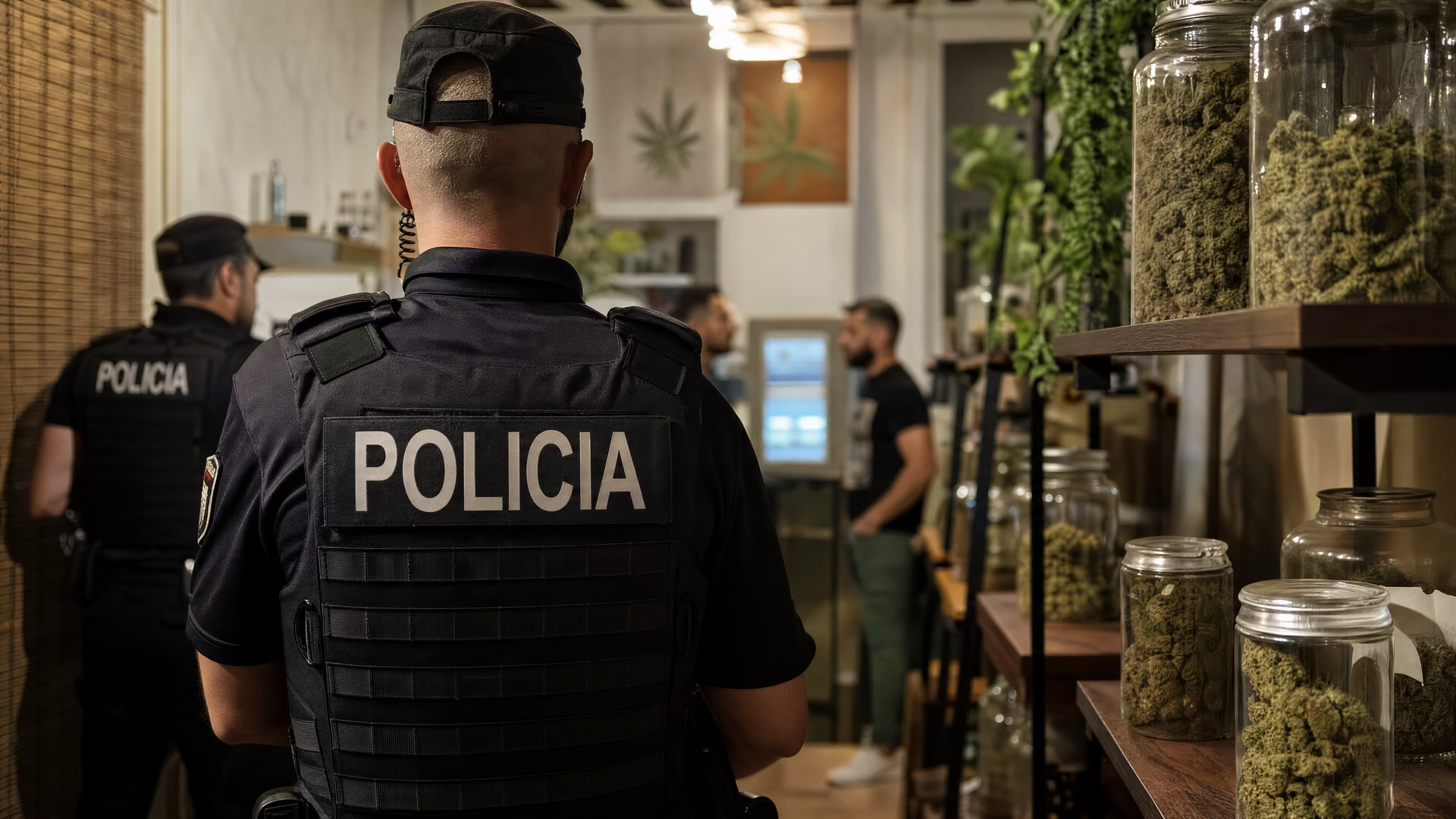
Spanish courts, police and regulators are reshaping cannabis club policy, while medical cannabis rules move ahead under a tightly controlled framework.

Spain’s cannabis scene is being pulled in two opposite directions. On one side, regulators have started building a formal medical-cannabis framework. On the other, courts and police continue to target cannabis associations and clubs that drift into commercial sales or fail to meet the standards authorities expect. The result is a legal landscape that is still unsettled, especially for cannabis social clubs and the local rules that govern them.
A clearer medical framework, but only in hospitals
Spain has now approved a medical-cannabis decree that keeps the system tightly controlled. The framework is hospital-based, and the medicines agency AEMPS will oversee the register of the formulas used in treatment. Reporting on the decree says only hospital specialists may prescribe, while AEMPS will define the clinical uses and preparation conditions through monographs and related procedures.
That structure matters because the state is not opening the door to recreational legalisation. The health ministry has said the government is not considering that route, even as it continues to defend medical use. A separate parliamentary discussion also pointed to a review of the wider addictions strategy later this year, underlining that cannabis policy remains politically active even when lawmakers are not moving on adult-use reform.
Barcelona’s local clampdown is changing the club landscape
The sharpest municipal pressure is visible in Barcelona. City officials have intensified their campaign against cannabis associations, and reporting from the city says four centers were closed in a single month amid legal pressure. That fits a broader local effort to tighten licensing and restrain cannabis-linked retail activity in central areas such as Ciutat Vella.
Barcelona’s position has been shaped by years of legal conflict. Catalan reporting notes that the city had rules for cannabis clubs, but the 2016 regulation was later struck down by the courts. Other coverage describes the clubs as permitted places for an illegal drug, a phrase that captures the contradiction at the heart of the local model: tolerated in practice, but vulnerable whenever municipal rules run into national criminal law or judicial review.
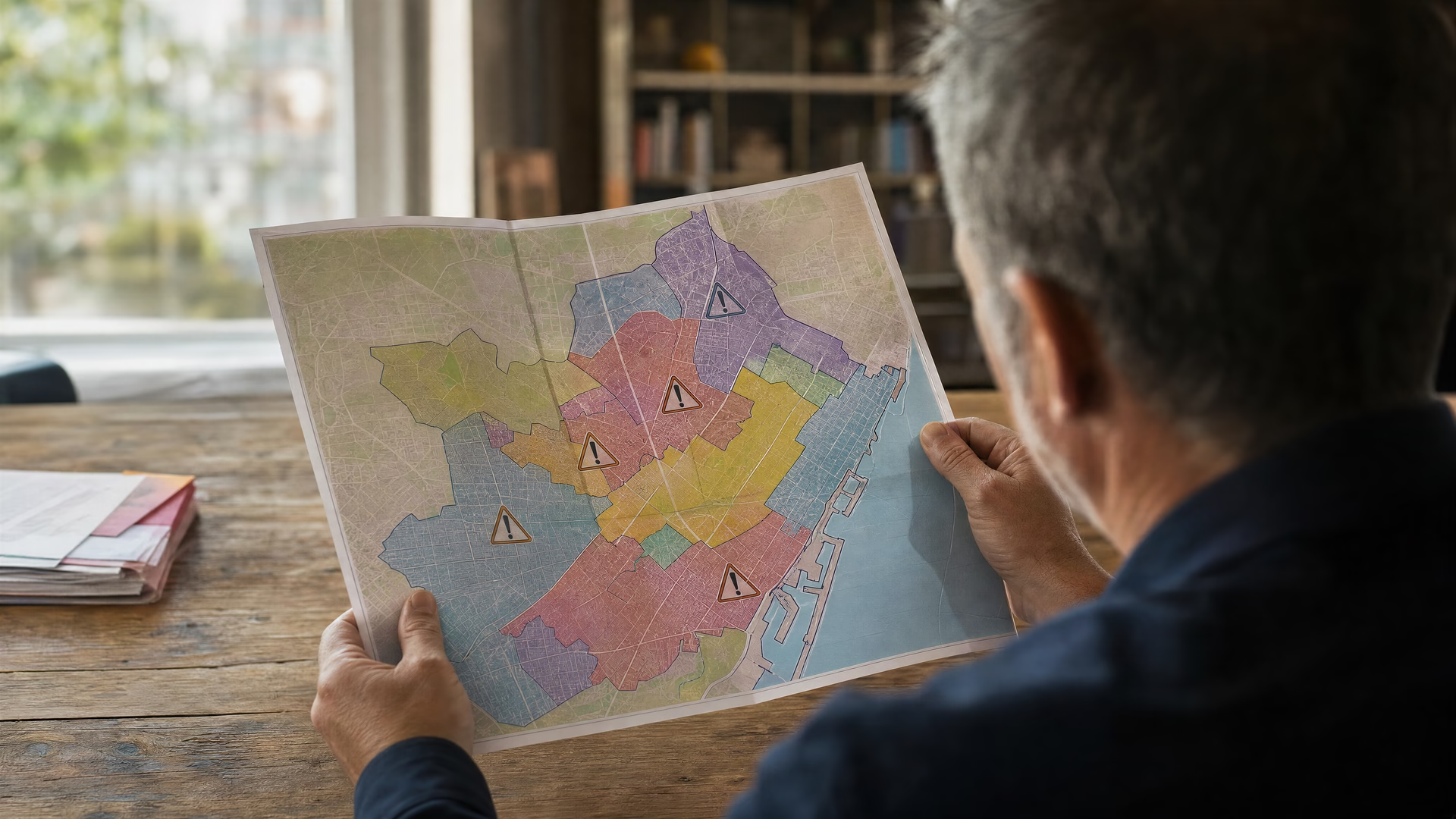
| Place or case | Action or outcome | Reported source |
|---|---|---|
| Barcelona | Four centers closed in one month amid intensified legal pressure | EL PAÍS |
| Ciutat Vella | Local leaders agreed to strengthen the brake on new marijuana shops | La Vanguardia |
| Barcelona city centre | A new commercial licensing plan also targets cannabis-linked retail activity | eldiario.es |
| Catalonia | The region once regulated cannabis social clubs, but the city rule later fell in court | ENCOD |
Raids, closures and convictions are drawing a line around the clubs
Across Spain, enforcement has increasingly focused on cannabis clubs and associations that appear to be acting like retail outlets or distribution points. Recent reports describe arrests in Dénia, Gandia, Murcia, and Los Abrigos, along with police action in Vega Baja and Costa del Sol. In Madrid’s Villaverde district, police dismantled 13 indoor grows run from an occupied apartment block, a reminder that enforcement is not limited to clubs alone.
The legal outcomes are mixed, and that is what makes this wave of cases so important. Some defendants have been acquitted where courts found the police search lacked legal requirements or prosecutors failed to prove sales to non-members. In other cases, judges have treated organised cultivation and distribution as a crime, including a Supreme Court ruling involving a club with 290 members. The message from the bench is that structure alone does not protect a club if the facts point to organised trafficking.
Selected enforcement actions against cannabis clubs and related sites (cases, arrests or closures)
The Supreme Court held that organised cultivation and distribution of cannabis by a club with 290 members constituted a crime.
Spain’s judicial press office
- Some courts have invalidated searches or acquitted defendants where police or prosecutors did not meet the legal burden.
- Other rulings have treated organised cultivation and distribution as criminal conduct, even when a club presented itself as a social association.
- Recent police actions suggest a growing focus on clubs alleged to sell to members, non-members or tourists.
- The line between association, private use and trafficking remains the central legal fault line.

Why courts are not treating every club the same way
The case law points in two directions at once. In Pasaia, a court invalidated a search of a cannabis club and acquitted four defendants because the legal requirements for entry and search were not met. In Madrid, a higher court upheld the acquittal of three defendants because prosecutors did not prove illegal sales to non-members or show that membership fees served another purpose. Tenerife reached a similar result when four founders of a cannabis social club were acquitted.
Elsewhere, the outcome was the opposite. Three leaders of a cannabis association in Alcalá de Guadaíra were convicted of drug trafficking after the court rejected the claim that the operation was shared self-consumption. Those splits explain why local authorities, police and prosecutors keep testing the boundaries of the club model: the label itself is not enough, and the facts behind operations matter more than the name on the door.
| Case | Outcome | What the court focused on | Source |
|---|---|---|---|
| Pasaia | Acquittal | Search invalidated because legal requirements were missing | Deia |
| Madrid | Acquittal upheld | Prosecutors did not prove sales to non-members or another purpose for fees | Público |
| Tenerife | Acquittal | Four founders cleared | Cáñamo |
| Alcalá de Guadaíra | Conviction | Court rejected the shared-self-consumption defence | Diario de Sevilla |
The federal backdrop: Spain’s cannabis debate is still unfinished
The enforcement and court cases are unfolding against a broader political backdrop that remains cautious. Industry figures have called for political courage on legalisation, but the public record supplied here shows the government sticking with medical regulation and rejecting recreational reform. At the same time, Spain continues to sit near the top of European drug-seizure rankings, including cannabis, which helps explain why enforcement pressure remains high.
Medical-cannabis permitting has also expanded even without a fully settled patient-access system. One report says Spain has granted 224 cultivation permits since 2018, while another says production rose 42% even though patients were not benefiting because the market was not yet properly regulated. That combination — more cultivation, limited dispensing, and a hospital-only framework — suggests a system that is building capacity before it settles on broad access.

What club operators and local officials are watching next
For club operators, the lesson from the recent cases is not subtle. Associations that resemble retail outlets, sell to tourists, or distribute beyond members risk police action and criminal charges. Where police entry or search fails legal tests, defendants may still prevail. But where the facts indicate organised sale or trafficking, courts have shown little patience for the club label as a shield.
Local officials, meanwhile, are using licensing and zoning tools to reduce the number of cannabis-linked premises in sensitive areas. That approach is unlikely to settle the larger national debate, but it does show how Spanish policy is increasingly being made at the municipal and judicial level rather than through one sweeping national settlement. The system is becoming narrower, not simpler.
The next major policy checkpoint is already visible in the facts supplied here: Spain’s health authorities plan to review the medical-cannabis regulation again at the end of 2026. Until then, the country is likely to keep moving along two tracks — a controlled medical framework and a hard-edged enforcement policy for clubs that overstep.
Spain is not moving toward a simple, all-purpose cannabis club model. It is building a controlled medical system while tightening pressure on associations that cross into commercial sales or organised distribution. The result is a legal environment defined less by slogans than by police evidence, court findings and local licensing rules — and that is likely to remain the case until the next regulatory review at the end of 2026.
Sources
- La guerra de Barcelona contra los centros cannábicos empieza a dar frutos: cuatro cierres en un mes (elpais.com)
- El PP y Collboni acuerdan reforzar el freno a las nuevas tiendas de marihuana en Ciutat Vella (lavanguardia.com)
- El PSC pacta con Junts en Barcelona el plan para regular las licencias comerciales en el centro (eldiario.es)
- Catalonia regulates the Cannabis Social Clubs (encod.org)
- Anulan el registro de un club de cannabis en Pasaia y absuelven a cuatro acusados (deia.eus)
- Confirman la absolución de tres acusados de un club de cannabis de Madrid (publico.es)
- La Justicia de Tenerife absuelve a cuatro fundadores de un Club Social de Cannabis (canamo.net)
- Condenan por tráfico de drogas a tres responsables de una asociación cannábica de Alcalá de Guadaíra (diariodesevilla.es)