












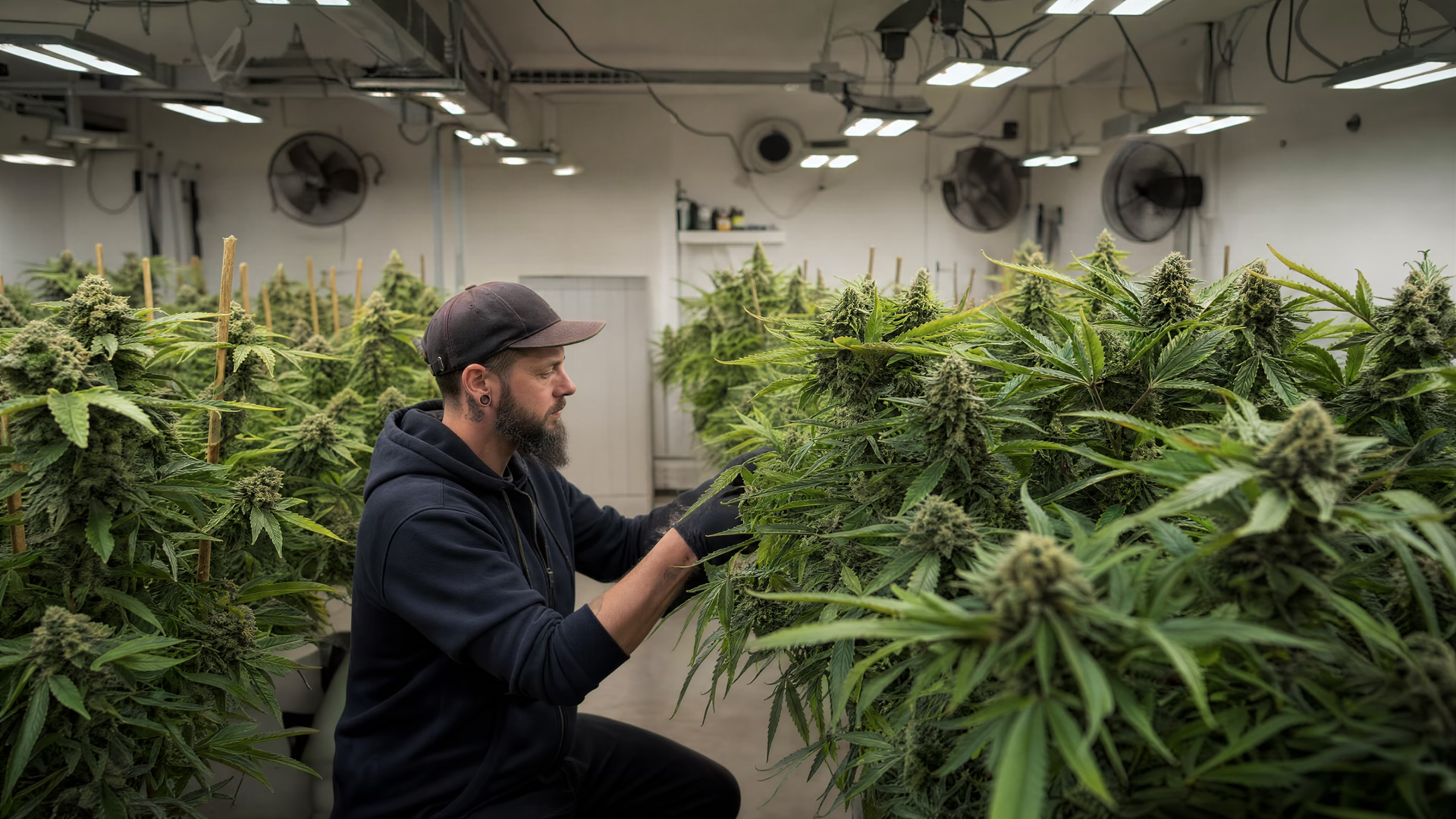
Germany’s cannabis clubs are approaching 400, but approvals remain patchy as Bayern faces a new legal challenge over zoning and club recognition.

Germany’s cannabis club system is no longer a fringe policy experiment. Less than two years after the country’s partial legalization took effect, clubs are multiplying, approval battles are moving into the courts, and the gap between national law and local implementation is still wide. The latest flashpoint comes from Bavaria, where the German Hemp Association and CSC Inntal are challenging the state over the baurechtliche treatment of cultivation associations, even as the broader club model keeps expanding across the country.
Bavaria becomes the new test case
The most recent dispute centers on Bavaria, where the German Hemp Association says it is funding a lawsuit brought by CSC Inntal after the club was denied building permission. The association’s goal is not only to reverse that individual refusal, but to secure a broader legal clarification of how cultivation associations are classified under construction law in the state, according to the group’s press statement on the lawsuit.
That challenge matters because the club model depends on more than the federal cannabis law on paper. Clubs need a workable local path through planning, permits, and site approval. When those administrative questions become hard blockers, legalization may exist in statute while remaining difficult to use in practice. The Bavarian dispute, then, is not a side issue. It is a stress test for whether the club framework can function as intended in a state known for a tougher line on cannabis policy.
A club network that is moving toward 400
The broader picture is one of rapid, uneven growth. Reporting on the current state of Germany’s cannabis clubs says the country is approaching 400 clubs, a striking sign of how quickly the system has grown since clubs became legal in July 2024. Yet the same reporting also underlines the administrative drag still shaping rollout across the country, with states applying the rules differently and local approvals lagging behind demand.
That mismatch between legal status and practical access has been a defining feature of the club model from the beginning. In April 2025, Deutsche Welle noted that cannabis social clubs had been legalized but that local approval was still slow, with Berlin approving only a small share of applications at the time. Earlier reporting also described a “jungle of bureaucracy” around the launch process, including the 500-member cap that limits the size of each club.
The rollout in numbers
A few grounded figures help show how the policy has evolved since the reform took effect. The key milestones and constraints are straightforward:
Seen together, those numbers explain why the club story remains unfinished. Legalization opened the door, but the member cap, slow approvals, and local administrative friction have shaped how far the model can scale. The result is a system that is clearly alive, yet still struggling to mature evenly from one state to the next.
| Milestone | What it shows | Source |
|---|---|---|
| March 22, 2024 | Germany’s liberalization cleared its final parliamentary hurdle, setting up decriminalization on April 1 and clubs from July 1 | AP |
| July 2024 | Cannabis clubs became legal, but the launch exposed heavy bureaucracy and state-by-state differences | DW |
| April 2025 | Local approval was still slow, with Berlin approving only a small share of applications | DW |
| June 2026 | The club count is nearing 400, while Bavaria becomes a key legal battleground | DHV |
For readers tracking the structure of the law itself, Cannabivo’s global legalization overview helps place Germany’s club model in a broader legal context, where decriminalization, home growing, and collective cultivation are often separated into different policy layers.
Political pressure is building around the reform
The expansion of clubs has not silenced critics. Instead, the reform is now being pulled into a wider political argument about whether Germany’s partial legalization is working at all. Deutsche Welle reported that conservatives attacked the cannabis reform after a two-year review, while also pointing to sluggish club approvals and continued pressure on the black market. Around the same time, the BKA president publicly criticized the implementation of the Cannabis Act, adding law-enforcement pressure to the political debate.
At the same time, critics are no longer speaking about a hypothetical future. They are responding to an operating system that now has real-world data attached to it. A first interim review found only limited changes from partial legalization, while other assessments have argued the reform created fresh administrative and enforcement problems rather than a clean reset. Those arguments now frame the club issue: if the system is too cumbersome to scale, opponents will use that fact to press for tighter rules.
Sluggish approval, bureaucratic friction and uncertainty over local implementation have become central to the political case against the reform.
Grounded in DW, ZEIT and interim-review reporting
Medical cannabis is scaling even as club politics harden
The club debate sits inside a much larger German cannabis market that has been expanding quickly since the April 2024 policy change. Bloomberg reported in February that online cannabis sales were booming in Germany, with telemedicine platforms and mail-order pharmacies becoming important channels for legal access. Separate reporting said medical cannabis prescriptions had risen by more than 3,300% by December 2025 compared with March 2024, while average flower prices fell sharply over the same period.
That medical market growth matters because it shows legalization is already changing behavior, even if the club model remains cumbersome. Imports also underscore the scale of demand: Germany imported 50.5 tonnes of medical cannabis in the first quarter of 2026, with Canada supplying more than half of that volume. In other words, the legal market is broadening quickly on the medical side while the collective-cultivation model is still fighting for smooth administrative footing.
The tension is visible in the policy debate over access. Reporting has said Germany’s health ministry wanted to tighten medical cannabis rules by ending online sales and increasing in-person doctor contact, even as market data pointed to rapid uptake. That makes the German system look less like a settled model and more like a moving target: liberalization in one lane, retrenchment pressure in another.
- Telemedicine and mail-order pharmacies have become major access channels for legal medical cannabis.
- Prescription demand has expanded sharply since the 2024 policy shift.
- Import data show the legal market relying heavily on cross-border supply.
- Policy critics are now focusing on implementation rather than just the law’s text.
| Track | What is happening | Source |
|---|---|---|
| Cannabis clubs | Rapid growth, but approvals remain uneven and bureaucratic | DW |
| Medical cannabis | Prescription demand and imports have scaled quickly | High Times |
| Access rules | Government pressure has pointed toward tighter online-sales controls | The Local |
What the club fight reveals about Germany’s broader experiment
The dispute over club permits in Bavaria is important because it reveals the structural weakness of Germany’s cannabis reform: the law changed faster than the administrative machinery around it. That has left clubs vulnerable to local interpretation, especially where authorities remain cautious. The fact that the country is nearing 400 clubs does not mean the system is settled; it means the rollout has gained momentum despite friction, not because the friction disappeared.
That point has wider implications for the European debate. Germany’s reform has been watched as a test case well beyond its borders, precisely because it combines partial legalization, collective cultivation, and a large legal medical market. If clubs can be blocked or delayed through zoning and construction rules, then the legal framework still depends on how aggressively each state and municipality chooses to interpret the rules.
For now, the key question is not whether Germany has legalized cannabis clubs — it has — but whether the system can be implemented with enough consistency to make the model more than a patchwork. Bavaria is now where that question may be answered first.
Germany’s cannabis clubs have moved from legal novelty to a live policy battleground. The count is rising, but the system remains fragile where local permitting meets state-level caution. Bavaria’s court fight may decide far more than one club’s future; it may help define how seriously Germany’s club model can operate in practice.
Sources
- Hanfverband und CSC Inntal verklagen Bayern wegen Verhinderung von Anbauvereinigungen (hanfverband.de)
- Germany's plan to liberalize cannabis rules clears its final parliamentary hurdle (apnews.com)
- German cannabis clubs face jungle of bureaucracy (amp.dw.com)
- Germany's first year of legalized cannabis: Has it worked? (dw.com)
- DHV vs Bayern: Klage wegen CSCs & Baurecht | DHV-News # 510 (hanfverband.de)
- Germany’s Medical Cannabis 'Problem' Is That It Worked. Prices Fell. Prescriptions Exploded (hightimes.com)
- Germany to scrap medical cannabis sales online (thelocal.de)