











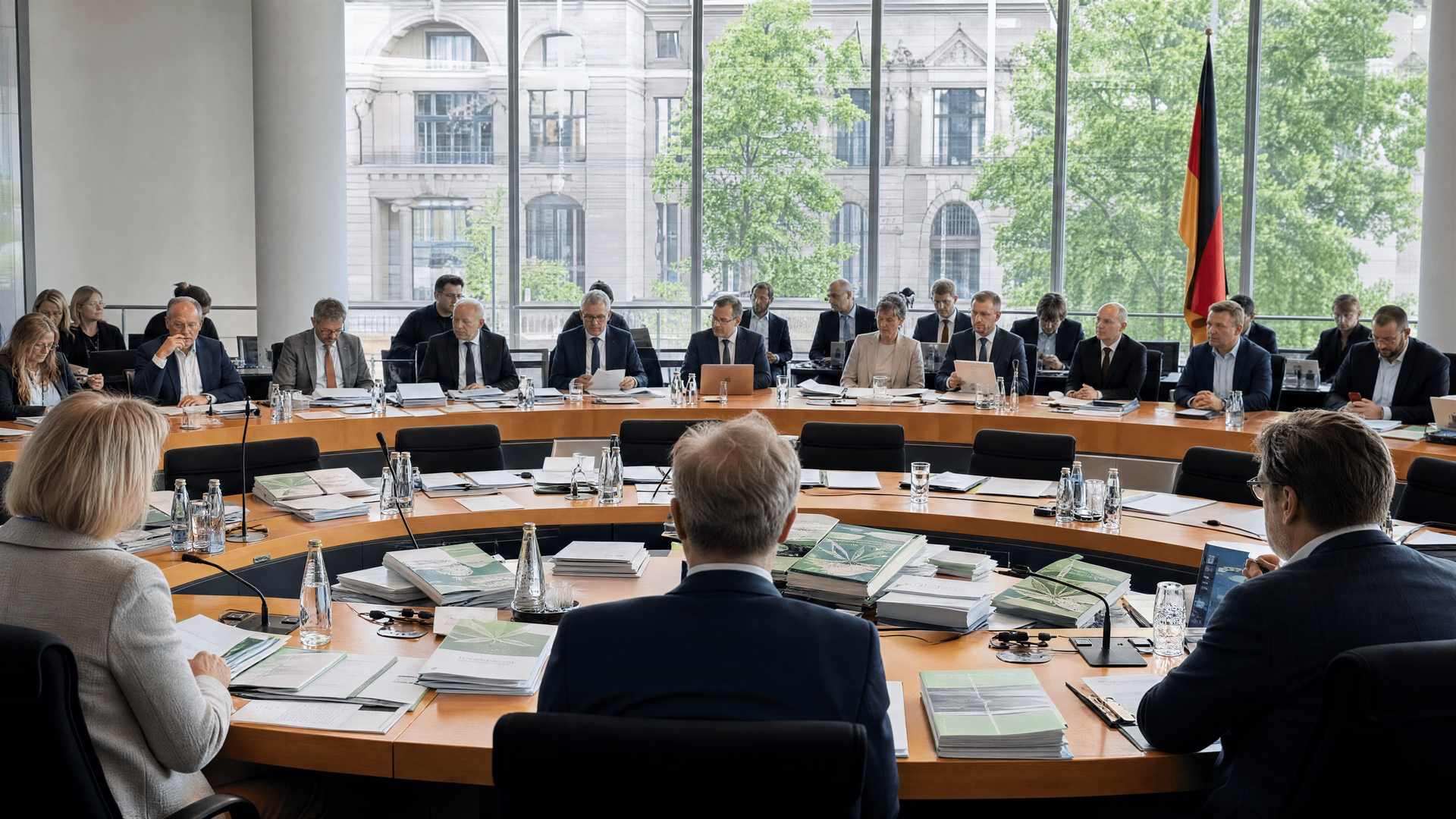
Germany’s cannabis evaluation has triggered a political backlash, with Dobrindt criticising the report and researchers saying they are disappointed.

Germany’s latest cannabis evaluation has quickly become a political argument rather than a settled assessment. Interior Minister Alexander Dobrindt has criticised the report, while researchers involved in the review say they are disappointed with the reaction to their work, according to tagesschau’s account of the dispute. The clash has reopened a wider fight over the partial legalisation introduced in 2024, with opposition voices using the report to argue for a rethink and supporters saying the findings are being read too selectively.
A report meant to inform, now pulled into politics
Germany’s cannabis evaluation was supposed to offer a factual basis for judging the country’s partial legalisation. Instead, it has become another point of friction in an already polarised debate. Dobrindt’s criticism landed alongside a sharp response from scientists involved in the assessment, who said they were disappointed by the way the findings were handled, as tagesschau reported.
That tension matters because the evaluation was never just an academic exercise. It sits inside a broader argument about whether the 2024 reform has improved control, reduced harm, or simply created new enforcement problems. Conservative critics have repeatedly framed the law as a failed experiment, while other voices in government have treated the report as a basis for targeted adjustments rather than a rollback, a divide visible in the current debate over Germany’s cannabis legalisation.
What Dobrindt said, and why researchers pushed back
The facts supplied here do not include a full verbatim statement from the interior minister, but they do show the shape of the dispute: Dobrindt criticised the cannabis report, and the scientists behind the evaluation said they were disappointed. That split is important because the evaluation’s credibility depends not only on its findings, but on whether political actors treat those findings as evidence rather than ammunition.
The public response from the SPD went in the opposite direction. According to Deutsches Ärzteblatt, the party accused Dobrindt of making unsound criticism of the evaluation. Stern’s report on the same exchange points in the same direction: the row is no longer about the existence of the report, but about how seriously its conclusions should be taken.
The scientists involved in the evaluation said they were disappointed.
tagesschau reporting on the dispute
- Dobrindt criticised the cannabis report.
- Researchers involved in the evaluation said they were disappointed.
- The SPD accused Dobrindt of unsound criticism.
- The argument has widened into a debate about how the report should shape policy.

The report lands in a wider fight over the 2024 reform
The controversy cannot be separated from the broader politics of cannabis in Germany. Conservative politicians have already used the evaluation period to press for a rethink of the law, and the debate has only sharpened since the partial legalisation took effect. DW reported that CDU and CSU ministers called for changes after a two-year report was filed, while other coverage has shown the same coalition pressure spilling into public messaging about crime, youth protection and policing.
This is also why the report’s reception matters beyond party politics. If the evaluation is treated as evidence of failure, it strengthens the case for rollback. If it is treated as a mixed but usable review, it supports a more incremental approach. The gap between those interpretations is exactly where Germany’s cannabis policy debate is now being fought.
| Actor or source | Position reflected in the facts | Source |
|---|---|---|
| Alexander Dobrindt | Criticised the cannabis report | tagesschau |
| Researchers involved in the review | Said they were disappointed by the reaction | tagesschau |
| SPD | Accused Dobrindt of unsound criticism | Deutsches Ärzteblatt |
| CDU/CSU ministers | Called for changes to the 2024 reform | DW |
Why the report’s interpretation matters for enforcement and access
The political reading of the evaluation matters because it can influence how officials handle the reform in practice. The facts supplied here point to three connected pressure points: enforcement, youth protection and local control. Coverage from The Guardian described the report as failing to settle the debate, which is a fair summary of the moment Germany finds itself in now.
Other reporting in the supplied set also shows that the legalisation debate is not confined to Berlin. Bavaria has pushed to reverse the reform, conservative figures have demanded a rollback, and discussions about the blurred line between medical and recreational cannabis have added further uncertainty. That wider setting helps explain why Dobrindt’s criticism drew such a sharp reaction: the report is not just a document, but a lever in a much larger policy struggle.
- Supporters of the reform see the evaluation as a basis for adjustment.
- Critics see it as evidence that the law should be scaled back.
- Researchers want the report to be read as evidence, not a talking point.
- The dispute now touches policing, youth protection and local implementation.
The next argument is already underway
Nothing in the supplied facts suggests this argument will fade quickly. On the contrary, the evaluation has arrived at a moment when conservative ministers are already pressing for changes, the SPD is defending the integrity of the assessment, and researchers are signalling frustration with the political treatment of their work. That combination virtually guarantees the report will keep shaping the next round of cannabis policy battles in Germany.
For now, the most notable feature is not consensus but its absence. The report has not resolved the question of whether Germany’s partial legalisation is working. It has only clarified how far apart the main political camps remain — and how easily a scientific review can become a symbolic fight over the future of reform.
Germany’s cannabis evaluation was meant to clarify the effects of reform, but it has instead sharpened the political divide around it. Dobrindt’s criticism, the researchers’ disappointment and the SPD’s counterattack all point to the same conclusion: the report has become a test not only of policy, but of how evidence is used in public life.
Sources
- Dobrindt kritisiert Cannabis-Bericht - Wissenschaftler "enttäuscht" (tagesschau.de)
- Germany: CDU/CSU calls for cannabis rethink 2 years in (amp.dw.com)
- SPD wirft Dobrindt unsachliche Kritik an Cannabis-Evaluierung vor (aerzteblatt.de)
- Cannabis-Evaluierung: SPD wirft Dobrindt unsachliche Kritik an Studie vor (stern.de)
- High times or low blows? Experts fail to clear air over German drug legalisation (theguardian.com)