

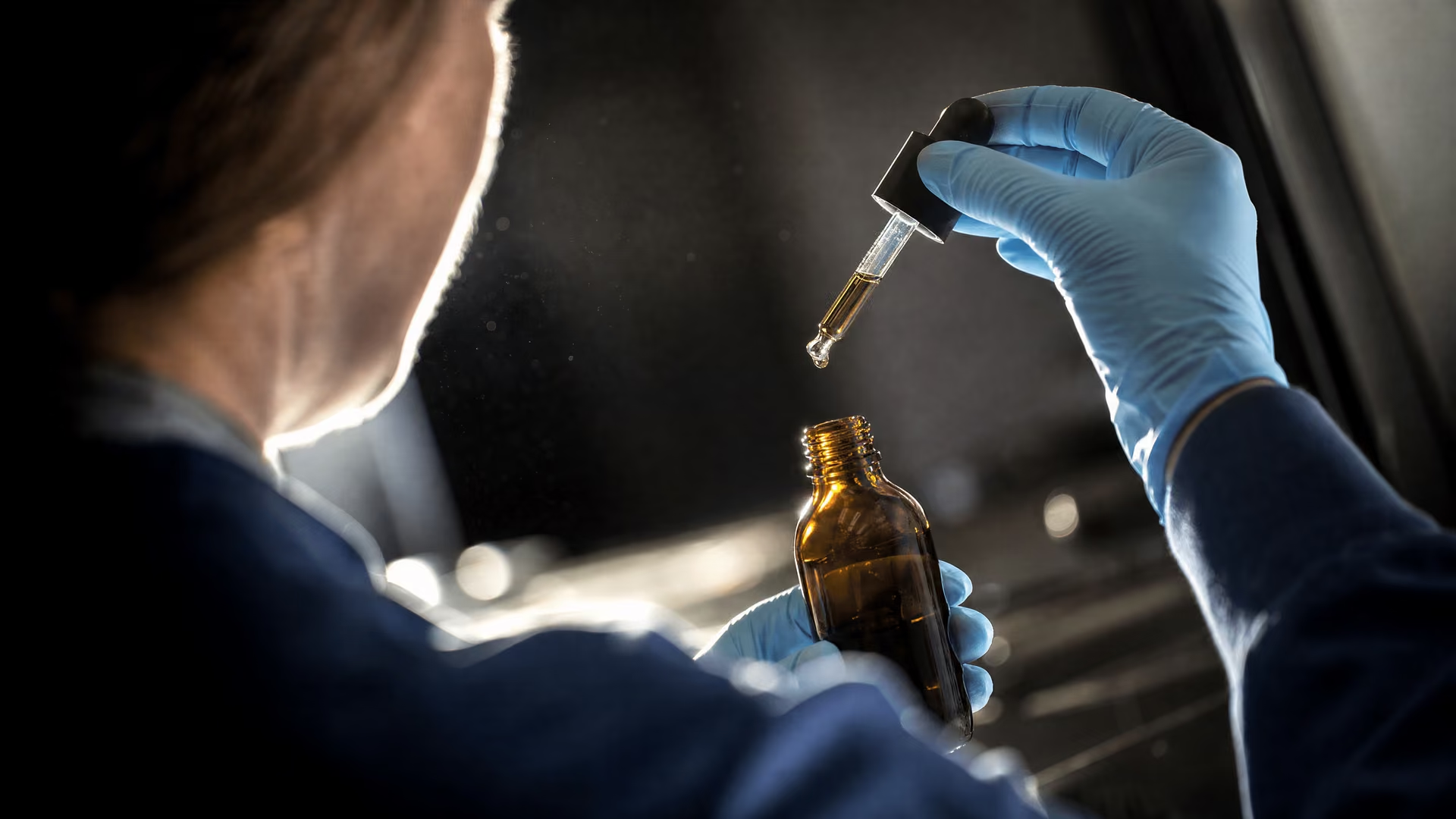











Two years after partial legalisation, German reports say cannabis consumption has barely shifted, even as politics and enforcement remain in flux.

Two years after Germany’s partial cannabis legalisation took effect, the clearest thread running through the latest reporting is restraint rather than disruption: consumption appears broadly stable, earlier trends continue, and the political debate has not settled around a single reading of the reform. Several outlets, citing a new evaluation and related reporting, say the law did not produce the sharp jump critics feared — but nor did it deliver the clean break supporters hoped for.
Consumption stayed steady, not sensational
The most consistent takeaway from the latest coverage is that cannabis consumption in Germany has not moved dramatically since the partial legalisation came into force. The ARD report says two years on, there has been “hardly any change” in use, while the DIW’s weekly report concludes that consumption and prices have not changed markedly after the first available data.
That assessment is echoed elsewhere. The Tagesspiegel reports that use has stagnated rather than climbed, and MDR says cannabis consumption in Germany appears not to have risen after the reform. Taken together, those accounts point to a policy that has so far altered the legal framework more than everyday behaviour.

The significance of that stability is political as much as statistical. A law that leaves consumption broadly unchanged gives ammunition to two opposing readings at once: critics can argue it failed to shift behaviour, while supporters can argue it did not trigger the surge opponents predicted.
What the evaluation says, and what it does not say
The latest public discussion was shaped by the federal government’s second interim evaluation of the Cannabis Act, presented in April 2026, which fed directly into Bundestag debate over possible reform steps. The federal drug commissioner said the second evaluation had been presented, and that timing helped reopen a dispute that had never fully gone away.
The reports supplied here are careful about scope. They do not describe a dramatic rise in consumption, but they also do not claim that the reform has resolved the deeper questions around access, enforcement, and the legal market. ZEIT’s summary of the interim report describes the picture as one of “light and shadow”, which fits the overall tone of the current debate better than any victory lap would.
| Source | Main finding | What it suggests |
|---|---|---|
| tagesschau report | Consumption has barely changed | The reform did not produce a visible jump in use |
| DIW weekly report | Consumption and prices were not markedly altered | The legal market and user behaviour appear relatively stable |
| MDR report | Cannabis use appears not to have increased | The expected consumption surge did not materialise |
Politics has not stopped arguing over the law
If the consumption data look subdued, the politics around them remain anything but. Tagesschau reports that ministers from the Union camp now see a need for reform, while Euronews says federal officials are arguing the law was a mistake and may need revision. DW likewise reports that conservatives are pushing to rethink the legislation after the two-year report was filed.
That pressure did not emerge in a vacuum. The law was controversial before it took effect, and the current debate follows the same line: not simply whether cannabis should be legalised in some form, but whether the present model is the right one. The Guardian’s account of the interim report says legal sources are slowly squeezing the illegal market, even as the government faces pressure to reverse the law. That is a more complicated political signal than either side would prefer.
Legal sources are slowly squeezing out the illegal market.
The Guardian, reporting on the two-year interim review
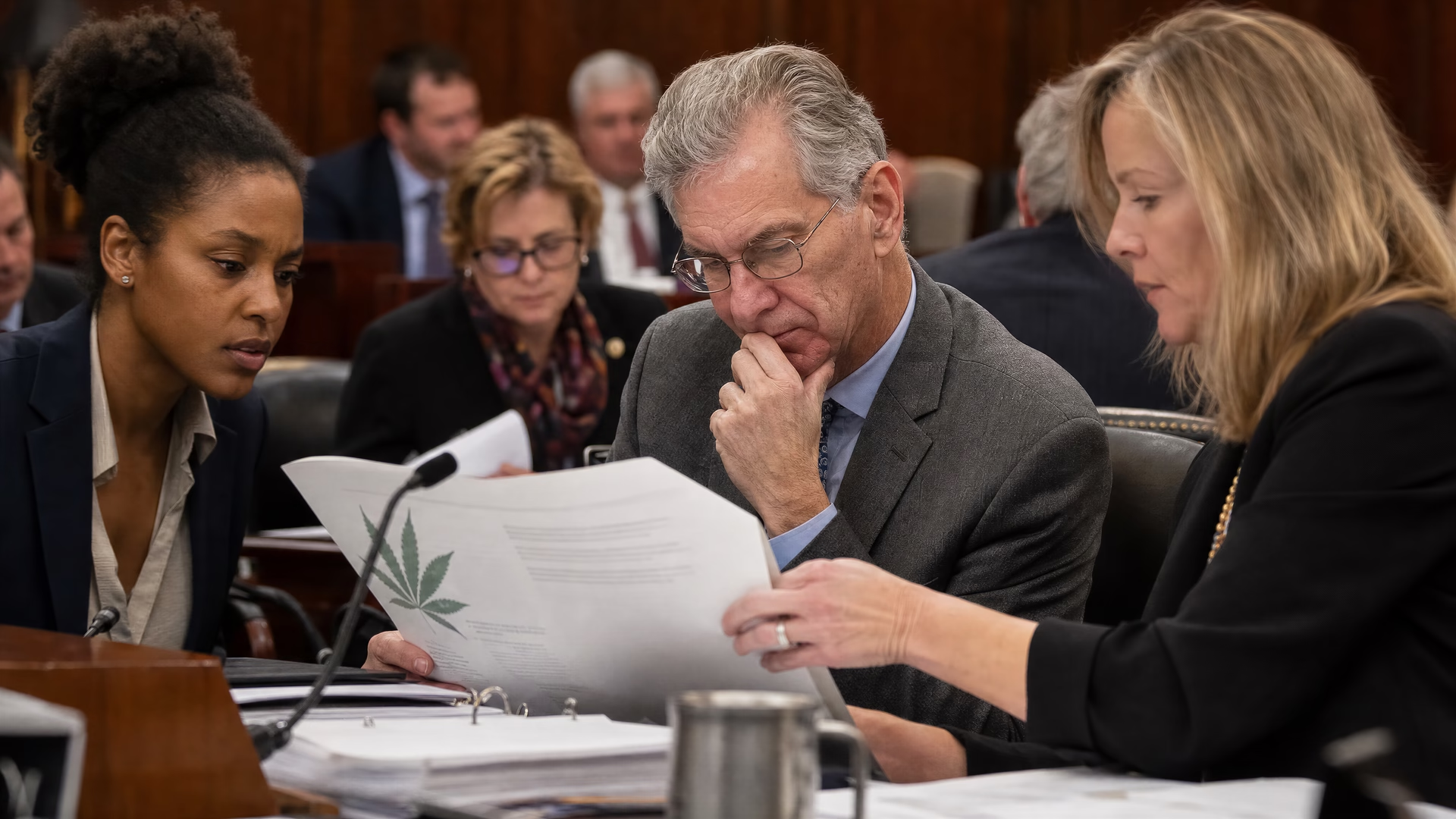
There is also a broader policy backdrop. Euronews notes that Europe’s drug market is becoming more complex, with the EU drugs agency warning about rising risks in a changing environment that includes high-potency cannabis. That does not prove anything specific about Germany’s reform, but it helps explain why the same data can be read as reassurance by some and as warning by others.
What changed at the margins: enforcement, prices and the legal market
Although the headline finding is stability in use, the reports also point to movement in adjacent areas. The DIW says cannabis prices did not change markedly in the early data, while the MDR and other reports note that cannabis delicts fell clearly after the reform. That combination matters: even where use remained stable, the legal and enforcement environment did not.
- Consumption appears broadly unchanged after two years.
- Cannabis prices did not show a marked shift in the early data cited by the DIW.
- Cannabis-related offences reportedly declined clearly.
- Political pressure for tightening rules has increased rather than faded.
That unsettled quality extends to the legal market itself. Supporters of the reform argue that regulated access and clearer rules are gradually displacing illegal supply. Critics, meanwhile, see enough ambiguity in the data to demand tougher rules or a partial rollback. The same evaluation is being used to support both positions.
The wider cannabis agenda keeps moving
The two-year cannabis debate is not happening in isolation. In the same policy space, Germany has continued to work through medical cannabis reform and possible next steps for pilot projects. The Bundestag held a health committee hearing on medical cannabis in January 2026, and experts reportedly urged changes to the government draft during that process.
At the same time, political signals around future retail models remain mixed. The drug commissioner has backed model projects, and reporting has said the door is open to pilot shops, but broader Pillar 2 commercial retail plans remain delayed. For now, the adult-use market is still being managed within the limits created by the partial legalisation already in force.

| Policy thread | What the supplied facts show | Status in the reporting |
|---|---|---|
| Medical cannabis reform | Experts urged changes during January 2026 committee work | Still under discussion |
| Pilot retail projects | The drug commissioner backed model projects and pilot shops | Politically discussed, not launched in the supplied facts |
| Partial legalisation review | A second interim evaluation was presented in April 2026 | Driving the current debate |
A reform measured less by use than by balance
Two years on, the most defensible description of Germany’s partial cannabis legalisation is not that it transformed the country, or that it failed outright, but that it produced a constrained and uneven shift. Consumption has not surged. Prices have not clearly broken. Enforcement appears to have eased in some respects. And the political conflict over the law has only sharpened.
That is why the current reporting feels so familiar and so unresolved at the same time. The facts supplied here point to a reform that changed the legal frame more than the social reality, leaving opponents and supporters to claim the parts of the story that suit them. The numbers and the politics are both still in motion.
Two years after Germany’s partial cannabis legalisation, the headline is not a boom or a backlash, but continuity. The latest reports say consumption has remained largely unchanged, even as the law continues to stir demands for revision and set the terms of a broader policy fight that is far from settled.
Sources
- Zwei Jahre nach Teillegalisierung: Kaum Veränderungen beim Cannabis-Konsum (tagesschau.de)
- Evaluation nach zwei Jahren: Bericht zu Cannabislegalisierung sieht Licht und Schatten (zeit.de)
- Cannabiskonsum nach Teillegalisierung stabil, Kokain nimmt seit Jahren zu (diw.de)
- Cannabiskonsum in Deutschland nach Teillegalisierung stabil (mdr.de)