













Prohibition Partners says UK medical cannabis patients could top 140,000 in 2026 as imports, product choice and private teleclinics expand.

The UK's medical cannabis market is on course to pass 140,000 patients by the end of 2026, according to Prohibition Partners, with imported volumes and the number of available products both more than doubling in 2025. The forecast points to a sector growing quickly in scale and complexity even as most access still sits outside the UK's National Health Service (NHS) through private online clinics.
A market that no longer looks niche
According to the UK Medical Cannabis Market Update 2026 as reported by Cannabis Health News, Prohibition Partners expects more than 140,000 people in the UK to be prescribed medical cannabis this year, up from around 100,000 a year earlier. That is a sharp increase for a market that, until recently, was often treated as peripheral in British healthcare debate.
The forecast matters not just because of the patient total. It comes alongside bigger import volumes, a much wider product range and lower prices, all of which suggest a market moving from scarcity toward competition. The patient number is the headline, but the commercial and regulatory structure underneath it may be the more consequential story.
The clearest markers of that shift are:
This is no longer a niche, fringe market. In the space of two years, the UK has become one of the fastest-growing medical cannabis markets anywhere in the world, and most people have no idea it’s happening on this scale. Canada is now supplying the vast majority of the cannabis being prescribed to UK patients, and the number of people accessing treatment is growing faster than almost anyone expected.
Alexander Khourdaji, Senior Analyst, Prohibition Partners
That assessment helps explain why this update matters beyond the sector itself. A prescription market that adds tens of thousands of patients in a year, while broadening its supplier base and reducing prices, stops being a specialist curiosity and starts becoming a health-policy issue.
Imports and product choice expanded at the same time
The supply side changed quickly in 2025. The UK imported 30,061 kilograms of medical cannabis, compared with 14,992 kilograms the year before. Over the same period, the number of cannabis-based medicines available to UK patients rose from 374 to 818, indicating that suppliers were not just shipping more volume but competing across a broader range of products.
The import jump is clearest in the annual totals:
UK medical cannabis imports, 2024-2025 (kilograms)
Price pressure followed. According to Prohibition Partners' market update, the average price of medical cannabis flower, the format the report describes as most widely prescribed in the UK, fell from £7.10 to £6.80 per gram over the past year. Vape prices fell by a quarter.
For patients, lower prices and a wider menu can mean easier access. For policymakers, the same trend signals a market maturing faster than its oversight framework. This is not just a story of higher demand; it is also a story of logistics, procurement and private prescribing channels scaling at speed.
One practical scene captures that shift well:
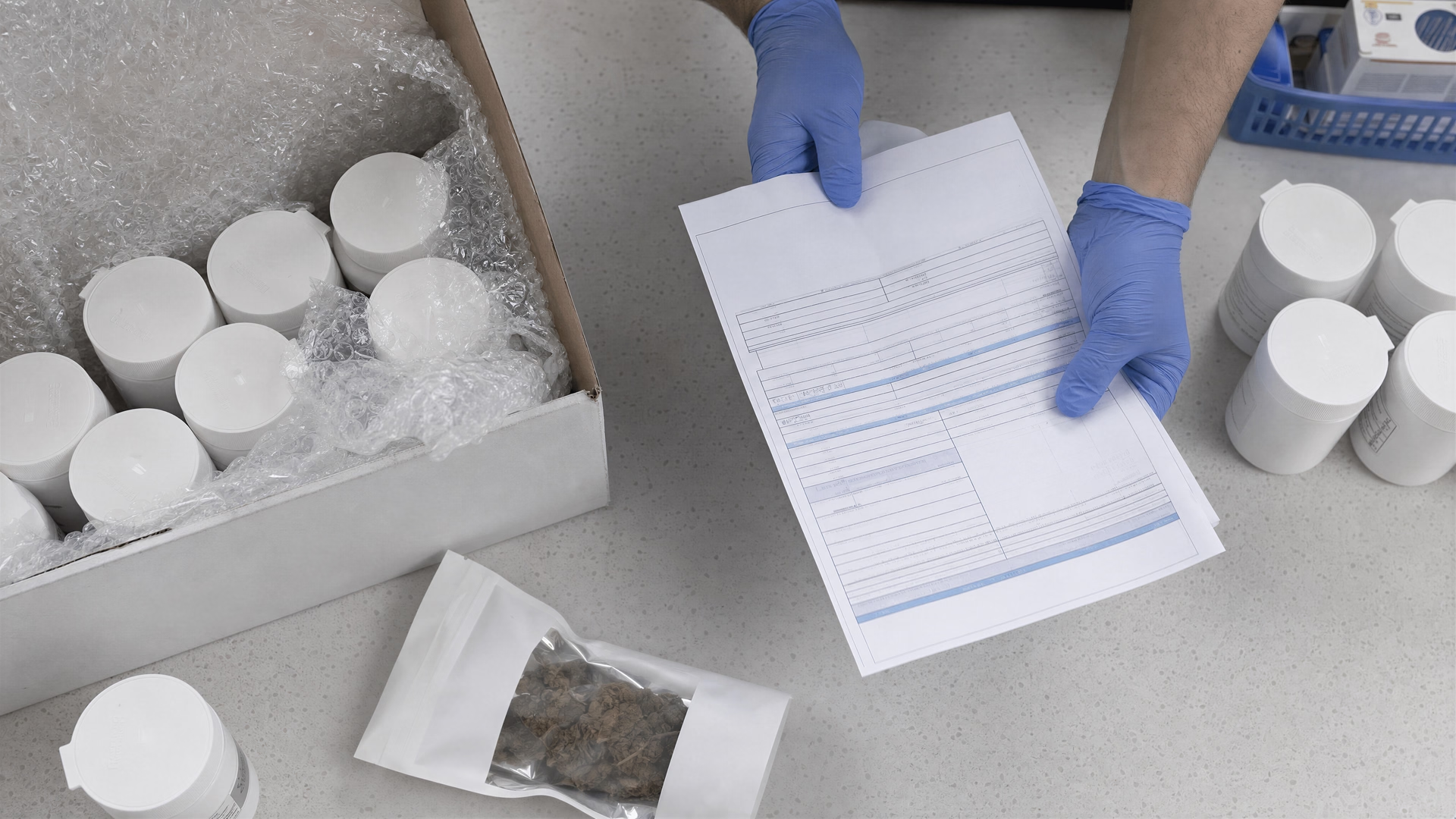
Canada replaced Spain as the market's main supplier
The biggest supply-side change sits with Canada. Canadian exports to the UK rose from 2.58 tonnes in 2024 to 17.07 tonnes in 2025, a jump of 562% in a single year. Once cannabis routed through other countries such as Portugal is taken into account, Prohibition Partners estimates Canada now supplies 70% to 80% of all medical cannabis entering the UK.
That is a striking reversal. Spain, which supplied more than half of the UK's medical cannabis as recently as 2023, is estimated to have fallen to 11% of supply. For international readers comparing systems, this UK story sits within a broader Cannabis Legalization Overview: Global Legal Status, but its immediate reality is an import-heavy prescription market with trade routes that are changing very quickly.
The supplier shift looks like this:
| Supplier | Earlier benchmark | Latest benchmark | What the report says | Source |
|---|---|---|---|---|
| Canada | 2.58 tonnes exported to the UK (2024) | 70% to 80% of UK supply (2025 estimate) | Estimate includes product rerouted through countries such as Portugal | Cannabis Health News report |
| Spain | More than half of UK supply (2023) | 11% of UK supply (2025) | A former leading supplier lost share as Canadian exports surged | Cannabis Health News report |
Taken together, those figures show a market growing in two directions at once: more patients on the demand side and a more concentrated import structure on the supply side. That concentration may become a policy concern of its own if the UK's next phase of scrutiny moves beyond patient numbers and toward resilience, oversight and market dependence.
Access sits mostly outside the NHS
The other defining feature of the UK market is where patients actually enter it. The report says access is delivered almost entirely through private-pay online clinics rather than the UK's National Health Service (NHS), with a network of more than 40 private clinics operating in the sector.
At the centre of that structure, just eight platforms are estimated to account for 80% of all prescriptions issued. That concentration helps explain how the market has scaled so quickly, but it also narrows the system through which most patients are assessed and prescribed.
In practical terms, the UK's access model has four defining features:
- Most patients access treatment through private online clinics rather than the NHS.
- The sector operates through a network of more than 40 private clinics.
- Eight platforms are estimated to account for around 80% of prescriptions.
- Supplier competition has expanded product choice and pushed some prices lower.
Regulators are already paying attention. The UK's Care Quality Commission has raised concerns about oversight and prescribing practices at some clinics, while the UK's Advisory Council on the Misuse of Drugs is expected to formally review the sector in 2026 or 2027.
The pace of expansion also shows up in The Cannabis Pages' analysis of NHSBSA FOI data, which found private cannabis-based medicinal product items dispensed in England rose from 278 in 2019 to 663,130 in 2024. That is a different measure from patient count, but it points in the same direction: prescribing activity has risen dramatically.
The regulatory pressure point is easy to picture:

The next question is governance, not just growth
The main unresolved issue is no longer whether the UK medical cannabis sector can expand. On the numbers in this report, it already has. The harder question is whether governance will keep pace with a market that is becoming larger, cheaper and more import-dependent at the same time.
Each part of the story reinforces the others. More patients encourage more imports; more imports widen the product range; a wider range and heavier competition push prices lower; and easy access through a concentrated private clinic system keeps the patient base growing. By the time a formal review arrives, regulators may be looking at a market that is substantially larger than the one they first began to scrutinise.
The recent milestones show how quickly the UK's market has moved:
For readers outside Britain, the immediate questions are straightforward:
What international readers need to know about the UK report
How many UK patients could be prescribed medical cannabis in 2026?
Prohibition Partners estimates that more than 140,000 people in the UK will be prescribed medical cannabis by the end of 2026, up from around 100,000 a year earlier.
Is most access happening through the NHS?
No. The report says access is delivered almost entirely through private-pay online clinics rather than the UK's National Health Service.
Where is the medicine coming from?
Imports dominate. The report estimates Canada now supplies 70% to 80% of all medical cannabis entering the UK once rerouted product is taken into account, while Spain's share has fallen to 11%.
Why are UK regulators paying attention?
The UK's Care Quality Commission has already raised concerns about oversight and prescribing practices at some clinics, and the UK's Advisory Council on the Misuse of Drugs is expected to review the sector in 2026 or 2027.
For now, the core points are clear:
If Prohibition Partners' forecast holds, the UK will end 2026 with a medical cannabis market that is larger, broader and more price-competitive than it was a year earlier. The unresolved part is not whether demand exists, but how the UK chooses to supervise a private clinic system that has become the main gateway for tens of thousands of patients.
Sources
- UK Medical Cannabis Patient Numbers Set to Reach 140,000 in 2026, Industry Report Finds (cannabishealthnews.co.uk)
- France Sets July Deadline for Medical Cannabis Regulations, as Study Shows Opioid Reductions (cannabishealthnews.co.uk)
- August 28th: Anniversary of When Bob Dylan Introduced The Beatles to Cannabis (projectcbd.org)
- Does “low dose” CBD pose a risk to liver health? (projectcbd.org)
- Why So Many Patients Feel Lost in Cannabinoid Medicine: Living Between Chronic Symptoms, Conflicting Information, and the Search for Better Answers (cannigma.com)
- From AIDS Wards to Dispensaries: The LGBTQ Activists Who Built Medical Cannabis (cannigma.com)
- Do 10 Doctors Really Prescribe Half of England’s Medical Cannabis? (thecannabispages.com)
- 7 unexpected takeaways from the newest research on cannabis and brain effects (washingtonpost.com)
- Scientists found a cannabis compound that relieves pain without the high (sciencedaily.com)
- Hidden driving danger when edible cannabis and alcohol mix (sciencedaily.com)