











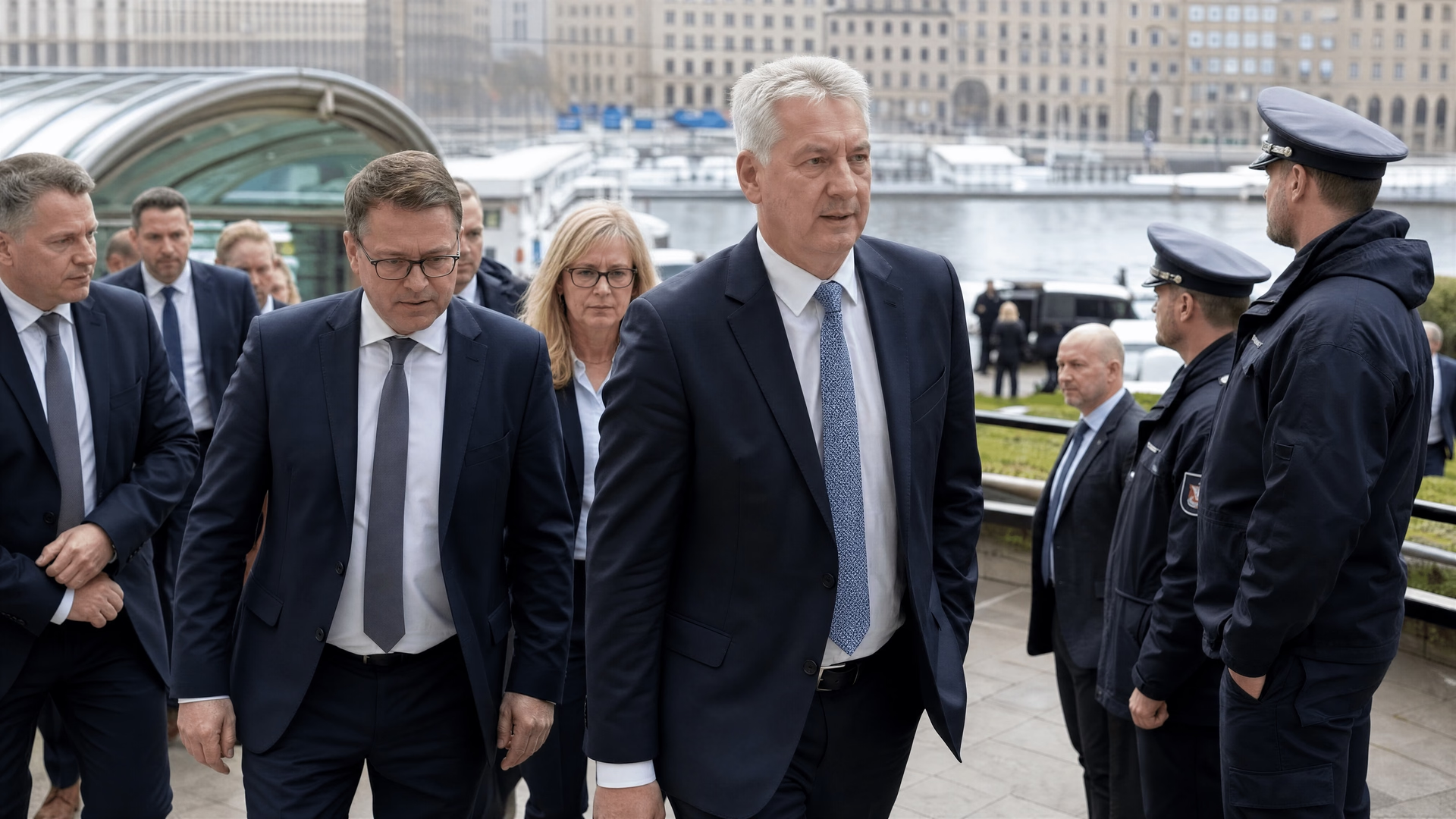
Germany’s state interior ministers want public cannabis consumption banned again and may seek limits on cannabis clubs at talks in Hamburg.

Germany’s partial cannabis legalisation is facing a fresh restriction push after the country’s state interior ministers moved to put public consumption back in the crosshairs. According to a draft resolution for this week’s Interior Ministers’ Conference in Hamburg, the ministers want Germany’s federal government to work toward a general ban on consuming cannabis in public and to examine whether the number of cultivation associations can be capped through a licensing stop.
A new restriction drive from Germany’s interior ministers
The proposal comes from Germany’s state interior ministers ahead of the Interior Ministers’ Conference in Hamburg, according to a report on the draft resolution. The text cited there says the conference is set to back the position that cannabis consumption in public should be "generally prohibited" and that the German Federal Interior Ministry should advocate for such a ban within the federal government.
The same draft also says Germany’s interior ministers want it examined whether the number of Anbauvereinigungen — the cultivation associations created under Germany’s 2024 reform — could be limited through a halt to new approvals. Their reasoning, as reported, centres on enforcement. They argue that possession limits in public space are set too high and can favour illegal trade, while illegal market structures remain particularly pronounced in commercial and organised cannabis trafficking.
The ministers want cannabis consumption in public to be "generally prohibited".
Draft resolution cited by Berliner Sonntagsblatt
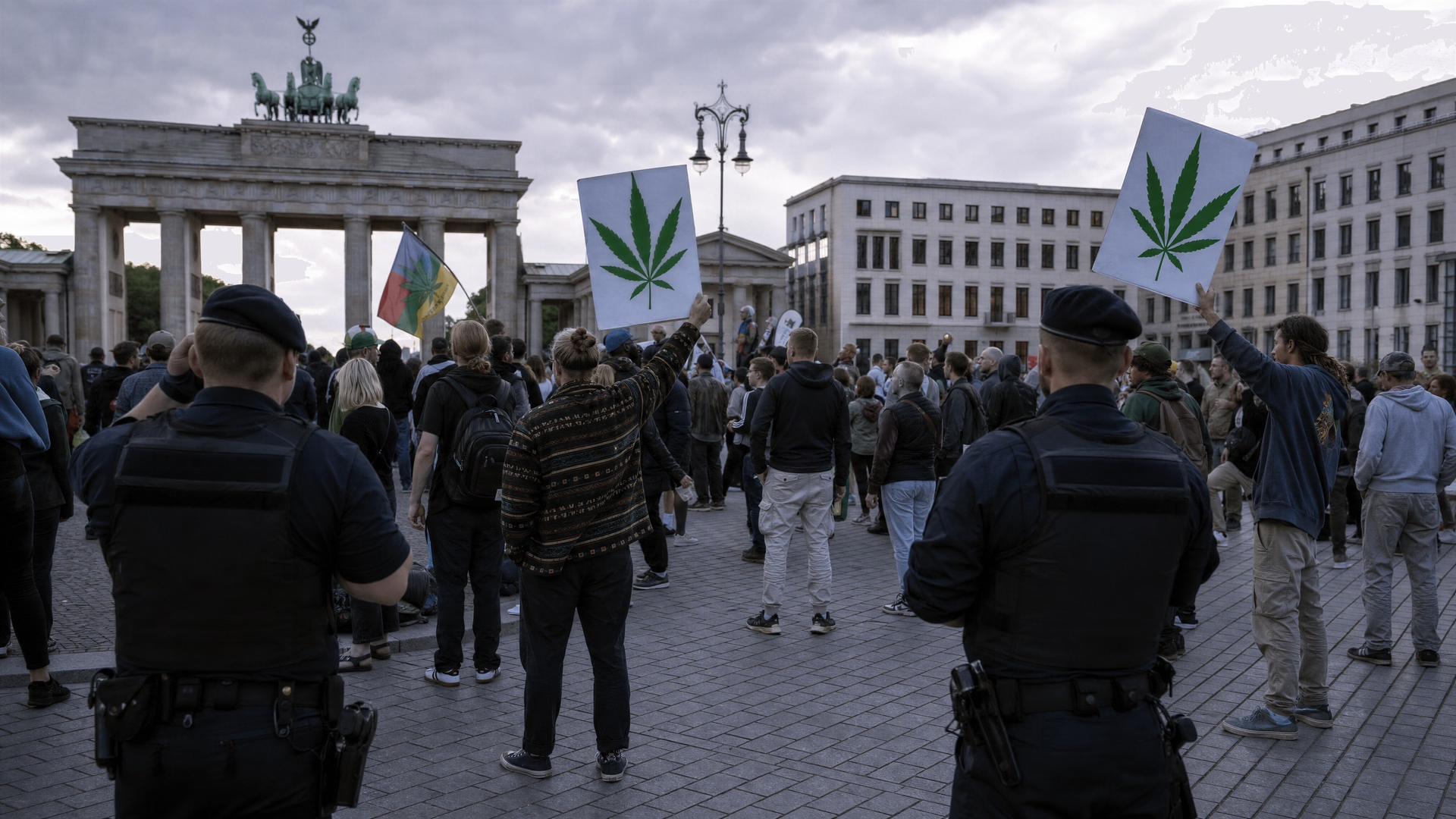
That makes this more than a symbolic complaint about the 2024 law. It is an attempt to reopen one of the most visible practical compromises of Germany’s partial legalisation: adults may consume cannabis legally in principle, but only within a framework that already includes public restrictions and exclusion zones.
What Germany’s ministers are trying to change
The draft described in the reporting points in two directions at once: changing the rules around public consumption and slowing the spread of licensed clubs. Read together, they show how parts of Germany’s security establishment are trying to narrow the real-world effects of legalisation without necessarily overturning the wider law outright:
- A push for a general ban on cannabis consumption in public in Germany.
- A request that the German Federal Interior Ministry argue for that ban inside the federal coalition.
- A call to examine whether cultivation associations can be limited through a stop on new approvals.
- A broader demand for legal tightening so police and prosecutors can pursue cannabis offences more effectively.
That is a narrower but potentially more immediate route than trying to relitigate the whole 2024 reform. Public-space rules are highly visible, politically legible, and easy to present as matters of order and enforceability. For ministers who say the current framework complicates policing, a public-use ban offers a concrete target.
The legal baseline they are pushing against
Since 1 April 2024, adult cannabis consumption has been allowed in Germany in principle, but not without limits. The primary report notes that public consumption is already subject to strict restrictions and prohibited zones. The current debate is therefore not about moving from unrestricted use to regulation; it is about whether Germany should go from restricted public legality back to a broader public prohibition.
Why public smoking has become the frontline issue
For Germany’s interior ministers, public consumption is where legalisation meets everyday policing. The rationale cited in the draft is not framed around health messaging but around criminal enforcement: possession amounts in public, they argue, are high enough to benefit the illegal market, and organised illicit trade remains active. A further report on the dispute in Hamburg described the argument as part of a broader struggle over Germany’s partial legalisation law.
That matters because it shows the current political line of attack. Rather than claiming the legal framework has erased enforcement concerns, the ministers are arguing that it has blurred them in public space. In practical terms, public smoking is visible, hard to ignore, and easier to make into a political symbol than questions such as private possession or home cultivation.
It also helps explain why the ministers’ language focuses on public order and illegal trade. Those are areas where Germany’s interior ministries and police authorities can claim institutional authority. The proposal is less a philosophical argument about legalisation than an administrative argument that the current rules create friction for enforcement.
For readers trying to understand the distinction, the debate is specifically about smoking and other public consumption in shared space, not about every possible form of cannabis use. Cannabivo has separate background explainers on Cannabis Smoking Methods: Joints, Pipes, Bongs Guide and Cannabis Vaporization vs Smoking: Chemical Changes, but the legal question here is where consumption is allowed, not how it works.
Cannabis clubs are the second target
The draft resolution does not stop at public-use rules. It also calls for a review of whether Germany can limit the number of cultivation associations by freezing new approvals. That matters because the club system is one of the main institutional pillars of the country’s partial legalisation model.
Supporting context from the German Hemp Association’s June coverage noted that Berlin and Hamburg had published lists of cannabis social clubs, a sign that the licensing structure has moved from theory into visible administrative practice. The same DHV update was also reporting from Berlin’s Mary Jane fair, where the sector’s public presence was on display in a different way. Separately, Germany’s record 75,000 visitors at the Mary Jane fair underlined how mainstream the cannabis conversation has become.
That combination helps explain why club approvals are now under pressure. Once lists of clubs are published and the sector becomes more visible, opponents of the reform can move from abstract warnings to concrete demands for a cap. The ministers’ proposal suggests that, from their perspective, limiting future approvals could be a way to contain the reform without dismantling what has already been licensed.
How the two pressure points compare
The current push breaks down into two distinct levers of restriction:
| Measure | What ministers want | Why they say it is needed | Source |
|---|---|---|---|
| Public consumption | A general ban on cannabis consumption in public | They cite enforcement problems, high public-space possession limits and continued illegal trade structures | Berliner Sonntagsblatt report on the draft resolution |
| Cultivation associations | Examine whether the number of clubs can be limited through a licensing stop | Part of a broader effort to tighten the legal framework around cannabis offences | Berliner Sonntagsblatt report on the draft resolution |
For Cannabivo readers who want wider background on how club systems fit into Europe’s policy landscape, our earlier feature on the cannabis clubs reshaping Europe’s community model offers that broader context. In Germany right now, though, the immediate issue is not the theory of clubs but whether federal and state authorities make them harder to expand.
A mixed signal from Berlin: restriction talk and pilot-project openness
The German debate is not moving in only one direction. While state interior ministers are pushing for tougher public-use rules, Germany’s federal drug commissioner Hendrik Streeck said in May that he is open to pilot projects for legal cannabis sales, according to reporting by the RedaktionsNetzwerk Deutschland.
That does not cancel out the interior ministers’ initiative, but it does show how fragmented cannabis policymaking remains in Germany. One part of the state is discussing controlled sales experiments; another is arguing that public consumption should again be broadly prohibited. For international readers, this is a reminder that Germany’s 2024 model never produced a settled consensus. It produced a live political contest over where access ends and control begins.
Cannabivo recently reported on Germany’s wider cannabis debate over courts, clubs and tighter medical rules. The public-consumption fight now adds another front to that same struggle: not whether cannabis remains legal in principle for adults, but how narrow the legal space around it becomes in practice.
What happens next at the federal level
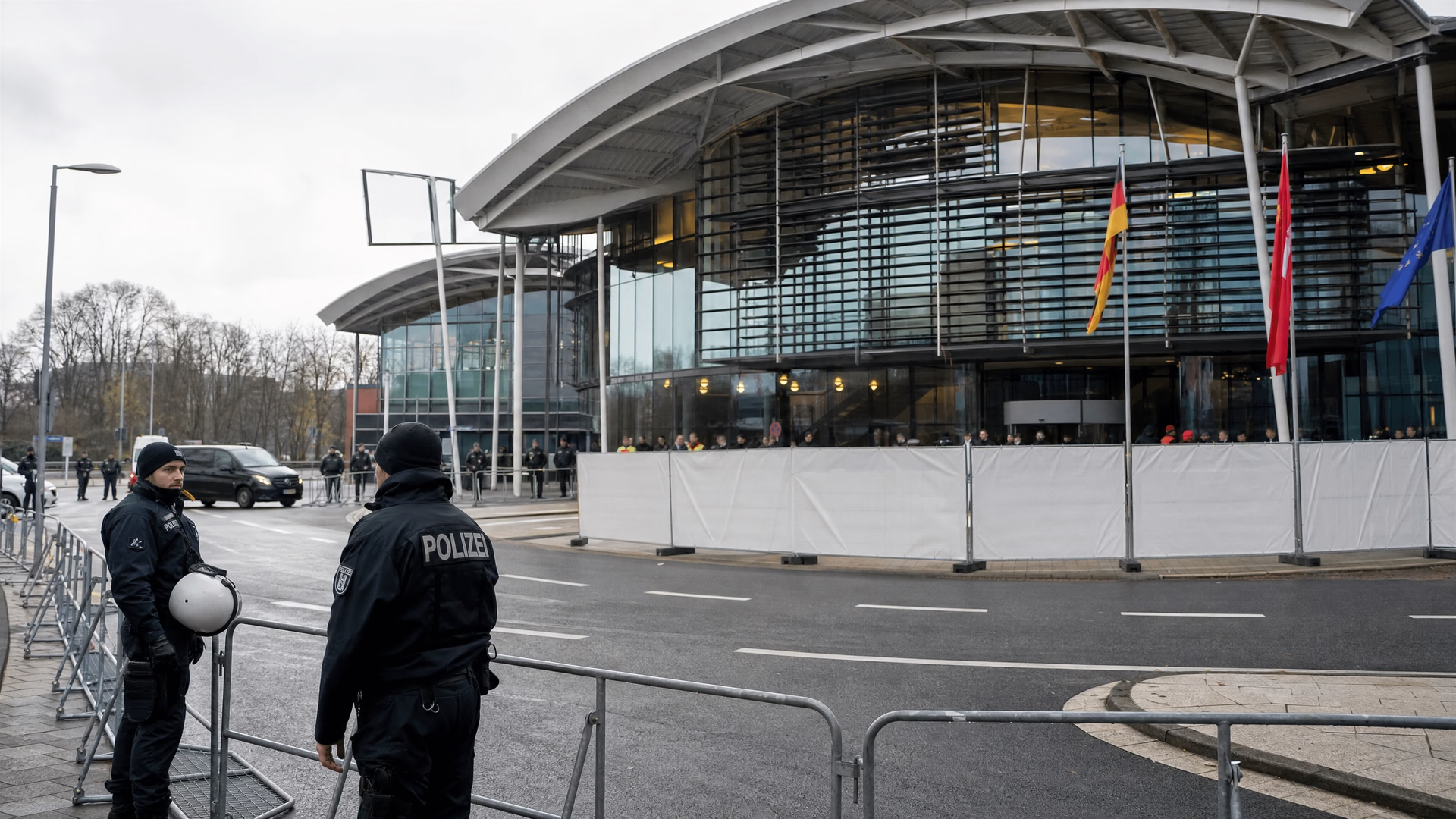
The immediate significance of the Hamburg meeting lies in agenda-setting. The state interior ministers cannot by themselves rewrite Germany’s cannabis law through a conference resolution, but they can formally press the German Federal Interior Ministry to act inside the federal government. That is what the reported draft aims to do.
The likely next questions are procedural rather than ideological:
- Whether the Interior Ministers’ Conference adopts the language reported in the draft.
- Whether Germany’s federal interior ministry takes up the request within the national government.
- Whether any concrete legislative or regulatory proposal follows on public consumption.
- Whether authorities move from discussion of a club licensing stop to an actual administrative mechanism.
The broader climate in Europe may also reinforce arguments for tighter control. Euractiv recently reported that European countries are increasingly taking a stricter approach to non-intoxicating cannabis products such as flowers and food items. That is not the same issue as Germany’s public-smoking debate, but it does point in the same general direction: more scrutiny, not less.
For now, the central point is straightforward. In Germany, partial legalisation did not end the political battle over cannabis in public space. It relocated that battle into the details of enforcement, visibility and administrative control.
Germany’s cannabis settlement still looks provisional
Two years after Germany’s reform took effect, the latest move by the country’s interior ministers suggests the settlement is still highly provisional. Public consumption remains the easiest part of the law to contest because it is the part ordinary voters, police officers and local authorities encounter most directly. Club approvals, meanwhile, are where the system becomes institutional rather than symbolic — which is why they are now under separate pressure.
Whether the Hamburg push becomes law is still an open question. What is already clear is that Germany’s cannabis politics have entered a phase of retrenchment arguments, not simple implementation. The fight is no longer only about whether legalisation happened. It is about how much of it will remain visible in public life.
Germany’s interior ministers are testing whether the country’s cannabis reform can be tightened from the outside in: first by targeting public consumption, then by questioning how many clubs should be allowed to operate. Even before any federal action, that alone tells readers something important about the state of the law in Germany. Legalisation may have begun in 2024, but the terms of coexistence in public space are still being fought over.
Sources
- Innenminister wollen öffentliches Kiffen wieder verbieten (berliner-sonntagsblatt.de)
- Innenminister streiten über Syrien und Cannabis: Klein-Klein statt Lösungen (fr.de)
- Berlin "Mary Jane": Cannabis-Messe in Berlin verzeichnet Besucherrekord von 75.000 Menschen (tagesschau.de)
- Drogenbeauftragter Streeck offen für Modellversuche zum legalen Verkauf von Cannabis (rnd.de)
- Cannabis-Lebensmittel und -Blüten werden in Europa zunehmend streng behandelt (euractiv.com)