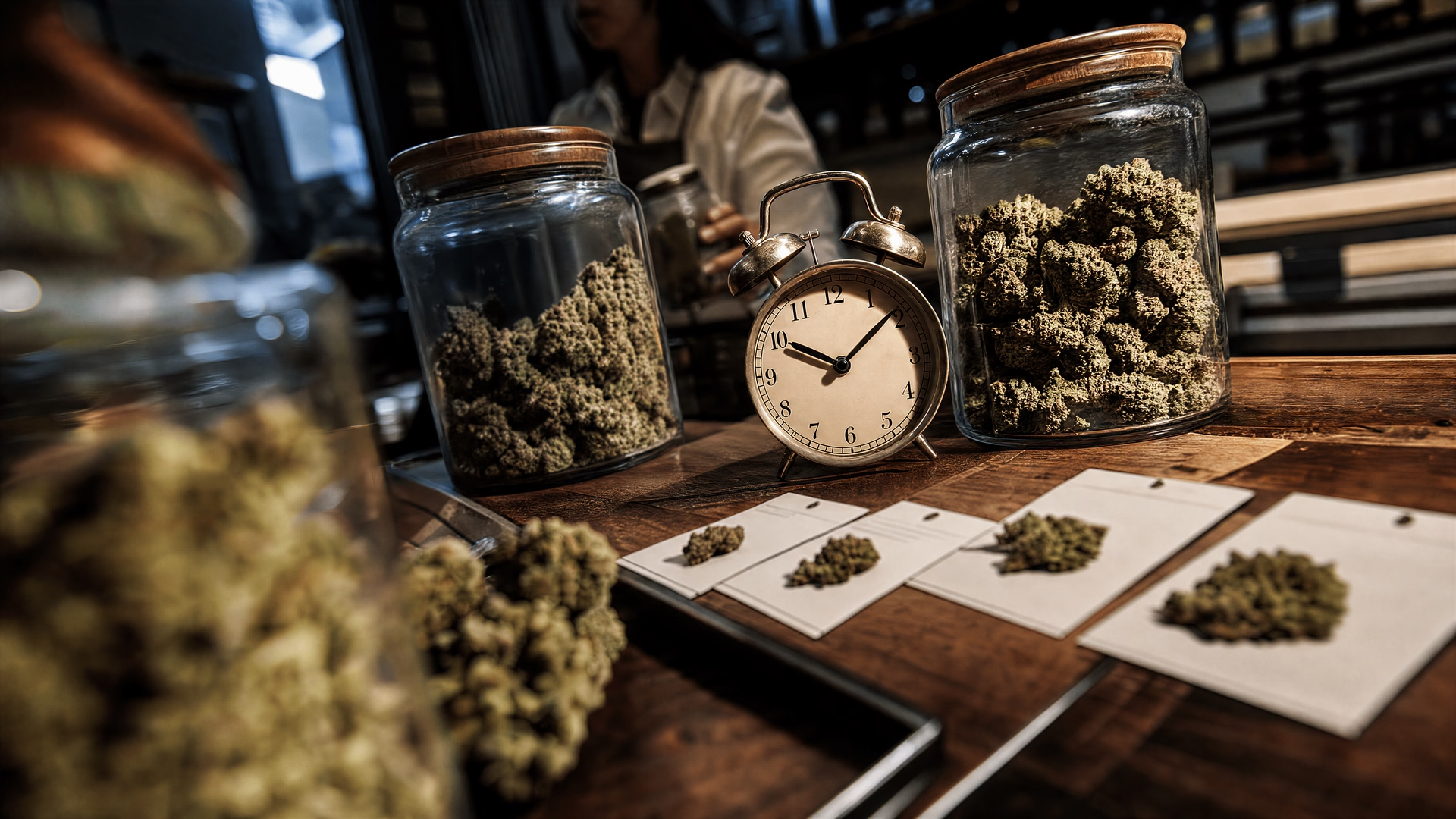













Germany’s second KCanG review finds modest gains, stable youth-use indicators, weak club uptake, and a medical cannabis market expanding fastest.

In Germany, two years after the federal Konsumcannabisgesetz (KCanG) partly legalised adult possession and home cultivation, the official picture is neither triumph nor collapse. The second interim evaluation says the law’s intended positive effects are still limited, but many of the most severe warnings made before it took effect have not materialised. What has changed most clearly is where people say they get cannabis: home growing has risen, the club system remains small, and Germany’s medical market has expanded far faster than the reform’s non-commercial access route.
Germany’s cannabis review is now moving beyond first impressions
For readers outside Germany, the KCanG is the federal law that entered into force on 1 April 2024 and partially legalised cannabis possession and cultivation for adults. The law also built in a formal, independent scientific review of its social effects. Two years on, that review is producing a cautious assessment: the benefits lawmakers hoped for are still modest, but many of the dire predictions voiced before implementation have not come to pass.
That review is being carried out by EKOCAN, an interdisciplinary evaluation project involving researchers from the universities of Düsseldorf, Hamburg/UKE and Tübingen. The second interim report, published on 1 April 2026, is the first to incorporate EKOCAN’s own interviews with young consumers, alongside surveys of addiction-prevention and counselling professionals and law-enforcement officers. In other words, Germany is no longer judging the reform only through administrative data; it is starting to hear directly from the people navigating the system. The reporting schedule now looks like this:
The tone matters as much as the dates. The second interim report does not present a sweeping success story, but it also does not validate the most dramatic warnings from opponents. Instead, it describes a reform whose measurable effects are real in places, missing in others, and still unfolding.
The report at the centre of Germany’s next cannabis argument

Home growing rose sharply, but social supply still leads
The clearest behavioural shift in the second interim report concerns where consumers say they source cannabis. In the first half of 2024, only 5.4% of surveyed consumers said their main source was their own cultivation. By the second half of 2025, that share had climbed to 21.4%. For a law that explicitly allowed adults to grow for themselves, this is one of the few unmistakable signs that the reform changed everyday supply patterns.
But the same data also puts firm limits on any claim that Germany has already built a strong new legal access system. The most frequently cited source in the second half of 2025 remained social supply — cannabis obtained through social contacts — at around 35%. And cannabis from the new cultivation associations accounted for only about 3.5% of sourcing in 2025. So the supply mix shifted, but not mainly through the route lawmakers had expected. The core numbers look like this:
Set side by side, the imbalance is easy to see:
Selected reported cannabis sources in Germany’s evaluation data (%)
The report’s broader conclusion is that cannabis consumed in Germany is increasingly coming from fundamentally legal sources. Even so, the country’s partial-legalisation model is not replacing informal networks in a neat or linear way. Home cultivation has expanded quickly; the club route has not.
The club model remains a small part of the market
That gap is clearest in cultivation associations, the non-commercial clubs that were supposed to become a central legal access route under Germany’s KCanG. Unlike retail models elsewhere, Germany’s reform placed heavy weight on collective self-cultivation rather than licensed shops. Two years in, the second interim report says that pillar is still far from dominant.
Only about 3.5% of consumers said they obtained cannabis from a cultivation association in 2025, and the evaluation summary adds that fewer than half of Germany’s districts have such an association at all. That helps explain why clubs have not displaced older supply channels on a national scale. It also fits the uneven rollout reflected in Germany: Four States Publish Cannabis Social Club Lists as CSC Rollout Turns to Transparency, which showed just how patchy club visibility still is across the country.
Based on the evaluation, four points stand out about the club pillar:
- In 2025, only about 3.5% of consumers said their cannabis came from a cultivation association.
- The most common reported source remained social supply through personal contacts, at around 35% in the second half of 2025.
- Home cultivation grew much faster, rising from 5.4% in early 2024 to 21.4% in late 2025.
- Fewer than half of Germany’s districts had a cultivation association at all, limiting how far the model could spread.
A rollout still uneven on the ground
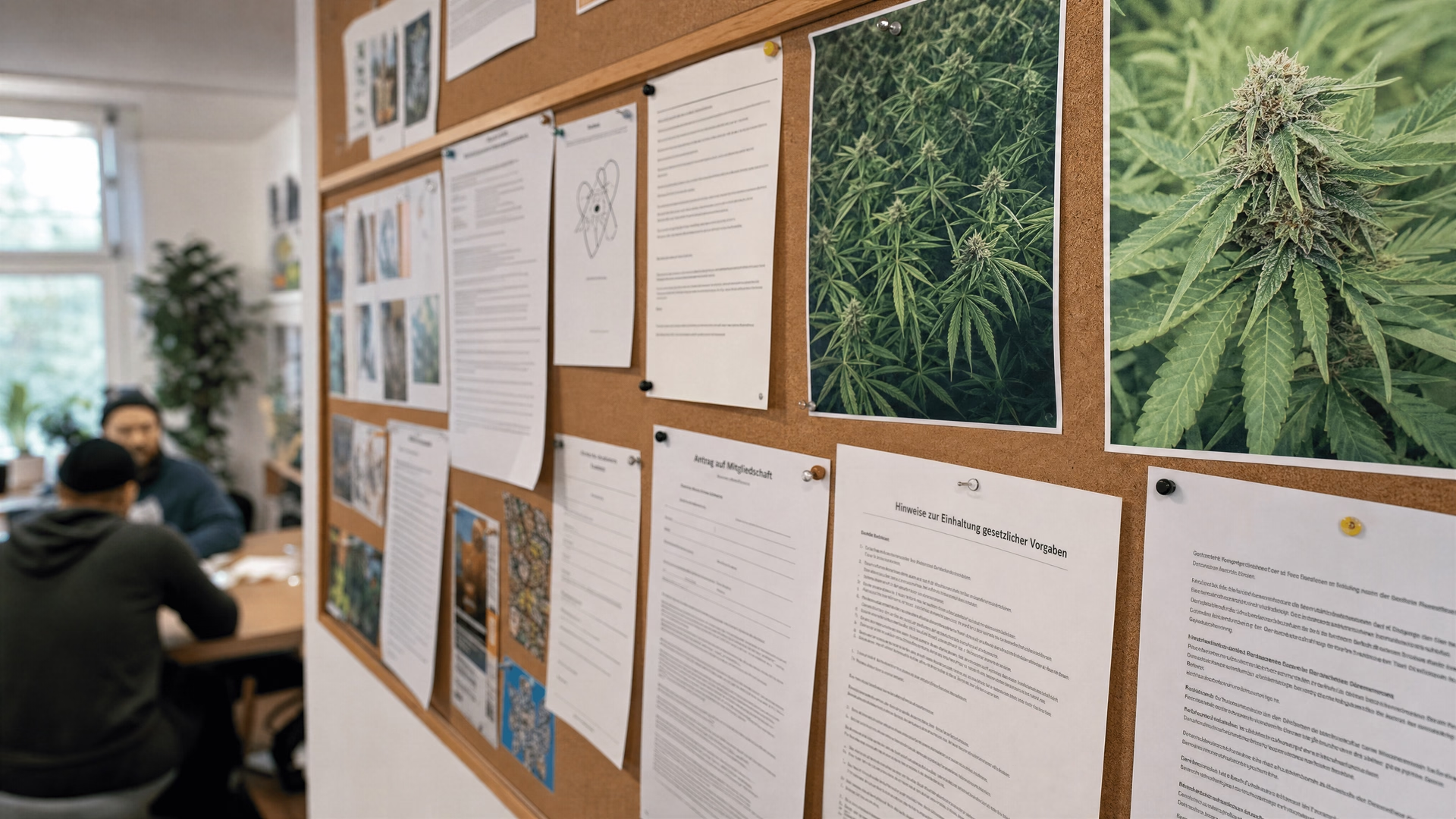
What the evaluation describes, then, is not a club system that has become Germany’s main legal substitute for informal supply. It is a club system that still looks partial, geographically uneven and nationally too small to define the market on its own.
Medical cannabis became the fastest-growing legal channel
If the club system has lagged, medical cannabis has moved in the opposite direction. The evaluators estimate that Germany is now the largest legal-commercial medical cannabis market in Europe. Together with domestic production capacity of 2.6 tonnes, as much as 200 tonnes of medical cannabis was available in Germany in 2025.
The report links that expansion in part to the spread of online medical-cannabis platforms. In the evaluation team’s research, young adults most often said they obtained cannabis from online pharmacies. That is one of the most politically awkward findings in the report: the legal channel growing fastest appears to sit in the prescription market, not in the non-commercial club model the KCanG was designed to foreground.
The legal market that scaled faster than the club system
For the next round of German cannabis policy, that raises a difficult question. If people are moving away from informal supply, but doing so disproportionately through medical channels, should lawmakers count that as evidence of successful legal access, evidence of a distorted model, or proof that the intended adult-use routes remain too weak? The second interim report does not answer that. It does, however, force the question into the open.
The feared youth spike did not appear, and justice relief did not either
On the indicators that dominated the pre-reform argument, the second interim report is notably restrained. Among adolescents and young adults, cannabis prevalence after partial legalisation is described as stable or even slightly declining. The evaluators also say there is no sign that young people’s risk perception has fallen; if anything, they suggest the opposite tendency. And a sudden increase in cannabis-related consumption problems has not been confirmed.
That reading fits the broader pattern in our earlier reporting on Germany’s largely unchanged cannabis-use patterns after two years: whatever else the KCanG has changed, it has not yet produced the dramatic youth-consumption surge many critics forecast.
One goal the report says is still unmet
The evaluation is not offering a clean bill of health, however. It also says that the hoped-for relief for Germany’s justice system has not yet materialised. In the source excerpt available here, that point is stated but not elaborated. Even so, it is important because it shows the report is not simply totalling up encouraging findings. Some practical promises of the reform remain unrealised.
Germany is also still improving how it measures some of the reform’s most contested effects. That is particularly true in traffic safety, where Germany: cannabis-related driving crashes should be counted in official statistics reported on plans to record serious accidents involving cannabis influence more systematically. Better measurement will not settle the political argument by itself, but it will make the next stages of the evaluation more robust.
Before the final report, Germany is already arguing about phase two
Because the evidence is mixed rather than dramatic, Germany’s political fight over the KCanG has not cooled. The second interim report quickly became fuel for a broader argument about whether the law should be tightened, defended, or used as the basis for a more controlled next step.
That next-step argument is already visible. Even as some conservative critics continue to attack the reform, Germany’s federal drug commissioner Hendrik Streeck has signalled openness to tightly controlled regional adult-use pilot projects, as RND reported on his support for model sales trials. That is a notable signal: parts of Berlin are no longer arguing only about rollback, but about whether the current framework should evolve.
Four adjacent debates show how the second interim evaluation is already spilling into Germany’s wider cannabis agenda:
| Issue | What happened | Why it matters | Source |
|---|---|---|---|
| Coalition backlash after the report | Interior Minister Alexander Dobrindt called the law a 'complete flop', and SPD figures pushed back against what they called unobjective criticism. | The evaluation is not just a research exercise; it has become a live political dispute inside Germany’s governing space. | Deutsches Ärzteblatt on SPD criticism of Dobrindt |
| Competing readings of the same findings | Reporting on the second interim evaluation stressed limited changes in consumption, while Union ministers pointed to treatment numbers for cannabis dependence. | The same evidence base is already being used to argue both continuity and correction. | Tagesschau on the second KCanG evaluation |
| Medical market scale beyond the club model | Germany imported more than 50 tonnes of medical cannabis in the first quarter of 2026. | That reinforces the evaluation’s picture of a medical market growing faster than the cultivation-association route. | International CBC on Germany’s Q1 2026 medical cannabis imports |
| Better road-safety measurement | Germany plans to count serious traffic accidents involving cannabis influence in official statistics. | Later stages of the KCanG evaluation should have firmer evidence on one of the reform’s most contested risk areas. | ZEIT on planned cannabis crash statistics |
Questions readers still have
Germany’s KCanG evaluation: key questions answered
When did Germany’s KCanG take effect?
Germany’s federal Konsumcannabisgesetz entered into force on 1 April 2024, partially legalising cannabis possession and cultivation for adults.
Did the second interim evaluation find a rise in youth cannabis use?
No clear rise was identified. The evaluation says cannabis prevalence among adolescents and young adults was stable or even slightly declining after partial legalisation.
Have cultivation associations become the main legal source?
No. Only about 3.5% of consumers said they sourced cannabis from a cultivation association in 2025, and fewer than half of Germany’s districts had one at all.
Why does medical cannabis feature so prominently in the evaluation?
Because the evaluators say Germany’s medical cannabis market has expanded rapidly, with online pharmacies emerging as a major access route and many young adults reporting them as a source.
When is the final KCanG evaluation due?
A final report is planned for 2028 or 2029.
Germany’s second KCanG evaluation does not read like vindication or failure. It reads like an unfinished reform: one that has redirected some supply, left key promises unmet, and shifted part of the country’s cannabis reality into channels lawmakers did not originally place at the centre of the model.
Sources
- Drogenbeauftragter Streeck offen für Modellversuche zum legalen Verkauf von Cannabis (rnd.de)
- SPD wirft Dobrindt unsachliche Kritik an Cannabis-Evaluierung vor (aerzteblatt.de)
- Zwei Jahre Cannabisgesetz: Unions-Minister fordern Nachbesserung (tagesschau.de)
- Germany Imported Over 50 Tonnes Of Medical Cannabis In Q1 2026 (ca.internationalcbc.com)
- THC-Wert: Cannabisunfälle sollen in amtliche Statistik einfließen (zeit.de)