










Germany's second KCanG interim review: no surge in use, more home cultivation, a weak club role and a fast-growing medical cannabis market nationwide so far.

Two years after Germany's Consumer Cannabis Act, the KCanG, came into force, the scientific interim assessment reads soberly. According to the primary source, the second interim report published on 1. April 2026 reaches a mixed conclusion: the positive effects hoped for by lawmakers remain limited so far, while the harshest warnings from critics have not materialised. For an international audience, the starting point matters: since 1. April 2024, Germany has partially legalised the possession and cultivation of cannabis for adults aged 18 and over, while young people still have no legal access. That shift between legal and illegal supply routes is now at the centre of the German evaluation debate.
Germany's KCanG shows a sober interim picture
The second interim report on the EKOCAN evaluation is neither a success story nor a reckoning. According to the primary source, the central conclusion is that the positive effects of the law remain limited so far, while the feared negative consequences have also largely failed to materialise. That matters politically, because Germany's reform was loaded from the outset with very different expectations: for some, it was meant to reorder the black market, law enforcement and health risks; for others, it threatened a loss of control.
The positive effects intended by lawmakers are still fairly limited, but most of the fears voiced by critics from politics and society before the law was introduced have also not come to pass.
Second interim assessment of the EKOCAN evaluation, as reproduced in the primary source
The evaluation is led by the EKOCAN collaborative research project, with an interdisciplinary expert advisory board made up of researchers from the Universities of Düsseldorf, Hamburg/UKE and Tübingen. The second report is, for the first time, more than a simple analysis of existing data: it also includes its own interviews with young consumers, surveys of professionals in prevention and counselling, and assessments from law-enforcement officers.
The key milestones of the German evaluation look like this:
That the report currently describes more of a test bench than a final result can also be visualised:

The sources of supply are shifting, but not as planned
A key question in the German evaluation is whether legal or at least legally provided sources are already displacing the illegal markets. That is especially sensitive because young people still have no legal access even under the KCanG, and lawmakers specifically wanted to steer young adults away from the black market. The primary source does describe movement here, but no complete shift.
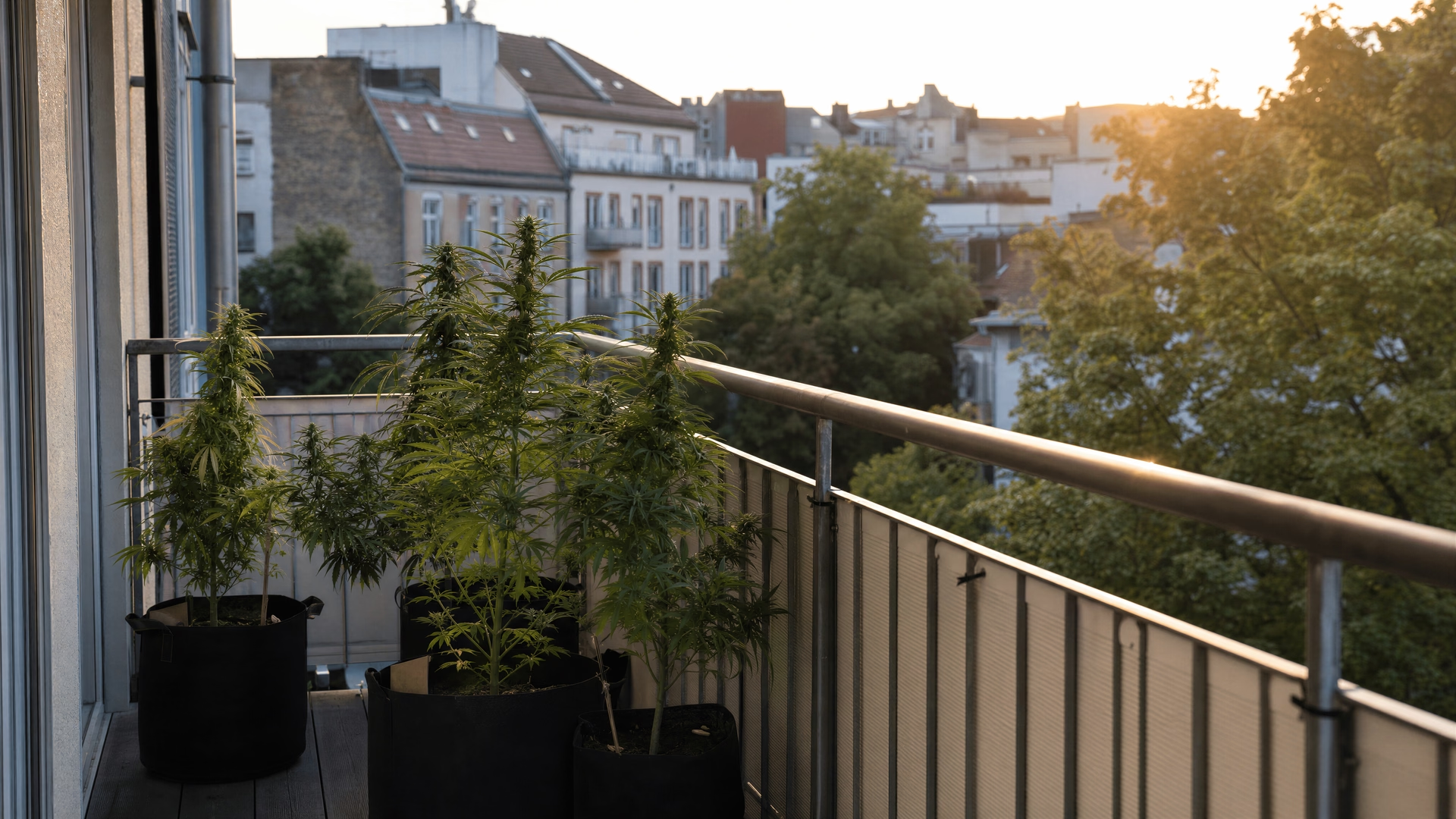
The shift is clearest in home cultivation:
Home cultivation as the main source in the survey (%)
According to the EKOCAN data reproduced in the primary source, the share of respondents who mainly get their cannabis from their own cultivation rose from 5,4 % in the first half of 2024 to 21,4 % in the second half of 2025. That supports the evaluation team's statement that cannabis consumed in Germany increasingly comes from fundamentally legal sources. At the same time, the most frequently cited channel remained the so-called Social Supply: that is, illegal sourcing through social contacts, which stood at around 35 % in the second half of 2025.
This is precisely where the gap between the law's design and reality becomes visible. The new cultivation associations, Germany's legal form of cannabis social clubs, were meant to turn collective home cultivation into an orderly, legal supply channel. In fact, however, only around 3,5 % of consumers had obtained cannabis from a cultivation association in 2025, and such an association existed in less than half of Germany's districts. How uneven the club rollout has developed regionally was also shown by our earlier reporting on the publication of CSC lists in four federal states.
The key supply figures in the interim report can be grouped as follows:
The most visible everyday change brought by the reform so far is therefore organised more privately than through associations:
The big surge in cannabis use failed to materialise
The politically most important news from Germany is that, according to the primary source, partial legalisation has so far not triggered any clear increase in cannabis use. Among adolescents and young adults, cannabis-use prevalence has remained stable or even fallen slightly. Likewise, the perceived risk of cannabis use among adolescents has not declined; if anything, the researchers see the opposite. Nor can any sharp rise in cannabis-related use problems be confirmed so far.
That means the second interim assessment deepens a finding that we had already taken up in our earlier overview of the largely unchanged patterns of use in Germany. In detail, the primary source confirms above all four points:
- The prevalence of cannabis use among adolescents and young adults has so far shown no clear increase.
- The perceived risk around cannabis use has not declined among adolescents.
- No sharp rise in cannabis-related consumption problems has been confirmed so far.
- A growing share of the cannabis consumed in Germany comes from fundamentally legal sources.
Other German media that summarised the same second interim report also arrived at similarly cautious readings, but placed different emphasis on them:
| Medium | Main point | Source |
|---|---|---|
| MDR | No increase in cannabis use nearly two years after the legal change. | Cannabis use in Germany stable after partial legalisation |
| Berliner Zeitung | Mixed picture: no higher use, slow displacement of the black market, but shortcomings in youth protection, law enforcement and medical cannabis. | Evaluation of cannabis legalisation: No increase in use, but government sees urgent need for action |
| Tagesschau | Hardly any changes in cannabis use; critics continue to point to high seizure volumes. | Two years after partial legalisation: Hardly any changes in cannabis use |
Less alarm does not yet mean an easy reprieve for the justice system
One point in the primary source deserves particular attention because it exposes the limits of the reform so far: the relief for the justice system expected by lawmakers has not yet materialised. That is an important difference. Even if consumption patterns remain stable and legal sources gain ground, that does not automatically mean the police, public prosecutors and courts are already noticeably relieved.
Why this distinction matters is shown by the continuing informal and illegal market. Social Supply remains, according to the interim report, the most common route of access, and illegal production has not disappeared either. A Tagesschau report on discovered illegal growing sites in North Rhine-Westphalia made clear in June 2026 that larger unauthorised cultivation structures still exist in Germany.
The German reform is therefore currently measured less by a single number than by an open three-part question: does supply shift into legal channels, do risks fall in the process, and are state institutions actually relieved? After two years, the answer on all three points is still not clear. What is most visible is that the problems have changed, not that they have disappeared:
Medical cannabis became an unexpected growth channel
While cultivation associations remain below expectations, the primary source describes a very different sector as highly dynamic: medical cannabis. The evaluation team estimates that Germany is now the largest legal-commercial market for medical cannabis in Europe. One reason given is the numerous online platforms that market the prescription-only medicine even to recreational consumers.
Germany is the largest legal-commercial market for medical cannabis in Europe.
Assessment by the evaluation team in the primary source
Together with domestic production capacity of 2,6 tonnes, up to 200 tonnes of medical cannabis were available in Germany in 2025, according to the primary source. In the evaluation team's interviews, many young adults even said they sourced cannabis from so-called “online pharmacies”. That shifts the political debate: not only the illegal market and the clubs, but also the medical channel is now part of the regulatory question. That Germany's drug commissioner Hendrik Streeck is open to pilot schemes for legal sales and at the same time is calling for a stricter separation between medical and recreational use was also reported by RND on the drug commissioner's position.
The medical sector is sensitive not only because of its size, but also because it has separate financing and regulation. That is already evident in other debates in Berlin, such as the discussion in the Bundestag over insurance coverage for cannabis flowers.
The most visible growth area of the German model is therefore not playing out in the clubhouse, but in the medical supply channel:
Germany's real assessment is still to come
The second interim assessment therefore answers the German KCanG question only in part. It argues against the most alarmist early warnings, but also against the idea that a stable regime is already fully in place. More home cultivation, stable or slightly declining prevalence among younger people, and a growing share of fundamentally legal sources are real changes. At the same time, Social Supply, the weak expansion of cultivation associations and the enormous dynamism of the medical channel remain open issues.
For readers who want to understand Germany's next step, the facts available here answer above all these questions:
FAQ on the second KCanG interim assessment
What exactly does EKOCAN assess?
EKOCAN is the collaborative research project for the scientific evaluation of the societal impact of Germany's Consumer Cannabis Act. Researchers from Düsseldorf, Hamburg/UKE and Tübingen are involved.
Has Germany's partial legalisation increased use?
According to the second interim assessment summarised in the primary source, there has so far been no increase in cannabis use among adolescents and young adults; prevalence was stable or slightly declining.
Have cultivation associations already displaced the black market?
No. Social Supply remained the most frequently named source in the second half of 2025 at around 35 %, while only around 3,5 % of consumers obtained cannabis from a cultivation association in 2025.
When will the final result be published?
A final report of the evaluation is scheduled for 2028 or 2029. Until then, the current balance sheet remains provisional.
Germany's second KCanG interim review therefore tells neither a simple success story nor a story of failure. After two years, what stands out above all is a redirection: somewhat more supply from legal or legally established sources, no clear increase among young consumers, but also no full displacement of the informal market. The decisive question for the next phase of Germany's reform is now not whether the law had any effect, but which of its effects are robust enough to form a durable regulatory model.
Sources
- Cannabiskonsum in Deutschland nach Teillegalisierung stabil (mdr.de)
- Evaluation der Cannabis-Legalisierung: Kein Konsumanstieg, doch Regierung sieht Handlungsbedarf (berliner-zeitung.de)
- Zwei Jahre nach Teillegalisierung: Kaum Veränderungen beim Cannabis-Konsum (tagesschau.de)
- Nordrhein-Westfalen: Mehr Cannabis-Plantagen im Bergischen? (tagesschau.de)
- Drogenbeauftragter Streeck offen für Modellversuche zum legalen Verkauf von Cannabis (rnd.de)